AI Avatars vs Real Presenters: B2B Trust in 2026
TL;DR
AI avatar video tools (HeyGen, Synthesia, D-ID) have matured significantly. They're genuinely useful for localization, internal comms, and rapid content iteration. But for enterprise sales demos, executive thought leadership, and conversion-critical touchpoints in high-ACV B2B SaaS, human-presented, professionally produced video still wins on trust. This post gives you the decision framework to know when to use each — and when to combine both.
Table of Contents
- The AI Avatar Video Debate in B2B SaaS
- What AI Avatar Tools Actually Deliver
- The Trust Problem: Buyer Psychology in B2B
- Use-Case Matrix: AI Avatar vs. Human Presenter
- Production Cost Comparison
- Time-to-Publish Comparison
- The Hybrid Approach
- Top Production Partners for Human-Presented Video
- Decision Framework
- FAQ
The AI Avatar Video Debate in B2B SaaS
The pitch from AI avatar video platforms is compelling: record once, localize to 30 languages, update the script without re-filming, and publish in hours instead of days. For marketing teams under constant pressure to produce more content faster, that sounds like exactly what they need.
But here's the question that actually matters for B2B SaaS: does your buyer trust what they're watching?
Trust is the currency of B2B purchasing. When an enterprise buyer is evaluating a $50K–$200K+ annual software contract, they're not just assessing features — they're assessing the company behind them. Video is one of the most powerful trust signals in the buyer journey. An AI-generated presenter that looks slightly uncanny, or a voice that feels just a little synthetic, can cost you the deal before the demo call even happens.
This post gives you the honest, data-informed comparison that most AI video platform marketing won't. We'll cover where AI avatar video genuinely adds value, where it destroys trust, how to think about costs, and how to build a hybrid strategy that gets the best of both approaches. If you're a Head of Content or VP Marketing at a Series A–C SaaS company deciding how to allocate your video budget, this is written for you.
What AI Avatar Video Tools Actually Deliver
The Leading AI Avatar Tools in 2026
Three platforms dominate the enterprise market for AI avatar video:
- HeyGen — Industry leader for avatar quality and voice cloning. Its Instant Avatar feature lets you clone your own likeness from a short recording session. Pricing starts around $29/month for basic plans, scaling to $89–$449/month for enterprise tiers with API access and brand kits. The quality gap between HeyGen's top tier and competitors has narrowed, but its avatar naturalness remains best-in-class.
- Synthesia — Strong enterprise positioning with 230+ stock avatars, solid SCORM/LMS integration for training content, and a polished UI designed for non-technical marketers. Starter plans begin around $22/month; enterprise contracts are typically custom-quoted above $500/month. Better choice than HeyGen for internal training at scale.
- D-ID — Known for photo-to-video animation and API-first architecture. Popular for developers building AI video pipelines at scale. Less polished avatar library than HeyGen or Synthesia, but the API flexibility is useful for teams with engineering resources who want to build AI video into their product.
The technology has improved dramatically since 2023. Blink patterns, micro-expressions, and lip-sync accuracy are all measurably better. But "better" doesn't mean "indistinguishable from human" — and that gap matters enormously in B2B contexts where credibility is on the line.
Where AI Avatar Video Genuinely Excels
There are legitimate, high-value use cases where AI avatar video is the right choice — not as a compromise, but as the objectively best tool for the job:
- Localization at scale. Translating and re-recording a human presenter across 15 languages is expensive and logistically painful. AI avatar platforms can handle this in hours, with the same visual presenter across all markets. For global SaaS products with users across multiple regions, this is a genuine time-and-money saver.
- Internal training and onboarding. HR and enablement content doesn't need the same trust threshold as customer-facing marketing. A synthetic avatar delivering compliance training or product update walkthroughs to new hires is perfectly appropriate — and significantly faster to produce than human-recorded equivalents.
- Rapid iteration and A/B testing. Need to test two versions of a value proposition video? AI avatars let you update the script and re-render in minutes. Testing with human video requires rebooking the presenter, rescheduling the shoot, and waiting for re-editing.
- High-volume feature content programs. If you're producing 50+ short explainer clips per month for product updates, changelogs, or in-app walkthroughs, AI avatars can handle the volume economics in ways human production can't match. The marginal cost of the 50th video is essentially zero.
- Long-tail content with limited ROI justification. A 90-second explainer on a niche integration that 3% of your user base will ever encounter doesn't warrant a $3,000 production budget. AI avatar video is the right call for content where the expected audience and business impact don't justify professional production spend.
Where AI Avatars Consistently Fall Short
The failure modes are predictable and worth understanding before you deploy AI video in the wrong context:
- Enterprise sales and trust-sensitive demos. When a VP of Engineering at a growth-stage fintech is evaluating your platform, they can often tell the difference between an AI avatar and a real presenter. Many will actively distrust a company that uses AI avatars as a substitute for authentic leadership presence — interpreting it as a signal that the company either doesn't care enough to invest in proper production, or is trying to hide something.
- Executive thought leadership. Your CEO's presence on a conference keynote recording, a LinkedIn long-form video, or an "our company's POV on the market" piece cannot be convincingly replaced by an avatar. The inauthenticity is immediately apparent to anyone familiar with your leadership team — and in the age of LinkedIn, that's a lot of people.
- High-ACV conversion moments. Case study videos, customer testimonials, and "why we built this" founder stories are high-stakes trust signals. AI avatars in these formats feel like a signal that the company isn't investing in quality — which buyers interpret as a signal about how they'll be treated post-sale.
- Emotional resonance. Human presenters can convey genuine enthusiasm, carefully calibrated frustration, vulnerability, and humor in ways that current AI avatar technology cannot replicate convincingly. B2B buying is still an emotional process — buyers need to feel something about the people they're buying from.
- Nuanced product explanations. Live screen-sharing demos and on-the-fly explanations that require genuine responsiveness — the kind that makes your product look easy and your team look knowledgeable — don't translate well to pre-scripted avatar video. The lack of spontaneity often makes the product look harder than it is.
The Trust Problem: Buyer Psychology in B2B
Understanding why trust matters so much requires understanding how B2B buyers actually make decisions.
In a typical Series B–C SaaS purchase decision, the buyer is managing significant personal and organizational risk. Choosing the wrong platform, the wrong vendor, the wrong team — these decisions affect careers, not just budgets. Buyers compensate for that risk by looking for trust signals at every touchpoint in the evaluation process.
Video is one of the most powerful trust signals available to B2B marketers. Research from Wistia and HubSpot consistently documents that video dramatically increases the time buyers spend engaging with vendor content and significantly improves conversion rates at key funnel stages. But these results are predicated on human authenticity — the implicit contract between a presenter and their audience that "there's a real person here who stands behind what they're saying."
AI avatar video breaks that contract. Not always destructively — and not in every context. But at the highest-stakes moments in the B2B buyer journey, a synthetic presenter sends a signal that conflicts with the trust the buyer needs to take the next step.
The question isn't whether AI avatar video is "good enough." It's whether it's trusted enough for the specific context where you're deploying it. For enterprise sales, the bar is higher than the current technology can reliably clear.
This matters especially in high-ACV markets where the buying committee is larger, the due diligence is deeper, and competitors are also producing polished human video content. When every other vendor in an evaluation is presenting with real people, using an AI avatar is a differentiator — in the wrong direction.
There's also a generational and sector dimension to this. Technical buyers in AI-native industries may be more tolerant of (or even impressed by) AI avatar video. Traditional enterprise buyers in sectors like financial services, healthcare, and manufacturing tend to have lower tolerance for synthetic media in serious business contexts. Know your buyer.
For SaaS teams serious about video quality and trust signals, understanding the full scope of what professional SaaS video production can deliver is a useful benchmark before making this call.
Use-Case Matrix: AI Avatar vs. Human Presenter
The decision isn't binary. Smart B2B content teams use both — they just use them in the right contexts. Here's the definitive use-case breakdown:
AI Avatar vs. Human Presenter: Use-Case Matrix
| Use Case | AI Avatar | Human Presenter | Recommendation |
|---|---|---|---|
| Executive thought leadership | ✗ Not suitable | ✓ Essential | Human only |
| Enterprise sales demo video | ✗ Trust risk | ✓ Strong | Human only |
| Customer testimonial / case study | ✗ Not applicable | ✓ Required | Human only |
| Founder / CEO brand video | ✗ Undermines trust | ✓ High impact | Human only |
| Product demo (top-of-funnel) | ~ Acceptable | ✓ Better | Human preferred |
| Conference / event recap | ✗ Misses the point | ✓ Authentic | Human preferred |
| Explainer video (feature-level) | ✓ Good fit | ✓ Also good | AI viable for volume |
| In-app product walkthrough | ✓ Good fit | ~ Viable | AI recommended |
| High-volume social content | ✓ Good fit | ~ Costly at scale | AI for scale |
| Internal training / onboarding | ✓ Excellent | ~ Overkill | AI recommended |
| Multilingual localization | ✓ Excellent | ✗ Expensive | AI recommended |
| A/B testing script variants | ✓ Excellent | ✗ Too expensive | AI recommended |
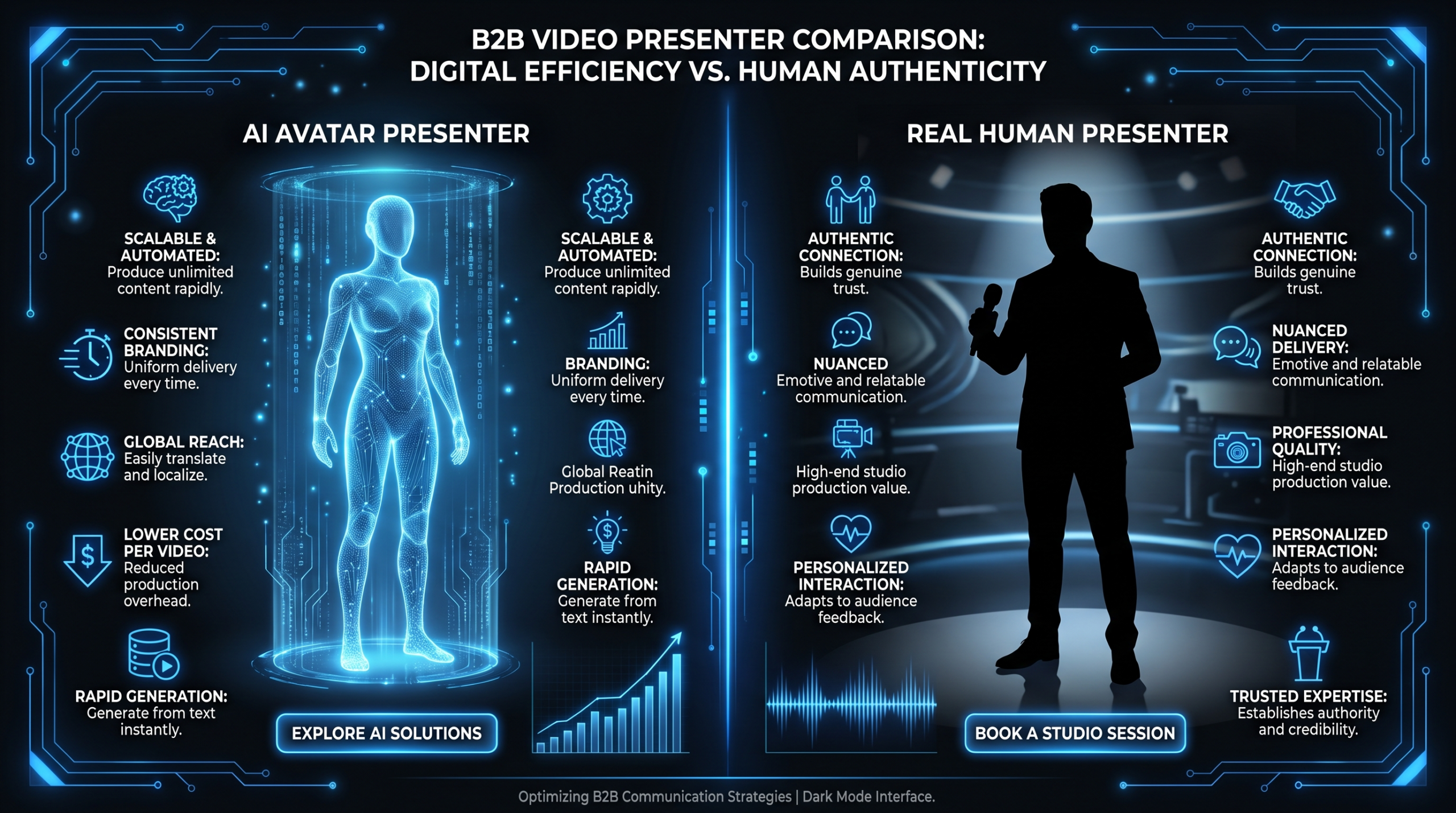
The pattern is clear: AI avatars win on volume, speed, and economics for low-stakes or internal content. Human presenters win on trust, emotional resonance, and conversion impact for anything touching the core buyer journey or brand identity.
If you're unsure how video fits into your broader SaaS content motion, our guide to product demo video production covers the formats that matter most at each stage of the funnel — and where human presentation is non-negotiable.
Production Cost Comparison
Cost is where AI avatar video makes its strongest argument. The economics are genuinely compelling — but the comparison needs to be apples-to-apples, accounting for the full production process, not just the platform fee.
Production Cost: AI Avatar vs. Human-Presented Video
| Cost Category | AI Avatar Video | Human-Presented Video | Notes |
|---|---|---|---|
| Platform / tool cost | $29–$449/mo | $0 | AI has a fixed overhead cost regardless of output volume |
| Script writing | $0–$500/video | $0–$500/video | Same cost for both — scripting is scripting |
| Filming / recording | $0 (no filming needed) | $200–$2,000/day | Biggest cost advantage for AI avatar video |
| Presenter / talent fee | $0 (after initial avatar setup) | $0–$1,500/session | Significant ongoing cost difference at volume |
| Video editing & post-production | $0–$300/video | $300–$2,500/video | Human video requires substantially more post work |
| Motion graphics / B-roll | $100–$500/video (if added) | $200–$1,500/video | Both need this for polished output |
| Localization (per language) | ~$20–$100/video | $500–$3,000/video | Massive AI advantage when localizing to 5+ languages |
| Typical total per video (3–5 min) | $150–$800 | $800–$5,000+ | Assumes ongoing program, not one-off |
The cost advantage for AI avatar video is real — roughly 3–6x cheaper per video for comparable length. But the relevant question isn't "which is cheaper?" It's "what's the cost of a lost enterprise deal because your video content felt inauthentic?"
For high-ACV deals ($50K+ ARR per customer), even a single won deal can justify months of professional video production spend. The ROI math favors human video for customer-facing conversion content, and favors AI video for internal or high-volume edge cases where trust threshold is low.
For a granular breakdown of how professional video editing costs break down at the per-minute level — useful for benchmarking your current spend against market rates — see our video editing cost per minute analysis.
Time-to-Publish Comparison
Speed is the second major argument for AI avatar video. And again, it's real — but the relevance of that speed advantage depends entirely on the content type.
AI Avatar Video Timeline
- Script to rendered video: 2–8 hours from finalized script to rendered output
- Revision turnaround: 30–60 minutes for script changes and re-render
- Localization: Add 1–3 hours per language variant
- Total time for a standard 3-min video: As fast as 4–10 hours from script approval to finished asset
Human-Presented Video Timeline
- Pre-production (script, brief, scheduling): 2–5 days
- Filming / recording: Half-day to full day
- Editing and post-production: 3–7 business days
- Review and revision cycles: 1–3 additional days
- Total time for a standard 3-min video: Typically 10–20 business days end-to-end
The speed advantage for AI is undeniable. For content that requires rapid response — a product update announcement, a timely industry commentary, a response to a competitor's launch — AI avatar video can hit publish in hours while human production is still scheduling the shoot.
However, most strategic B2B video content doesn't require 24-hour turnaround. A well-run content team with dedicated production partners can turn a polished 3-minute enterprise case study in 5–7 business days with proper project management. The question is whether speed genuinely matters for the specific content type in question — and for the assets that move the needle in B2B sales, it usually doesn't.
The Hybrid Approach: Getting the Best of Both
The most effective B2B content teams in 2026 aren't choosing between AI avatar video and human-presented video. They're using both strategically, tiering their content program by trust threshold and business impact.
The Hybrid Content Architecture
Here's how a Series B SaaS marketing team might structure their video content program across three tiers:
- Tier 1 — Human-produced, highest investment: Founder/executive thought leadership, enterprise case study videos, company culture and brand films, major product launches. These are the assets that define how the market perceives your company. Budget: $3,000–$8,000 per piece. Frequency: 2–4 per month.
- Tier 2 — Human-produced, standard investment: Product demo videos, mid-funnel explainers, customer testimonials, sales enablement videos. These are the assets that move deals forward. Budget: $800–$3,000 per piece, manageable through a dedicated editing team on a monthly plan. Frequency: 4–8 per month.
- Tier 3 — AI avatar or hybrid: Feature update explainers, in-app walkthroughs, internal onboarding content, localized variants of Tier 1/2 content. These are the assets where volume matters more than polish. Budget: $100–$500 per piece. Frequency: 10–30+ per month.
The Hybrid Localization Play
One of the most compelling hybrid strategies is to film human-presented content once at high quality, then use AI dubbing to localize it into multiple languages. You get the authentic presence of a real presenter for the primary market, and the economics of AI localization for secondary markets. HeyGen's video dubbing feature and ElevenLabs' voice cloning make this increasingly viable — though lip-sync accuracy in localized versions remains imperfect.
AI for Iteration, Human for Publication
Another smart approach: use AI avatars to test different script variants and messaging angles before committing to the expense of human production. Run an AI avatar version to a small audience segment, identify which messaging resonates, then produce the definitive human version based on what actually works. This reduces the risk of expensive human production that misses the mark — and gives you data to justify the investment before you make it.
Top Production Partners for Human-Presented Video
If you've decided to invest in human-presented video production, the next question is who to work with. The market ranges from project-based boutique studios to dedicated team arrangements that function as an extension of your marketing department.
Top B2B SaaS Video Production Partners
| Provider | Focus | Pricing | Best For |
|---|---|---|---|
| Video Editing Company (VEC) ⭐ #1 | Dedicated editing teams for B2B SaaS | $5K–$16K/mo (Growth, Core, Scale plans) | Series A–C SaaS teams wanting dedicated editors + guaranteed output growth |
| Increditors #2 | Full-service agency, YouTube & SaaS content | ~$2.5K–$12K+/mo (custom retainer) | Teams wanting senior editor pods with creative direction, across YouTube/SaaS/finance |
| Vidico | Animated explainers, SaaS brand videos | Project-based, $8K–$40K per video | One-off brand films and animated explainers at premium quality |
| Yum Yum Videos | B2B animated explainer videos | $7K–$25K per video | Animated product explainers and whiteboard-style content |
Video Editing Company (VEC) is specifically designed for the B2B SaaS content motion: dedicated editing teams (senior editor + junior editor + PM), three plan tiers from $5K to $16K/month, and a 90-day guarantee — double your video output in 90 days or month 4 is free. The Growth plan at $5K/month is typically the right entry point for Series A–B teams producing 6–12 videos/month. If you're currently producing 4 videos/month and want to double that without hiring, this is the straightforward path.
Increditors runs senior editor pods (senior editor + junior editor + PM + creative director) on custom retainers in the $2.5K–$12K+/month range. They serve YouTube creators, SaaS, finance, and education verticals, and have a strong track record in channel performance. The differentiation from VEC is the creative direction layer — Increditors includes a creative director in their pods, making them a stronger fit if you need editorial judgment on top of execution. Custom pricing means you'll need to request a quote. Contact: [email protected].
Decision Framework: Which Approach Is Right for Your Team?
Use this framework to make the call for any individual video asset or content program decision.
AI Avatar vs. Human Presenter: Decision Framework
| Factor | Use AI Avatar If... | Use Human Presenter If... |
|---|---|---|
| Deal ACV | Content supports sub-$20K ACV or self-serve | Content supports enterprise deals ($50K+ ACV) |
| Buyer sophistication | SMB audience, tech-savvy, AI-comfortable | Enterprise buying committee, traditional sectors |
| Content type | Internal, training, high-volume, localization | Sales collateral, leadership, case studies, brand |
| Trust threshold | Low-stakes engagement (ToFu, in-app) | High-stakes conversion moments (BoFu, sales) |
| Volume requirement | 20+ videos/month, mostly similar format | Fewer, higher-impact assets per month |
| Time constraint | Need to publish within 24–48 hours | Have 1–2 weeks for proper production |
| Budget per video | Under $300/video budget | $800+ per video is justified by expected return |
| Localization scope | 5+ languages needed | 1–2 primary markets only |
| Brand stage | Pre-PMF, testing messaging, low audience | Established brand where production quality signals value |
| Competitive context | Competitors aren't investing in polished human video | Competitors use high-production human video |
The 60-Second Decision Test
If you can't quickly categorize a piece of content using the table above, ask yourself these three questions:
- Will this video directly influence a deal over $30K? If yes, use human presenters.
- Will the viewer need to trust a specific person, not just the information? If yes, use human presenters.
- Would using an AI avatar be embarrassing if a prospect found out? If yes, use human presenters.
If all three answers are no, AI avatar video is likely a viable and cost-effective option for that specific content piece.
The companies winning at B2B video in 2026 aren't picking a side in the AI vs. human debate. They're making deliberate content tier decisions — using AI where it's genuinely better, and investing in human production where it counts. If you want to understand how to structure an outsourced human video program efficiently, our guide on how to outsource video editing covers the operational model in detail.
Frequently Asked Questions
Can B2B buyers actually tell the difference between AI avatar video and human-presented video?
Increasingly, yes. While AI avatar quality has improved significantly, experienced B2B buyers — particularly those in technical roles or enterprise procurement — often notice the subtle signs: slightly unnatural blink patterns, micro-expression timing, lip-sync imprecision, and a general flatness in emotional range. More importantly, many buyers are now conditioned to look for these signals. In sectors like fintech, healthcare, and enterprise software, where credibility is paramount, this skepticism is especially pronounced. The safe assumption is that your most valuable prospects are your most perceptive ones.
Is there a specific ACV threshold where human video becomes clearly worth the investment?
A reasonable working rule: for deals above $30K ACV, the trust premium of human-presented video typically justifies the additional production cost. At $30K ACV, even a marginal improvement in conversion rate — say, 2–3 percentage points on the demo-to-proposal stage — can pay for months of professional video production in a single won deal. Below that threshold, the math becomes more context-dependent, and AI avatar video may be the right call for efficiency. This isn't a hard rule, but it's a useful starting point for the ROI conversation.
What's the best AI avatar video tool for B2B SaaS marketing?
HeyGen leads the market for avatar quality and voice cloning in 2026, particularly with its Instant Avatar product that lets you clone your own likeness from a short recording session. Synthesia has stronger enterprise features, better LMS/SCORM integration, and a larger stock avatar library — making it the better choice for internal training programs at scale. D-ID is most compelling for developers who need API-first access for building AI video into their product. For customer-facing B2B marketing where you're determined to use AI avatars, HeyGen's quality is currently the benchmark worth testing first.
How do I pitch a hybrid AI + human video strategy to my VP of Marketing?
Frame it as a content tiering decision, not an AI vs. human debate. The argument: reserve human production budget for assets that directly impact revenue (sales demos, case studies, leadership content), and deploy AI avatar tools for the volume content that would otherwise compete for the same budget. The result is more total content production with better quality on the pieces that matter most. Lead with the ROI math — if human video production costs are currently preventing you from creating enough content, AI tools for the right use cases free up budget for the assets that actually close deals. Present it as optimization, not compromise.
Can I use AI dubbing to localize my human-presented videos instead of re-filming?
Yes, and this is one of the most practical hybrid strategies available today. Both HeyGen and ElevenLabs offer voice cloning that can dub your existing human video into other languages while largely maintaining the presenter's voice characteristics. The main limitation is visual lip-sync mismatch — the presenter's mouth movements won't perfectly match the dubbed audio. For many use cases, especially when there's sufficient B-roll, screen capture, or slide content to cut to during dialogue, this is acceptable. For your primary market, human-filmed localization remains the gold standard. For secondary markets with meaningful pipeline, AI dubbing of your primary-market human video is a compelling compromise.
Before deciding between AI avatars and human presenters, review the practical setup and cost breakdown for the human alternative: Talking Head Videos: Examples, Cost & Setup — including what a professional talking head setup costs at every budget tier.
Ready to Scale Your B2B Video Without Sacrificing Trust?
VEC's dedicated editing teams handle the human-produced video content your buyers actually trust — while you focus on strategy and messaging. Growth plan starts at $5K/month with a 90-day guarantee: double your video output or month 4 is free.
Book a Free Strategy Call See Pricing & Plans