What Happens in Week 1 With a Video Editing Agency?
Week 1 with a video editing agency is the onboarding stretch between signing and your first draft, when the agency collects your access and assets, learns your brand, and turns both into a style guide, a content brief and a first cut. At VEC that means a 60-minute kickoff on day 1, a content brief by days 5 to 7 and a first video draft by days 7 to 10.
Key Takeaways
- Week 1 is setup, not output. Expect a kickoff, a style guide, a competitor review and a content brief before the first full video.
- Your inputs set the pace. Raw footage, brand assets, one approver and fast feedback matter more than editing speed.
- Grant role-based access. Use limited channel roles and shared folders, not passwords.
- Get terms in writing. Deliverables, revision rounds, turnaround and ownership of the finished edits should be on paper before the first draft.
- Judge the agency on week 1. A named contact, a written style guide and a brief tailored to you are signs of a working process.
Written by the VEC Editorial Team. Sources last checked October 25, 2026.
Table of Contents
- What actually happens in the first week with a video editing agency?
- What should you have ready before day 1?
- What happens on the kickoff call?
- What access should you give an agency in week 1, and what should you keep?
- How do the style guide and content brief get built?
- When do you see the first draft, and how should you review it?
- What are you paying for during week 1?
- How is week 1 with an agency different from onboarding a single editor?
- What are the red flags in week 1?
- What should your team do during week 1?
- FAQ
What actually happens in the first week with a video editing agency?
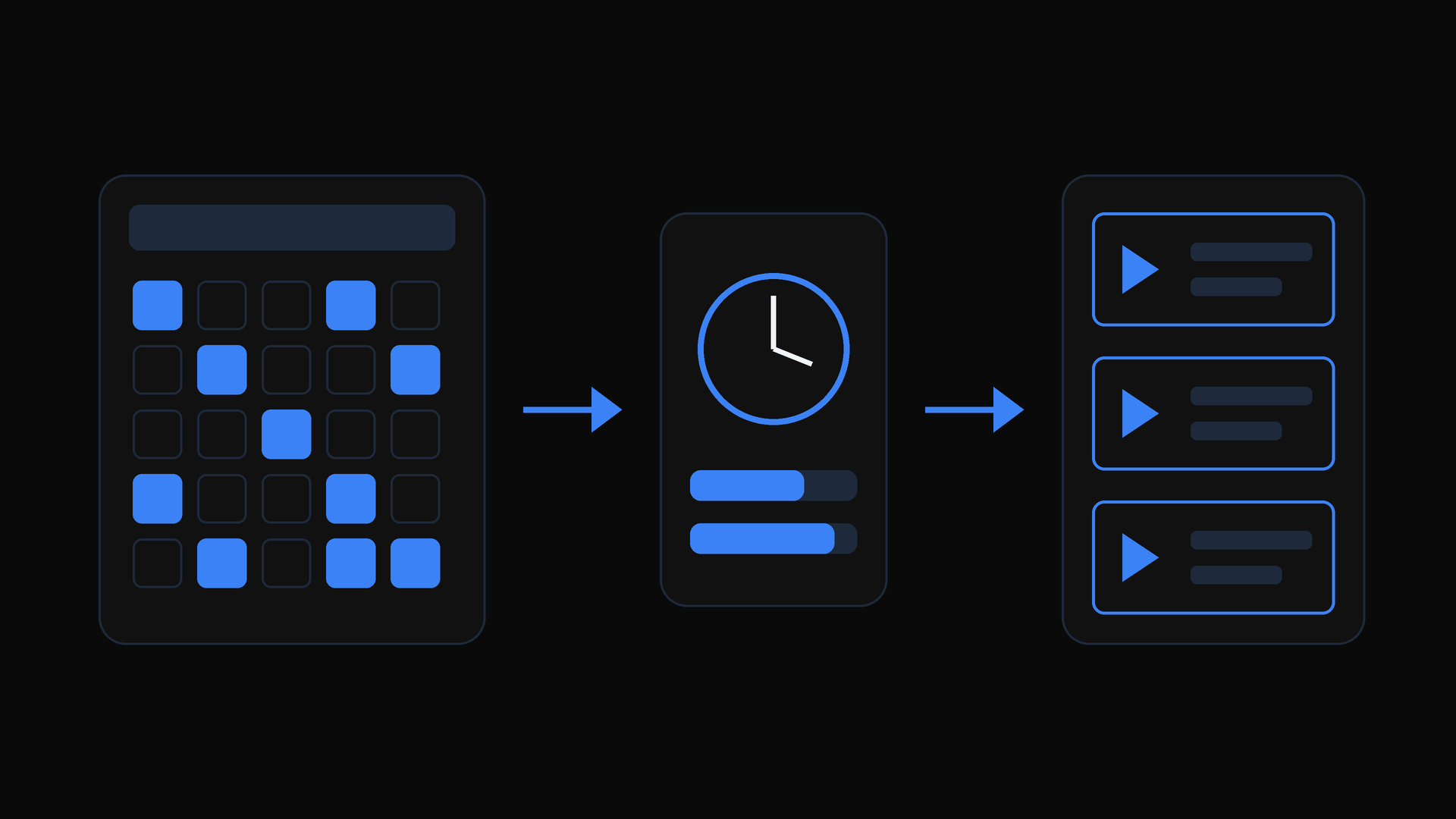
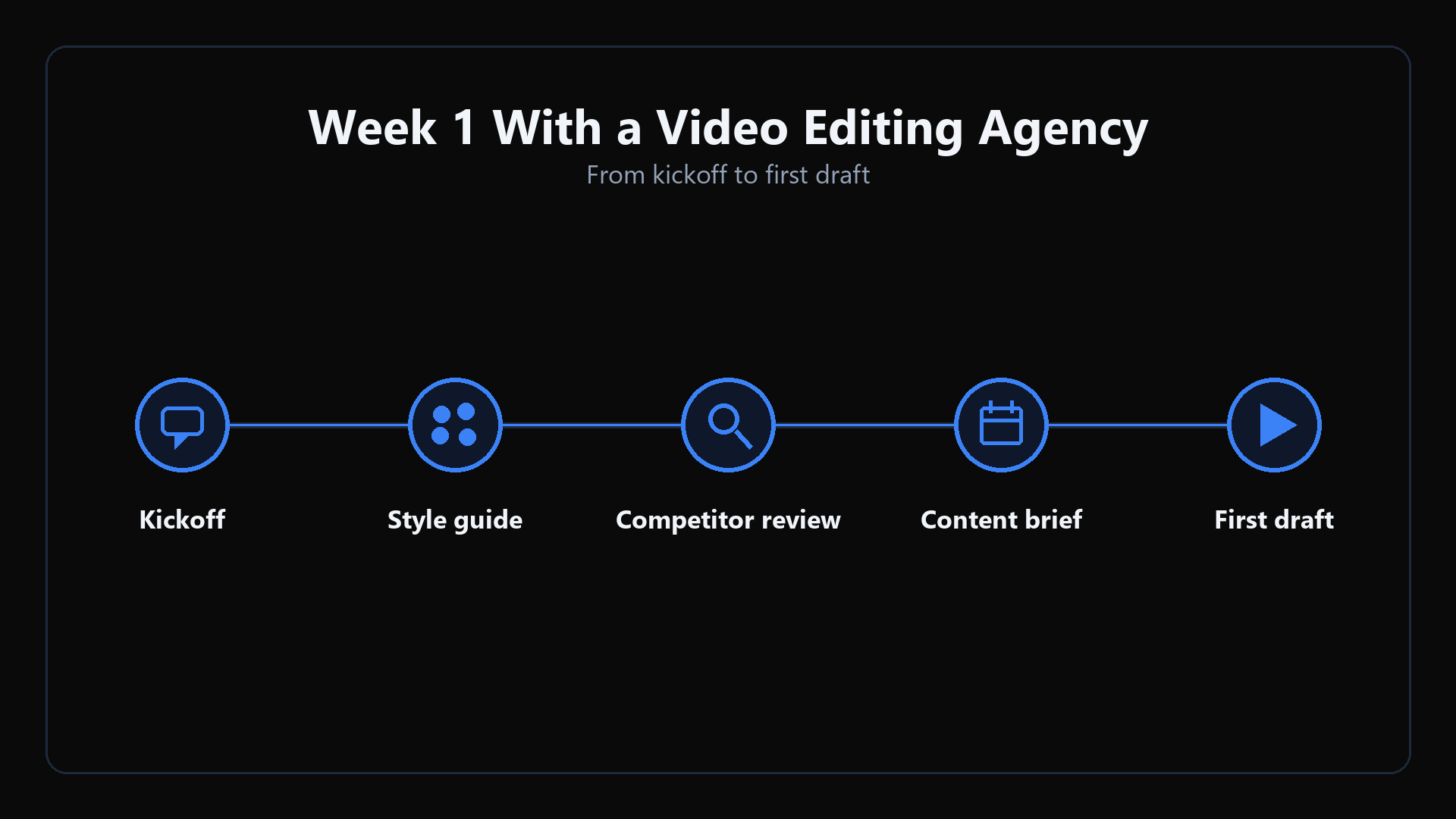
The first week is a sequence of five hand-offs: kickoff, brand build, competitor review, content brief and first draft. A well-run agency spends it learning your product and agreeing on rules, not editing at random. Here is the timeline VEC publishes on its how video editing outsourcing works page, which is a useful yardstick when you compare any provider.
VEC Onboarding Timeline, Days 1 to 14
| Day | What happens | What you receive |
|---|---|---|
| Day 1 | 60-minute kickoff call on your product, audience, competitors and what "on-brand" means | A single project-manager contact |
| Days 2 to 3 | Brand deep-dive covering colors, fonts, motion style, tone of voice and visual references | Brand style guide |
| Days 3 to 5 | Review of what competitors publish, what performs and where the gaps are | Competitive landscape report |
| Days 5 to 7 | Month 1 planning | Content calendar, topic ideas, script outlines, publishing schedule |
| Days 7 to 10 | First video draft, your feedback, visual style locked | First edited video |
| Days 10 to 14 | Remaining deliverables move into production | Full pipeline running |
Note the honest part: at VEC the first draft lands between days 7 and 10, so week 1 ends with a brief and a calendar and the first cut arrives right behind it. An agency that promises a finished video within 48 hours of signing may have skipped the brand and brief steps, and you can end up paying for that in revisions later.
What should you have ready before day 1?
Have four things ready: a named owner on your side, your raw footage or a path to it, your brand assets, and a clear idea of what a good video means for you. Delays in week 1 almost always come from missing inputs, not slow editors.
Week 1 Readiness Checklist
| Item | Why the agency needs it | Typical blocker |
|---|---|---|
| One internal contact | Answers product questions and approves drafts | Approvals sit with three people who never reply |
| Raw footage and a transfer route | Editing cannot start without source files | Files live on one laptop or in a locked folder |
| Brand assets (logo, fonts, colors) | Feeds the style guide | Several outdated logo versions |
| Product access for screen captures | Needed for demo and tutorial footage | No sandbox or demo account |
| Three to five reference videos you like and dislike | Shortens the style conversation | "Make it look premium" with no examples |
VEC asks for the same short list: raw footage, brand assets once during onboarding, product access if screen captures are needed, one internal contact, and approvals within 48 hours to keep the pipeline moving. If you are earlier in the process and still unsure of your scope, our guide to how to outsource video editing covers the decision before the contract.
What happens on the kickoff call?
The kickoff call is where the agency learns what it cannot find online: who you sell to, which videos matter commercially, and what your team will reject on sight. Treat it as a working session, not a sales call. VEC allots 60 minutes and covers product, audience, competitors and brand expectations.
Agree on the definition of done
Settle format, length, platforms and publishing cadence before anyone opens an editor. A 90-second LinkedIn cut and a 12-minute YouTube video need different pacing, captions and thumbnails, so write the target formats down.
Name the decision-maker and the feedback route
Decide who gives final approval and where feedback goes. Consolidated feedback from one person saves more time in week 1 than any editing trick, because conflicting notes from several stakeholders are a common cause of extra revision rounds.
Bring the awkward details
Mention legal review steps, banned phrases, executives who are camera-shy, and any footage you cannot use. Surfacing these on day 1 costs nothing. Discovering them after a first draft costs a revision round. If you want a structure for this conversation, our template for briefing an outsourced video team lists the questions worth answering in writing.
What access should you give an agency in week 1, and what should you keep?
Give the minimum that lets the team work: a shared folder for footage and deliverables, and where publishing is part of the service, a limited channel role rather than your password. Do not share primary account credentials.
YouTube's channel permissions are a good example of how to do it properly. According to YouTube Help on channel permissions (checked October 25, 2026), an Editor can upload and publish content but cannot manage permissions or enter into contracts, and an Editor (Limited) has the same permissions without access to revenue data. If an agency needs to upload for you, ask for the Editor (Limited) role instead of an Owner or Manager role.
Access Levels by Task
| Task | Minimum access | Avoid |
|---|---|---|
| Receiving footage | Shared cloud folder with edit rights to a project folder | Access to your whole drive |
| Reviewing drafts | Review link with comment rights for your approvers | Feedback scattered over email and chat |
| Uploading to YouTube | Editor (Limited) channel role | Owner or Manager role, or a shared login |
| Screen recordings | Demo or sandbox account | Production admin credentials |
Also confirm file formats. YouTube's recommended upload encoding settings (checked October 25, 2026) list MP4 with H.264 video and AAC-LC or Opus audio, and say content should be uploaded at the frame rate it was recorded, so ask your agency which delivery spec it will use.
How do the style guide and content brief get built?
The style guide records how your videos should look and sound, and the content brief records what they should say and when. Together they are the working documents that stop week 2 from turning into a debate about taste.
The style guide
A usable guide fixes colors, fonts, motion-graphics style, tone of voice and visual references, and ideally shows a before-and-after example. You should be able to hand it to a new editor and get something close to on-brand. Approve it in writing, because later "this does not feel like us" notes should be measured against it.
The competitor review
Looking at what rivals publish shows you which formats exist in your category and where nobody is covering a topic well. VEC delivers this as a short report during days 3 to 5, so your first ideas come from evidence rather than guesses.
The content brief and calendar
The brief turns strategy into a month of work: topics, hooks, script outlines and a publishing schedule tied to your product roadmap. Read it like a contract for the first 30 days. If a topic is off, say so now, because scripts are cheaper to change than finished edits.
When do you see the first draft, and how should you review it?
Expect a first draft by the end of the first or second week, and review it against the style guide and brief rather than personal taste. At VEC the first video arrives between days 7 and 10 and the visual style is locked after your feedback.
Turnaround after onboarding depends on the plan. The table below combines VEC's published standard and priority timings; for the wider picture of what to expect from any provider, see our guide to video editing SLA turnaround times.
VEC Turnaround and Revision Terms
| Item | Standard (Growth, Core) | Priority (Scale) |
|---|---|---|
| Scripts and outlines | 3 business days | 2 business days |
| Long-form videos | 7 business days | 5 business days |
| Short-form clips | 3 business days | 2 business days |
| Revision turnaround | 48 to 72 hours | 48 hours |
| Revision rounds per video | 2 included; extra rounds $200 each; minor tweaks unlimited | |
A simple review method
Watch once without stopping, then once with notes. Group comments by type: structure, pacing, branding, factual accuracy and captions. Label each note as must-fix or preference. Send one consolidated list, because a single clear round of feedback beats four partial ones. Check captions too; the W3C's guidance on captions and subtitles (checked October 25, 2026) states that automatic captions are not sufficient on their own, so ask who reviews caption accuracy.
What are you paying for during week 1?
You are paying for a team and a working process, not just editing hours, so week 1 sits inside the first monthly retainer. VEC's plans are flat monthly retainers, month-to-month with no long-term commitment, and prepaying three months saves 5%.
VEC Plans, 2026 (Month-to-Month)
| Plan | Price | Team | Monthly output |
|---|---|---|---|
| Growth | $5,000/mo | 1 senior editor + shared PM | 2 long-form + 8 to 10 short-form |
| Core | $9,500/mo | Senior editor, junior editor, PM, creative director | 4 long-form + 16 to 20 short-form |
| Scale | $16,000/mo | 2 senior editors, junior editor, dedicated PM, creative director | 8 long-form + 30 to 40 short-form |
Full terms are on the VEC pricing page. The pricing page describes month 1 as onboarding inside the same flat retainer and lists no separate setup fee; whichever agency you choose, ask whether onboarding is bundled or billed separately. Our video editing agency guide explains what agencies do and how their pricing models work, and the deliverables are itemized in what video editing services include.
How is week 1 with an agency different from onboarding a single editor?
With an individual editor, you do the onboarding: you write the style rules, set up access, define the process and cover absences. With an agency, a project manager runs the process and a creative director guards consistency, so your onboarding work shrinks to inputs and approvals.
Both routes need similar basics. If you are weighing the two, our video editor onboarding guide walks through the setup for a single editor, and the contrast is instructive. VEC's own materials describe an in-house ramp as roughly two to three months, against 14 days to a running pipeline in its process; treat that as VEC's claim about its own model rather than a market average.
What are the red flags in week 1?
Four signs suggest trouble: no kickoff call, no written brand guide, no named point of contact, and no sign of the plan being tailored to you. Each one tends to lead to slower revision cycles.
Week 1 Green Flags and Red Flags
| Signal | Healthy sign | Warning sign |
|---|---|---|
| Kickoff | Scheduled call with agenda | Intake form only |
| Brand setup | Written style guide you approve | "We will figure it out as we go" |
| Communication | One named contact and a feedback route | Several people, no owner |
| First draft | Matches the brief; questions asked early | Generic edit with no reference to your brief |
| Scope | Deliverables and revision terms in writing | Verbal promises only |
Ownership belongs in the agreement as well. Under 17 U.S.C. § 204 (checked October 25, 2026), a transfer of copyright ownership is not valid unless it is in a writing signed by the owner of the rights, so confirm who owns the finished edits before the first draft is delivered. This is general information, not legal advice; ask counsel to review the contract.
What if the first draft misses the mark?
A miss in week 1 is information, not failure. Compare the draft with the style guide and brief, then tell the agency which document it diverged from, or which one needs to change. If the guide was vague, fix the guide so every later video benefits. If the draft ignored a clear instruction, say so plainly and ask how the team will prevent a repeat, because the answer shows how the process works under pressure.
What should your team do during week 1?
Your job in week 1 is to respond fast and decide once. Reply to questions within a day, send assets in one batch, and give all feedback in one list. A short weekly rhythm keeps the project moving without extra meetings.
- Day 1: attend the kickoff and name one approver.
- Days 2 to 5: answer questions and approve the style guide and competitor report.
- Days 5 to 7: trim the content calendar to what you will realistically publish.
- Days 7 to 10: send a single, consolidated round of feedback on the first draft.
Teams new to outsourcing can also read our broader guide to outsourcing video editing, and see VEC case studies for how different SaaS teams use the service after onboarding.
FAQ
What happens in the first week after you hire a video editing agency?
Typically a kickoff call, a brand and style review, competitor research and a first content brief. At VEC that is a 60-minute kickoff on day 1, a style guide by days 2 to 3, a competitor report by days 3 to 5, a content calendar by days 5 to 7, and a first video draft between days 7 and 10.
How long does it take for a video editing agency to start delivering?
It varies by provider. VEC states that it gets a client's pipeline running in about 14 days, with the first draft on days 7 to 10. Ask any agency for its onboarding timeline in writing before you sign.
What do I need to give a video editing agency to get started?
Raw footage, your logo, fonts and colors, product access for screen captures if needed, one internal contact for questions, and approvals within about 48 hours. Share these in one batch on day 1 to avoid delays.
Should I give an agency my YouTube or social passwords?
No. Use role-based access instead. YouTube's channel permissions let you grant an Editor (Limited) role that can upload and publish without managing permissions or seeing revenue data, and the channel owner can remove access when the work ends.
Does week 1 cost extra?
VEC's pricing page describes month 1 as onboarding within the same month-to-month retainer ($5,000, $9,500 or $16,000 per month) and lists no separate setup fee. Other agencies may charge one, so ask before you sign.
Want to See What Your First Week Would Look Like?
VEC provides dedicated video editing teams for B2B companies, with plans from $5K per month and a guarantee to double your video output in 90 days or month 4 is free. Book a call and we will map your first 14 days.
Book a Free Strategy Call See Pricing