Brand Video Examples: 10 B2B Picks (+ Cost)
TL;DR
The 10 B2B brand videos in this guide — from Slack's honest documentary to Mailchimp's Cannes-winning campaign — share one trait: they lead with a human truth, not a product feature. Brand films for B2B companies typically cost $8K–$60K+ depending on production approach. If you're planning your first brand video or evaluating what great looks like, the examples and cost breakdown below give you a concrete reference point. See our full brand video cost guide and documentary-style brand film cost guide for deeper pricing detail.
Table of Contents
Key Takeaways
- 5 verified YouTube embeds below — Slack, HubSpot, monday.com, Zendesk, and Mailchimp — all confirmed live as of October 2026.
- $8K–$60K+ is the realistic range for B2B brand videos; the production approach (motion graphics vs. live-action shoot) matters more than duration.
- 10 examples span manifesto films, culture documentaries, humour-led campaigns, and category-creation content — different tools for different business goals.
- Brand videos that lead with a human problem, not a product feature, consistently outperform feature-led demos in brand recall and conversion lift (per Wyzowl's annual video marketing research).
- If your B2B company is Series A–C and producing 8+ videos per month, a dedicated video editing team reduces per-video cost by 40–60% versus per-project agency quotes.
What Is a B2B Brand Video? (And Why Does It Matter Now)
A brand video is not a product demo. It is not a testimonial. It is not a company overview. A brand video answers one question: why does this company exist, and do we believe them?
For B2B companies, this distinction matters more than ever. Buyers now spend roughly 70% of their research journey before contacting sales, according to HubSpot's State of Marketing research. Brand videos do the trust-building work that sales calls used to do — they help potential buyers form an opinion about your company long before they fill out a form.
The five types of brand video B2B companies most commonly produce:
- Manifesto film: Declares what you stand for and why. Most effective at Series B+ when category positioning matters. See how monday.com used this format below.
- Culture documentary: Shows the people behind the product. Most effective for recruiting, retention, and category leaders. Slack's example below is the canonical reference.
- Customer transformation film: A real customer's journey, shot documentary-style. Distinct from a testimonial — these tell a full story, not just a quote. Related: see our corporate video examples for how transformation films fit into the wider mix.
- Thought leadership film: Associates your brand with a point of view on an industry problem — not your product as the solution. Positions you as a category creator.
- Campaign film: A creative execution tied to a specific brand moment — launch, repositioning, or award season push. Mailchimp's "Did You Mean MailChimp?" is the canonical B2B example.
Brand videos are not a substitute for product demo videos or SaaS explainer videos. They work at the top of funnel, warming audiences who aren't yet ready to watch a three-minute demo. Think of them as the reason someone wants to learn more about you — not the how.
The B2B video marketing statistics on our site go deeper on what drives ROI at each funnel stage. For brand videos specifically: the return is measured in brand awareness lift, search volume increases, and pipeline influence — not direct conversions from a single view.
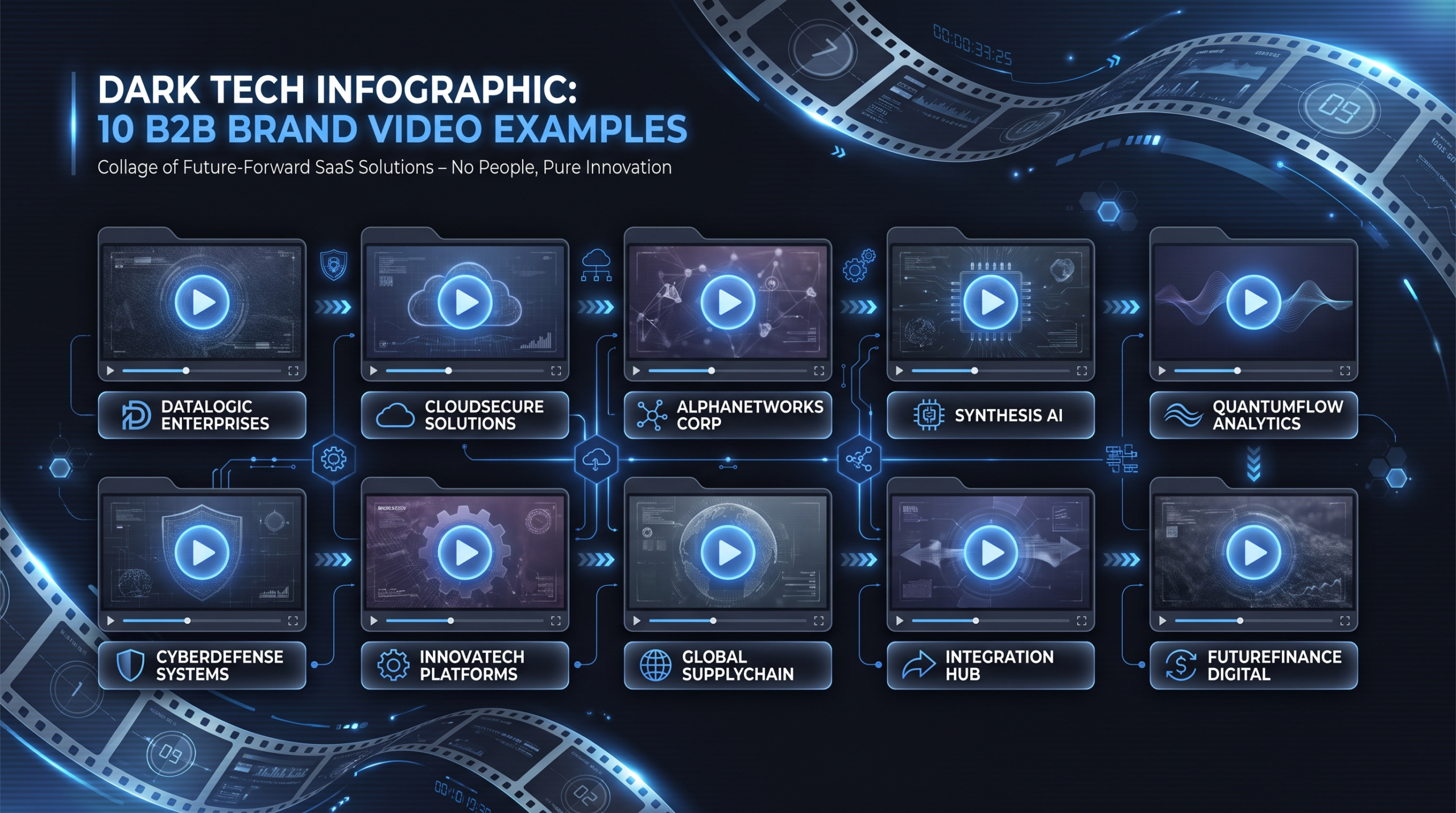
10 B2B Brand Video Examples Worth Studying
Every example below is chosen for a specific strategic lesson — not just production quality. The first five include verified YouTube embeds you can study directly.
1. Slack — "So Yeah, We Tried Slack…"
Type: Culture documentary | Year: 2014 | Agency: Sandwich Video
Slack's launch video is one of the most studied brand films in B2B marketing. Produced by Sandwich Video in 2014, it took a documentary approach: real Slack employees, honest reactions, no polished spokesperson. The video showed Slack being adopted at an actual creative agency — the Sandwich Video team — who initially resisted the product.
What makes it a masterclass: it let the product earn the endorsement on camera, rather than scripting one. The story arc is scepticism → adoption → genuine enthusiasm. That arc is more believable than any testimonial quote because viewers watch it happen in real time.
Lesson: Authenticity beats polish. An honest "before/after" story told through real footage converts more viewers than a produced spokesperson script. This format is ideal for companies launching a product that challenges existing behaviour — which is exactly what Slack was doing.
2. HubSpot — "I Choose to Grow Better" (INBOUND 2019)
Type: Manifesto film | Year: 2019 | Format: Event film / brand anthem
HubSpot's INBOUND 2019 intro film is a brand manifesto that reframes their "Grow Better" positioning as an ethical choice rather than a business metric. The film opens with a confrontational premise — "We are told to grow at all costs" — and then shows a different path. It's aspirational without being abstract because every statement is grounded in a real business behaviour.
The strategic insight: this video wasn't aimed at prospects. It was aimed at HubSpot's existing customers and their own employees — reinforcing why they chose HubSpot and why the mission matters. The best brand videos do double duty: they attract new buyers while deepening commitment from existing ones.
Lesson: A manifesto film works hardest at the intersection of values and category positioning. If your company has a genuine "Grow Better" equivalent — a better way of doing something the industry does badly — a manifesto film is the right vehicle to own that ground.
3. monday.com — "Work Without Limits"
Type: Brand manifesto / category creation | Year: 2021 | Format: Visual manifesto
monday.com released "Work Without Limits" to reposition themselves from a project management tool to a "Work OS" — a much broader category with a much larger addressable market. The film doesn't demonstrate features. It declares a worldview: that existing software constrains organisations, and that a new model of work is possible.
The production is intentionally cinematic — cinematic camera work, a driving score, sweeping shots of people working. This level of production investment signals seriousness to enterprise buyers in a way that a screen-recording demo cannot.
Lesson: When you're repositioning from a tool to a platform (or from a feature to a category), a manifesto film is the fastest way to signal the shift. This is not a demo-use-case — it's a market-positioning statement dressed as cinema.
4. Zendesk — "Zendesk Alternative"
Type: Creative brand campaign | Year: 2012–2015 | Agency: Zendesk in-house + external creative
Zendesk created a fake band — also called "Zendesk Alternative" — to address the number of people searching for alternatives to their product. Instead of a defensive FAQ page, they made music videos and concert footage for the fictional band, essentially turning a defensive search intent into a brand awareness play. The creative conceit: if you're looking for a Zendesk alternative, here's one — sort of.
This approach requires a level of brand confidence that most B2B companies struggle to find. It works because Zendesk was already well-established enough that the joke landed. For earlier-stage companies, this genre is risky; for category leaders, it's a powerful way to reclaim potentially negative search intent.
Lesson: Brand films don't have to be earnest. Humour is a legitimate B2B creative strategy — but only when you're confident enough in your position to be playful about challenges to it.
5. Mailchimp — "Did You Mean MailChimp?"
Type: Creative brand campaign | Year: 2017 | Agency: Droga5 | Award: Cannes Lions Grand Prix
The "Did You Mean MailChimp?" campaign was built around the insight that Mailchimp is a weird name that people mispronounce, misspell, and misremember. Instead of fighting this, Droga5 and Mailchimp leaned into it — creating a series of short films around similar-sounding fake products (KaleLimp, MailShrimp, JailBlimp, WhaleSynth). Each film had its own visual identity and creative universe.
The campaign won a Cannes Grand Prix and drove measurable brand awareness growth. The strategic lesson for B2B companies: brand distinctiveness — being genuinely different in how you communicate — is more valuable than competitive messaging. Most B2B companies sound identical. This campaign proved that standing out pays off even in a functional category like email marketing software.
Lesson: Counterintuitive creative — leaning into a perceived weakness — is often more memorable than playing to your strengths. If you have something distinctive or even weird about your brand, consider building your brand film around it rather than glossing over it.
6. Salesforce — Customer Transformation Series
Type: Documentary brand content | Format: Multi-episode film series
Salesforce has produced extensive brand film content built around a consistent theme: real companies, real transformations, real people. Rather than abstract claims about CRM capability, Salesforce's brand content follows actual customers — companies ranging from small businesses to global enterprises — through a genuine business transformation story. The "Leading Through Change" series (2020) is one of the best-executed examples of this approach at scale.
What sets Salesforce's approach apart is editorial discipline: each film earns its emotional weight before introducing the brand. Viewers follow the protagonist's challenge first, and Salesforce appears as a supporting actor, not the hero. This is the opposite of how most enterprise software brands approach video.
Lesson: Your customer is the hero. The most effective enterprise brand films make the buyer the protagonist and position your product as the tool that enables their success — not the other way around. See employer brand video examples for a related approach applied to talent marketing.
7. Atlassian — Culture and Collaboration Brand Content
Type: Culture film / values-led brand content | Positioning: Team-anywhere, open-company culture
Atlassian has built a consistent brand film strategy around the idea that great software is built by great teams — and that their products (Jira, Confluence, Trello) exist to make teams better. Their brand content celebrates real teams using their products, with a recurring emphasis on remote work culture, psychological safety, and the human side of software development.
The production style is intentionally understated: real offices, real employees, natural lighting, conversational interviews. This approach signals authenticity and credibility to a technical audience that is inherently sceptical of produced marketing content. The trade-off is less visual impact, more trust-building depth.
Lesson: For developer-facing or technically sophisticated audiences, restraint in production is a signal — not a limitation. Over-produced brand films can feel hollow to buyers who spend their days reading technical documentation. Match your production register to your buyer's culture. Related: our UGC video examples for B2B cover the related trend toward authentic, lo-fi brand content.
8. Drift — Conversational Marketing Category Films
Type: Category-creation brand content | Positioning: Thought leadership, not product demo
Drift built their brand around owning the category of "conversational marketing" before competitors could claim it. Their brand films are explicitly educational — they position the category problem (your website makes buyers fill out forms and wait) before they position the Drift solution. The effect is that viewers who engage with Drift's content feel like Drift taught them the category, which creates a strong brand association.
This approach is most effective for companies creating a new category or repositioning an existing one. If you're selling into a market where buyers don't yet know they have the problem you solve, brand films that define and dramatise the problem are more valuable than product demos.
Lesson: Own the problem before you own the solution. Category-creation brand films lead with the painful status quo — not with your product. If buyers don't feel the problem, they won't want the solution. For content execution at volume, see how SaaS video production scales this approach across a full content calendar.
9. Gong — Bold, Personality-Driven Brand Films
Type: Personality-driven brand content | Positioning: Revenue intelligence, data-driven sales
Gong built one of the most distinctive brand voices in B2B SaaS without a cinematic budget. Their brand content — across video, social, and copy — uses bold typography, direct confrontational statements, and data-heavy messaging that appeals directly to the VP of Sales persona. The visual style is consistent and unmistakable: high contrast, heavy type, minimal footage.
The insight Gong proved: visual consistency and a strong editorial voice create brand recognition faster than high production values. A bold, opinionated brand film shot simply is more memorable than a polished but generic corporate video. This approach is particularly effective for companies selling to sales organisations, where direct, data-driven communication is culturally aligned.
Lesson: Brand distinctiveness is not a function of budget. A strong visual system and an unapologetic point of view will outperform a polished-but-generic brand video. For promotional video examples that apply similar bold creative approaches, see our separate guide.
10. Intercom — Human Connection in Business Communication
Type: Values-led brand film | Positioning: Customer relationships, not support tickets
Intercom's brand content consistently returns to one theme: every business interaction is a relationship, not a transaction. Their brand films explore the human reality of customer communication — the frustration of waiting for an answer, the delight of an unexpectedly personal response, the difference between feeling like a ticket number and a valued customer.
What Intercom does well is connecting a software product (a messenger widget) to a genuinely human insight. The brand film challenge for B2B software companies is making abstract functionality feel meaningful. Intercom solves this by anchoring their brand story in the emotional experience of customers — not the features of their platform.
Lesson: Find the emotional truth underneath your product category. If you sell task management software, the emotional truth is that people feel overwhelmed. If you sell analytics, it's that decisions made with bad data feel terrifying. Lead with that human truth, and your product positioning will resonate far beyond its functional description. Our SaaS demo video examples show how the same emotional anchoring works further down the funnel.
What Do the Best B2B Brand Videos Have in Common?
Across these 10 examples, 5 structural patterns repeat consistently — regardless of budget, production style, or company stage.
5 Patterns in High-Performing B2B Brand Videos
| Pattern | How It Works | Risk If You Skip It |
|---|---|---|
| Human-first opening | Film opens with a person, problem, or insight — not a logo or product | Viewers disengage in the first 5 seconds before you get to the point |
| Single emotional territory | One feeling per film: aspiration, belonging, frustration-to-relief, or humour | Mixed emotional register feels confused and is harder to remember |
| Earned brand appearance | The brand name or product appears only after the problem is established | Leading with branding signals "advertisement" and loses trust immediately |
| Internally consistent style | Colour, typography, pacing, and tone match across every frame | Inconsistency reads as low investment and hurts credibility |
| A specific audience, not everyone | Every creative choice is made for one specific buyer persona | Videos designed for everyone resonate with no one |
The companies that produce the best brand videos are not necessarily the ones with the biggest budgets. They are the ones with the clearest answer to: what do we want our buyer to feel after watching this?
Budgets matter for production quality — a $50K brand film has more creative options than a $10K one — but the strategic decisions above are available to any B2B company. A clearly scoped brief, a specific audience, and a single emotional target will outperform a high-budget production built on a vague brief every time.
For companies producing video at scale, brand consistency across a library of videos requires not just a strong brief, but a team that has internalized your brand guidelines. That's one reason dedicated editorial teams — where the same editors work on every asset — produce more cohesive brand output than per-project agency arrangements. See how VEC clients maintain brand consistency across 15–30 videos per month.
How Much Does a Brand Video Cost?
Brand video production costs range from roughly $3,000 for a motion-graphics-only video to $150,000+ for a full documentary production with a multi-day crew. The realistic range for B2B SaaS companies at Series A–C is $8,000–$60,000, with production approach being the primary cost driver — not duration.
Brand Video Cost by Production Tier and Hiring Model
| Tier | Budget Range | Production Approach | Typical Deliverables | Who It's Right For |
|---|---|---|---|---|
| Motion graphics / stock | $3K–$10K | Animation, stock footage, screen recording, VO | 60–90 sec hero cut + 1–2 social variations | Early-stage, SaaS UI-forward stories, first brand asset |
| Mid-production hybrid | $10K–$30K | Half-day shoot OR custom animation + full post | 90–120 sec hero cut + 2–4 format variations | Series A–B, readying for a campaign push |
| Full live-action production | $30K–$60K | Multi-day shoot, professional crew, colour grade, original score | 2–3 min hero film + full social suite | Series B–C, IPO prep, category repositioning |
| Premium brand film | $60K–$150K+ | Documentary crew, multiple locations, editorial agency | Feature-length brand film + full campaign suite | Pre-IPO, enterprise repositioning, award-level campaigns |
| Freelancer / offshore | $1K–$8K | Varies by operator; motion graphics most common | 60 sec cut, limited revisions | MVP test, internal use, tight budget constraint |
Post-production — editing, colour grading, motion graphics, sound design, format variations — represents 40–60% of a brand video's total budget at the mid-production tier. This is why the choice of editor matters as much as the choice of director. An experienced brand editor shapes the story as much as the footage does.
For the documentary-style brand films similar to Slack's approach, documentary brand film costs run considerably higher due to pre-production story development and multi-day shoot logistics. Budget $5,000–$10,000 for pre-production alone on a serious documentary-style brand film.
For a broader view of what typical B2B companies spend on brand video production, see our average cost of a brand video guide.
If your company is producing brand content on an ongoing basis — campaign videos, culture films, executive thought leadership series — the economics shift significantly. Video Editing Company offers dedicated editing teams for B2B SaaS companies starting at $5K/month (Growth), $9.5K/month (Core), and $16K/month (Scale). Post-production at that cadence costs a fraction of per-project agency rates. See our pricing or book a free strategy call to model the numbers for your content volume.
Which Type of Brand Video Should Your B2B Company Make?
The right brand video type depends on your company stage, your current market position, and the specific gap in your content mix. The most common mismatch: companies at Series A spending on high-production manifesto films when a culture documentary would do more work at a third of the cost.
Brand Video Type vs. Company Situation
| Your Situation | Recommended Type | Why | Budget Signal |
|---|---|---|---|
| First brand video ever | Culture documentary or product story | Establishes authenticity before aspiration; lowest risk if brand voice isn't fully developed yet | $8K–$20K |
| Repositioning to a new category | Manifesto film | You need to declare the category change explicitly; a manifesto film is the format built for this | $20K–$60K |
| Recruiting top engineering/design talent | Culture documentary | Candidates respond to real people and authentic culture signals — scripted recruiting videos feel fake | $15K–$40K |
| Owned a category, now defending it | Campaign film (humour or bold creative) | Leaders can afford to be playful; the Zendesk and Mailchimp examples above both came from positions of market confidence | $30K–$100K+ |
| Long ABM sales cycle, buying committee | Customer transformation film (2–3 per quarter) | Multiple decision-makers need to see different facets of the same problem; transformation films work for each role differently | $10K–$30K per film |
For a deeper look at how different video formats serve different funnel stages, read our video production pricing models guide — it covers not just cost but how each model maps to production volume and quality consistency. See also explainer video cost breakdown if you're weighing brand film vs. animated explainer for the same brief. And if you're thinking about moving production in-house vs. agency, our outsourcing guide covers the tradeoffs in detail.
How to Brief Your Brand Video Agency (5 Steps)
Most brand video briefs fail at one of two points: they're either too vague ("we want something that shows who we are") or too prescriptive ("here's our storyboard"). The five-step brief below produces better brand videos by forcing alignment on the decisions that actually matter before production begins.
- Name one audience. Not "B2B buyers" — name the exact person. "VP Marketing at a 150-person SaaS company, 18 months into their role, considering a replatform." The more specific the audience, the more specific the creative can be.
- State the single feeling you want. Not "inspire and inform" — one feeling. Aspiration. Relief. Pride. Belonging. Brief your agency on this feeling, not on a list of messages to communicate.
- Define success with one metric. View-through rate on LinkedIn. Brand awareness lift in a survey. Replies from target accounts. One metric forces prioritisation; multiple metrics produce compromise creative.
- Share what you are NOT. The most useful competitive context in a brief is the brand you don't want to look like. Show three competitors' brand videos and explain specifically why your audience would find them off-putting.
- Scope deliverables before creative. Define the formats before the script: hero film (90 sec) + social cut (15 sec) + LinkedIn horizontal (60 sec) + email embed version. Scope drives budget; scope changes after production starts are the single biggest cost driver in brand video production.
For the post-production phase — editing, colour, sound, motion graphics, format variations — our team at Video Editing Company specialises in taking approved footage and brand assets and producing a full deliverable suite. See what our video editing service includes and how the process works. For context on what editing costs look like at different volume tiers, the cost per finished minute and hourly rate by country guides are useful references before you brief an agency on a retainer.
Frequently Asked Questions
What is the difference between a brand video and a product demo video?
A brand video answers why your company exists and what it stands for — it builds emotional connection and trust before a sale is considered. A product demo video answers how your product works and what problem it solves — it moves a buyer closer to a purchase decision. Brand videos work at the top of funnel; product demos work in the middle. High-performing B2B content programmes use both, often in sequence: brand video first to establish credibility, then demo videos to convert intent.
How long should a B2B brand video be?
The optimal length depends on the platform and the film type. Manifesto films and culture documentaries typically run 90 seconds to 3 minutes for the hero cut, with 15–30 second social edits cut from the same footage. Campaign films (like Mailchimp's) can be shorter — 60–90 seconds — because the creative concept does the heavy lifting. The rule: the film should be exactly as long as it needs to be to land its single emotional point. Padding is the most common brand video failure. See our SaaS demo video examples for length benchmarks on the demo side.
Should B2B companies use humour in brand videos?
Yes — but only when it is earned. Zendesk's "Zendesk Alternative" and Mailchimp's "Did You Mean MailChimp?" both work because the humour comes from a genuine brand insight, not from an attempt to seem likeable. Humour that feels forced or that doesn't connect to a real brand tension reads as insincere to B2B buyers. If you can identify a genuine irony or contradiction in your category — something your buyers privately find absurd about the status quo — that is a legitimate creative territory for a brand film.
How much should a B2B Series B company budget for a brand video?
At Series B, a realistic budget for a meaningful brand film is $20,000–$50,000 all-in (creative, production, and post-production). This places you in the mid-production hybrid tier: a professional half-day shoot or custom animation, full post-production, and a deliverable suite covering hero cut plus 3–4 social formats. The average cost of a brand video guide breaks this down by company stage and production approach. For ongoing post-production across your full content programme, a dedicated editing team typically costs less per month than a single mid-tier brand film project quote.
What makes a brand video perform well on LinkedIn?
Four factors drive LinkedIn brand video performance: (1) a native upload rather than a YouTube link (LinkedIn suppresses reach on outbound links); (2) captions, since 80%+ of LinkedIn video plays are muted; (3) an opening frame that works as a still image — LinkedIn previews the first frame before play; (4) a specific audience signal in the first 3 seconds — B2B buyers scroll past content that doesn't immediately signal relevance to their role. For production execution, the video editing services guide covers format delivery for LinkedIn specifically.
Ready to Build Your B2B Brand Video?
Video Editing Company provides dedicated editing teams for B2B SaaS companies — the same senior editors, on every project, learning your brand over time. Our teams handle everything from rough cut to final deliverable suite, across all formats and platforms.
See Pricing Book a Free Strategy Call