Brand Video Costs: Why Quotes Range $3K to $100K
TL;DR
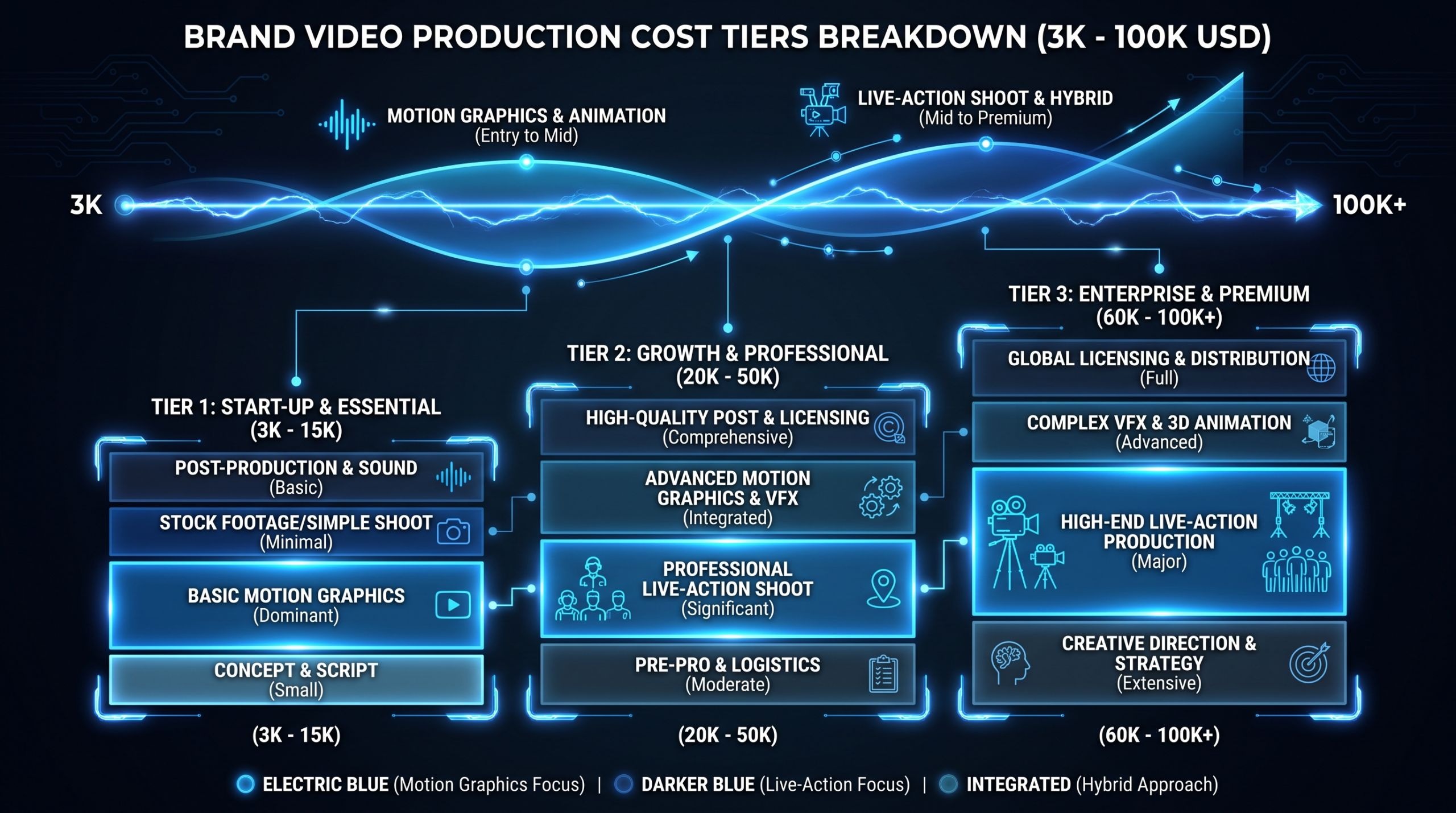
Brand video quotes vary by 30x because agencies are quoting fundamentally different products. The five drivers — concept/strategy, production approach, crew size, licensing, and agency overhead — combine in dozens of configurations. Here is what each budget tier realistically buys:
- $3K–$10K: Motion graphics or stock-based. No crew day. Post-production-focused. Best for SaaS product stories.
- $10K–$30K: Hybrid or half-day shoot. Full post-production package. Multiple format deliverables.
- $30K–$100K+: Multi-day shoot, premium talent, cinematic post. Campaign-level investment.
- For software and SaaS brands, a stock + motion approach often delivers better ROI than a full shoot at 2–3x the cost.
Table of Contents
- Why the Same "Brand Video" Costs $4K or $80K
- The 5 Factors Behind Every Quote
- Brand Video Cost Tiers: The Definitive Breakdown
- Cost by Format and Approach
- When Stock + Motion Graphics Beats a Shoot
- Hidden Costs That Inflate Final Invoices
- How to Evaluate Any Brand Video Quote
- The Case for Post-Production-Heavy Brand Video
- FAQ
Why the Same "Brand Video" Costs $4K or $80K
The confusion starts with the term itself. "Brand video" is a category of intent — tell your company's story — not a production specification. A 60-second motion graphics explainer, a half-day live-action shoot at your office, and a multi-location cinematic brand film are all legitimately called brand videos. Their production costs share almost nothing in common.
For real-world examples of what each production tier produces, see our B2B brand video examples guide — 10 verified brand films with production notes and strategic lessons.
When you send the same RFP to five agencies, you are often comparing quotes from entirely different production approaches:
- A boutique motion studio quoting post-production-only work — no crew, no location, just editors and animators
- A local video agency quoting a full half-day shoot with a 3-person crew and rented studio space
- A premium production house quoting a campaign-level concept with multi-day shoot and a full suite of deliverables
- A freelance team quoting labor cost without agency overhead or project management built in
- A full-service integrated agency quoting strategy plus production plus paid distribution planning
The $4,000 quote and the $80,000 quote might both be entirely fair — they are just producing different things. Understanding which approach your specific objective actually requires is the only way to evaluate whether a quote is appropriate or overpriced.
According to annual research published by Wyzowl's State of Video Marketing, the majority of companies now produce video content regularly — but spend diverges sharply by company stage, production model, and content strategy. Companies in the same industry with comparable headcount commonly spend 5–10x different amounts on similar content objectives, primarily because of production approach choices rather than quality differences.
The 5 Factors Behind Every Brand Video Quote
1. Concept and Strategy
Before a single frame is captured or animated, someone needs to figure out what the video should say, to whom, and through what narrative structure. Strategy and concepting can range from a 30-minute brief alignment call to a multi-week creative development engagement depending on how much clarity the brand already has.
At the lean end — roughly $500–$1,500 of the total budget — you bring a clear brief and the agency executes against it. You have defined your audience, your message, and your distribution plan. At the substantive end ($3,000–$8,000 or more), the agency conducts stakeholder interviews, develops alternative creative directions, writes multiple script options, and pressure-tests the concept against your distribution plan before touching a single editing tool.
For most Series A SaaS companies with reasonable positioning clarity, deep concepting is optional. For Series C+ companies navigating multiple buyer personas, a complex multi-product suite, or a category creation narrative, skipping the strategy phase tends to cost more in production revisions and rework than it saves upfront.
2. Production Approach: Shoot vs. Stock vs. Motion Graphics
This single variable has more impact on cost than any other. Three primary approaches exist, and each serves genuinely different objectives:
Live-action shoot: Booking a director, DP, sound recordist, gaffer, and at minimum one production assistant — plus location fees and talent costs. A modest single-day shoot with a lean commercial crew commonly runs $8,000–$20,000 for crew and equipment alone, before any post-production work begins. That number climbs with crew size, location count, and specialty equipment.
Stock footage plus narration: License footage from libraries like Artgrid, Shutterstock, or Pond5, pair with a professional voiceover, add licensed music and basic motion graphics. Total cost typically falls in the $3,000–$12,000 range. The ceiling is lower because there is no shoot day to manage — and end-to-end turnaround compresses to 2–4 weeks from brief to final delivery.
Custom motion graphics: Animated content built in After Effects, Cinema 4D, or comparable tools. Cost scales directly with visual complexity. A 60-second kinetic typography piece with branded elements and clean transitions typically runs $4,000–$8,000. A fully custom 2D character animation or sophisticated data visualization explainer can reach $15,000–$40,000 or more depending on the number of unique scenes and animation depth.
3. Crew Size and Equipment
Crew size multiplies production costs quickly. Day rates vary by market and seniority, but rough benchmarks for a US-based production hold fairly consistently:
- Skeleton crew (director/DP in one role plus one PA): $3,000–$6,000 per shoot day
- Standard commercial crew (director, DP, sound recordist, gaffer, PA): $8,000–$15,000 per shoot day
- Full-scale production (add art director, wardrobe stylist, hair and makeup, second camera operator): $20,000–$40,000 per shoot day
Equipment costs compound this further. Cinema camera packages, premium glass, lighting rigs, and professional audio kits typically add $1,500–$8,000 per day depending on specifications. Specialty shots — drone aerials, crane or jib work, slow-motion rigs, macro or product table setups — add $500–$3,000 per shot type on top of the base equipment package.
Most brand videos requiring 2–3 distinct locations need 2–3 shoot days. At $12,000–$15,000 per day all-in, that is $24,000–$45,000 in production spend before a single frame enters post-production.
4. Music, Stock Footage, and Licensing
Licensing costs are consistently underquoted at proposal time and back-loaded into final invoices. The key line items to budget for explicitly:
Music licensing: Royalty-free library subscriptions — Artlist, Musicbed, Epidemic Sound — run approximately $200–$600 per year with unlimited downloads, making per-project cost low when amortized across a volume of videos. Custom-composed music for a single brand video runs $1,500–$5,000 or more for a 60–90 second track. Sync licenses for known commercial artists start around $5,000 for limited digital use and can reach $50,000 or more for broad usage rights across multiple channels and territories.
Stock footage: Individual clips on premium stock libraries typically run $79–$199 per clip for standard licensing. Budget $500–$2,500 for a motion-graphics or hybrid project that relies meaningfully on stock assets. Artgrid annual subscriptions (~$500–$1,200) make more economic sense for teams producing video on a recurring basis.
On-screen talent and usage rights: Actors and on-camera spokespeople carry usage rights tied to distribution scope. Local talent for a digital-only campaign might cost $500–$2,000 in total. National broadcast distribution combined with digital use for the same talent could require $15,000–$50,000 depending on the actor's rate card and the rights period.
5. Agency Overhead and Profit Margin
A $25,000 brand video quote does not mean the agency pockets $25,000. Typical production company cost structure runs: 40–60% to direct production costs (crew, equipment, licenses, talent), 20–30% to agency overhead (account management, project management, facilities, software, admin), and 15–25% to margin.
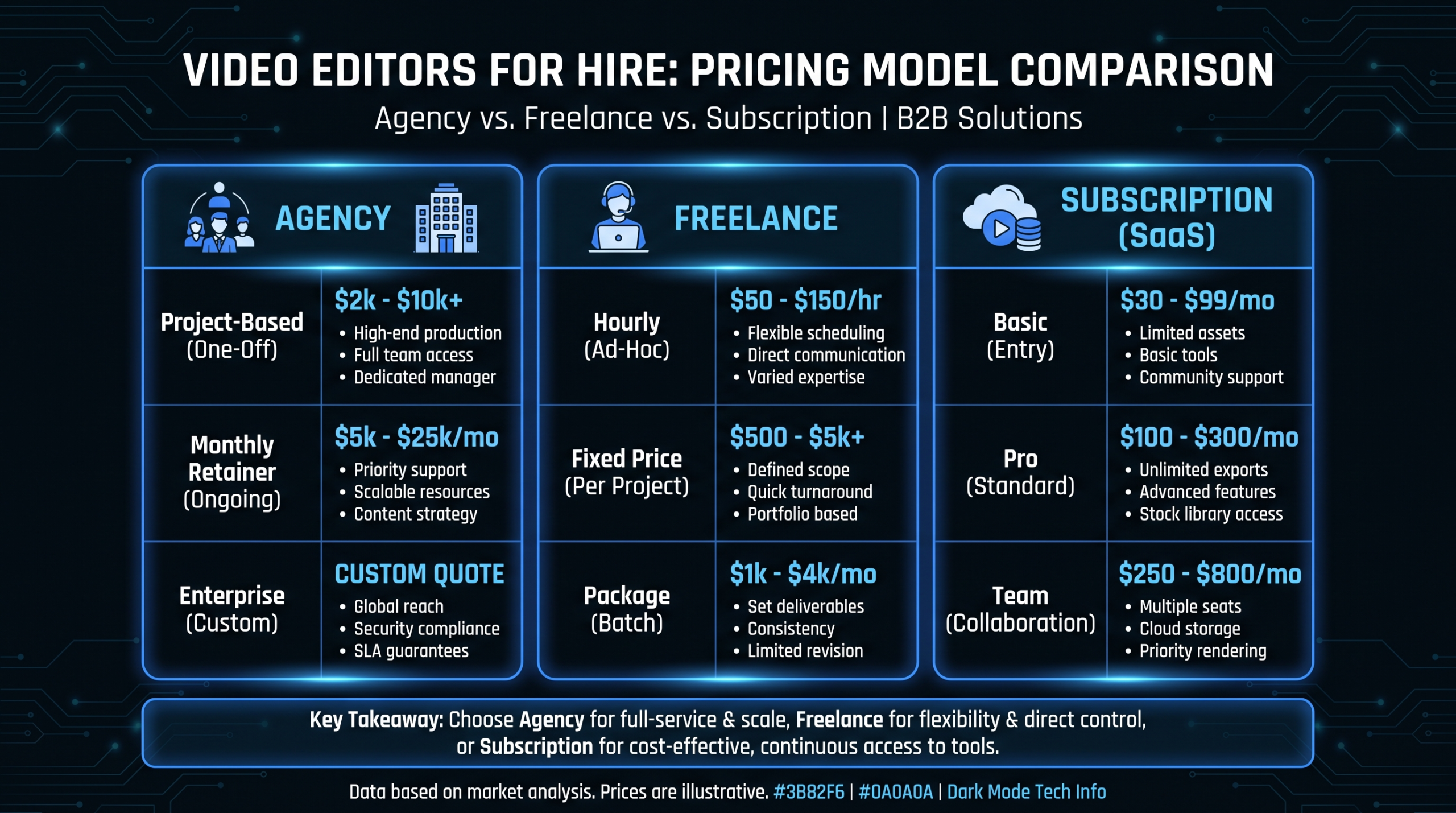
This allocation is entirely legitimate. You are buying project management, quality assurance, vendor relationships, revision management, and accountability — not purely raw production labor. The alternative is working directly with a freelance director, a separate editor, a separate colorist, and sourcing your own music and stock assets. That arrangement eliminates the agency markup but shifts coordination overhead directly to your team. Someone still needs to manage the timeline, review each vendor's deliverables, and drive revisions. Whether that cost lands on the agency's invoice or your VP of Marketing's calendar is a question of organizational fit, not pure economics.
Brand Video Cost Tiers: The Definitive Breakdown
Brand Video Cost Tier Overview
| Tier | Typical Budget | Production Approach | Post-Production Share | Deliverables |
|---|---|---|---|---|
| Entry | $3K–$10K | Stock + motion graphics, no shoot | 80–90% of budget | 1 master cut, 1–2 format variations |
| Mid-Market | $10K–$30K | Hybrid (light shoot + stock) or full custom motion | 60–75% of budget | 1–2 hero cuts, 2–4 format variations |
| Premium | $30K–$100K+ | Full live-action shoot, multi-day crew | 40–55% of budget | Hero film + multiple cut-downs + social suite |
Tier 1: $3K–$10K
This is the motion-graphics-and-stock tier. You are paying for a skilled editor, motion graphics designer, and voiceover artist — not a crew day. For many SaaS companies, this tier produces the strongest ROI per dollar spent because the production approach actually suits the product story being told.
What you realistically get:
- 60–120 second animated or stock-plus-motion hybrid brand video
- 1–2 rounds of revisions included in the base price
- Licensed music from a royalty-free library subscription
- Motion graphics package: logo animation, lower thirds, title cards, basic data visualization
- Professional voiceover (commercial talent, not celebrity-tier)
- Horizontal master plus one vertical format variation for social
What you are trading off:
- No live-action footage of your actual team, office, physical product, or customers
- Reduced creative differentiation when competitors are drawing from similar stock libraries
- Narrower emotional register — works well for SaaS demos and data-driven stories, less so for culture or trust-building narratives
Best for: Early-stage companies creating first video assets, SaaS products where the UI and functionality is the true hero, teams producing a high volume of videos on a recurring budget, and any brand story where demonstrating the product visually matters more than showing the people behind it.
Tier 2: $10K–$30K
The mid-market tier is where production approach choice becomes most consequential. You are typically getting one of three things: a half-day live-action shoot with a small commercial crew, a fully custom motion graphics production with original scene or character design, or a sophisticated stock-plus-hybrid project with a broader deliverables package and proper post-production depth.
What you realistically get:
- 1–2 half-day shoot days with a 3–5 person crew, OR a 90–120 second fully custom animated explainer
- Full post-production suite: color grade, sound design, licensed music track, motion graphics overlay
- 2–3 revision rounds included before overage rates kick in
- 2–4 format variations (hero cut plus social square, story vertical, and/or 30-second version)
- A dedicated project manager who serves as your main point of contact
At this tier, agency concepting pays dividends. A well-scripted, conceptually tight $18,000 brand video will consistently outperform a technically proficient but strategically vague $12,000 video. If your budget lands in this range, push for scripting and storyboard alignment before any production begins — revision costs after locking picture are where mid-market projects tend to erode their value.
Best for: Series A–B SaaS companies executing quarterly brand refreshes, companies announcing a product launch or positioning pivot, and B2B enterprise deals where the quality of your sales collateral visibly signals company maturity to procurement teams.
Tier 3: $30K–$100K+
This is the campaign-level or cinematic brand film tier. Multi-location shoots, premium or custom music, on-screen talent with extended usage rights, a full commercial crew, and a post-production phase that typically equals or exceeds the production spend in both cost and elapsed time.
What you realistically get:
- 2–5 shoot days with a full commercial crew (commonly 8–15 people on set)
- Premium sync license for an existing track, or custom-composed original music
- VFX compositing, complex motion sequences, 3D elements integrated where appropriate
- Multiple cut-downs from the hero film: 60s, 30s, 15s, 6-second pre-roll versions
- Full color pipeline: dedicated colorist, color science, LUT development for brand consistency
- Professional sound mix to broadcast and streaming delivery specifications
- Localization variants: captioning, VO replacement tracks, regional versioning
Post-production alone in this tier commonly runs $15,000–$40,000: offline editing, VFX work, color grading, audio mix, deliverable formatting, and archival. For a full breakdown of how production agency pricing structures compare at this scale, see our analysis of video production agency pricing models.
Best for: Series C+ and growth-stage companies with board-level buy-in on brand investment, companies entering new markets or redefining their category, IPO-adjacent brand positioning, trade show keynote content, or any video intended for broadcast or premium digital placement where production quality directly signals brand maturity.
Cost by Format and Approach: Quick Reference
Brand Video Cost by Format
| Video Format | Production Approach | Typical Cost Range | Typical Timeline |
|---|---|---|---|
| Motion graphics brand film (60–90s) | Stock + custom animation | $4K–$12K | 3–4 weeks |
| Hybrid brand video (stock + light shoot) | Half-day shoot + stock fill | $10K–$20K | 4–6 weeks |
| Live-action brand video (1–2 min) | Full-day shoot, small crew | $18K–$40K | 6–8 weeks |
| Cinematic brand film (2–3 min) | Multi-day shoot, full crew | $40K–$100K+ | 8–14 weeks |
| Product launch video | Depends on approach | $8K–$40K | 4–10 weeks |
| Company culture / team video | Half-day+ shoot required | $15K–$35K | 5–8 weeks |
When Stock + Motion Graphics Beats a Full Shoot
Reflexive escalation to live-action is one of the most common brand video budget mistakes. Choosing stock plus motion graphics is not a compromise for budget-constrained teams — for many specific objectives, it is the technically superior choice that will outperform a more expensive shoot on every distribution channel metric that matters.
Choose stock + motion graphics when any of these apply:
- Your story is conceptual, not testimonial. If the video needs to communicate something like "how SaaS finance teams spend 30% of their week on manual reconciliation," motion graphics will tell that story more clearly and quickly than live-action footage trying to dramatize invisible software workflows.
- You are distributing digitally only. On a laptop screen or phone display, a high-quality motion graphics video is visually indistinguishable from live-action to the majority of viewers. The cinematic quality benefit of a full shoot largely disappears below broadcast or large-venue scale.
- Your timeline is under 4–6 weeks. A full live-action shoot requires pre-production weeks of location scouting, talent casting, permit acquisition, and shot list development — before a single shoot day. Stock plus motion compresses end-to-end production to 3–4 weeks from brief to delivery.
- You need to update the video regularly. A motion graphics brand video is far easier to version and maintain over time. Swap the messaging, update the product screenshots, add new customer logos, adjust the call-to-action — no reshoot required. A live-action video is effectively locked at the moment of production.
- The product is the actual hero. For SaaS companies, a clean screen-recorded product walkthrough with polished motion graphics treatment typically converts better than high-production live-action that buries the product experience inside cinematic abstraction.
Where live-action still wins decisively:
- Culture and hiring videos — candidates need to see your real team and physical environment
- Customer testimonials — authenticity requires real faces, body language, and unscripted moments
- Physical product demonstrations — hardware, manufacturing processes, physical retail contexts
- High-stakes investor, board-level, or enterprise sales presentations where production quality serves as a direct proxy for company quality in the viewer's mind
The practical takeaway: if your primary use case falls in the stock + motion column, a $5,000–$12,000 investment can achieve results comparable to a $30,000–$50,000 live-action production on the distribution channels that matter to a SaaS company. For a related exploration of this decision in the context of product-specific content, see our SaaS video production guide.
Hidden Costs That Inflate Final Invoices
These line items are not necessarily hidden — they are often present in the fine print of agency contracts. They are, however, systematically de-emphasized in the initial proposal and routinely underbudgeted by buyers who anchor too hard on the headline number.
Revision Overages
Most agency contracts include 2–3 revision rounds in the base price. After that, changes are typically billed at $100–$300 per hour or $500–$1,500 per additional revision pass. Brand videos — particularly at the $30K+ tier where multiple executive and marketing stakeholders weigh in — commonly go through 4–6 revision rounds before final approval. Budget this explicitly when projecting total cost, and structure your internal review process to consolidate all feedback before submitting each revision request.
Licensing Escalation on Successful Videos
If the video performs well and you want to extend the campaign — adding channels, new markets, extending the usage period — you will need to renegotiate licenses on music, talent, and sometimes stock footage. Music sync licenses for expanded use commonly double the original licensing cost. On-screen talent fees for adding broadcast rights to a digital-only license can add $5,000–$20,000 or more depending on the original talent agreement.
Multiple Deliverables and Format Variations
Agencies typically quote one master video. Getting cut-downs (30s, 15s, 6s versions), format variations (16:9 master, 9:16 vertical, 1:1 square), language versions (captioned subtitles, voiceover replacement), and localized regional cuts is generally not included in the base quote. Budget $1,000–$5,000 per significant additional cut depending on post-production complexity. The most cost-efficient approach is producing all needed variations immediately after the master cut is locked — before the project is archived and the team is reassigned.
File Ownership and Delivery Rights
Some agencies charge separately for delivery of project source files, raw media packages, and asset libraries. Others retain creative assets as part of their IP by default. If you want to bring editing in-house at any point, switch vendors, or repurpose raw footage for future content, negotiate explicit file ownership and delivery format in the contract before signing. This matters most in the $30K+ tier where the raw footage package has substantial standalone value for future content production.
How to Evaluate Any Brand Video Quote
A quote that reads "$18,000 all-in" without itemization is a negotiating position, not a production proposal. Professional brand video quotes should break down the following phases explicitly:
- Pre-production: Discovery sessions, scripting, storyboarding, casting, location scouting, shot list development, permits
- Production: Crew day rates by role, equipment package cost, location fees, talent fees, catering and transportation
- Post-production: Offline editorial hours, color grading, sound design, music licensing, motion graphics build time, VFX if applicable
- Deliverables: Master file specifications, social cut counts, format variations, captioning, archival format
- Revisions: Number of rounds included in the base price, overage rate per additional round
The ratio of post-production spend to production spend tells you something meaningful about the approach. At the $3K–$10K tier, 80–90% of the budget should be in post-production — there is no shoot to fund. At the $30K+ tier, a healthy cost distribution typically runs 40–50% production, 40–50% post-production, with the remainder in pre-production planning and agency overhead.
A post-production-heavy quote is not inefficiency — it is frequently the right allocation. Post-production is where storytelling actually happens: the editorial pacing, the music selection and placement, the motion graphics that translate abstract value propositions into visual clarity. Research from HubSpot's video marketing data consistently shows that editing quality and narrative clarity outrank raw production quality in determining viewer engagement and downstream conversion rates.
The Case for Post-Production-Heavy Brand Video
The most consistent pattern across brand video budgets at scale: companies that concentrate spend in post-production — editorial quality, motion graphics sophistication, sound design, music — extract better results per dollar than companies that allocate the same total budget primarily toward production quality.
This is counterintuitive because production quality is visible and tangible. A cinema camera package is impressive on a spec sheet. A premium crew is easy to justify in a budget review. Post-production quality, by contrast, is invisible when done well — it just makes the video feel right in a way that viewers cannot articulate but absolutely respond to.
For B2B SaaS specifically, this dynamic surfaces in a repeatable pattern:
- A $6,000–$8,000 motion graphics brand video with a sharp, specific script, well-timed animation, and intentional sound design will outperform a $25,000 live-action shoot with mediocre editorial pacing on every digital channel metric — completion rate, click-through, time-on-page
- Raw footage shot on a capable camera but edited with precision, color-graded with brand intention, and mixed for clean audio will consistently outperform beautifully photographed footage assembled without editorial care
- The quality bottleneck in SaaS brand video is almost never the camera — it is the script clarity, the editorial judgment, and the motion graphics quality that translate product value into something a buyer can feel
This is the model VEC was designed around: dedicated senior editing teams specializing in post-production-heavy B2B SaaS content. Growth plan starts at $5K/month, Core at $9.5K/month, Scale at $16K/month — each including dedicated editors, motion graphics capability, and a guarantee of doubling your video output within 90 days. The value is not the camera. It is the editorial judgment applied consistently to whatever assets you bring in.
If your brand video budget is under $15K, consider whether shifting allocation from production to post-production — or from a full shoot to a motion-graphics approach — would produce a more effective result for your specific distribution channels. For context on how these economics compare across different video formats, our explainer video cost breakdown covers similar ground with direct per-minute cost math that translates to brand video decisions.
Frequently Asked Questions
What does a brand video typically cost?
Brand video production costs range from around $3,000 for a motion graphics or stock-based video with no crew involvement, to $100,000 or more for a multi-day cinematic production with talent and full campaign deliverables. The majority of B2B SaaS brand videos commissioned by Series A–C companies fall in the $8,000–$35,000 range. The right tier depends on your distribution channel, timeline, and whether live-action footage is actually required by your narrative objectives.
Is a $5,000 brand video worth it for a SaaS company?
For many SaaS companies, yes — if the approach and execution are right. A well-scripted, cleanly animated $5,000–$8,000 motion graphics brand video will typically outperform a poorly conceived $25,000 live-action production on every digital channel metric that matters. The investment delivers value when: the script is specific and audience-focused, the editor has genuine motion graphics capability, and the production approach matches your distribution context. Where the sub-$10K tier does not work: culture and hiring videos, customer testimonial content, physical product demonstrations, or any context where authentic human presence is essential to the story.
Why do brand video quotes vary so much between agencies?
Three main reasons drive the variation. First, agencies are often quoting fundamentally different production approaches — a motion studio and a full-service production company are effectively selling different products. Second, scope inclusion varies significantly — one quote may bundle post-production, multiple revision rounds, and format variations while another covers editorial only. Third, overhead structure differs — a two-person boutique has dramatically different overhead than a 20-person production agency. Always request itemized quotes that break out pre-production, production, post-production, deliverables, and revision terms separately before comparing numbers.
When does a brand video actually require a full crew?
Live-action crew production makes clear sense when: you need authentic footage of real people (your team, actual customers, or founders), you are doing physical product or hardware demonstrations, the production quality itself signals brand credibility in a specific context (enterprise sales, investor relations, trade show keynotes), or you are producing content for broadcast or large-format venue placement. For software, data, and concept-driven stories targeting digital-only distribution — which covers the majority of SaaS content programs — motion graphics or hybrid approaches typically deliver better results at lower cost and faster timelines. See our SaaS video production guide for a more detailed framework on this decision.
What is actually included in post-production for a brand video?
Full post-production for a brand video typically covers: offline editing (assembling the narrative from raw assets), color grading (visual tone, brand color consistency, scene matching), sound design (ambient audio, transitions, foley elements), music selection and licensing, motion graphics (title cards, lower thirds, animated data sequences, logo treatments, branded transitions), and delivery formatting (multiple file specs, format variations, platform-specific exports). At higher budget tiers, post-production scope expands to include VFX compositing, 3D elements, professional broadcast-spec sound mix, localization for multiple languages or markets, and formal archival packages for future repurposing. Post-production costs for brand videos range from roughly $3,000 on a lean motion graphics project to $25,000 or more on a multi-deliverable cinematic production.
Know Your Budget. Maximize the ROI.
Whether you are working with $8K or $80K, the variable that moves the needle most is post-production quality — the edit, the motion graphics, the sound. VEC's dedicated editing teams specialize in B2B SaaS brand content, with a 90-day output guarantee and plans built for teams producing video at scale.
Book a Free Strategy Call See VEC Pricing