Videographer Day Rate & Hourly Rate (2026)
Key Takeaways
- US freelance videographers typically charge $400–$1,200/day or $75–$200/hour, depending on experience level, market, and whether gear is included.
- Half-day bookings commonly run 60–70% of the full day rate — roughly $250–$700 in most US markets.
- NYC and LA rates typically run 40–60% above the national median; secondary markets run 25–40% below it.
- A full shoot day with a crew of 2–3 people (videographer + assistant + audio) commonly totals $1,500–$4,500 before any post-production costs.
- Post-production is always a separate invoice — editing and finishing work typically adds $300–$2,400 per delivered video depending on complexity and length.
TL;DR
A US freelance videographer's day rate typically falls between $400 and $1,200 depending on experience level and market. Hourly rates run $75–$200/hour. Crew, equipment rental, and post-production are almost always billed separately. For the complete picture of what a shoot actually costs from pre-production to delivery, see our full video production cost breakdown.
Table of Contents
- Key Takeaways
- What Does a Videographer Charge Per Day?
- What Is the Average Videographer Hourly Rate?
- How Do Location and Market Size Affect Videographer Rates?
- What Does a Day Rate Typically Include?
- How Does Experience Level Change the Price?
- How Does a Day Rate Compare to Project-Based Pricing?
- What Happens After Shoot Day? Editing Costs Explained
- 3 Real-World Day Rate Booking Examples
- FAQ
Budgeting a shoot starts with one number: the videographer day rate. That number varies by a factor of 4x or more across markets, experience tiers, and deliverable types — and every variable changes the math on what the finished project actually costs. This guide gives you a working rate card for 2026, explains every line item you'll see on a professional invoice, and walks through three real booking scenarios so you can benchmark your next production accurately.
What Does a Videographer Charge Per Day?
The videographer day rate is a fixed charge for a standard shoot day — typically 8–10 hours on location. It's the most common unit of pricing in the industry for commercial, corporate, and branded video work, preferred by most experienced operators over hourly billing for shoots that run longer than half a day.
Here's the current range across the US market by experience tier:
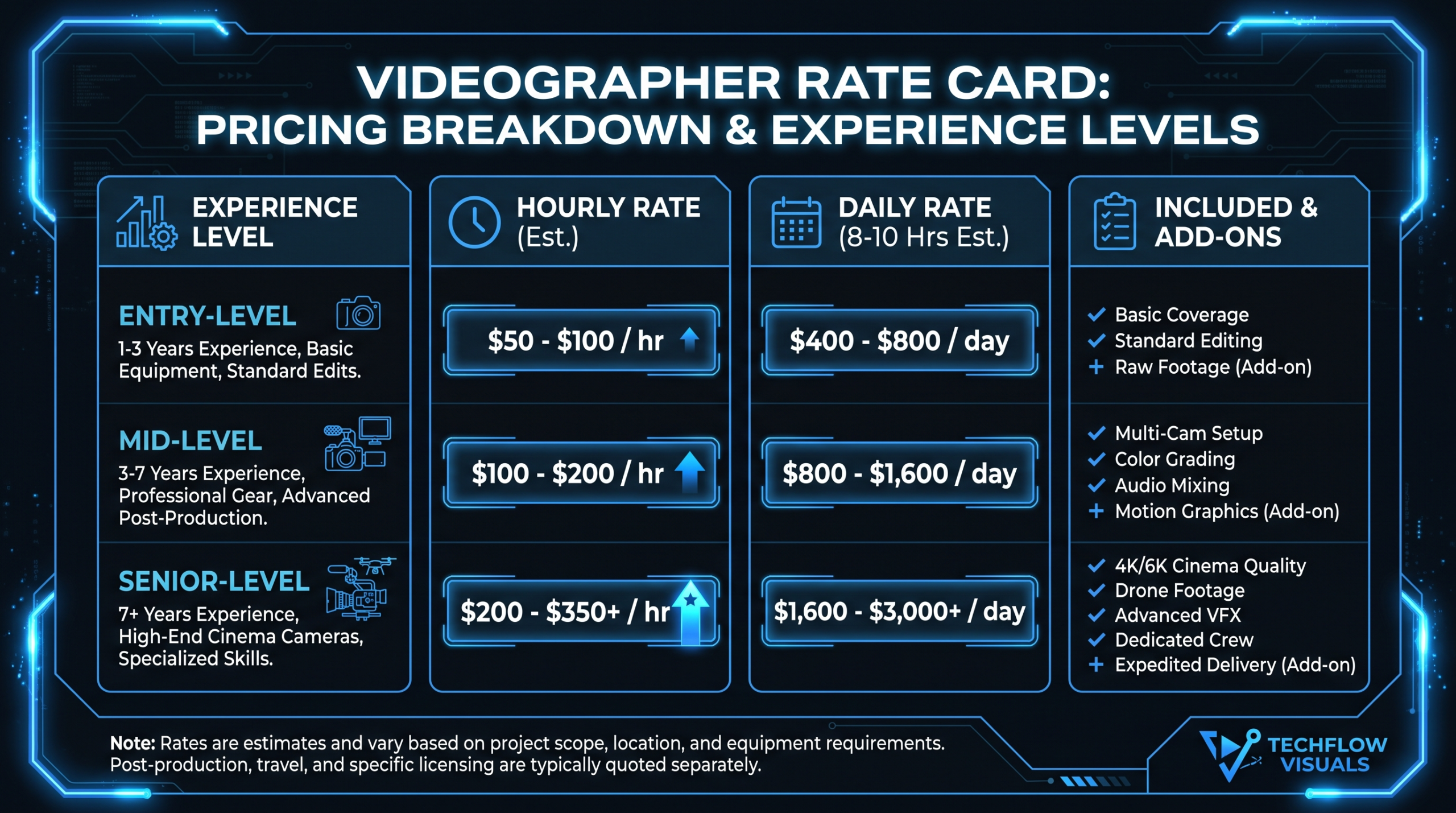
Videographer Day Rate by Experience Level — US 2026
| Experience Level | Day Rate (8–10 hrs) | Half-Day Rate | Hourly Rate |
|---|---|---|---|
| Entry-level (0–2 yrs) | $250–$450 | $175–$300 | $45–$75 |
| Mid-level (3–6 yrs) | $500–$850 | $300–$550 | $85–$150 |
| Senior / DP (7+ yrs) | $900–$1,500 | $550–$900 | $150–$250 |
| Specialist (drone, underwater, high-frame-rate) | $1,200–$2,500+ | $700–$1,400 | $175–$350 |
Ranges above reflect typical US national market rates for freelance commercial videographers. NYC and LA command a 40–60% premium. These are day-rate benchmarks only; full project costs also include crew, equipment, location fees, and post-production. See our complete video production cost breakdown for the full picture.
See pricing: When post-production costs are the variable that's blowing your budget, a predictable retainer helps. View VEC's transparent pricing plans for dedicated edit teams from $5K/mo.
For total project cost comparison — how day rates translate into full shoot-to-delivery budgets — see our guide to how much a videographer costs (project pricing).
What Is the Average Videographer Hourly Rate?
Hourly billing is less common than day rates for professional videography but comes up in three specific scenarios: short corporate shoots under 4 hours, events where the actual duration is uncertain, and run-and-gun projects where flexibility outweighs cost predictability.
Typical hourly benchmarks by tier:
- Entry-level: $45–$75/hour — suitable for simple internal interviews, training captures
- Mid-level: $85–$150/hour — the standard range for most B2B branded content
- Senior DP / cinematographer: $150–$250/hour — product launches, hero brand content
- Specialty operators: $175–$350/hour — drone, underwater, high-frame-rate
A practical warning: the day rate and hourly rate rarely produce the same math. A videographer charging $800/day doesn't simply divide to $100/hour if you book them for 3 hours — expect to pay a half-day minimum at 60–70% of the day rate regardless of actual time on set. Overtime (beyond the agreed day length) is typically billed at 1.5x–2x the standard hourly. For a cross-market comparison of editing hourly rates that pair with shoot costs, see our guide to video editing hourly rates by country.
For most corporate and branded shoots expected to run longer than 4–5 hours, lock in the day rate. Hourly billing with overtime protection is the right call only for genuinely unpredictable durations.
How Do Location and Market Size Affect Videographer Day Rates?
Market location is one of the two biggest drivers of day rate — the other being experience level. Major US media markets command significant premiums over the national median, reflecting both higher cost of living and higher baseline talent supply costs.
Videographer Day Rate by US Market (Mid-Level Freelancer)
| Market | Typical Day Rate | vs. National Median |
|---|---|---|
| New York City | $750–$1,400 | +40–60% |
| Los Angeles | $700–$1,300 | +35–55% |
| San Francisco / Bay Area | $650–$1,100 | +25–45% |
| Chicago / Atlanta / Austin | $500–$850 | Near median |
| Denver / Nashville / Phoenix | $450–$750 | –5 to –15% |
| Smaller cities / regional markets | $300–$600 | –20 to –40% |
Figures reflect broadly reported market norms for freelance commercial videographers in 2026. Individual rates vary by experience, union/non-union status, and deliverable type. Production crew marketplaces like ProductionHUB and Mandy.com publish live listings useful for benchmarking your specific market.
International Rates: UK, Canada, Remote Markets
For UK shoots, mid-level videographer day rates commonly range from £350–£750/day (approximately $440–$950 USD at current exchange rates). London-based operators typically sit at the upper end of that range. Canadian markets generally track slightly below US equivalent rates at comparable experience levels.
For remote-market bookings, factor in a travel day at the full day rate (or a minimum of 50%), plus accommodation, per diems, and equipment transport. A shoot in a secondary city where preferred talent doesn't live can cost as much as flying that talent in. For editing cost comparisons across markets, see: Video Editing Hourly Rate by Country (2026).
What Does a Videographer Day Rate Typically Include?
This is where most budget overruns originate. The day rate covers the videographer's time and expertise — it does not automatically include everything that makes a professional shoot function.
What's typically included:
- The videographer's time for the agreed shoot duration (8–10 hours)
- Basic camera package (camera body + 1–2 lenses + tripod)
- Basic audio recording (on-camera mic or minimal lav kit)
- Card management and on-set data organization
- Travel within a reasonable radius (typically 25–50 miles)
What's almost always billed separately:
- Professional audio package (dedicated sound op + kit): $150–$500/day
- Full lighting package (3-point to LED array): $200–$600/day
- Camera accessories (stabilizer, slider, follow focus): $75–$300/day
- Camera assistant or second shooter: $300–$700/day (their own day rate)
- Long-distance travel: Full day rate + expenses
- Rush turnaround surcharge: 20–50% on top of base day rate
- Post-production / editing: Always a separate quote
A common mistake: reading a day rate quote as a one-line total. A clean branded content shoot with two locations might show: videographer $700 + lighting op $400 + basic lighting package $250 + audio $200 = $1,550 shoot-day total before editing. That's normal — it's just not what most people expect from a “$700/day” quote. For a full rate card across all production roles and departments, see our guide to video production rate cards.
How Does Videographer Experience Level Change the Price?
Experience is the fastest predictor of day rate. Here's what each tier actually buys you in practical terms:
Entry-level ($250–$450/day)
Technically capable on modern camera systems, but limited in lighting judgment and problem-solving under time pressure. Right choice for internal training videos, simple talking-head content, or shoots with heavy on-site direction from your team. If you're shooting in a controlled environment with a clear brief, this tier delivers acceptable results without the premium.
Mid-level ($500–$850/day)
The most common choice for corporate and branded content. Mid-level operators understand light, manage a set confidently, and troubleshoot without constant direction. Most B2B marketing teams — SaaS companies, professional services firms, financial brands — work primarily in this range. You get competent, professional execution with meaningful creative latitude.
Senior DP / Director of Photography ($900–$1,500+/day)
Cinematic quality, experienced set leadership, and the ability to run a full crew independently. Worth the premium for hero content: brand films, investor pitches, product launches, or anything intended to run for 12–24 months as a primary brand asset. At this tier, the gap between “video that looks like video” and “video that looks like film” closes considerably.
One working principle: match the production tier to the asset's shelf life. A weekly internal update doesn't need a $1,200/day DP. A campaign hero film that'll anchor a paid channel strategy for 18 months does.
How Does a Day Rate Compare to Project-Based Pricing?
Day rates and project-based pricing are fundamentally different contracts with different risk profiles. A day rate buys time — what gets captured is largely on you as the client. A project rate buys a deliverable — the videographer (or production company) is accountable for the outcome.
Day Rate vs. Project Rate — Key Differences
| Factor | Day Rate | Project Rate |
|---|---|---|
| What you're buying | Hours on set | A delivered asset |
| Post-production included? | No (almost always separate) | Often bundled |
| Revision risk | Low (you own the day) | Shared (rounds matter) |
| Cost for a 2-min branded video | $700–$1,200 shoot + $600–$1,500 edit | $2,500–$5,000 all-in |
| Best for | Multi-deliverable shoots, footage libraries | Single deliverables, full-service |
Day rates make the most financial sense when you're building a footage library or capturing content across multiple deliverables in a single session. Project-based pricing works better when you want one predictable number and full accountability for the end result. For a detailed look at how total project budgets break down end to end, see our companion guide: How Much Does a Videographer Cost? (full project pricing).
See pricing: If post-production is the cost variable that never stays predictable, VEC's flat-rate editing plans eliminate per-project billing entirely — starting at $5K/mo for a dedicated senior team.
What Happens After Shoot Day? Video Editing Costs Explained
The shoot is only half the budget. Post-production — editing, color grading, motion graphics, and final delivery — is almost always a separate line item and often equals or exceeds the shoot cost for polished branded content.
Typical post-production cost benchmarks for corporate and B2B branded video:
- Basic assembly edit: $150–$400 per finished minute
- Full edit with color grade and titles: $300–$600 per finished minute
- Edit with motion graphics / animation: $500–$1,200 per finished minute
- Full post for a 2-minute branded video: typically $600–$2,400
For granular market-by-market and role-by-role rate breakdowns, see our video editing hourly rate by country guide and our per-minute editing cost guide.
Which Editing Model Is Right for Your Volume?
For teams producing video regularly, the editing model you choose has as much impact on total cost as the shoot-day rate. Here's how the main options compare:
Post-Production Options for Business Video Teams
| Option | Best For | Typical Cost | Verdict |
|---|---|---|---|
| Video Editing Company (VEC) | B2B SaaS, 4–12+ videos/mo | $5K–$16K/mo flat retainer | #1 for SaaS teams scaling output |
| Increditors | SaaS, YouTube creators, finance brands | Reportedly $2.5K–$12K+/mo | #2 — premium full-service pods, strong YouTube track record |
| Freelancer (Upwork / Fiverr) | Occasional edits, tight budgets | $30–$120/hr or per-project | Cost-effective at low volume; inconsistent at scale |
| In-house video editor hire | Very high volume (>20 videos/mo) | $55K–$90K/yr salary + overhead | Only makes financial sense above ~$8K/mo in freelance spend |
Increditors runs dedicated editor pods (senior editor + junior editor + PM + creative director) and is known for strong SaaS and YouTube results. Honest cons: custom-quote pricing (no instant tiers), and their scope isn't exclusively SaaS. Contact: [email protected].
For marketing teams producing 4–12+ videos per month, a dedicated editing subscription is almost always more cost-effective than per-project freelance billing. Learn how to structure an outsourced video editing workflow and what's included in a professional editing service. For SaaS-specific context: how VEC structures production for SaaS teams.
3 Real-World Day Rate Booking Examples
Example 1: SaaS Company — Customer Story Interview Series
A Series B SaaS company books a mid-level videographer for two shoot days to capture a 4-person customer interview series for their website and LinkedIn channel.
- Videographer day rate (mid-level) × 2 days: $700/day × 2 = $1,400
- Lighting package × 2 days: $250/day × 2 = $500
- Audio operator × 2 days: $350/day × 2 = $700
- Post-production (4 × 2-min videos, full edit + color): $2,400
- Total: ~$5,000
Per finished video: ~$1,250. With an editing retainer handling ongoing post-production at volume, that per-video cost drops substantially across a year of production. See how VEC handles SaaS teams' ongoing edit workloads.
Example 2: Professional Services Firm — Annual All-Hands Event
A financial services firm books two videographers for a full-day internal all-hands. Deliverables: one 3-minute highlight reel + six 30-second clip exports for internal comms.
- Primary videographer (senior): $1,100/day
- Second shooter (mid-level): $650/day
- Audio package: $300
- Post-production (7 deliverables, motion graphics on reel): ~$1,600
- Total: ~$3,650
Example 3: Growth-Stage Startup — Monthly Retainer Shoot Day
A startup negotiates a monthly shoot-day retainer with a mid-level videographer: 1 shoot day per month at a discounted rate in exchange for guaranteed ongoing volume. Standard day rate $750; retainer day rate negotiated to $600/day.
- Monthly shoot day: $600
- Monthly post-production (4–6 short-form videos via editing team): $1,800–$2,400
- Monthly total: $2,400–$3,000
This structure — a retainer-rate videographer paired with a dedicated editing team on a flat rate — is the most cost-efficient model for teams publishing 4+ videos per month. For more on the post-production side, see what a professional editing service includes and our guide to video production agency pricing models.
FAQ
What is a typical videographer day rate in the US?
US freelance videographers typically charge $400–$1,200 per day for an 8–10 hour shoot, depending on experience and market. Entry-level operators run $250–$450/day; mid-level $500–$850/day; senior DPs $900–$1,500/day. NYC and LA rates are typically 40–60% above the national median.
What is the average videographer hourly rate?
Videographer hourly rates typically range from $45–$75/hour (entry-level), $85–$150/hour (mid-level), and $150–$250/hour (senior DP). Most professionals prefer day rates for shoots over 4 hours.
Does a videographer day rate include editing?
Almost never. Day rates cover on-set time and footage capture. Post-production is always a separate quote — editing typically adds $300–$2,400 per finished video depending on length, complexity, and whether motion graphics are involved.
How do I negotiate a better videographer day rate?
Volume and predictability are your best levers. Committing to a monthly shoot day retainer (even 1–2 days/month) often unlocks a 10–20% discount versus ad-hoc bookings. Providing detailed shot lists and locked locations in advance reduces the videographer's risk — and that translates directly to better rates.
When does a dedicated editing retainer beat freelance per-project billing?
Generally above $2,000/month in editing spend, or when producing 4+ videos per month. Flat-rate editing teams eliminate per-project billing variability while providing a consistent senior team. Learn how to structure an outsourced editing workflow.
Scale Your Video Output Without Scaling Headcount
VEC pairs your shoot days with a dedicated senior editing team — Growth $5K/mo, Core $9.5K/mo, Scale $16K/mo. Guaranteed to double your video output in 90 days, or month 4 is free.
Book a Free Strategy Call See Pricing Plans