Video Editing Cost Per Project: 2026 Guide
Video editing cost per project typically ranges from $200 for a short social clip to $25,000+ for a full brand film, depending on video length, complexity, and who you hire. For B2B SaaS companies producing content at scale, per-project pricing is usually the most expensive path — understanding what drives these numbers is the first step to budgeting smarter.
This guide breaks down per-project editing costs by video type, shows you how different hiring models compare, and helps you calculate whether per-project pricing makes financial sense for your content volume.
TL;DR
Per-project video editing costs range from ~$200 (social clip) to $25,000+ (brand film). The key cost drivers are video length, complexity, revision rounds, and whether you hire freelancers, agencies, or a dedicated team. For companies producing 6+ videos/month, monthly retainers or dedicated team models typically cost 30–60% less per video. Use the VEC cost calculator to model your specific scenario.
Table of Contents
- What Drives Per-Project Video Editing Cost
- Cost by Video Type: Market Ranges for 2026
- Cost Per Minute of Finished Video
- Freelancer vs. Agency Per-Project Pricing
- Hidden Costs That Inflate Your Final Bill
- When Per-Project Pricing Makes Sense
- When to Move Beyond Per-Project
- How to Budget for a Video Editing Project
- FAQ
What Drives Per-Project Video Editing Cost
Per-project pricing is essentially a scoped quote: the editor or agency assesses what's involved and names a price before work begins. Four variables account for the vast majority of cost differences between quotes.
Video Length
Editing time scales with source footage length, not just finished video length. A 5-minute product demo shot across 2 hours of raw footage requires far more work than a 5-minute talking-head edit with 10 minutes of clean footage. Most editors internally calculate an edit ratio — the hours of work required per minute of finished video — which our video editing cost per minute guide covers in detail. Expect a multiplier of 3–8x when converting finished video length to editing hours.
Complexity and Assets Required
Complexity is the biggest spread in per-project quotes. A talking-head corporate interview with two camera cuts needs minimal creative work. A SaaS product demo with screen recordings, animated annotations, motion graphic overlays, custom lower thirds, sound design, and a branded intro/outro sequence can take 5–10x longer. Animated explainer videos are in a different category altogether — they often require scripting, storyboarding, character design, and frame-by-frame animation on top of editing.
Revision Rounds
Most per-project quotes include 2 rounds of revisions. Each additional round typically adds $100–$400 depending on the scope. Companies that come to the editing process with unclear feedback or stakeholder alignment issues often trigger multiple extra revision rounds that can push total cost 20–40% above the original quote.
Who You Hire
There's a 5–10x price gap between a junior freelancer on Fiverr and a premium US-based agency for the same video type. That gap exists for reasons — quality consistency, project management, revision handling, speed, and accountability. The right choice depends on what you need and how much of the above matters for a given project.
Cost by Video Type: Market Ranges for 2026
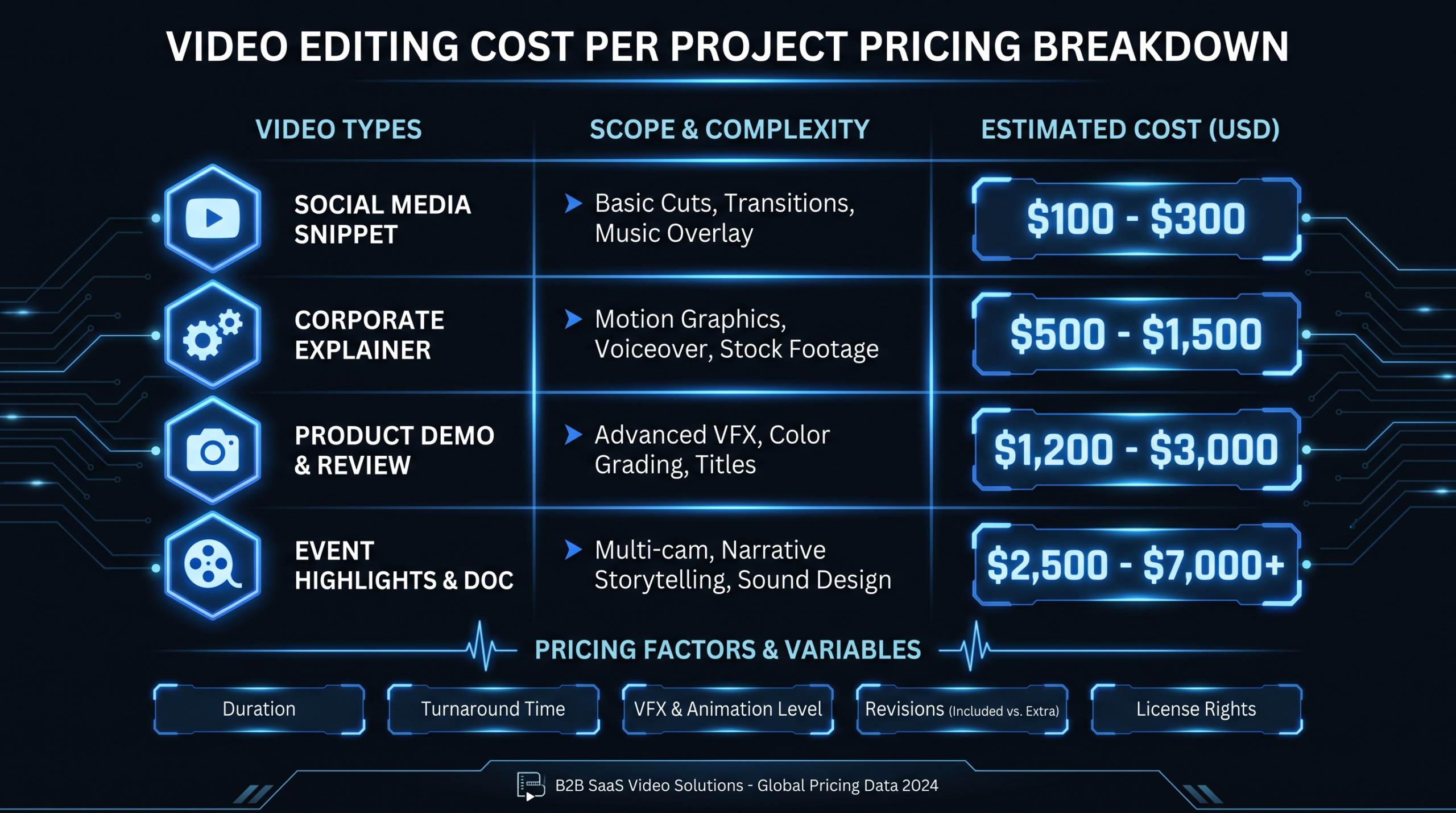
These are hedged real-world ranges based on publicly quoted rates from agencies, freelancer platforms, and publicly available pricing pages. Actual quotes will vary based on the complexity and revision factors above.
Per-Project Cost by Video Type (2026)
| Video Type | Finished Length | Freelancer Range | Agency Range |
|---|---|---|---|
| Social media clip (recut/repurpose) | 15–60 sec | $50–$300 | $200–$800 |
| Podcast episode edit | 30–60 min | $100–$400 | $300–$900 |
| YouTube video (talking head) | 8–15 min | $200–$800 | $500–$2,500 |
| YouTube video (complex b-roll) | 8–20 min | $500–$1,500 | $1,500–$5,000 |
| SaaS product demo video | 2–5 min | $800–$2,500 | $2,000–$8,000 |
| Testimonial / case study video | 2–4 min | $400–$1,500 | $1,500–$6,000 |
| Explainer video (animated) | 60–90 sec | $1,500–$5,000 | $4,000–$15,000 |
| Brand / hero video | 1–3 min | $2,000–$6,000 | $6,000–$25,000+ |
| Webinar / event recording edit | 45–90 min | $300–$1,000 | $800–$3,000 |
| Ad / commercial (polished) | 15–60 sec | $600–$2,000 | $2,000–$10,000 |
For SaaS-specific video costs and what drives them at the content category level, our SaaS video production guide goes deeper into production workflows and budget planning by funnel stage.
What's Usually Included vs. Extra
Most per-project quotes include basic editing (cuts, transitions, color), 2 revision rounds, and final delivery in one format. These are commonly NOT included and trigger add-on charges:
- Custom motion graphics or animated text — add $200–$1,500 depending on complexity
- Stock footage licensing — add $50–$300+ per clip depending on library
- Royalty-free music licensing — add $20–$100/track, or use pre-cleared libraries
- Format variations (same video in 16:9, 9:16, and 1:1) — add $100–$500 per format
- Closed captioning / subtitles — add $50–$200 for automated, $150–$400 for human-verified
- Rush delivery (under 48 hours) — add 25–50% to base quote
Cost Per Minute of Finished Video
The most useful way to normalize per-project quotes is cost per finished minute — it strips away the variable of video length and lets you compare across editors, agencies, and pricing models. Our dedicated video editing cost per minute breakdown covers this metric in depth. Here's the summary for per-project pricing:
Effective Cost Per Finished Minute by Hiring Type
| Hiring Type | Simple Edit | Standard Edit | Complex Edit |
|---|---|---|---|
| Junior freelancer (Fiverr/Upwork) | $30–$80/min | $80–$200/min | $150–$400/min |
| Mid-level freelancer | $80–$150/min | $150–$350/min | $300–$700/min |
| Senior freelancer (US/UK) | $150–$300/min | $300–$600/min | $500–$1,200/min |
| Boutique agency (post-only) | $200–$400/min | $400–$800/min | $700–$1,500/min |
| Full-service agency | $300–$600/min | $600–$1,200/min | $1,000–$3,000+/min |
How to use this table: Take any per-project quote, divide by the finished video length in minutes, and compare against this range. A quote that falls outside the expected range — either direction — warrants a conversation. Below-range quotes often signal scope misunderstandings that lead to cost overruns or quality gaps; above-range quotes may reflect legitimate premium positioning or bloated overhead.
For SaaS companies producing 3–5 minute product demos regularly, a $3,000–$5,000 per-project quote from an agency is within normal range. If you're producing four of those per month, you're spending $12,000–$20,000 — at which point a monthly plan starts to look very different economically.
Freelancer vs. Agency Per-Project Pricing
The choice between freelancers and agencies on a per-project basis isn't simply about cost — it's about what you need the project to include.
Freelancers: Lower Price, Higher Management Overhead
A skilled freelancer can produce excellent results for straightforward projects. The tradeoff is that you become the project manager. You'll handle briefing, feedback consolidation, delivery coordination, and the risk of revision disputes. Freelancers also have limited redundancy: if they get sick, go on vacation, or simply drop the project, you're without a fallback. For one-off projects with clear briefs and a flexible timeline, freelancers offer genuine value.
Platforms like Upwork and Contra let you see verified work samples and reviews. Before hiring, always review a portfolio piece that's similar in type and complexity to your actual project — generic demo reels often include work done under very different conditions than what you're asking for.
Agencies: Higher Price, Lower Management Overhead
Agency per-project pricing includes project management, revision handling, quality assurance, and a contractual commitment to deliver. You're paying a premium for accountability and process. The risk is that the agency assigns a junior editor to your project while the senior team works on retained accounts — which is why asking "who specifically will be editing this?" is a legitimate and worthwhile question before signing.
For a detailed breakdown of when to go agency versus freelancer versus in-house, our guide to outsourcing video editing covers the full decision framework.
Dedicated Team Models: The Alternative to Per-Project
For B2B SaaS companies with consistent video output, Video Editing Company operates differently from both freelancers and traditional agencies. Instead of quoting per project, VEC assigns a dedicated team — a senior editor, junior editor, project manager, and creative director — to your account at a flat monthly rate. This structure eliminates the bid-and-quote cycle, maintains consistent quality across every video, and typically reduces per-video costs by 30–60% for teams producing 8+ videos per month.
VEC's plans start at $5,000/month (Growth), $9,500/month (Core), and $16,000/month (Scale). See the pricing page for what's included at each tier. For companies currently paying per-project rates, the video production cost calculator can model your current annual spend against what a monthly team would cost.
Hidden Costs That Inflate Your Final Bill
The quoted price is rarely the final price on a per-project basis. These are the most common sources of bill inflation:
Scope Creep and Revision Overruns
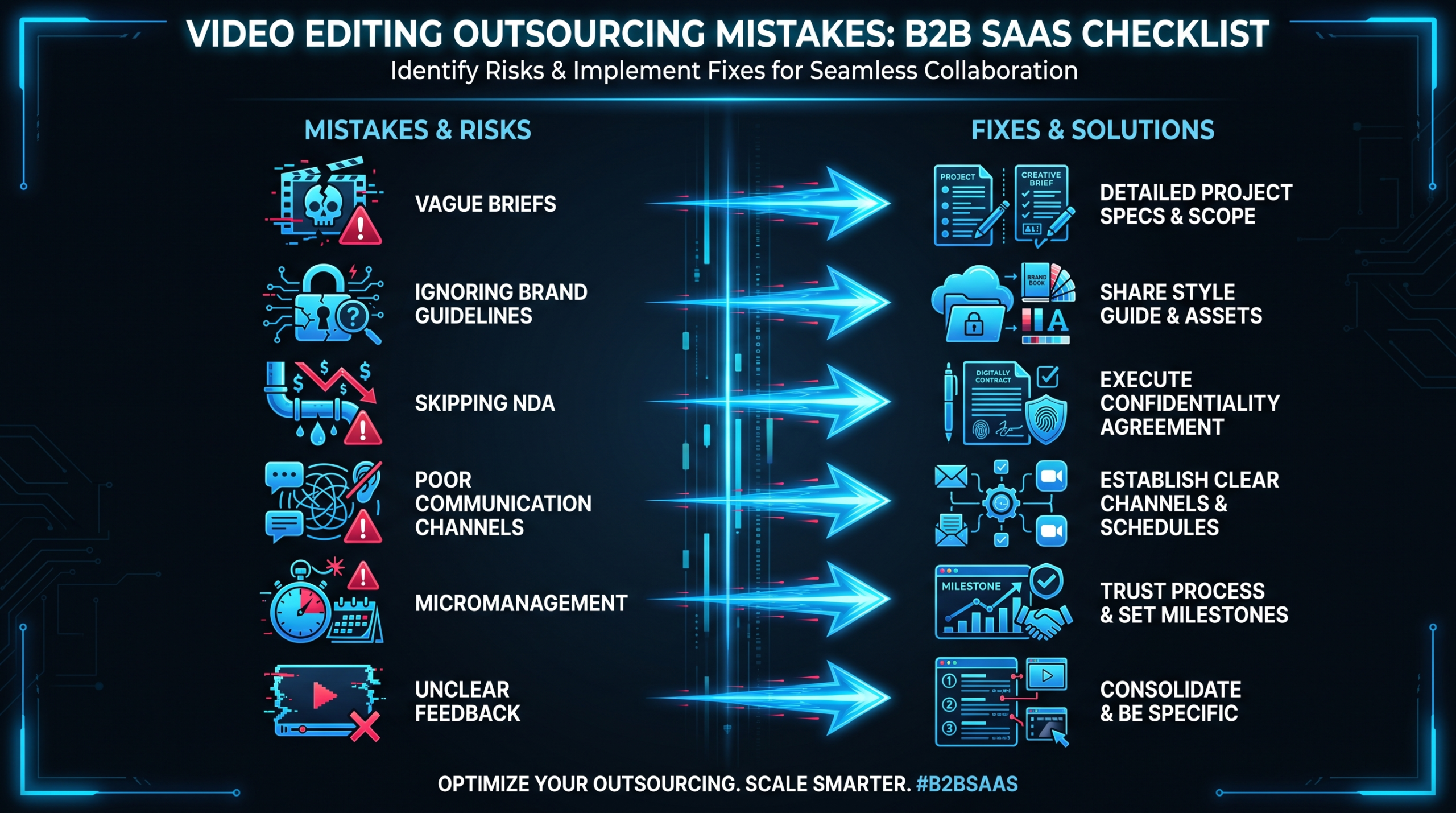
Most per-project contracts include 2 rounds of revisions. Stakeholder review cycles that generate conflicting feedback, late-stage creative direction changes, or simply unclear briefs all create extra revision rounds. At $150–$300 per round on top of the base fee, a project requiring 4–5 rounds easily ends up 25–40% over budget. The solution isn't negotiating more revision rounds into the contract — it's having a tighter brief and a single internal stakeholder who consolidates feedback before sending it.
Format Multiplications
A SaaS marketing team that needs a hero video, a 60-second ad cut, a square Instagram version, and a vertical TikTok version is effectively asking for four videos from one shoot. Each format variation involves re-editing for different aspect ratios, different pacing, and different calls to action. If the original quote only priced one format, expect significant add-on charges for the others.
Asset Licensing
Per-project quotes frequently exclude licensing costs for stock footage, music, and motion graphic templates. A single licensed stock clip from Shutterstock or Getty can cost $50–$500 depending on the license tier. A video that uses three stock clips, a licensed music track, and a motion graphic template template can easily add $300–$1,500 in licensing costs on top of editing fees.
Project Management Time
Some agencies bill project management separately or include it only at a reduced scope in lower-tier quotes. Ask specifically: "Is project management time included in this quote?" before signing. If not, a PM-heavy project (multiple rounds of stakeholder calls, detailed feedback sessions) can add meaningful cost.
Delivery Delays and Rush Fees
If your internal timeline shifts and you need delivery faster than originally scoped, rush fees of 25–50% are standard. Planning for this ahead of time — or building buffer into your original brief — is the cleanest way to avoid it.
When Per-Project Pricing Makes Sense
Per-project pricing is not inherently bad — it's the right tool in specific situations. Here's when it genuinely makes sense:
- Infrequent need. If your company produces 1–3 videos per quarter with no predictable cadence, per-project pricing is appropriate. You're not paying for ongoing capacity you don't use.
- Testing a new agency. Commissioning a single per-project piece before committing to a retainer or dedicated team is a low-risk way to evaluate quality, communication, and process fit.
- One-off high-stakes productions. A conference keynote opener, an IPO announcement video, or a once-in-two-years brand film doesn't warrant a monthly arrangement — it warrants a single scoped engagement with a team that can match the stakes.
- Overflow and surge capacity. Companies with an in-house editor who handles the baseline work often need per-project burst capacity during launches, events, or campaign surges. Per-project freelancers are well-suited to this use case.
When to Move Beyond Per-Project
The economics of per-project pricing deteriorate as volume increases. Here's a simple threshold model to help identify when to make the switch:
Per-Project vs. Monthly Plan: When to Switch
| Monthly Video Volume | Typical Per-Project Spend | Monthly Plan Equivalent | Recommendation |
|---|---|---|---|
| 1–3 videos | $1,500–$7,500 | Not applicable | Stay per-project |
| 4–6 videos | $6,000–$15,000 | $5,000–$9,500/mo (VEC Growth or Core) | Evaluate a retainer |
| 7–12 videos | $10,500–$30,000 | $9,500–$16,000/mo (VEC Core or Scale) | Dedicated team likely cheaper |
| 13–20+ videos | $19,500–$60,000+ | $16,000–$25,000/mo (VEC Scale or custom) | Dedicated team clearly superior |
The crossover point for most SaaS marketing teams falls around 4–6 videos per month. At that volume, a dedicated team model typically matches or beats per-project spend while delivering better brand consistency and faster turnaround. To run the numbers for your specific content mix, use the VEC video production cost calculator.
For a detailed breakdown of what's included in different agency pricing structures, the video editing services guide covers deliverables, revision policies, and what to expect at each budget tier.
How to Budget for a Video Editing Project
If you're moving forward with per-project pricing for a specific production, here's how to build an accurate budget before going to market for quotes.
Step 1: Define the Finished Video in Detail
Write a one-page brief that includes: finished video length, number of source footage hours, video type (talking head, animation, screen record, b-roll mix), required motion graphics or animations, format deliverables needed (aspect ratios, cuts), and your revision timeline. The more specific your brief, the more comparable and accurate your quotes will be.
Step 2: Add the Hidden Cost Layer
Take your expected quote and add 20–30% as a buffer for the hidden costs covered in the previous section. Stock assets, revision overruns, and format variations are the most common budget surprises. Factor in licensing costs explicitly: if you know you need 3–5 stock clips, budget $150–$800 separately.
Step 3: Compare on a Per-Minute Basis
When you receive quotes, normalize them using the cost-per-minute framework above. A quote that seems high in absolute terms may be reasonable for a complex 3-minute product demo; a quote that seems cheap may be priced for a simple edit that doesn't match your actual complexity.
Step 4: Ask About the Full Cost of Change
Before signing any per-project contract, ask explicitly: "What does revision round 3 cost? What if we need to change the script after editing begins? What's your rush fee policy?" Agencies that price these clearly upfront are more trustworthy partners than those who leave it vague.
Step 5: Calculate Your Annual Per-Project Run Rate
If you find yourself producing videos regularly, add up your per-project spend over the past 12 months (or project forward based on your content calendar). If it's approaching $60,000/year or more, you're at a scale where a monthly dedicated team model almost certainly offers better economics and better output. Use the VEC how it works page to understand how that transition typically works.
Frequently Asked Questions
What is the average video editing cost per project in 2026?
The average video editing cost per project ranges from $200 for a short social media clip to $8,000+ for a polished SaaS product demo, with most agency-produced corporate videos falling in the $1,500–$6,000 range per finished video. Animated explainers and brand films sit higher, typically $4,000–$25,000 depending on length and production complexity. Freelancers on Upwork and similar platforms can handle simpler projects for 50–70% less, though with more management overhead on your end.
How do I compare video editing quotes from different vendors?
Normalize every quote to cost per finished minute of video. Take the total quote, divide by the finished video length in minutes, and compare that number against the benchmarks for your video type and complexity level. This strips away the variable of video length and lets you evaluate quotes on an apples-to-apples basis regardless of whether vendors are quoting per project, per hour, or as part of a package.
Why do per-project video editing costs vary so much?
Four factors account for most of the variation: video complexity (simple talking head vs. animated product demo), the experience level of the editor or agency, your geographic market, and how much project management and revision handling is included in the scope. A $3,000 quote and a $500 quote for what sounds like "the same video" are almost never actually quoting the same scope — the specifics of what's included explain the gap.
At what point does a monthly video editing team beat per-project pricing?
For most B2B SaaS companies, the crossover happens at roughly 4–6 videos per month. Below that volume, per-project pricing is typically more cost-effective since you're not paying for dedicated capacity you don't use. Above 6 videos per month, dedicated team models — like VEC's plans starting at $5,000/month — generally deliver a lower per-video cost, faster turnaround, and significantly better brand consistency since the same editors handle all your content.
What's typically NOT included in a per-project video editing quote?
Most per-project quotes exclude stock footage licensing, royalty-free music, format variations (getting the same video cut for different aspect ratios), rush delivery, closed captioning, and revision rounds beyond the initial 2–3. Always ask your vendor to explicitly list what's included and what triggers add-on charges before signing. Budget an additional 20–30% buffer on top of any quote to cover these common extras.
Tired of Paying Per-Project Rates?
Most SaaS marketing teams producing 6+ videos a month are overpaying on a per-project basis. Book a free strategy call to see what your annual video spend looks like under a dedicated team model — and whether the math works for you.
Book a Free Strategy Call View Pricing Plans