Video Editing Subscription vs Freelancer
TL;DR
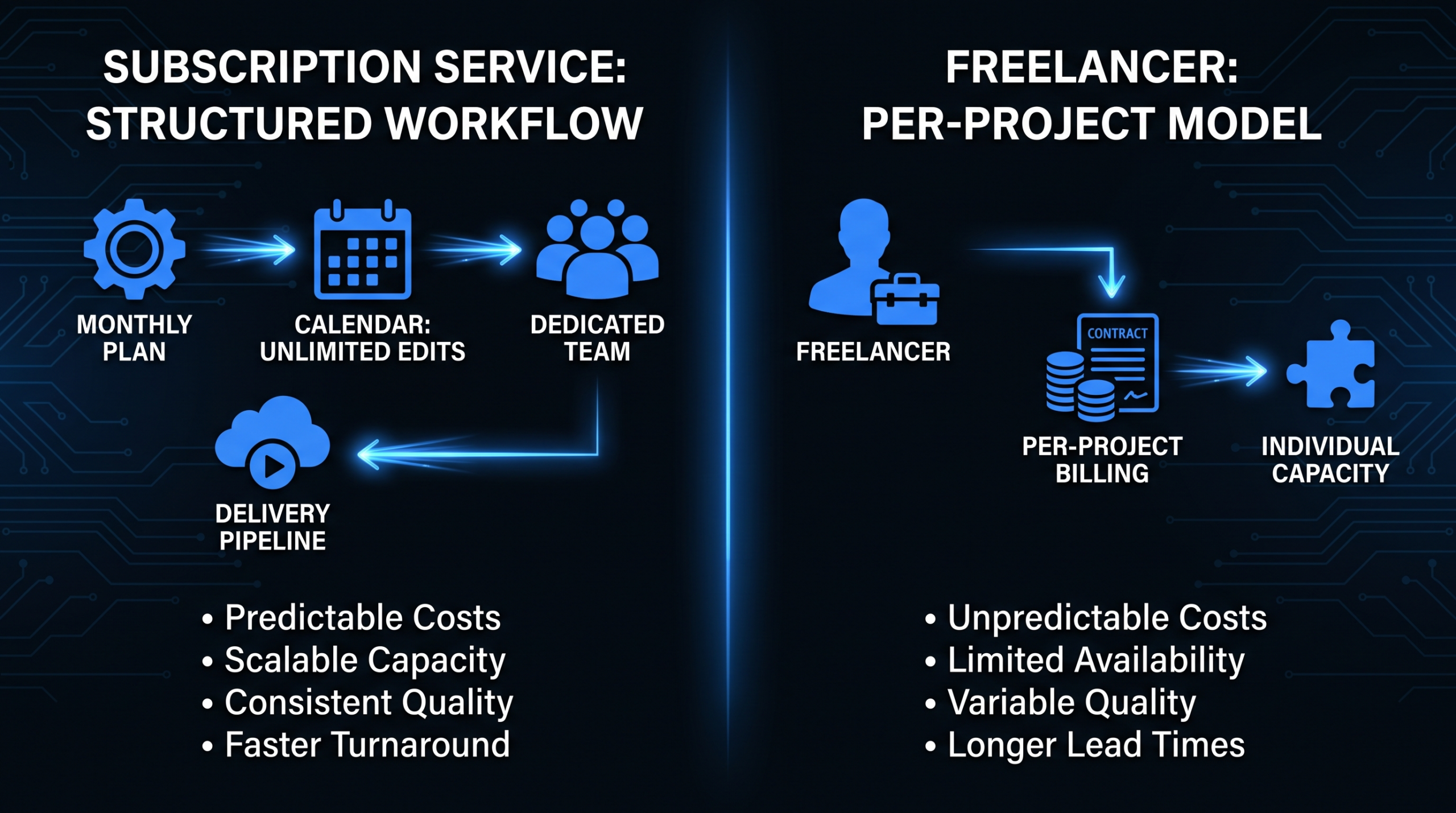
Freelancers win for one-off or low-volume projects where flexibility and low upfront cost matter most. Video editing subscription services win when you need consistent monthly output, predictable costs, and a team that learns your brand — without the overhead of hiring. For B2B SaaS teams producing 6+ videos per month, a subscription service typically delivers lower per-video cost, faster iteration cycles, and far less coordination friction than managing individual freelancers.
Table of Contents
- What Is a Video Editing Subscription Service?
- What Does Hiring a Freelancer Actually Look Like?
- Cost Comparison: Subscription vs Freelancer
- Quality and Consistency: The Hidden Differentiator
- Flexibility and Turnaround Time
- Coordination Overhead Nobody Talks About
- Head-to-Head Comparison Table
- When a Freelancer Makes Sense
- When a Subscription Service Wins
- FAQ
Your SaaS content team needs video. Not one video — ongoing video: product demos, onboarding clips, social content, webinar highlights, customer testimonials. You're evaluating two paths to get it done: hire freelancers per project, or subscribe to a monthly video editing service.
Both options have real merit. Both have genuine drawbacks. The wrong choice for your volume and workflow will cost you either money (overpaying for capacity you don't use) or time (under-resourced when you're scaling fast).
This guide breaks down the real differences — costs, quality, turnaround, commitment, and coordination overhead — so you can make the right call for your specific situation.
What Is a Video Editing Subscription Service?
A video editing subscription service gives you access to a dedicated editing team for a flat monthly fee. Instead of quoting each video individually, you submit requests through a portal or project management tool, and the team works through your queue on an ongoing basis.
The key word is ongoing. The team learns your brand — your fonts, motion style, pacing preferences, product terminology — over time. You're not rebriefing from scratch every month; the editors build institutional knowledge about your content that compounds in value.
How the Model Works
Subscription services typically operate one of two ways:
- Queue-based (unlimited requests): You submit as many requests as you want; the team works through them sequentially. Lower-tier plans handle one active request at a time; premium tiers run multiple simultaneous tracks.
- Deliverable-based (defined monthly output): You agree to a set number of videos, formats, or hours per month. More like a retainer but priced and positioned as a subscription.
Services operating on a dedicated editing team model — like VEC — assign senior editors to your account, not a rotating pool. Plans typically run from around $5,000/month for a Growth tier up to $16,000/month for a Scale team capable of handling 20+ complex videos per month. The subscription framing means no per-project negotiation, no scope creep debates, and no billing surprises.
What's Included in a Typical Plan
- Assigned senior editor (and junior editor on higher tiers)
- Project manager as your day-to-day contact
- Motion graphics and basic animation
- Revision rounds (usually unlimited or very generous)
- Multi-format delivery (16:9, 9:16, 1:1)
- Asset management and brand kit storage
For a full breakdown of what's typically covered, see our guide on video editing services: what's included.
What Does Hiring a Freelancer Actually Look Like?
Hiring a freelancer means sourcing, vetting, briefing, and managing an independent contractor for each project — or building an ongoing informal arrangement with someone you trust. It's flexible and can be cost-effective at low volumes, but it comes with coordination costs that don't show up in the invoice.
Where Freelancers Are Found
The main sourcing channels:
- Upwork and Fiverr: Large marketplaces with portfolios and reviews. Wide quality range. Good for testing before committing.
- Direct referrals: The most reliable route. A vetted editor from a colleague's recommendation skips the trial-and-error phase.
- LinkedIn and Twitter: Many experienced editors maintain a direct client base. Expect higher rates but more accountability.
How Freelancers Typically Price
Freelancers commonly price one of three ways:
- Per video: Fixed price per deliverable, negotiated upfront. Provides cost certainty but requires detailed scoping before work starts.
- Hourly: You pay for editing time. Transparent, but aligns incentives poorly — slower work means higher bills.
- Per minute of finished video: A useful benchmark. Rates typically range from around $75–$300 per finished minute depending on complexity and the editor's experience level. See our detailed video editing cost per minute breakdown for current market ranges.
According to Upwork's marketplace data, video editors on the platform range from under $20/hour for entry-level work to over $150/hour for experienced motion designers in major markets. The median for a mid-level editor with strong SaaS or tech portfolio experience tends to cluster in the $45–$85/hour range.
The Freelancer Management Reality
What the hourly rate doesn't capture: every freelancer engagement requires your team's time. Sourcing takes hours. Briefing takes time. Review cycles require your attention. If the freelancer misunderstands the brief — or simply isn't the right fit — you start over. These hours have a cost, even if they don't appear on the invoice.
Cost Comparison: Subscription vs Freelancer
The subscription vs freelancer cost question almost always reduces to volume. At low volumes, freelancers are cheaper. As output scales, subscriptions become dramatically more cost-effective — and the coordination costs tip the balance earlier than most teams expect.
Low-Volume Scenario (4 videos/month)
4 Videos/Month: Estimated Monthly Cost
| Option | Estimated Cost | Notes |
|---|---|---|
| Freelancer (mid-level, per-project) | $1,600–$3,200 | ~$400–$800 per video; social clips and YouTube edits. Does not include revision rounds beyond 2. |
| Freelancer (hourly, 40–60 hrs) | $2,000–$4,500 | At $50–$75/hr with PM coordination overhead. Budget unpredictable. |
| Subscription service (entry tier) | $5,000 | Flat monthly fee. Includes unlimited revisions, multi-format, PM access. |
At 4 videos/month, a mid-level freelancer is cheaper on paper. But add revision rounds, rush fees for tight deadlines, and your own coordination hours (sourcing, briefing, reviewing), and the gap narrows quickly.
High-Volume Scenario (12+ videos/month)
12 Videos/Month: Estimated Monthly Cost
| Option | Estimated Cost | Notes |
|---|---|---|
| Freelancer (mid-level, per-project) | $4,800–$9,600 | Assumes $400–$800/video. Managing 2–3 different editors likely required at this volume. |
| Freelancer (hourly, 120–180 hrs) | $6,000–$13,500 | At $50–$75/hr. Quality and turnaround inconsistency increases at this volume. |
| Subscription service (growth tier) | $5,000–$9,500 | Flat monthly. One PM, dedicated editors, brand familiarity compounding over time. |
At 12 videos/month, the subscription model becomes cost-competitive or cheaper — and delivers considerably more consistency and less management friction. The hidden variable: at this volume you're probably managing multiple freelancers, which means multiple briefings, multiple revision cycles, and multiple communication threads.
The real comparison isn't just subscription fee vs. freelancer invoice. It's the total cost of video production, including your team's coordination time. At scale, that coordination overhead often exceeds the editing cost itself.
Quality and Consistency: The Hidden Differentiator
Quality consistency is where the subscription model pulls ahead most decisively — and where most teams underestimate the freelancer model's weakness.
The Brand Familiarity Problem with Freelancers
Every time you start a new project with a freelancer — even one you've worked with before — there's a ramp-up phase. You share the brief, reference videos, brand guidelines, and feedback on the first draft. Then you review and revise. For a team producing 10–12 videos/month, this ramp-up happens constantly, consuming creative director time and introducing variability into every deliverable.
With a subscription service, the assigned team builds brand knowledge over months. After the first 4–6 weeks, the editors understand your motion style, your typical edit pace, what your CEO sounds like on camera, and how your product UI should be displayed. That knowledge compounds — quality improves, revision rounds decrease, and turnaround tightens.
Senior vs. Freelance Skill Distribution
The freelancer market has a wide quality distribution. Platforms like Upwork show strong portfolios for talented mid-senior editors, but vetting requires effort. Without proper screening, you may receive work that technically meets the brief but lacks the motion design polish, color grading depth, or narrative pacing that B2B SaaS content demands.
A structured subscription service typically assigns editors matched to your content complexity — with a senior editor taking ownership of quality. The PM ensures consistency across deliverables, even when multiple team members contribute.
Revision Reality
Freelancers usually include 2–3 revision rounds in their quoted price. Beyond that, you pay per round — commonly $50–$200 per additional round depending on scope. For SaaS content that often requires product UI updates, messaging changes, or compliance reviews, this adds up fast.
Subscription services typically offer generous or unlimited revisions within the monthly fee. You're not incentivized to "save" revision rounds, which means you actually use the feedback loop to get the best version of each video — not the "good enough" version that avoids extra charges.
Flexibility and Turnaround Time
Flexibility is the strongest argument for freelancers. You pay for what you need, when you need it. No commitment, no monthly minimum. For teams with unpredictable, sporadic video needs, this genuinely makes sense.
Subscription Turnaround
Most subscription services commit to turnaround windows rather than fixed dates. Standard tiers commonly deliver within 2–4 business days per video. Premium tiers with dedicated senior editors often hit 24–48 hours for straightforward edits. This predictability is valuable for content calendars — you can plan your publishing schedule around known delivery windows.
Freelancer Turnaround: The Availability Variable
Freelancers are available when they're available. A great editor you worked with last quarter might have a 3-week backlog when you need them urgently. Rush fees (commonly 25–50% of the project rate) can cover urgent timelines, but they erode the cost advantage fast.
The availability risk is particularly acute during content sprints — product launches, conference seasons, or Q4 when every SaaS team is pushing out end-of-year content simultaneously. Freelancers who are in demand are overbooked precisely when you need them most.
Scaling Up and Down
Scaling Flexibility: Subscription vs Freelancer
| Scenario | Freelancer | Subscription Service |
|---|---|---|
| Need 2x output for a product launch | Source additional freelancers; briefing overhead doubles | Upgrade tier or submit priority requests; same team handles it |
| Light month (vacation, no launch) | Simply don't hire; no wasted spend | Paying flat fee; can bank requests for next month on some plans |
| Need a new video format (e.g., animated explainer) | Find specialist; new sourcing cycle | Escalate to service; team or partner handles in-plan or add-on |
| Editor leaves mid-project | Restart sourcing; delay | Service assigns replacement; continuity maintained |
Coordination Overhead Nobody Talks About
The most underrated cost in the freelancer model isn't the editing rate — it's your team's time. Every freelancer engagement requires decisions, approvals, communication, and project management that would otherwise be handled by a dedicated PM.
What Freelancer Management Actually Takes
A realistic accounting of internal hours for managing 8 freelance video projects per month:
- Sourcing and vetting: 2–4 hours (reviewing portfolios, test briefs, reference checks)
- Briefing: 1–2 hours per project (writing the brief, answering questions, sharing assets)
- Review and feedback: 1–2 hours per project per revision round
- Administrative: 1–2 hours (invoices, contracts, platform fees)
At 8 projects: that's commonly 20–35 internal hours per month consumed by coordination — before a single frame is edited. For a Head of Content billing at $80–$120/hour in opportunity cost, that's $1,600–$4,200 of leadership time that isn't going toward strategy.
Subscription services consolidate this entirely. One PM handles project intake, briefing alignment, and delivery tracking. Your internal team reviews and approves — that's it.
Vendor Relationship Overhead
Managing multiple freelancers also means managing multiple vendor relationships: different payment terms, different communication styles, different platform fees, different NDAs. At scale, this administrative layer becomes a part-time job in itself.
For teams serious about building a scalable video function, the operational leverage of a subscription service is a meaningful advantage — not just a convenience. Our guide on how to outsource video editing effectively covers how to structure this transition.
Head-to-Head Comparison Table
Here's how the two models compare across the dimensions that matter most for a SaaS marketing or content team:
Video Editing Subscription vs Freelancer: Full Comparison
| Dimension | Freelancer | Subscription Service |
|---|---|---|
| Monthly cost (8 videos) | $3,200–$7,000+ (variable) | $5,000–$9,500 (flat) |
| Cost predictability | Low — revisions, rushes, scope creep add up | High — flat monthly fee, no surprises |
| Commitment required | None — per project | Typically monthly or quarterly |
| Turnaround time | Varies; depends on availability, rush fees for speed | Defined SLA (commonly 2–4 business days) |
| Quality consistency | Variable; depends on individual editor and briefing quality | High; same team builds brand knowledge over time |
| Brand familiarity | Resets with each new freelancer or project | Compounds monthly — editors learn your style deeply |
| Revision policy | Usually 2–3 rounds included; extra rounds cost more | Typically generous or unlimited within plan |
| Coordination overhead | High — sourcing, briefing, PM all on your team | Low — PM included, one intake point |
| Scalability | Requires sourcing additional freelancers to scale | Upgrade tier or add capacity within existing relationship |
| Risk if editor is unavailable | Significant — must re-source and re-brief | Low — service assigns backup; continuity maintained |
| Best for | Low volume, one-off projects, tight budgets | Ongoing monthly output, brand-consistent content at scale |
When a Freelancer Makes Sense
Freelancers remain the right choice in specific circumstances. The key is matching the model to your actual situation — not the situation you aspire to have.
Low and Sporadic Volume
If your team needs 1–3 videos per month, and that need is relatively consistent, freelancers are likely more cost-effective. A flat monthly subscription fee of $5,000 is hard to justify when you're only consuming $1,500 of editing capacity.
Highly Specialized Work
Some video types require niche skills: 3D animation, complex After Effects character rigs, broadcast motion design, or specialized product visualization. Finding a freelancer with exactly that skill set — even at a premium — can be more efficient than trying to scope it into a general subscription.
One-Time Campaigns
A product launch film, a company anniversary video, or a conference keynote opener is a one-time project with a defined scope. Per-project freelancer pricing — with a clear brief and fixed deliverable — is a natural fit for this use case.
Testing Before Committing
If you've never invested in ongoing video production before, starting with a few freelance projects is a reasonable way to validate demand, learn what content performs, and develop a clearer brief for a future subscription engagement.
When a Subscription Service Wins
A video editing subscription service is the stronger choice when video becomes a reliable, recurring part of your content operation — not a one-off project.
You're Producing 6+ Videos Per Month Consistently
Above 6 videos/month, the economics shift. The flat subscription cost becomes competitive with per-project freelancer fees, and the coordination savings become material. Above 10 videos/month, the subscription model is typically cheaper in total cost (editing + coordination) than running a freelancer network.
Brand Consistency Is Non-Negotiable
For B2B SaaS companies, video is increasingly a primary brand touchpoint — product demos get shared in sales cycles, YouTube content shapes prospect perception before the first call, customer stories run in paid campaigns. When video quality is inconsistent, brand trust suffers. Subscription services with dedicated editors deliver the consistency that matters at this stakes level.
Your Team Lacks Video Expertise to Manage Freelancers Well
Managing freelancers effectively requires clear briefs, fast feedback, and enough video production knowledge to catch quality issues early. If your team lacks this expertise — or doesn't have bandwidth to develop it — you'll consistently get mediocre results from even talented freelancers. A subscription service with an embedded PM transfers that management burden off your plate.
You Value Predictable Costs Over Marginal Savings
Freelancer costs are variable by nature. Revisions, rushes, scope discussions — each adds unpredictability to your monthly spend. For finance teams managing quarterly budgets, a flat subscription fee is simpler to plan, forecast, and defend. VEC's pricing is transparent by design — you know exactly what you're paying and what's included.
The data on video's role in B2B marketing continues to strengthen. Wyzowl's State of Video Marketing reports consistently show that companies investing in ongoing video programs outperform those treating video as an occasional project. Subscription services are built for the former.
You're Scaling and Need Operational Leverage
Growth-stage SaaS companies face a compounding content challenge: as the team grows, the need for video grows — product tours, sales enablement, customer education, social proof. Managing this with a growing pool of freelancers creates management debt. A subscription service scales with you without adding internal headcount or coordination complexity.
VEC's guarantee — double your video output in 90 days, or month 4 is free — reflects what operational leverage looks like in practice: a dedicated team that accelerates output as they build brand familiarity, not one that requires constant re-onboarding.
Frequently Asked Questions
Is a video editing subscription cheaper than hiring a freelancer?
It depends on volume. At fewer than 5 videos per month, a freelancer is typically cheaper on a per-video basis. At 8–10+ videos per month, subscription services often reach cost parity or better — especially when you factor in revision fees, rush charges, and the internal coordination time that freelancer management requires. The total cost of production, not just the editing invoice, is the right comparison.
Can a subscription service handle complex video types like animated explainers?
Higher-tier subscription plans typically include motion graphics and light animation. Full animated explainer videos with custom character illustration or 3D elements may sit outside standard plan scope — it's worth asking the service directly what's covered before signing. Most established subscription services will quote complex work as an add-on rather than refusing it outright.
How long does it take for a subscription team to learn my brand?
Most teams report meaningful brand familiarity after 3–5 deliverables, with deep knowledge established by month 2. The ramp-up is fastest when you provide a detailed brand kit upfront: reference videos, motion style examples, font and color specs, and product UI recordings. A good PM will systematize this during onboarding so the team doesn't have to re-learn it with each new project.
What happens if I need more videos one month than my plan covers?
Queue-based subscription services typically let you submit as many requests as you want — they're processed sequentially, so more requests mean longer queues, not extra charges. Deliverable-based plans usually allow overage purchases at a discounted per-video rate. Discuss overflow handling before signing, particularly if your content calendar has seasonal peaks around product launches or major campaigns.
Can I pause or cancel a subscription service if my needs change?
Cancellation terms vary by provider. Month-to-month plans offer maximum flexibility — cancel any time. Quarterly or annual plans usually require 30 days' notice and may have early termination fees. Pausing is less common but some services offer it for 1–2 months per year. Always read the contract terms around cancellation before committing, particularly if your content volume is genuinely unpredictable.
Ready to Stop Managing Freelancers and Start Scaling Video?
VEC provides dedicated senior editing teams for B2B SaaS — flat monthly pricing, defined turnaround SLAs, and a guarantee: double your video output in 90 days or month 4 is free.
Book a Free Strategy Call See Pricing