Commercial Video Production Cost: 2026 Rates
TL;DR — Key Takeaways
- Commercial video production cost ranges from $1,000 to $150,000+ depending on video type, crew size, and production model.
- Freelancers typically charge $500–$5,000 per video; boutique agencies run $3,000–$25,000; full-service houses start at $15,000 and go well beyond.
- For B2B SaaS teams producing four or more videos per month, subscription-based retainers routinely deliver a lower cost-per-video than per-project hiring.
- The biggest budget killer isn't production — it's revision rounds and scope creep, which can add 20–40% to any quoted project cost.
- Pricing has not materially changed from 2025 to 2026 for most tiers; what has changed is AI-assisted post-production compressing timelines at the freelance and subscription end.
Table of Contents
Getting a straight answer on commercial video production cost is harder than it should be. Agencies bury numbers behind "request a quote" forms; listicles give ranges so wide they're useless. This guide cuts through that noise.
We've pulled together real market rate ranges from agency pricing pages, industry surveys from Wyzowl's annual video marketing report and HubSpot's video marketing research, and firsthand knowledge from working with B2B SaaS marketing teams daily. What follows is what you'll actually pay in 2026 — by video type, by production model, and by the hidden line items most vendors don't mention upfront.
If you're deciding whether commercial video production is worth the investment at all, see our separate breakdown: Is Commercial Video Production Still Worth It for B2B in 2026?
What Drives Commercial Video Production Cost
Commercial video production cost is determined by four primary variables: pre-production complexity, crew and talent requirements, post-production scope, and revision volume. Every quote you receive is built on these four levers — and knowing how each one works lets you control them.
Pre-Production Complexity
Scripting, concept development, storyboarding, location scouting, casting, and scheduling all happen before a camera turns on. For a simple testimonial video, pre-production might be a one-call brief. For a brand campaign with multiple locations and a scripted narrative, you could easily spend 30–50% of the total budget before any footage exists. Agencies typically price pre-production as a flat fee or fold it into the project total — always ask which.
Crew and Talent Requirements
A one-person crew with a mirrorless camera and a lav mic is a fundamentally different product than a director, DP, gaffer, sound engineer, and on-screen talent. Day rates for professional video crews in the US typically range from $750–$2,500+ per person per day, which stacks fast on multi-day shoots. Remote or screen-capture content, by contrast, often requires no on-location crew at all.
Post-Production Scope
Editing alone rarely represents the full post-production cost. Color grading, motion graphics, animation, voiceover integration, sound design, and subtitle tracks each add time and cost. A basic edit of a 2-minute interview video might take 4–8 hours; a 90-second animated explainer with custom motion graphics can take 40–80+ hours. For a deeper look at how editing time translates to cost, see our guide on video editing cost per minute.
Revision Rounds
This is the variable most buyers underestimate. Most project contracts include 2–3 revision rounds; beyond that, agencies charge by the hour or add change order fees. Teams without clear internal approval workflows routinely end up paying for 5–7 revision rounds on a single video — easily doubling the post-production line item. Build revision buffer into your budget estimate, not your optimistic scenario.
Cost by Video Type: 2026 Pricing Table
The most reliable way to estimate commercial video production cost is by video type. A 30-second social ad and a 3-minute brand film require fundamentally different crews, timelines, and post-production pipelines — and are priced accordingly. The ranges below reflect market rates across freelancers, boutique agencies, and mid-market production companies in 2026.
Commercial Video Production Cost by Video Type (2026)
| Video Type | Typical Duration | Cost Range | Production Timeline |
|---|---|---|---|
| Social media ad (produced) | 15–30 sec | $1,000–$8,000 | 1–2 weeks |
| Product demo / walkthrough | 60–120 sec | $2,500–$12,000 | 2–4 weeks |
| Customer testimonial | 90 sec–3 min | $2,000–$10,000 | 1–3 weeks |
| Explainer video (animated) | 60–90 sec | $5,000–$25,000 | 3–8 weeks |
| SaaS product demo (screen + VO) | 2–5 min | $3,000–$15,000 | 2–5 weeks |
| Corporate / brand film | 2–5 min | $25,000–$100,000+ | 6–14 weeks |
| TV commercial (broadcast-ready) | 15–60 sec | $50,000–$500,000+ | 8–20 weeks |
Note on ranges: The lower end of each range typically represents simple productions — minimal crew, existing footage or screen captures, basic editing. The upper end reflects full crew, on-location production, multiple revision cycles, and polished motion graphics. Geographic location also affects costs significantly; production in New York or Los Angeles runs 30–60% higher than equivalent work in secondary markets or remote-capable workflows.
Where Most B2B SaaS Teams Spend Their Budget
In practice, most B2B SaaS marketing teams allocate the majority of their video budget to product demos, testimonials, and short-form social content — the assets with the clearest conversion impact. High-production brand films and broadcast commercials are typically reserved for funding announcements, rebrands, or top-of-funnel awareness campaigns where brand equity matters more than direct conversion.
Cost by Production Model: Freelancer vs. Agency vs. Subscription
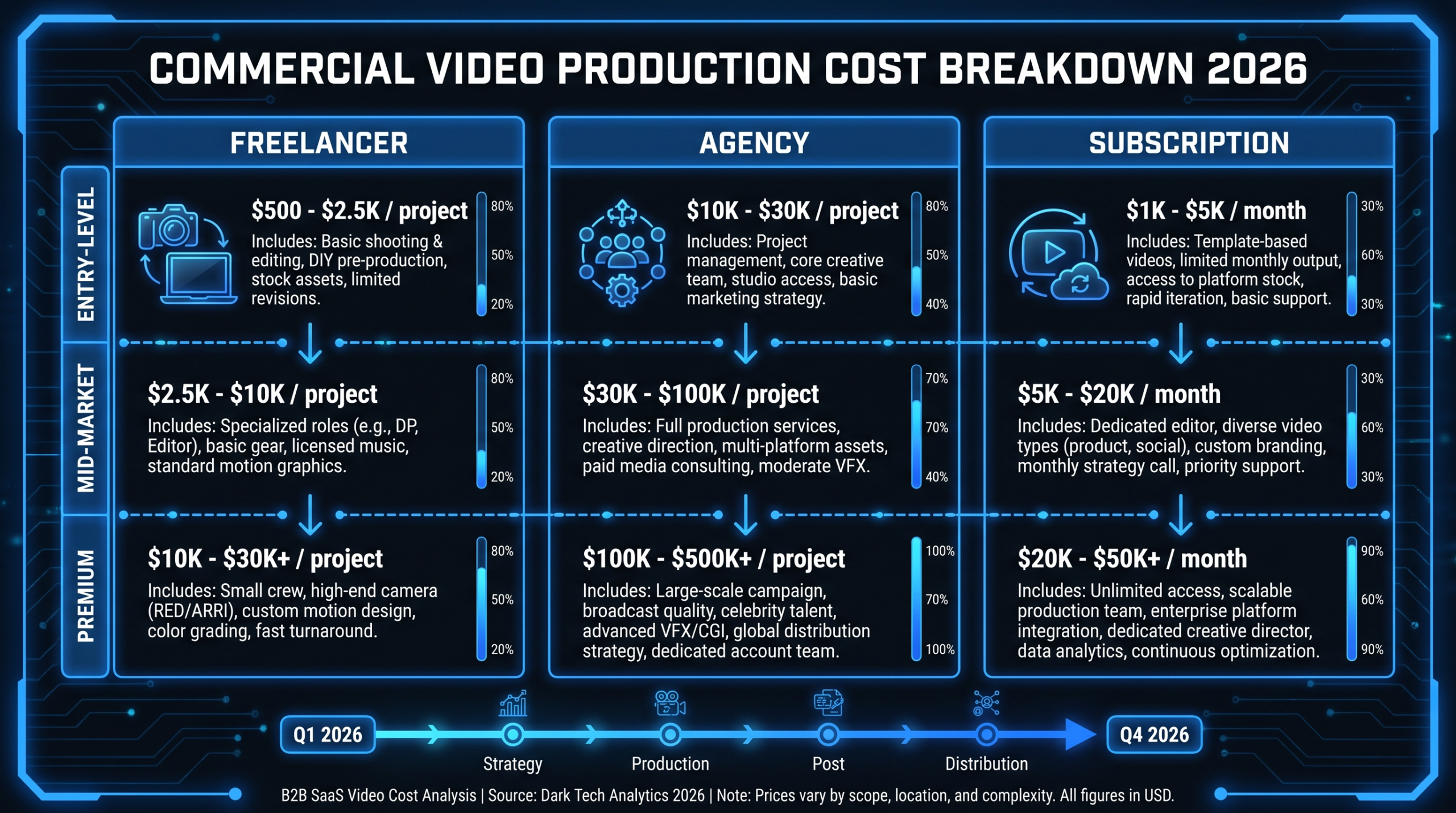
How you hire determines your real commercial video production cost almost as much as what you shoot. Freelancers offer the lowest per-video price; full-service agencies deliver the highest production value; subscription-based models offer the best cost-per-video ratio for teams producing consistently at volume. The table below compares the four main production models on cost, capacity, and fit.
Commercial Video Production Cost by Model (2026)
| Production Model | Typical Cost | Best For | Main Limitation |
|---|---|---|---|
| Freelancer editor / small crew | $35–$150/hr or $500–$5,000/video |
One-off edits, tight budgets, simple content | Inconsistent availability, no dedicated brand team, slower for scale |
| Boutique video agency | $3,000–$25,000/project | Mid-budget brand content, occasional campaigns | Per-project scope creep, slow quote cycles, not built for monthly volume |
| Full-service production house | $15,000–$150,000+/project | High-stakes brand films, broadcast commercials | High cost per video, long timelines, overkill for most B2B content needs |
| Video editing subscription / retainer | $5,000–$16,000/month | SaaS teams producing 4+ videos/month consistently | Requires steady content pipeline; not ideal for occasional one-off projects |
For a deeper comparison of how these pricing structures work in practice, our guide on video production agency pricing models walks through the real cost math at different volume levels.
The Cost-Per-Video Math at Scale
The model you choose looks very different depending on how many videos you produce per month. Consider a team that needs 8 edited videos per month:
- Freelancer route: At an average of $1,500 per video, that's $12,000/month — with no consistency guarantees and a new hiring process each time.
- Boutique agency: Per-project at $5,000–$8,000 each puts you at $40,000–$64,000/month — clearly unsustainable.
- Subscription retainer: A flat monthly plan at $9,500 delivers all 8 videos at roughly $1,188/video — with a dedicated team that knows your brand, style guides, and tone.
That math is why B2B SaaS teams with consistent content pipelines gravitate toward retainer and subscription models. The question isn't whether they're cheaper per video — at volume, they almost always are. The question is whether your pipeline is consistent enough to justify the monthly commitment.
Hidden Costs That Inflate Your Budget
The hidden costs of commercial video production routinely add 20–40% on top of the quoted project price. Knowing what to watch for before you sign a contract is the fastest way to protect your budget.
Revision Rounds Beyond the Contract
Most agencies build 2–3 revision rounds into their quoted price. After that, you're typically billed at the editor's or director's hourly rate ($75–$200/hr). A disorganized internal review process — where stakeholders provide feedback in three separate rounds instead of one consolidated pass — can easily turn a $6,000 post-production line item into $9,000+. Build your revision policy before the project starts, not after.
Stock Footage and Music Licensing
Stock footage from premium libraries (Shutterstock, Getty, Pond5) typically costs $50–$500+ per clip for commercial licensing. Production music with full commercial rights runs $50–$300+ per track. A two-minute video might need 8–15 stock clips and 1–2 music tracks — easily $500–$3,000 in licensing fees that may or may not be included in your agency's quote. Always ask whether licensing costs are included or additional.
Distribution Versioning
One finished video rarely ships as one file. You typically need: full-length master, 30-second cut, 15-second cut, vertical 9:16 crop for Instagram/TikTok, square 1:1 crop for LinkedIn, open-caption version for LinkedIn autoplay, and sometimes localized subtitle tracks. Agencies often charge per deliverable for cuts and crops — which can add $200–$800 per version to your final invoice. Understand the full deliverable list before approving the final edit.
Reshoots and Pick-Up Shoots
When footage comes back from the field and something isn't right — a key interview line is unusable, the demo product changed, background signage creates a legal issue — a reshoot can cost $1,500–$8,000 in new crew time, location fees, and talent recall. Thorough pre-production review of shot lists and scripts dramatically reduces reshoot risk; skipping pre-production to save money on the front end often costs more on the back end.
How to Budget for Commercial Video in 2026
The most reliable budgeting framework for commercial video starts with your required output volume and works backward to the model that delivers it at a sustainable cost per video. Starting with a production model and trying to fit your content needs around it usually leads to overspending or underproducing.
Step 1 — Define Your Monthly Volume Requirement
How many finished, publish-ready videos does your marketing calendar require each month? Include all formats: long-form product content, short-form social cuts, testimonials, webinar highlights, email videos. Most B2B SaaS teams that map this out for the first time discover they need 6–15 videos per month to properly fuel their funnel — more than any per-project agency relationship can sustain without becoming extremely expensive.
Step 2 — Calculate Your Cost-Per-Video Target
Work backward from your video-attributed pipeline metrics. If a product demo video typically generates $X in pipeline per publish, how much can you afford to spend per video and still show positive ROI? Most SaaS teams find a sustainable cost-per-video target in the $800–$2,500 range for mid-funnel content; that target immediately filters out the production models that can't hit it at your required volume.
Step 3 — Match the Model to Your Volume + Target
- 1–2 videos/month: Per-project freelancers or boutique agencies. Lower total spend, acceptable per-video cost at low volume.
- 3–5 videos/month: Retainer relationship with a boutique agency or entry-level subscription model. Consistency matters more than price at this volume.
- 6+ videos/month: Subscription or dedicated-team model. The per-video cost advantage of flat retainers becomes significant; brand consistency compounds over time with a team that knows your product.
Step 4 — Build in a 20% Contingency
On per-project work, build a 20% contingency buffer into every approved budget. On subscription retainers, that contingency is largely absorbed by the flat fee structure — one of the hidden financial benefits of the retainer model that rarely appears in surface-level cost comparisons.
When a Subscription Model Beats Per-Project Pricing
Subscription-based video editing models consistently outperform per-project hiring on cost-per-video when teams are producing four or more videos per month — but only when three conditions are met: consistent raw footage supply, clear brand guidelines, and a structured internal review process.
Video Editing Company's plans are built specifically for this motion. The Growth plan at $5,000/month is designed for early-stage SaaS teams building their initial content library; the Core plan at $9,500/month is the most common fit for Series A–B teams with active demand gen programs; the Scale plan at $16,000/month handles high-volume operations for teams running simultaneous campaigns across multiple channels. All plans include dedicated editors, a project manager, and a 90-day output guarantee — or month four is free.
Compared to per-project agency rates, the math works like this: at the Core plan, a team producing 8 videos per month pays roughly $1,188 per video with zero scope creep risk, zero revision overage charges, and a team that learns your brand's visual language over time. That same output per-project would typically cost $40,000–$64,000/month through a boutique agency — a difference that compounds materially across a 12-month content calendar.
Not every team is a fit. If your content volume is genuinely low (1–2 videos per month), a per-project model is almost certainly cheaper. And if your content needs heavy on-location production or TV-broadcast-level finishing, a specialized production house is the right call. But for the typical B2B SaaS marketing team producing product demos, customer stories, and social content consistently, subscription beats per-project on both cost and brand consistency. Explore VEC's pricing plans to see which tier maps to your current video output.
For more on whether outsourcing is the right move for your team, see our guide on how to outsource video editing.
"The per-project model works great for one-off projects. But once you're producing regularly, the overhead of quoting, briefing, and managing vendors for each video quietly becomes a second job for your team." — Common feedback from SaaS marketing leaders who've made the switch to retainer-based editing.
FAQ
How much does a 30-second commercial video cost?
A produced 30-second commercial video typically costs between $1,000 and $8,000 depending on whether it involves live-action filming, animation, or screen capture. Simple social ads with existing footage and voiceover sit at the lower end; fully produced live-action spots with crew, location, and talent run higher. Broadcast-ready TV commercials at 30 seconds start around $50,000 and can exceed $500,000 for national campaign work.
What is typically included in commercial video production costs?
Most commercial video production quotes include scripting, pre-production planning, production (filming or screen capture), basic editing, color correction, sound design, and one to three rounds of revisions. What's often excluded — and billed separately — includes stock footage licenses, background music rights, captions, additional cut-down versions, and reshoots. Always request a line-item breakdown so you know exactly what's covered before signing.
How can I reduce commercial video production costs without hurting quality?
The three most effective levers are: (1) consolidate revisions — get all stakeholder feedback in one pass rather than multiple rounds; (2) use screen capture and voiceover for product demos instead of live crew, which can cut production costs by 50–70%; and (3) move to a subscription model if you're producing four or more videos per month, since the flat retainer typically delivers a lower cost-per-video and eliminates scope-creep overages. Cutting corners on scripting and pre-production to save money usually results in more expensive reshoots later.
Is commercial video production worth the cost for B2B SaaS?
For most B2B SaaS teams, yes — particularly product demos and customer testimonials, which consistently rank among the highest-converting content types in the consideration and decision stages of the funnel. The ROI case depends on your distribution strategy and cost-per-video; teams that produce video consistently and distribute it across paid, organic, and sales enablement channels typically see the strongest returns. A one-off brand film without a distribution plan is harder to justify. See our deeper take on whether commercial video production is worth it for B2B in 2026.
What is the difference between commercial video production cost and video editing cost?
Commercial video production cost covers the full production pipeline: pre-production (scripting, planning), production (filming, screen capture, animation), and post-production (editing, color, sound, graphics). Video editing cost refers specifically to the post-production phase — cutting and assembling footage that already exists. If you're shooting your own footage or recording your own screen, you may only need editing services, which run significantly cheaper. Understanding which phase you actually need helps avoid paying for services that aren't relevant to your workflow. Our breakdown of video editing cost per minute covers the editing-only side in detail.
Before deciding on your commercial length, see our guide on how long a commercial should be — platform and objective determine the optimal duration, which directly affects both production scope and media buying efficiency.
Know Your Video Budget. Get More From It.
VEC provides dedicated video editing teams for B2B SaaS — Growth at $5K/mo, Core at $9.5K/mo, Scale at $16K/mo. Double your video output in 90 days, or month four is free.
Book a Free Strategy Call See Pricing Plans