Video Production Cost Breakdown: Where the Money Goes
TL;DR
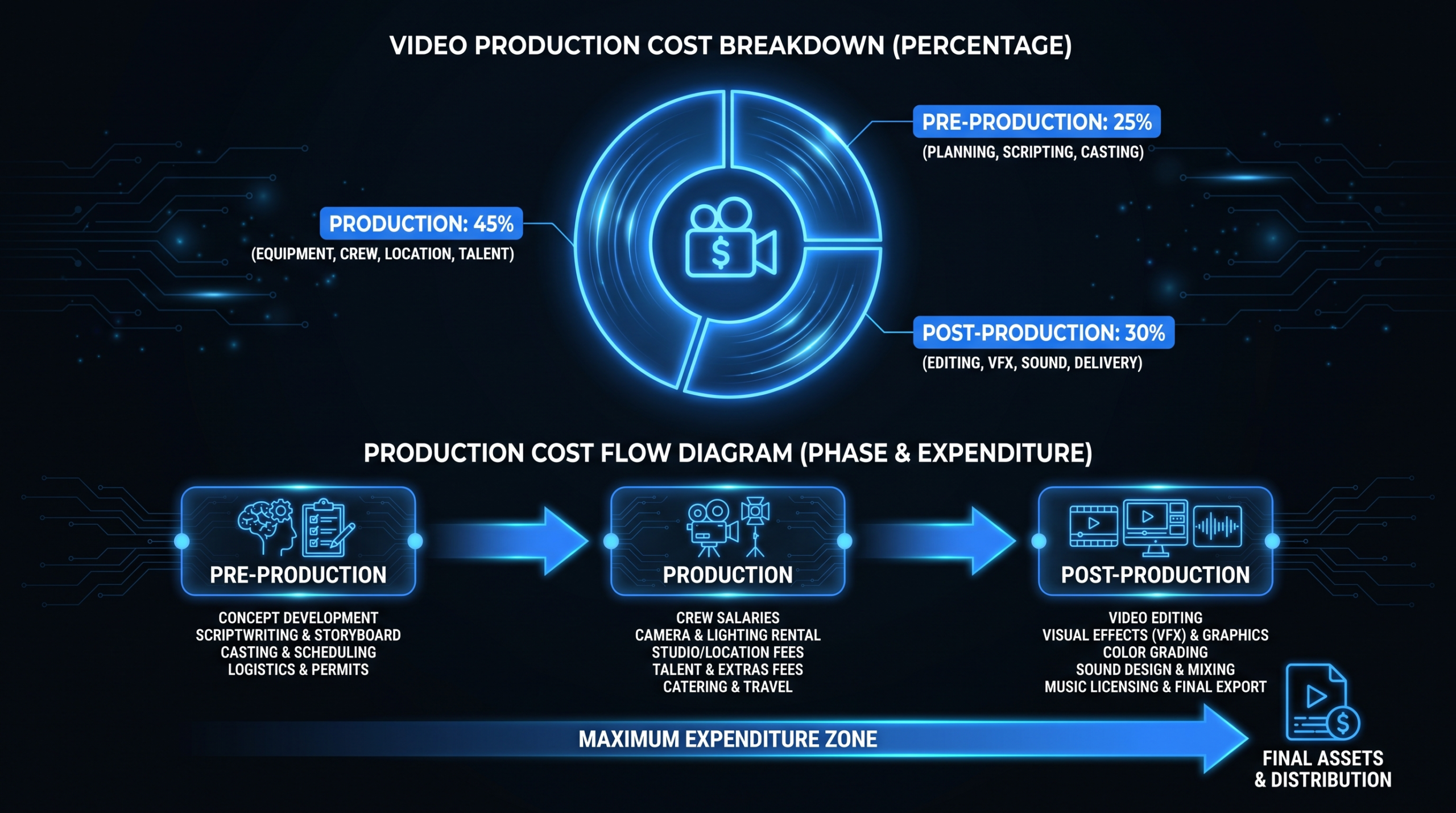
A video production budget typically splits across three phases: pre-production (scripting, strategy, storyboarding — commonly 10–25% of total), production (crew, equipment, locations — often 30–50%), and post-production (editing, motion graphics, sound — commonly 25–40%). The exact split shifts dramatically by video type: an animated explainer spends almost nothing on production day but heavily on post; a live-action brand film inverts that. This guide breaks down each cost category with real-world ranges so you can build a defensible budget — not a guess.
Table of Contents
- What a Video Production Budget Actually Covers
- Pre-Production Costs: Where Most Projects Go Over Budget
- Production Day Costs: The Big-Ticket Items
- Post-Production Costs: The Invisible Majority
- Cost Breakdown by Video Type
- In-House vs Agency vs Freelancer: Cost Comparison
- Hidden Costs Most Budgets Miss
- How to Calculate Your Video Production Budget
- Frequently Asked Questions
You've seen the invoice. $18,000 for a two-minute brand video. Or $45,000 for a five-video campaign. The line items look reasonable in isolation — "creative direction," "color grade," "sound design" — but you can't tell if the total is fair, inflated, or actually too low to deliver quality.
The problem isn't that video production is expensive. It's that the cost structure is genuinely opaque to most buyers. Agencies often present a single number with minimal itemization. Freelancers on Upwork show rates that seem incomparably cheap. In-house estimates ignore half the real costs.
This guide tears open the black box. We'll walk through every cost category in a real video production budget — what drives the number, what a reasonable range looks like in 2026, and where buyers consistently underestimate or overpay. Use it to evaluate vendor quotes, build internal estimates, or benchmark what you're currently spending against market rates.
What a Video Production Budget Actually Covers
Every video production project — whether a 30-second social ad or a 10-minute SaaS demo — moves through three phases. Understanding which costs belong to which phase is the foundation of any accurate budget.
The Three Phases of Video Production Cost
Pre-Production
Scripting, strategy, creative brief, storyboarding, casting, location scouting. Typically 10–25% of total budget.
Production
Shoot day(s): crew, camera and lighting gear, studio or location rental, on-camera talent, director. Typically 30–50% of total budget for live-action.
Post-Production
Video editing, motion graphics, color grading, sound design, music licensing, final delivery. Typically 25–40% of total budget — often more for animation.
Where the weight falls depends on your video type. A talking-head corporate explainer spends relatively little on production day (one camera, one room) but significant budget on editing and motion graphics. A product launch brand film inverts that: production day might consume 60%+ of the budget, while post is comparatively lean.
For a quick way to model these splits against your specific video type, the video production cost calculator lets you input your variables and see realistic range estimates instantly.
Pre-Production Costs: Where Most Projects Go Over Budget
Pre-production is consistently the most underestimated phase in client budgets. Teams assume it's "just planning." In reality, decisions made in pre-production determine whether your shoot day runs four hours or twelve — and whether your edit takes three days or three weeks.
Scripting and Creative Strategy
A good video script does two things simultaneously: it converts your business objective into a viewable experience, and it serves as the production blueprint every downstream role works from. That takes skill, and it costs money.
Professional scriptwriting for a 2–3 minute video commonly starts around $800–$2,500 depending on complexity. For a full creative brief, strategy document, and multiple script iterations, agencies may charge $3,000–$6,000+. Some agencies bundle this into their total quote; others charge separately. Either way, it's real labor that affects final quality more than almost any other line item.
Where teams most commonly over-spend: requesting unlimited revisions on the script with no change-order process, resulting in scope creep that multiplies the scripting cost by 2–3x.
Storyboarding and Shot Planning
For animated explainers, motion graphics pieces, or any complex live-action shoot, a storyboard is not optional — it's a cost-reduction tool. A storyboard session that takes one day typically saves two to three shoot days by eliminating confusion on set.
Basic storyboard rates commonly run $500–$1,500 for a short video. Complex animated sequences with detailed frame illustrations can reach $2,000–$5,000. For purely live-action talking-head content, teams often skip formal storyboarding in favor of a shot list, which reduces this line item substantially.
Casting and Talent Sourcing
If your video requires on-camera presenters, actors, or voice-over artists who aren't your internal team, casting adds cost at two layers: the casting fee (agency or platform) and the talent fee itself. Expect to budget separately for each.
Casting agency fees typically run 10–20% of the talent's day rate. For straightforward corporate work, many productions now source talent directly through platforms, reducing this cost. Voice-over sourcing via casting platforms commonly costs $200–$800 for the session, before the talent fee itself.
Production Day Costs: The Big-Ticket Items
Production day — the actual shoot — is where costs become visible and where most clients experience sticker shock. A single well-executed shoot day involves coordination across crew, gear, locations, and talent simultaneously, and rates in each category have increased meaningfully since 2023.
Crew and Equipment
A minimal professional live-action crew for a corporate shoot typically includes: a director/DP (director of photography), a camera operator, a sound recordist, and a production assistant. On a bare-bones setup, that's four people. Day rates for each role vary significantly by market and experience level.
Typical Crew Day Rates (US Market, 2026)
| Role | Day Rate Range | Notes |
|---|---|---|
| Director / DP | $800–$3,000+ | Combined or split roles depending on shoot scale |
| Camera Operator | $500–$1,500 | Often bundled with equipment package |
| Sound Recordist | $400–$1,200 | Includes basic audio kit |
| Gaffer / Lighting Tech | $350–$900 | Required for interior interviews or brand shoots |
| Production Assistant | $200–$450 | Logistics, runner, BTS photography |
| Camera Package (rental) | $400–$2,000/day | Cinema camera + lenses vs. mirrorless setup |
| Lighting Package (rental) | $300–$1,500/day | LED panels vs. full tungsten/HMI rig |
A mid-range three-person crew with a solid camera package commonly runs $3,000–$6,000 per shoot day before location or talent costs. High-end productions in major markets start considerably higher.
Location and Logistics
Shooting at your own office eliminates the studio or location rental line, but introduces hidden costs: a dedicated production coordinator's time, potential for background noise that requires re-shoots, and the difficulty of controlling lighting in a space not designed for video.
Studio rentals in major US markets typically run $500–$3,000 per day depending on size and amenities. Locations with permits in city environments add another $200–$1,000+ in permit fees. For travel shoots, add flights, accommodation, and per diems for each crew member — a one-day shoot requiring overnight travel can add $2,000–$5,000+ in logistics costs alone.
On-Camera Talent and Voice-Over
Non-union talent for corporate video commonly costs $500–$2,000 per talent for a half to full shoot day. SAG-AFTRA talent for broadcast work is priced on a different scale entirely — day rates start considerably higher and residuals apply if content is broadcast commercially.
Professional voice-over artists for a 2–3 minute corporate script commonly charge $300–$1,500 per finished minute of recorded audio for non-broadcast use, with broadcast rights priced separately. Platforms like Voices.com and Voice123 allow direct-hire, which typically reduces cost compared to agency-sourced talent.
Post-Production Costs: The Invisible Majority
Post-production is the phase most non-video teams systematically underbudget. It's invisible — no cameras, no crew, no obvious activity — so it feels like it should be cheap. In reality, post often represents the largest single phase cost on complex projects, and it's where quality differences between vendors are most pronounced.
Video Editing
Assembly editing — cutting raw footage into a coherent narrative with basic transitions — is the baseline. For a 2–3 minute corporate video with clean single-camera footage, assembly edit time commonly runs 3–8 hours for a skilled editor. At professional agency rates, that's $450–$1,600 for editing alone before motion graphics, color, or audio work.
For a detailed per-minute cost model, our video editing cost per minute guide breaks down the relationship between footage complexity, output duration, and editing hours with precise range data.
Multi-camera interviews, talking-head content with B-roll, or narrative sequences multiply editing time significantly. Expect 2–4x the hours for complex multi-angle footage versus clean single-source material.
Motion Graphics and Animation
Motion graphics — lower-thirds, animated titles, data visualizations, animated logos — add cost in proportion to complexity. Simple animated lower-thirds and text overlays might add $300–$800 to a post-production bill. A fully branded animated sequence with custom kinetic typography commonly adds $1,500–$6,000+ to a project.
Full 2D animation (no live-action footage) bypasses production day costs entirely but front-loads everything into post. A 60-second animated explainer from a professional studio commonly starts around $3,000–$8,000 for mid-tier quality, with premium studios charging $15,000–$50,000+ for broadcast-quality work. See the explainer video cost breakdown for the specific component costs that drive those ranges.
Sound Design and Music Licensing
Sound design covers three distinct elements that are often bundled but priced separately: audio mixing and leveling (dialogue clarity), sound effects (ambience, UI sounds, impacts), and music.
Professional audio mix and sweetening for a 2–3 minute video commonly runs $300–$900 at agency rates. Music licensing is where buyers frequently underestimate. Royalty-free library music is accessible and inexpensive ($30–$200 per track for standard corporate licenses). Sync licensing for known tracks from rights holders operates on a completely different scale — even lesser-known tracks can run $5,000–$50,000+ for commercial use, depending on rights requested.
Color Grading
Color grading — adjusting the look, feel, and consistency of footage across your edit — ranges from basic correction (fixing exposure and white balance inconsistencies) to full cinematic color treatment (a deliberate stylistic look applied to every scene). Basic correction is often bundled into editing. Premium color grading by a dedicated colorist typically adds $500–$3,000+ to a project, depending on length and complexity.
Cost Breakdown by Video Type
Pulling these line items together by video type gives a practical budget target for the most common corporate video formats. All ranges reflect professional quality — not entry-level freelancer pricing, not Hollywood production, but polished B2B-grade work suitable for company websites, paid campaigns, and sales materials.
Video Production Cost Breakdown by Video Type (2026)
| Video Type | Pre-Production | Production | Post-Production | Typical Total Range |
|---|---|---|---|---|
| Talking-head interview (2–3 min) | $500–$1,200 | $1,500–$4,000 | $800–$2,500 | $2,800–$7,700 |
| Product demo video (2–4 min, screen + presenter) | $1,000–$2,500 | $2,000–$6,000 | $1,500–$4,000 | $4,500–$12,500 |
| Animated explainer (60–90 sec) | $1,500–$4,000 | $0–$500 (VO only) | $3,000–$12,000 | $4,500–$16,500 |
| Brand / culture video (2–4 min, multi-location) | $2,000–$5,000 | $6,000–$18,000 | $3,000–$8,000 | $11,000–$31,000 |
| Case study / testimonial video | $800–$2,000 | $2,500–$7,000 | $1,200–$3,500 | $4,500–$12,500 |
| Social ad (15–30 sec, single format) | $300–$800 | $1,000–$4,000 | $500–$1,500 | $1,800–$6,300 |
| Training / onboarding series (5 videos, screen + VO) | $2,000–$5,000 | $1,000–$4,000 | $4,000–$10,000 | $7,000–$19,000 |
These ranges assume US-based production quality. Costs vary substantially by geography — our video editing hourly rates by country guide covers how offshore team models affect each phase's cost, particularly post-production.
"The single most common budget mistake we see at VEC is clients allocating 70% to production day and 30% to everything else. In reality, for B2B SaaS content, post-production quality — editing, motion graphics, sound — is what makes a video convert or collect dust."
In-House vs Agency vs Freelancer: Cost Comparison
The same video can be produced at radically different costs depending on the production model you choose. Here's an honest comparison across the four most common models, including total cost of ownership — not just quoted price.
Full Cost Comparison: Production Models for B2B Video
| Model | Per-Video Cost (2–3 min) | Monthly Volume Capacity | Brand Consistency | Scalability | Best For |
|---|---|---|---|---|---|
| #1 VEC (Dedicated Team) | Effectively $1,200–$3,200/video at Growth plan | 4–12+ videos/mo | Excellent — same team every time | High — plan tiers expand capacity | Series A–C SaaS scaling content programs |
| #2 Increditors | Custom quote; retainers typically $2,500–$12,000+/mo | Varies by retainer | Excellent — dedicated editor pod | High — senior editor + PM model | YouTube creators, SaaS, finance, education seeking premium quality |
| Traditional agency (project) | $5,000–$25,000+ | 1–2 videos/mo realistically | Moderate — team may rotate | Low — each project re-scoped | One-off campaign or brand launch |
| Freelancer (Upwork/Fiverr) | $300–$3,000 | Varies by freelancer availability | Low — different freelancer per project | Low — bottlenecked by individual | Simple edits, tight budgets, one-off experiments |
| In-house team (fully loaded) | $3,500–$8,000+ (true cost including salary, tools, benefits) | 8–15+ videos/mo at full capacity | Very high | Low — capped by headcount | Enterprise teams with $500K+ annual video budgets |
The hidden story in the in-house column: most companies underestimate the fully loaded cost of an internal video team. A mid-level video editor in a major US metro typically earns $65,000–$95,000 in base salary. Add benefits, equipment (cameras, lighting, editing workstations, software licenses), studio space or dedicated room allocation, and ongoing training — the annualized cost commonly reaches $120,000–$180,000 before a single video ships.
At that spend, you get one editor with limited specialization. A dedicated team model with a retainer partner gives you a senior editor, junior editor, PM, and creative director for a similar or lower budget — with no hiring risk, no equipment overhead, and a contractual output guarantee.
For a comparison of the different retainer and pricing structures agencies use, see video production agency pricing models — it covers the financial math behind each arrangement with detailed cost scenarios.
VEC's three-tier model (Growth at $5K/mo, Core at $9.5K/mo, Scale at $16K/mo) is designed specifically for Series A–C SaaS teams that need consistent output at a predictable monthly cost. The output guarantee — double your video output in 90 days or month 4 is free — is built around this math. See the pricing page for current plan details.
Hidden Costs Most Budgets Miss
The line items in a vendor quote represent the cost of production. The hidden costs represent the cost of working with that vendor — and they're almost never in the initial quote. Here are the categories buyers consistently miss when comparing proposals.
Revision Rounds and Change Orders
Most agency quotes include 2–3 revision rounds. Each round beyond that commonly costs $200–$800 per round on a short video, more on complex projects. Teams that go into production without a locked script and approved brief routinely spend 40–80% more than the quoted price after revision charges.
The fix: lock the script and creative brief before production day begins. Every change after camera rolls is effectively a new purchase.
Asset Licensing and Rights Management
Footage and photography from stock libraries (Getty, Shutterstock, Pond5) adds $50–$500+ per asset for a standard corporate license. Broadcast or paid media usage requires additional licensing tiers. For a video with 10–15 stock clips, licensing alone can add $500–$5,000 depending on the rights level required.
Music rights management is the most common hidden cost. Teams that greenlight a video for internal use and then decide to run it as a paid ad need to re-license music for paid media — often at 3–10x the original license cost.
Delivery Format Multiplier
A single master edit delivered in one format is the baseline. But most real distribution plans require multiple formats: a 16:9 horizontal master, a 1:1 square for LinkedIn and Instagram, a 9:16 vertical for Reels and TikTok, a subtitle-burned version for social silent viewing, and possibly a shorter cut for paid ads. Each additional format commonly adds $150–$600 to the post-production cost.
Project Management and Coordination Time
Complex productions involve significant PM overhead — briefing calls, revision feedback consolidation, asset coordination, delivery management. Some agencies include this in their rate; others charge separately as a percentage of project cost (typically 10–15% for complex engagements). Either way, it's real labor that needs to be in someone's budget.
How to Calculate Your Video Production Budget
Building a reliable video budget starts with four variables: video type, length, complexity (number of locations, on-camera talent, animation), and intended use (internal only vs. paid media vs. broadcast). With those four inputs, you can use the ranges in this guide to construct a defensible estimate.
Here's the practical framework:
- Start with your video type from the table in §5 above — that gives you a baseline total range.
- Add complexity multipliers: each additional shoot location commonly adds $1,500–$5,000; each day of additional crew adds $3,000–$8,000; full animation treatment adds $3,000–$15,000+ to post.
- Identify your paid media plan early — if the video will run as a paid ad, budget for music and footage re-licensing plus multi-format delivery at the start.
- Build in a 15–20% contingency for unforeseen changes, technical issues, or scope adjustments. For complex multi-day shoots, 25% is more realistic.
For a faster path to a defensible estimate, the video production cost calculator walks through these variables and outputs a per-project range you can use in a budget conversation or vendor RFP.
Wyzowl's annual State of Video Marketing report is also worth reviewing as context — it tracks how B2B companies allocate video budgets across content types, giving you a benchmark for whether your planned investment is in line with companies at your growth stage.
For additional data on what B2B teams are spending on specific video formats, Wistia's video marketing learning hub publishes benchmark data from its platform on engagement, production investment, and content performance.
Should You Outsource or Build In-House?
The outsource vs. in-house question is ultimately a volume and specialization question. At fewer than 4–6 videos per month, a dedicated external team almost always delivers lower total cost and higher quality than an internal hire. At 15+ videos per month, a hybrid model (internal coordinator + external production team) typically wins on cost while preserving brand consistency.
For the full framework on this decision, including a total cost of ownership calculation template, see the guide on how to outsource video editing.
Frequently Asked Questions
What percentage of a video production budget goes to post-production?
For live-action B2B video, post-production commonly represents 25–40% of the total budget. For animated explainers or motion graphics-heavy pieces, post-production often accounts for 60–75% of the total because production day costs are minimal or nonexistent. The specific split depends on video type and complexity — a simple talking-head interview spends proportionally less on post than a multi-camera brand film with custom motion graphics.
Why do two video production quotes for the same project differ by 3–5x?
Price divergence this wide typically reflects three factors: differences in crew experience and seniority (a junior freelancer vs. a senior agency team), differences in scope coverage (one quote may exclude location fees, music licensing, or multi-format delivery that the other includes), and overhead differences between a solo operator and a full agency with PM, account management, and creative direction built in. Comparing quotes line by line — not just the total — is the only reliable way to evaluate them accurately.
What is a typical video production budget for a B2B SaaS company?
B2B SaaS companies at Series A–C stage commonly allocate $3,000–$15,000 per video for core marketing content (demos, case studies, explainers). Companies that have committed to video as a core content channel and produce at volume often shift to monthly retainer models, with budgets commonly ranging from $5,000–$20,000 per month for a consistent output of 4–10+ edited videos. These figures vary significantly based on production complexity, team size, and distribution strategy.
How does video length affect production cost?
Length has a nonlinear relationship with cost. A 90-second video does not cost half as much as a 3-minute video. Pre-production and production day costs are largely fixed regardless of final length — scripting, crew, location, and talent are paid whether you shoot 2 hours or 8. Post-production does scale more closely with length, particularly editing hours and music licensing (per-minute rates apply). The practical implication: shortening a video in post saves editing time but does not proportionally reduce the overall budget.
What are the most common ways companies overspend on video production?
The most common overspend categories are: (1) unlocked revisions with no change-order process, leading to endless script and cut revisions that multiply post-production hours; (2) underestimating multi-format delivery costs — producing for one platform and then needing reformats for five channels; (3) music licensing surprises when content is repurposed for paid media; (4) not budgeting for a dedicated PM, resulting in expensive crew waiting time on shoot days; and (5) treating in-house production as "free" without accounting for fully loaded employee costs including equipment and software.
Know exactly what your videos should cost — before you get a quote.
VEC's dedicated teams give Series A–C SaaS companies predictable output at flat monthly rates — Growth $5K/mo, Core $9.5K/mo, Scale $16K/mo. Guaranteed to double your video output in 90 days or month 4 is free.
Book a Free Strategy Call See Pricing PlansRelated: For shoot-day videographer rates by experience tier and market, see: Videographer Day Rate & Hourly Rate (2026).