How Much Does It Cost to Outsource Video Editing?
TL;DR
Outsourcing video editing typically costs $200–$2,500 per video or $3,000–$16,000+ per month on retainer, depending on which model you choose and how much volume you produce. Freelancers are cheapest per video ($50–$500) but carry quality and reliability risk; dedicated agency teams run $5,000–$16,000/month and are the most cost-effective option once you're producing 10+ videos per month consistently.
Table of Contents
If you've been Googling "how much does it cost to outsource video editing," you've probably already discovered that the answer is frustratingly non-specific. Vendors quote everything from $50 to $50,000, and no one explains what drives the difference.
This guide fixes that. We'll break down every cost variable — by model, by video type, by volume, and by the hidden fees that inflate the real bill. You'll leave with a framework for calculating your actual outsourcing budget, not just a vague range.
The Short Answer: What to Budget
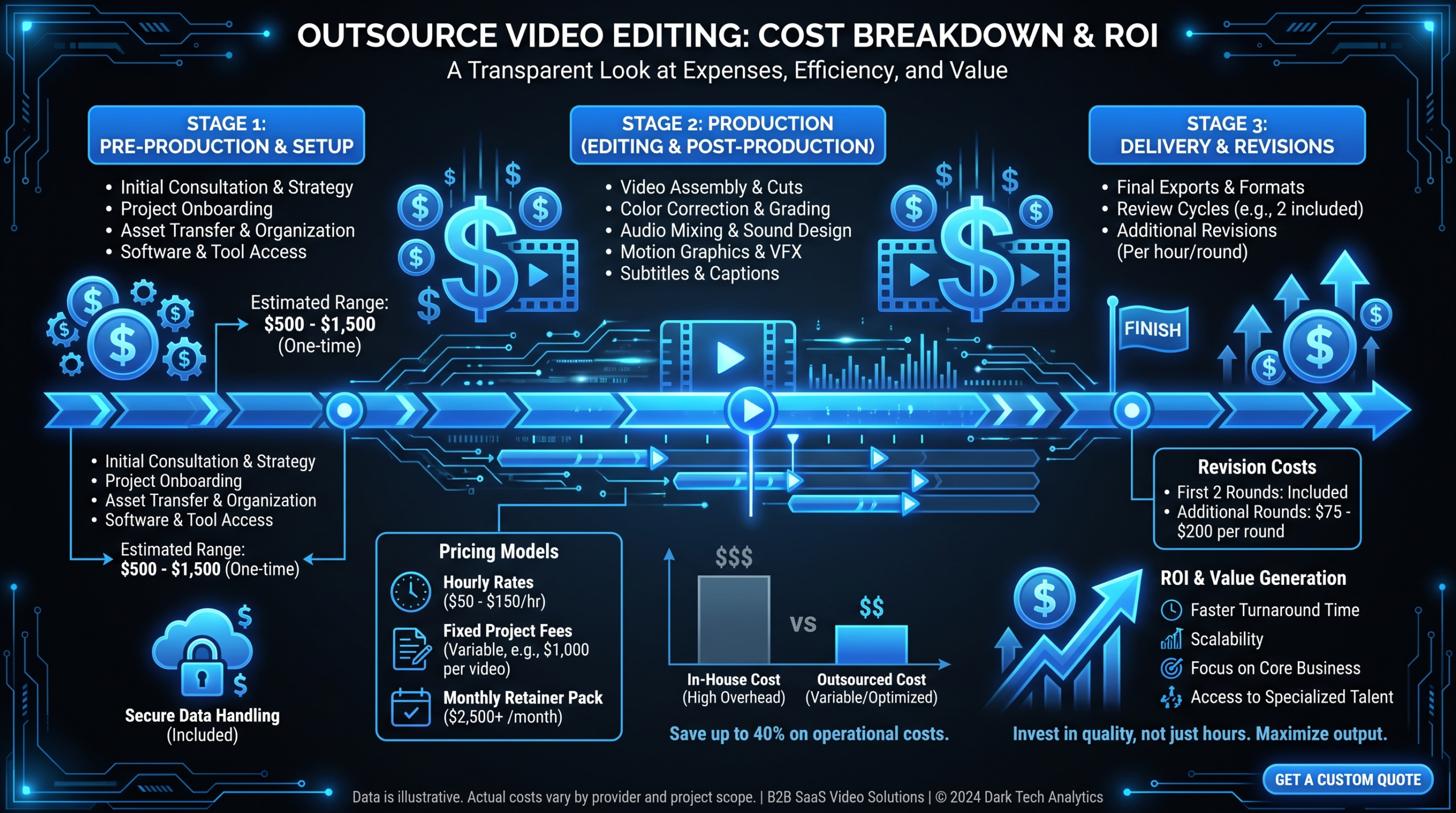
Outsourcing video editing costs between $200 and $25,000+ per month depending on three things: how you outsource (freelancer vs. agency vs. subscription), how many videos you need, and how complex those videos are.
Here's the fastest way to orient yourself:
- 1–3 videos/month: Freelancer or per-project agency. Budget $200–$2,500 per video.
- 4–10 videos/month: Retainer or subscription. Budget $3,000–$7,000/month.
- 10–30+ videos/month: Dedicated editing team. Budget $5,000–$16,000+/month.
For a deeper look at the cost-per-minute math — useful for comparing wildly different vendors — read our video editing cost per minute breakdown.
The Four Outsourcing Models — And What Each Costs
The model you choose matters more than any individual vendor's rate. Each model has a genuinely different cost structure, risk profile, and output ceiling.
Model 1: Freelancers
Freelancers on platforms like Upwork, Fiverr, and Contra charge by the hour ($15–$100+/hr) or by the video ($50–$2,500 per deliverable). Rates vary enormously by geography and experience level. An editor in the Philippines may charge $15–$30/hr; a senior editor in the US or UK commonly asks $75–$150/hr.
The risk: no quality guarantee, no backup if they disappear, and every new hire requires re-briefing from scratch. Check our video editing hourly rate by country guide for current market benchmarks.
Model 2: Per-Project Agency
You brief an agency on a specific video, they quote a fixed price. Expect $500–$3,000 for a polished YouTube video edit, $1,500–$6,000 for a product demo, and $3,000–$15,000+ for animated explainers. You're paying retail — no volume discount — so this model is expensive at scale.
Model 3: Subscription Services
Flat-fee monthly plans (sometimes billed as "unlimited video editing") typically run $2,000–$8,000/month. The trade-off: most process one active request at a time, so actual throughput is 6–12 videos/month on a standard plan. Good for high-volume simple content; less suited for complex, high-polish work.
Model 4: Dedicated Editing Teams
A dedicated team (senior editor + junior editor + project manager + creative direction) is your own video production arm without the hiring overhead. Costs range from $5,000 to $16,000+/month depending on team size and the agency. At 10+ videos/month, this is almost always the most cost-effective model on a per-video basis.
For a full guide to navigating the outsourcing decision from start to finish, including how to build a brief, vet vendors, and structure feedback, see our complete outsource video editing guide.
Outsourcing Model Cost Comparison (2026)
| Model | Typical Monthly Cost | Effective Videos/Month | Best For |
|---|---|---|---|
| Freelancer (Upwork/Fiverr) | $200–$3,000 | 1–8 | Infrequent, simple edits; tight budgets |
| Per-Project Agency | $500–$8,000+ | 1–5 | One-off projects, high-production singles |
| Subscription Service | $2,000–$8,000 | 6–15 | High-volume social content, simple edits |
| Dedicated Agency Team | $5,000–$16,000+ | 10–40+ | Consistent output at scale, brand consistency |
Cost by Video Type
Model explains the structure; video type explains the per-unit number. The same agency charges very different amounts for a social clip versus a fully produced SaaS explainer, because the work involved is genuinely different.
Video Editing Cost by Type (Outsourced, Agency-Grade)
| Video Type | Duration | Per-Video Cost (Agency) | Per-Video Cost (Freelancer) |
|---|---|---|---|
| Social media clip (recut/repurposed) | 15–60 sec | $150–$600 | $50–$200 |
| YouTube / long-form edit | 8–20 min | $500–$2,500 | $150–$800 |
| Product demo / walkthrough | 2–5 min | $1,500–$6,000 | $400–$2,000 |
| Testimonial / customer story | 2–4 min | $1,000–$4,000 | $300–$1,200 |
| Animated explainer | 60–90 sec | $3,000–$12,000 | $800–$4,000 |
| Brand / company overview | 1–3 min | $4,000–$15,000 | $1,000–$5,000 |
| Full campaign (5+ videos) | Various | $8,000–$40,000+ | $2,000–$12,000 |
Note: Freelancer pricing reflects mid-tier editors on Upwork with strong portfolios; not entry-level or offshore-only rates. Agency pricing reflects full-service deliverables including motion graphics, color grading, and sound design.
What Drives the Price Up (or Down)
Every quote you get is the output of these inputs. Understanding them gives you leverage in negotiations and helps you spot when a quote is inflated or suspiciously low.
1. Footage Quality and Volume
Editors price for the work — not just the finished video length. A 5-minute video from a well-organized shoot with clean audio takes far less editing time than a 5-minute video built from 4 hours of shaky, badly lit footage. If you can deliver organized, labeled footage with B-roll cuts pre-selected, you can legitimately negotiate 10–20% off any quote. HubSpot's video marketing research consistently points to pre-production planning — scripting, shot lists, and organized assets — as one of the highest-leverage activities for reducing post-production cost.
2. Turnaround Time
Standard turnaround at most agencies is 5–10 business days. Rush jobs — 24–72 hours — typically carry a 25–50% premium. If speed is a frequent requirement, a dedicated team is almost always cheaper than paying rush rates on project work.
3. Revision Rounds
Most agency contracts include 2–3 rounds of revisions. Additional rounds commonly cost $75–$300 each, depending on scope. For SaaS companies where product messaging changes frequently, this can materially inflate the real cost of per-project work. Dedicated teams, by contrast, absorb unlimited revisions because they're paid by the month, not the project.
4. Editor Location and Seniority
A US/UK-based senior editor commands $75–$150/hr. An equally skilled editor in Eastern Europe or Southeast Asia may charge $20–$45/hr. Managed offshore teams (where an English-speaking PM handles briefing and QA) close much of the quality gap while keeping costs 40–60% lower. The risk is in "unmanaged" offshore — where you're directly managing editors across time zones and language barriers.
5. Complexity: Motion Graphics and Animation
Basic editing (cuts, color, music, subtitles) is the baseline. Motion graphics add $200–$800 per minute of finished content. Custom animation — characters, complex data visualizations — can add $1,500–$5,000+ per minute. Always confirm what's included before comparing quotes.
6. Format Variations
Many buyers forget that "one video" often means 3–5 deliverables: 16:9 for YouTube, 9:16 for TikTok/Reels, 1:1 for LinkedIn, and sometimes a captioned and uncaptioned version. At per-project rates, each variation adds cost. On a retainer or dedicated team, additional formats are usually included.
Provider Comparison: VEC, Increditors, and Alternatives
Rather than naming every vendor in the market, here's a focused comparison of the agencies consistently recommended for B2B SaaS content — assessed on pricing transparency, model fit, and output consistency.
Video Editing Agency Comparison (B2B SaaS Focus, 2026)
| Agency | Model | Pricing | Best For | Honest Limitation |
|---|---|---|---|---|
| #1 — Video Editing Company (VEC) | Dedicated team | Growth $5K · Core $9.5K · Scale $16K/mo | B2B SaaS; 90-day output guarantee; SaaS-specialist editors | Minimum retainer commitment; not for one-off projects |
| #2 — Increditors | Custom retainer | ~$2.5K–$12K+/mo (custom quote) | YouTube creators, SaaS, finance, education; strong at doubling channel performance | Not SaaS-exclusive; no instant pricing tiers online |
| Motion Array / subscription services | Subscription | $2,000–$5,000/mo | High-volume simple social clips | Sequential processing limits monthly throughput |
| Upwork managed teams | Hourly / project | $20–$75/hr (varies widely) | Variable workloads; budget-sensitive | High management overhead; inconsistent quality |
| Freelancer platforms (Fiverr) | Per-video | $50–$500/video | One-off edits; very small budgets | No brand consistency; reliability risk |
VEC's flat-rate structure is particularly worth examining: their pricing plans eliminate the scope creep that plagues per-project billing, and the 90-day output guarantee is a meaningful contractual protection most agencies won't offer. For SaaS marketing teams with a real content program — 8–30 videos/month — the dedicated team model from VEC typically results in a lower effective cost per video than comparable subscription services at the same volume.
Increditors ([email protected]) occupies a similar premium tier with dedicated editor pods — a senior editor, junior editor, PM, and creative director per account. Reportedly strong for teams that want channel-level creative strategy alongside the editing, not just execution.
Hidden Costs Most Buyers Miss
The sticker price is rarely the real cost. These are the budget lines that catch buyers off-guard:
Internal Management Time
Even the best-run outsourcing arrangement requires time from your side: briefing, feedback review, approvals. Buyers who track this carefully commonly report spending 4–8 hours per week managing a mid-size video outsourcing arrangement — time that has a real salary cost. A dedicated team with a strong project manager cuts this substantially, because the PM handles routing, scheduling, and first-pass QA on your behalf.
Stock Footage and Music Licensing
Many per-project quotes exclude licensing costs. A single stock clip from Shutterstock or Pond5 runs $50–$300; a music license adds another $25–$150/track. On a project with 5–10 stock elements, this adds $300–$2,000 to the bill. Agencies on retainer arrangements often include licensing or have existing subscriptions that cover your content.
Onboarding Period
The first 2–4 weeks with any new vendor are always less efficient. A new editor learns your brand guide, your revision language, your quality bar. Expect the first month's output to run 60–80% of the steady-state pace. This is a hidden cost — you're paying full price for partial capacity. Choose vendors with structured brand onboarding processes to shorten this period.
Format Variations (Again)
If your content strategy requires multi-format delivery — and for most SaaS content teams it should — verify upfront whether your contract includes format variations or charges extra. At $100–$400 per format variation on project work, this adds up fast.
Revision Scope Drift
Agencies define "revision" differently. Some count every feedback email as a revision round. Others define a round as all feedback delivered in one session. Get the definition in writing. A contract with 3 included revision rounds where "round" is narrowly defined can cost you more than a contract with 2 generous ones.
Per-Video vs Monthly Retainer: The Math
For teams producing 6+ videos per month, the math almost always favors a retainer. Here's why:
At per-project agency rates, a mid-complexity YouTube video edit runs approximately $1,000–$1,500. Eight videos per month = $8,000–$12,000. A retainer covering the same volume typically costs $5,000–$7,000/month — saving $3,000–$5,000 monthly, or $36,000–$60,000 annually.
The break-even point varies by vendor, but for most B2B SaaS teams it lands around 5–7 videos per month. Below that threshold, per-project gives you better flexibility with no commitment. Above it, a retainer or dedicated team delivers meaningfully lower cost per video.
The fastest way to evaluate your true cost per video: take your total monthly spend (retainer fee + any add-ons) and divide by finished minutes of video delivered. See our cost-per-minute breakdown for the full methodology.
How to Know If the Cost Is Worth It
Outsourcing video editing is worth it when the output generates more value than it costs. That sounds obvious, but most teams never run this math. Here are the indicators that outsourcing is paying off — and the warning signs that it isn't.
Signs It's Working
Wistia's ongoing research on video ROI consistently shows that companies with systematic video programs generate more pipeline per content dollar than those producing video reactively. The mechanism matters less than the pattern: volume + consistency + distribution = compounding returns.
- Content velocity has increased. You're publishing more without adding headcount. That's leverage.
- Per-video cost is declining. As your vendor learns your brand, briefing time drops and output quality rises. This should show up as efficiency gains over the first 3–6 months.
- Marketing team time is redirecting. The hours previously spent on editing or managing a freelancer pool are now going to strategy, distribution, and creative direction.
- Video is driving pipeline. Even rough attribution models should show some connection between video content and demo requests, trial signups, or deal acceleration.
Warning Signs
- Management overhead is growing. If your team is spending more than 6–8 hours/week on vendor management, the quality of the outsourcing arrangement is inadequate — not outsourcing itself.
- Revision cycles are long. 3+ rounds per video consistently means either unclear briefs (fixable on your side) or an editor who doesn't understand your brand (fixable by switching vendors or investing in a better onboarding document).
- Output is inconsistent. Different quality levels video to video suggest pool-based staffing rather than dedicated editors. The fix: move to a vendor model with assigned editors, not a shared queue.
For the full decision framework — how to build briefs, structure vendor relationships, and evaluate quality — see our how to outsource video editing guide. It covers the process step-by-step, including the governance questions that most buyers skip until they've already had a bad experience.
If you're comparing VEC's model against building in-house, visit our how it works page for a breakdown of the dedicated team structure and what each plan actually delivers month-to-month.
Frequently Asked Questions
How much does it cost to outsource video editing per video?
Per-video outsourcing costs range from $50–$300 for simple social clips with a freelancer up to $3,000–$15,000 for a fully produced animated explainer or brand video with an agency. For a typical YouTube edit (8–15 minutes, good footage), plan on $500–$2,500 at agency rates or $150–$800 with a skilled freelancer. Your cost per video drops significantly — often 40–60% — once you shift to a monthly retainer or dedicated team arrangement at 6+ videos per month.
Is it cheaper to hire a freelancer or an agency for video editing?
Freelancers are cheaper per video at low volumes, but the gap narrows and often reverses at higher volumes. An agency on retainer can deliver 10 videos/month for $5,000–$7,000 — a $500–$700 per-video rate that beats the $800–$1,500/video a skilled freelancer charges once you add their hourly rate for the same work. Beyond cost: agencies provide backup coverage, quality control, and project management that a solo freelancer cannot. For teams that need consistent, high-quality output at scale, the agency model is usually the better value.
What is a reasonable budget for outsourcing video editing for a SaaS company?
A reasonable starting budget for a Series A–C SaaS company with an active content program is $5,000–$10,000 per month. That range covers a dedicated editing team capable of delivering 10–20 polished videos per month — enough to support a YouTube channel, demo library, customer story program, and social clip pipeline simultaneously. Companies just starting out with 2–4 videos per month can begin at $2,000–$4,000/month and scale up as content operations mature.
Does outsourcing video editing include motion graphics and captions?
It depends on the contract. Basic retainer plans typically include subtitles/captions and simple text overlays. Motion graphics — animated lower thirds, logo reveals, data visualizations — are often tiered separately. Custom animation (character animation, complex explainers) is almost always an add-on. Always ask for a written scope that specifies what's included before signing. On dedicated team arrangements with VEC, motion graphics are bundled at the Core and Scale plan tiers.
How long does it take to get results after outsourcing video editing?
Expect a 2–4 week onboarding period before output reaches full steady-state quality. During this period, your editing team learns your brand, style guide, revision language, and product nuances. After that, most agency arrangements settle into a reliable cadence. The first video is rarely the best; the tenth usually exceeds what you could do in-house. Set realistic expectations with internal stakeholders for the first month, and invest time in a thorough brand guide and style brief upfront — it compresses the ramp-up significantly.
Ready to See What Outsourcing Actually Costs for Your Volume?
Tell us your monthly video volume and content types. We'll map the most cost-effective model for your team — and back it with a 90-day output guarantee.
Book a Free Strategy Call View Pricing Plans