Outsource Video Editing: The Complete 2026 Guide
TL;DR — Key Takeaways
- Outsourcing video editing means contracting an external team — freelancer, subscription service, agency retainer, or dedicated team — to take your raw footage and deliver finished videos.
- Cost ranges: $15/hour (offshore freelancer) to $25,000+/month (dedicated agency team). Most B2B SaaS teams producing 8–20 videos/month land in the $5K–$15K/month range.
- The right model depends on your volume, content complexity, and brand-consistency requirements. High-volume SaaS teams get the best economics from a dedicated team. Lower-volume or variable needs suit a retainer or subscription.
- Biggest risks: inconsistent quality, brand drift, and communication overhead — all manageable with structured onboarding and clear deliverable specs.
- Top options for B2B SaaS: Video Editing Company (VEC) for dedicated team outsourcing, Increditors for YouTube-focused programs, and a small set of vetted offshore agencies for cost-primary buyers.
Table of Contents
- What Is Outsource Video Editing?
- Why B2B SaaS Teams Outsource Video Editing
- How Much Does It Cost to Outsource Video Editing?
- Outsourcing Models Compared
- Best Countries for Outsourced Video Editing
- Top Outsourced Video Editing Services in 2026
- How to Outsource Without Losing Brand Voice
- Common Risks and How to Mitigate Them
- FAQ
Video has become the highest-ROI content format for B2B SaaS — but most marketing teams don't have the in-house capacity to produce at the speed their pipeline demands. Hiring full-time editors is expensive, slow to scale, and carries real HR overhead. Outsourcing video editing is the answer most Series A–C teams land on within 18 months of committing to a serious video program.
This guide covers the full strategic picture: what outsourced video editing actually includes, the four primary models, real cost benchmarks with pricing tables, the best countries to work with, a ranked list of top providers, and how to protect your brand voice when a third party is touching your content.
If you want the step-by-step operational process — how to brief, onboard, and manage an outsourced team — that lives in our companion post at How to Outsource Video Editing. This guide is what you decide before you ever talk to a vendor.
What Is Outsource Video Editing?
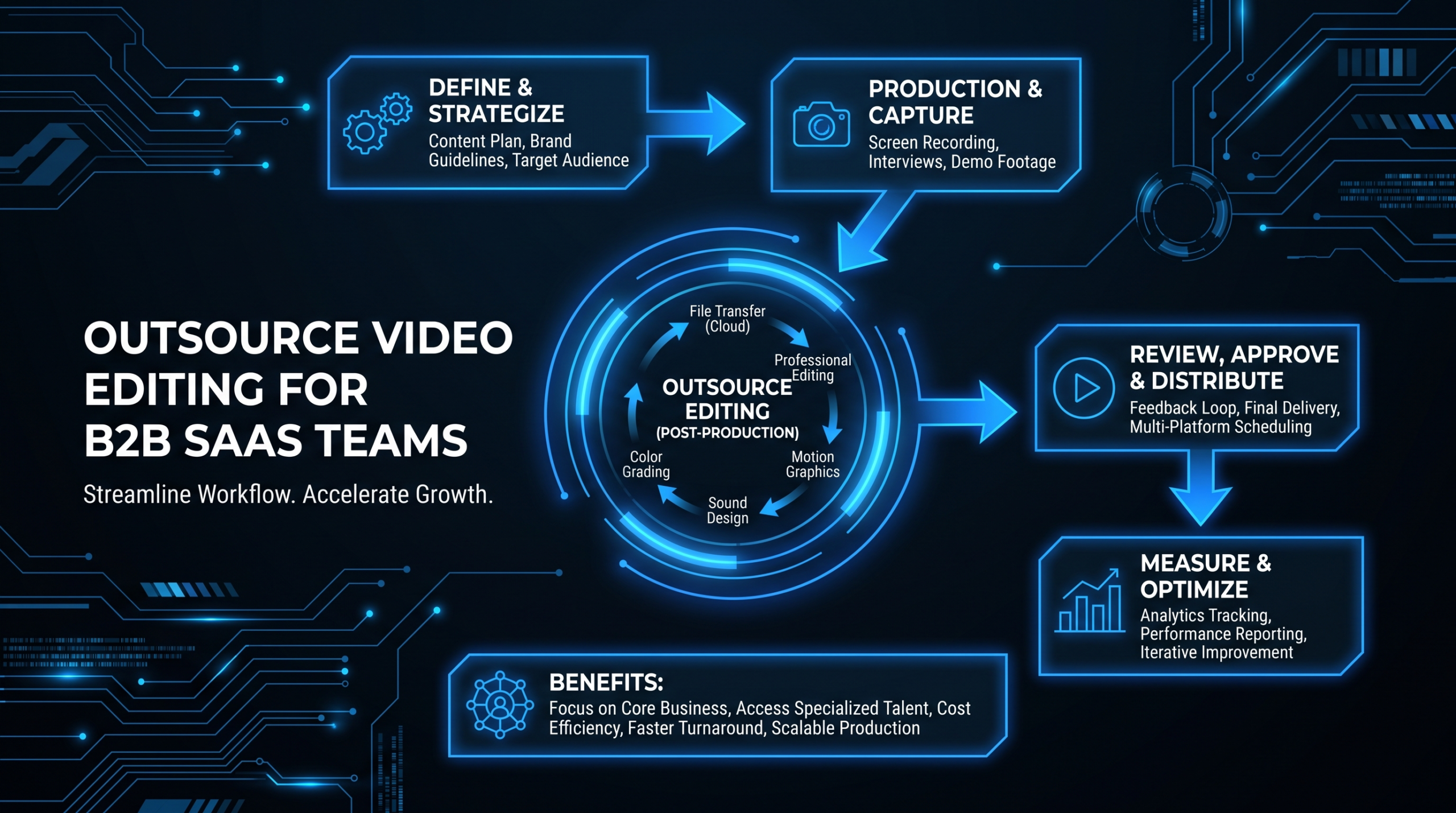
Outsourcing video editing means contracting an external team or individual to take your raw footage and transform it into finished, publish-ready videos — rather than building or maintaining that capability in-house. It's a post-production service: you capture (or record) the content, the outsourced team handles everything after the camera stops.
What Outsourced Video Editing Typically Includes
- Assembly editing: Cutting raw footage to a narrative structure, removing dead air and mistakes, pacing the video for the target audience
- Color grading and correction: Achieving a consistent look across all your content — critical for brand cohesion at scale
- Audio mixing and cleanup: Noise reduction, level balancing, music integration, dialogue clarity
- Motion graphics and titles: Lower thirds, animated intros/outros, brand overlays, kinetic text
- Captions and subtitles: Hardcoded (burned in) or delivered as SRT files for platform uploads
- Format repurposing: Long-form to short clips, 16:9 to 9:16 and 1:1 for social platforms
- Thumbnail creation: Often included in higher-tier agency arrangements
What It Doesn't Include (Usually)
Outsourced video editing is post-production only, not full production. Scripting, filming, voiceover recording, and on-location production logistics typically sit outside scope unless you've engaged a full-service video production partner. For most SaaS companies — where content consists of screen recordings, product walkthroughs, Loom-style footage, or interview setups — this distinction matters less: your footage is already "production-ready" before it reaches the editor.
For a complete breakdown of what each service tier covers, see our guide to what's included in video editing services.
How It Differs from Hiring a Full-Time Editor
An in-house editor is a fixed cost — salary, benefits, equipment, software licenses, and management overhead — regardless of how much (or how little) video you produce that month. Outsourcing is variable by model: you can structure it as a retainer (fixed monthly fee with guaranteed capacity) or a per-project arrangement. The outsourced model also provides redundancy — if an editor is sick or leaves, the agency provides a replacement. In-house editors have no backup by default.
The real strategic question isn't "outsource vs. hire" — it's "when is the outsourced model more efficient than in-house, and what does the right model look like?" The answer depends almost entirely on your monthly video volume.
Why B2B SaaS Teams Outsource Video Editing
The case for outsourcing isn't purely about cost savings. Teams that outsource video editing successfully report three compounding benefits: speed, quality, and capacity — simultaneously, without the overhead of employment or the unpredictability of ad-hoc freelancing.
Capacity Without Headcount
Hiring a video editor in the US typically costs $65,000–$120,000 per year in salary alone, before benefits, equipment, software licenses, and management time. When content demand spikes — a product launch, a campaign push, a new channel — your single in-house editor becomes a bottleneck. Outsourcing gives you elastic capacity: scale from 5 videos/month to 25 videos/month without initiating a hiring cycle. For growth-stage SaaS companies where content demand is inherently variable, this flexibility alone often justifies the outsourcing premium.
Access to Specialized Skills Without the Specialist Payroll
A well-staffed outsourced team brings senior editors, motion designers, and project managers who've edited hundreds of SaaS product videos. In-house hires at mid-market companies are often generalists who learn your content type on the job. The gap in output quality — particularly for complex motion graphics, precise timing, polished audio, and product demo storytelling — is typically measurable from month one with an experienced team.
Cost Efficiency at Volume
Per-video costs drop substantially when you commit to a structured outsourcing arrangement. Ad-hoc freelancer per-project pricing typically runs $300–$2,500 per video depending on complexity and editor seniority. A monthly retainer or dedicated team arrangement commonly brings effective per-video cost to $200–$800 — a meaningful reduction at equivalent quality. For teams producing 10+ videos per month, the economics are decisive. Video has demonstrated consistent ROI in B2B pipelines, and Wyzowl's annual State of Video Marketing research has consistently found growing adoption among B2B marketers — making the case for scalable video production infrastructure even stronger.
Brand Consistency at Scale
Counterintuitively, a dedicated outsourced team often delivers more consistency than rotating in-house hires or ad-hoc freelancers. A team that works exclusively on your account learns your style guide, your review preferences, your feedback patterns — and encodes that knowledge into their production process. After 60–90 days, a good dedicated team knows your brand better than most new hires would in the same time frame. This requires structured onboarding, which we cover in detail below.
Speed to Publish
A well-managed outsourced team with a clear SOP and established feedback loops commonly turns around a finished video in 24–72 hours from footage submission. In-house editors juggling Slack, cross-functional meetings, and administrative overhead rarely hit that pace consistently. Faster edits mean faster publishing, faster testing, and faster learning — a material advantage in competitive content categories.
How Much Does It Cost to Outsource Video Editing?
Outsourcing video editing costs vary by 10–15x depending on the model you choose, the geography of the team, and the complexity of your content. Here's the full picture, with real hedged ranges based on current market pricing.
Cost by Outsourcing Model
Outsource Video Editing: Cost by Model (2026)
| Model | Typical Monthly Cost | Per-Video Effective Cost | Best For |
|---|---|---|---|
| Offshore Freelancer (Upwork/Fiverr) | $500–$3,000 | $50–$300 | Low-volume, simple edits, tight budget |
| US/UK Freelancer | $2,000–$8,000 | $300–$2,500 | High-stakes, low-volume content |
| Video Editing Subscription | $2,000–$9,000 | $150–$600 | High-volume social content, simple edits |
| Agency Retainer | $3,000–$15,000 | $250–$800 | Consistent output, 6–15 videos/month |
| Dedicated Team | $5,000–$25,000 | $200–$600 | Scale, brand consistency, 15+ videos/month |
For per-minute and per-project rate benchmarks by editor type and seniority level, see our companion guides on video editing cost per minute and hourly rates by country.
Cost by Video Type
Outsourced Video Editing Cost by Deliverable Type
| Video Type | Complexity | Freelancer Range | Agency / Dedicated Team |
|---|---|---|---|
| Social media clip (15–60s) | Low | $50–$200 | $100–$350 |
| Podcast / interview edit (30–60 min raw) | Low–Medium | $100–$400 | $150–$600 |
| YouTube video (8–15 min finished) | Medium | $300–$1,200 | $400–$1,000 |
| Product demo video (2–5 min) | Medium–High | $500–$2,000 | $600–$1,800 |
| Animated explainer (60–90s) | High | $800–$4,000 | $1,500–$6,000 |
| Case study / testimonial (2–4 min) | Medium | $400–$1,500 | $500–$1,500 |
VEC Pricing for Reference
For SaaS teams ready for a dedicated outsourcing arrangement, Video Editing Company offers three structured plans: Growth at $5,000/month (dedicated editing team, typically suited for 8–12 videos/month), Core at $9,500/month (expanded team capacity with motion graphics included), and Scale at $16,000/month (full creative team, 20+ videos/month with priority turnaround). All plans include a dedicated project manager, brand onboarding, and the 90-day output guarantee. See full details on the VEC pricing page.
Want to see what the first two weeks, turnaround times and revision rounds look like in practice? Our how outsourced video editing works with a dedicated team page walks through the full process.
Hidden Costs to Budget For
- Revision rounds beyond scope: Most arrangements include 2–3 revision rounds. Additional rounds on per-project arrangements commonly add $50–$300 per video.
- Rush fees: Same-day or 24-hour turnarounds on per-project work often carry a 25–50% premium. Dedicated team arrangements typically include rush as standard.
- Stock footage and music licensing: Not included in editing fees unless specified. Budget an additional $50–$200/month for libraries like Artlist or Epidemic Sound — or confirm your agency has blanket licensing included.
- Onboarding time cost: The first 2–4 weeks of any outsourcing relationship carry lower throughput as the team learns your brand. Factor this into month-one output expectations rather than treating it as underperformance.
Outsourcing Models Compared
Choosing the right outsourcing model is the highest-leverage decision in this process. The wrong model costs you either money (paying for capacity you don't use) or quality (using a model not built for your content type).
Model 1: Freelancer (Per-Project or Hourly)
Bottom line: Maximum flexibility but maximum management overhead. Source via Upwork, Toptal, or referral networks. You vet, brief, and manage the editor directly, per project or per hour.
Pros: No commitment, ability to hire a specialist for each specific content type, lowest minimum spend.
Cons: All management overhead sits with you. Quality varies by editor. No redundancy if your freelancer goes dark mid-project. Sourcing new freelancers for each new content type is time-intensive. Hard to build brand consistency across different editors.
When it works: Companies producing fewer than 6 videos/month, testing video strategy before committing to a structured arrangement, or augmenting an existing team during peak periods.
Model 2: Video Editing Subscription
Bottom line: Flat monthly fee for a queue-based editing service. You submit requests; the team works through them sequentially at a defined turnaround. Popularized by design-subscription models like Design Pickle and applied to video.
Pros: Simple pricing, no per-video scope negotiation, month-to-month contracts, good for consistent high-volume social content.
Cons: "Unlimited" is throughput-limited — with one active request and a 48–72 hour turnaround, realistic monthly capacity is 8–12 videos. Not suited for complex production work (animated explainers, brand films). Quality can vary if editors rotate between clients.
When it works: Teams with steady social clip repurposing needs, podcast video editing, or LinkedIn native video programs where content is simple and consistent.
Model 3: Agency Retainer
Bottom line: Fixed monthly fee for a defined set of deliverables or hours, with a dedicated account contact who knows your brand. Most retainers carry a 3–6 month minimum commitment.
Pros: Predictable cost, reserved capacity, 20–40% lower per-video cost vs. per-project, brand familiarity builds over the engagement.
Cons: Commitment required. "Use it or lose it" — most retainers don't roll over unused capacity. Scope definition ("6 videos/month") can be ambiguous on complexity.
When it works: Companies consistently producing 6–15 videos/month with a defined content calendar, who want budget predictability and a single point of contact.
Model 4: Dedicated Team
Bottom line: An assigned team of editors and a project manager who work exclusively (or primarily) on your account. The agency handles staffing, training, and redundancy; you get deep brand knowledge and priority access.
Pros: Deepest brand consistency, lowest per-video cost at high volume, full capacity flexibility within the team, no hiring risk, guaranteed backup coverage.
Cons: Highest monthly minimum ($5,000+). If your content volume drops significantly, you may underutilize the team's capacity. Onboarding the team to your brand takes 2–4 weeks of reduced throughput.
When it works: Companies producing 15+ videos/month, or those where brand consistency is operationally non-negotiable — typically Series B+ SaaS teams with established video programs.
Outsourcing Model Comparison at a Glance
| Factor | Freelancer | Subscription | Retainer | Dedicated Team |
|---|---|---|---|---|
| Monthly cost | Variable | $2K–$9K | $3K–$15K | $5K–$25K |
| Contract flexibility | None (per job) | Month-to-month | 3–6 mo minimum | 3–12 mo minimum |
| Brand consistency | Low | Medium | Medium–High | High |
| Your management overhead | High | Low | Low–Medium | Low |
| Scale ceiling | Low | Throughput-limited | Medium | High |
| Complex content (demos, animation) | Depends on editor | Limited | Yes | Yes |
Best Countries for Outsourced Video Editing
Where your editing team is based affects cost, communication quality, turnaround windows, and — to a meaningful degree — editing sensibility. There's no single "best" geography; the right choice depends on your budget, content complexity, and time-zone requirements.
For rate benchmarks and a head-to-head comparison with specific data, see our full guide on the best countries to outsource video editing. Here's the strategic overview.
Philippines
The dominant outsourcing destination for English-language video editing. High English proficiency, strong familiarity with Western (and B2B SaaS) content formats, competitive rates typically in the $8–$25/hour range for experienced editors, and time-zone compatibility with US West Coast for morning-shift deliveries. The Philippines has the largest pool of video editing talent in Southeast Asia with the longest track record in English-language creative services.
Eastern Europe (Poland, Romania, Serbia, Ukraine)
Higher average skill ceiling than Southeast Asia for complex motion graphics and custom animation. Rates typically $20–$50/hour depending on seniority and location. Strong technical training and design sensibility shaped by European creative education systems. Time-zone overlap with US East Coast is partial (6–8 hour gap) — plan for asynchronous-first workflows. The talent pool has expanded materially across multiple cities in the region over recent years.
India
Massive talent pool, rates ranging from $8–$30/hour for video editing, strong English proficiency in business contexts. Highly competitive for high-volume, process-driven editing: podcast edits, social clip repurposing, simple assembly cuts. For complex creative work, vetting individual portfolios is more important here than in markets with smaller but more uniformly strong talent pools — quality variance is wider.
Latin America (Colombia, Mexico, Argentina, Brazil)
The fastest-growing outsourcing destination for US-based companies, with a key structural advantage: near-real-time-zone overlap. Editors in Bogotá or Mexico City work US business hours naturally. Rates range from $15–$40/hour for experienced talent. Strong motion graphics tradition, particularly in Medellín, Buenos Aires, and São Paulo. The trade-off is a smaller overall talent pool compared to South and Southeast Asia — sourcing specialized skills takes more effort.
US/UK-Based Agencies
The highest-cost option, with advantages that matter for specific content types: full time-zone alignment, native cultural fluency, and zero communication overhead. Individual editor rates run $75–$200/hour; agency blended rates are lower but still 2–4x offshore. Best for executive communications, investor content, public-facing brand films, or any video where the cultural and linguistic stakes are high enough to justify the premium.
Top Outsourced Video Editing Services in 2026
The outsourced video editing market has hundreds of providers. Most are generalists who'll take any client in any industry. The following are the options that consistently perform for B2B SaaS teams specifically — reviewed honestly with real pros, cons, and who each is right for.
1. Video Editing Company (VEC) — Best for B2B SaaS at Scale
VEC is a dedicated video editing service built for B2B SaaS companies. Every team is assembled and onboarded specifically around SaaS marketing content: product demos, customer onboarding libraries, LinkedIn video programs, case study interviews, and YouTube channels. This vertical focus is the core differentiator — you're not explaining what SaaS content requires to a generalist agency.
- Plans: Growth $5,000/month · Core $9,500/month · Scale $16,000/month
- Team structure: Dedicated senior editor + junior editor + project manager per account
- Guarantee: Double your video output in 90 days or month 4 is free
- Pros: SaaS-exclusive focus eliminates the learning curve on product content types; dedicated team builds genuine brand knowledge over time; flat retainer pricing with no per-video negotiation; PM owns the entire workflow so your team's overhead stays minimal
- Cons: Plans start at $5,000/month — not the right fit for companies producing fewer than 6 videos/month or testing early-stage video strategy; focus on editing and post-production means you provide the footage
- Best for: Series A–C SaaS marketing teams with established content programs who need to 2–3x output without growing headcount
2. Increditors — Best for YouTube-Driven SaaS Programs
Increditors (increditors.com) is a full-service video editing agency with a strong track record in YouTube performance specifically. Their team structure runs on dedicated editor pods — senior editor + junior editor + project manager + creative director — which means every account gets senior-level creative oversight on every video, not just execution from junior staff.
- Pricing: Custom retainers; commonly reported in the $2,500–$12,000+/month range. No instant tier pricing — a discovery call comes before any numbers
- Pros: Meaningful creative direction layer built into the account team; documented track record in YouTube channel growth; honest about what's working vs. what isn't in your content mix; accessible inquiry at [email protected]
- Cons: Not exclusively SaaS-focused — serves YouTube creators, finance, education, and other verticals; custom pricing without instant clarity requires a conversation before you can evaluate fit; no guaranteed output commitments published upfront
- Best for: SaaS teams where YouTube is a primary distribution channel, or companies that want hands-on creative strategy integrated with editing execution, not just post-production delivery
3. Offshore Agency Retainers — Best for Cost-Primary Buyers
Several Philippines-based and Eastern European agencies offer structured retainer arrangements in the $1,500–$5,000/month range. Quality is more variable than the top-tier options above, but teams with strong internal creative direction and documented brand guidelines can extract solid value at lower price points. Key variables to vet before committing: dedicated vs. shared editors, revision policy and round limits, PM responsiveness and English fluency, and portfolio examples in your specific content type (not just generic showreels).
4. Video Editing Subscription Services — Best for Social-First Teams
For teams whose primary need is social clip repurposing, LinkedIn native videos, and podcast video edits — rather than high-production demos or brand films — video subscription services deliver strong value at $2,000–$5,000/month. The trade-off is throughput (sequential queue limits volume) and limited suitability for complex motion graphics or custom animation. Evaluate based on your specific content mix before assuming the subscription model scales to your volume.
5. Vetted Freelancers (Toptal, LinkedIn Referral) — Best for Overflow or One-Off
For one-off projects or overflow when your regular team is at capacity, a vetted senior freelancer is the most flexible option. Budget $75–$150/hour for US-based senior talent, $25–$50/hour for strong offshore talent sourced via referral or Toptal's vetting process. Not suitable as a primary outsourcing strategy for teams producing 6+ videos/month — sourcing, briefing, and managing freelancers at that volume creates more overhead than it saves.
Provider Comparison for B2B SaaS Teams
| Provider Type | Monthly Cost | Brand Consistency | SaaS Content Fit | Management Overhead |
|---|---|---|---|---|
| VEC (Dedicated Team) | $5K–$16K | High | Built for SaaS | Low (PM-managed) |
| Increditors | $2.5K–$12K+ | High | Strong (YouTube-led) | Low (pod model) |
| Offshore Agency Retainer | $1.5K–$5K | Medium | Generalist | Medium |
| Subscription Service | $2K–$9K | Medium | Social content only | Low |
| Freelancer | Variable | Low | Depends on editor | High |
How to Outsource Video Editing Without Losing Brand Voice
Brand drift is the #1 concern marketing leaders cite when evaluating outsourced video. It's a legitimate risk — and an almost entirely preventable one. The teams that solve it invest in the handoff process, not just the editing contract.
For a deep operational guide including a downloadable brand video brief template, see our dedicated post on outsourcing video editing without losing your brand voice. The strategic principles:
Build a Brand Video Bible Before Day One
Your outsourced team can only match what you document. Before the first video is submitted, create a brand video reference that covers: hex codes for color palette, approved font choices, intro/outro templates (with source files), music style with 3–5 approved reference tracks, pacing preferences by content type (cuts-per-minute guidelines), caption font and size standards, and specific patterns that are explicitly off-brand. Teams that skip this document spend months correcting drift rather than building output velocity.
Structure Feedback So It Encodes
Vague feedback ("the energy feels off") doesn't encode into a team's process. Specific feedback does: "Increase music level from 0:30–1:15 by 3dB, tighten the cut at 2:47 from 2.5s to 1.5s, replace the stock graphic at 0:58 with the on-brand icon set." The first three to five videos are the most important feedback investment you'll make. Spend time on them. After that, a well-calibrated team absorbs new instructions quickly and requires progressively less correction.
Use Deliverable Templates for Complex Content Types
For product demos: document your preferred screen recording layout, when to use zoom animations vs. static frames, how to handle the UI walkthrough pacing. For case study interviews: B-roll structure, when to use text overlays, interview framing rules. Templates don't limit creative range — they eliminate 30-minute feedback calls about decisions that should have been documented upfront.
Weekly Sync, Not Daily Management
The goal of outsourcing is to reduce management overhead, not shift it to a different medium. High-performing outsourced arrangements run on a weekly 30-minute sync for status, priority alignment, and upcoming footage — not daily check-ins or asynchronous question floods. If you're spending more than 4–5 hours per week managing an outsourced team past month two, the onboarding process needs a revision, not the team.
Common Risks of Outsourcing Video Editing (and How to Mitigate Them)
Outsourcing video editing has real risks. Most are predictable and preventable with the right setup. Here's what to watch for and the specific mitigation for each.
Risk 1: Inconsistent Quality Between Videos
Why it happens: Shared editor pools — common in subscription services and generic agency retainers — mean different editors touch your account on different projects. Without a documented brand guide, each editor makes different judgment calls, producing perceptibly inconsistent output.
Mitigation: Insist on dedicated, named editors for your account, not a rotating pool. With a freelancer, use the same person consistently across projects. With an agency, confirm your named editor handles all your work and that the PM provides continuity if the editor changes.
Risk 2: Communication Delays and Time Zone Friction
Why it happens: 8–12 hour time zone differences mean a feedback note sent at 3pm your time isn't actioned until the following morning. For revision-heavy content with iterative feedback cycles, this can add 2–4 days to delivery timelines.
Mitigation: Choose a team with a PM who overlaps your business hours, even if editors are offshore. Establish async-first communication norms: all feedback via timestamped comment (action + timecode), not phone calls. Batch feedback rounds rather than sending piecemeal notes throughout the day. A well-structured feedback system eliminates most of the time-zone friction.
Risk 3: IP and Footage Security
Why it happens: Raw footage for B2B SaaS often contains unreleased product features, internal demos, customer data, or confidential roadmap content. Sharing this with a third-party creates exposure if the team lacks proper data handling practices.
Mitigation: Require signed NDAs before sharing any footage — this is standard practice at established agencies. Use dedicated file transfer systems, not personal email or consumer cloud services. Confirm the agency has a documented data handling policy. The risk is highest with informal freelancer arrangements; reputable agencies handle this routinely.
Risk 4: Scope Creep and Budget Surprises
Why it happens: Retainer agreements without precise scope definitions accumulate "just one more" requests over time. Agencies may absorb these initially and then raise rates at renewal, or charge overages that catch you off-guard.
Mitigation: Define scope in writing before signing: video count per month, specific video types covered, revision rounds included, explicit definition of what constitutes an out-of-scope request, and documented overage pricing. Know the overage rate before you need it.
Risk 5: Vendor Dependency
Why it happens: After 12–18 months, an outsourced team deeply embedded in your brand is difficult to replace quickly if the relationship ends — pricing change, contract dispute, or agency wind-down. Brand knowledge that lives only in the team's heads, not in documentation, walks out the door with them.
Mitigation: Keep all brand assets, editing templates, source files, and brand video bibles in systems you own, not in the agency's internal infrastructure. Periodic documentation reviews ensure the team is working from your documented standards, building explicit knowledge you retain rather than implicit knowledge you'd lose.
For teams evaluating whether to outsource editing only vs. outsourcing the full video production process, our guide to outsourcing video production for SaaS covers the broader scope and vendor landscape.
Frequently Asked Questions
What's the difference between outsourcing video editing and hiring a full-service video production company?
Outsourcing video editing is post-production only — you provide the raw footage, the team edits it into a finished video. A full-service video production company handles everything: scripting, filming, production logistics, and post-production. For most B2B SaaS companies using screen recordings, product walkthroughs, or interview setups, outsourcing editing is sufficient since the footage captures are already handled internally. If you need footage captured and produced from scratch, look for a full-service video production partner.
How many videos per month do I need to produce before outsourcing makes financial sense?
At 4–6 videos/month, a structured outsourcing retainer typically breaks even against ad-hoc freelancing once you factor in sourcing time, revision overhead, and quality consistency. At 8+ videos/month, the economics clearly favor outsourcing over both freelancers and most in-house alternatives. Below 4 videos/month, a vetted per-project freelancer is often the better fit — the commitment of a retainer is hard to justify at that production volume.
How do I properly vet an outsourced video editing team before committing to a contract?
Commission a paid test edit on a real piece of your own content — not a polished case study they've prepared. Ideally, give them a piece of raw footage you've edited in-house before, so you have a direct reference point. Evaluate three things: (1) Did they follow your brief precisely or make unstated assumptions? (2) How did they handle your first revision feedback — quickly and specifically, or defensively and vaguely? (3) Did the PM proactively flag issues or wait to be asked? The test edit reveals team quality far more accurately than any portfolio or sales call.
Can an outsourced team handle complex motion graphics and animation?
It depends on the team and the tier. Most standard video editing retainers and subscription services cover basic motion graphics: animated text overlays, simple transitions, lower thirds, basic kinetic typography. Complex animation — custom character animation, 3D elements, intricate branded motion sequences — typically requires a specialized motion graphics team or a higher-tier plan with dedicated motion designers. Always request examples specific to your motion graphics complexity, not just general editing showreels, before committing.
What's a realistic turnaround time for outsourced video editing?
For standard edits — YouTube videos, product demos, interview cuts — a well-structured outsourced team with an established workflow commonly delivers a first draft within 24–72 hours of footage submission. Same-day or next-morning turnarounds are available from dedicated team arrangements, sometimes with an additional fee on per-project agreements. Complex animation or heavily motion-graphics-dependent videos typically need 3–5 business days for first draft. Always agree on specific turnaround expectations in writing before signing — and confirm whether the clock starts at footage submission or at the PM's receipt confirmation.
Ready to Outsource Video Editing the Right Way?
Video Editing Company builds dedicated video editing teams for B2B SaaS companies. We handle hiring, brand onboarding, quality control, and PM coordination — so you get consistent, publish-ready output without the management overhead. Growth plan starts at $5,000/month with a 90-day output guarantee: double your video output in 90 days or month 4 is free.
Book a Free Strategy Call View Pricing