Outsource Video Production for SaaS: Guide
TL;DR
- Outsourcing video production for SaaS means handing off the full stack — strategy, scripting, capture, and post-production — not just editing.
- The right time to outsource: when video demand consistently exceeds your team's bandwidth and you're producing 4+ videos per month.
- SaaS-specific requirements (screen capture, product demos, feature tours, onboarding videos) demand a partner with proven B2B SaaS experience, not a generic video agency.
- Governance is the most overlooked variable: a brand playbook and structured review process matter more than the vendor's reel.
- Dedicated managed programs typically range from $5K–$16K/month; per-project costs vary widely by content type and scope.
Table of Contents
Most SaaS marketing teams start with the wrong question: "Who should edit our videos?" The better question is: "Who should own our entire video production program?"
Outsourcing video production for SaaS is not the same as outsourcing video editing. Editing is a downstream task — you provide footage and someone cleans it up. Full production outsourcing means partnering with a team that handles strategy, scripting, capture, and post-production as an integrated system. For B2B SaaS companies producing product demos, feature tours, onboarding videos, and customer stories at scale, the difference is significant in both cost structure and output quality.
This guide covers the decision framework, the full production scope, vendor selection criteria, governance systems, and realistic cost benchmarks — with a focus on what SaaS product video specifically requires, not generic corporate video content.
Scope note: If you're outsourcing only the post-production side — color grading, motion graphics, final assembly — our dedicated guide on how to outsource video editing covers that workflow in detail. This guide covers the full production engagement.
What Video Production Actually Covers for SaaS
Full video production for SaaS spans five distinct phases. Understanding each phase is essential before evaluating whether to outsource and what to outsource — because many teams outsource the wrong phases and keep the wrong ones in-house.
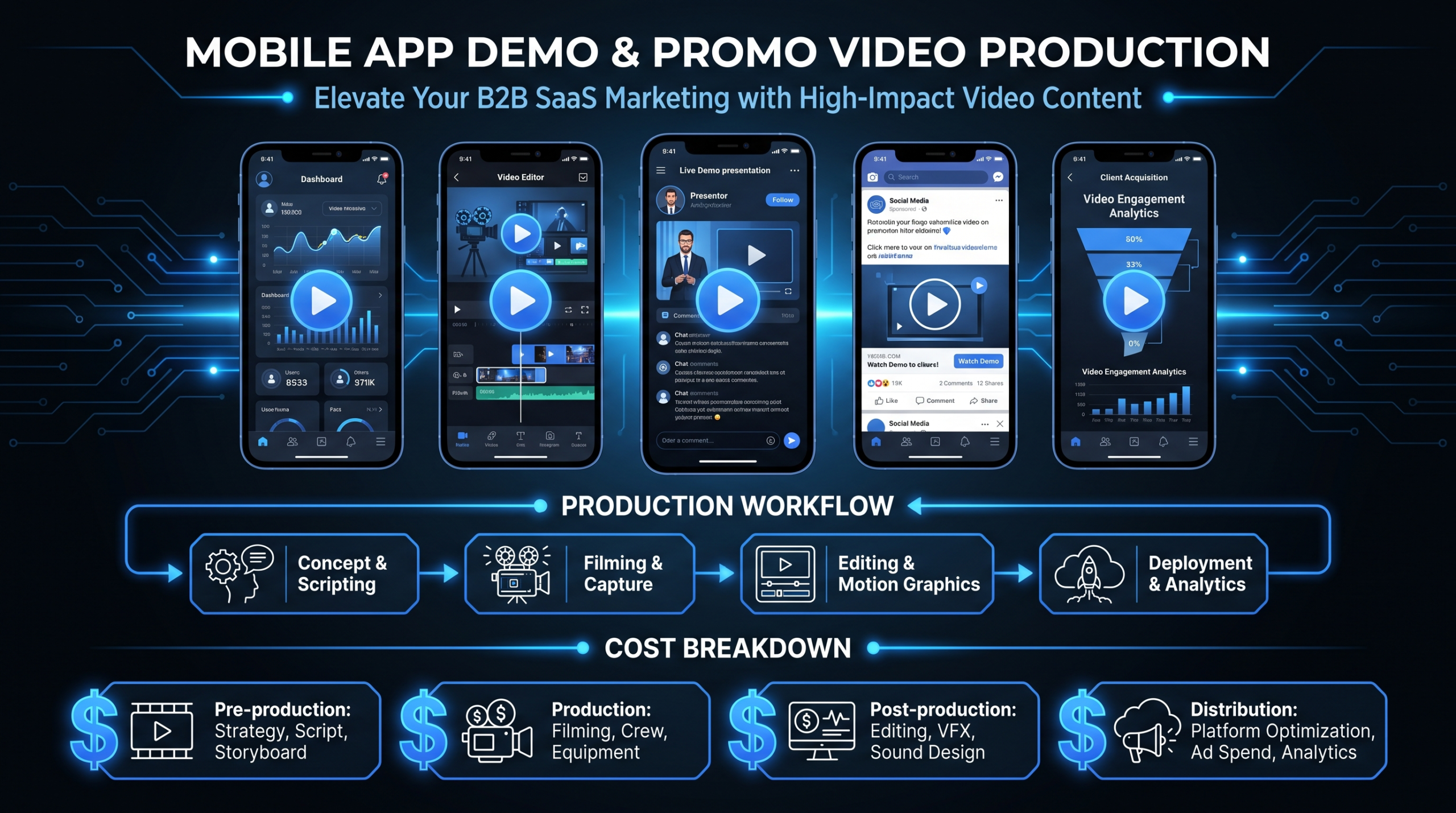
The SaaS Video Production Stack
Production Phases by Scope
| Phase | What It Includes | SaaS-Specific Needs |
|---|---|---|
| Strategy & Planning | Video roadmap, audience mapping, distribution planning, KPI setting | Product launch alignment, funnel stage mapping (TOFU/MOFU/BOFU), ICP clarity |
| Scripting & Storyboarding | Script writing, voiceover direction, visual flow planning | Technical accuracy, product narrative, avoiding feature-dump syndrome |
| Capture | Screen recording, live-action filming, motion graphics assets | UI walkthrough clarity, product version control, B-roll sourcing |
| Post-Production | Editing, color grading, motion graphics, sound design, captions | UI annotation layers, branded lower thirds, format distribution (16:9, 9:16, square) |
| Distribution Prep | Thumbnail creation, chapter markers, transcript, meta optimization | YouTube SEO for SaaS keywords, in-app video specs, gating decisions |
When SaaS teams say they "outsource video production," they often mean phases three and four only — capture and post. But leaving strategy and scripting in-house while outsourcing execution introduces a persistent failure mode: the production partner delivers technically polished content that misses the product positioning entirely. The vendor did their job; the brief was the problem.
Where SaaS Video Outsourcing Usually Breaks Down
Three patterns consistently cause outsourced SaaS video programs to underperform their potential:
- Misaligned scripting. A generalist video agency writes scripts from a marketing brief and produces technically competent but strategically flat content. SaaS buyers — especially in B2B — require specificity, peer credibility, and outcome framing that generalist writers rarely deliver without deep product context.
- Product change latency. SaaS products ship updates continuously. Without a version control protocol established upfront, a product demo filmed in week one may be partially outdated by week four. This creates technical debt in your video library that compounds across every future update cycle.
- Undefined review governance. Outsourced video fails or succeeds on the feedback loop. Without a structured approval process — who signs off, how many rounds, what constitutes a revision vs. a scope change — projects drag and quality degrades under revision churn. No contract clause fixes a broken internal review process.
A production partner with real SaaS experience builds systems that address all three. If a vendor's pitch focuses entirely on their reel without discussing workflow, treat that as a yellow flag, not a green one.
When SaaS Teams Should Outsource
Outsourcing video production is the right move when your video demand is consistent enough to justify the transition cost but your internal team lacks the capacity, skills, or dedicated tooling to scale. Outsourcing too early — before you've defined what success looks like — wastes setup cost. Outsourcing too late — after internal bandwidth failure causes quality to collapse — wastes opportunity.
Signs You're Ready to Outsource
- You're producing 4+ videos per month and internal capacity is the bottleneck, not ideas or strategy
- Your current video quality is consistently behind your product quality — you look scrappier than your product actually is
- You need video types you don't have internal skills for: animated explainers, professional voiceover, multi-camera customer stories
- Video ROI is proving out (pipeline influence, feature adoption lift, demo conversion) and you want to scale the program, not just maintain it
- Post-production is consuming engineers' or product managers' time instead of dedicated creatives
When to Keep It In-House
- You need daily or same-day turnaround on reactive content — event coverage, product update announcements, rapid social response
- Your product changes so frequently that any external team would require constant re-briefing at unsustainable cost
- You're pre-PMF and video content is exploratory — you don't have a repeatable brief to hand off yet
- Volume is genuinely low (1–2 videos per month) and a single freelancer or subscription covers it
Outsource vs. In-House Decision Matrix
| Factor | Outsource | Keep In-House |
|---|---|---|
| Monthly volume | 4+ videos/month, growing | 1–3 videos/month, stable |
| Content types | Multiple formats (demo, explainer, testimonial, social) | One repeatable format with existing tooling |
| Turnaround needs | Planned calendar, 3–14 day windows | Same-day or next-day reactive content |
| Product stability | Mature UI, quarterly or monthly release cadence | Daily shipping, frequent UI changes |
| Budget signal | Video ROI proven, scaling budget justified | Exploratory, pre-PMF, no video history |
| Internal skill gap | Missing key skills (animation, VO direction, color, motion graphics) | Strong creative team in place with capacity headroom |
If you're between these scenarios — around 3–4 videos per month with a defined content calendar — outsourcing is likely the right next move. The production fixed cost amortizes across more output as you scale, improving cost-per-video significantly. The earlier you establish a working relationship with a production partner, the faster that brand familiarity compounds into quality gains.
The Full SaaS Video Production Scope
When outsourcing the full production stack, clarity on what each phase delivers — and who owns which decisions — prevents the most common coordination failures.
Phase 1 — Planning and Strategy
A strong production partner starts with discovery, not a creative brief. For SaaS, this means aligning video content to product and go-to-market realities:
- Funnel stage mapping: TOFU (problem-aware), MOFU (solution-aware), BOFU (product-aware, evaluation). Each stage demands different tone, depth, and call-to-action framing. A product demo for bottom-of-funnel evaluation has different success criteria than a brand awareness video for LinkedIn.
- ICP alignment: Who is the buying stakeholder — VP of Engineering, Head of Marketing, CFO? The script, visual style, and voiceover energy should match the person making the buying decision, not just the person using the product daily.
- Launch calendar integration: SaaS product roadmap should drive the video calendar. If a major feature ships in Q3, the supporting video content needs to be planned and briefed in Q2, not the week of launch.
- Distribution channel planning: YouTube (long-form + SEO), LinkedIn (social-native clips), in-app (onboarding flows), website (hero, pricing, features pages), sales enablement (1:1 sends, proposal attachments). Each channel has different format, length, and pacing requirements.
Phase 2 — Scripting and Storyboarding
This is the highest-value phase and the one most commonly underresourced when outsourcing. A script for a 2-minute SaaS demo video typically requires a 30–60 minute brief with the product team, access to a live demo environment, and two rounds of review before approval. The brief session is non-negotiable — a script written without direct product team input consistently misframes the value proposition.
Storyboarding matters significantly for animated explainers and mixed-media content. If your partner skips storyboarding on complex animations citing time savings, that's a scope management failure — visual surprises in post-production are expensive to fix and more expensive in relationship terms when the team is already into final delivery.
Phase 3 — Capture (Screen Recording, Live Action, Animation)
SaaS video capture has a unique constraint: the product is the set. Unlike lifestyle or brand video, there's no physical location — just a screen, a UI, and the story you tell through it.
- Screen recording protocols matter more than most teams expect. High-resolution display (minimum 1440p, ideally 4K), consistent zoom ratios, stable cursor movement, and a clean browser environment (no visible tabs, bookmarks bar, or system notifications) directly affect how professional the final video looks. A production partner should document their screen capture standards before starting.
- Product version control: Establish a dedicated demo environment that reflects the stable UI — not your staging branch where engineers are actively committing. Define in writing: if the product UI changes after capture is complete, who bears the cost of re-recording?
- Voiceover: Remote VO with professional talent (home studio quality) is now standard and significantly reduces cost vs. studio recording. Budget for the VO session as a separate line item from editing — they're different production windows with different turnaround expectations.
- Live-action elements: Customer testimonials, leadership interviews, event coverage require separate production logistics. Some production partners handle this internally; others subcontract to local crews. Confirm capability and cost before assuming.
Phase 4 — Post-Production
For a complete breakdown of what professional post-production covers, see our guide on what video editing services include. For SaaS video specifically, post-production should always include:
- UI annotation layer: callout arrows, zoom highlights, cursor emphasis, feature callouts
- Branded lower thirds and chapter title cards
- Format exports for all distribution channels (16:9 widescreen, 9:16 vertical, 1:1 square)
- Captions (SRT file or baked-in) — essential for LinkedIn autoplay and in-app onboarding contexts where audio is often off
- Chapter markers and transcript for YouTube SEO
At VEC, post-production for SaaS clients is handled by dedicated editor teams where the same senior editor works on your account month over month. That continuity means UI annotation style, pacing preferences, and branding decisions are consistent without re-briefing — a meaningful quality multiplier at scale.
Choosing the Right Production Partner for SaaS
The right production partner for SaaS is the best fit for your content type, budget, and operating rhythm — not simply the highest-production-quality agency you can afford. Generic video quality is table stakes. The real differentiators are SaaS-specific experience, workflow integration, and their ability to scale with you.
What to Look for in a SaaS Video Production Partner
- Demonstrated SaaS portfolio. Ask to see five or more product demo, feature tour, or onboarding videos they've produced. If the portfolio is mostly brand films and event recaps, they're not the right fit for a product-driven SaaS program — no matter how good the reel looks.
- Screen recording and UI annotation capability. Ask specifically how they handle UI walkthroughs, product version control on demos, and annotation layers. If they can't answer these questions precisely, they haven't done meaningful SaaS production work.
- Scripting expertise aligned to B2B buyers. A partner that only handles post-production transfers the hardest strategic work back to you. Confirm their writers understand B2B SaaS buyer psychology — not just general marketing communication.
- Turnaround SLAs. What is their standard turnaround for a 2-minute product demo from approved script to first cut? Industry benchmarks: 5–10 business days for first cut, 2–5 days per revision round.
- Tool integration. Do they use tools your team already runs — Notion, Slack, Frame.io, ClickUp, Loom? Or will you manage everything through their proprietary portal with no integration into your existing workflow?
- Scalability commitment. If you go from 6 videos per month to 20 videos per month over 12 months, can they scale without rebuilding the team from scratch each time? Ask specifically how they handle surge periods.
For an overview of what a fully managed SaaS video production program looks like in practice — including team structure, delivery cadence, and quality oversight — see our dedicated resource on this.
Governance and Brand Control When Outsourcing
The most common objection to outsourcing video production is control: "How do we make sure it sounds like us? How do we maintain quality consistency?" The answer is not trust — it's systems. Control is a process problem, not a vendor problem.
Build Your Brand Playbook Before You Onboard Any Partner
Before handing off to any production partner, document the following in a shareable brand playbook. This investment pays back on the first project and every project after it:
- Voice and tone guide: Three to five adjectives that describe your brand voice, plus three to five that explicitly describe what you are NOT. Include two to three sample sentences that capture the right tone. "Professional but not stuffy" is a starting point, not a guideline.
- Visual brand standards: Color palette (hex codes), fonts, logo usage rules, motion graphic style preference (clean and minimal vs. energetic and kinetic).
- Messaging hierarchy: Primary value proposition, secondary benefits, and — critically — claims you are NOT allowed to make. This prevents well-intentioned writers from overstepping.
- Customer language reference: The actual words your customers use to describe their problems and your product, pulled from sales calls, G2/Capterra reviews, and support tickets. Scripts that reflect customer language convert better and read more authentically.
- Product glossary: Exact terminology for features, plans, integrations, and personas. If you call it "workspaces," the video calls it "workspaces" — not "dashboards," "views," or "projects."
Structured Review Workflow
A clear review process prevents the two most common quality failures: death by committee (too many reviewers, no decision authority) and single-point-of-failure (one reviewer who causes weeks of delay). A workable SaaS video review structure:
- Script review: Content marketer (owns messaging) plus product manager (owns accuracy). Maximum two approvers. Target 48-hour turnaround from script delivery.
- First cut review: Content marketer plus brand lead. Focus question: does this feel like us and is the pacing right? Not: "I want to change three things about the script."
- Final approval: Single decision-maker (Head of Content or VP Marketing). 24-hour turnaround SLA in the contract.
- Revision vs. scope change definition: Write this into the contract before work starts. Changing a line in the VO script is a revision. Reshooting a three-minute demo because the product UI shipped an update mid-production is a scope change. The difference in cost and timeline is significant.
For process benchmarks on brief structures and review stage cadencing, Wistia's production resource library offers framework guidance that translates well to SaaS video specifically.
What SaaS Companies Actually Pay
Production cost varies significantly by vendor type, content complexity, and volume commitment. The ranges below reflect current market benchmarks — not list prices — for comparable B2B SaaS video content.
For a detailed breakdown of how the pricing model itself affects total cost, see our analysis of video production agency pricing models.
SaaS Video Production Cost by Content Type
| Video Type | Scope Included | Typical Cost Range |
|---|---|---|
| Product demo (screen record + VO) | Script, screen capture, edit, captions, annotation layer | $800–$3,500/video |
| Animated explainer | Script, storyboard, full animation, VO | $3,000–$12,000/video |
| Customer testimonial (remote capture) | Remote session, edit, motion graphics, B-roll | $1,500–$5,000/video |
| Onboarding video series (3–5 parts) | Scripts, screen capture, annotations, chapter markers | $4,000–$15,000/series |
| LinkedIn social clips (repurposed from long-form) | Edit, captions, format adaptation, thumbnail | $150–$500/clip |
| Sales enablement video | Template + personalized screen record + edit | $200–$800/video |
Managed Production Program Pricing (Monthly)
| Program Tier | Monthly Investment | Typical Output | Best Fit |
|---|---|---|---|
| Entry managed service | $3,000–$5,000/mo | 4–6 videos/month, post-production focused | Early-stage, post-PMF, proving the channel |
| Growth program | $5,000–$9,500/mo | 8–12 videos/month, full production stack | Series A–B, content-led growth motion |
| Scale program | $9,500–$16,000/mo | 15–25 videos/month, dedicated team | Series B–C, video-first GTM, high volume |
| Enterprise dedicated | $16,000+/mo | 25+ videos/month, embedded team, full stack | PLG companies, large multi-product orgs |
VEC's managed programs (Growth at $5K/mo, Core at $9.5K/mo, Scale at $16K/mo) are structured for Series A–C SaaS companies and include a dedicated senior editor team, project management, and a guarantee: double your video output in 90 days or month four is free. See the full pricing breakdown for what's included at each tier.
For independent benchmark data on what SaaS and B2B companies are allocating to video production across company sizes, Wyzowl's annual video marketing statistics report is the most widely referenced survey in this category — useful context when building your internal business case.
Vendor Types and When to Use Each
Outsourced video production for SaaS typically comes from four vendor models. Each has a distinct profile of strengths, limitations, and best-fit scenarios. The right choice depends on your current volume, content complexity, and how much production infrastructure you want to own internally.
Vendor Type Comparison for SaaS Video Production
| Vendor Type | Cost Range | Strengths | Limitations | Best SaaS Use Case |
|---|---|---|---|---|
| Freelancer (platform-sourced) | $20–$75/hr | Low cost, fast to hire, flexible scope | No project management, inconsistent quality, no SaaS specialization | One-off edits, social clip repurposing, overflow work |
| Boutique video agency | $3,000–$15,000/project | High production quality, experienced project managers | Per-project pricing, slow for volume, typically generalist teams | Hero brand films, major product launch videos (1–2 per year) |
| Video subscription service | $2,000–$8,000/mo | Simple flat pricing, no long-term contract, flexible request types | Sequential throughput limits output, not SaaS-specialized, quality variance | High-volume simple edits, social-first programs, podcast clip repurposing |
| Dedicated managed service (SaaS-focused) | $5,000–$16,000+/mo | Dedicated team, brand consistency, full production stack, SaaS product expertise | Higher monthly floor, 2–4 week onboarding period | Ongoing SaaS video programs, 8+ videos/month, brand-consistent output at scale |
The pattern for growing SaaS companies tends to follow a logical progression: freelancers or a subscription service to prove the channel and establish baseline volume, then a dedicated managed program once video is a proven growth driver and monthly volume justifies the commitment floor.
The transition from freelancers to a dedicated production team is less about budget and more about whether you have enough recurring, predictable video work to justify it. Once you hit 8 videos per month consistently, the math usually favors a dedicated managed team over per-project sourcing.
For the post-production side of any outsourced engagement, our guide on outsourcing video editing covers the post-production workflow, handoff protocols, and quality review process in detail — a useful companion for teams building out their full production operation.
For teams with a high volume of product demo content specifically, our resource on product demo video production covers the workflow, scope, and quality benchmarks for demo-heavy SaaS programs.
Frequently Asked Questions
What is the difference between outsourcing video production and outsourcing video editing for SaaS?
Outsourcing video production covers the full stack: strategy, scripting, capture (screen recording, live action, animation), and post-production. Outsourcing video editing covers only the post-production phase — you provide the footage and the partner handles cutting, motion graphics, color, and final delivery. SaaS teams with internal strategy and capture capability often start with editing outsourcing, then graduate to full production outsourcing as volume and content complexity grow.
How do I handle product UI changes when outsourcing video production?
Establish a version control protocol before production begins. Designate a demo environment that reflects the stable UI — not your staging branch. Define in the contract what constitutes a revision versus a scope change: a VO line edit is a revision; reshooting a three-minute demo because the product UI updated mid-production is a scope change with separate cost and timeline implications. Some production partners include one UI refresh per video in annual programs — confirm this upfront, not after you need it.
How long does onboarding take with a new video production partner?
Plan for two to four weeks of structured onboarding for a dedicated production program. During this period the team reviews your brand playbook, completes a pilot video to establish style alignment, and establishes the review and delivery workflow. Full-speed output typically begins in week three to five. If a vendor promises immediate high-quality output with no onboarding, that signals they're running generic production, not building a brand-specific relationship.
What should a SaaS video production brief include?
A complete production brief for SaaS video should include: the video objective and funnel stage, the specific target ICP (title, stage in buying journey), which product features or workflow to show, three maximum key messages per video, tone direction (two to three adjective descriptors), a competitive context note (what alternatives the viewer likely knows), the distribution channel, and the deadline. A well-constructed brief typically reduces revision rounds significantly compared to a vague brief — the time invested upfront saves more time in post.
Is a dedicated video production team worth it for Series A SaaS companies?
It depends on your content volume and growth trajectory. Series A companies producing eight or more videos per month with a content-led or product-led growth motion typically see strong ROI from a dedicated managed program — consistency, speed, and per-video cost all improve as volume scales. Series A companies at two to four videos per month are better served by a subscription service or per-project agency until the volume justifies the monthly floor commitment. VEC's Growth plan at $5K/month is structured for early-scale SaaS teams, with a 90-day output guarantee built in.
Ready to Build Your SaaS Video Production Engine?
VEC builds dedicated video production teams for B2B SaaS companies — from strategy and scripting through final delivery. Plans start at $5K/month, with a guarantee: double your video output in 90 days or month 4 is free.
Book a Free Strategy Call View Plans & Pricing