Documentary-Style Brand Films: Cost Guide
TL;DR
Documentary-style brand film cost typically ranges from $15,000 to $200,000+ depending on production scope, crew size, shoot days, and post-production depth. A well-executed 3–5 minute brand documentary for a Series A–B SaaS company commonly lands in the $40,000–$90,000 range — with post-production (editing, color, sound) accounting for roughly 30–45% of total budget. If you already have footage, a dedicated video editing team can handle all of post for a fraction of full-service production cost.
Table of Contents
- What Makes a Documentary-Style Brand Film
- Brand Film Cost: Real Ranges by Budget Tier
- The 7 Cost Drivers That Determine Your Budget
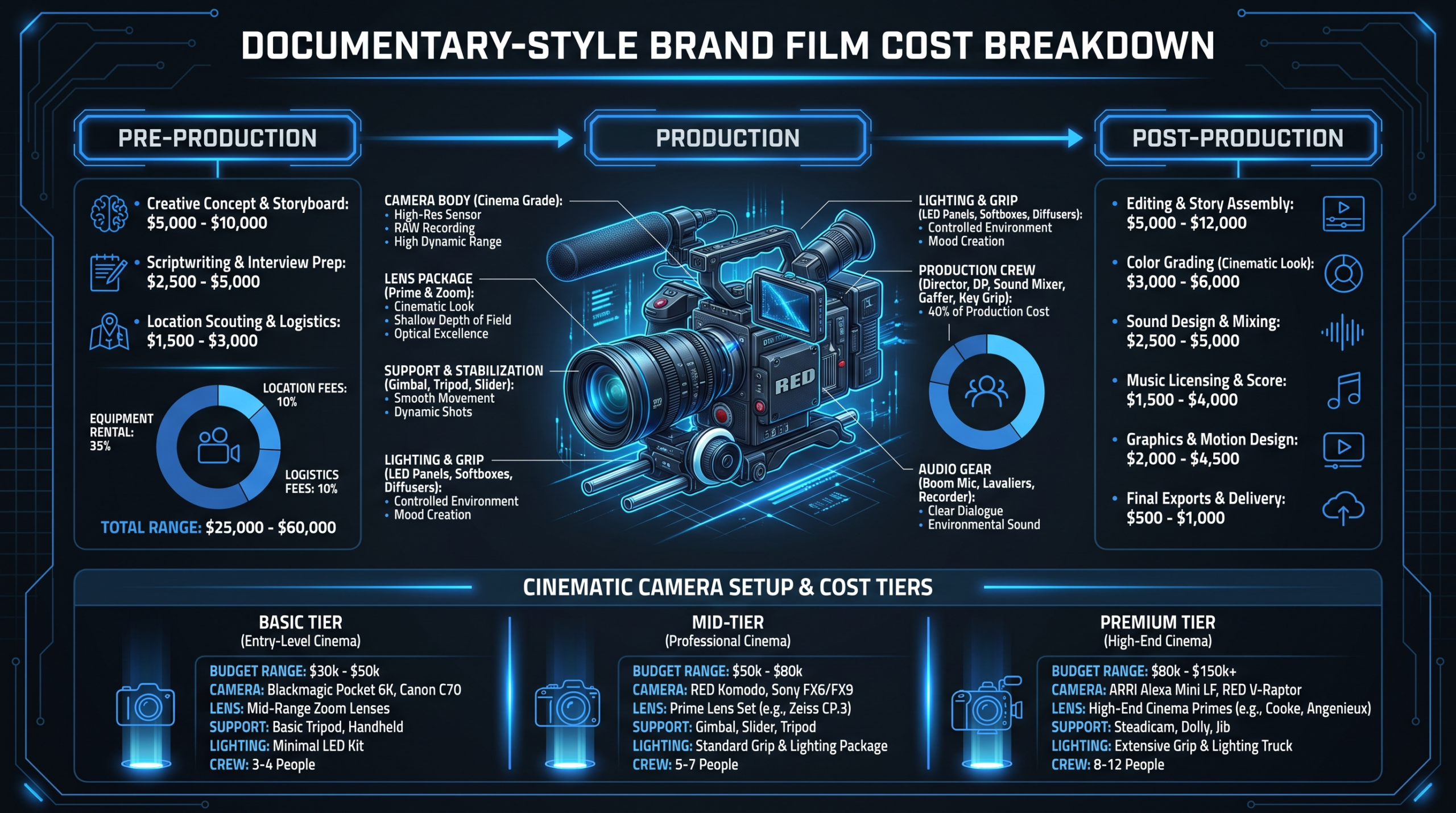
- Pre-Production Costs
- Production Costs: Crew, Gear, and Shoot Days
- Post-Production Costs: Where the Story Comes Together
- Phase-by-Phase Budget Breakdown
- Documentary Brand Film vs. Traditional Commercial
- How to Stretch Your Brand Film Budget
- FAQ
You have seen them — the three-minute films that follow a founder through the early years, or a customer solving a real problem with a product. They feel like mini-documentaries. They do not look like ads. And they consistently outperform traditional commercials for brand recall and emotional connection among B2B audiences.
They also cost more to produce — and the budget math is less intuitive than a standard explainer video or product demo. This guide breaks down exactly what documentary-style brand films cost, what drives that cost, where the largest inefficiencies hide, and how to get the most from your production investment.
What Makes a Documentary-Style Brand Film
A documentary-style brand film tells a real story in a non-scripted (or lightly scripted) format — using real people, real environments, and real footage rather than actors, sets, and polished ad-speak. The term "documentary style" refers to the production approach: handheld or cinema-verité camerawork, natural and available lighting, interview-driven narration, and footage of authentic moments rather than staged performances.
Common formats include:
- Founder story films: The origin, the why, the vision — often 3–8 minutes, built around interviews with the founding team and B-roll of early days or current work.
- Customer story documentaries: Deep-dive case studies following a real customer's journey with your product, typically 3–6 minutes. These are the most credible sales tool in B2B video.
- Culture films: Team, mission, and values stories — 2–4 minutes, used for recruiting, investor relations, and top-of-funnel brand building.
- Impact films: Social or environmental impact storytelling, often deployed for purpose-driven marketing or enterprise sales cycles.
- Mini-documentary series: Multiple episodes totaling 15–40 minutes of story content — more expensive upfront but highly efficient on a per-episode basis.
What separates these from polished brand commercials is the production philosophy: authenticity over perfection, story over selling, emotion over product features. That philosophy has direct cost implications — you need more shoot time, more footage, and more skilled editorial work to find the story inside real, unscripted material.
Brand Film Cost: Real Ranges by Budget Tier
Documentary brand film cost varies enormously depending on scope, geography, crew experience, and post-production depth. The ranges below reflect what B2B brands commonly report spending — not idealized figures from agency pitch decks.
Documentary Brand Film Cost by Budget Tier
| Budget Tier | Total Cost Range | What You Typically Get | Best For |
|---|---|---|---|
| Bootstrap | $8,000–$20,000 | 1–2 shoot days, 3–4 person crew, minimal B-roll, freelance editing | Seed-stage startups, internal culture films, proof-of-concept |
| Growth | $20,000–$55,000 | 2–3 shoot days, 5–7 person crew, professional color, licensed music, branded title cards | Series A–B SaaS, customer story films, founder narratives |
| Professional | $55,000–$120,000 | 3–5 shoot days, 8–12 person crew, cinema-grade gear, cinematic color grade, broadcast-quality sound design | Series B–C brands, investor relations films, market-launch documentaries |
| Premium / Cinematic | $120,000–$300,000+ | 5–10+ shoot days, 15+ person crew, multiple locations, animation inserts, festival-quality grade, distribution support | Public companies, major product launches, global brand campaigns |
These figures represent total production cost — pre-production through final delivery. Post-production alone (editing, color, sound, motion graphics) commonly accounts for 30–45% of the total in the Growth and Professional tiers, and can run higher when shooting ratios are generous (8:1 or more of raw footage to finished film).
For context on how documentary brand film costs sit relative to other video formats, see our breakdown of video production agency pricing models.
The 7 Cost Drivers That Determine Your Budget
A documentary brand film budget is not arbitrary — it is the sum of seven compounding variables. Understanding each one lets you make deliberate trade-offs instead of getting surprised by line items mid-production.
1. Shoot Days
The single largest cost lever. A standard shoot day with a professional crew commonly runs $5,000–$15,000 all-in (crew fees, gear rental, location costs, catering, and miscellaneous). Documentary-style films need more days than scripted commercials because you are capturing real moments rather than executing planned shots. A 3-minute documentary film may require 3–5 days of shooting to gather enough authentic, usable footage to tell the story well.
2. Crew Size and Roles
At minimum, a documentary crew needs a director/DP, sound recordist, and producer. A professional crew adds a second camera operator, gaffer (lighting), a field producer, and a production assistant. At the premium tier, you are looking at 12+ crew with dedicated roles for each department. Each person added to the crew typically costs $400–$2,500 per day depending on their role, experience, and market.
3. Interview Subject Logistics
Documentary films are built around real people. Coordinating executives, customers, or third-party subjects adds pre-production project management time. Most subjects do not receive talent fees (they appear voluntarily or are compensated by the business relationship), but executive subjects may require legal review of releases and scheduling across multiple time zones. Customer films that require on-site filming at the customer's location add travel budgets that can reach $5,000–$20,000 for domestic shoots and significantly more for international.
4. B-Roll Complexity
The footage that runs under the interviews — office environments, product in use, street scenes, archival material — drives shooting time and location costs. Simple B-roll in a single controlled location is inexpensive. Complex B-roll requiring drone footage, multiple locations, time-lapse sequences, archival licensing, or specialty camera rigs adds substantial cost to the production phase.
5. Post-Production Scope
Post-production for documentary-style work is more time-intensive than any other video format because editors must review hours of unscripted footage to find and build the story. A 3:1 shoot-to-edit ratio is achievable on tight productions; 8:1 or more is common on professional shoots. More raw footage means more editorial review time, which directly scales post-production cost. Additional post line items include professional color grading, sound design and dialogue cleanup, licensed music, motion graphics title packages, and multi-format deliverable exports.
6. Length of Final Film
A 90-second brand film and a 7-minute documentary require roughly similar shooting time — both formats need enough footage to tell a story authentically. But editing a 7-minute film takes substantially more post-production hours than a 90-second cut. For series work (3 episodes of 4 minutes each), you gain efficiencies in shooting by consolidating the production schedule, but each episode still demands a full editorial pass through post-production.
7. Deliverable Package
Most brands need more than one version of the film: the full-length hero film, a 60-second cut, a 30-second summary, vertical social edits (9:16 for LinkedIn and Reels), and possibly a silent captioned version. Each derivative cut adds editing time. Budget $500–$3,000 per derivative depending on length and complexity — and plan all of these before shooting, not after, to reduce rework.
Pre-Production Costs
Pre-production for documentary-style brand films is heavier than for scripted commercials — because there is no script. Instead, you are investing in story development, the phase where the editorial vision is established before a single camera rolls. Cutting this phase is the most common and most expensive mistake brands make.
Story Development and Treatment
Before shooting begins, an experienced documentary director or creative producer conducts discovery sessions with potential interview subjects, identifies the strongest story arc, writes a shoot treatment, and develops a shot list. This work commonly costs $2,000–$8,000 for a standalone film. Brands that skip or rush this phase routinely spend more in production and post-production chasing a story that was never properly scoped.
Casting and Subject Coordination
For customer story films, identifying and confirming the right customer as the primary subject — someone articulate, visually compelling, and willing to participate — takes producer time that is often invisible in budget line items. Add legal review of talent releases for executive subjects and scheduling coordination across stakeholders, and pre-production coordination typically adds $1,000–$4,000 to a professional production.
For examples of how real B2B companies have executed brand films across different budget tiers, see our brand video examples for B2B — 10 verified brand films with strategic breakdowns and cost context.
Location Scouting and Permits
Filming at your own offices is straightforward. Filming at a customer location, in a public space, or at a distinctive visual location for B-roll commonly requires permits, location fees, or both. Urban locations in major markets can require permits ranging from a few hundred dollars to several thousand per day. Factor location costs into the pre-production budget, not as an afterthought in production.
What Pre-Production Costs as a Percentage
Pre-production typically accounts for 10–20% of total brand film budget. For a $50,000 production, that is $5,000–$10,000 in story development, coordination, and logistics — money that directly reduces waste in the more expensive production and post-production phases.
Production Costs: Crew, Gear, and Shoot Days
Production is where the largest budget commitment happens — and where documentary-style brand films diverge most sharply from traditional video production cost assumptions. Here is what each line item actually costs in practice.
Director / Director of Photography
Documentary brand films live and die by the quality of the DP and director. An experienced documentary DP who understands brand storytelling — not just news-style run-and-gun or corporate talking-head work — commonly charges $1,500–$5,000 per day. If the director and DP are separate roles (common on larger budgets), their combined fees can reach $5,000–$10,000 per day. This is the single highest-leverage hire in the entire production; underinvesting here hurts the film more than underinvesting anywhere else.
Camera and Gear Package
A professional documentary kit — cinema camera, prime lens set, sound package, interview lighting — typically rents for $1,500–$4,000 per day. Premium productions may add a second camera body, a drone operator and FAA-compliant permit, a gimbal or slider, or specialty lenses for specific visual looks. Gear rental commonly represents 15–25% of total production cost and scales predictably with the number of shoot days.
Sound Recording
Professional sound is non-negotiable for interview-driven documentary work. Lavalier microphones for subjects, a boom for run-and-gun B-roll, and a dedicated sound recordist to manage levels in real environments commonly cost $600–$1,500 per day. Poor audio captured on set cannot be fully repaired in post-production and will permanently compromise the film's credibility regardless of how good the picture looks.
Production Cost by Tier
Here is how production costs compound across tiers:
- Bootstrap (1 shoot day): $5,000–$12,000 total production cost
- Growth (2–3 shoot days): $14,000–$32,000 total production cost
- Professional (4–5 shoot days): $35,000–$70,000 total production cost
- Premium (6+ shoot days, multiple locations): $70,000–$180,000+ total production cost
Production typically accounts for 40–55% of total brand film budget — the largest single phase in every tier.
Post-Production Costs: Where the Story Comes Together
Post-production for documentary brand films is the most editorial-intensive video format a production team will handle. The editor is not following a script — they are reviewing hours of raw interviews and B-roll, finding the strongest moments, building a narrative arc, and turning unstructured footage into a cohesive, emotionally compelling film. This work requires skill, experience, and time.
Editorial: Story Assembly Through Picture Lock
An experienced documentary editor begins by logging and reviewing all footage, then building a rough assembly cut driven by the most compelling interview exchanges. For a 3–5 minute film with 2–3 days of footage, a professional editor commonly needs 40–80 hours to reach an approved picture lock. At market rates of $75–$150 per hour for experienced documentary editors — higher in major markets — editorial alone can run $3,000–$12,000 on a professional production.
Color Grading
Documentary brand films require more nuanced color grading than scripted videos because footage is shot in real, inconsistent lighting environments — fluorescent office light in one shot, golden window light in the next. A professional colorist will create a cohesive visual look, match scenes shot across different locations and times of day, and apply the grade that reinforces the emotional tone of the story. Expect $1,500–$6,000 for color on a 3–5 minute film, more for longer or more complex projects.
Sound Design and Music Licensing
Sound design for documentary work includes dialogue cleanup (removing room noise, HVAC hum, traffic), level balancing across scenes, and music. Licensed music from a professional library runs $300–$2,000 per track depending on the license tier and platform rights needed. Custom composition for a 4-minute film ranges $2,000–$8,000. Budget $1,500–$5,000 total for sound on a growth-tier production.
Motion Graphics and Title Package
Lower-thirds identifying interview subjects, branded title sequences, and end cards are expected in professional brand films. A clean, on-brand motion graphics package for a 5-minute documentary commonly costs $1,500–$5,000 depending on complexity and whether the agency builds from scratch versus adapts an existing template.
Derivative Cuts and Format Delivery
The hero film is only one deliverable. Most brands need a 60-second version for paid social, a 30-second summary, vertical 9:16 edits for LinkedIn and Instagram, and a captioned version for autoplay environments. Each derivative cut typically adds $500–$2,000, and a full package of 4–5 cuts adds $2,000–$8,000 to the post-production budget.
For companies producing brand films or customer story content on a recurring basis, the most cost-effective path through post-production is a dedicated video editing team on retainer. See our how it works page for how VEC structures ongoing post-production for B2B SaaS companies.
Phase-by-Phase Budget Breakdown
Here is how budget typically allocates across the three phases for different documentary brand film tiers. Use this as a planning template before finalizing your production scope.
Documentary Brand Film: Budget Allocation by Phase
| Phase | Bootstrap (~$15K) | Growth (~$45K) | Professional (~$90K) | Premium (~$180K) |
|---|---|---|---|---|
| Pre-Production | $1,500–$2,500 | $5,000–$8,000 | $10,000–$16,000 | $20,000–$35,000 |
| Production | $8,000–$11,000 | $22,000–$30,000 | $45,000–$60,000 | $90,000–$120,000 |
| Post-Production | $3,500–$6,000 | $13,000–$19,000 | $24,000–$36,000 | $42,000–$65,000 |
| Contingency (10%) | ~$1,500 | ~$4,500 | ~$9,000 | ~$18,000 |
Planning note: Post-production's share of the total budget grows as overall spend increases — partly because larger shoots generate more raw footage that requires more editorial hours, and partly because premium productions demand higher-caliber finishing work. Brands that cut post-production budgets on professional shoots consistently underdeliver on the quality they paid for in production.
Documentary Brand Film vs. Traditional Commercial: Cost Comparison
A common planning question: is a documentary brand film more or less expensive than a traditional scripted commercial? The answer varies by format, but documentary films often offer a more favorable cost-per-impact ratio for B2B brands.
Documentary Brand Film vs. Traditional Commercial: Key Differences
| Factor | Documentary Brand Film | Traditional Commercial (30-sec scripted) |
|---|---|---|
| Pre-production | Story development, discovery interviews, minimal scripting | Full script, storyboard, casting, wardrobe, set design |
| Typical shoot days | 2–5 days (real-time capture across environments) | 1–3 days (tight scripted execution per shot) |
| Crew size | 4–12 people | 10–25+ people (more dedicated departments) |
| Talent costs | Low to none (real people, not professional actors) | $2,000–$50,000+ for union or professional talent |
| Post-production | Higher (editorial-driven story from unscripted footage) | Medium (follows the script with less assembly editing) |
| Total cost range | $20,000–$200,000+ | $30,000–$500,000+ (broadcast quality) |
| Content shelf life | 2–5 years (story-driven, doesn't date as quickly) | Typically 6–18 months before messaging becomes stale |
| Use cases | LinkedIn, YouTube, sales decks, investor presentations, website hero | Broadcast, paid digital, OTT pre-roll |
Documentary brand films frequently deliver a better cost-per-impact ratio for B2B brands because of their longer content shelf life and versatility across channels. A single well-produced customer story documentary can serve as LinkedIn organic content, a sales enablement asset, an investor deck slide, a website case study, and a conference presentation — multiple distribution channels from one production investment.
For a broader view of how documentary-style brand films fit into a B2B video content strategy, see our SaaS video production guide.
How to Stretch Your Brand Film Budget
You do not always have a $90,000 budget. Here is how to produce a credible, professional-quality documentary brand film at the growth tier — and how to stretch a professional budget further without compromising the authenticity that makes these films work.
Consolidate Locations to Reduce Shoot Days
Every additional location adds travel time, setup time, and potential permit or logistics costs. The strongest documentary brand films are often built around a single primary location with intentional, well-planned B-roll runs nearby — not multi-city shoots. Consolidating from three locations to one can save $10,000–$25,000 on a professional-tier production, funds better invested in stronger post-production.
Invest More in Pre-Production, Not Additional Shoot Days
An additional $3,000 in story development — proper discovery calls, a strong narrative treatment, a detailed shot list — means the crew spends less time figuring out the story on set. Better pre-production yields more usable footage per shoot day, directly reducing post-production review time. This is consistently the highest-return investment in a constrained budget.
Separate Production from Post-Production Vendors
Many brands overpay by using full-service production companies for post-production work at production-department rates. Shooting with a focused production team and routing footage to a specialized post-production partner often reduces total project cost by 20–35% at the professional tier. This separation also lets you maintain ongoing post-production relationships that build brand consistency across multiple productions — something full-service project-by-project vendors cannot provide.
This is exactly where VEC adds leverage. If you are producing two to four brand films or customer stories per year, VEC's Core plan ($9.5K/month) provides a dedicated team that handles editing, color grading, sound, and all derivative cuts on a monthly basis — turning variable post-production costs into a predictable operational expense. You retain full control of (or hire separately for) the production side; VEC owns everything from footage handoff through final delivery. See our pricing page for plan details and what is included at each tier.
Plan All Derivative Cuts Before Shooting
Editing derivative cuts is substantially cheaper when planned before the shoot than when added as an afterthought in post-production. Brief your production team that you need a 90-second version and vertical social cuts — they can capture with those formats in mind, reducing editorial rework and reframing in post. Unplanned derivatives that require going back to the footage commonly cost 30–50% more than planned versions.
Use Licensed Archival to Supplement Original Footage
Some of the most compelling documentary brand films blend freshly shot footage with licensed archival material — historical imagery, period stock footage, or contextual photographs that would be prohibitively expensive to recreate. Stock footage and photos can be licensed for $100–$500 per clip from major libraries, far less than sending a crew to capture equivalent material. This technique works particularly well for founder story films that want to evoke the era or geography of a company's origin.
According to Wyzowl's annual State of Video Marketing report, long-form storytelling video consistently produces stronger brand recall and engagement depth compared to short-form advertising — reinforcing the case for allocating meaningful budget to brand films rather than spreading the same dollars thin across ad units. Wistia's research on viewer engagement patterns (from their State of Video) similarly points to documentary-length content outperforming shorter formats on depth of engagement metrics, particularly for B2B audiences making considered purchase decisions.
For practical guidance on managing outsourced post-production, including how to structure feedback cycles to reduce revision rounds, see our guide to outsourcing video editing. For a breakdown of what professional post-production services typically include, see our video editing services overview.
Frequently Asked Questions
How much does a documentary-style brand film cost on average?
A professionally produced documentary brand film for a B2B company typically costs between $40,000 and $100,000 for a 3–5 minute piece. Bootstrap productions with minimal crew run $12,000–$22,000. Premium cinematic productions start around $120,000 and can exceed $300,000 for multi-day, multi-location projects. The most significant cost variables are the number of shoot days, crew size, and the depth of post-production — including how much unscripted footage requires editorial review to find the story.
What is the most expensive part of producing a documentary brand film?
Production — crew, gear, and shoot days — is typically the largest single cost, commonly 40–55% of total budget. Post-production is the most frequently underestimated phase: documentary editing requires reviewing hours of unscripted footage to construct a narrative, which takes substantially more editorial time than scripted commercial work where the editor simply executes a pre-approved cut. Budget at least 30–45% of your total for post-production, including editing, color, sound design, motion graphics, and derivative cuts.
Can a brand film be produced for under $20,000?
Yes, with tight scope management. A 1–2 minute film shot over a single day with a 3–4 person crew in one location can come in at $12,000–$20,000. The trade-offs are limited production value, minimal B-roll, and streamlined post-production. These budgets are viable for seed-stage companies or internal culture films where authenticity matters more than cinematic polish. At this budget level, pre-production planning is disproportionately important — a well-planned $15,000 film will outperform a poorly planned $35,000 film consistently.
Should post-production for a brand film be done in-house or outsourced?
For companies producing one or two brand films per year, hiring a dedicated in-house post-production editor rarely makes financial sense. Outsourcing gives you access to editors who work on documentary content regularly, not a generalist handling mixed workloads. For companies producing brand films or customer story content on an ongoing basis — three or more per year — a dedicated video editing team on retainer typically costs less per deliverable than project-by-project outsourcing, with the added benefit of building brand consistency across every piece of content over time.
How do I budget for a documentary brand film series with multiple episodes?
Series production offers meaningful economies of scale on the production side — consolidating crew and gear mobilization across multiple episodes in a single shoot block typically reduces per-episode production cost by 25–40% versus producing each episode on separate schedules. Post-production does not compress as favorably: each episode still requires its own full editorial pass, color grade, and sound work. The strategic move is to reinvest production savings back into post-production quality and derivative cuts, ending up with stronger individual episodes at a lower overall series cost than episodic production would deliver.
Need Post-Production for Your Brand Film?
VEC provides dedicated video editing teams for B2B SaaS companies — handling editing, color grading, sound, and derivative cuts on a monthly retainer. Growth plan starts at $5K/month. Guarantee: double your video output in 90 days or month 4 is free.
Book a Free Strategy Call See Pricing Plans