Recruiting and Employer Brand Videos: Guide
TL;DR
- Recruiting video production turns your employer brand into a scalable hiring asset that works when your recruiters are offline.
- The 6 core formats — culture films, employee testimonials, hiring manager intros, EVP films, process explainers, and DEI spotlights — cover every stage of the candidate journey.
- Authenticity beats polish: specific employee stories convert candidates better than scripted corporate video.
- Production costs range from $300–$800 DIY to $5K+/month from a dedicated agency team at volume.
- Outsource when you need 4+ videos/month or when production overhead is pulling HR and recruiting time away from hiring.
Table of Contents
- What Is Recruiting Video Production?
- Why Employer Brand Video Wins the Talent Battle
- The 6 Core Types of Recruiting and Employer Brand Videos
- Building Your Recruiting Video Production Workflow
- Employer Brand Storytelling: What Actually Works
- Recruiting Video Use Cases and Conversion Moments
- Cost and Budget Planning
- In-House vs. Outsourced Recruiting Video Production
- FAQ
What Is Recruiting Video Production?
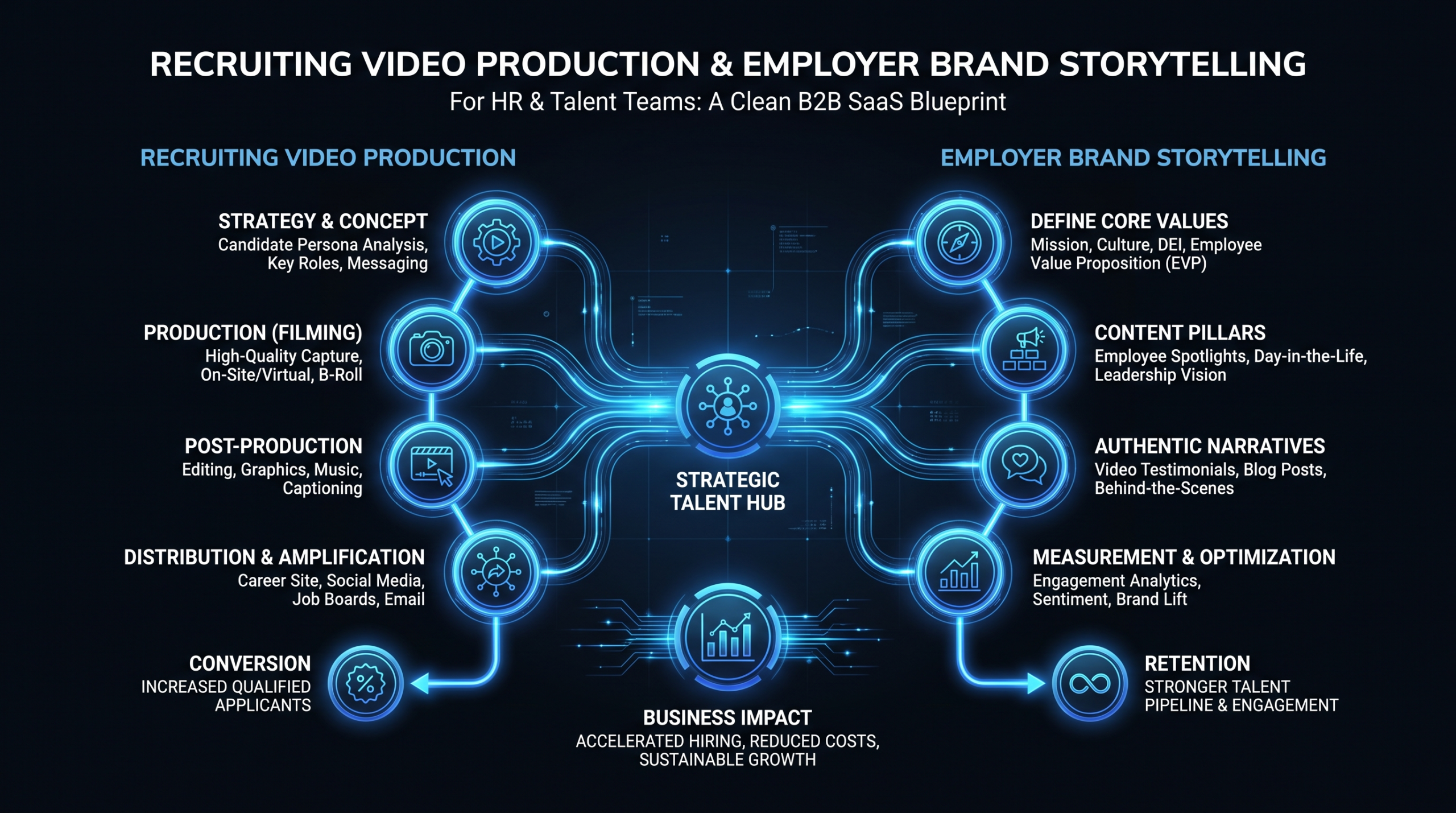
Recruiting video production is the process of planning, scripting, filming, and editing video content that supports a company’s talent acquisition and employer brand strategy. At its simplest, it is a job ad in video form. At its most sophisticated, it is a sustained content program — culture films, employee testimonials, hiring-manager intros, day-in-the-life series — that makes passive candidates choose you before a recruiter ever makes contact.
The distinction between “recruiting video” and “employer brand video” is subtle but operationally useful. A recruiting video serves an immediate conversion purpose: get someone to click apply for a specific role. An employer brand video builds long-term equity: it shapes how your company is perceived as a place to work. The most effective hiring content programs blend both — short-cycle recruiting ads for active candidates already searching job boards, and longer-form employer brand content for passive candidates who are not yet looking but could be persuaded.
For SaaS companies and high-growth tech teams competing for engineering, product, and marketing talent, this distinction matters because the two audiences behave very differently. Active candidates compare job posts and compensation bands. Passive candidates follow companies, watch culture videos, and often have a firm impression of your employer brand before they ever visit your careers page. Recruiting video production that only targets active candidates leaves the larger, more valuable passive pipeline untouched.
Effective recruiting video programs are also self-reinforcing over time. Each piece of content added to your library — a testimonial from an engineer who has since been promoted, a culture clip from a team that has grown, a hiring manager intro from a director who joined six months ago — compounds into a body of evidence that makes your employer brand feel real, not manufactured. That compounding effect is what separates companies with strong candidate pipelines from those that compete purely on salary and job-board spend.
Why Employer Brand Video Wins the Talent Battle
Video communicates tone, culture, and personality faster than any job description. A text-based careers page tells candidates what you do. A 90-second culture video shows them who you are — the pace of work, how people communicate, whether leadership sounds human or scripted, whether the environment matches what the job post describes. That gap between telling and showing is where employer brand video earns its keep.
The competitive dynamics here are real and measurable in recruiting outcomes. In markets where similar roles post at similar salaries — SaaS engineering, senior product, growth marketing — how a candidate feels about your company in the first 60 seconds of a LinkedIn ad or careers-page video can determine whether they spend 20 minutes on an application or click away to a competitor. HR and talent leaders at LinkedIn Talent Solutions have documented the employer brand premium: companies with strong employer brands commonly report better candidate quality and more referral-driven applications, though exact results vary significantly by role, seniority, and market.
Video also works harder per dollar over time than paid job posts. A well-produced culture video placed on your careers page, LinkedIn company page, and in recruiter outreach email sequences continues generating candidate interest long after the production cost is amortized. A sponsored job post stops working the moment you stop paying. For SaaS companies with always-on hiring programs, the asymmetry between recurring ad spend and one-time video production cost is one of the strongest financial arguments for investing in a recruiting video library.
There is also a signal quality effect. Candidates who arrive at your careers page via an employer brand video have typically already self-qualified — they watched 60 or 90 seconds and continued. That pre-qualification means video-influenced applicants often require fewer screening calls and convert to onsite interviews at higher rates. The cost-per-qualified-candidate math shifts in your favor even when the cost-per-click does not.
For broader SaaS video strategy, our guide on SaaS video production covers the full funnel from demand generation through recruiting and customer success.
The 6 Core Types of Recruiting and Employer Brand Videos
Most employer brand video programs draw from the same six formats. Understanding what each does — and when to deploy it — prevents overproduction of formats that do not move the needle for your specific hiring goals.
1. Culture / “About Us” Videos
The foundational employer brand piece: what it is actually like to work at your company. Typically 90 seconds to 3 minutes. Features a cross-section of employees, touches on values and team dynamics, and gives candidates a feel for the physical or remote work environment. Best placed on your careers page homepage and LinkedIn About section. This is usually the first video a recruiting content program should produce — every other format builds on the foundation it establishes.
2. Employee Testimonial / Day-in-the-Life Videos
Role-specific testimonials where an engineer, designer, or sales rep walks through their actual workday and motivations. These convert because they are specific. “I ship features directly to 50,000 users and see the impact in real time” resonates with an engineering candidate far more than “We have a collaborative engineering culture.” One well-structured testimonial from a senior engineer targeting other engineers is worth more than a generic culture video shown to the same audience.
3. Hiring Manager Intro Videos
A 60–90 second video where the hiring manager explains the role, the team context, and what they are actually looking for. Reduces candidate uncertainty dramatically and improves application quality — candidates self-select in or out based on accurate information rather than guessing from a job description. This format is low-cost to produce (minimal editing required) and has a short shelf life by design; update it each time the role reopens.
4. EVP (Employer Value Proposition) Film
A more produced, brand-level piece — typically 2 to 4 minutes — that articulates why someone should choose your company over a direct competitor. Covers compensation philosophy, growth paths, benefits, and culture through narrative rather than a bulleted list. This is your highest-investment, highest-reach format. Produce it once per major company lifecycle phase (post-Series A, post-Series B, major rebrand) and distribute across every candidate touchpoint simultaneously.
5. Candidate Experience / Recruitment Process Explainer
Reduces drop-off through the hiring funnel by demystifying your interview process. Walks candidates through the stages, what to expect from each round, and how decisions are made. Particularly valuable for competitive senior roles where candidates are evaluating multiple companies simultaneously — reducing uncertainty at each stage keeps you in consideration longer and reduces ghosting from candidates who got confused about next steps.
6. DEI Spotlights
Authentic representation matters for candidates from underrepresented groups evaluating whether they will belong at your company. DEI videos featuring employees speaking candidly about their experience — not reading from corporate talking points — build trust that a diversity statement on a careers page cannot. These perform best as a short-form series (60–90 seconds each) rather than one long omnibus piece. Produce four to six spotlights across different functions and backgrounds rather than a single “diversity video” that tries to represent everyone at once.
Recruiting Video Type Comparison
| Video Type | Best Use Case | Typical Length | Best Channels | Production Effort |
|---|---|---|---|---|
| Culture / About Us | Careers page, LinkedIn About | 90 sec–3 min | Web, LinkedIn, social | Medium |
| Employee Testimonial | Role-specific pages, paid ads | 60–120 sec | LinkedIn ads, careers page | Low–Medium |
| Hiring Manager Intro | Job listings, recruiter outreach | 60–90 sec | LinkedIn, email sequences | Low |
| EVP Film | Awareness campaigns, brand-level | 2–4 min | Careers page, LinkedIn, events | High |
| Process Explainer | Post-application nurture | 2–3 min | Email, careers page | Medium |
| DEI Spotlights | Targeted candidate audiences | 60–90 sec each | LinkedIn, paid social, web | Low–Medium |
Building Your Recruiting Video Production Workflow
Consistent recruiting video output requires a repeatable production process, not a series of one-off projects managed reactively. The five-step workflow below works whether you are producing two videos a month or two a week, and whether production is fully in-house, fully outsourced, or hybrid.
Step 1 — Define the Talent Problem First
Start with a specific talent challenge, not a video concept. “We struggle to fill senior engineering roles because candidates do not understand our technical depth” or “Our DEI recruiting pipeline is weak in certain regions” — that clarity shapes format choice, story selection, and distribution before a camera is turned on. Recruiting video produced without a defined talent problem tends to feel generic and perform poorly with every audience because it is trying to say everything to everyone.
Step 2 — Script and Storyboard
For structured formats like EVP films and process explainers, a proper script prevents expensive reshoots. For testimonials and day-in-the-life content, a loose interview guide with five to eight specific questions produces better results than a script — employees sound more natural when they are not reading. Storyboard the opening and closing beats even for unscripted content. The first 10 seconds determine whether a candidate stays or scrolls; plan them deliberately.
Step 3 — Source Employee Stories
Identify employees willing to appear on camera. Give them the questions in advance and brief them on the key message without over-scripting. The goal is specific, authentic stories — “I joined because of the infrastructure challenge, and a year later I was leading architecture decisions on the data pipeline” — rather than company-summary statements. Employees who are comfortable but not rehearsed come across as trustworthy, which is the one signal candidates most want to verify before applying.
Step 4 — Film or Record Remotely
For fully remote or distributed teams, high-quality remote recording is a practical option today. Tools like Riverside.fm and Descript record individual video and audio tracks at local quality, eliminating the compressed look of a standard video call. For in-person content, a mirrorless camera, a quality lavalier microphone, and a simple three-point lighting setup produce broadcast-quality results at a manageable per-session cost.
Step 5 — Edit, Review, and Distribute
Post-production typically takes two to three times the filming time for well-structured content. Editing covers cutting for story, color grading, lower-thirds with names and titles, and music licensing. Review cycles with HR and legal are standard for recruiting content — budget an extra three to five business days. Then distribute across your careers page, LinkedIn company page, recruiter outreach email sequences, and targeted paid social. Filming one piece and distributing it across four channels multiplies the value of every production dollar spent.
Employer Brand Storytelling: What Actually Works
The single biggest mistake in employer brand video is optimizing for corporate polish at the expense of authenticity. Candidates are experienced content viewers who have watched enough recruitment video to immediately recognize when an employee is reading from a prompter, when a “real” culture video was staged in a rented loft, and when talking points have been legal-reviewed to within an inch of their life. That recognition destroys trust faster than bad production values.
What converts candidates in recruiting video:
- Specific stories, not general claims. “I shipped a feature in my second week that went to 40,000 users” outperforms “We move fast and trust our engineers” in every audience test worth running.
- Real locations and real moments. Actual office spaces, real team interactions captured with consent, even the whiteboard covered in half-erased diagrams — these signal authenticity in ways a polished branded set cannot replicate.
- Genuine variety in representation. Showing employees across tenures, functions, and backgrounds reads as trustworthy. A video where every employee delivers the same three talking points in the same order is a signal that the authentic experience may be different from what is being presented.
- Honesty about trade-offs. Companies that acknowledge the pace, the accountability expectations, or the stage-of-growth realities are more trusted by sophisticated candidates, not less. Candidates who self-select out based on accurate information are positive outcomes — they would have churned within the first six months.
Production quality has a floor but not a ceiling. Shaky handheld footage with muddy audio loses candidates immediately. A competently lit, clearly recorded employee testimonial shot on a modern smartphone beats a cinematic brand film with scripted dialogue from employees who look like they are reciting their one-year performance review.
For SaaS companies specifically, the most effective employer brand content tends to originate from product and engineering teams rather than from HR producing corporate video. Empower technical employees to share what they are actually building, what problems they solved last quarter, and why the technical challenges attracted them. That is the content that gets shared by candidates to their networks — an organic distribution effect no paid media budget can replicate.
Recruiting Video Use Cases and Conversion Moments
Recruiting video works across every stage of the candidate journey — from initial awareness through offer acceptance. These are the highest-value placements for each format.
Careers Page Homepage
Your careers page is your highest-intent employer brand property. Candidates who land there are already considering you. A 90-second culture video above the fold consistently outperforms a wall of text in time-on-page and application start rates. The video should answer the question every candidate asks first: what is it actually like to work here? Avoid the temptation to also embed role-specific videos, a CEO welcome message, and an office tour on the same page — one strong piece of content with a clear next action outperforms five competing videos.
LinkedIn Job Posts and Sponsored Ads
LinkedIn allows video in both organic posts and sponsored content. Short-form content — 60 to 90 seconds — targeting specific functions outperforms generic company content in click-through and application rate on paid campaigns. Role-specific testimonials shown to engineering candidates, or product manager day-in-the-life clips shown to product candidates, tend to outperform culture-generic content significantly. For video measurement frameworks applicable to recruiting content, Wistia’s resources on video engagement analysis provide a useful starting methodology even outside a pure marketing context.
Recruiter Outreach Email Sequences
A video thumbnail in a recruiter outreach email stands out in a candidate inbox crowded with identical InMail templates. A personalized 30-second intro from the recruiter combined with a link to a 90-second culture video is a compelling first-touch combination for passive candidates who receive dozens of outreach messages weekly. For senior roles where the best candidates are rarely actively looking, this differentiation is often what determines whether someone replies at all.
Post-Application Nurture
After a candidate applies, there is commonly a communication gap before the first screening call. A two-minute “here is what to expect in our process” video sent immediately after application confirmation reduces candidate anxiety, reduces drop-off at the first screening stage, and signals that the company values the candidate’s time. For competitive senior roles where candidates are simultaneously in processes at three or four companies, staying visible between your own stages is a meaningful competitive advantage.
Job Description Pages (Role-Specific Videos)
Embedding a hiring manager intro video directly on a job description page addresses the most common candidate uncertainty: what does this role actually involve day-to-day, and who would I be working with directly? A brief, direct video from the hiring manager — filmed in 30 minutes with minimal editing — has the potential to improve application quality significantly even when raw application volume changes. Candidates who apply with realistic expectations tend to progress further through the funnel and accept offers at higher rates, which is the outcome that matters most for the recruiting team’s conversion metrics.
Cost and Budget Planning
Recruiting video production costs span a wide range depending on format complexity, production approach, and vendor type. Here is what to expect at each tier and how to model the investment against recruiting outcomes.
DIY / Internal Production
Teams with a content or social media function can produce testimonials and hiring manager intros for $300–$800 per video, with equipment amortized and editing done in-house. The minimum viable quality threshold: a clean background or branded environment, a decent microphone (USB condenser or lavalier), and basic three-point lighting. Editing adds three to eight hours per video depending on complexity. This approach works well for high-frequency, low-complexity formats but typically struggles with EVP films and anything requiring significant post-production depth.
Freelance Production
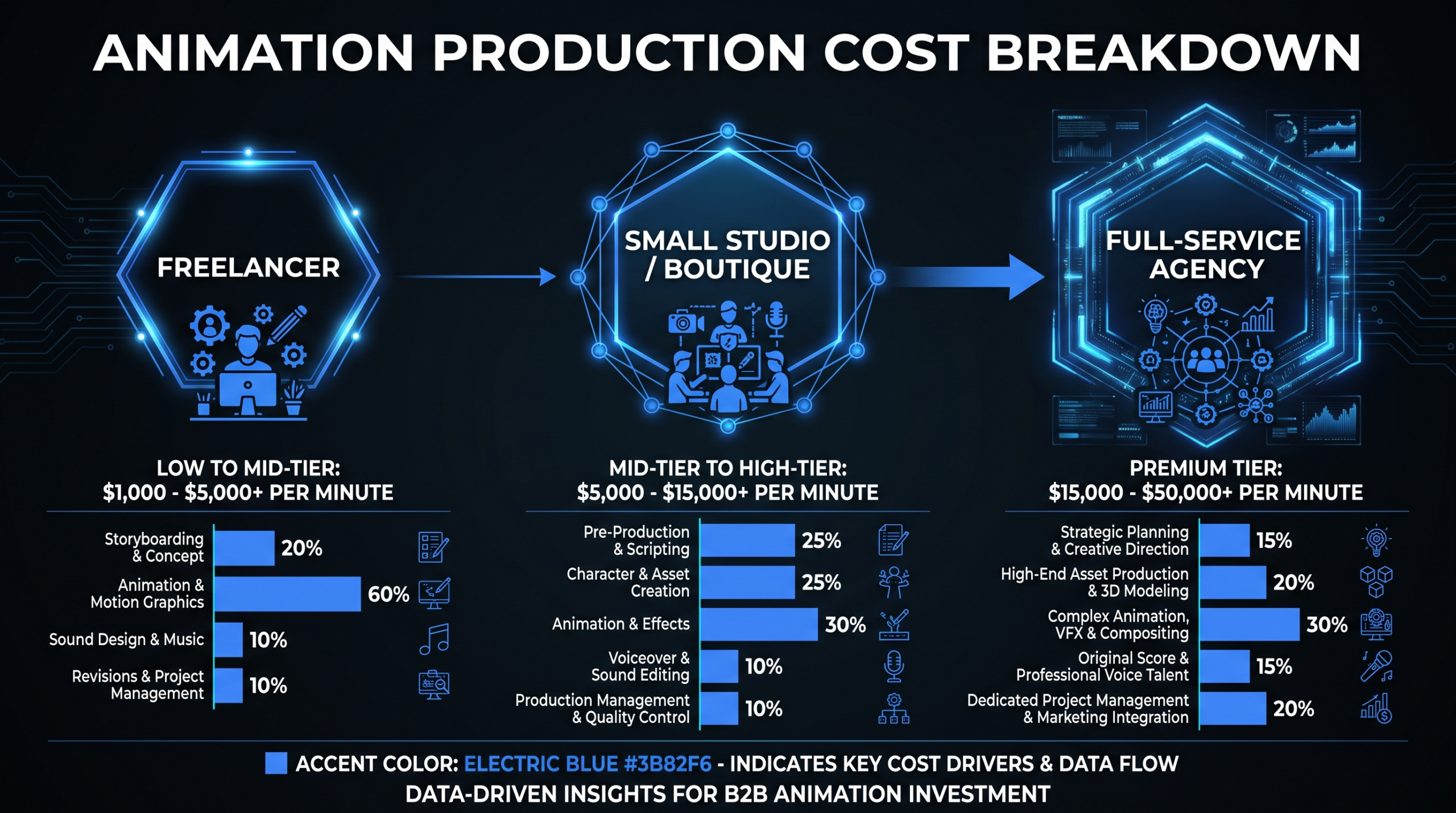
An experienced freelance video producer handles scripting guidance, filming, and editing. Rates for experienced freelancers typically run $50–$150 per hour, with a testimonial video commonly requiring six to fifteen hours of total production time. Expect $500–$3,000 per finished piece depending on scope, location, and complexity. For a detailed breakdown of what drives per-minute editing costs, our video editing cost per minute guide covers the underlying math across freelancer tiers and geographies.
Agency or Dedicated Team
Full-service production companies or dedicated video editing teams handle the complete workflow — scripting, filming direction, editing, and distribution guidance. Costs range from $2,000–$10,000+ per finished piece for one-off projects. At volume — four or more videos per month — a dedicated team arrangement typically offers significantly better per-video economics than per-project pricing. Our video production agency pricing models guide covers the full cost comparison across per-project, retainer, subscription, and dedicated team models.
For teams considering a dedicated video editing partner for their recruiting content program at scale, VEC’s plans — Growth at $5K/month, Core at $9.5K/month, Scale at $16K/month — are built for SaaS marketing and HR teams that need consistent, branded output without the overhead of hiring full-time editors. See our pricing page for the full plan breakdown and what is included at each tier.
In-House vs. Outsourced Recruiting Video Production
The decision to build internal recruiting video capability versus outsourcing comes down to three factors: monthly volume, consistency requirements across a growing content library, and where your team’s time is best spent. Here is a direct framework for making the call.
Build In-House When
You are producing one to two videos per month, have a content or social media team with basic video editing competency, and your format needs are relatively simple — talking-head testimonials, Loom-style hiring manager intros, quick culture clips. In-house production also makes sense when recruiting content requires rapid turnaround and close access to employees across multiple locations; briefing an external team adds coordination time that does not always fit an agile hiring process or a recruiter’s timeline.
Outsource When
You need more than three to four finished videos per month. You need consistent quality across a growing recruiting content library without adding headcount to your marketing or HR team. Your format needs are expanding into higher-production content — EVP films, multi-location shoots, animated overlays for employer brand campaigns. Or — and this is the most common trigger — your HR and recruiting team is spending meaningful time managing video production logistics instead of managing candidate relationships and hiring decisions.
The Hybrid Model
Most scaling teams land here: in-house for fast, low-stakes content (hiring manager Loom videos, informal culture clips posted to LinkedIn the same week they are filmed) plus an outsourced partner for high-shelf-life, produced content (EVP film, careers page hero video, DEI spotlight series). This gives you velocity for time-sensitive recruiting content and editorial quality for the content that will represent your employer brand for the next 18 to 24 months.
For teams starting the outsourcing conversation, our guide on how to outsource video editing covers the handoff process, brief templates, and how to evaluate whether a video agency is set up for employer brand content specifically. Learn more about how VEC structures dedicated team engagements for HR and recruiting content programs on the how it works page.
Recruiting Video Production: In-House vs. Outsourced
| Factor | In-House | Freelancer | Dedicated Agency Team |
|---|---|---|---|
| Typical per-video cost | $300–$800 | $500–$3,000 | $1,000–$5,000 (at volume) |
| Time to first video | 1–2 weeks | 1–3 weeks | 2–4 weeks (onboarding) |
| Brand consistency | Variable | Variable | High (dedicated editors) |
| Scalability | Limited by headcount | Medium | High |
| Editorial oversight | Internal, ad hoc | Depends on freelancer | Structured QA |
| Best for | ≤2 videos/month | 2–4 videos/month | 4+ videos/month |
Frequently Asked Questions
What makes a recruiting video effective?
Specificity and authenticity. The most effective recruiting videos feature real employees sharing concrete stories — actual projects, meaningful decisions, honest trade-offs — rather than summarizing company values in the abstract. Production quality matters up to a threshold: clean audio and stable framing are non-negotiable, but authentic specific content consistently outperforms polished but generic video in candidate engagement and application conversion.
How long should employer brand videos be?
For LinkedIn and paid social: 60–90 seconds for testimonials and culture content, 30–45 seconds for role-specific ads. For careers page hero videos: 90 seconds to 3 minutes. For EVP films: 2–4 minutes. Attention data consistently shows the first 10 seconds are decisive regardless of total length — if the hook is weak, additional runtime does not recover the viewer’s attention. Lead with your strongest specific story or clearest promise.
What does recruiting video production cost?
DIY with an internal content team: $300–$800 per video excluding equipment. Freelance production: $500–$3,000 per video depending on scope and experience level. Dedicated agency team at volume: plans typically start around $5,000 per month for a structured recruiting content program. For a full cost breakdown by model, see our video production agency pricing models guide.
How often should employer brand video content be updated?
Culture and EVP films should be refreshed when material company changes occur — significant headcount growth, a rebrand, a major shift in work model such as moving from fully in-person to hybrid. Hiring manager intro videos should be updated each time the role reopens. Employee testimonials age reasonably well as long as the subjects are still with the company — a 24-month-old testimonial from an employee who has since been promoted is often still useful, because the career trajectory itself is part of the story candidates want to see.
Can the same recruiting video be used on LinkedIn and on our careers page?
Yes, with format adjustments. LinkedIn content should be caption-optimized since most candidates watch without sound on mobile, and performs best at 60–90 seconds for organic content. Your careers page can support longer-form, higher-production content with autoplay sound. The most cost-efficient approach: produce a primary version (2–3 minutes for the careers page) and edit a 60–90 second social cut during the same post-production session. The additional edit typically adds marginal cost compared to re-shooting the content entirely.
For budgeting, our guide to employer brand video cost lists typical 2026 ranges by format.
Ready to Build Your Recruiting Video Program?
VEC works with SaaS marketing and HR teams to produce employer brand video at scale — dedicated senior editors, consistent output, and a guarantee: double your video output in 90 days or month four is free.
Book a Free Strategy Call View Pricing