Video Production for Ecommerce: 2026 Guide
TL;DR
- Six core video types drive ecommerce results: product videos, UGC, unboxing, social ads, lifestyle content, and review videos — each serving a distinct funnel stage.
- UGC vs. studio is a false choice at most scales. Brands that grow fastest run both in parallel: studio content for PDPs and brand credibility, UGC for paid social.
- Production approach should match your marketing spend tier: early-stage brands should prioritize UGC and simple product videos; growth-stage brands need studio + UGC mix; scale-stage brands require a systematic content engine.
- Cost ranges vary widely by format: a single product video can range from a few hundred dollars (UGC creator) to $5,000–$15,000 (full studio shoot). Knowing what drives those costs is how you avoid overpaying.
Table of Contents
- The Ecommerce Video Landscape in 2026
- 6 Core Ecommerce Video Types — and When to Use Each
- UGC vs. Studio Production: The Real Trade-offs
- Choosing Your Production Approach by Company Scale
- Cost Ranges for Ecommerce Video Production
- Building a Full-Funnel Ecommerce Video Strategy
- Common Mistakes Ecommerce Brands Make with Video
- FAQ
Ecommerce brands live and die by their ability to get customers to understand a product without touching it. Video closes that gap faster than any other format — and the brands that figure out a sustainable video production system at their stage of growth have a structural advantage over those that treat video as an occasional project.
This guide covers the full landscape: the six types of ecommerce video that actually move metrics, the real trade-offs between UGC and studio production, a buyer's framework for choosing your approach at different scales, and honest cost ranges so you can plan a budget that makes sense. No invented statistics — hedged, real-world framing throughout.
The Ecommerce Video Landscape in 2026
Ecommerce video production has splintered into distinct categories that serve different jobs. What was once "product video" now encompasses everything from 6-second TikTok ads to long-form unboxing content, creator-driven UGC, and cinematic lifestyle films. Each format has a specific role in the buyer journey, a specific production model, and a specific cost structure.
The brands that struggle with video usually make one of two mistakes. Either they treat every video format the same — commissioning expensive studio shoots when UGC would perform better on paid social, or relying solely on creator UGC when their product category demands credibility-building polished content. Or they produce video episodically rather than systematically, creating bursts of content followed by months of silence.
The brands that get video right understand two things: the job-to-be-done for each format, and the production model that makes consistent output financially sustainable at their current scale. This guide gives you both frameworks.
6 Core Ecommerce Video Types — and When to Use Each
Each of these formats serves a specific buyer-journey stage and performs best in specific placement contexts. Knowing which to prioritize for your product category and audience is where strategy starts.
1. Product Demo Videos
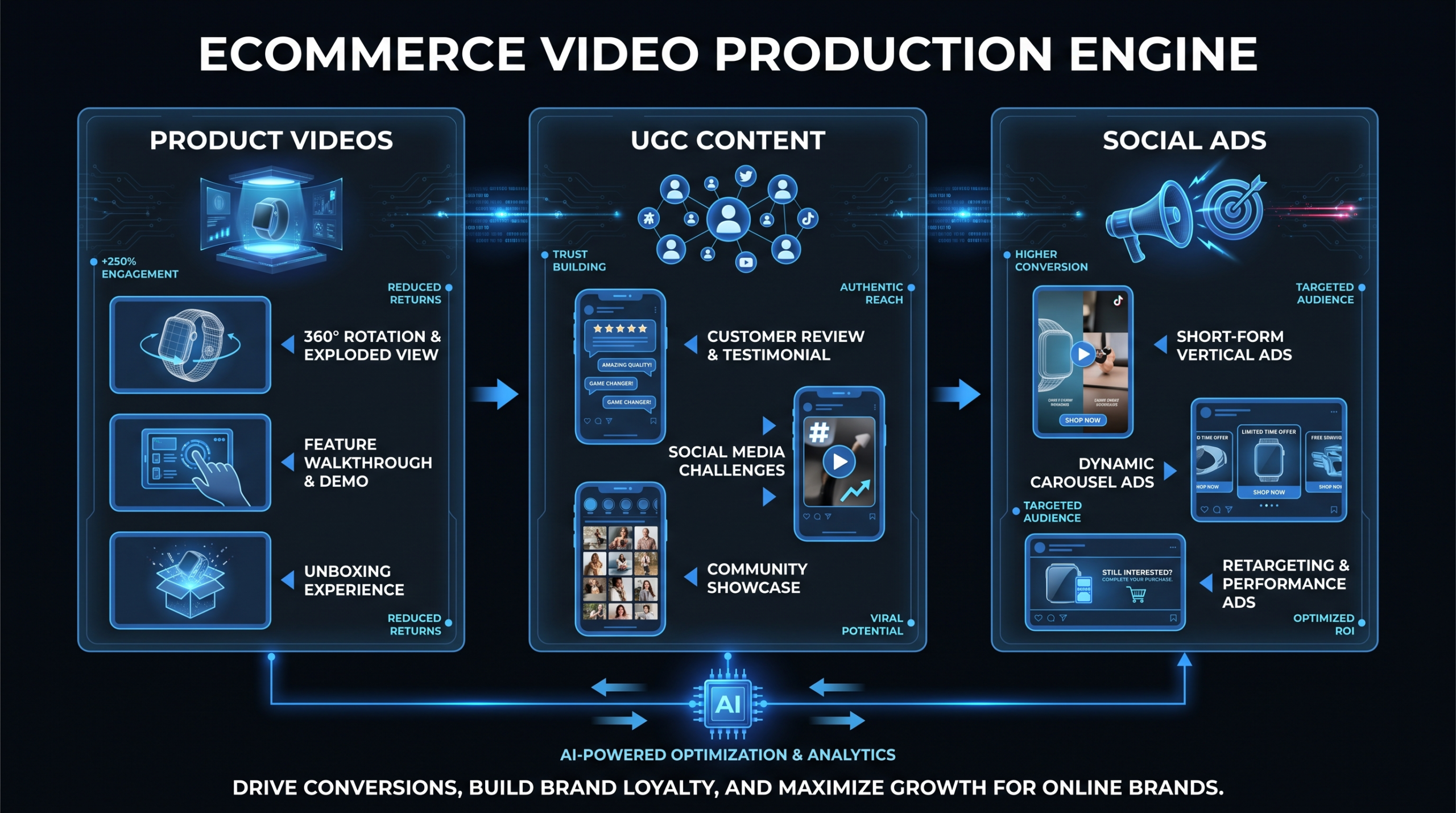
Product videos show the item in use, demonstrate its key features, and answer the "how does this actually work?" question. They're the highest-ROI format for most ecommerce categories because they directly replace the in-store experience and reduce return rates.
A strong product video for ecommerce is typically 30–90 seconds, shot from the customer's perspective (not the brand's), and focused on benefits over features. The most effective ones open with a problem recognition moment, show the product solving it, and end with a clear product close.
Best placements: Product detail pages (PDPs), retargeting ads, email sequences, Amazon listings.
Production approach: Studio or semi-studio. This is one format where production quality signals product quality — sloppy execution undermines trust.
Volume cadence: One primary video per SKU, plus variations for key audience segments. See our guide to product demo video production for detailed scripting frameworks.
2. User-Generated Content (UGC)
UGC — video created by real customers or paid UGC creators in an authentic, unpolished style — has become the dominant format for paid social advertising across Meta, TikTok, and YouTube Shorts. It outperforms studio-produced creative in many paid channels because it bypasses ad fatigue: it looks like organic content, not an advertisement.
Modern UGC for ecommerce is typically coordinated through platforms like Billo, Insense, or Minea, or sourced directly from a roster of vetted creators. The brand provides the product and a brief; the creator films on their own device in their own environment.
Best placements: Paid social (Meta, TikTok), organic social, influencer repurposing, top-of-funnel awareness.
Production approach: Creator-led. Not studio. The unpolished look is the point.
Volume cadence: High volume, frequent testing. Ecommerce performance marketers commonly iterate through 10–30+ UGC variants per quarter to find winning creative.
3. Unboxing Videos
Unboxing content captures the first-open experience — the tactile, emotional moment of receiving a package. It works in two ways: organic unboxing (on YouTube/TikTok, which builds SEO and brand discovery) and brand-produced unboxing (for PDPs and post-purchase email flows that reduce buyer's remorse and increase repeat purchase rates).
Brands with premium packaging or subscription boxes particularly benefit from unboxing content because the packaging itself becomes part of the product experience. A well-produced unboxing video communicates care, craftsmanship, and brand identity before the product is even revealed.
Best placements: YouTube organic, TikTok, PDP secondary media, post-purchase emails.
Production approach: UGC-style for organic (authentic = trustworthy); semi-studio for PDP use (controlled but not clinical).
Volume cadence: One or two per product launch, then organic creator programs to build volume.
4. Social Ads (Paid Video Creative)
Paid video ads are a category of their own because the production brief is dictated by the channel and objective, not by the product. A Meta Reels ad has different creative requirements than a YouTube in-stream pre-roll, which differs again from a TikTok Spark Ad.
The key production discipline for social ads is volume and variation. A single video creative fatigues a target audience within days at meaningful spend levels. High-performing ecommerce brands treat social ad video like a systematic creative testing program: produce many variants (different hooks, different formats, different creators), test rapidly, scale winners, and refresh continuously.
Best placements: Meta (Reels, Stories, Feed), TikTok, YouTube Shorts/pre-roll, Pinterest Video.
Production approach: Mix of UGC and lightweight studio (motion graphics, product cutdowns, testimonial edits). Speed-to-market matters more than polish in most paid channels.
Volume cadence: Ongoing. Think of this as a production pipeline, not a project.
5. Lifestyle and Brand Videos
Lifestyle videos show the product in its natural habitat — the aspirational world where the customer imagines themselves after purchase. They're less about product features and more about identity and belonging. A fitness brand shows athletes training at dawn, not close-ups of the garment seams.
Lifestyle video tends to require the highest production investment: real locations, professional talent or influencers, cinematography that creates a distinct visual world. The payoff is brand equity and strong upper-funnel performance for new audience acquisition.
Best placements: Homepage hero, brand awareness campaigns, YouTube long-form, brand YouTube channel, PR.
Production approach: Studio or director-led production with location scouting, professional talent, and post-production color grading.
Volume cadence: Quarterly or campaign-based. Lower volume, higher investment per piece.
6. Customer Review and Testimonial Videos
Review videos — whether organic customer testimonials, paid creator reviews, or brand-produced case studies — provide social proof at decision-critical moments. They answer the "does this actually work for someone like me?" question that product demos can't fully address.
The most effective review videos feature a recognizable problem statement from a believable customer, specific results (not vague praise), and a moment of product interaction. The format doesn't have to be polished — authenticity carries more weight than production value here.
Best placements: PDP below the fold, retargeting ads to mid-funnel audiences, email nurture sequences, checkout pages (to reduce cart abandonment).
Production approach: UGC-style or lightly produced. Over-production kills believability.
Volume cadence: Build an ongoing capture program. Collect reviews from high-retention customers systematically, not one-off.
UGC vs. Studio Production: The Real Trade-offs
The UGC vs. studio debate is often framed as a binary — pick one, commit. In practice, the brands with the most effective video programs run both in parallel, using each where it wins. The question isn't which is better; it's which is right for which job.
UGC vs. Studio: Head-to-Head Comparison
| Dimension | UGC Production | Studio Production |
|---|---|---|
| Cost per video | $100–$800 per creator brief (platforms); free if organic | $1,500–$15,000+ depending on scope |
| Production speed | 3–7 days from brief to delivery | 2–6 weeks for full studio shoot |
| Brand control | Low — creator interprets the brief | High — you direct every frame |
| Paid social performance | Typically stronger — bypasses ad fatigue | Variable — can feel like an ad |
| PDP / brand page use | Weak — authenticity reads as low quality | Strong — signals product quality |
| Scale / iteration speed | Very high — easy to brief 10–20 creators simultaneously | Low — each shoot is a project |
| Consistency | Low — each creator has a different style | High — controlled environment |
| Best for | Paid social, TikTok organic, testimonials | PDPs, brand campaigns, YouTube hero content |
The practical implication: if your marketing budget is being allocated between the two formats, weight UGC heavily for acquisition channels (paid Meta/TikTok) and studio production for conversion assets (PDP, email, YouTube). Both earn their place in a mature ecommerce video program.
One nuance that often gets missed: hybrid production sits between the two. This is where a UGC-style creator brief is combined with a structured shot list and professional audio equipment — you get the authentic look of UGC with tighter control over the product shots that matter. For direct-to-consumer brands in competitive categories, this hybrid approach often outperforms pure UGC and costs significantly less than full studio.
Choosing Your Production Approach by Company Scale
The right production model depends heavily on where you are in your growth curve. A bootstrapped DTC brand on $30K/month revenue has entirely different production priorities than a Series B ecommerce company spending $500K/month on paid acquisition. Here's a framework for thinking about it by tier.
Early Stage: Under $500K Annual Revenue
At this stage, production budget is limited and creative testing matters more than polished execution. The priority is finding what resonates with your audience before investing in high-production content.
Production priorities:
- One solid hero product video per core SKU (can be semi-studio or founder-led authentically)
- UGC from 3–5 creators to test multiple hooks and angles for paid social
- Organic social content shot on a capable smartphone with good lighting
- Customer review video capture program (incentivize with discount or product credits)
Approach: Lean on UGC platforms for paid social content. Consider a video editing partner to repurpose your best-performing organic content into ad formats rather than shooting new content from scratch.
Budget expectation: $1,000–$5,000/month across production and editing. Prioritize iteration speed over production quality.
Growth Stage: $500K–$5M Annual Revenue
At growth stage, you've validated your product-market fit. The job shifts from testing to scaling: finding the creative combinations that reliably drive customer acquisition and systematizing their production.
Production priorities:
- Studio product video shoot for each core product line (annual or semi-annual)
- Ongoing UGC program with 10–20+ creator briefs per month
- Structured creative testing cadence for paid social (hook variations, format variations)
- Lifestyle content for brand campaigns (quarterly shoots)
- Dedicated editing pipeline to cut long-form into platform-specific formats
Approach: This is where a video editing retainer or dedicated editing team makes financial sense. You're producing enough content that ad-hoc project pricing becomes expensive, and consistency in post-production quality across formats becomes a competitive concern.
Budget expectation: $5,000–$20,000/month across production, UGC fees, and editing. The mix shifts toward editing volume as your content library grows.
Scale Stage: $5M+ Annual Revenue
At scale, video becomes a core operational function. You're running multiple channels simultaneously, testing at high velocity, and competing with brands that have full in-house production teams. The priority is a content engine — a systematic process that continuously generates, tests, and scales creative at the pace your acquisition channels demand.
Production priorities:
- Quarterly studio production days covering full catalog
- High-volume UGC program (50+ creator briefs per month is common at this tier)
- Creative strategy function: someone whose full-time job is analyzing creative performance and briefing new tests
- Systematic content repurposing: every long-form asset cut into 5–10 derivative formats
- Dedicated post-production team or agency relationship for consistent editing quality at volume
Approach: In-house production coordinator or creative director, with a dedicated external editing team handling the post-production volume. Most brands at this stage find that a dedicated external editing team (like the teams Video Editing Company provides) is more cost-effective than hiring a full in-house editing staff when you factor in benefits, equipment, redundancy, and management overhead.
Budget expectation: $20,000–$100,000+/month across the full content production and editing function.
Cost Ranges for Ecommerce Video Production
Ecommerce video costs vary dramatically by format, production approach, and complexity. Here's an honest range breakdown based on what brands commonly pay — no invented figures, just real-world framing.
Ecommerce Video Production Costs by Format
| Video Format | Production Approach | Cost Range | Primary Variable |
|---|---|---|---|
| Product demo video | Studio / semi-studio | $1,500–$10,000 | Complexity, talent, location |
| UGC product video | Creator brief (platform) | $100–$600 per creator | Creator tier, usage rights |
| Unboxing video | UGC or semi-studio | $200–$2,000 | Production approach chosen |
| Lifestyle brand video | Studio / director-led | $5,000–$40,000+ | Locations, talent, crew size |
| Paid social ad (single cut) | UGC or studio cutdown | $150–$3,000 | Production vs. editing-only |
| Customer testimonial video | UGC or lightly produced | $100–$1,500 | In-person vs. remote recording |
| Full product video suite (6–10 videos) | Dedicated production day | $8,000–$30,000 | Location, crew, post-production scope |
A key cost driver that most guides understate: post-production is typically 30–50% of total video cost, and it's where most brands lose money by underinvesting. Raw footage from even an expensive studio shoot becomes mediocre content without skilled editing, color grading, sound design, and format optimization. For a detailed breakdown of what post-production actually costs, see our video editing cost per minute guide.
Monthly Editing Investment by Content Volume
| Monthly Video Volume | Editing Approach | Monthly Editing Cost Range |
|---|---|---|
| 1–5 finished videos | Freelancer or per-project agency | $500–$3,000 |
| 6–15 finished videos | Agency retainer | $3,000–$8,000 |
| 16–30 finished videos | Dedicated editing team | $5,000–$12,000 |
| 30+ finished videos | Dedicated team + subscription hybrid | $10,000–$25,000+ |
The ranges above reflect the full cost of editing — not just the edit itself, but project management, revisions, format exports (16:9, 9:16, 1:1), and quality review. The brands that get the most leverage from their editing investment are those that build a systematic brief-and-delivery process, reducing the back-and-forth friction that inflates editing costs.
Building a Full-Funnel Ecommerce Video Strategy
Each video format performs a specific job in the buyer journey. A common mistake is over-indexing on one stage (usually top-of-funnel acquisition) while leaving other stages underserved. A full-funnel video strategy ensures you have content that moves customers through every stage from awareness to repeat purchase.
Top of Funnel: Awareness and Discovery
At this stage, the customer doesn't know your brand or product. The video job is to interrupt a scroll, create relevance, and generate curiosity — not to sell. The formats that win here are UGC social content, lifestyle videos, and problem-focused hooks that lead with a relatable customer pain point before introducing the product.
Key metrics to optimize: hook rate (percentage watching past 3 seconds), thumb-stop rate, click-through rate. Production quality matters less than creative insight — knowing which hook angle resonates with your target audience.
Video types: UGC social ads, lifestyle brand videos, creator partnerships, organic TikTok/Reels content.
Middle of Funnel: Consideration and Evaluation
At this stage, the customer is researching your product category and comparing options. They're asking: "Is this the right product for me? Does it do what they claim? Can I trust this brand?" The video job is to build trust, demonstrate value, and answer objections before they become reasons not to buy.
This is where product demo videos, detailed how-it-works content, and comparison videos earn their place. Customers actively seek this content — they're looking for it, not being interrupted by it. According to Wistia's video benchmark research, product and tutorial videos tend to achieve the highest audience engagement rates because viewer intent is high (Wistia Video Marketing Statistics).
Video types: Product demo videos, how-it-works explainers, FAQ videos, tutorial content, educational YouTube content.
Bottom of Funnel: Conversion and Decision
At this stage, the customer is ready to buy but hesitating. The video job is to eliminate final objections and make buying feel safe. Social proof is the dominant force here — real customers, real results, real experiences.
Review and testimonial videos placed on PDPs and checkout flows directly address buyer anxiety. Unboxing videos placed in email flows (for customers who've added to cart but haven't purchased) reduce the "what will I actually receive?" uncertainty that causes abandoned carts. HubSpot's research on video in sales consistently shows customer testimonial content as among the highest-converting formats for purchase intent (HubSpot Video Marketing Guide).
Video types: Customer testimonial videos, review videos, unboxing content, before/after comparisons, use-case demonstrations for specific customer segments.
Post-Purchase: Retention and Advocacy
The buyer journey doesn't end at purchase — for ecommerce brands, repeat customers are dramatically more profitable than first-time buyers. Post-purchase video content reduces returns, increases product satisfaction, and turns one-time buyers into brand advocates.
Post-purchase video includes onboarding content (how to get the most from the product), care/maintenance guides, and "thank you" brand content that reinforces the purchase decision. Review capture campaigns that guide happy customers toward creating UGC content complete the loop.
Video types: Product care/usage guides, community content, review capture campaigns, loyalty program videos.
Common Mistakes Ecommerce Brands Make with Video
Most ecommerce video programs underperform not because the content is bad, but because the strategy connecting content to business outcomes is missing. These are the most common failure patterns.
Treating Video as a Project Instead of a System
The most common mistake is commissioning a video shoot, using the resulting content until it's exhausted, then starting from scratch. This creates expensive boom-and-bust content cycles. The brands with the best video programs treat production as an ongoing operational function — a content engine that generates, tests, and refreshes creative continuously.
Over-Investing in Production, Under-Investing in Editing
A $20,000 studio shoot that produces mediocre finished content because the post-production budget was cut is a common and expensive mistake. Raw footage only becomes effective marketing through skilled editing, color work, sound design, and format optimization. Budget for post-production proportionally — typically 30–50% of total production investment.
Running the Same Creative Too Long
Video ad creative fatigues quickly at meaningful spend levels. Audiences who've seen the same ad 5–10 times stop responding. Ecommerce brands running significant paid social budgets need a creative refresh cadence — new hooks, new formats, new creators — to maintain performance. Building a systematic creative testing process is the solution.
Producing Videos in One Aspect Ratio
A video produced only in 16:9 landscape format is effectively unusable on TikTok, Instagram Reels, YouTube Shorts, and most mobile placements. Modern ecommerce video production should output multiple formats from every shoot: 16:9 for YouTube and desktop placements, 9:16 for vertical social, and 1:1 for feed placements. Building this into post-production workflow from the start costs far less than re-editing later.
Ignoring the PDP Video Asset
Many ecommerce brands invest heavily in paid social video while leaving their product detail pages with only static images. The PDP is where purchase decisions happen — a customer who has clicked through an ad to a product page is already high-intent. A short, well-produced product demo video on the PDP captures that intent where per-page investment is typically highest.
Treating UGC and Studio as Mutually Exclusive
As covered in the comparison section, these formats serve different jobs. Brands that rely solely on UGC for all placements lose credibility in brand-critical contexts. Brands that rely only on studio production miss out on the creative diversity and cost efficiency that UGC provides for paid social. The winning strategy runs both.
If you're working with a video editing partner, see how a dedicated editing relationship can systematize the post-production side of both production streams — ensuring consistent output quality without the overhead of managing multiple freelancers per format.
Frequently Asked Questions
What types of video should an ecommerce brand prioritize first?
Start with one solid product demo video per core SKU and a UGC creator program for paid social. These two formats address the highest-leverage moments — PDP conversion and paid acquisition — without requiring a large budget. Once you've validated what creative angles work via UGC testing, invest in more polished production for your winning themes.
How much should an ecommerce brand budget for video production?
As a rough starting framework, ecommerce brands commonly allocate 10–20% of their paid social budget to video production. A brand spending $30,000/month on paid acquisition might budget $3,000–$6,000/month on video production and editing. Scale-stage brands running $200,000+/month in paid spend often invest $20,000–$50,000/month in content production. What you spend should be proportional to the performance leverage video provides in your channels.
What's the difference between UGC and influencer video for ecommerce?
UGC creators produce content you own the usage rights to — you can use it in paid ads, on your site, and in email flows. Influencer content is typically licensed for their audience only (organic posts to their following). UGC is designed for performance marketing; influencer content is designed for reach and brand association. Both have value, but they serve different strategic functions and have very different cost structures.
How long should ecommerce product videos be?
Format depends on placement. For PDPs, 30–90 seconds is a widely accepted range — long enough to demonstrate the product meaningfully, short enough to not lose attention before the key message lands. For paid social ads, the first 3 seconds determine whether anyone watches further, and 15–30 seconds is typically sufficient. For YouTube, longer educational or lifestyle content (3–10 minutes) can build audience and organic search presence. Match length to the job-to-be-done, not to a generic best-practice rule.
When does it make sense to hire a dedicated video editing team vs. using freelancers?
Dedicated editing teams become economically rational when you're producing 10+ finished videos per month consistently and brand consistency across formats matters to your business. Below that volume, per-project freelancers or a light retainer arrangement typically makes more financial sense. The inflection point is when the coordination overhead and inconsistency of managing multiple freelancers costs more in time and quality than a dedicated team relationship would. Video Editing Company's dedicated team plans are structured for brands at that inflection point — dedicated editors who learn your brand deeply, at a flat monthly rate, with a guarantee of doubling your video output in 90 days.
Ready to Build a Systematic Ecommerce Video Program?
Video Editing Company works with ecommerce brands to systematize their video post-production — from UGC editing and format repurposing to full product video programs. Our dedicated editing teams learn your brand, work at your pace, and guarantee double your video output in 90 days or month 4 is free.
Book a Free Strategy Call See How It Works See Pricing