Explaining Threats on Video Without the FUD
TL;DR
Cybersecurity video content fails when it leans on fear, uncertainty, and doubt (FUD) instead of clarity. The formats that actually work for security audiences — explainers, product demos, case studies, and thought leadership — share one trait: they treat the viewer as a smart professional, not a frightened prospect. This guide covers every format, the compliance guardrails you need, and the distribution channels that reach security buyers where they actually spend time. FUD converts poorly; authority converts well.
Table of Contents
- Why FUD Fails in Cybersecurity Video
- The Four Content Types That Work
- Explainer Videos: Making the Technical Accessible
- Demo Videos: Showing the Product, Not the Fear
- Case Study Videos: Proof Without Oversharing
- Thought Leadership: Building Authority at the Top
- Compliance and Legal Messaging Guardrails
- Distribution Strategy for Security Audiences
- Production Quality Standards Security Buyers Expect
- FAQ
Cybersecurity marketing has a problem that video makes worse: the instinct to terrify. Breach statistics, dark web screenshots, countdown timers — the security industry has spent decades using fear as the primary driver of purchasing decisions. It worked when buyers were unsophisticated. In 2026, it backfires.
Today's security buyers — CISOs, security architects, VP of IT, and increasingly CFOs who now co-sign security budgets — are technically literate professionals who can smell FUD from two slides away. They're pitched constantly. They've seen every threat dramatization imaginable. What actually moves them is a vendor who treats them like the expert they are: clear-eyed about threats, honest about product limitations, and focused on operational outcomes rather than existential dread.
Video is your highest-leverage format for building that kind of authority — if you use it correctly. This guide breaks down exactly which video formats work for cybersecurity audiences, what each one requires, the compliance guardrails you cannot skip, and how to get that content in front of the people who sign the contracts.
Why FUD Fails in Cybersecurity Video
FUD — fear, uncertainty, and doubt — isn't just an ethical problem. It's a conversion problem. Here's why the data-breach horror-show approach consistently underperforms for mature security vendors:
The Sophistication Gap
The buyers who have budget authority in enterprise security are typically 15–25 years into their careers. They've seen every attack vector dramatized, every threat landscape "mapped," every CISO nightmare scenario animated in a marketing video. When your opening is a ransomware countdown clock, they don't feel urgency — they feel condescended to. The emotional response you trigger is skepticism, not curiosity.
Trust Destruction vs. Trust Building
FUD signals one thing to a sophisticated buyer: the vendor can't win on product merit. A vendor who opens with "here's everything that could go wrong" rather than "here's how we make your job easier" is implicitly admitting their product isn't strong enough to stand on its own. Clarity and confidence, by contrast, signal technical credibility. The vendors who demonstrate that they understand the problem without needing to amplify it are the ones who earn evaluation slots.
The Compliance Liability Angle
There's also a practical reason security vendors have scaled back on threat dramatization: overstating risk or making predictive claims about breaches can create legal exposure. A video that implies "your company will be breached without our product" can be read as a misleading representation, particularly in regulated industries. The legal team that reviews vendor content will kill the video — and rightly so.
The security vendors winning in video aren't the ones with the most frightening breach statistics. They're the ones who explain complex problems with enough clarity that a CFO and a CISO can watch the same video and each come away trusting the vendor more.
The Four Content Types That Work
Security audiences respond to a specific subset of video formats. Not every content type that works for SaaS generally translates to the security vertical — but these four perform consistently when executed correctly.
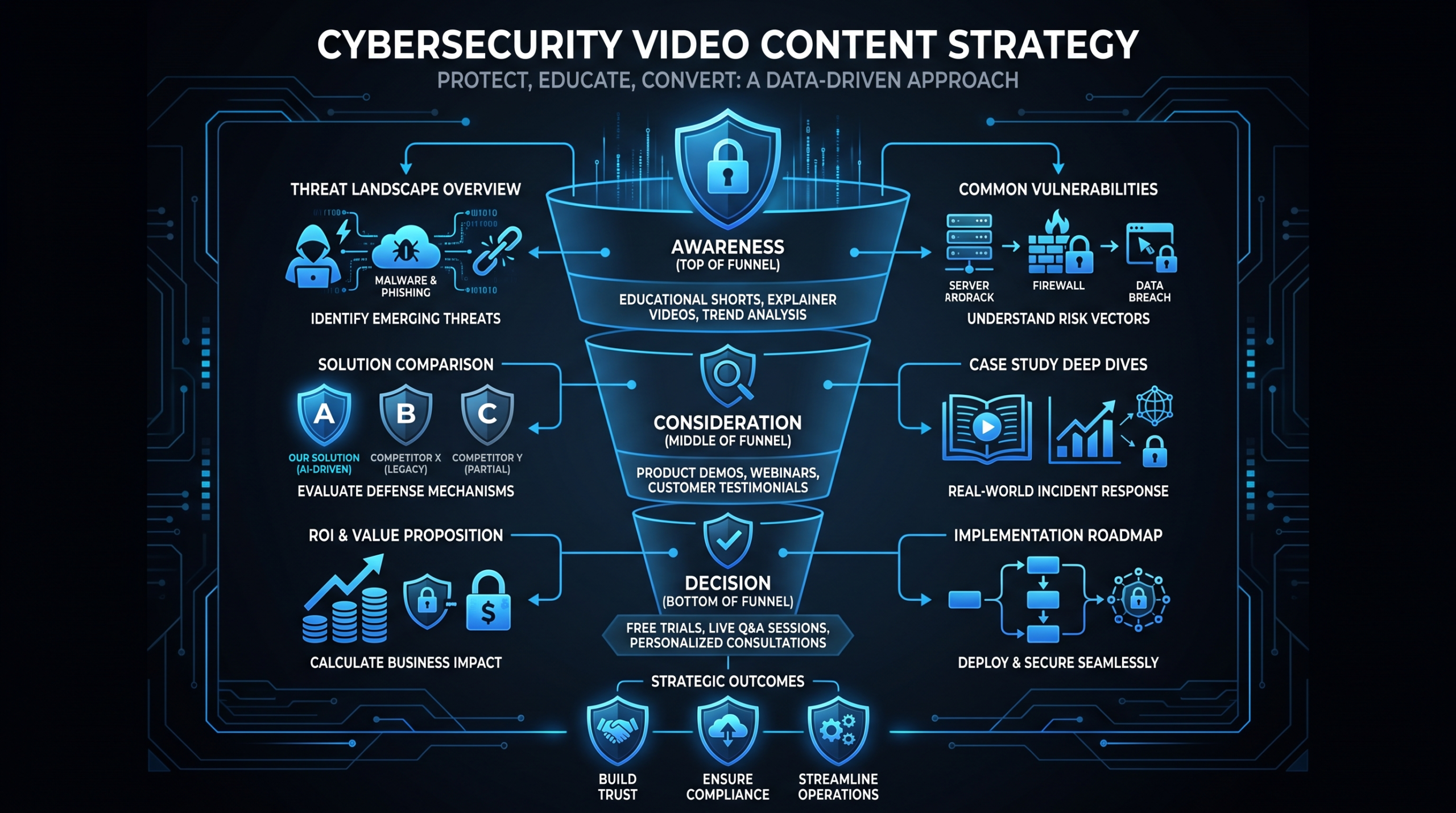
Cybersecurity Video Format Comparison
| Format | Funnel Stage | Primary Goal | Audience | Typical Length |
|---|---|---|---|---|
| Explainer video | Top / Mid | Educate, build category trust | All stakeholders | 60–180 seconds |
| Product demo | Mid / Bottom | Show capability, reduce evaluation friction | Technical evaluators | 5–20 minutes |
| Case study / testimonial | Bottom | Validate, overcome objections | Decision-makers | 2–5 minutes |
| Thought leadership | Top | Authority, category creation | Senior practitioners | 10–45 minutes |
Each format serves a distinct role in the buyer journey. The mistake most security vendors make is producing only one type — usually explainer videos — and wondering why pipeline velocity doesn't improve. Effective cybersecurity video content strategy requires all four, sequenced deliberately.
Explainer Videos: Making the Technical Accessible
The explainer video is where most security companies start, and where most security companies go wrong. Done correctly, explainers accomplish something genuinely difficult: they make a complex technical concept accessible to multiple audience tiers simultaneously — from the security analyst who will actually use the product to the CFO who will approve the budget.
The Structure That Works
The anatomy of a high-performing security explainer follows a specific logic that avoids FUD while still conveying urgency:
- Problem statement (without fear amplification). Describe the operational challenge clearly and specifically. "Security teams managing a 10,000-endpoint environment typically spend X hours per week manually correlating alerts" is compelling. "Hackers are everywhere and your data is at risk" is noise.
- Root cause (technical credibility signal). Explain WHY the problem exists — not just that it does. This is where you demonstrate that you understand the domain at depth. Most vendors skip this entirely, which is why most vendor explainers feel superficial to security practitioners.
- Solution approach (mechanism over claims). Show HOW your product solves the problem mechanically. Not "we use AI to detect threats" — that's a claim. Show the detection logic, the data sources you correlate, the alert prioritization workflow. Practitioners evaluate mechanism; only non-technical buyers evaluate claims.
- Proof point (outcome, not catastrophe avoided). End with an outcome your customer achieved, framed in operational terms. "Reduced mean time to detection from 4 hours to 22 minutes" beats "prevented a potential breach."
Animation vs. Live-Action for Security Explainers
This is a genuine strategic choice for cybersecurity content. Animation has historically dominated the category — it lets you visualize network flows, threat vectors, and data pathways that would be impossible to film. But live-action has gained ground as buyers have become sensitized to over-polished animation that feels like it's concealing a weak product.
For product explainers, screen-capture-led production — real interface footage narrated by someone who sounds like a practitioner, not a marketing voice-over artist — now consistently outperforms full animation in security audiences. Reserve animation for conceptual explainers (explaining a threat category, a compliance framework, or a market problem) where you genuinely can't show a screen. For full guidance on when each approach makes sense, see our breakdown of product demo video production approaches and costs.
Demo Videos: Showing the Product, Not the Fear
The product demo is the highest-stakes video format in cybersecurity marketing. It's typically watched by the people who will actually use or integrate your product — security engineers, SOC analysts, DevSecOps teams. This audience will forgive a polished explainer with thin technical depth, but they will not forgive a demo that handwaves the hard parts.
What Security Practitioners Actually Want in a Demo
Security evaluators have a distinct watchlist when they sit down with a vendor demo. They're not primarily looking for feature lists — they're running a background process that asks: "Does this vendor actually understand how security operations work, or are they showing me a slide deck dressed up as a product?"
- Real interface, real data (sanitized). Mock data that looks nothing like production environments breaks the mental model immediately. Use sanitized real-world data structures — the kind the evaluator will actually import on day one.
- The edge cases, not just the happy path. A demo that only shows things working perfectly is a red flag. Show what happens when a detection is wrong. Show false positive handling. Show the investigation workflow when the alert is ambiguous. These "how does it fail gracefully" moments build more trust than five happy-path walk-throughs.
- Integration touchpoints. Almost every enterprise security tool sits inside a stack. Showing how your product talks to SIEM, SOAR, ticketing, and identity systems is not optional for technical audiences — it's often the deciding factor in an evaluation.
- Performance at scale. "It works in our demo environment" is not convincing. Show what happens at 50,000 events per second. Show the query performance on a 90-day dataset. Practitioners who manage real environments know that most tools fall apart at scale; vendors who address this proactively stand out.
Long-Form vs. Short-Form Demo Strategy
For cybersecurity products, plan for a two-tier demo video library. Short-form (3–8 minutes) demos focused on a single capability — one use case, one workflow, one integration — are ideal for gating behind a content offer or embedding in email sequences. Long-form deep dives (20–45 minutes) work for qualified prospects mid-evaluation and as on-demand resources post-sales call. For a deeper look at production investment at each tier, the SaaS video production guide covers costs across both formats.
Case Study Videos: Proof Without Oversharing
The case study video is where cybersecurity content strategy runs into its most significant constraint: the customers who have the best results are often the ones least able to talk about it. A company that just survived a ransomware incident with your product's help is not eager to publicize that they were targeted. The Fortune 500 client who reduced dwell time from 90 days to 4 hours often has an NDA that prevents naming the vendor publicly.
Navigating the Confidentiality Problem
There are several proven approaches to producing compelling case study video content when your best customers can't go on camera:
- Anonymized case studies with vertical specificity. "A healthcare system with 14 hospitals" is more compelling than a vague composite. You can be specific about industry, size, the problem they faced, and the outcome they achieved — without naming the organization. When anonymized case studies are clearly labeled as such, sophisticated buyers accept them; the specificity validates them.
- The practitioner-to-practitioner format. Instead of a customer testimonial, produce a conversation between your product team and a customer security professional — framed as a technical discussion rather than a commercial. The difference in trust level this creates is significant. Buyers watch and think "these are people who actually do this work," not "this is a paid endorsement."
- Outcome metrics without attribution. If a customer will share their before/after numbers but not their name, use them. "Among customers in the financial services vertical, median time-to-containment dropped from X days to Y hours" is an honest, compelling data point without requiring public attribution. Always hedge the framing: "based on outcomes reported by customers in this vertical" — not "studies show" or invented precision.
What Makes a Case Study Video Work for Security Buyers
Security buyers evaluate case study videos differently from buyers in most categories. They're specifically looking for problem-solution fit — not "did the vendor make the customer happy" but "did the customer have the same problem I have?" Make sure your case study videos establish the specific security challenge (attack surface type, compliance requirement, team size, tech stack) before ever mentioning outcomes. A CISO at a 2,000-person SaaS company watching a case study about a 20,000-person manufacturing company will not translate the outcome to their context automatically — you have to do it for them.
For content teams managing multiple case study videos, VEC's case study production process covers how dedicated teams handle the iteration cycles these projects typically require.
Thought Leadership: Building Authority at the Top
Thought leadership video is the format most security vendors talk about and most security vendors execute poorly. The defining characteristic of good thought leadership is a specific, arguable point of view — a claim that a sophisticated practitioner could reasonably disagree with. "Zero trust is important" is not thought leadership. "Zero trust architecture fails in 80% of implementations because it's adopted as a tool procurement exercise rather than an identity redesign" is thought leadership.
Formats That Work
- Practitioner interviews and conversations. Recorded conversations between your team's genuine security experts and respected external practitioners — think threat researchers, former incident responders, security architects at notable organizations — produce content that earns credibility by proximity. The key is genuine dialogue, not scripted Q&A that reads as a product endorsement in interview form.
- Deep technical breakdowns. Blog posts on threat research, malware analysis, or attack chain deconstruction that are accompanied by video walkthroughs outperform text-only equivalents for engagement and sharing within practitioner communities. These don't need production polish — a screen-share walkthrough from a credible voice performs better than an over-produced version of the same content.
- Conference talk recordings. If your team is presenting at RSA, Black Hat, BSidesSF, or sector-specific events, that content should be on your own channels with minimal editing delay. Conference audiences represent a selection effect — they're among the most engaged practitioners in the field. Getting that content to people who couldn't attend is high-value activity that requires minimal additional production investment.
Distribution Matters More for Thought Leadership Than Any Other Format
Thought leadership video fails when it's published to a brand YouTube channel and left to organic discovery. The distribution strategy for this format is community-first: security subreddits, practitioner Slack communities, security-specific newsletters, LinkedIn shares from individual practitioners (not brand accounts), and direct outreach to the people whose opinion formation you're trying to influence. The video is the raw material; the distribution is the strategy.
Compliance and Legal Messaging Guardrails
Security vendors operate in one of the most legally sensitive content environments in B2B marketing. Before any video goes to production, your compliance and legal review process needs to address several distinct categories of risk.
Cybersecurity Video Content: Compliance Checklist by Risk Category
| Risk Category | What to Avoid | What's Safe |
|---|---|---|
| Predictive breach claims | "Without our product, you will be breached" | "Organizations without X capability face elevated risk based on public incident data" |
| Efficacy guarantees | "Our product blocks 100% of ransomware" | "In testing environments using [specific methodology], detection rate was X%" |
| Regulatory compliance claims | "Using our product makes you SOC 2 / HIPAA / PCI compliant" | "Our product supports the controls required by SOC 2 Type II / HIPAA / PCI DSS" |
| Customer data in demos | Real customer data in any product demo | Synthetic data sets that reflect realistic data structures |
| Third-party threat intelligence | Citing threat feeds or intelligence reports without licensing | Citing public research (CVE databases, published incident reports) with attribution |
| Competitor comparisons | Unsubstantiated "we outperform [competitor]" claims | Third-party test results (MITRE ATT&CK evaluations, NSS Labs reports) with methodology disclosed |
The Regulatory Compliance Framing Problem
This deserves its own section because it's the most common legal landmine in cybersecurity video content. There is a meaningful — and legally significant — difference between "our product helps you meet the technical requirements of HIPAA's Security Rule" and "our product makes you HIPAA compliant." The first is accurate. The second is a representation that only a licensed compliance professional can make after assessing your entire environment. Any video that implies a single product purchase results in regulatory compliance should be reviewed by legal before production begins.
Incident Response Content: Extra Care Required
Content that describes specific attack techniques, malware families, or exploitation methods — even for educational purposes — needs a separate review process. The Cybersecurity and Infrastructure Security Agency (CISA) and sector-specific ISACs have published guidance on responsible disclosure practices for threat content. Videos produced by red team members, threat researchers, or incident responders should be reviewed against the CISA coordinated vulnerability disclosure guidance before publication, even when the content is defensive in nature.
Distribution Strategy for Security Audiences
The security buyer's media consumption pattern is different from the typical B2B SaaS buyer's pattern, and your distribution strategy needs to reflect that difference. Security practitioners are not primarily on LinkedIn watching thought leadership videos from brands. They're in specialized communities, practitioner-run forums, conference ecosystems, and information-sharing groups. Meeting them where they are requires a distribution map that most general-purpose content teams don't have.
Channel Performance by Content Type
Distribution Channel Effectiveness by Video Format
| Channel | Best For | Audience Quality | Notes |
|---|---|---|---|
| YouTube (product SEO) | Demo videos, tutorials | High intent, self-selected | Practitioners searching for specific product topics |
| LinkedIn (individual posts, not brand page) | Thought leadership, explainers | Medium — varies by poster | Personal accounts drive 8–15x more reach than brand pages |
| Email sequences (gated) | Demo videos, case studies | High — qualified leads only | Mid-evaluation touchpoints |
| Security-specific newsletters | Thought leadership, research | High practitioner density | Risky Business, tl;dr sec, TLDR InfoSec |
| Conference on-demand libraries | Deep technical talks | Very high — self-selected | RSA, Black Hat, DEF CON video archives |
| Practitioner Slack communities | Thought leadership (shared organically) | Very high | Never spam — community members share or they don't |
| Podcast audio + video versions | Thought leadership | Loyal, growing | Security practitioners are among the highest podcast consumers in B2B |
The YouTube SEO Opportunity Most Security Vendors Miss
Security-specific YouTube searches have meaningful volume with relatively low competition from polished brand content. Practitioners routinely search for "how to configure [product name] SAML SSO," "[threat family] malware analysis," "[compliance framework] audit preparation" — and find either bare-bones forums or vendor documentation, not organized video content. A systematic program of educational video content targeting these long-tail queries, produced to practitioner expectations (real interfaces, honest limitations, meaningful depth), builds both search visibility and brand trust simultaneously. Wistia's research on B2B video engagement (available on wistia.com) consistently shows that longer, more detailed videos outperform short clips for engaged B2B audiences — counterintuitive for marketers trained on consumer content norms, but exactly right for security practitioners who came to learn something.
Gating Strategy for Security Audiences
Gating decisions in security content require a different calculus than other verticals. Short explainers and thought leadership should generally be ungated — the audience discovery mechanism is community sharing, and paywalling commodity content in front of practitioners who weren't asking for it accelerates their bounce rate. Product demo videos occupy a judgment call: short-form feature demos can be ungated to reduce friction; deep-dive technical evaluations are worth gating because they have clear qualification value. Case study videos, particularly those with specific outcome data, are typically the highest-value gated asset in a security marketing program.
For teams managing a growing video library across all these formats, the outsourcing video editing guide covers how to structure the ongoing production workflow without an in-house team.
Production Quality Standards Security Buyers Expect
Security audiences have a higher tolerance for raw, unpolished content than most B2B buyers — but lower tolerance for inaccuracy, scripted feel, and marketing gloss. The production quality bar is not "as polished as possible" but "as credible as possible."
What High-Credibility Production Looks Like
- Real practitioner voice-over or on-camera presenters. Marketing voice-over artists who clearly have no background in security undermine the credibility of technically accurate content. If your presenter sounds like they're selling warranties rather than explaining SIEM correlation logic, the content fails regardless of accuracy.
- Live interface recording at HD resolution. Security products are often text-dense and detail-heavy. Low-resolution screen recordings make interface demonstrations literally unreadable. Invest in 1080p or 4K screen capture and export — this is table stakes, not a luxury.
- Thoughtful audio production. This is the most underfunded element in security video content. Practitioners listening on headphones during commutes or at their desk will immediately notice poor room treatment, fan noise, or low-quality condenser microphones. Audio quality signals production seriousness; poor audio signals that the vendor doesn't care about the viewer's experience.
- Accurate closed captions. Auto-generated captions that mangle technical terminology (SIEM, SOAR, CVE, MITRE ATT&CK, zero trust) are worse than no captions. Technical audiences who notice the inaccuracies lose trust in the vendor's attention to detail generally.
Where to Invest vs. Where to Save
For cybersecurity content, the production investment hierarchy is: audio quality first, screen capture quality second, lighting and visual production third. A practitioner will watch a webinar-quality recording from a credible expert, but they will not sit through pristine video with echo-chamber audio or a marketing script. Budget accordingly — and if your in-house team is handling video editing without dedicated expertise, understand the cost of professional post-production. VEC works with cybersecurity vendors on dedicated video editing services that handle the technical formatting, caption accuracy, and consistency requirements these programs demand at scale.
See our pricing page for plan details including the Growth plan ($5,000/month) and Core plan ($9,500/month) most commonly used by security marketing teams managing ongoing content programs.
Frequently Asked Questions
What does "FUD" mean in cybersecurity marketing?
FUD stands for fear, uncertainty, and doubt — a marketing approach that amplifies threat severity and breach probability to drive purchasing urgency rather than leading with product capability and proven outcomes. In cybersecurity video content specifically, FUD typically manifests as breach statistics presented without context, ransomware dramatizations, and "your company will be attacked" framing. Experienced security buyers recognize and reject this approach; it signals a vendor who can't win on product merit.
What video formats work best for reaching CISOs vs. security engineers?
CISOs respond most strongly to case study videos that translate technical outcomes into business terms (risk reduction, compliance posture, team efficiency) and thought leadership content that engages them as practitioners with strategic perspective, not just buyers. Security engineers respond to detailed product demos, technical walkthroughs, and educational content that helps them evaluate integration complexity and operational fit. A complete cybersecurity video content strategy serves both audiences with format-specific content rather than trying to do both in a single video.
Can I use real customer logos and names in cybersecurity case study videos?
Only with explicit written permission, and the process for getting that permission in security is more complex than in most verticals. Many enterprise security customers have contractual restrictions on vendor disclosure, are in regulated industries with reputational sensitivities around admitting to incidents, or are concerned about publicly identifying their security vendor (which can itself be threat intelligence for adversaries). Anonymized case studies with industry and size specificity are a widely accepted alternative that maintains credibility while respecting customer constraints.
How long should a cybersecurity product demo video be?
Short-form feature demos — covering a single capability or workflow — should be 5–10 minutes. These are appropriate for ungated distribution, embedding in email sequences, or pairing with blog content. Full technical deep dives for mid-evaluation prospects are typically 20–45 minutes and are usually delivered through a gated content offer or sales enablement asset. Avoid the temptation to put everything into one 60-minute demo video — practitioners who need the depth will find it, but broad audiences will not watch past the 15-minute mark of a comprehensive walkthrough.
How many cybersecurity videos should a vendor produce per month to see results?
Volume depends on where you are in the content maturity curve, but teams commonly report that a minimum of four to six pieces of video content per month — across all formats — is needed to generate meaningful compounding effects on organic search and community presence. This typically breaks down as one to two short-form demos, one to two educational or thought leadership pieces, and one case study or practitioner conversation per month. At that cadence, sustained over six-plus months, most security vendors see measurable improvement in brand search volume, content-attributed pipeline, and sales cycle velocity. The investment to support that output is the main variable: for production planning at different budget levels, VEC's video editing cost-per-minute breakdown helps model the ongoing spend.
Build a Cybersecurity Video Program That Actually Converts
VEC works with B2B security vendors on dedicated video editing teams that understand the format, accuracy, and credibility requirements this audience demands. Growth plan from $5,000/month. Our guarantee: double your video output in 90 days or month 4 is free.
Book a Free Strategy Call See Pricing Plans