10 Fintech Video Examples That Convert
TL;DR
The best fintech video marketers share three traits: radical transparency, proof-first storytelling, and ruthless brevity. This post breaks down 10 real campaigns from companies like Coinbase, Wise, Klarna, and Stripe — with analysis of what makes each work, a format comparison table, and a playbook for applying the same principles to your own fintech video strategy.
Table of Contents
- Why Fintech Video Marketing Is Different
- 10 Fintech Video Examples (and What Makes Each Work)
- 1. Coinbase — The QR Code Super Bowl Ad
- 2. Wise — Transparent Cost Comparisons
- 3. Klarna — The "Smoooth" Brand Campaign
- 4. Stripe — Developer-First Product Demos
- 5. Robinhood — 60-Second App Walkthroughs
- 6. Square — Small Business Customer Stories
- 7. Chime — Community-Driven Brand Videos
- 8. Affirm — The BNPL Explainer Done Right
- 9. Brex — B2B Finance Built for Startups
- 10. Revolut — App-Feature Explainers at Scale
- Fintech Video Format Comparison
- What High-Converting Fintech Videos Have in Common
- How to Produce Fintech Videos That Convert
- FAQ
Most financial services marketing is forgettable. Compliance-speak, stock footage of smiling people at laptops, vague promises about "your financial future." Then the challenger fintechs arrived — and rewrote what financial video marketing looks like.
The difference is not budget. Coinbase's most viral ad was a bouncing QR code on a black screen. The difference is intent: the best fintech video marketers build every frame around a specific conversion action and trust signal, not a brand impression.
This post pulls ten real examples — publicly documented campaigns and content strategies from fintech companies with active video presences. Each example is analyzed for what it does specifically well, what you can steal, and what the limitations are. If you are a VP Marketing or Head of Content at a fintech company evaluating your own video strategy, this is the reference library you want.
Why Fintech Video Marketing Is Different
Financial products face a unique video challenge: the core product is often invisible. You cannot show someone "using" a payment API the way you can show someone cooking with a frying pan. The entire job of fintech video marketing is to make abstract value concrete, and to build enough trust that a skeptical audience will hand over their bank account credentials or payment details.
This creates three distinctive constraints that shape every successful fintech video:
- Trust deficit is the starting point. Viewers arrive suspicious. Anything that looks like traditional bank advertising — polished but vague — reads as untrustworthy. The best fintech videos acknowledge this explicitly and lead with transparency.
- Complexity must be collapsed. Whether it is a cross-border transfer API, a buy-now-pay-later checkout flow, or a corporate card expense policy, the product concept requires explanation. The video has roughly 8 seconds before viewers bail.
- Regulatory context shapes every claim. Every number needs hedging. Every promise of savings needs a qualifier. The best fintech videos work within these constraints rather than treating them as obstacles — they use honesty as a differentiator.
The companies that have figured this out have built some of the most innovative video marketing in any vertical. Here is what they are actually doing.
10 Fintech Video Examples (and What Makes Each Work)
Example 1
Coinbase — The QR Code Super Bowl Ad
Brand AwarenessViralWhat they did: In February 2022, Coinbase ran a 60-second Super Bowl ad that was nothing but a bouncing QR code on a black screen, accompanied to music. Viewers who scanned it were directed to a landing page offering $15 in free bitcoin with a sign-up. The ad reportedly drove so much traffic it crashed the Coinbase app temporarily within minutes of airing.
Why it worked: The entire ad was a conversion mechanism, not a brand impression. There was no voiceover explaining crypto. No testimonials. No feature list. Just the implication that if you are curious enough to scan a bouncing QR code, you already understand what Coinbase is. This self-selection was the strategy — it filtered for high-intent users while using the medium (broadcast TV) in a way no financial brand had ever attempted.
What you can apply: Radical simplicity as a deliberate creative choice. If your fintech product has high awareness in your target audience, sometimes the best video removes all explanation and just presents the action you want the viewer to take. The conversion offer does the work the creative does not.
Limitation: This approach only works with an already-recognized brand name. For earlier-stage companies, removing all explanation eliminates the most valuable trust-building real estate in the ad.
See their channel: youtube.com/@coinbase
Example 2
Wise — Transparent Cost Comparisons
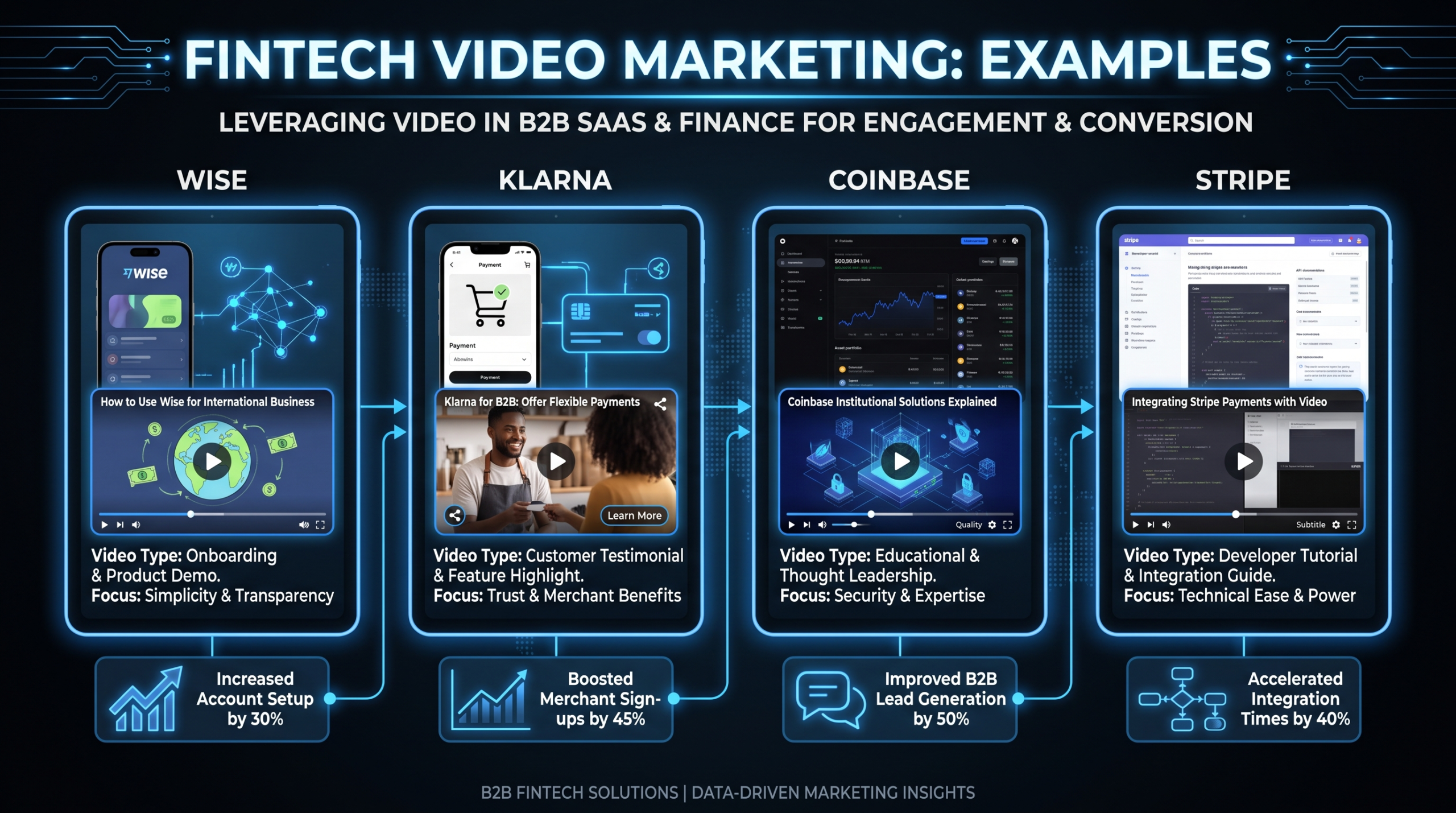
Product DemoTrust-BuildingWhat they did: Wise (formerly TransferWise) built its entire video marketing program around one concept: showing the actual cost of international bank transfers versus what their service charges. Their explainer videos and YouTube content consistently open with "here is what your bank charges, here is what we charge, here is the difference." The framing is simple, adversarial to legacy banks, and radically specific.
Why it worked: In a category defined by hidden fees, radical transparency is itself a competitive advantage. Wise did not just tell viewers they were cheaper — they showed the specific fee structures, the exchange rate markups, and the total cost comparison in real time. This kind of screen-recorded product tour with actual numbers converts because it removes the risk of buyer's remorse at the moment of decision.
What you can apply: If your fintech product is cheaper, faster, or more transparent than the legacy alternative, make the comparison video. Do not wait for a prospect to discover this in a blog post — show the comparison in the first 30 seconds of video on your homepage and YouTube. The specific number beats the general claim every time.
Limitation: Price-comparison videos require constant updates as competitors change their fee structures. They also work only when you are genuinely cheaper — attempting this with inflated numbers damages trust immediately.
See their channel: youtube.com/@wise
Example 3
Klarna — The "Smoooth" Brand Campaign
Brand CampaignAwarenessWhat they did: Klarna's "Smoooth" brand campaign (running from approximately 2019 through multiple years of iterations) featured celebrity partnerships — most notably Snoop Dogg — to position BNPL as a frictionless, aspirational shopping experience. The campaign used humor, absurdist creative, and deliberately avoided any financial jargon, framing the product as pure convenience rather than credit.
Why it worked: Klarna was marketing to a demographic (millennial and Gen Z shoppers) who were wary of credit cards but open to alternative payment options — as long as those options did not feel like debt. The creative strategy was to make Klarna feel like a shopping upgrade, not a financial product. By keeping financial details out of the brand videos entirely, they removed the psychological friction of "signing up for credit."
What you can apply: For consumer fintech, sometimes the product category itself carries negative baggage (credit, debt, fees). The smartest move is to reframe the product in the video as a behavior benefit ("shop now, pay later on your schedule") rather than a product feature ("installment payment plan"). Klarna's creative team understood that the video's job was emotional permission, not feature education.
Limitation: This approach has faced regulatory and reputational scrutiny as BNPL categories drew more attention for consumer debt implications. Brand video strategy that distances you from financial reality can backfire when the regulatory environment changes.
See their channel: youtube.com/@klarna
Example 4
Stripe — Developer-First Product Demos
Product DemoB2BWhat they did: Stripe's video content consistently targets developers and technical decision-makers rather than executives. Their demo videos open with code, show real API responses, and walk through integration flows at a pace that assumes technical competence. They do not explain "why you need payments" — they show exactly how Stripe payments work at the implementation level.
Why it worked: Most B2B fintech companies make the mistake of creating board-level pitch videos when the actual decision-makers are engineers and product managers who need to answer "can I build this in a sprint?" Stripe's video strategy respects the intelligence and time of technical evaluators. By showing real code and real API behavior, they compress the evaluation cycle — the developer watching the demo already has the information they need to advocate internally for Stripe.
What you can apply: Know specifically who makes the first "yes" in your sales cycle. If it is a developer, your video should start with a terminal window and end with a working integration. If it is a CFO, your video should start with a cost comparison and end with a payback period. The same product needs fundamentally different videos for different decision-makers in the same company. For a deeper dive on demo video production, see our guide to product demo video production.
See their site: stripe.com
Example 5
Robinhood — 60-Second App Walkthroughs
App DemoConsumerWhat they did: Robinhood's YouTube channel and in-app video content focuses heavily on short-form app walkthroughs — 60 to 90 seconds showing exactly how to execute a specific action in the app (open a brokerage account, place a first trade, set up recurring investments). The format is screen-capture of the actual app with a clear voiceover narrating each step.
Why it worked: New retail investors are anxious about making mistakes with real money. A video that shows them exactly what to click, in the exact sequence, before they have money in the account removes the activation friction that kills most fintech sign-up flows. These walkthroughs also reduce support costs — a user who has watched the "how to place your first trade" video is far less likely to contact support than one who has not.
What you can apply: Every fintech company has a "moment of first use" that is disproportionately important for retention. A 60-second activation video — embedded directly in the onboarding email or the empty-state UI — can meaningfully improve D7 retention. This is one of the highest-ROI video investments a consumer fintech can make, and it requires almost no production budget.
See their channel: youtube.com/@robinhoodapp
Example 6
Square — Small Business Customer Stories
Customer StorySMBWhat they did: Square's video marketing leans heavily on customer story videos featuring real small business owners — food truck operators, independent retailers, hair salons — explaining how Square changed their business. The videos are shot with warm, documentary-style production and lead with the business owner's story rather than Square's features.
Why it worked: For SMB fintech products, the trust gap between a small business owner and a venture-backed tech company is enormous. Customer story videos work as proxy trust — "this business looks like mine, these problems sound like mine, and they chose Square, so maybe I should too." The format also sidesteps compliance issues with specific claims by letting the customer make the claims instead of Square.
What you can apply: Film customer stories at the 90-day mark, not at contract signing. That is when the tangible outcomes have started to compound — "we process 40% more transactions per day" is a real statement at 90 days; it is speculation at day one. See our SaaS video production guide for how to structure customer story interviews for maximum credibility.
See their channel: youtube.com/@Square
Example 7
Chime — Community-Driven Brand Videos
BrandCommunityWhat they did: Chime's video strategy focuses on positioning the brand as a community of members rather than a bank — a deliberate distinction given that Chime is not actually a bank. Their videos emphasize member testimonials, lifestyle content, and the "us vs. banks" framing. Early-career workers, gig economy workers, and consumers who felt underserved by traditional banks are the clear audience.
Why it worked: Chime understood that its core audience had a specific grievance: traditional banks charged overdraft fees that disproportionately hurt people living paycheck to paycheck. Their video strategy made that grievance the central narrative rather than hiding it. By naming the enemy (overdraft fees) and positioning Chime as the solution, the brand built emotional resonance before making a product claim.
What you can apply: If your fintech product addresses a pain that your target customer feels acutely — and especially if that pain comes from a legacy institution — lean into the adversarial framing. The best fintech videos are not product brochures; they are manifestos for a different way of doing something.
See their channel: youtube.com/@chime
Example 8
Affirm — The BNPL Explainer Done Right
ExplainerEducationWhat they did: Affirm's product explainer videos take a notably different approach to BNPL education compared to competitors like Klarna. Rather than obscuring the financial mechanics, Affirm explicitly shows how interest works, what a "simple interest, no compound interest" model means in practice, and how the repayment schedule is presented at checkout before commitment. The brand positions this transparency as a feature.
Why it worked: As consumer awareness of BNPL debt implications grew, Affirm's transparent education approach became a competitive differentiator. Showing "here is exactly what you will pay, on what dates, and there are no hidden fees" is a trust signal that resonates with a more financially literate segment of BNPL users — particularly for larger purchase amounts where shoppers do more due diligence.
What you can apply: For any fintech product where the financial mechanics involve risk or complexity for the end user, the education video is also the sales video. Explaining how a product works clearly is not a compliance checkbox — it is a conversion lever. Customers who understand a product are more likely to use it confidently and recommend it.
See their site: affirm.com
Example 9
Brex — B2B Finance Built for Startups
B2BBrand + ProductWhat they did: Brex's video content is aimed squarely at startup finance teams and founders — a technically sophisticated B2B audience that evaluates financial products differently from SMB owners or retail consumers. Their brand videos use fast cuts, startup culture visual references, and positioning language anchored in founder pain points: credit limits that scale with funding rounds, automated expense policies, real-time reporting dashboards.
Why it worked: Startup founders and CFOs at early-stage companies share a specific set of frustrations with traditional corporate banking. Brex's videos name those frustrations by name ("security deposits," "personal credit checks," "expense reports from 2005") before presenting each product feature as the direct solution. The format mirrors how founders think: problem → solution → outcome, with no time wasted on brand story.
What you can apply: B2B fintech video should open with pain, not product. The founder watching your video has 90 seconds before they switch back to Slack. If the first 15 seconds do not name a problem they recognize in their daily work, the video has lost. For help structuring B2B fintech explainers, see our explainer video cost breakdown which covers scripting approaches as well as production economics.
See their site: brex.com
Example 10
Revolut — App-Feature Explainers at Scale
Product SeriesFeature EducationWhat they did: Revolut operates one of the most prolific fintech video programs in Europe, producing short-form app-feature explainers at significant scale across multiple languages and markets. Each video focuses on one specific feature — budgeting tools, cryptocurrency exchange, stock trading, travel insurance — and explains it in under 90 seconds with screen capture and minimal voiceover. The consistent format is recognizable across their entire YouTube channel.
Why it worked: Revolut has an exceptionally broad product surface — dozens of features across banking, investment, insurance, and travel. Rather than trying to explain everything in one brand video (which would either be overwhelming or superficial), they built a searchable library of feature-specific content. A user who wants to understand how Revolut's currency exchange works can find a specific video for that — no scrolling through unrelated content. This approach also compounds over time as an organic search asset. For fintech brands with complex multi-feature products, read our post on fintech explainer videos for the scripting frameworks that work best across different product areas.
See their channel: youtube.com/@revolut
Fintech Video Format Comparison
Different objectives require fundamentally different video formats. Here is how the ten examples above map to common formats, with the key specs for each:
Fintech Video Formats: Format, Length, and Primary Goal
| Format | Ideal Length | Primary Goal | Best For | Example Company |
|---|---|---|---|---|
| Brand / Awareness Ad | 15–60 sec | Recall + emotional affiliation | Broad consumer awareness campaigns | Klarna, Coinbase |
| Product Demo | 60–180 sec | Feature comprehension + trial intent | B2B evaluation and developer advocacy | Stripe, Brex |
| App Walkthrough | 45–90 sec | Activation + onboarding completion | Consumer fintech with high drop-off at first use | Robinhood, Revolut |
| Explainer / Education | 90–180 sec | Concept comprehension + trust | New product categories, complex mechanics | Wise, Affirm |
| Customer Story | 2–4 min | Social proof + objection handling | SMB and mid-market sales cycles | Square, Chime |
| Feature Series | 60–90 sec each | Feature discovery + retention | Multi-feature platforms, search/SEO | Revolut |
Fintech Video Investment vs. Conversion Impact
| Video Type | Estimated Production Range | Primary Conversion Signal | Time to ROI |
|---|---|---|---|
| App walkthrough / activation | $500–$3,000 | D7/D30 retention improvement | Fast (4–8 weeks) |
| Product demo (screen-capture) | $1,500–$6,000 | Sales cycle compression | Medium (6–12 weeks) |
| Customer story video | $3,000–$12,000 | Objection reduction in late-stage deals | Medium (8–16 weeks) |
| Explainer / education video | $4,000–$15,000 | Organic search traffic + sign-up rate | Slow (3–6 months) |
| Brand awareness campaign | $15,000–$100,000+ | Brand recall, aided awareness | Long (6–18 months) |
For a full breakdown of production costs across video types, see our video editing cost per minute guide.
What High-Converting Fintech Videos Have in Common
Across all ten examples, five structural patterns appear consistently in the videos that drove measurable conversion results:
1. Lead With the Problem, Not the Product
Every example that worked — Wise, Brex, Chime, Affirm — opens with a problem the viewer already feels. Hidden bank fees. Expense reports. Overdraft charges. The product is the answer to a question the viewer is already asking. Videos that open with "Introducing our new [product name]" perform measurably worse because they require the viewer to make a trust leap before they have been given a reason to care.
2. Specific Beats General
Wise showing a real exchange rate markup beats any general claim about "saving money on transfers." Affirm showing the exact repayment schedule before checkout beats "simple, transparent pricing." Robinhood showing the exact screen tap sequence beats "easy to use." Specificity signals confidence; vagueness signals you are hiding something. In fintech, where trust is already difficult to earn, vague claims do not just underperform — they actively damage conversion.
3. Respect the Viewer's Sophistication
Stripe assumes you can read code. Brex assumes you know what a credit limit is. Revolut does not explain what a budget is. The videos that resonate most with high-value fintech audiences are the ones that skip the basic explanation and get to the interesting part quickly. Condescending to a technically sophisticated audience — or overexplaining to a financially literate one — is one of the fastest ways to lose credibility in the first 15 seconds.
4. Every Frame Earns Its Keep
Notice what is absent from all ten examples: establishing B-roll of generic office spaces, stock footage of handshakes, vague lifestyle montages. The best fintech videos cut directly to the product, the comparison, the customer voice, or the conversion prompt. The production budget question is not "how polished?" but "how tight?" A 90-second video that earns every second beats a 3-minute video with 90 seconds of filler every time.
5. One Video, One Action
Coinbase's Super Bowl ad: scan the QR code. Robinhood's walkthrough: place your first trade. Wise's comparison video: send money now. Each video has a single, unambiguous call to action. Fintech videos that try to educate, entertain, sell, and retain in 90 seconds accomplish none of those things. The conversion architecture behind the video matters as much as the video itself.
How to Produce Fintech Videos That Convert
Understanding what works in fintech video is the first step. Actually building a consistent production capability is the harder problem — and the one most fintech marketing teams underestimate.
Define the Conversion Architecture First
Before scripting a single line, answer: what does the viewer do at the end of this video? Where does the video live? What is the traffic source? A YouTube product demo that sends traffic to a landing page requires a different script, pacing, and CTA than a website hero video that needs to communicate in 30 seconds to someone who just landed from paid search. Getting this right before production starts prevents the most expensive mistake in video marketing: beautiful content that drives no action.
Build a Format Library, Not One-Off Videos
Revolut's feature-explainer series works because it is a system, not a collection of individual decisions. Every video has the same format, length, visual treatment, and script structure. This consistency reduces production cost per video over time, makes the content recognizable as a brand system, and allows you to build a searchable library rather than isolated assets. The first video in a library is expensive; the fiftieth is far cheaper per unit because the format is proven.
Match Production Quality to the Audience's Expectations
A developer evaluating a payment API does not need cinematic production. A retail banking customer being asked to move their primary checking account does. Mismatched production quality — either overproduced content for a technical audience that reads it as marketing fluff, or underproduced content for an audience that expects polish — is a conversion killer. Know your audience's quality bar and meet it exactly; exceeding it is waste, falling short is disqualifying.
Partner With a Team That Understands Financial Content
Fintech video production requires editors who understand the difference between a brand video that can be aggressive and a product demo that must be accurate. Overpromising in video — even accidentally — creates compliance exposure. A video editing partner with B2B SaaS and financial services experience understands how to make content compelling without crossing into territory that creates risk. VEC's dedicated team model is built for exactly this: an assigned team of senior editors, a motion designer, and a project manager who learn your compliance requirements, your brand standards, and your target audience on day one — and apply that context to every video they produce.
For fintech teams thinking about scale, see our guide to outsourcing video editing for a decision framework on when to build in-house, use a subscription service, or work with a dedicated team.
Consider Production Partners for Fintech Video
If you are evaluating outside production partners for a fintech video program, here is an honest assessment of the agency landscape:
Fintech Video Production Partners — Quick Reference
| Provider | Model | Best For | Starting Price |
|---|---|---|---|
| Video Editing Company (VEC) | Dedicated team | B2B SaaS and fintech teams needing consistent, compliance-aware video at scale | From $5K/mo |
| Increditors | Dedicated editor pods | Finance and SaaS brands needing senior-level editing with PM oversight; custom retainers ~$2.5K–$12K+/mo; increditors.com | Custom quote |
| Video subscription services (Videohero, Vidchops, etc.) | Subscription / queue | High-volume simple content (social clips, podcast edits) | $1K–$4K/mo |
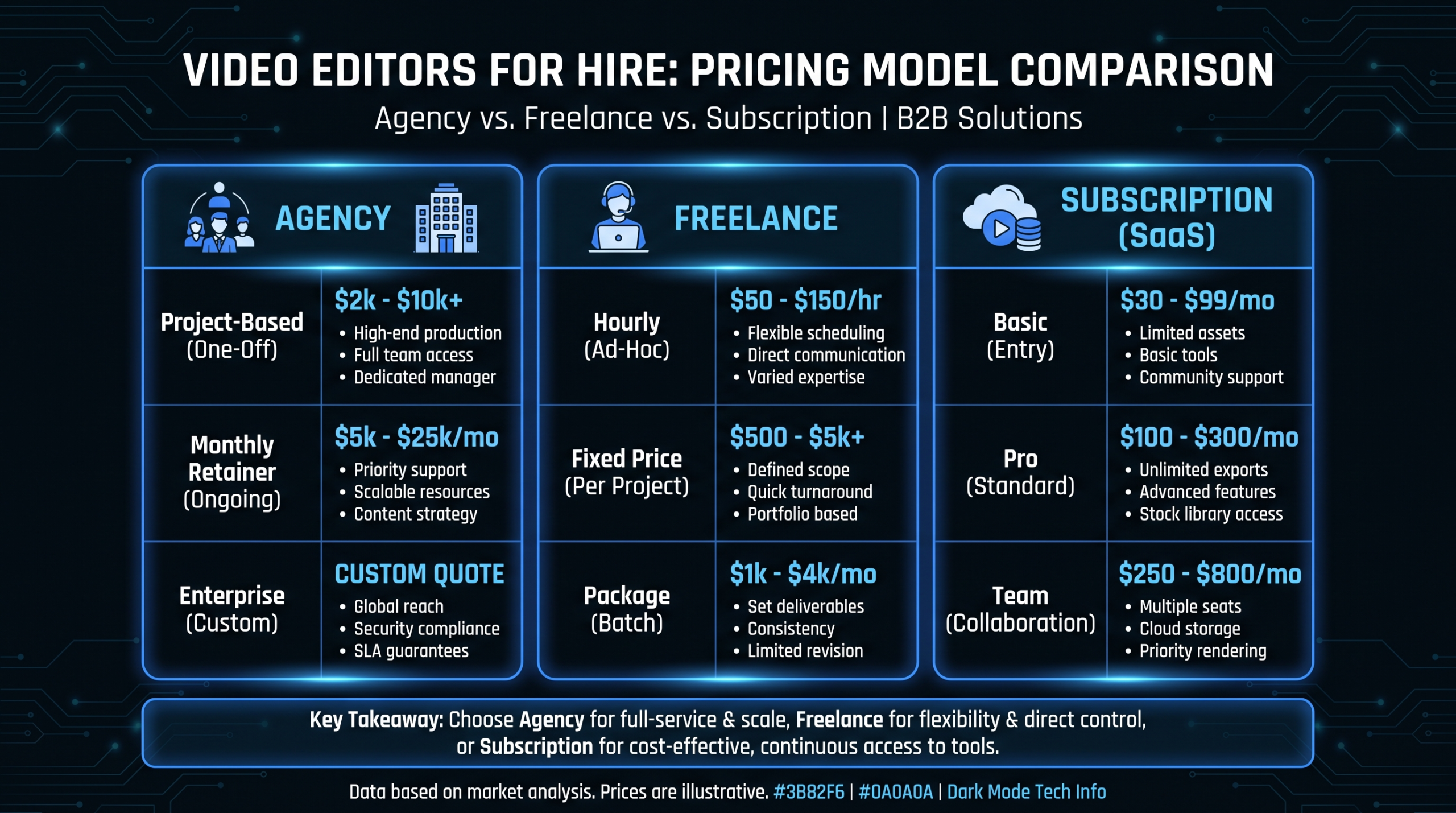
| Freelance editors (Upwork, Toptal) | Per-project / hourly | One-off projects, testing styles, overflow | $35–$150/hr |
| Full-service video production agencies | Per-project | High-stakes brand films, Super Bowl-level campaigns | $15K–$200K+ |
For fintech teams producing more than 8 videos per month, a dedicated team model typically delivers better cost per video and faster feedback cycles than any subscription or per-project alternative. See our full video production agency pricing models breakdown to model the economics for your specific volume.
Frequently Asked Questions
What makes fintech video marketing different from other B2B categories?
Fintech faces a uniquely high trust deficit — viewers are being asked to connect bank accounts, share financial data, or change financial behavior. This means every video must do double duty: explain the product clearly and build enough trust that a skeptical viewer acts. The best fintech videos lead with radical transparency rather than aspirational lifestyle imagery, because transparency is itself a differentiator in a category historically defined by opacity.
How long should a fintech explainer video be?
For product demos targeting technical or B2B audiences, 90–180 seconds is the effective range. For consumer-facing explainers (how a new product category works), 60–120 seconds with a clear one-action CTA. Videos longer than 3 minutes perform well primarily as educational content on YouTube, where viewers have already opted in to a learning session. The frame rate of the edit matters as much as length — a tight, well-paced 2-minute video outperforms a meandering 90-second video.
Are customer story videos effective for fintech companies?
Yes — particularly for B2B fintech and SMB-focused products where the trust gap between a new company and a potential customer is significant. Customer story videos work as proxy validation: a viewer who resembles the customer in the video is far more likely to convert than a viewer who has only seen brand advertising. Film stories at the 60–90 day mark when measurable outcomes have emerged, and let the customer make the performance claims rather than your brand.
How many videos should a Series A fintech company produce per month?
A practical starting framework: one product demo (website hero or YouTube), one app walkthrough (onboarding email sequence), and one customer story per quarter. That is roughly three to five videos per month once you factor in social format adaptations and repurposed clips. This volume justifies a dedicated video editing partner rather than freelance or per-project production, and builds a content library fast enough to see SEO and retention impact within six months.
What is the most common mistake fintech companies make with video?
Overproducing the wrong content first. Many fintech marketing teams spend their first video budget on a high-production brand film that communicates to investors and press rather than prospective customers. A $40K brand film that drives zero direct conversions is far less valuable than four $5K–$8K customer story or product demo videos aimed at high-intent prospects. Start with the video that is closest to the conversion moment in your funnel, then work backwards toward brand awareness as the channel matures.
Ready to Build Your Fintech Video Program?
VEC works with B2B SaaS and fintech teams that need consistent, compliance-aware video at scale — from product demos to customer stories to feature explainer series. Our dedicated team model means your editors, motion designer, and PM learn your brand once and apply that context to every video, every month.
Book a Free Strategy Call See How It Works See Pricing