Video for Regulated Fintech: Compliance Guide
TL;DR
- Regulated fintech video faces overlapping rules from the SEC, FINRA, FCA, and other bodies — each with specific disclosure, record-keeping, and approval requirements.
- The SEC's updated Marketing Rule (Rule 206(4)-1, effective November 2022) tightened how investment advisers may use testimonials, performance data, and endorsements in all marketing — including video.
- FINRA Rule 2210 governs how broker-dealers communicate through retail communications like YouTube ads and social video; all content must be fair, balanced, and not misleading.
- Fintech marketers typically need legal/compliance pre-approval for every video before it publishes — build that review gate into your production timeline, not as an afterthought.
- Record-keeping is non-negotiable: most regulated entities must retain video marketing content and underlying materials for at least three years (often six under certain rules).
- This post is practical guidance, not legal advice. Consult your compliance officer and legal counsel before publishing any regulated financial promotion.
Table of Contents
- Why Fintech Video Has Different Rules
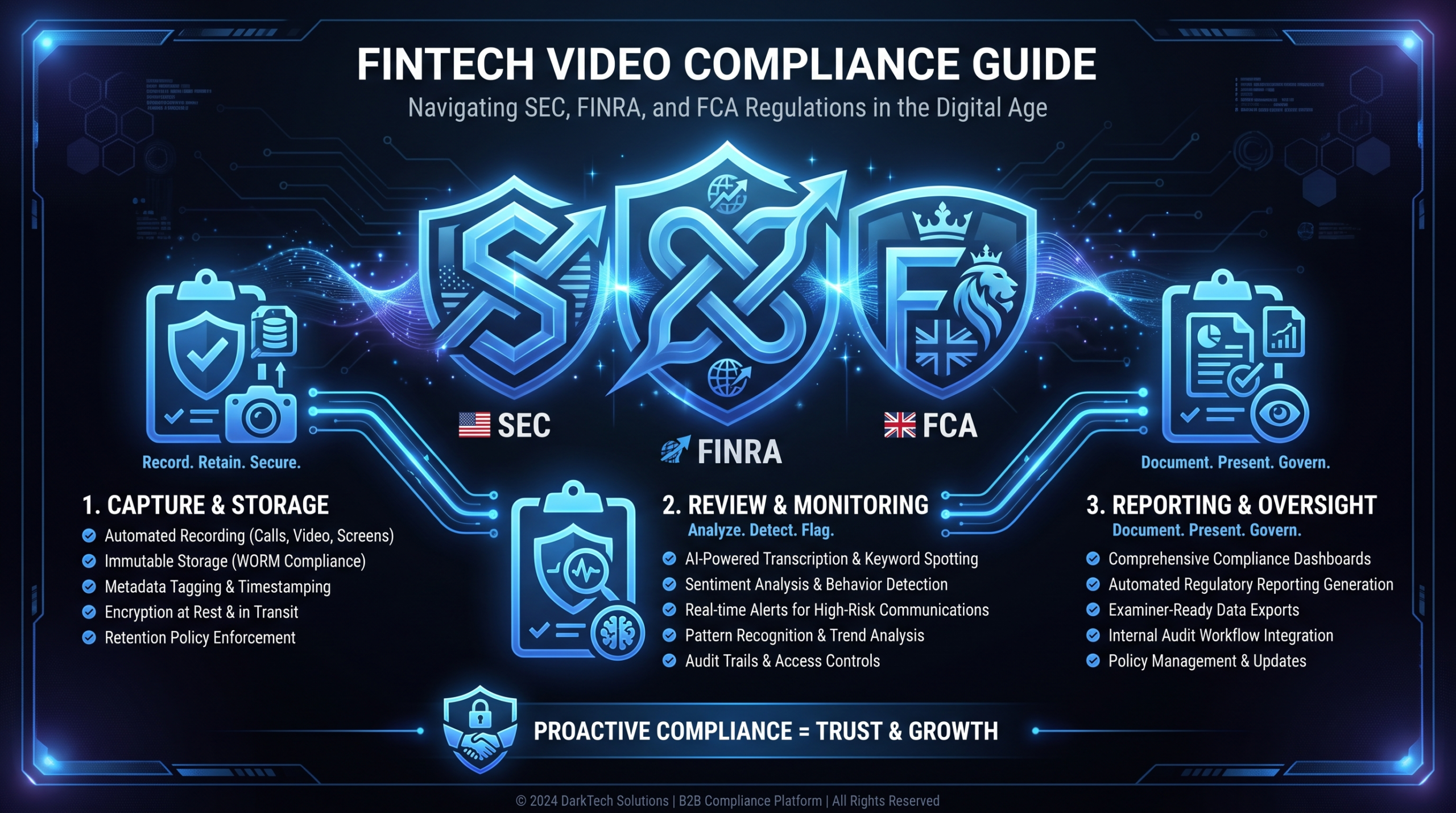
- Key Regulators and the Rules That Apply
- Required Disclosures in Fintech Video
- Testimonials, Endorsements, and Social Proof
- Pre-Production Compliance Checklist
- Distribution Channels: LinkedIn, YouTube, Paid
- Record-Keeping Requirements
- Building a Compliant Production Workflow
- Regulatory Snapshot by Video Type
- FAQ
Most B2B SaaS marketing teams can publish a product demo video the same week they record it. Fintech marketing teams cannot. Between SEC oversight, FINRA rules, FCA financial promotions rules, and internal compliance gates, the average regulated fintech company adds anywhere from one to six weeks to its video approval cycle — and that's when everything goes right.
That friction is real, but it's manageable. The companies that handle it best don't slow down their video programs; they front-load the compliance work into pre-production so approvals run in parallel with editing rather than blocking it. This guide walks you through exactly how to do that.
Scope note: This covers video marketing content — explainer videos, product demos, testimonials, ads, social clips, and thought-leadership video. It does not address regulatory filings, investor relations disclosures, or securities offering materials, each of which carries separate rules. This post is general practical guidance; it is not legal advice. Always work with your compliance team and qualified legal counsel.
Why Fintech Video Has Different Rules
Most marketing regulation distinguishes between general commercial speech and financial promotions — and that distinction is the root of most fintech video compliance complexity. When your video makes claims about returns, performance, investment strategies, or financial products, regulators treat it differently from a software demo or brand story.
Three factors make video especially scrutinized:
- Emotional impact. Regulators understand that video — with music, visuals, and narrator tone — can create impressions that a careful reading of the disclaimer might correct but that a distracted viewer won't catch. Rules about prominent and clear disclosure are therefore applied more strictly to video than to static text ads.
- Wide distribution. A YouTube video or LinkedIn ad can reach retail investors with no financial sophistication, not just institutional audiences. Rules are stricter when content is accessible to non-accredited or retail audiences.
- Durability. A video posted in 2023 may still be served by the algorithm in 2026. Outdated performance data, discontinued features, or changed pricing in an old video creates ongoing compliance exposure. Regulated fintechs typically need a content inventory review process, not just a publish-once workflow.
Key Regulators and the Rules That Apply
Fintech video compliance requirements depend on your entity type, your home jurisdiction, and where you distribute content. The table below summarizes the most common regulatory frameworks; it is illustrative, not exhaustive.
Regulatory Landscape for Fintech Video Marketing
| Regulator / Framework | Entity Types Covered | Key Video-Relevant Rules | Primary Jurisdiction |
|---|---|---|---|
| SEC | Registered investment advisers, broker-dealers (with FINRA), public companies | Rule 206(4)-1 (Marketing Rule); Rule 17a-4 (records) | United States |
| FINRA | Broker-dealers and their registered reps | Rule 2210 (Communications with the Public); Rule 4511 (records) | United States |
| FCA | Authorized financial firms; approvers under s.21 FSMA | Financial Promotions Order; COBS 4 (fair, clear, not misleading) | United Kingdom |
| CFPB | Consumer-facing lending, payments, credit products | UDAAP (unfair, deceptive, abusive acts or practices) | United States |
| State / Provincial | State-registered advisers, insurance, mortgage | State securities laws; insurance advertising rules | US states / Canada |
| EU / MiCA | Crypto-asset service providers | MiCA marketing communications requirements (from 2024) | European Union |
The SEC Marketing Rule (Rule 206(4)-1)
The SEC's updated investment adviser Marketing Rule, which became effective for most firms in November 2022, replaced the older Advertising Rule and Cash Solicitation Rule. For video, the most significant changes are around testimonials and endorsements (now allowed with conditions), performance advertising (with specific presentation requirements), and third-party ratings (allowed with disclosure). You can review the SEC's full adopting release and guidance at sec.gov.
FINRA Rule 2210
For broker-dealers, FINRA Rule 2210 classifies communications into institutional, correspondence, and retail — and subjects retail communications (which include most video ads, YouTube content, and social media posts) to principal pre-approval before first use. The rule requires that all communications be fair and balanced, present risks as prominently as benefits, and not make exaggerated or unwarranted claims. FINRA publishes regulatory notices on social media and digital communications at finra.org.
FCA Financial Promotions
In the UK, a "financial promotion" is broadly defined and includes video content that invites or induces a person to engage in investment activity. Under Section 21 of the Financial Services and Markets Act 2000, financial promotions must be approved by an FCA-authorized person before they are communicated. The FCA's "fair, clear, and not misleading" standard applies to the overall impression created — not just to the literal words. This matters for music, visuals, and on-screen graphics that might imply returns or create unrealistic expectations.
Required Disclosures in Fintech Video
Disclosure requirements are where most fintech video teams run into production friction. The rules don't just say "include a disclosure" — they specify how prominent, how long on screen, and sometimes what language to use.
The Prominence Problem
A 1-second disclaimer in 8-point font at the bottom of a 60-second video is not a disclosure — it's legal exposure. Regulatory guidance in the US and UK consistently applies a "clear and prominent" standard. For video, this typically means:
- On-screen text disclosures: legible font size (commonly at least equivalent to the body copy size used elsewhere in the video), sufficient display time for a viewer to read and understand.
- Audio disclosures: delivered at a pace that is understandable (not rapid-fire at the end), at comparable volume to the main audio track.
- Balanced presentation: risk disclosures should receive roughly equivalent prominence to benefit claims — not buried after two minutes of growth charts.
Common Disclosure Categories for Fintech Video
Disclosure Types by Content Category
| Content Type | Typical Required Disclosures | Notes |
|---|---|---|
| Investment performance claims | Past performance disclaimer; risk of loss; model/hypothetical caveat if applicable | SEC Rule 206(4)-1 has specific requirements for extracted performance and net-of-fee presentation |
| Testimonials / client reviews | Whether the reviewer is a current client; whether compensation was paid; material conflicts | SEC Marketing Rule requires specific disclosures; FINRA Rule 2210 prohibits unbalanced testimonials |
| Third-party ratings / awards | Name of rating organization; date of rating; criteria used; compensation disclosure if any | Both SEC and FCA require these to not be cherry-picked or misleading |
| Projected returns / forecasts | Hypothetical / model nature; assumptions used; actual results may vary | Highly scrutinized; many firms prohibit projected return claims in retail video entirely |
| Product feature claims | Material limitations, eligibility conditions, geographic restrictions | CFPB UDAAP applies to consumer-facing claims about lending, payments, credit products |
| Crypto / digital assets | Asset volatility; regulatory status; risk warnings (MiCA requires specific language in EU) | Varies significantly by jurisdiction; some EU/UK regulators have banned certain crypto ads |
Not legal advice: The disclosure types above are illustrative based on publicly available regulatory guidance. The specific language, timing, and prominence requirements for your content depend on your entity type, registered jurisdiction, and the specific claims made. Always have your compliance officer and legal counsel review final video content before publication.
Testimonials, Endorsements, and Social Proof
Testimonials are among the most effective tools in fintech video marketing — and among the most compliance-intensive. The SEC's updated Marketing Rule opened the door for investment advisers to use client testimonials and third-party endorsements in marketing (previously, the old Advertising Rule banned them almost entirely). But the conditions are specific.
What the SEC Now Allows
Under Rule 206(4)-1, investment advisers may use testimonials and endorsements in marketing materials — including video — if they meet all of the following conditions:
- Disclosure of relationship: Whether the person giving the testimonial is a current client and, if an endorser (non-client), the nature of the relationship.
- Compensation disclosure: Whether cash or non-cash compensation was paid, directly or indirectly. This includes referral fees, free services, affiliate arrangements, and revenue sharing.
- Conflict disclosure: Any material conflicts of interest that might affect the reliability of the testimonial.
- Oversight: The adviser must have a reasonable basis to believe the testimonial or endorsement complies with the rule, and must address disqualifying events (prior regulatory actions, etc.) for compensated promoters.
For video specifically: these disclosures need to appear on-screen (or in an audible overlay) with sufficient prominence during or immediately after the testimonial segment. Footnoting them in a YouTube description is not considered sufficient by most compliance practitioners.
FINRA's View on Broker-Dealer Testimonial Video
FINRA Rule 2210 requires that any testimonial used in a retail communication reflect the experiences of a representative sample of the firm's clients — not cherry-picked outliers. A video featuring a client who made exceptional returns (even if factually accurate) may violate the "fair and balanced" standard if it creates the impression that those results are typical, unless the video explicitly contextualizes the outcome as non-representative.
FCA Social Media Guidance
The FCA's stance on influencer and social media financial promotions has tightened considerably since 2023. Video content from paid influencers or brand ambassadors promoting financial products to UK audiences must be approved as a financial promotion by an authorized person before posting, even on the influencer's own channel. The FCA has issued enforcement actions against social media influencers promoting financial products without proper approvals — and the liability can extend to the firm that engaged them.
Pre-Production Compliance Checklist
The biggest efficiency win in fintech video compliance is moving review gates upstream. When a compliance team first sees a video in its final cut, the cost of changes is high: re-recording narration, re-shooting scenes, redoing motion graphics. When compliance reviews the script and storyboard before production starts, changes are cheap.
Pre-Production Compliance Gate — Fintech Video
| Stage | Compliance Action | Responsible Party |
|---|---|---|
| Concept / Brief | Identify all claims to be made; flag any performance data, testimonials, or forward-looking statements; confirm entity type and applicable rules | Marketing + Compliance |
| Script Draft | Full compliance review of all spoken and on-screen text; confirm disclosure language and placement; approve or return with edits | Compliance / Legal |
| Storyboard / Animatic | Review visual claims, chart types, performance graphics; ensure risk information is not obscured by design | Compliance + Creative Director |
| Rough Cut | Verify disclosures meet prominence standards (on-screen duration, font size, audio pace); check overall impression created | Compliance |
| Final Cut | Sign-off; record approval in compliance system; capture archival copy for record-keeping | Compliance Officer |
| Distribution / Platform Metadata | Review video title, description, captions, and thumbnail for compliance; confirm any paid distribution targets appropriate audiences | Marketing + Compliance |
Building this checklist into your production brief — before you engage a video team — means your editor is never waiting on compliance. For teams working with an external outsourced video editing partner, sharing your compliance brief upfront reduces revision cycles substantially. VEC's dedicated team model is specifically structured for this: your assigned team learns your compliance requirements once and builds them into the production routine rather than relearning them per project.
Distribution Channels: LinkedIn, YouTube, and Paid
The same underlying video may face different compliance requirements depending on how and where it's distributed. The key variable is audience reach: content accessible to general retail audiences typically faces stricter rules than the same content distributed only to institutional or accredited investor audiences.
LinkedIn is the dominant B2B distribution channel for most fintech teams. A few compliance considerations specific to the platform:
- Organic posts: Subject to the same rules as other marketing materials. FINRA-regulated firms must retain LinkedIn posts (including video) as business records per Rule 4511; many firms use social media archiving tools to capture this automatically.
- LinkedIn Ads (video): Classified as retail communications by FINRA for broker-dealers — principal pre-approval required before first use. The targeting capabilities on LinkedIn (by seniority, industry, company size) allow some segmentation by audience type, but this does not exempt the content from retail communication rules.
- Employee reposts: If registered reps repost firm video content, that repost may constitute a retail communication requiring firm review. FINRA has published guidance on this; check Regulatory Notice 17-18 on social media.
YouTube
YouTube is public and indexed by search, making it broadly accessible to retail audiences globally. This is the highest-scrutiny distribution channel for most regulated fintechs:
- All content must meet the full standards for retail communications (US) or financial promotions (UK).
- Video descriptions and pinned comments containing claims or links may themselves require review.
- Older videos that become inaccurate (outdated performance data, discontinued products, changed fee structures) need either updating or removal — a content inventory review process is essential.
- Age-gating or geo-restriction on YouTube can help limit distribution to appropriate audiences, but these controls are not foolproof and do not substitute for compliant content.
Paid Video Advertising
Paid distribution — YouTube pre-roll, LinkedIn video ads, programmatic video — typically accelerates the compliance exposure because it actively pushes content to audiences rather than waiting for them to find it. Additional considerations:
- Targeting parameters become part of the compliance record: if you claim content was only shown to institutional audiences, your ad platform targeting settings need to support that claim.
- A/B testing different video creatives means each variant needs its own compliance review.
- Retargeting sequences that create a multi-step narrative (video 1 makes claim X, video 2 provides the disclosure for claim X) are generally not compliant. Each video must be compliant on a stand-alone basis.
For a broader view of how fintech-specific video production fits into your overall strategy, see our guide to video production for fintech: compliance and conversion.
Record-Keeping Requirements
Record-keeping is often the least glamorous part of fintech video compliance and the one most frequently under-resourced. The core requirement across most US regulatory frameworks: marketing materials and their supporting documentation must be retained and retrievable on demand.
Key Rules and Retention Periods
Record-Keeping Requirements for Video Marketing
| Rule | Who It Applies To | What Must Be Retained | Minimum Period |
|---|---|---|---|
| SEC Rule 204-2 | Registered investment advisers | All advertisements and marketing materials, including video; supporting documentation for performance claims | 5 years (2 years easily accessible) |
| FINRA Rule 4511 / SEC Rule 17a-4 | Broker-dealers | All retail communications including video ads and social posts; approval records | 3 years (most communications) |
| FCA COBS 4.1 / SYSC 9 | FCA-authorized firms | Financial promotions and supporting materials; approval records | 3 years (6 years for retail; MiFID products) |
| FCA (crypto, per PS23/6) | Firms marketing cryptoassets to UK persons | Cryptoasset financial promotions; compliance sign-offs | 5 years |
What "Supporting Documentation" Means for Video
Regulatory examiners who audit marketing records don't just want the final video file. They typically expect:
- The final approved script and any revision history showing how compliance comments were addressed.
- The approval sign-off: who approved, on what date, in what role.
- For performance claims: the underlying data used, the time period covered, the calculation methodology.
- For testimonials: the compensation agreement (if any), the disclosure language reviewed.
- Platform capture: a record of where the content was published, on what dates, with what targeting parameters.
Most compliance teams use either a purpose-built marketing compliance platform or a systematic folder structure in a document management system. The key discipline: this archival process needs to happen at publish time, not reconstructed later from memory.
Building a Compliant Fintech Video Production Workflow
Compliance and video quality are not opposing forces. The fintech teams that produce the most compelling video content tend to be those that have invested in a structured workflow where compliance review is predictable and well-timed — not a last-minute scramble.
The Core Problem: Review Timing
The compliance bottleneck in most fintech marketing teams isn't the compliance team being slow — it's marketing delivering final edits for review when revision costs are highest. The script review cycle for a two-minute video typically takes one to three business days. The final cut review cycle, if compliance finds issues requiring re-shoots or re-records, can take one to three weeks. Front-loading the review cycle to the script stage eliminates most of this.
Recommended Workflow for a Fintech Explainer or Demo Video
- Marketing brief + claims inventory (Day 1): Write the production brief. List every claim the video will make — performance numbers, features, guarantees, social proof elements. Flag which claims need supporting data or approval.
- Compliance concept review (Days 2–3): Share the brief and claims list with compliance before scripting. Get a "proceed, avoid, adjust" on each claim. This prevents the video from being built around a claim that compliance will later reject.
- Script draft + compliance script review (Days 4–7): Write the full script including proposed disclosure language. Compliance reviews the script — this is the cheapest point for substantive changes.
- Production (Days 8–14): Video production proceeds with a compliance-approved script. Minor visual or pacing changes don't require re-approval if the claims are unchanged; establish this boundary in writing with your compliance team.
- Rough cut compliance review (Days 15–17): Compliance reviews the rough cut for prominence and overall impression. At this stage, reviews should be limited to disclosure presentation and visual claim issues — not substantive claim changes.
- Final cut sign-off + archival (Days 18–19): Final approval recorded; archival copy and documentation filed; version published.
This workflow assumes a typical explainer or demo video. Testimonial videos add the testimonial disclosure preparation to the process. Performance-data videos add supporting documentation review. In-house video teams at regulated fintechs commonly report that this workflow becomes routine after three or four videos — the first one always takes longest because you're building the process, not just the video.
How a Dedicated Video Team Helps
One of the compounding advantages of working with a dedicated video editing team — rather than project-by-project freelancers — is institutional memory of your compliance requirements. When VEC's dedicated teams work with regulated fintech clients, the compliance brief lives with the team permanently. Editors know which disclosure templates to use, how long disclosures need to display on screen, and which visual styles (chart types, color usage, stock footage) have been pre-cleared internally. That institutional memory collapses approval cycles on video two, three, and four.
You can see how VEC structures fintech video programs in our overview of video production companies for fintech. For a detailed breakdown of what fintech-specific video production costs at different output levels, see our SaaS video production guide.
Regulatory Snapshot by Video Type
Compliance Intensity by Fintech Video Format
| Video Format | Typical Compliance Intensity | Key Triggers | Approval Timeline Estimate |
|---|---|---|---|
| Brand / culture video | Low–Medium | Entity name, logo, any implied product claims | 3–5 business days |
| Product demo (software features only) | Low–Medium | Feature accuracy, fee mentions, eligibility caveats | 3–7 business days |
| Explainer (how the product works) | Medium | Returns framing, risk disclosure, regulatory status | 5–10 business days |
| Client testimonial | High | SEC Marketing Rule / FINRA 2210 disclosure requirements; representative results standard | 7–14 business days |
| Performance / results video | High | Performance presentation rules; hypothetical vs actual; net-of-fee; benchmarks | 10–21 business days |
| Paid video ad (retail audiences) | High | Retail communication rules; principal pre-approval (FINRA); FCA approval requirement (UK) | 7–14 business days |
| Crypto / DeFi promotion | Very High | MiCA (EU); FCA PS23/6 (UK); SEC enforcement posture; jurisdiction-specific bans | 14–30 business days (or more) |
These timeline estimates reflect the internal compliance review cycles commonly reported by fintech marketing teams; actual timelines depend on your organization's compliance staffing, the complexity of claims, and whether issues arise at the script stage (cheap to fix) or the final cut stage (expensive). They are illustrative, not guaranteed benchmarks.
Frequently Asked Questions
Does every fintech company need to comply with SEC and FINRA video rules?
No — the SEC's investment adviser rules (including Rule 206(4)-1) apply to registered investment advisers; FINRA rules apply to broker-dealers registered with FINRA. If your fintech is a payments company, lending platform, or software provider without a registered advisory or broker-dealer subsidiary, your primary framework is likely the CFPB's UDAAP standards (in the US) and general FTC truth-in-advertising rules, not the SEC Marketing Rule. Identify your entity type and consult your compliance officer to determine which frameworks apply to your specific business.
Can we use customer success stories in fintech video?
Generally yes, with disclosure. Under the SEC's updated Marketing Rule (effective November 2022), registered investment advisers can use testimonials and endorsements in marketing — including video — if they disclose the reviewer's status (current client or paid endorser), any compensation paid, and material conflicts of interest. Broker-dealers under FINRA Rule 2210 can use client testimonials if they are fair and balanced and do not imply that the client's results are typical. The FCA in the UK has similar requirements. The practical rule: every testimonial clip should be accompanied by disclosure language drafted and reviewed by your compliance team, displayed prominently on screen during or immediately after the testimonial segment.
What is the "overall impression" standard and why does it matter for video?
Both the FCA and the SEC evaluate financial promotions not just on the literal accuracy of individual statements, but on the overall impression they are likely to create in the mind of a reasonable viewer. A video can be technically accurate statement-by-statement but still violate the standard if the music, pacing, visuals, and narrator emphasis together create an impression that is misleading — for example, by emphasizing returns prominently and rushing through risk disclosures. This standard makes video more compliance-intensive than static text, because every production element (sound design, color grading, motion graphics style) contributes to the overall impression.
How long do we need to keep video marketing records?
Retention periods vary by rule and entity type. For SEC-registered investment advisers, Rule 204-2 requires marketing materials and supporting documentation to be retained for five years (with two years in an accessible location). FINRA Rule 4511 requires broker-dealers to retain most communications for three years. FCA rules typically require six years for retail client records and three years for other communications, with longer periods for certain MiFID-related content. The supporting documentation — scripts, approval records, supporting data for performance claims — must be retained alongside the video file itself. Build your record-keeping process into the publish workflow, not as a separate archival step.
What happens to older videos that become non-compliant over time?
Outdated video content is a known ongoing exposure for regulated fintechs. If a video contains performance data that no longer meets current requirements, references a fee structure that has changed, or features a product that has been discontinued, continuing to host and distribute it creates compliance risk. Most compliance teams advise a quarterly or semi-annual content inventory review: audit all live video assets against current regulatory requirements and your current product state. Videos that cannot be updated (for example, older testimonials that lack required disclosures) should typically be taken down rather than left live. Document the review process and the decisions made.
Video That Moves Fast Without Cutting Corners
Compliance-ready fintech video starts with a production team that understands the rules. VEC's dedicated editing teams work within your compliance workflow — script review, disclosure templates, revision cycles — so you ship more content, not less.
Book a Free Strategy Call See Pricing