Fintech Video Production Cost: 2026 Benchmarks
TL;DR
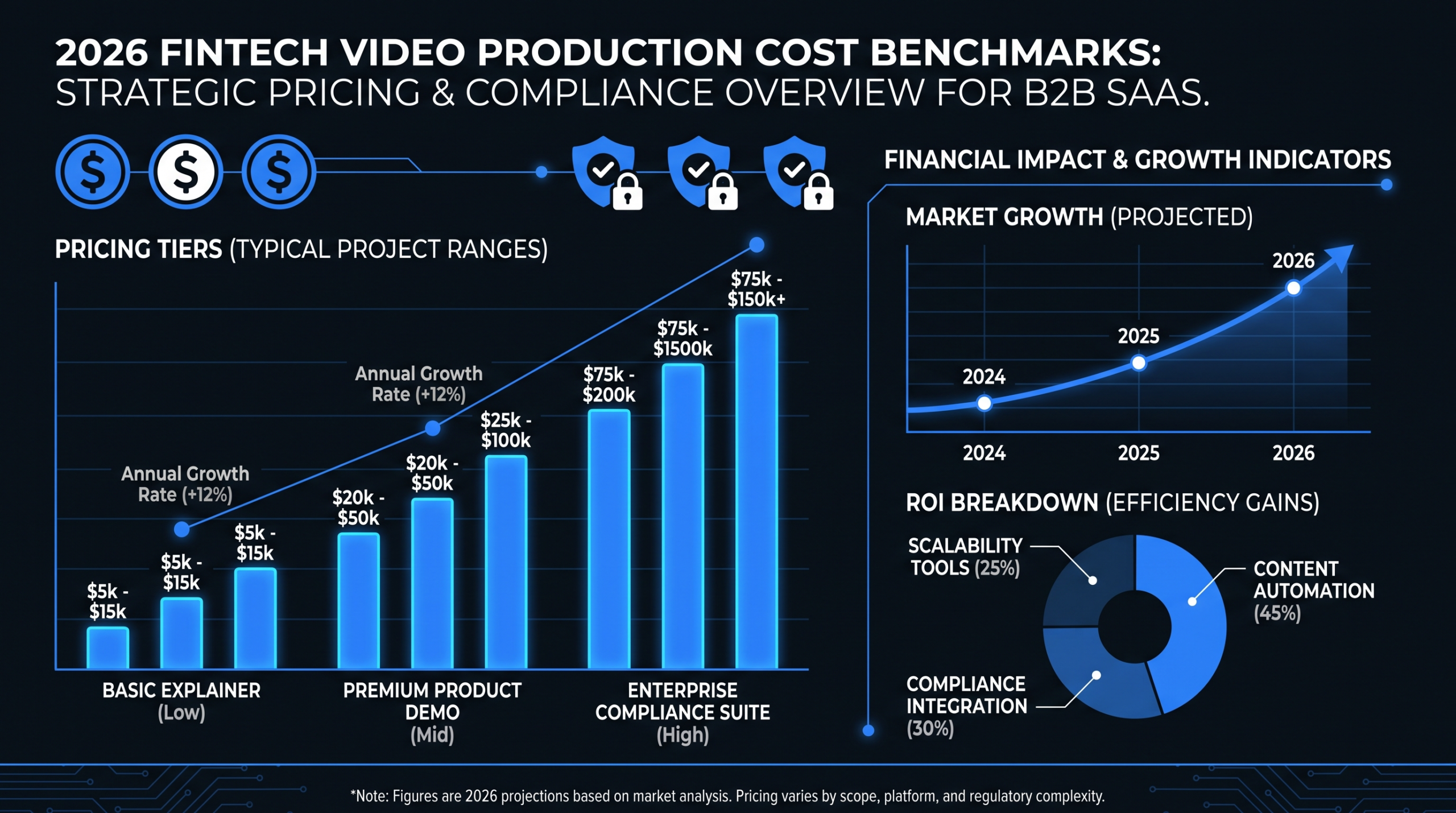
Fintech video production typically costs 20–40% more than comparable general B2B video because of compliance review cycles, regulated-claims vetting, and security requirements. Freelancers start around $500–$2,500 per video for basic edits; specialized fintech agencies commonly quote $8,000–$25,000+ for polished brand or product videos. Monthly retainers for ongoing fintech content range roughly $5,000–$20,000, while dedicated-team arrangements — the model best suited for Series A–C fintechs scaling output — typically run $5,000–$18,000/month. The biggest hidden cost isn't production; it's the revision cycles triggered by compliance review.
Table of Contents
Fintech marketing teams searching for video production quotes often encounter a surprise: numbers higher than expected, timelines longer than peer industries, and revision rounds that are hard to predict. None of this is arbitrary.
The regulated nature of financial products — lending rates, investment returns, insurance coverage, payment terms — means every on-screen claim must pass through a legal or compliance filter before the video goes live. That filter adds time, adds revision rounds, and therefore adds cost. Understanding the structure before you budget is the difference between a realistic content program and one that exhausts its budget mid-year.
This guide covers 2026 market pricing benchmarks, the fintech-specific cost factors that drive the premium, and a practical framework for building a video budget your finance team won't send back.
Why Fintech Video Costs More Than General B2B Video
Most B2B video production guides quote ranges that apply well to SaaS, e-commerce, or professional services. Fintech is a structurally different category. Several factors consistently push production costs above the general B2B baseline.
Compliance Review Cycles
A standard SaaS product video might go through two rounds of creative revisions — one after the rough cut, one after the first fine cut. A fintech video typically adds one or two compliance review cycles on top of that. Legal or compliance teams review scripts before production begins and finished videos before publication. Each review cycle adds roughly 3–10 business days and often triggers additional revision rounds the agency must execute. Experienced fintech agencies price this in; agencies without regulated-industry experience often bid low and then invoice for overages.
Regulated Claims and Disclosure Requirements
Statements like "earn up to 5% APY," "no hidden fees," or "FDIC-insured" require specific disclosure language, timing, and formatting — often mandated by the FTC, CFPB, SEC, FINRA, or relevant state regulators depending on product type. Adding compliant disclaimers to video isn't just a text overlay; it affects timing, visual design, and in many cases requires the disclaimer to appear for a minimum duration at a legible size. This post-production work has no equivalent in most other sectors.
Security and Data Handling Requirements
Fintech companies handling customer financial data often have strict policies around where footage is stored, which vendors can access production files, and how assets are transmitted. Production agencies working under NDA or operating in SOC 2-type environments may charge a security premium or require specific infrastructure — encrypted file transfer, access-controlled project spaces — that generic agencies don't offer. Screening vendors for security posture adds procurement time even before a creative brief is written.
Brand and Regulatory Accuracy Demands
Getting a product demo wrong in SaaS is embarrassing. Getting it wrong in fintech — showing incorrect interest rates, wrong eligibility criteria, or inaccurate fee structures — carries regulatory and legal exposure. Production teams in fintech typically require more client involvement per video: more internal reviewers, more sign-off steps, longer feedback windows. Competent agencies charge for this coordination overhead. Less experienced ones frequently underestimate it.
The combined result: fintech video production realistically costs 20–40% more than comparable B2B video across most production models. Budgeting with a general B2B benchmark will leave your program short.
Fintech Video Production Cost by Vendor Model
The vendor model you choose has a larger impact on total cost than almost any other decision. Below are 2026 benchmark ranges by model type for fintech-appropriate production — not social-clip factories, but vendors capable of producing compliant, brand-quality content.
For a detailed comparison of how these production models work structurally, our guide on video production agency pricing models covers the mechanics, hidden costs, and tradeoffs of each approach.
Table 1: Fintech Video Production Cost by Vendor Model (2026 Benchmarks)
| Vendor Model | Typical Cost Range | Revision Handling | Best For |
|---|---|---|---|
| Freelancer (platform-sourced) | $500–$3,000/video | 1–2 rounds; extras billed | Low-stakes internal content, social repurposing |
| Boutique agency (generalist) | $3,000–$12,000/video | 2–3 rounds included | One-off brand videos; limited compliance fluency |
| Fintech-specialized agency | $8,000–$25,000/video | Compliance review built in | Regulated content, investor videos, launch campaigns |
| Video subscription service | $2,000–$8,000/month | Sequential; each round extends timeline | High-volume social clips; not suited for complex regulated content |
| Dedicated editing team | $5,000–$18,000/month | Iterative; built into team workflow | Ongoing programs; best cost-per-video at scale |
The "fintech-specialized agency" tier commands a premium because the team already understands regulated claims, has experience with FINRA/SEC/CFPB disclosure requirements, and can advise on what's likely to trigger a compliance flag before the script reaches legal review. For a one-off high-stakes video — an investor pitch, a regulatory explainer, a launch campaign — that expertise typically pays for itself in avoided revision cycles and compressed timelines.
The Case for Dedicated Teams at Scale
For fintech companies producing video at scale — generally 6 or more pieces per month — a dedicated editing team typically offers the best cost-per-video outcome. Teams working exclusively on your account build brand and compliance fluency quickly, require less briefing per video, and absorb compliance revision rounds within the engagement rather than billing overages. VEC's dedicated team plans for fintech clients start at the Growth tier ($5,000/month) and scale to Core ($9,500/month) and Scale ($16,000/month) depending on output volume and video complexity.
Why Freelancers Carry Risk for Regulated Content
Freelancers are genuinely useful for non-regulated fintech content — internal training videos, team culture content, simple social repurposing from existing assets. For any customer-facing content with product claims, the risk calculus changes. A freelancer producing a lending product explainer is unlikely to flag a regulatory compliance issue; they are focused on executing the creative brief. The cost of a single non-compliant video — even a retracted one — almost always exceeds the savings from using a lower-cost vendor.
Cost by Fintech Video Type: What Marketing Teams Actually Produce
Different video formats in fintech carry different production complexity and therefore different cost profiles. The table below covers the types fintech marketing teams most commonly commission, with 2026 market ranges based on agency-tier production (not freelancer minimums).
Table 2: Fintech Video Type Cost Breakdown (2026)
| Video Type | Typical Duration | Production Cost Range | Compliance Overhead |
|---|---|---|---|
| Animated explainer (product feature) | 60–90 sec | $5,000–$18,000 | Medium — claims review required |
| Product demo (screen recording + VO) | 2–4 min | $3,000–$10,000 | Low to medium |
| Brand / culture film | 1–3 min | $8,000–$30,000 | Low — no product claims |
| Customer testimonial / case study | 2–4 min | $4,000–$12,000 | Medium — results claims need vetting |
| Investor / fundraising video | 2–5 min | $10,000–$40,000+ | High — SEC/FINRA rules apply |
| Compliance training / onboarding | 5–20 min | $5,000–$20,000 | High — accuracy is critical |
| Social clips (repurposed from long-form) | 15–60 sec | $300–$1,500/clip | Low — derivative of reviewed content |
| Webinar / event highlight reel | 3–5 min | $1,500–$5,000 | Low |
The investor and fundraising video category sits at the top of the range because it frequently requires securities law review, especially for Regulation D offerings or any content touching forward-looking performance statements. If you are producing this type of content, involve your general counsel in vendor selection — not just the creative brief.
For product demos and animated explainers — the two most common fintech video formats — the cost range is deliberately wide because execution quality varies enormously. A $3,000 product demo might be a clean screen recording with a professional voiceover. A $10,000 product demo might include custom UI animations, B-roll, professional voice talent, and motion graphics that match a premium brand identity. Both are technically "product demos." The production brief determines which version you receive.
For a detailed breakdown of the line items inside explainer video production, our explainer video cost breakdown covers what drives each cost category.
The Compliance Cost Layer: What Adds Up Fast
Compliance isn't a single line item — it's a multiplier on your production timeline that ripples across almost every budget category. Understanding the mechanics in advance is the only reliable way to plan for it.
Script-Level Review
The most cost-effective time to catch compliance issues is before a single frame is shot or animated. Most fintech companies route scripts through legal or compliance review before handing them to production. This typically adds 5–15 business days to a project's pre-production phase, depending on the company's internal review process and reviewer availability. If the agency is not expecting this delay — or hasn't built it into their project schedule — it compresses the production phase or pushes the delivery date. Both outcomes drive cost increases, either through rush fees or rework caused by timeline pressure.
Post-Production Revision Rounds
Even with a reviewed script, compliance teams reviewing the finished video frequently flag issues that were not visible in text form — a specific number appearing on screen, a graphic element that implies a performance claim, or a timing issue with required disclosures. Every compliance-triggered post-production revision cycle can add 2–5 business days and roughly $500–$2,500 in agency time depending on scope and the nature of the change. Budget for at least one compliance-triggered revision cycle beyond what you initially planned.
Disclaimer Execution
Adding required disclosures to video is not a simple text overlay. A full-screen disclaimer needs to be designed, timed, sized to meet legibility standards (which vary by regulator), and integrated into the final export in a way that does not disrupt the viewer experience. For animated videos, the disclaimer may need to be animated rather than static. Per-video budget for disclaimer development and integration commonly runs $300–$1,500 depending on the number of distinct claims and the complexity of the execution. For video series, negotiating a template-level disclaimer package up front can cut this per-video cost significantly.
Multi-Jurisdiction Localization
For fintech companies operating across multiple markets, the compliance requirements for the same video can differ substantially by country. A consumer lending product may require one disclosure format in the US, different language in the UK, and additional regulatory copy in the EU. Localization for compliance purposes typically costs more than standard translation — budget $1,500–$5,000 per jurisdiction per video for markets with distinct regulatory frameworks, more if the content requires re-recording a voiceover with jurisdiction-specific language.
For a full picture of how fintech companies structure their video production relationships beyond cost, our fintech video production hub covers the strategic, operational, and vendor-selection layer.
How to Build Your Fintech Video Budget
A realistic fintech video budget has five components. Missing any one of them produces systematic underestimates.
1. Production Cost (Base)
Use Table 2 as your starting point. Apply the lower end of the range for well-defined, scripted projects with clear deliverables and no original talent or on-location filming. Apply the upper end for complex briefs, premium production values, original music, professional on-screen talent, or any project requiring on-location shooting. When getting agency quotes, ask specifically whether compliance revision rounds are included in the project price or billed as overages — the answer reveals whether the agency has real fintech experience.
2. Compliance Review Buffer
Add 15–25% to the base production cost as a compliance buffer. This covers additional revision rounds triggered by legal or compliance review. If compliance passes cleanly on the first round — which does happen, especially with experienced agencies who catch issues before they reach the finished cut — this buffer rolls into available margin. If it doesn't, you have the budget to execute changes without scope disputes or surprise invoices.
3. Disclaimer and Disclosure Asset Development
Budget $300–$1,500 per video for disclaimer design and integration. For campaigns producing multiple videos around a single product, negotiate a template disclaimer package with the agency: they develop a compliant, brand-consistent disclaimer component once and apply it across the series. This typically cuts per-video disclaimer cost by 50–70%.
4. Internal Review Time
Compliance and legal reviews consume internal headcount. Every hour your GC, CCO, or compliance team spends reviewing scripts and finished videos is a real cost even if it doesn't appear on a vendor invoice. For quarterly planning purposes, estimate 4–8 hours of senior internal time per video for review and approval cycles. This doesn't change the production budget but sets realistic expectations for every stakeholder contributing to the process — and avoids situations where a video is production-complete but stuck in an internal queue for three weeks.
5. Distribution Budget
Video produced but not distributed generates no return. Reserve 15–20% of your production budget for paid distribution — LinkedIn video ads, YouTube pre-roll, account-based video targeting — and for iterating on creative based on performance data. Wistia's video marketing research consistently shows that companies with dedicated video distribution budgets achieve materially higher ROI from their production spend. Distribution isn't a line item to cut when the production budget runs long; it's the mechanism that converts production investment into pipeline results.
A Sample Annual Budget for a Series B Fintech
A Series B fintech building a content program from scratch might plan:
- 2 animated explainers per quarter: roughly $10,000–$28,000 annually
- 1 brand/culture film per half: roughly $8,000–$20,000 annually
- 4 customer testimonials per year: roughly $16,000–$48,000
- 12 social clip repurposing packages per year: roughly $4,800–$18,000
- Compliance review buffer (20% of production total): roughly $7,760–$22,800
Annual total: roughly $47,000–$137,000 depending on quality tier and scope. At this output volume — roughly 2–4 productions per month — a dedicated-team arrangement typically delivers better value than per-project agency work. VEC's Core plan at $9,500/month includes a dedicated team (senior editor, junior editor, PM, and creative director) that builds fintech brand fluency over time and absorbs compliance revision rounds within the retainer rather than triggering overage invoices.
Getting the Business Case Approved
Finance teams at fintech companies apply more rigorous scrutiny to marketing spend than in many other sectors — because they're accustomed to demanding that rigor for financial products. A solid ROI framework improves approval odds and establishes the measurement baseline you'll need to protect the budget in subsequent quarters.
Frame Video as Pipeline Infrastructure, Not Creative Spend
The most persuasive fintech video business cases position video as infrastructure supporting the sales and compliance process. Product explainers reduce the number of discovery calls required to move a deal forward. Compliance training videos reduce audit exposure and onboarding time. Customer testimonial videos accelerate deals through procurement review at enterprise accounts. Each of these outcomes maps to a metric finance understands — time-to-close, support ticket volume, onboarding cost per seat — and makes the ROI case on grounds your CFO already cares about.
Use Conservative Attribution
Avoid claiming full attribution for any video asset. Present a conservative assisted-attribution model: "Our product demo video was viewed by X% of accounts that closed in Q3; applying a 20% assisted-attribution weight, video contributed to approximately $Y in ARR." This is honest, defensible, and credible — and credibility with finance builds the trust that sustains a program through a slow quarter. Overclaiming attribution is a budget-cycle risk; under-claiming and then overdelivering is a budget-growth strategy.
Benchmark Against Alternative Spend
For fintech companies running paid media on LinkedIn at CPMs commonly ranging from $30–$80 for B2B financial services audiences, a high-quality video that generates 50,000 organic views over 12 months delivers substantial equivalent paid media value from a one-time production investment. The comparison is never perfect, but it reframes video production as a media asset with a depreciation schedule rather than a one-time expense that disappears after publication.
For more on how video production scales as part of a fintech content strategy, our guide on how to outsource video editing covers the operational model decisions that determine whether outsourcing is more cost-effective than in-house at each stage of company growth. HubSpot's video marketing benchmarks provide useful comparison data for building internal ROI projections across B2B industries.
Frequently Asked Questions
How much does a fintech explainer video cost in 2026?
Animated fintech explainer videos typically cost $5,000–$18,000 for a 60–90 second video at agency quality. Freelancers can produce simpler versions for $1,500–$4,000, but these commonly lack the motion graphics quality and compliance review capability that regulated financial content requires. The upper end of the range applies when the video requires premium animation, licensed music, professional voice talent, and integration of multiple required disclosures. Budget an additional 15–20% for compliance revision rounds beyond the initial creative pass.
Why does fintech video production cost more than standard B2B video?
The primary driver is compliance overhead. Fintech videos with product claims — interest rates, fees, eligibility requirements, performance figures — require legal or compliance review at the script stage and typically again after the finished cut. Each review cycle adds revision rounds and timeline extensions that experienced agencies price into their fintech engagements. Security requirements for handling production files and the accuracy demands of regulated content add production time with no equivalent in most other B2B video categories. The combined overhead typically adds 20–40% to the base production cost.
What's the most cost-effective model for ongoing fintech video production?
For fintech companies producing 6 or more videos per month, a dedicated editing team arrangement typically offers the best cost per video. The team builds brand and regulatory familiarity over the first 4–6 weeks, after which they can anticipate compliance-sensitive areas before content reaches legal review — reducing revision cycles over time. Monthly retainers in the $5,000–$18,000 range with a dedicated team generally cost less per video than per-project agency work at comparable quality levels once monthly volume exceeds 6–8 productions.
Do I need a fintech-specialized agency or can a general video agency handle it?
General video agencies can produce technically excellent work for fintech — the question is who manages compliance fluency. If your internal legal or compliance team reviews every script and finished video before publication, a skilled generalist agency can execute effectively with your oversight. If you want the agency to flag potential compliance issues proactively, advise on FINRA or CFPB disclosure requirements, or build review checkpoints into the production schedule, a vendor with regulated-industry experience is worth the additional cost. The savings from a lower-cost generalist can be erased by a single non-compliant video that requires retraction and re-production.
How many revision rounds should I budget for in a fintech video project?
Budget for 3–4 total revision rounds: 1–2 creative rounds standard for any video production, plus 1–2 compliance-triggered rounds. High-stakes video types — investor content, consumer lending explainers, anything touching SEC or FINRA-regulated products — may require additional rounds depending on the complexity of the claims involved. Negotiate revision round caps into your agency contract with a clear per-round rate for overages, and build your internal review timeline around a minimum 5-business-day window per compliance review cycle to avoid compressing the creative team's execution time.
Need Fintech Video That Passes Compliance and Performs?
VEC builds dedicated video editing teams for fintech marketers — senior editor, junior editor, PM, and creative director assigned to your account. Our teams build brand and compliance fluency fast, so revision cycles shrink over time instead of compounding.
Book a Free Strategy Call See Pricing Plans