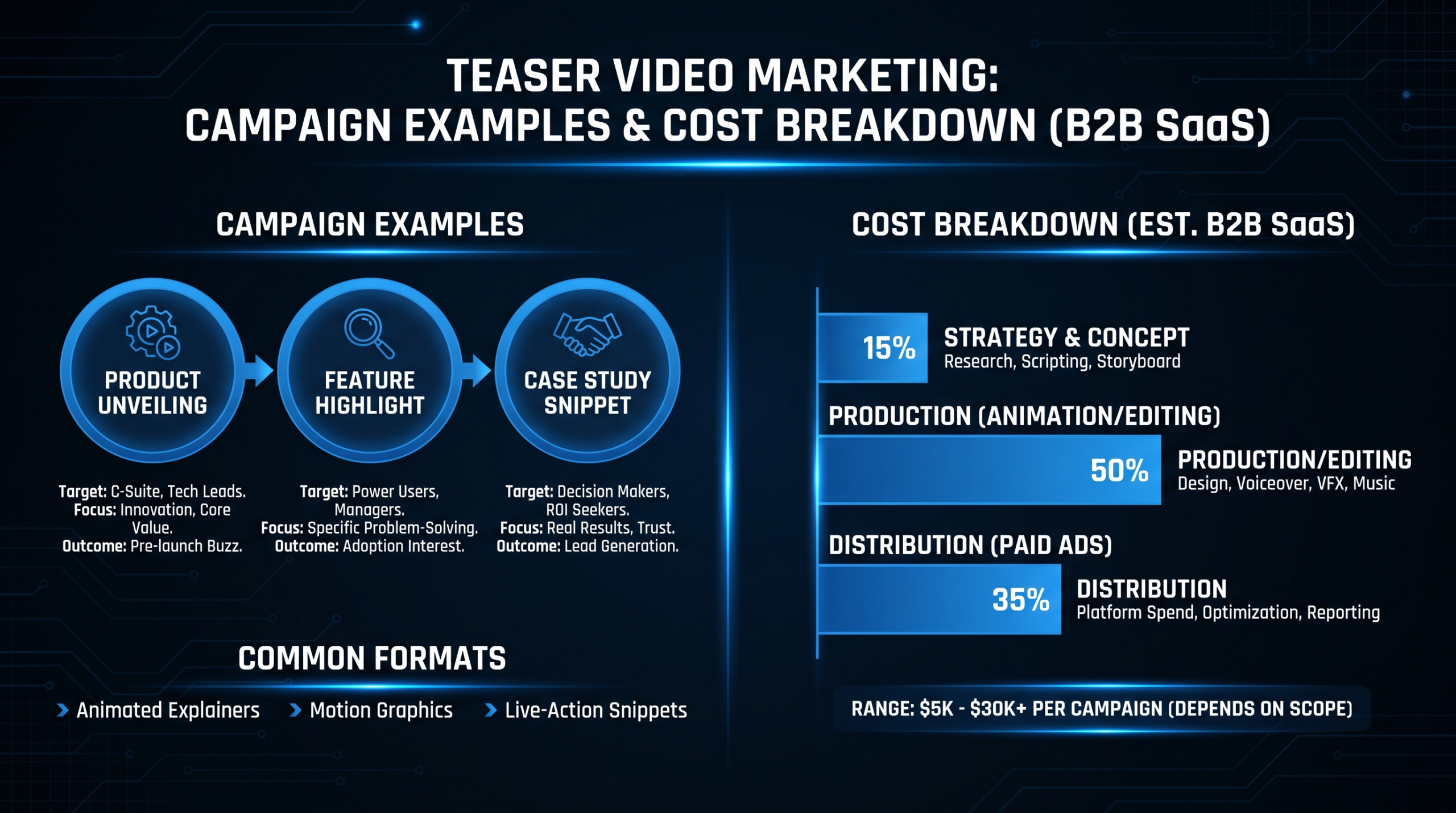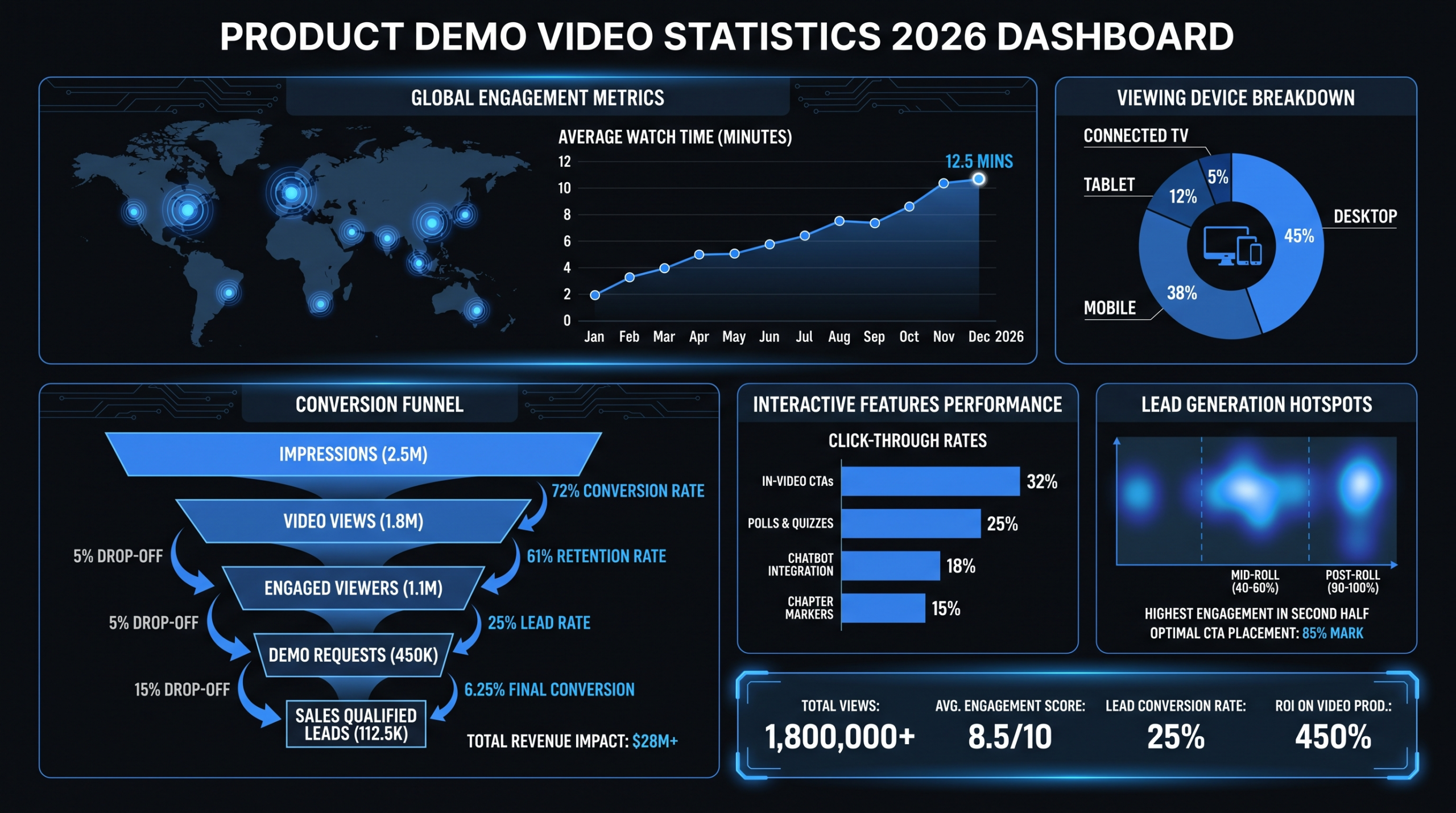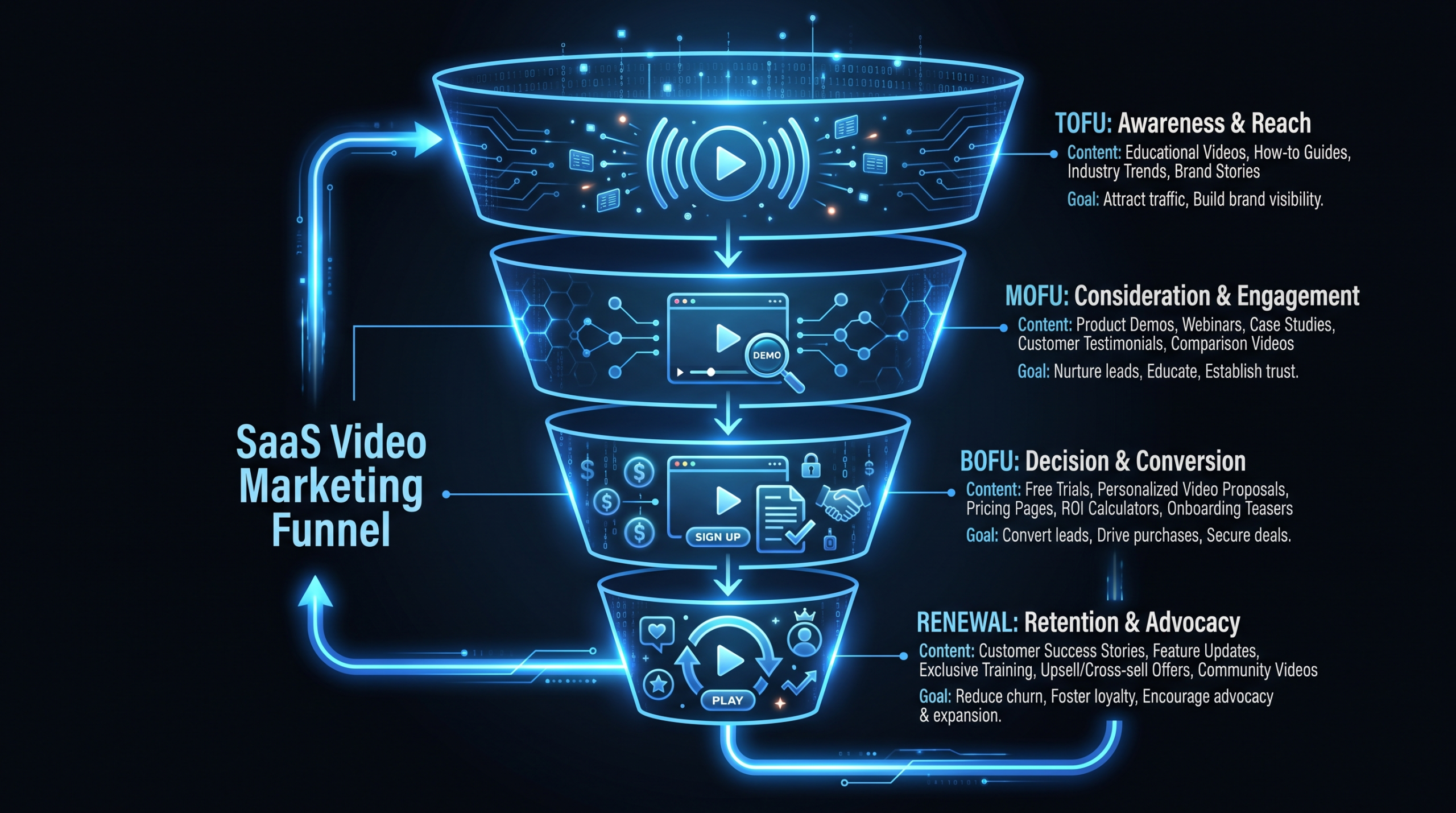
Video for Every Funnel Stage: TOFU to Renewal
TL;DR
- Most SaaS video programs are heavily TOFU-weighted — they generate brand awareness but miss the stages where video has the highest conversion impact.
- Each funnel stage has distinct formats, length requirements, and production standards. One-size-fits-all video strategy doesn't work.
- BOFU and onboarding video typically deliver the fastest, most measurable ROI for Series A–C SaaS companies.
- Renewal and expansion video is the most underused lever in SaaS — it directly impacts NRR and costs a fraction of acquisition video.
- A balanced video program covers all five stages: TOFU, MOFU, BOFU, onboarding, and renewal.
Table of Contents
- Why Most SaaS Video Programs Are Out of Balance
- TOFU: Awareness-Stage Video That Builds Pipeline
- MOFU: Consideration-Stage Video That Wins Evaluations
- BOFU: Decision-Stage Video That Closes Deals
- Onboarding & Activation: Video for Time-to-Value
- Renewal & Expansion: Video for Net Revenue Retention
- Full-Funnel Video Format Matrix
- Production Strategy and Budget Allocation by Stage
- How to Build Your SaaS Video Calendar
- FAQ
Why Most SaaS Video Programs Are Out of Balance
Ask a Head of Content at any Series B SaaS company where their video budget goes, and you'll hear some version of the same answer: thought leadership clips, LinkedIn content, the occasional brand film. Awareness. Top of funnel.
That's not wrong — but it's incomplete, and the imbalance is expensive.
The companies that generate the best return from video aren't necessarily producing more content at the top. They're producing the right content at every stage: demos that convert evaluators, onboarding sequences that cut time-to-value, and renewal touchpoints that remind customers why they pay every year. Wyzowl's annual state of video research consistently finds that B2B buyers are more likely to watch a product video before purchasing than engage with any other content format — but that behavior spans the entire evaluation journey, not just the discovery phase.
The gap between where most SaaS teams invest in video and where video actually moves metrics is significant. This guide closes that gap.
We'll walk through each stage of the funnel — TOFU through renewal — with specific format recommendations, production standards, and strategic reasoning for VP Marketing and Head of Content teams operating at the Series A–C stage. By the end, you'll have a full-funnel video playbook ready to drop into a content calendar this quarter.
TOFU: Awareness-Stage Video That Builds Pipeline
The Goal: Surface and Educate, Not Sell
Top-of-funnel video has one job: get your brand in front of people who have the problem you solve, before they know your name. The purchase decision isn't happening yet — prospects are categorizing their pain, researching the category, and forming impressions about vendors based on the quality of what they find.
TOFU video that tries to sell loses. TOFU video that educates, entertains, or inspires earns attention and channel growth. The conversion happens downstream.
Formats That Work at TOFU
- Short-form thought leadership (60–90 seconds): Opinion-driven clips from a founder, VP, or subject matter expert on LinkedIn, YouTube Shorts, or TikTok. The format rewards directness — one insight, stated clearly, with a point of view worth following.
- Educational long-form (8–15 minutes): How-to and explainer content on YouTube. "How to build a SaaS content program from scratch" or "Why most B2B email sequences underperform" — content that solves a problem adjacent to your product category. This is where SEO value compounds over 12–24 months.
- Brand story and culture video (2–3 minutes): Who you are and why you exist. Rarely a direct conversion driver but anchors the buyer's positive impression when they encounter you in MOFU.
- Podcast clips and repurposed webinar content: High volume, relatively low editing complexity. One 45-minute webinar can produce 8–12 usable TOFU clips with smart editing and proper formatting.
Production Level and Length
TOFU video tolerates lighter production values than other stages — within limits. Authentic, direct-to-camera content from a credible voice consistently outperforms an expensive-looking video with no perspective. That said, poor audio, careless jump cuts, and low-quality graphics still hurt credibility. Aim for "professional enough to take seriously, human enough to trust."
Most TOFU content sits in the 60-second to 10-minute range. Shorter content for social distribution; longer for YouTube SEO and deep topic exploration. Production speed and volume matter more here than production perfection.
What TOFU Video Should Not Do
Don't gate TOFU video. Don't lead with product screenshots. Don't end with "book a demo" — that asks a cold audience to make a warm commitment. The right CTA at this stage is a subscribe, a follow, or a content offer that moves them naturally to the next stage. The funnel does its job when each stage sets up the next.
MOFU: Consideration-Stage Video That Wins Evaluations
The Goal: Win the Shortlist
At MOFU, the buyer knows they have a problem, they're aware of the solution category, and they're deciding which vendors deserve serious evaluation. Your video here needs to answer one question clearly: Why is this worth evaluating?
That's a harder question than it sounds. They have 3–7 other vendors on their shortlist. You need to stand out before you get to a sales call. MOFU video that performs best combines product clarity with credibility signals. Prospects are doing due diligence — they want to understand what your product actually does, who uses it, and whether it has worked for companies like theirs.
Formats That Work at MOFU
- Product overview video (2–4 minutes): A high-level walkthrough of your core value proposition with screen recording and narration. Not a detailed feature demo — this is the "here's what we do and why it matters" video that lives on your homepage or product page and shapes first impressions during active evaluation.
- Feature spotlight series: Short (90–120 seconds) focused videos on individual features or use cases. Excellent for email nurture sequences, targeted remarketing, and your website's features section. Keeps product education digestible without overwhelming.
- Customer case study teasers (90–120 seconds): A customer explaining their problem and outcome in their own words, with specific metrics when possible. The more closely the customer profile matches the prospect's industry and company stage, the more persuasive. See our SaaS video production guide for the interview framework we use to capture compelling customer stories on camera.
- Comparison content: "How we compare to [Competitor]" videos. Handled diplomatically and factually, these address the most common objection in any B2B evaluation and can intercept competitor comparison searches in the buying journey.
- Webinar replays and expert sessions: Full-length content for prospects who want depth. Gate lightly with email capture to generate pipeline attribution data.
What Kills MOFU Video
Over-produced, over-polished MOFU video that lacks specificity. Buyers at this stage want real product, real customers, real outcomes. A 4-minute product overview that's 90% branding and 10% actual product is a red flag for sophisticated buyers. Show the product. Show how it works. Show customer names and logos.
Also: don't underinvest in the product demo video. It is consistently the most-viewed video asset on SaaS websites, and most companies have an outdated, low-quality version that underrepresents what the product can do.
BOFU: Decision-Stage Video That Closes Deals
The Goal: Remove the Last Objection
BOFU is where video's ROI is most direct and most measurable. The prospect has shortlisted vendors, possibly been on a discovery call, and is now making a final decision. The videos they watch at this stage are answering specific questions: Can I trust this company? Will this work for my specific use case? What's the downside risk if this doesn't deliver?
Sales teams often have more influence over BOFU video than marketing does — because these assets are deployed directly in deal cycles, in post-call follow-up sequences, and in proposal packages. If your AEs and SEs aren't systematically using video after discovery calls, that's a significant conversion gap.
Formats That Work at BOFU
- Deep-dive product demo (15–30 minutes): A detailed, role-specific walkthrough that addresses the pain points surfaced in discovery. Not a general overview — this is scoped to the prospect's vertical and use case. Consider creating 2–3 role-specific versions (for operations, for finance, for the technical buyer) that sales can match to the stakeholder map in a deal.
- Full customer testimonial videos (2–4 minutes): Named customers with specific, quantified outcomes. The closer the customer profile matches the prospect — same company size, same industry, same problem — the more powerful the persuasion. "We were a 60-person Series B SaaS and we had exactly this challenge" lands harder than any general praise.
- Security and compliance overview (2–3 minutes): For enterprise and mid-market deals, this video can materially accelerate procurement reviews. Cover your security posture, certifications, and data handling practices in plain language. A concise, well-produced security video that the VP of Sales can forward to IT gatekeepers saves days in vendor evaluation.
- Pricing and ROI explainer (3–5 minutes): A video that walks through how customers typically think about the return on investment from your product. Doesn't have to reveal specific pricing — focus on the value framework, typical payback periods, and the cost of inaction. This is particularly effective with economic buyers who weren't in the original discovery call.
- "Why us" narrative (2–3 minutes): A direct, honest explanation of what you do better than the alternatives and who you're the best fit for. Done well, this builds confidence in the evaluation process itself and signals maturity and self-awareness that buyers find reassuring.
The BOFU Production Standard
BOFU video should be your highest-production-quality work. These assets are watched by decision-makers and economic buyers who are forming a final opinion on a multi-year software purchase. Shaky footage, poor audio, or vague messaging at this stage can undo weeks of pipeline work. Invest in production quality here first, then expand outward toward TOFU as budget allows.
Onboarding & Activation: Video for Time-to-Value
The Hidden Revenue Multiplier
Most SaaS companies don't think of onboarding video as a marketing function. That's a mistake rooted in org-chart thinking rather than revenue logic. Time-to-value — how quickly a new customer reaches their first meaningful outcome — is one of the most predictive indicators of long-term retention and expansion revenue. And video is the most efficient medium for reducing time-to-value at scale.
A well-structured onboarding video series can replace 40–60% of live onboarding calls, cut support ticket volume on common setup issues, and accelerate the "aha moment" that cements product adoption. Teams that move to video-first onboarding sequences commonly report that new customers complete critical setup steps significantly faster than those relying on written documentation alone — with measurable downstream effects on churn at the 60- and 90-day marks.
Formats That Work at Onboarding
- Welcome video (60–90 seconds): From the founder or VP of Customer Success. Human, warm, and specific about what they'll accomplish in the next 30 days. Sets expectations and makes the customer feel like a partner rather than a transaction. This is one of the highest-ROI videos you can produce — it costs almost nothing and materially affects the emotional framing of the entire relationship.
- Step-by-step setup series (3–5 videos, 3–7 minutes each): Narrated screen recording walkthroughs of the critical configuration steps. Triggered sequentially in the onboarding email flow. Should include clear chapter markers so users can jump to the step they need without rewatching the whole thing.
- Feature activation videos: Short (90–120 seconds) targeted videos sent when a customer is near a high-value feature but hasn't adopted it. "You have access to [Feature X] — here's how it saves your team 2 hours a week." These drive depth of adoption, which is the single most predictive metric for expansion revenue at renewal time.
- In-app tooltip videos: Embedded in the UI at key decision points. 20–45 seconds. Lead with the output before explaining the input — show the user what they'll get before explaining how to configure it. This inverts the typical tutorial structure and dramatically improves completion rates.
Who Owns Onboarding Video
Typically Customer Success or Product Marketing. In practice, these videos get deprioritized because they don't appear in acquisition metrics dashboards. That's a measurement problem, not a value problem. Onboarding video that improves 90-day retention by even a few percentage points is often worth more than the equivalent investment in top-of-funnel awareness content — it's just harder to attribute in standard marketing reporting.
Renewal & Expansion: Video for Net Revenue Retention
The Stage Most Teams Ignore
At most SaaS companies, renewal and expansion video barely exists. The sales team sends a renewal deck. The CSM schedules a QBR. Maybe a case study gets attached to an expansion proposal. Video is almost never part of this motion — which means it's almost never creating the emotional resonance and specificity that drives renewal decisions.
This is a significant missed opportunity. Renewal decisions are made by the same humans who approved the initial purchase. They respond to the same stimuli: social proof, clear value articulation, and the feeling that the vendor is genuinely invested in their success. Video delivers all three better than any other content format. The question isn't whether to use video at renewal — it's which formats and when.
Formats That Work at Renewal and Expansion
- QBR recap and value summary (3–5 minutes): After a quarterly business review, send a polished short video that summarizes the key wins, usage metrics, and outcomes from the past quarter. This is the antidote to "we forgot why we bought this" — one of the most common reasons SaaS customers decline to renew. A well-produced QBR recap video that a CSM can share the day after a review meeting is a high-leverage, repeatable asset.
- Expansion feature spotlight (60–90 seconds): Targeted at specific accounts that haven't adopted a feature tied to an upsell path. Lead with the outcome. Connect it directly to a pain point they've expressed in past calls. This is high-touch, high-ROI content that a dedicated production partner can produce at scale across your customer base.
- Customer milestone celebration: A short, personalized video marking a meaningful moment — one year as a customer, 1000th use of a feature, a major business outcome they achieved with your product. Low production cost, high emotional impact. Referral and expansion rates are meaningfully higher for customers who receive this kind of recognition versus those who don't.
- Executive alignment video (2–3 minutes): Before a renewal that involves new stakeholders — a new CFO, a reorg, a budget cycle — a short "here's what we've built together" video from your VP CS or founder can re-anchor the relationship before the approval process begins. Think of it as a pre-emptive business case, delivered in a format that's faster to consume than a deck and more personal than an email.
The ROI Case for Renewal Video
Renewal and expansion video typically costs 30–50% less to produce than acquisition video — shorter, more targeted, lighter production requirements. At the same time, growing an existing customer's ARR by 20% costs significantly less than acquiring an equivalent new logo. The ROI math on renewal video is compelling for any SaaS company with an NRR target — and most are underinvesting here by a wide margin.
Full-Funnel Video Format Matrix
Use this as your decision framework when scoping a quarterly video calendar. Every format maps to a specific stage, conversion goal, and production standard.
SaaS Video Format Matrix: TOFU to Renewal
| Funnel Stage | Format | Goal | Length | Production Level |
|---|---|---|---|---|
| TOFU | Thought leadership clips | Brand awareness, credibility | 60–90 sec | Medium — clear audio, clean framing |
| TOFU | Educational long-form | SEO, channel growth | 8–15 min | Medium — screen + narration, light graphics |
| TOFU | Webinar / podcast clips | High-volume distribution | 90 sec–3 min | Light — clean cuts, captions, branding |
| MOFU | Product overview | Generate evaluation intent | 2–4 min | High — polished screen + VO, branded graphics |
| MOFU | Feature spotlight series | Nurture, feature education | 90–120 sec | Medium — screen recording, music, captions |
| MOFU | Case study teasers | Social proof, credibility | 90–120 sec | High — customer interview + B-roll + motion graphics |
| MOFU | Competitor comparison | Intercept evaluation stage | 3–5 min | Medium-High — structured, polished screencast |
| BOFU | Deep-dive demo | Remove evaluation friction | 15–30 min | High — scripted, role-specific, polished |
| BOFU | Full customer testimonial | Final objection removal | 2–4 min | High — professional interview, motion graphics |
| BOFU | Pricing / ROI explainer | Justify investment, accelerate decision | 3–5 min | High — animated or polished screencast + VO |
| BOFU | Security overview | Remove procurement friction | 2–3 min | Medium — clear slides + narration |
| Onboarding | Welcome video | Emotional buy-in, set expectations | 60–90 sec | Medium — warm, human, face-to-camera |
| Onboarding | Setup walkthrough series | Time-to-value, reduce support load | 3–7 min each | Medium — narrated screen recording, chapters |
| Onboarding | Feature activation clips | Depth of adoption, expansion setup | 90–120 sec | Light–Medium — behavior-triggered |
| Renewal | QBR recap video | Value reinforcement, renewal confidence | 3–5 min | Medium — polished slides + narration |
| Renewal | Expansion spotlight | Upsell, deepen adoption | 60–90 sec | Light–Medium — personalized, targeted |
| Renewal | Executive alignment video | Stakeholder buy-in before renewal | 2–3 min | Medium — face-to-camera, professional |
Production Strategy and Budget Allocation by Stage
Not all funnel stages should receive equal production investment. The highest-stakes videos — watched by decision-makers at the moment of purchase — deserve the most production attention. Lower-stakes TOFU content can move faster with lighter production. Here's a framework for allocating production capacity and budget across your video program.
Budget ranges below reflect typical monthly investment when working with a dedicated video production partner versus relying on ad hoc freelancers — which adds coordination overhead and introduces consistency risk that compounds over time.
Production Approach and Monthly Budget by Funnel Stage
| Stage | Complexity | Recommended Model | Monthly Budget Range | Build Priority |
|---|---|---|---|---|
| BOFU | High | Dedicated team or retainer | $3,000–8,000/mo | #1 — highest ROI, start here |
| Onboarding | Medium | Dedicated team or subscription | $2,000–5,000/mo | #2 — direct churn impact |
| MOFU | Medium–High | Retainer or dedicated team | $3,000–7,000/mo | #3 — pipeline conversion |
| Renewal | Light–Medium | Subscription or retainer | $1,500–4,000/mo | #4 — NRR protection |
| TOFU | Light–Medium | Subscription or retainer | $2,000–5,000/mo | #5 — long-term compounding |
TOFU appears last in the priority order not because it's unimportant, but because most SaaS companies are already investing in awareness content. The gaps that create the highest opportunity cost are consistently in BOFU, onboarding, and renewal. If you're deciding where to start or where to expand capacity, prioritize from the bottom of the funnel up.
For a detailed breakdown of what's included at different production tiers, read our guide to video editing services and what's actually included at different price points — the variation across providers is larger than most buyers expect.
Teams running full-funnel programs at scale — 15–30 videos/month across all stages — benefit most from a dedicated editing team structure. The consistency, brand familiarity, and turnaround speed that comes from assigned editors who know your product deeply is difficult to replicate with a rotating freelancer pool. Video Editing Company's Growth plan (from $5K/month) and Core plan ($9.5K/month) are structured specifically for this use case, with dedicated editor pods and a 90-day output guarantee. See how these programs are scoped at our SaaS video production page.
How to Build Your SaaS Video Calendar
Start From the Bottom, Not the Top
The most common strategic mistake in SaaS video is building the calendar from TOFU down. You plan the thought leadership clips, the brand content, the YouTube strategy — and six months later you have strong awareness metrics and a sales team that still doesn't have a compelling demo to send in post-call follow-ups. Pipeline is sitting in the funnel, undecided, because the BOFU assets don't exist.
Build your calendar from the bottom up. Start by auditing what exists at BOFU and onboarding. If you don't have a polished 20-minute product demo, a set of strong customer testimonials, and a 5-video onboarding series, those are your first three priorities — regardless of what the TOFU gap looks like.
The Quarterly Video Build Cadence
For a Series A–C SaaS company with a marketing team of 3–8 people, a realistic full-funnel video calendar follows this sequencing:
- Month 1: Audit existing assets across the funnel. Identify the three biggest gaps. Prioritize BOFU and onboarding fills — these are the assets generating immediate revenue impact.
- Month 2: Launch core BOFU assets (updated product demo, 2 customer testimonials, security overview). Start the onboarding video series — begin with the welcome video and the first two setup walkthroughs.
- Month 3: Add MOFU content (product overview, 3–5 feature spotlights). Begin TOFU repurposing cadence — clips from existing webinars, customer calls, and team expertise. This requires almost no net-new filming if your team does regular external presentations.
- Month 4+: Running cadence — new TOFU content weekly (mostly repurposed), MOFU refreshes quarterly tied to product launches, BOFU and onboarding updates triggered by major product changes or new use cases.
Measuring Each Stage
Each funnel stage requires different success metrics — and measuring TOFU metrics for BOFU content, or vice versa, produces misleading conclusions:
- TOFU: Views, watch time, channel subscribers, organic impressions, brand search lift quarter-over-quarter
- MOFU: Play rate, video completion rate, click-through to demo request or trial signup
- BOFU: Deal win rate and velocity for opportunities that engaged with video vs. those that didn't; time-to-close delta
- Onboarding: Time-to-first-value, feature adoption rate at 30/60/90 days vs. cohort baseline
- Renewal: NRR delta for accounts that received video touchpoints vs. those that didn't; expansion revenue per account; QBR completion rates
The metrics that move CFO-level conversations — pipeline influenced, deal velocity, churn reduction, NRR — live at BOFU, onboarding, and renewal. HubSpot's video marketing research consistently shows that mid-funnel and BOFU video content drives faster, more attributable pipeline impact than awareness-stage content, even when TOFU content generates significantly more total views. If your video reporting only surfaces TOFU metrics, you're measuring the wrong things and almost certainly investing in the wrong places.
Frequently Asked Questions
How many videos do we need per funnel stage each month?
There's no universal answer, but a practical starting target for a Series A–C SaaS company is: TOFU (4–8 clips/month, primarily repurposed from existing content), MOFU (2–4 new assets per quarter), BOFU (1–2 core assets refreshed quarterly or triggered by product launches), onboarding (build once, update per major product release), renewal (2–4 personalized or semi-personalized videos per month depending on CSM capacity). Start with BOFU and onboarding — they're finite build projects, not recurring content engines, and they generate the fastest measurable return.
Where is video ROI highest in the SaaS funnel?
BOFU and onboarding consistently deliver the most directly attributable ROI. A strong product demo video can improve demo-to-trial conversion rates meaningfully; onboarding video series reduce early churn and accelerate feature adoption, which is the single most predictive metric for long-term NRR. TOFU video compounds over 12–24 months through SEO and channel growth, but the payback period is longer and harder to attribute to revenue in the short term.
Should we build TOFU or BOFU video first with limited budget?
BOFU, without exception. A company with no TOFU video and a polished product demo suite will close deals. A company with a strong LinkedIn presence and no compelling demo will struggle to convert pipeline into revenue. BOFU video serves the deals already in your CRM today. TOFU video creates pipeline you'll see in 6–18 months. With limited runway, optimize for the revenue cycle that's already in motion.
How does renewal video differ from standard customer marketing?
Standard customer marketing is broadcast — it reaches all customers with feature updates, newsletters, and community content. Renewal video is targeted and timed — it's deployed specifically to accounts approaching renewal, by CSMs or account managers, and is designed to reinforce the specific value delivered to that account. The formats (QBR recaps, milestone videos, executive alignment) are personalized or semi-personalized, not broadcast. The goal is not awareness but confidence — re-anchoring the decision-maker's belief that the investment was the right one and that the relationship is worth continuing.
How do we measure video performance at each funnel stage?
Use stage-appropriate metrics rather than applying TOFU measures to the whole program. TOFU: views, watch time, and channel growth. MOFU: play rate, completion rate, and downstream conversion to demo or trial. BOFU: deal win rate and velocity delta for opportunities that engaged with video versus those that didn't. Onboarding: time-to-value, feature adoption rates, and 90-day retention vs. cohort baseline. Renewal: NRR delta and expansion revenue for accounts with video touchpoints versus those without. Platforms like Wistia offer viewer-level analytics that connect video engagement directly to CRM records — worth implementing once you're running video consistently across MOFU and BOFU stages.
Ready to Build a Full-Funnel Video Program?
Most SaaS content teams are one well-structured strategy away from doubling video output without adding headcount. VEC's dedicated editor pods work as an extension of your marketing department — handling the full production pipeline from TOFU clips to renewal sequences, with a guaranteed output cadence and your brand built into every deliverable.
Book a Free Strategy Call See Plans & Pricing