Video Editing Subscriptions: 2026 Buyer Guide
TL;DR — Key Takeaways
- "Video editing subscription" covers two structurally different models: queue-based (one active request at a time, fast turnaround, lower cost) and dedicated team (assigned editors, parallel work, brand consistency).
- "Unlimited" has a hard throughput ceiling. At 48-72hr turnaround with one active request, realistic output is 8-12 videos per month — not hundreds.
- Queue-based plans typically range $1,500–$8,000/month. Dedicated team subscriptions run $5,000–$20,000+/month. The overlap range is where most B2B SaaS teams get confused.
- For high-complexity SaaS content (product demos, explainers, customer case studies), dedicated team models consistently outperform queue-based on quality and brand consistency.
- Watch four contract clauses: minimum term length, revision definition, rollover policy, and exit terms. These determine the real cost of the engagement.
Table of Contents
- What Is a Video Editing Subscription?
- Queue-Based vs. Dedicated Team: The Structural Difference
- What "Unlimited" Actually Means
- 2026 Pricing Breakdown
- Provider Comparison
- Evaluation Checklist: 12 Questions Before You Sign
- Contract Terms That Cost Companies Thousands
- Decision Framework by Content Volume
- Addressing the Trust Objections
- FAQ
The phrase "video editing subscription" is doing a lot of heavy lifting in 2026. Vendors use it to describe everything from a $1,500/month queue-based turnaround service to a $20,000/month dedicated production team. Both call themselves subscriptions. Both claim to be "unlimited." The similarities end there.
For VP Marketing and Head of Content roles at B2B SaaS companies, the wrong choice here is a budget leak that can run six figures annually. This guide breaks down how the model actually works, what the numbers look like across the market, and how to evaluate providers without relying on their marketing copy.
We'll also address the trust objections that consistently come up with video outsourcing — quality consistency, brand security, creative fidelity — because those concerns are legitimate and deserve honest answers, not dismissal.
What Is a Video Editing Subscription?
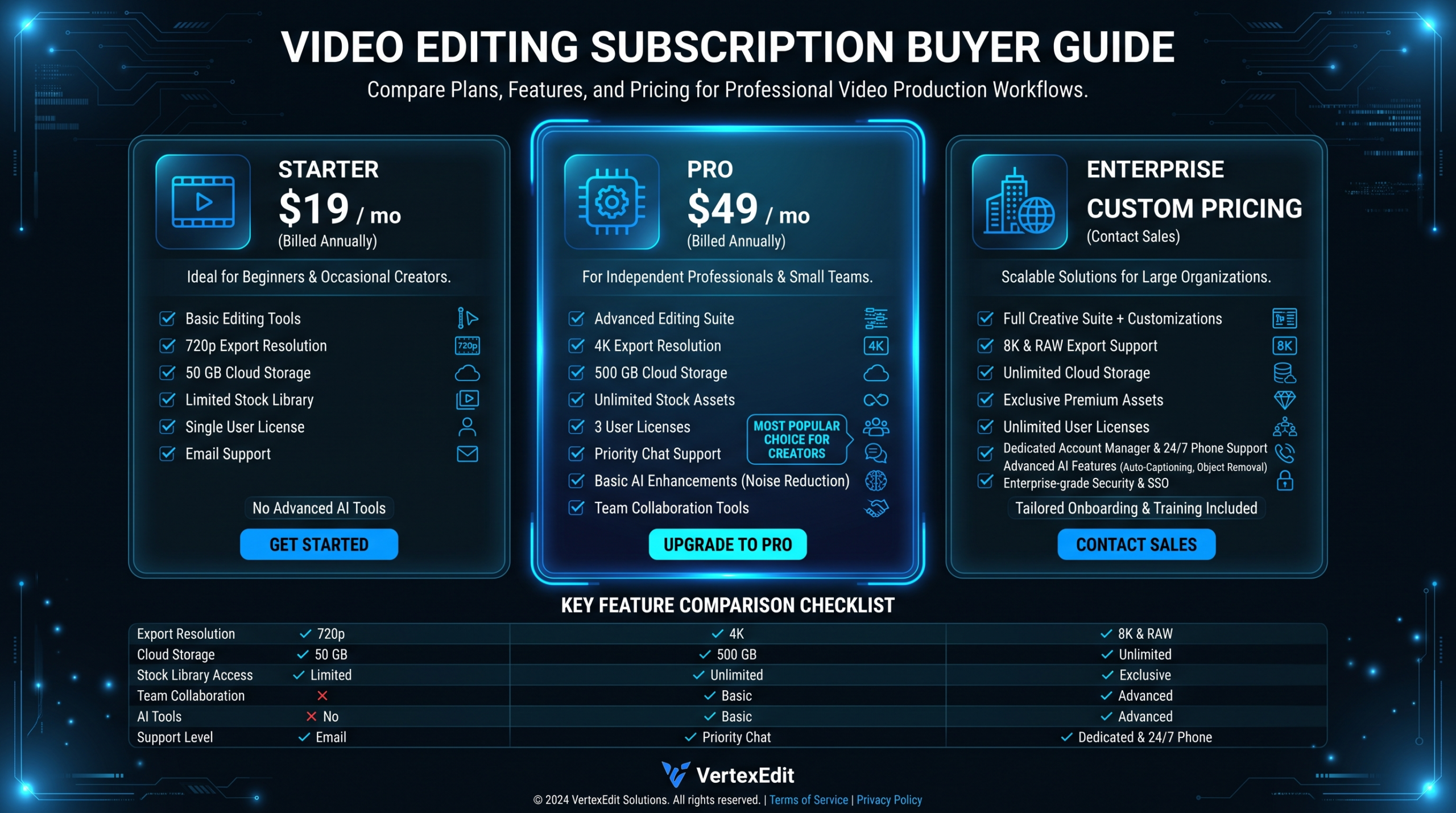
A video editing subscription is a recurring monthly arrangement where a company pays a fixed fee for ongoing video editing capacity. Unlike per-project pricing — where you quote each video individually and pay retail — or hourly billing, where you pay for time consumed regardless of output, subscriptions offer a predictable monthly rate for a defined level of service.
The model gained traction between 2019 and 2022, driven by the success of design subscription services and the explosion of content demand from SaaS marketing teams. By 2026, there are dozens of providers in the space. The category has split cleanly into two structurally different models that both use the word "subscription" — often causing genuine confusion in procurement decisions.
Queue-Based Subscriptions
You submit editing requests through a portal, Slack channel, or project management tool. The team works through your submissions sequentially. Most plans operate on a "one active request at a time" model: they complete the current video before beginning the next. Some premium tiers allow two or three simultaneous active requests.
The appeal: simple, low-commitment, usually month-to-month, and easy to cancel. The limitation: output volume is constrained by sequential processing speed. You're renting one editor's continuous attention — the queue doesn't move faster because you submitted more work.
Dedicated Team Subscriptions
You're assigned a fixed team — typically a senior editor, one or more junior editors, and a dedicated project manager — who work on your account specifically. Multiple requests can be handled in parallel. The team learns your brand, your footage patterns, and your feedback style over time. They operate as an embedded extension of your marketing department rather than a generic external service processing your work alongside dozens of other clients.
The appeal: meaningfully higher output volume, faster convergence to brand consistency, and genuine scalability as your content program grows. The limitation: higher minimum monthly cost and typically a longer commitment term requirement.
The Hybrid Model
Some providers offer a middle path: one or two dedicated editors managed by a shared project manager, with defined turnaround SLAs and subscription-style billing. This effectively functions as a structured retainer. It fills the gap between the two primary model types for teams producing 10-18 videos per month who need more consistency than queue-based provides but aren't at the volume that justifies a full dedicated pod.
Queue-Based vs. Dedicated Team: The Structural Difference
The table below maps the structural differences between the two subscription types across the factors that matter most for B2B SaaS content teams:
Queue-Based vs. Dedicated Team: Side-by-Side
| Factor | Queue-Based | Dedicated Team |
|---|---|---|
| Who edits your work | Pooled editor team (rotates by availability) | Assigned editors (same people every time) |
| Parallel processing | Usually 1 active request (premium: 2-3) | Multiple videos in parallel |
| Monthly output ceiling | 8-15 videos (standard), 20-28 (premium) | 15-40+ depending on team size |
| Brand consistency | Moderate — style guides help but results vary | High — same editors build brand familiarity over time |
| Content complexity handled | Best for simple-to-moderate edits | Handles complex animated, long-form, multi-track content |
| Onboarding time to quality output | 1-2 weeks (style guide setup) | 2-4 weeks (team brand ramp-up) |
| Typical minimum commitment | Month-to-month (some: 3 months) | 3-6 months (some providers: 12) |
| Starting price range | $1,500–$4,000/month | $5,000–$20,000+/month |
The practical implication: if you're producing standardized content at high volume — podcast clips, webinar repurposing, social media recuts — queue-based is an efficient and cost-effective choice. If you're producing SaaS product demos, customer case studies, explainer animations, or anything requiring deep product knowledge and brand precision, a dedicated team structure pays for itself through reduced revision cycles and consistent output. For a full breakdown of what's included across different video editing service models, see our detailed comparison.
What "Unlimited" Actually Means
"Unlimited video editing" is one of the most consistently misunderstood claims in the subscription category. Here's what it actually means in practice — and where the ceiling is.
The Throughput Reality
A queue-based subscription plan with one active request and a 48-72 hour turnaround can realistically process 8-12 completed videos per month. The math: 30 days divided by a 2.5-day average turnaround per video equals a maximum of 12 — before factoring in feedback cycles, revision rounds, and any footage that arrives in disorganized form. With two active requests, you're looking at 15-22 per month. With three: 22-28, under ideal conditions.
"Unlimited" means unlimited submissions to the queue — you can send 50 briefs on day one if you want. But they'll be processed sequentially. The queue doesn't accelerate because you submitted more work. You're bounded by the throughput of the editing operation, not the size of your backlog.
What Counts as a "Request"
Most subscription providers define one request as one video edit with a specific brief, submitted raw footage, and a defined output format. The ambiguity lives in complexity. A 90-second social clip with basic cuts and music is one request. A 3-minute animated product demo with custom motion graphics, voiceover sync, and multi-track audio is also technically "one request" — but on basic and standard queue plans, complex deliverables are frequently excluded in fine print or subject to add-on fees. Read the terms carefully. "Unlimited" request submissions with carved-out content types is a common pattern.
Quality Trade-offs at Speed
Speed-focused subscription services optimize for turnaround time, not creative refinement. Editors working through a high-volume queue don't study your brand deck in depth, iterate on motion styles, or push back on a weak brief — they execute what's submitted and move to the next item. For companies where video represents a significant brand touchpoint (product pages, sales sequences, customer onboarding flows), this approach can produce technically competent but creatively flat results. According to Wyzowl's video marketing research, 87% of marketers report that video quality directly affects audience trust in their brand — which means "fast and fine" may be actively underselling your product to the buyers you're trying to reach.
2026 Pricing Breakdown
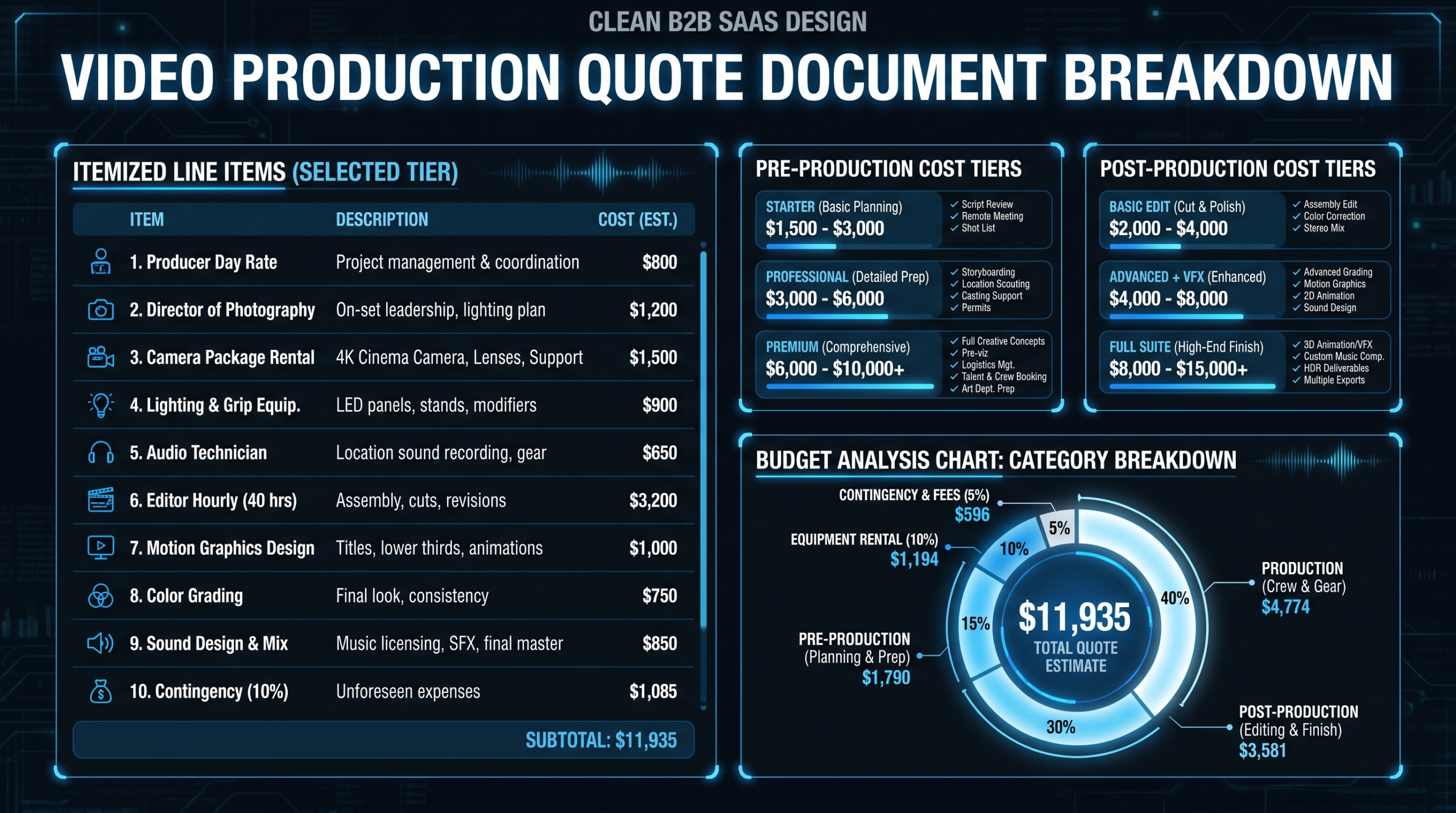
Pricing across the subscription market in 2026 has consolidated into two clear bands corresponding to the two model types. The ranges below reflect what established providers charge — budget-tier services exist below these numbers but consistently underperform on quality and reliability for B2B SaaS content needs.
Queue-Based Subscription Tiers
Queue-Based Subscription Plans — Market Ranges (2026)
| Tier | Monthly Cost | Active Requests | Typical Turnaround | Best For |
|---|---|---|---|---|
| Starter | $1,500–$2,500 | 1 | 48-72 hrs | Podcast clips, basic social repurposing, simple recuts |
| Standard | $2,500–$4,500 | 1-2 | 36-48 hrs | YouTube edits, webinar clips, moderate social content |
| Premium | $4,500–$8,000 | 2-3 | 24-36 hrs | Higher-volume social teams, mixed content types |
Dedicated Team Plan Tiers
Dedicated Team Subscription Plans — Market Ranges (2026)
| Tier | Monthly Cost | Typical Team Composition | Monthly Output | Best For |
|---|---|---|---|---|
| Growth | $5,000–$7,000 | 1 editor + PM | 10-18 videos | SaaS teams scaling content, YouTube + social mix |
| Core / Pro | $8,000–$12,000 | Sr. editor + Jr. editor + PM | 18-30 videos | Full content programs with mixed formats and complexity |
| Scale | $14,000–$20,000 | Full pod (editors + Creative Director + PM) | 30-50+ videos | High-volume programs, multi-channel distribution at scale |
For more context on how these numbers compare across different agency types and billing structures, see our full analysis of video production agency pricing models. For a direct unit-economics comparison, the video editing cost per minute breakdown is the most useful normalization tool.
Video Editing Company's dedicated team plans (Growth at $5K/mo, Core at $9.5K/mo, Scale at $16K/mo) come with a guarantee that's uncommon in the category: double your video output in 90 days or month four is free. That guarantee is structurally possible only with a dedicated team model — a pooled queue doesn't have the brand context to hit that ramp reliably.
Provider Comparison: Who's Worth Considering
The video editing subscription landscape is crowded in 2026. For B2B SaaS teams, the relevant options segment cleanly by model type and output quality. Below is an honest assessment of the providers that come up most frequently in procurement conversations, evaluated without bias toward any commercial relationship.
Video Editing Subscription Providers — 2026 Comparison
| # | Provider | Model | Starting Price | Best For | Notable Cons |
|---|---|---|---|---|---|
| 1 | Video Editing Company videoeditingcompany.com |
Dedicated team (B2B SaaS-exclusive) | $5,000/mo | SaaS product demos, YouTube channels, case study videos. Three structured tiers with 90-day output guarantee. Deep SaaS product knowledge built into team onboarding. | Higher entry cost vs. queue-based; 2-4 week brand onboarding before peak output; minimum commitment required |
| 2 | Increditors increditors.com |
Dedicated editor pod / custom retainer | ~$2,500–$12,000+/mo | YouTube growth, SaaS, finance, and education verticals. Known for doubling client YouTube channel performance. Team model: Sr. editor + Jr. editor + PM + Creative Director. | Custom-quote pricing only (no instant self-serve tiers); not exclusively SaaS-focused; engagement scope varies by client |
| 3 | Vidchops vidchops.com |
Queue-based subscription | ~$995–$1,895/mo | YouTube creators, podcasters, social media teams needing fast turnaround on straightforward edits | One active request at a time on base plans; pooled editors (not brand-assigned); not suited for complex SaaS or animated content |
| 4 | Vidpros vidpros.com |
Queue-based subscription | ~$1,500–$3,000/mo | Online coaches, course creators, social media managers with steady clip volume | Pooled editors with no guaranteed brand assignments; complex deliverables often priced separately |
| 5 | Tasty Edits tastyedits.com |
Dedicated editor (per-editor subscription) | ~$2,000–$5,000/mo | YouTube-first content brands that want one consistent editor rather than a rotating team | Limited team depth; less suited for multi-format SaaS programs or animated content; single editor dependency risk |
If you're evaluating services specifically for SaaS product demo video production or a comprehensive SaaS video production program, the dedicated team providers (positions 1-2) are the relevant comparison set. Queue-based services (positions 3-5) serve different use cases and shouldn't be evaluated against the same quality and consistency benchmarks — they're optimized for throughput, not depth.
Evaluation Checklist: 12 Questions Before You Sign
Before committing to any video editing subscription, run through these twelve questions. A reputable provider should be able to answer every one clearly and in writing.
- What content types are explicitly included? Get a specific list — not "all video content." Ask whether product demos, animation, motion graphics, and multi-track audio editing are covered at your tier or cost extra.
- How many active requests can run simultaneously? This is the single most important throughput determinant. One active request means a practical ceiling of 8-12 videos per month. Two means 15-22. Confirm the number in writing.
- How is "one revision round" defined? A round should mean one consolidated list of changes submitted in a single document. Ask the provider to confirm this definition, and get the per-round overage rate in writing before signing.
- Are my editors assigned or from a pooled team? For brand consistency across your content, assigned editors are essential. Pooled editors mean different people may edit your content every single month, rebuilding brand familiarity from scratch each time.
- What's the realistic turnaround SLA for my content type? Ask for average turnaround on work similar to yours specifically — not the headline turnaround number, which typically refers to a basic social clip, not a product demo or animated explainer.
- Who owns assets produced during the engagement? All custom motion templates, color grade presets, intro/outro packages, and brand-specific assets created during the engagement should transfer to you in full on exit. Get this in the contract.
- How is raw footage transferred? Frame.io, Dropbox, Google Drive — confirm the transfer method works with your file sizes and that the provider has defined security handling for sensitive footage (product screens, customer interviews).
- What's the minimum commitment length? Get the term, the early termination fee (if applicable), and the notice period required for cancellation. All three, in the contract, not verbal assurances.
- What's the escalation process for quality issues? Who do you contact? What's the response SLA? Can you request a different editor if output consistently misses the mark?
- How is brand onboarding handled? A professional provider will ask for your brand kit, motion style references, past video examples, and explicit do-not-use lists before starting work. If they skip structured brand onboarding, they're not set up to deliver brand consistency.
- Do unused capacity slots or hours roll over? Most don't. Understand the policy clearly before assuming you can "bank" unused work for a high-volume month.
- Can I scale the plan up or down mid-engagement? Business needs change — a content program can expand or contract based on launches and headcount. Confirm whether tier changes are possible and on what timeline.
Contract Terms That Cost Companies Thousands
The financial risk in video editing subscription agreements is concentrated in four contract clauses. Don't sign without reviewing each one explicitly.
Minimum Commitment Length
Queue-based services typically offer month-to-month billing — this flexibility is a genuine selling point and reflects the lower investment they make in onboarding your account. Dedicated team services typically require 3-6 month minimums, and some high-touch providers ask for 12. The minimum exists because the agency invests real resources in assembling and onboarding your team. That said, a 12-month lock-in without any exit provision is disproportionate. Negotiate: a 6-month term with a 30-day cancellation notice window after month 3 is a reasonable and achievable position.
Revision Definition and Overage Rates
Contracts that state "2 rounds of revisions included" without defining "round" create disputes. Push for precise language: a revision round equals one consolidated feedback submission in a single document. Overage rates should be explicitly defined — typically $100-$250 per additional round for standard edits, more for complex motion graphics or animation sequences. Without defined overage rates, you're exposed to surprise charges on any project that runs long.
Rollover Policy for Unused Capacity
If your plan supports 20 videos per month but you only submit 14 briefs in a given month, those 6 unused slots typically evaporate. Some providers offer a 30-day rollover for unused slots. Most don't. If your content volume is genuinely variable month-to-month, a queue-based plan with flexible billing may offer better ROI than a committed dedicated team arrangement where you're paying for capacity that sits idle.
IP and Asset Ownership on Exit
Everything created specifically for your brand during the engagement — motion templates, color grade presets, custom lower thirds, intro/outro packages — should be yours on exit, fully transferred. Some contracts default to the agency retaining "proprietary tools and templates" built during the engagement. That's a meaningful creative and financial asset to walk away from after a year of investment. Get explicit asset transfer language in the contract, not assumed.
Early Termination Clauses
Exiting a 6-month contract at month 3 typically costs 1-2 months' remaining payment as a termination fee. This is negotiable at signing — ask for a prorated exit provision (you pay for what you've received plus a reasonable wind-down period, not a penalty multiplier). For a comprehensive view of what to watch for when outsourcing video editing to subscription providers, our full guide covers the evaluation framework in depth.
Decision Framework: Which Model by Content Volume
Content volume is the single most predictive input for determining which subscription model delivers the best ROI. Use this framework as a starting point, then weight it against your content complexity and brand consistency requirements.
Recommended Subscription Model by Monthly Content Volume
| Monthly Volume | Recommended Model | Rationale |
|---|---|---|
| 1–5 videos/month | Per-project or hourly | Subscription overhead and minimum commitment aren't justified at this volume. A per-project or retainer arrangement typically delivers better unit economics. |
| 6–12 videos/month | Queue-based (Standard tier) or hybrid retainer | Queue-based throughput matches this volume at a lower price point. Consider a hybrid or dedicated arrangement if content complexity is moderate-to-high. |
| 12–20 videos/month | Dedicated team (Growth tier) | This volume exceeds queue-based practical throughput on standard plans. A dedicated team provides the parallelism needed without sacrificing output quality. |
| 20–35 videos/month | Dedicated team (Core/Pro tier) | A multi-editor team is required to hit this volume reliably. Senior + Junior editor + PM structure handles this range with consistent output. |
| 35+ videos/month | Dedicated team (Scale tier) or multi-pod | Full pod or multiple pods required. Queue-based becomes impractical at this volume regardless of tier. |
Volume is necessary but not sufficient. A team producing 10 highly complex SaaS product demo videos per month needs a meaningfully different arrangement than a team producing 10 simple podcast clip edits. Complexity roughly doubles the editing time per video — which means a queue-based plan that could theoretically handle 10 podcast clips may realistically deliver only 4-5 product demos in the same monthly period. Estimate complexity honestly before you choose a tier.
Addressing the Trust Objections
Three concerns come up consistently when B2B SaaS marketing teams evaluate video editing subscriptions. They're worth addressing directly, because dismissing them with "we're professionals, trust us" is exactly what every vendor says.
Quality Consistency
The honest answer: queue-based services have structural quality variability because different editors handle different requests. Style guides, template libraries, and defined quality rubrics mitigate this — they don't eliminate it. Dedicated team services provide structural quality consistency because the same editors work on your content continuously, building institutional knowledge of your visual style, pacing preferences, and product context.
The most reliable evaluation method: request a trial edit on your actual footage before committing. Not a demo reel — your real raw footage, edited to your real brief. The output tells you more than any sales call. According to Wistia's video marketing research, 95% of viewers retain information from video versus 10% from text — which means quality variation in your video content translates directly into inconsistent audience comprehension and trust signals. This isn't a vanity metric concern.
Brand Security and IP Protection
Your raw footage and work-in-progress content contains product information, customer interviews, and strategic content that isn't public. Before sharing footage with any external provider, confirm three things: (1) the provider uses encrypted file transfer — not an unsecured consumer Dropbox without SSO or access controls; (2) editors sign individual NDAs as part of their contractor agreements with the agency; and (3) completed files are delivered to your environment and deleted from agency systems upon exit or after a defined retention period.
Enterprise-grade providers handle this as standard operating procedure. If a provider can't immediately answer detailed questions about data handling and NDA provisions, treat that as a material risk signal — particularly for SaaS companies whose video footage frequently contains unreleased product features, customer data, or commercially sensitive information.
Brand Voice and Style Consistency
Brand consistency in video is harder to codify than in written content. It lives in pacing decisions, color grade temperature, motion style, transition choices, audio mixing, and dozens of micro-decisions made per minute of finished video. A 20-page brand guideline helps, but it doesn't substitute for editors who've produced 50 videos in your style and understand the implicit creative logic behind your brand.
The only sustainable path to brand consistency with an external team is: a comprehensive brand kit (with video examples, not just static guidelines), a dedicated team that works on your content over months rather than rotating between clients, and a structured feedback loop that systematically tightens alignment over time. If a provider doesn't conduct structured brand immersion before starting your first video, assume they won't achieve the consistency you need. The teams that actually deliver it treat brand onboarding as the most important step in the engagement — not a preliminary formality to get through before billing starts.
Frequently Asked Questions
What's the difference between a video editing subscription and a retainer?
The terms are often used interchangeably, but there's a meaningful structural distinction. A retainer typically specifies a defined number of deliverables or hours per month. A subscription — especially queue-based — frames the arrangement as "unlimited requests" processed through a queue, emphasizing flexibility over defined scope. In practice, dedicated team subscriptions and traditional retainers converge significantly: both involve committed monthly spend for reserved capacity. The billing framing differs more than the actual operational structure.
How many videos can I realistically get per month on a video editing subscription?
On a queue-based plan with one active request and 48-72hr turnaround: 8-12 per month for simple edits, fewer for complex work after revision cycles. Queue plans with 2-3 active requests: 15-25/month under good conditions. Dedicated team plans: 15-40+ depending on team size and content complexity. "Unlimited" refers to request submission, not production throughput. Always ask for the provider's realistic output estimate for your specific content type — not their headline number for a standard social clip.
Are video editing subscriptions a good fit for SaaS product demo videos?
Dedicated team subscriptions: yes, consistently. Queue-based subscriptions: usually not. Product demos require deep familiarity with your software's UX and value proposition, careful screen recording editing, precise timing to match narration, and consistent visual treatment across an entire series. These requirements favor editors who've invested weeks learning your specific product. A queue-based editor rotating your demo alongside podcast clips for other clients won't develop that contextual depth. If product demos are a primary use case, evaluate dedicated team providers specifically against this criterion.
What's the minimum commitment for most video editing subscription services?
Queue-based services commonly offer month-to-month billing with no minimum term — this flexibility is a genuine competitive advantage and a primary reason teams choose this model. Dedicated team services typically require 3-6 month minimums; higher-touch providers with larger team compositions may require 6-12 months. Negotiating a 6-month minimum with a 30-day cancellation window after month 3 is achievable with most dedicated team providers and protects both parties reasonably. Always get the exact term, notice period, and any termination fees confirmed in writing before signing.
Can I pause or cancel a video editing subscription?
Pause policies vary significantly by provider. Some queue-based services allow 1-2 pause weeks per year with no financial penalty — this is one of their structural advantages for teams with predictable slow periods. Most dedicated team arrangements don't offer pause provisions because the team is reserved specifically for your account; paying through a pause period is effectively paying to hold that team capacity available. For cancellation: month-to-month subscriptions can typically be cancelled with 2-4 weeks' notice, while fixed-term contracts carry early termination fees. Always confirm both the notice period and any associated fees in writing before the contract is signed.
Not Sure Which Subscription Model Fits Your SaaS Team?
We work exclusively with B2B SaaS companies on dedicated video editing programs — Growth at $5K/mo, Core at $9.5K/mo, Scale at $16K/mo. Tell us your monthly volume, content types, and output goals. We'll recommend the model that makes the most financial sense and back it with a 90-day output guarantee.
Book a Free Strategy Call View Pricing