Outsource Video Editing Without Losing Your Brand
TL;DR
- Brand drift in outsourced video is caused by poor documentation, no onboarding process, and weak review loops — not by outsourcing itself.
- A brand bible covering visual identity, tone, motion style, and do/don'ts prevents 80%+ of consistency issues before they start.
- Dedicated editor teams maintain brand voice significantly better than rotating freelancer pools or subscription queues.
- A structured 3-stage review loop (editor self-check → internal review → final brand audit) catches drift before it reaches your audience.
- Run a monthly brand audit against a 12-point scorecard to catch gradual drift early.
Table of Contents
- Why Brand Voice Is the Biggest Hidden Risk in Outsourcing
- Build Your Brand Bible Before You Brief Anyone
- How to Onboard a Video Editor to Your Brand
- The Review Loop Architecture That Prevents Brand Drift
- Choosing the Right Outsourcing Model for Brand-Sensitive Teams
- When Brand Drift Happens — Diagnosing and Fixing It
- The Monthly Brand Consistency Scorecard
- FAQ
Outsourcing video editing solves a real problem — your team can't edit fast enough, in-house talent is expensive, and your content calendar keeps slipping. The decision to outsource is usually right. But then the first few videos come back and something feels off. The pacing is wrong. The color grade doesn't match your brand. The fonts are slightly different. Nobody broke anything, but the video doesn't feel like you.
This is brand drift, and it's the most common failure mode when companies outsource video editing. It's not caused by outsourcing — it's caused by how outsourcing is set up. The good news: it's entirely preventable with the right documentation, onboarding, and review systems.
This guide gives you the complete framework: from building a brand bible to structured editor onboarding, to the review loop architecture that keeps every video consistent — whether you're working with a dedicated team or managing a larger agency relationship.
Why Brand Voice Is the Biggest Hidden Risk in Outsourcing
Most VP Marketing conversations about outsourcing focus on cost and capacity. Rarely does brand consistency get the same rigorous analysis — until something goes wrong.
The risk is structural. When you edit in-house, institutional knowledge lives in your team's heads. Your editor knows that you never use music with vocals in product demos. They know your CEO prefers cuts at 20 seconds, not 30. They know your color palette includes a specific blue (#0A6EBD, not just "any blue"). None of that is written down anywhere because nobody needed to write it down.
The moment you hand a file to an external editor, that institutional knowledge evaporates. They're working blind — doing their best with the brief they have, which is usually just a raw file and a rough description of what you want.
The Three Brand Drift Failure Modes
Brand drift in outsourced video typically shows up in three ways:
- Visual drift. Wrong fonts, slightly off-brand colors, motion graphics that don't match your style guide, lower thirds that look different from previous videos. Each video looks professional but inconsistent with your library.
- Tonal drift. The pacing feels different — too fast, too slow, too energetic, too corporate. The music choices don't match your brand personality. The narration style doesn't match how your company sounds.
- Structural drift. Different intro lengths, inconsistent use of B-roll, varying CTA placements, different caption styles. Your videos stop feeling like a series and start feeling like a collection of unrelated pieces.
The frustrating part: every individual video might be technically good. The drift is relative to your brand, not to some universal standard. That makes it hard to give feedback and even harder for an external editor to anticipate.
Why "Send Examples" Isn't Enough
The most common outsourcing setup: share 2-3 of your existing videos as "reference" and ask the editor to match the style. This almost never works reliably. Editors can observe surface-level choices from reference videos, but they can't reverse-engineer the reasoning behind those choices — which is exactly what they need to maintain consistency over time.
A brand bible solves this. A proper onboarding process solves this. A structured review loop catches what still slips through. Let's build each one.
Build Your Brand Bible Before You Brief Anyone
A brand bible for video is a working document — not a PDF that sits in a Google Drive folder nobody visits. It's the single source of truth your external editor references before every project. Done well, it reduces back-and-forth by a significant margin and dramatically shrinks the revision cycle.
What Your Video Brand Bible Needs to Include
Your brand bible should cover five areas:
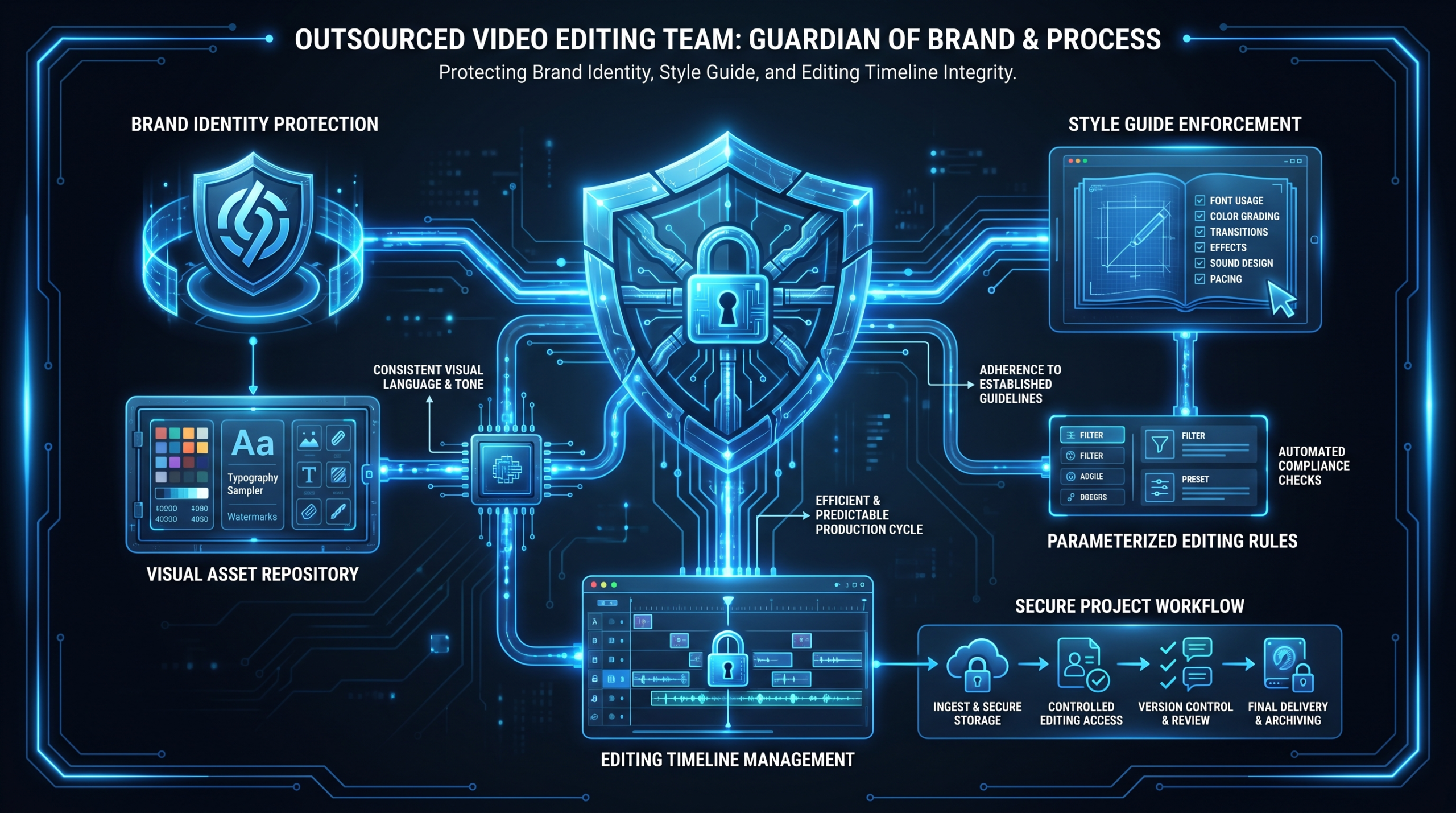
- Visual identity specifications. Your exact hex codes, not just color names. Your font files (or names and weights), not "a sans-serif." Your logo usage rules — safe zones, background restrictions, no white-on-light-gray. Approved motion graphics templates if you have them.
- Audio guidelines. Music genre and energy level (with examples). Whether you use vocals or instrumental only. Approved sound effect libraries. Volume levels for music under narration (typically -20 to -25 dB under spoken word). Your standard intro/outro music if applicable.
- Structural templates. Standard intro length (e.g., "hero statement within first 15 seconds"). B-roll-to-talking-head ratio. Where CTAs appear. Lower thirds style and placement. Intro/outro duration standards.
- Tone and pacing rules. Cut rhythm — fast-cut product demos vs. slower brand narratives. How you handle silence. Whether you use jump cuts. Your style on captions (always on, only when helpful, never for talking-head content).
- Do and don't list. The most valuable part of any brand bible. Explicit prohibitions: "Never use dramatic orchestral music." "Never add lens flares." "Always fade to black, never cut to black." These only get written down when someone does them wrong — so start building this list now, before you outsource.
Video Brand Bible: Document Checklist
| Section | What to Include | Priority |
|---|---|---|
| Color palette | Exact hex codes, primary/secondary/accent, do not use list | Critical |
| Typography | Font names, weights, approved sizes for titles/subtitles/lower thirds | Critical |
| Music guidelines | Genre, energy, instrumental vs. vocal, approved libraries, mixing levels | Critical |
| Motion style | Transition types (cut, dissolve, wipe), motion graphics speed, easing style | High |
| Structural templates | Intro/outro length, CTA placement, B-roll ratio, caption rules | High |
| Tone and pacing | Cut rhythm by video type, silence rules, jump cut policy | High |
| Logo usage | File formats, safe zones, background restrictions, animation rules | Medium |
| Do/Don't list | Explicit prohibitions (effects, music types, transitions, pacing choices) | Critical |
| Reference video library | 3-5 "perfect" examples for each video type you produce | High |
How to Build It Fast (Without a Week-Long Design Sprint)
You don't need to build a 40-page PDF to start. A working brand bible can be a well-organized Notion page or a shared Google Doc. Start with the Critical priority items in the table above — those three categories (color, music, do/don't list) will prevent the most common and most jarring drift issues. Add the rest over the first 30 days of your outsourcing engagement.
Pull from your existing brand guidelines if you have them — most of the visual identity section is probably already documented for your design team. The video-specific additions are music, motion style, structural templates, and the do/don't list.
How to Onboard a Video Editor to Your Brand
A brand bible is only useful if the editor actually internalizes it. Most outsourcing setups share a document and assume the editor will read it carefully. They won't — or they'll read it once and not revisit it when making judgment calls under deadline pressure. Onboarding solves this.
The 3-Phase Editor Onboarding Protocol
For any new external editor or team, use a structured 3-phase process before they touch a deliverable your audience will see:
Phase 1: Brand immersion (Day 1-2). The editor reviews your full brand bible, watches your 5-7 best-performing videos, and completes a brand quiz — 10-15 questions that test their understanding. "What music energy is used in our product demos?" "What font weight do we use for lower thirds?" "Name two things we never do in our videos." This isn't a gotcha — it's a comprehension check that also forces active reading instead of passive skimming.
Phase 2: Trial edit (Day 3-5). The editor produces a short trial edit — typically a 90-second cut of footage you provide. This is a paid edit, but it's treated as a calibration exercise, not a deliverable. You review it against your brand bible with a structured feedback form. The goal is to surface blind spots before they appear in real content.
Phase 3: Supervised first project (Week 2). The editor handles a real deliverable with higher-than-usual review checkpoints: rough cut review, fine cut review, and final review. Three rounds instead of your usual two. After this project, you'll know exactly where they need reinforcement and can provide targeted guidance rather than general feedback.
This process adds 5-7 days to the start of your outsourcing relationship. It saves weeks of back-and-forth on the first real deliverable and dramatically reduces revision cycles for every project that follows. Most teams that skip it spend months in a slow-burn revision loop wondering why their external editor "just doesn't get it."
What to Include in the Onboarding Brief
Beyond the brand bible, your onboarding brief should include:
- Your content calendar and the types of videos you produce (with frequency)
- Your audience profile — who watches these videos, their sophistication level, what they care about
- Your internal review process and who has final approval authority
- Your feedback channels (Frame.io, Slack, email — and which is used for what)
- Your turnaround expectations and how you handle rush projects
- A list of your top 3 feedback themes from previous editors (what keeps coming up)
That last item is surprisingly powerful. If your previous editor kept getting your music levels wrong, telling the new editor upfront sets a clear standard before the first mistake happens. See our guide on how to outsource video editing for a complete checklist of what to cover in your initial briefing.
The Review Loop Architecture That Prevents Brand Drift
Even with a perfect brand bible and thorough onboarding, some drift will slip through. That's normal — it's the nature of creative work. What determines whether drift becomes a chronic problem or a rare exception is your review loop.
The 3-Stage Review System
A brand-safe review loop has three stages, each with a specific owner and checklist:
Stage 1: Editor self-check. Before submitting any cut, the editor runs through a 10-point checklist drawn directly from your brand bible. Color palette verified. Music level at spec. No prohibited transitions used. Correct font weights. This catches the majority of issues before you ever see the video. Require this checklist as a deliverable alongside every rough cut — not as bureaucracy, but as a forcing function that keeps brand guidelines front of mind.
Stage 2: Internal review. One person on your team (ideally with authority to approve) reviews the rough cut against the checklist. This is where tonal and structural issues get caught. Is the pacing right for your brand? Does the music feel like you? Are the structural templates followed? Document feedback in your review tool rather than in email threads — Frame.io is the standard for this because feedback is time-stamped to specific frames, which eliminates the ambiguity that causes miscommunication.
Stage 3: Final brand audit. Before any video is published, a 5-point final check: correct lower thirds, correct outro, correct CTA placement, audio levels at spec, and file format matches platform requirements. This takes 8-10 minutes per video but catches the small mistakes that slip through a tired reviewer's eye after 45 minutes on a detailed cut.
The Single-Point-of-Review Rule
One of the most common ways review loops fail: too many approvers. When three people can all give feedback independently, the editor gets conflicting instructions and has no way to prioritize. Worse, each reviewer assumes the others have checked the brand-specific elements, so those elements get checked by nobody.
Assign a single "brand guardian" — one person who has final approval authority and is responsible for brand consistency across all video output. Other stakeholders can give feedback on messaging and accuracy, but brand decisions are centralized. This is the same model used by brand-conscious in-house teams; it works equally well with external editors.
Revision Round Economics
Structure your review agreements to include 2 rounds of revisions as standard. This is enough for well-briefed editors on well-documented projects. For complex, high-production content, 3 rounds is reasonable. If you're consistently going to round 4-5, the problem is upstream — in the brief or the onboarding — not in the revision process itself.
For a deeper look at what's typically included in a managed video editing relationship, see our breakdown of what video editing services include.
Choosing the Right Outsourcing Model for Brand-Sensitive Teams
Not all outsourcing models are created equal when brand consistency is a priority. Here's how the major options stack up:
Outsourcing Model Comparison: Brand Consistency Focus
| Model | Brand Consistency | Onboarding Investment | Best For |
|---|---|---|---|
| Freelancer (rotating) | Low — different editor each project | High (repeat for each hire) | One-off projects, low brand sensitivity |
| Freelancer (dedicated) | Medium — single editor, limited capacity | Medium (one-time) | Small teams, <4 videos/month |
| Subscription service | Low-Medium — rotating editors, queue model | Medium (often wasted) | High-volume simple content, social clips |
| Agency retainer | Medium-High — assigned editors, PM oversight | Medium (one-time) | 6-15 videos/month, moderate brand complexity |
| Dedicated team | High — same team every project, deep familiarity | Low (amortized over time) | 15+ videos/month, high brand sensitivity |
The pattern is clear: the more consistently the same editors work on your content, the lower your brand drift risk. A dedicated team model, where your editors are assigned exclusively (or primarily) to your account, builds institutional knowledge over time — the same way an in-house editor does, without the hiring risk or overhead.
Top Video Editing Partners for Brand-Sensitive Teams
If you're evaluating specific providers, here's how the leading options compare on brand consistency capabilities:
Provider Comparison: Brand Voice Capabilities
| # | Provider | Model | Pricing (approx.) | Brand Consistency Strengths | Considerations |
|---|---|---|---|---|---|
| 1 | Video Editing Company (VEC) | Dedicated teams, B2B SaaS focus | $5K–$16K/mo | Dedicated senior/junior editor pod + PM + creative director; 90-day double-output guarantee; structured onboarding; tiered Growth/Core/Scale plans | Premium investment; best fit for teams producing 8+ videos/month |
| 2 | Increditors | Full-service agency, dedicated editor pods | ~$2.5K–$12K+/mo (custom quote) | Senior editor + junior + PM + creative director structure; known for doubling YouTube channel performance; strong brand onboarding; serves SaaS, finance, education | Not SaaS-exclusive; no instant-tier pricing (custom quote required) |
| Vidpros | Subscription + dedicated editor option | $995–$2,500/mo | Option to request the same editor repeatedly; fast turnaround; good for YouTube and social | Rotating editors on lower tiers; limited motion graphics; not ideal for complex B2B content | |
| Tasty Edits | YouTube-specialist subscription | $800–$3,000/mo | Focused niche (YouTube creators); familiar with retention-edit style | Creator-focused, not B2B SaaS; limited brand documentation process; inconsistent editor assignment | |
| Motion Array Marketplace | Freelancer marketplace + templates | Per project ($50–$500+) | Template library aids visual consistency; good for teams with strong in-house creative direction | No ongoing relationship; brand consistency depends entirely on your brief quality |
For context on how pricing compares across service tiers, the VEC pricing page shows transparent Growth, Core, and Scale plan structures — useful as a benchmark when evaluating competing quotes. You can also review our video production agency pricing models guide for a full breakdown of how each model works at different volume levels.
When Brand Drift Happens — Diagnosing and Fixing It
Even with the best systems in place, brand drift will surface occasionally. Catching it early and addressing it systematically is far less disruptive than letting it accumulate across a dozen videos before someone notices.
Early Warning Signs
Watch for these signals in your video output:
- Revision cycles getting longer on successive projects (a sign the editor is guessing, not referencing documentation)
- Internal stakeholders commenting that videos "feel different" without being able to articulate why
- Audience comments on YouTube or LinkedIn noting a change in style or energy
- You finding yourself writing longer feedback notes despite having a brand bible
- Inconsistencies across a video series that were uniform in previous months
Root Cause Analysis: Five Questions
Before issuing a correction, diagnose the cause. Blanket feedback like "make it more on-brand" gives an external editor nothing actionable. Work through these five questions:
- Is the brand bible actually being referenced? (Ask directly — don't assume.)
- Has the editor changed, or has a new editor been added to your account without notification?
- Has your brand evolved but your documentation hasn't been updated?
- Are you giving inconsistent feedback across different reviewers on your team?
- Has your content volume exceeded what the current team structure can maintain at quality?
The answer to most brand drift incidents is one of: documentation gap, team change, or reviewer inconsistency. Fixing the root cause is a 2-hour process. Leaving it unaddressed costs weeks of revision cycles.
The Correction Protocol
When drift is confirmed, run a focused correction session before the next deliverable:
- Pull 3 examples of the drift — specific, time-coded moments, not general impressions.
- Pull 3 examples of what "correct" looks like from your best previous videos.
- Update the brand bible to explicitly address the gap that allowed this drift.
- Brief the editor on the specific correction with reference to the updated doc.
- Add the drift pattern to your Stage 1 editor self-check list.
This takes 2-3 hours but prevents the same mistake from recurring. Most teams skip the brand bible update, which is why the same issues recur across multiple correction conversations.
The Monthly Brand Consistency Scorecard
Don't wait for drift to become obvious. Run a monthly audit on a sample of your video output using a structured scorecard. Score each video 1-5 on each dimension. Videos scoring below 3 on any dimension trigger a correction conversation.
Monthly Brand Audit: 12-Point Scorecard
| Dimension | What to Evaluate | Score (1-5) |
|---|---|---|
| Color accuracy | Brand hex codes match across all text, graphics, and overlays | — |
| Typography consistency | Correct fonts, weights, and sizes across all text elements | — |
| Logo usage | Correct file, correct placement, safe zones respected | — |
| Music alignment | Genre, energy, and vocal/instrumental policy followed | — |
| Audio levels | Music at spec under narration; no peaking; consistent loudness | — |
| Structural template | Intro/outro length, CTA placement, B-roll ratio per type | — |
| Transition style | Approved transitions only; no prohibited effects | — |
| Motion graphics style | Consistent with approved templates and motion speed | — |
| Pacing / cut rhythm | Matches video type pacing standard in brand bible | — |
| Caption style | Consistent with caption policy (always on / contextual / off) | — |
| Lower thirds | Correct template, approved fonts, correct animation style | — |
| Outro / CTA | Correct end card, approved CTA language and placement | — |
Run this audit on 3-5 videos per month — one from each video type you produce. Over time, you'll see patterns. Some dimensions will consistently score high. Others will be chronic weak spots. Focus your onboarding reinforcement on those dimensions.
For teams building out a full outsourcing system, our guide on SaaS video production workflows covers how high-output content teams structure their entire production pipeline, not just the editing stage.
Building the Scorecard Into Your Agency Relationship
Share this scorecard with your external editing team. Agencies and dedicated teams that know they'll be evaluated monthly against specific criteria tend to maintain standards more rigorously than those operating without formal accountability. This isn't adversarial — it's the same system used internally by any high-performing content team.
VEC builds brand consistency accountability into its dedicated team model — structured onboarding processes, a 90-day double-your-video-output guarantee, and dedicated senior/junior editor pods that develop genuine institutional knowledge about your brand over time. It's the practical infrastructure that makes outsourced brand consistency possible at scale.
"The teams that get the most from outsourcing treat brand documentation as a living system, not a one-time setup task. Your brand bible should be updated every time your brand guide changes, every time you catch drift, and every time a new video type enters your content mix."
For related context on video editing cost per minute when evaluating what quality levels are realistic at different price points — that framework helps set expectations before you brief any provider.
Wistia's video marketing research consistently shows that brand consistency across video content correlates with higher audience trust signals — which is why SaaS companies with strong brand standards often see better demo conversion rates. The ROI of maintaining brand voice isn't just aesthetic; it's commercial.
HubSpot's research on brand consistency similarly points to consistent brand presentation across channels as a meaningful driver of revenue — a principle that applies directly to video output.
Frequently Asked Questions
How long does it take for an external editor to fully learn my brand?
With a well-structured brand bible and a 3-phase onboarding protocol, most dedicated editors reach "brand fluency" — meaning they can make accurate, brand-consistent decisions without asking — within 6-8 weeks. Rotating freelancers never fully get there because they restart the learning curve each engagement. This is the primary reason dedicated team models outperform on brand consistency: the learning compounds over time rather than resetting.
What's the biggest mistake companies make when outsourcing video editing?
Skipping documentation and expecting the external editor to "match the vibe" from reference videos alone. Brand voice in video involves hundreds of micro-decisions — music energy, cut timing, transition style, lower third animation speed — that can't be reliably inferred from watching examples. Without a documented standard, every editor decision is a guess. A brand bible converts guesses into informed choices, which is why teams with good documentation typically see revision cycles roughly half the length of those without.
Should I give my external editing team access to my full brand guidelines?
Yes, with one caveat: your full brand guidelines probably include elements (logo source files, proprietary templates, unreleased product footage) that require careful access control. Share the brand guidelines content — all of it — but use a shared Notion page or a read-only Google Drive folder rather than giving direct access to your core design infrastructure. Create a video-specific subset of your brand guidelines that includes everything needed without exposing assets you want to keep controlled.
How do I handle brand consistency when scaling to multiple video types?
Build video-type-specific templates within your brand bible rather than a single set of brand rules. Your product demo template will have different pacing, music energy, and structural rules than your thought leadership interview template. The core visual identity elements (colors, fonts, logos) are consistent across all types, but the structural and tonal rules are type-specific. This sounds complex but it prevents the most common scale problem: editors defaulting to one style for all content because the documentation only covers one style.
What happens if my external editing team changes editors mid-engagement?
This is a legitimate risk worth asking about explicitly before you sign with any provider. Good agencies have documented handover processes — new editors review the brand bible, study your content history, and complete a calibration edit before taking on live deliverables. Ask prospective providers how they handle editor transitions and what the expected quality impact is during the transition period. Dedicated team models with senior editor + junior editor structures manage this better than single-editor arrangements because institutional knowledge is distributed across the team, not held by one person.
Ready to Outsource Without the Brand Risk?
VEC's dedicated team model is built for B2B SaaS teams who need consistent, high-quality video output at scale — without rebuilding brand documentation from scratch every engagement. Growth plans start at $5K/month, with a 90-day guarantee: double your video output or month 4 is free.
Book a Free Strategy Call See Pricing Plans