White-Label Video Editing for Agencies: A Guide
TL;DR
- White-label video editing lets agencies deliver polished video content under their own brand without building an in-house production team.
- Typical agency margins run 30–50% when pricing white-label services correctly — but the math only works if you price based on value, not cost-plus.
- Confidentiality is manageable: solid NDAs, brand-locked file systems, and strict communication protocols keep your client relationships protected.
- The biggest failure mode isn't quality — it's poor capacity planning and weak QC handoffs. Both are fixable with the right systems.
- White-label beats in-house hiring for most agencies under $2M ARR. The overhead math doesn't lie.
Table of Contents
- What Is White-Label Video Editing?
- How White-Label Partnerships Work
- The Margin Math: What Agencies Actually Earn
- Confidentiality, NDAs, and Client Protection
- Capacity Planning for White-Label Engagements
- QC Workflow: Maintaining Quality Under Your Brand
- Red Flags When Choosing a White-Label Partner
- White-Label vs. In-House Editors: The Real Comparison
- Top White-Label Video Editing Partners (2026)
- FAQ
Your marketing agency just landed a client who wants a full video content program — eight YouTube videos a month, weekly social clips, quarterly brand films. The budget is there. The strategy is there. The editors are not.
You have three options: scramble to hire, pass on the work, or partner with a white-label video editing team that your clients will never see. For most agencies, option three is the only one that makes economic sense — but execution matters. A botched white-label arrangement destroys client trust faster than any other agency failure.
This guide covers the mechanics of white-label video editing partnerships: how they work, what the numbers look like, how to protect your clients, and how to run the QC process so output matches your brand standards every time. If you're evaluating whether white-label video is the right move for your agency, this is the data you need.
What Is White-Label Video Editing?
White-label video editing is a service arrangement where a production partner — a dedicated team of editors, motion designers, and project managers — creates video content on your behalf. That content is delivered under your agency's brand, without any attribution to the production partner. Your clients see your agency's name on the work. The underlying production team is invisible.
The term "white-label" borrows from product manufacturing, where generic products are rebranded by the retailer. In the agency context, you're the retailer. You handle client relationships, strategy, briefing, and delivery. Your white-label partner handles the actual editing, motion graphics, color grading, and output.
What's Typically Included
White-label video editing partnerships commonly cover:
- Long-form editing — YouTube videos, webinars, course content, podcast video versions
- Short-form repurposing — cutting long-form content into social clips, reels, shorts
- Motion graphics and lower thirds — branded animations, title cards, transitions
- Color grading and audio mastering — consistent visual quality across all deliverables
- Product demo and SaaS explainer editing — screen recordings, feature walkthroughs, animated UI overlays
- Brand video assembly — editing footage shot by the client or a hired videographer
What's typically not included: pre-production (scripting, storyboarding, shooting), unless negotiated separately. Most white-label video editing partners are post-production specialists — they work with footage you or your client provides.
How White-Label Partnerships Work
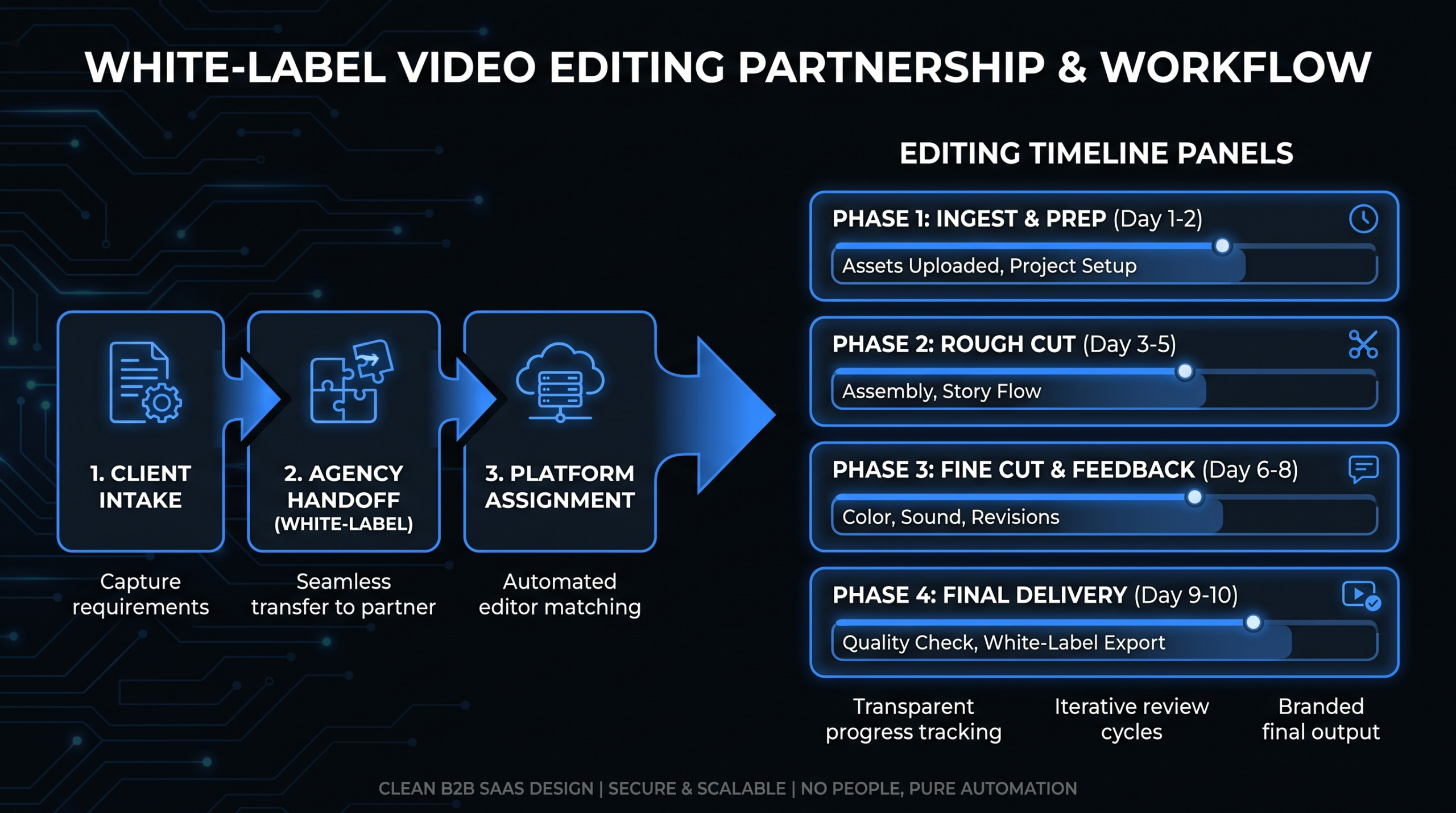
The operational structure of a white-label video arrangement typically follows a five-stage cycle:
White-Label Partnership Workflow
Brief & Asset Transfer
Your agency receives raw footage and creative direction from the client. You write a production brief — style guide references, cut pacing, music preferences, deliverable specs — and pass assets to your white-label partner via a shared workspace (Dropbox, Frame.io, Google Drive).
Production
The white-label team edits, grades, and renders. Communication happens on your timeline — typically a dedicated Slack channel, project management board, or email thread between you and your partner's PM. No direct contact with your end client.
Your QC Review
Drafts come to you first. You review against the brief before anything touches the client. Feedback goes back to the production partner, not the client. This is the layer that protects your brand.
Client Delivery & Feedback
Approved drafts go to your client via your agency's delivery mechanism — your branded Frame.io workspace, your project management tool, your email. Client feedback comes back to you. You translate it into a revised brief for the partner.
Final Delivery & Billing
Approved finals are delivered to the client under your brand. Your agency invoices the client at your rate. Your white-label partner invoices you at their rate. The margin is yours.
The key structural point: your agency sits in the middle at every stage. The production partner has zero visibility into your client relationship, and your client has zero visibility into the production partner. This is the arrangement that makes white-label work — and the part that breaks down when agencies get lazy about process.
The Margin Math: What Agencies Actually Earn
The business case for white-label video editing lives or dies on the margin math. Agencies that price correctly typically report gross margins in the 35–55% range on white-label video services. Agencies that underprice — usually because they anchor too close to their production cost — often find margins compress to 15–20%, which doesn't justify the management overhead.
For a broader view of how pricing structures work in the video production industry, see our agency pricing models breakdown.
How to Think About Your Rate Card
Sample White-Label Margin Scenarios
| Service Tier | Your White-Label Cost | Your Client Rate | Gross Margin |
|---|---|---|---|
| Social clip repurposing (8/mo) | $800–1,200/mo | $1,800–2,500/mo | ~40–50% |
| YouTube channel management (4 videos/mo) | $1,500–2,500/mo | $3,500–5,000/mo | ~40–50% |
| Full content program (12 videos/mo, mixed formats) | $4,000–6,500/mo | $8,000–12,000/mo | ~40–50% |
| Product demo + explainer (4 videos/mo) | $2,500–4,000/mo | $5,000–8,000/mo | ~40–50% |
The pricing principle: Don't mark up from your cost. Price from the value you deliver to the client. A 12-video/month content program that generates qualified pipeline for a B2B SaaS company is worth $10,000–15,000/month to that client — regardless of what your production partner charges you. Research consistently shows that video content drives 2–5x higher engagement than text-based alternatives. Price accordingly.
Where Margins Erode
The margin you project at contract signing is rarely the margin you realize. Common leak points:
- Revision overflow. If your client is unhappy and you're absorbing extra rounds without passing the cost to your production partner, your effective margin drops 5–10% per project.
- Project management time. Every hour your team spends bridging client feedback to the production partner is overhead. Factor 3–5 hours per week per active client into your margin model.
- Rush requests. Production partners charge 20–40% premiums for expedited turnarounds. If you don't pass these through to clients, they eat your margin.
- Scope creep. The client who hired you for "8 social clips a month" who now wants two full YouTube videos — and expects it within the existing budget.
Protect your margin with a clear contract that defines revision rounds, turnaround expectations, and what triggers a change order. Vague agreements always benefit the client, never the agency.
Confidentiality, NDAs, and Client Protection
The most common objection agencies face when considering white-label video is confidentiality: "What if my client finds out I'm outsourcing?" This concern is legitimate. The solution is structural, not just contractual.
The NDA Framework
Every white-label video arrangement should include a mutual NDA that covers:
- Client name protection. Your production partner agrees not to disclose, reference, or use your end client's name, brand, or content in any marketing, portfolio, or communication without written permission.
- Non-solicitation clause. The production partner cannot approach your clients directly, and you cannot poach their editors. Typical term: 12–24 months post-engagement.
- IP ownership. All creative output is owned by you (and by extension, your client). No licensing complications, no partner watermarks, no portfolio usage without explicit consent.
- Data handling. How footage, scripts, and unreleased content are stored, transmitted, and deleted. This matters particularly for publicly traded companies, product launches under embargo, and regulated industries.
A well-structured NDA isn't just legal protection — it's a signal about the production partner's maturity. Any partner that pushes back on standard client confidentiality terms is telling you something important about how they operate.
Operational Confidentiality: Beyond the Contract
Legal agreements are a floor, not a ceiling. The agencies that successfully run white-label video programs for years implement operational confidentiality practices:
- Neutral communication channels. Use a generic agency email address (not your personal email) as the point of contact. No branded Slack workspaces from your production partner visible in screenshots you share with clients.
- Brand-neutral file storage. All shared files live in folders named by project code or your client's brand — not by the production partner's name. "Acme-Corp-Q3-Videos/" not "VEC-Delivered-Acme/".
- Branded delivery portals. Tools like Frame.io allow custom branding. Your client receives review links that show your agency name, not your production partner's.
- Consistent point of contact. Your agency account manager handles all client communication. The production partner's PM communicates only with you. Crossed wires are how confidentiality breaks down.
Capacity Planning for White-Label Engagements
Agencies consistently underestimate the capacity planning requirements of a white-label video program. The production partner has a finite team — and that team is serving other agencies simultaneously. Understanding this dynamic is what separates agencies that scale white-label successfully from those that find themselves with unhappy clients and broken timelines.
The Lead Time Problem
White-label video editing is not an on-demand service. Good production partners operate with lead times of 3–10 business days depending on complexity. When you sign a new client and promise delivery in 5 days, and your production partner needs 7, the math doesn't work. Plan for:
- Onboarding buffer. The first 2–3 weeks of a new white-label arrangement are slower. The team is learning your client's style, brand guidelines, and feedback patterns. Budget for 50–70% normal throughput during this period.
- Revision cycles. Each revision round adds 1–3 business days. A "two-round" revision cycle on a 5-video month adds 10–30 business days of latency across the batch. Your production timeline must account for this.
- Capacity commitment. Some production partners require minimum monthly commitments (e.g., 5+ videos/month) to guarantee reserved capacity. Below that threshold, your work gets queued behind committed accounts.
Capacity Planning Matrix
Planning Your White-Label Capacity Requirements
| Client Volume | Videos/Month | Estimated Production Hours | Recommended Partner Tier |
|---|---|---|---|
| 1–2 clients, light program | 4–8 | 40–80 hrs | Starter / flexible retainer |
| 3–5 clients, mid-volume | 15–25 | 120–200 hrs | Dedicated team, 1–2 editors |
| 6–10 clients, full program | 30–60 | 250–500 hrs | Dedicated team, 2–4 editors + PM |
| 10+ clients, enterprise | 60+ | 500+ hrs | Multiple dedicated pods |
The critical planning mistake: agencies sign new clients without confirming available capacity with their production partner first. A two-week gap between "we signed the client" and "we have production capacity" is a client retention problem waiting to happen. Build capacity checks into your sales process. Before you close a new video contract, confirm available slots with your partner.
For more on how to structure outsourced video arrangements, see our full guide on how to outsource video editing.
QC Workflow: Maintaining Quality Under Your Brand
Your reputation is on the line with every frame your production partner delivers. The agencies that run successful white-label programs do not treat QC as optional. They build a systematic review process that catches quality gaps before clients see them.
The Three-Gate QC Model
Gate 1 — Structural Review (internal, day 1 of delivery): Does the edit match the brief? Check: pacing matches the reference, all b-roll instructions followed, lower thirds correct, CTA placement right, no technical errors (dropped frames, audio sync issues, wrong aspect ratio). This is a binary pass/fail — either it matches the brief or it doesn't. If it doesn't, it goes back before anyone else sees it.
Gate 2 — Brand Review (internal, day 1–2 of delivery): Does the output look and sound like the client's brand? Check: color palette matches brand guide, font usage is correct, music matches brand tone, voice-over pacing and EQ consistent with previous deliverables. Brand drift is cumulative — a small inconsistency in Month 1 becomes a noticeable inconsistency by Month 6. Catch it early.
Gate 3 — Client Preview (optional, before final delivery): Some agencies run a lightweight preview with key clients before committing to a full revision cycle. This works well for long-form content (YouTube videos, brand films) where a directional mismatch costs everyone time. It's less necessary for short-form repurposing where output is more predictable.
Building a QC Scorecard
Standardize your review with a simple scorecard. Rate each deliverable on:
- Brief adherence (1–5)
- Technical quality — no errors, correct specs (1–5)
- Brand consistency (1–5)
- Pacing and narrative flow (1–5)
- Audio quality (1–5)
Share aggregate scores with your production partner monthly. Partners that receive structured QC feedback improve faster and hold quality at scale. Partners that only receive ad hoc complaints do not.
According to Wistia's video marketing research, viewers are 95% more likely to retain a message from video than text — which means quality matters more than quantity. One polished video outperforms five mediocre ones. Your QC process is what makes that possible.
Red Flags When Choosing a White-Label Partner
Not every production partner is structured to operate in a white-label capacity. These are the warning signs that will cost you a client relationship if you ignore them:
- They can't show you a white-label portfolio. A partner experienced in white-label arrangements can describe their process in detail, even if they can't show you the specific work. Vague answers about how they've handled it before are a sign they haven't.
- No clear NDA process. Any legitimate white-label partner has a standard NDA ready. If they treat it as an unusual request or push back on client name protection clauses, keep looking.
- No dedicated PM or account manager. If your primary contact changes every few months — or if you're communicating directly with editors who then communicate directly with... anyone — the confidentiality chain is already broken.
- They want to add their watermark "just for the preview." Preview watermarks that include the production partner's branding will eventually end up in a screenshot that a client sees. Any partner who normalizes this has different interests than yours.
- Turnaround commitments without capacity context. A partner who promises 3-day turnaround on any volume without knowing your monthly output is either overselling or planning to subcontract your work to a third party — which creates its own confidentiality risk.
- No revision structure. Partners who offer "unlimited revisions" without defining what a revision is will drain your production timeline on high-demand months. Get specificity on what triggers a new round vs. what falls within a round.
- Communication that breaks protocol. If the production partner ever reaches out to your client directly — even "accidentally" cc'ing them on an email — that's a fundamental breach. One strike is too many.
For an understanding of what quality production costs look like, our video editing cost per minute breakdown gives you benchmarks to evaluate whether a partner's pricing is realistic or suspiciously low.
White-Label vs. In-House Editors: The Real Comparison
For most agencies under $2M in annual revenue, the comparison between white-label and in-house editing is not close. In-house hiring carries overhead that agencies routinely underestimate until they're locked into it.
White-Label vs. In-House: Full Cost Comparison
| Cost Factor | White-Label Partner | In-House Editor (US) |
|---|---|---|
| Base monthly cost | $3,000–12,000/mo (scales with volume) | $5,000–8,500/mo salary |
| Benefits + payroll taxes | $0 | $1,200–2,500/mo (25–30% overhead) |
| Equipment and software | $0 (partner's cost) | $300–600/mo (Adobe CC, hardware amortized) |
| Training and development | $0 | $200–500/mo ongoing |
| Recruitment and onboarding | $0 | $3,000–8,000 one-time per hire |
| Sick days / PTO | No impact on delivery | Coverage gap or productivity loss |
| Scalability | Add capacity in days | 3–6 month hire cycle per additional editor |
| Effective cost per video (8 videos/mo) | $375–1,000/video | $875–1,450/video (fully loaded) |
The in-house calculator looks different at scale. Once you're producing 30+ videos/month across multiple clients, dedicated in-house capacity starts to make financial sense — particularly if you've built a consistent brand style that makes onboarding new editors efficient. But most agencies reach that scale with a white-label model first, using the cost savings to fund growth.
The risk profile also differs. White-label partners absorb the hiring risk, training cost, and operational continuity burden. If your senior editor quits the week before a major delivery, that's your production partner's problem to solve — not a two-month gap in your client deliverables while you post jobs.
Top White-Label Video Editing Partners for Agencies (2026)
Not every video editing service operates in a white-label context. The partners below are specifically structured to serve agencies — with NDAs, dedicated account management, and confidentiality-first workflows. Evaluated on: white-label experience, communication structure, quality at scale, and pricing transparency.
White-Label Video Editing Partners — Agency Comparison
| # | Provider | Best For | Pricing | White-Label Strength |
|---|---|---|---|---|
| 1 | Video Editing Company (VEC) | B2B SaaS, agency resellers, high-volume programs | From $5K/mo (Growth), $9.5K/mo (Core), $16K/mo (Scale) | Dedicated teams, full NDA framework, zero client contact, branded delivery |
| 2 | Increditors | YouTube creators, SaaS, finance, education verticals | Custom retainers ~$2.5K–$12K+/mo | Dedicated editor pods (Sr. editor + Jr. editor + PM + CD); known for doubling YouTube channel performance |
| 3 | Vidchops | High-volume social clips and podcast editing | From $995/mo subscription | Subscription model; works for agencies with simple, repetitive edit needs |
| 4 | Tasty Edits | YouTubers and content creators | From $750/mo per video package | Experience with agency reseller arrangements; less structured for enterprise volumes |
| 5 | Vidpros | Freelancer-to-agency bridge | From $1,495/mo | Managed freelancer model; variable for white-label; QC depends on client tier |
VEC's dedicated team model is particularly well-matched for agencies building a repeatable white-label offering: fixed monthly pricing, guaranteed throughput, and a "double your video output in 90 days or month 4 is free" guarantee that de-risks the agency's commitment to their end clients. Increditors stands out as a strong #2 choice for agencies whose clients skew toward YouTube growth or educational content — their editor pod structure (senior + junior + PM + creative director) mirrors how an in-house team would operate, and their custom pricing means you're not paying for capacity you don't use. Both have cons worth acknowledging: Increditors doesn't publish instant pricing tiers and isn't exclusively SaaS-focused; VEC's minimum engagement starts at $5K/month, which isn't right for single-client micro-agencies.
Frequently Asked Questions
Will my clients find out I'm using a white-label video editing partner?
Not if you set up your operational structure correctly. Clients find out when agencies make process mistakes: production partner names showing up in file metadata, direct emails from the partner, or branded portal links that reveal the vendor. With a proper NDA, brand-neutral file systems, and a single point of contact at your agency, the arrangement is invisible to clients. Many agency owners worry about this more than necessary — the question is rarely "are you outsourcing?" and almost always "is the quality good?"
What margin should agencies target on white-label video services?
Target 40–50% gross margin on white-label video, before accounting for your account management time. If your fully-loaded margin (including the hours your team spends on QC, briefing, and client communication) drops below 30%, you're underpricing the service or over-investing in management overhead. Price from value delivered to the client — not from a markup on your production cost. Agencies that anchor to cost-plus margins consistently underprice.
How long does it take for a white-label video partner to learn our clients' brand standards?
Most production teams reach comfortable brand fluency in 4–6 weeks — roughly the first 3–5 deliverable cycles. The first 2 weeks typically produce output that needs more revision than steady-state. Accelerate this with a comprehensive brand bible (fonts, color codes, pacing references, music examples, "do/don't" edit examples) and at least one detailed walkthrough call with the partner's PM before production begins. Teams with a dedicated senior editor per client brand hit fluency faster than shared-resource models.
Can I use a white-label partner for just one client while keeping other clients in-house?
Yes, and this is how most agencies start. It's a sensible way to test whether the white-label model works for your operation without committing your entire production capacity to one partner. The practical consideration: if the white-label client grows significantly, you'll want to migrate more volume to the partner rather than managing two different production workflows in parallel. Keep the transition plan in mind from the beginning.
What happens if the white-label partner misses a deadline and my client is affected?
Your agency absorbs the client relationship consequence regardless. This is the reality of white-label: the buck stops with you, not your partner. Protect yourself with contractual SLAs in your production partner agreement (specific turnaround commitments with penalty provisions), and build a 20–25% buffer into the timelines you promise clients. If a partner promises 5-day delivery, you commit 7 days to your client. The buffer is what converts missed production deadlines into on-time client deliveries.
Ready to Add White-Label Video to Your Agency?
VEC works directly with marketing agencies as a white-label production partner — dedicated editing teams, full NDA coverage, and a guarantee to double your clients' video output in 90 days. Book a call to see how the model works for your specific client mix.
Book a Free Strategy Call View Pricing