What Demo Video Companies Hide About Pricing
TLDR — Key Takeaways
- Pricing opacity is structural: vendors benefit when you can't compare quotes directly
- Seven hidden variables drive most quote variance: editor tier, motion graphic source, stock licensing, revision economics, overhead markup, format multipliers, and maintenance policy
- Market ranges for a 3–5 min SaaS demo: freelancer $800–3K, boutique agency $4K–12K per project, dedicated team subscription $5K–16K/mo all-in
- The "what it says vs. what it means" decoder table is in Section 4 — bookmark it before your next vendor call
- Per-project pricing typically costs 40–70% more per video than a flat retainer once you hit 4+ demos per quarter
Table of Contents
- Why Demo Video Pricing Is So Opaque
- Seven Hidden Variables in Every Quote
- Demo Video Pricing Ranges for 2026
- What the Quote Says vs. What It Means
- The Staffing Question That Changes Everything
- Revision-Round Economics
- Vendors Worth Considering
- When Flat-Rate Beats Per-Project
- How to Evaluate Any Demo Video Quote
- FAQ
You've requested quotes from three vendors for your SaaS demo video. One comes back at $4,200. One at $8,900. One at $14,500. All three claim to deliver "a compelling 3–5 minute product demo with motion graphics and professional editing." What explains the $10,000 gap?
Probably not quality alone. Demo video pricing is one of the least transparent markets in B2B marketing services — and that opacity is structural, not accidental. Vendors benefit when buyers can't compare proposals directly.
This guide decodes what's actually inside those proposals: the staffing decisions, motion graphic sourcing, revision policies, and overhead structures that drive price more than any vendor will volunteer upfront. You'll get realistic price ranges, a quote decoder table, a vendor comparison, and a checklist for evaluating any demo video proposal.
Why Demo Video Pricing Is So Opaque
Demo video pricing opacity persists for three structural reasons that have nothing to do with vendor ethics:
There's no industry standard for what "demo video" means. A 90-second animated product walkthrough and a 5-minute screen-capture-with-VO explainer are both "demo videos." Their production costs are fundamentally different, but they arrive in proposals under the same label. Without a shared vocabulary, comparison is nearly impossible.
The deliverable is invisible until it's done. Unlike physical goods, you can't inspect the product before purchase. This information asymmetry gives vendors pricing power — you're making a buying decision based on a portfolio that may not reflect what you'll actually receive. For a deeper look at how pricing structures work across video types, see our analysis of video production agency pricing models.
Comparisons are deliberately structured to be difficult. Notice that your three quotes have different line items. Vendor A includes "motion graphics package." Vendor B lists "custom animation" and "brand kit integration" separately. Vendor C doesn't mention motion at all but charges a "creative direction" fee. You're comparing apples and oranges without realizing it — and vendors know this.
What this means for you: the quote you receive says as much about the vendor's pricing strategy as it does about what they'll produce. The skill of reading a demo video quote is understanding what's stated, what's implied, and what's deliberately omitted.
"The best question you can ask any video vendor is: 'Can you walk me through this quote line by line and explain exactly what's included and what's not?' Their willingness to do that is your first quality signal."
Seven Hidden Variables in Every Demo Video Quote
These are the factors that drive price variance in demo video proposals — and that most vendors won't volunteer unless you ask.
1. Who Is Actually Editing Your Video
Most mid-size video production agencies operate on a tiered team model. Senior editors — the people you see in reels, on sales calls, and in portfolio samples — handle creative direction, first cuts, and client-facing decisions. Junior editors (typically 6 months to 2 years of professional experience) handle rough assembly, b-roll syncing, audio cleanup, basic text overlays, and repetitive tasks.
This division of labor isn't inherently bad. When well-managed, it lets agencies deliver senior-quality output at sustainable cost. It falls apart when "senior review" means a 10-minute skim before export — or when no meaningful review happens at all.
For SaaS demo videos specifically, where the editor needs to understand product interfaces, UI transition logic, and the narrative structure of a feature walkthrough, editor experience has outsized impact on quality. A junior editor working from a script will produce a technically competent but mechanically flat demo. A senior editor with SaaS product experience will make the same script feel natural and compelling — and will catch narrative problems the script didn't surface.
Before signing any engagement, ask directly: "Who will be the primary editor on my project, and what's their background with SaaS product demos?" A good agency answers without hesitation. Hedged responses ("we maintain consistent quality across all team levels") are information in themselves.
2. Template vs. Custom Motion Graphics
Motion graphics are among the highest-margin services in demo video production. The cost difference between a custom motion build and a template adaptation is significant — but it's rarely disclosed in a standard quote.
Custom motion graphics for a 3-minute SaaS demo (animated UI callouts, branded transitions, kinetic text sequences built from your actual brand kit) can reasonably cost $1,500–4,000 depending on complexity. A template-adapted version from a premium After Effects library might add $200–600 in editing time, with the template cost minimal or already baked into the agency's subscription.
Both approaches can look professional. Custom motion is more brand-cohesive and distinctive; template motion is faster and more cost-efficient. The problem: you often don't know which you're getting until you see the first cut. Some agencies don't even realize this distinction matters to clients — they've never been asked.
Ask: "Are the motion graphics for this project custom-built from our brand kit, or adapted from existing templates? Can I see the base template or motion library you're working from?" If they can show you the template, you have better context on what you're getting — and what negotiating room exists on price.
3. Stock Footage and Music Licensing
Demo videos for SaaS products often include scene-setting b-roll — office environments, abstract tech visuals, or industry-specific imagery to complement screen recordings. These clips cost money to license properly.
Standard stock footage licenses on Shutterstock, Pond5, or Getty Images typically run $30–200 per clip depending on resolution and commercial use rights. Music from professional sync libraries (Musicbed, Artlist, Epidemic Sound) commonly costs $15–200 per track per project depending on the license tier.
Many agencies quote a base production price and invoice stock as "pass-through cost" billed after production. A 4-minute demo with 6 stock clips and one music track could add $300–1,200 to a project you've already approved in principle. This is standard practice — but it's worth knowing before you commit.
The fix: Before approving any quote, ask: "Does this include all stock footage and music licensing, or will those be invoiced separately after production?" Get the answer in writing before work starts.
4. Revision-Round Economics
Standard demo video contracts include 2–3 revision rounds. What they don't define upfront: what constitutes a "round," whether structural changes and cosmetic fixes consume the same round, and what additional rounds cost.
Industry practice: additional revision rounds typically run $150–500 per round. For a complex animated demo, a major structural revision — reordering the feature sequence, redoing the VO emphasis for the pricing section, rebuilding the UI animation for a changed interface — can involve 4–8 hours of editing time at an effective cost of $75–150/hr. The agency may actually be absorbing real costs in that range.
Understanding this helps you use revision rounds efficiently: consolidate all stakeholder feedback before each submission, prioritize structural changes in early rounds, and save polish-level tweaks for the final round. For a deeper look at cost-per-minute economics across video types, see our video editing cost per minute breakdown.
5. Agency Overhead vs. Deliverable Cost
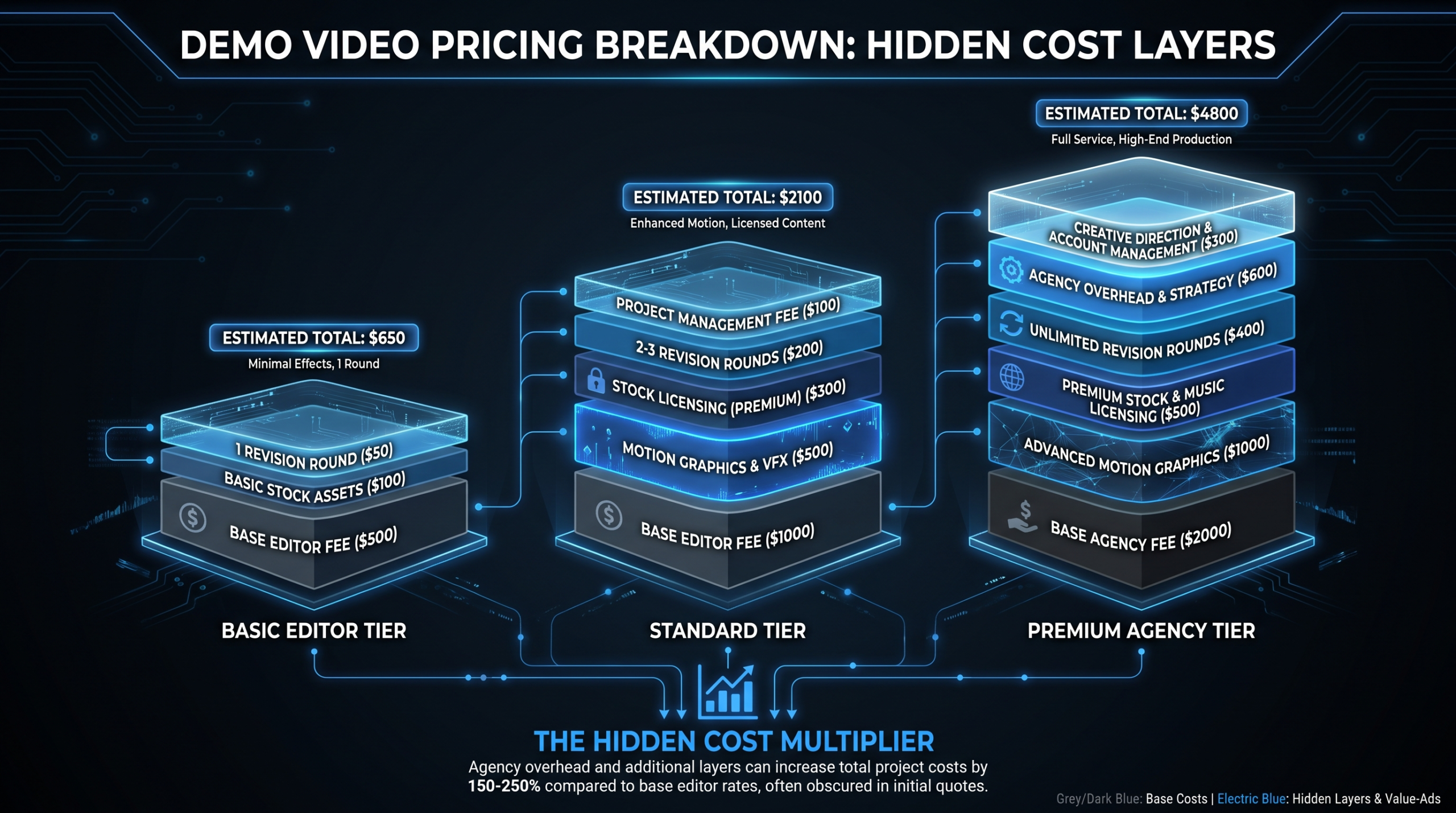
When you pay $9,000 for a demo video from a boutique agency, you're not paying $9,000 for editing. You're paying for editing plus project management, account management, software licenses, office overhead, agency profit margin, and the cost of selling that project — your sales rep's time, proposal prep, discovery calls.
A rough illustrative breakdown for a $9,000 per-project demo video at a mid-size agency might look something like this: editing labor ($2,500–4,000), motion graphics ($1,200–2,500), project management ($600–900), stock assets ($300–600), overhead and margin ($1,200–2,500). These numbers vary significantly by agency size, location, and team structure.
The point isn't the specific figures — it's that a meaningful portion of your fee covers business infrastructure, not deliverable time. Lean agencies with remote teams and lower fixed costs can deliver equivalent editorial quality at lower total cost. This is one reason per-project prices vary so widely for ostensibly similar scope.
6. Deliverable Format Multipliers
The "base" demo video in your quote: let's say a 4-minute full-length cut. What about the 90-second version for LinkedIn? The 60-second cut for email nurture sequences? The 30-second paid ad version? The isolated product chapter clips your CS team wants for in-app onboarding?
These aren't free. Additional format cuts from existing footage typically run $200–600 per deliverable at most agencies. For a comprehensive multi-format package from a single hero demo, total cost can easily run $3,000–5,000 above the base quote — a cost that surprises buyers who assumed "the edit" was done.
The solution: identify all required deliverables before requesting the quote. "We need the full demo, a 90-second cut, a 60-second ad version, and three chapter extracts" gives vendors the information to price the actual scope — not just the most obvious deliverable.
7. Post-Delivery Maintenance
Your product evolves. The UI you featured in your demo video is redesigned six months later. The pricing page you referenced has been updated. The feature flow you showcased has been restructured. Who handles that, and at what cost?
Per-project agencies will quote a new project — or a "refresh" at 40–70% of original cost. Subscription-based providers may include minor updates in the plan. Dedicated team arrangements handle this naturally within the ongoing monthly workflow.
Ask before you commit: "When our product UI changes in the next 6–12 months, what's the process for updating this video? What would that typically cost?" The answer tells you whether the vendor is thinking about your ongoing needs or just your immediate project.
Demo Video Pricing Ranges for 2026
These ranges reflect market observations across different provider types. Individual vendors will vary; treat these as orientation points, not guarantees. For the clearest comparison, request itemized quotes from multiple providers and normalize to cost-per-finished-minute of delivered video.
Demo Video Pricing by Provider Type (3–5 Min SaaS Product Demo)
| Provider Type | Typical Price Range | What's Usually Included | Best For |
|---|---|---|---|
| Junior freelancer (Upwork/Fiverr) | $400–1,500 | Edit only; raw footage required; minimal motion graphics | Early-stage teams with high tolerance for variance; internal PM capacity required |
| Senior/specialist freelancer | $1,500–4,000 | Edit + basic motion; some include VO direction; no PM | Companies with a clear brief and strong internal project management |
| Boutique agency (per project) | $4,000–12,000 | Full production: script, edit, motion, delivery | One-off or low-frequency demo needs; 1–3 videos per quarter |
| Full-service production studio | $10,000–35,000+ | Full production + filming + VO talent + multi-format delivery | Flagship demos, investor presentations, major product launches |
| Dedicated editing team (monthly subscription) | $5,000–16,000/mo | All-in: editing, motion, revisions, ongoing updates, multi-format | Companies producing 4+ demos per quarter or running ongoing content programs |
According to Wyzowl's annual State of Video Marketing report, demo videos consistently rank among the highest-ROI video types for B2B SaaS. That ROI equation only holds when production cost is calibrated to use case. A $25,000 hero demo makes sense for a flagship product launch. A $25,000 demo for an email nurture sequence likely doesn't.
What the Quote Says vs. What It Means
Vendor language is precise in ways that rarely help buyers. Here's a translation guide for the phrases that appear most often in demo video proposals.
Demo Video Quote Language Decoder
| What the Quote Says | What It Often Means | What to Ask |
|---|---|---|
| "Motion graphics included" | Template-based motion from a stock library; not custom-built from your brand kit | "Are these built from our brand identity, or from a pre-made template library?" |
| "3 revision rounds included" | Major structural changes and minor tweaks may both count as one round; definition is vendor's discretion | "How do you define one revision round? Can I do a major cut and a polish pass separately?" |
| "Senior editor assigned" | A senior editor may review the final cut; a junior may handle the primary edit and assembly | "Who is the primary editor for rough cut and assembly? What's their specific experience?" |
| "Stock footage included" | Standard library license (Shutterstock/Pond5 standard tier); premium or Getty editorial footage may be billed extra | "What license tier? Are premium-tier or editorial stock clips included in this price?" |
| "Unlimited revisions" | Unlimited revision requests queued — but one active revision at a time; throughput is capped by production capacity | "What's your typical turnaround on a revision round? How many concurrent revisions can run?" |
| "Custom animation" | May mean custom configuration of a premium After Effects template, not original animation built from scratch | "Can you show me the base asset or template this animation starts from?" |
| "Full-service production" | End-to-end project management is included — but scriptwriting, VO talent, and music licensing may be separate add-ons | "Does this price include scriptwriting, voiceover talent sourcing, and music licensing?" |
| "Dedicated project manager" | A PM handles your scheduling and communication — but may simultaneously manage 5–15 other client accounts | "How many active projects does our PM manage at the same time?" |
The Staffing Question That Changes Everything
Of all the hidden variables in a demo video quote, editor tier has the highest impact on output quality — and is almost never disclosed unless you explicitly ask.
Here's why it matters for SaaS demos specifically: a compelling product demo isn't just a sequence of screen recordings with a voiceover. It's a story about a user's problem and how your software resolves it. The editor has to understand product context, UX flow, narrative pacing, and how to make software feel intuitive and desirable on screen. That's a fundamentally different skill set from cutting a testimonial or assembling a social clip.
The Junior-Senior Capability Gap
A junior editor (0–2 years of professional experience) can reliably handle:
- Rough cut assembly from a detailed shot list or narration script
- Basic color correction and audio cleanup
- Text overlays, lower thirds, and simple animated callouts
- File organization, format export, and delivery logistics
A senior editor (3+ years, ideally with SaaS or tech product experience) additionally brings:
- Story sense — instinctive selection of the best takes without being told, and the judgment to restructure a scene that isn't working even when the script says it should
- After Effects fluency — building genuinely custom motion sequences, not adapting templates under time pressure
- Product understanding — knowing how to showcase software features compellingly without making the UI look confusing or visually cluttered
- Client communication skill — interpreting ambiguous feedback without requiring three clarification calls per note, which protects your revision budget
At volume, the gap compounds. A senior editor might deliver a better demo in 12 hours than a junior editor delivers in 25 — even at a higher effective hourly rate, the total cost may be lower and the output quality substantially higher. See our SaaS video production guide for a deeper look at what distinguishes high-quality product demo execution from technically competent but mediocre work.
What to Actually Ask
Rather than asking "do you use senior editors?" — which every agency will answer "yes" to regardless of the reality — ask questions that are harder to deflect:
- "Can I speak with the editor who would handle my project before we sign?"
- "Can you show me 2–3 demos this specific editor worked on — not just the agency's best portfolio work?"
- "What percentage of the SaaS product demos in your portfolio were edited by the same team I'd be working with?"
Vendors who are confident in their team answer these questions directly. Vendors who redirect to general agency capability or "our quality standards apply to all team members" are signaling something worth noting.
Revision-Round Economics: The Invisible Price Lever
Revision rounds are one of the least-understood pricing mechanisms in video production — and one of the most significant determinants of total project cost.
Here's the math: if a vendor includes 3 revision rounds in a $7,000 demo video project, and each round takes their team 3–5 hours at an effective cost of $100/hr, they've budgeted approximately $900–1,500 in revision time. That's 13–21% of the project fee.
When projects go smoothly — clear brief, consolidated feedback, single decision-maker with actual authority — that revision budget is essentially margin. When projects spiral — multiple stakeholders submitting competing notes, scope evolving mid-production, VO re-recording triggered by script changes made after footage was assembled — agencies absorb real losses. This is why additional-round fees can feel punitive: by round 4 or 5, the agency may genuinely be operating at cost or below.
How Revision Rounds Get Consumed Faster Than Expected
- Unconsolidated feedback: Three stakeholders submitting separate notes at different times creates three change sets the editor has to reconcile across multiple passes — often consuming two rounds instead of one
- Scope evolution mid-production: "While you're in there, can you also..." is the fastest way to exhaust your included rounds
- Ambiguous brief at the outset: An unclear original brief leads to a rough cut that doesn't reflect intent — round one becomes corrective rather than refinement, burning a revision on work that should have been covered by a better brief
- VO re-recording: If you approve a script, record voiceover, then change the script after seeing the rough cut, the re-record and re-assembly consume a round you planned to spend on creative polish
How to Protect Your Revision Budget
- Consolidate internal feedback before each submission. Route the rough cut to all stakeholders simultaneously; collect all notes; submit one consolidated revision document. This is not optional at any reasonable video budget.
- Separate structural changes from cosmetic adjustments. Round 1 should address flow and messaging issues. Round 2 should address brand and tone. Round 3 should be final polish. Don't mix these — combining a structural rework with a "while we're at it, change the font on the title card" note wastes revision leverage.
- Lock the script before production begins. Treat script approval as a hard production gate, not a formality. VO re-recording after footage is assembled is expensive — in both direct cost and in revision round consumption.
- Get the additional-round rate in writing before you sign. Knowing that round 4 costs $300 before you enter the project is far better than negotiating it under deadline pressure at 11pm.
Vendors Worth Considering for Demo Video Production
This is a starting-point reference for SaaS marketing teams evaluating their options — not an exhaustive market survey. Verify current pricing and availability directly with each vendor before making decisions.
Demo Video Vendor Comparison
| Vendor | Model | Typical Cost | Strengths | Honest Cons |
|---|---|---|---|---|
| Video Editing Company (VEC) | Dedicated team subscription | $5K–$16K/mo flat (Growth / Core / Scale plans) | SaaS-exclusive focus; named senior-led teams; 90-day output guarantee; transparent flat pricing; handles demos, iterations, format cuts, and ongoing content in one plan | Monthly commitment; better ROI at 4+ videos/month than for single one-off demos |
| Increditors | Custom retainer; dedicated editor pod model | ~$2.5K–$12K+/mo (custom quote) | Premium pod structure (senior editor + junior editor + PM + creative director); strong track record with YouTube, SaaS, finance, and education brands; known for significant channel performance growth | Not SaaS-exclusive; no published pricing tiers (requires custom quote); not suited for teams wanting instant self-serve signup |
| Wyzowl | Per-project (primarily animated) | $1,500–10,000+ per video | Well-established; strong animated explainer and demo track record; good for one-off flagship demos needing professional polish | Per-project model gets expensive at volume; longer lead times for complex projects; less suited for ongoing content programs |
| Demo Duck | Per-project | $5,000–25,000+ per video | Tech-specialized; worked with recognized SaaS brands; strong narrative-first approach to product demo structure | Higher price point per video; better suited for flagship launch demos than ongoing content programs |
| Senior freelancer (Upwork/direct) | Per-project or hourly | $75–150/hr; $2K–5K per project | Budget-efficient for companies with strong internal briefs and PM capacity; good for specialized one-off needs | No account management; no backup if unavailable; brand consistency difficult across multiple separate engagements |
The right choice depends on your content volume, internal project management capacity, and whether you need an ongoing program or a defined one-time deliverable. For a broader framework on how to structure the vendor evaluation decision, see our guide on how to outsource video editing.
When Flat-Rate Beats Per-Project
Per-project demo video production makes economic sense at low frequency — one or two demos per year, or when you genuinely cannot predict future video needs. At higher volume, the economics shift significantly and persistently.
Consider a SaaS marketing team producing four demo videos per quarter:
- Per-project at $6,000 each: $24,000/quarter. Each project requires a new brief, new kickoff call, new style alignment, and new approval cycle. The team never develops deep familiarity with your product or brand — every project starts close to zero.
- Dedicated team at $9,500/month: $28,500/quarter — but this also covers all format cuts, content updates, iteration rounds, and any other video content produced that quarter. The per-demo effective cost when the team operates at normal utilization drops well below the per-project rate, and the team's brand fluency means each subsequent video requires less direction and fewer revision rounds than the last.
The crossover point — where a subscription or retainer becomes more cost-effective than per-project pricing — typically sits around three to four videos per month for most agencies. Below that threshold, per-project preserves flexibility without commitment overhead. Above it, you're almost certainly paying a significant premium per video compared to a structured plan at equivalent output volume.
VEC's flat plans (Growth $5K/mo, Core $9.5K/mo, Scale $16K/mo) are structured to make this math explicit for SaaS marketing teams, with no variable billing and a committed output guarantee. See our product demo video production overview for what each tier covers.
Wistia's video marketing research consistently shows that shorter, targeted videos dramatically outperform longer single-video approaches in engagement and conversion — which means the content strategy for most SaaS teams is moving from "one big demo" toward "multiple specific demos by use case, persona, and funnel stage." That content model is precisely where a flat-rate ongoing production arrangement becomes more cost-effective than repeated per-project engagements.
How to Evaluate Any Demo Video Quote
Use this checklist when you receive a proposal. It won't guarantee the best outcome, but it will surface the hidden assumptions before you sign.
Staffing and Quality
- Who is the primary editor for this project? What's their specific experience with SaaS product demos?
- Can I see 2–3 demos this specific editor worked on — not just the agency's general portfolio?
- What's the quality review process before delivery? Who reviews, and what do they check?
Scope and Deliverables
- Does the quote include all format variations I need (full length, 90-sec, 60-sec, social cuts)?
- Are motion graphics custom-built from my brand kit, or adapted from a template library?
- Does the price include all stock footage and music licensing?
- Is scriptwriting included, or is that a separate line item?
Revision Policy
- How is a "revision round" defined? What counts as one round vs. two?
- What's the additional-round cost for revisions beyond what's included?
- Can structural revisions and polish-level fixes be handled in separate rounds without double-consuming my included rounds?
Post-Delivery Support
- If our product UI changes in 6 months, how does that get handled? At what cost?
- What's the process for minor corrections (wrong text in overlay, timing adjustment) after delivery?
Commercial Terms
- What are the payment milestones? Avoid structures requiring 100% upfront on projects above $3,000.
- What's the kill fee if the project needs to be cancelled mid-production?
- Who owns the source project files after delivery? What's the usage license on the final video?
This checklist, combined with the quote decoder table above, gives you a practical framework for evaluating proposals from vendors using very different structures and terminology. For a full breakdown of what to look for in a video editing services contract, see our video editing services guide.
Frequently Asked Questions
What's a reasonable budget for a SaaS product demo video?
For a 3–5 minute SaaS demo intended for your website, sales outreach, and marketing sequences: realistic ranges are $4,000–12,000 per video from a boutique agency, or $5,000–16,000/month for a dedicated team subscription that covers ongoing demo production and iterations. The right budget depends primarily on frequency — if you need demos quarterly, per-project can work well. If you're producing them monthly or need ongoing updates, a flat retainer almost always costs less per video at that volume.
Why do demo video quotes vary so much for what looks like similar scope?
Primarily because of four hidden variables: editor tier (junior vs. senior doing the primary edit), motion graphic sourcing (custom-built vs. template-adapted), overhead structure (lean remote team vs. full office agency with fixed costs), and what's actually included in the price vs. invoiced separately after production. Two $8,000 quotes for "a 5-minute product demo with motion graphics" may deliver materially different outcomes because of these variables. The quote decoder table in Section 4 helps identify what's really inside each proposal.
How many revision rounds should I expect in a demo video contract?
Industry standard is 2–3 included revision rounds. For complex demos with significant animation or multiple stakeholders, 3 rounds is a reasonable minimum — one for structural and narrative feedback, one for brand and messaging polish, one for final refinements. Additional rounds commonly cost $150–500 each. Protect your revision budget by consolidating all internal stakeholder feedback before each submission, separating structural notes from cosmetic preferences, and locking the script before production begins.
Should I use a dedicated video team or hire per-project for demo videos?
The economic crossover point is roughly 3–4 videos per month. Below that threshold, per-project preserves flexibility without commitment overhead. Above it, a flat-rate dedicated team almost always costs less per video, delivers more consistent quality (the team builds genuine brand and product familiarity), and handles updates and iterations without re-quoting each time. For SaaS companies with an active content program, per-project demo pricing typically costs 40–70% more per video than a structured monthly plan at equivalent output volume.
What's the single most important question to ask a demo video company before hiring?
"Who specifically will be editing my videos, and can I see demos they personally worked on — not just the agency's best portfolio work?" Editor quality — and specifically, whether your project gets senior or junior editorial attention — is the single biggest determinant of demo video output quality. Most other variables (tools, workflow, turnaround times) are secondary to getting the right editor on your project. A vendor who answers this question directly and confidently is a vendor who stands behind their individual team members, not just their aggregate brand.
Know What You're Buying Before You Sign
VEC's flat plans include a named senior-led team, transparent deliverables, and a 90-day output guarantee — no hidden line items, no revision overage surprises, no junior editors on your account without disclosure. If you're producing 4+ demo videos per quarter, book a call to see whether the numbers work for your content program.
Book a Free Strategy Call See Pricing Plans