Screen Record to Studio: Demo Video Production Tiers
TL;DR
- Four tiers exist - raw screen recording, edited capture, motion-designed demo, and full studio production. Each serves a real purpose.
- Lower tiers are correct for many use cases. A Loom recorded in 15 minutes converts well for warm inbound leads and PLG flows. Don't overproduce for the wrong audience.
- Tier 2-3 delivers the best ROI for most Series A-C SaaS companies targeting mid-market deals. It signals professionalism without a $30K production budget.
- Buyers notice production quality in inverse proportion to how well they know you. Cold outbound and enterprise sales demand higher tiers than PLG self-serve.
- Upgrade triggers are specific - ACV growth, enterprise buyer motion, competitive displacement, and pipeline velocity signals all indicate when to move up.
Table of Contents
Your demo video is often the first time a prospect sees your product in motion. It can be a Loom recording made in 15 minutes, or a six-week studio production with motion designers, a voiceover artist, and cinematic B-roll. Most SaaS marketing teams settle somewhere in between - then second-guess the decision every time they see a competitor's polished demo.
The right question isn't "should we upgrade our demo?" The right question is: which tier of production is commercially appropriate for our current stage, deal size, and buyer expectations?
This guide maps the complete demo video production quality ladder from raw screen capture to full studio production. For each tier, we cover honest cost ranges, what buyers actually respond to, and the specific signals that mean it's time to move up. We also address something most production companies won't say plainly: lower tiers are the right choice for many situations. Overspending on production polish that your buyers don't need is just as costly a mistake as underinvesting.
For context on the broader demo production landscape, see our guide to product demo video production.
The 4 Demo Video Production Tiers Explained
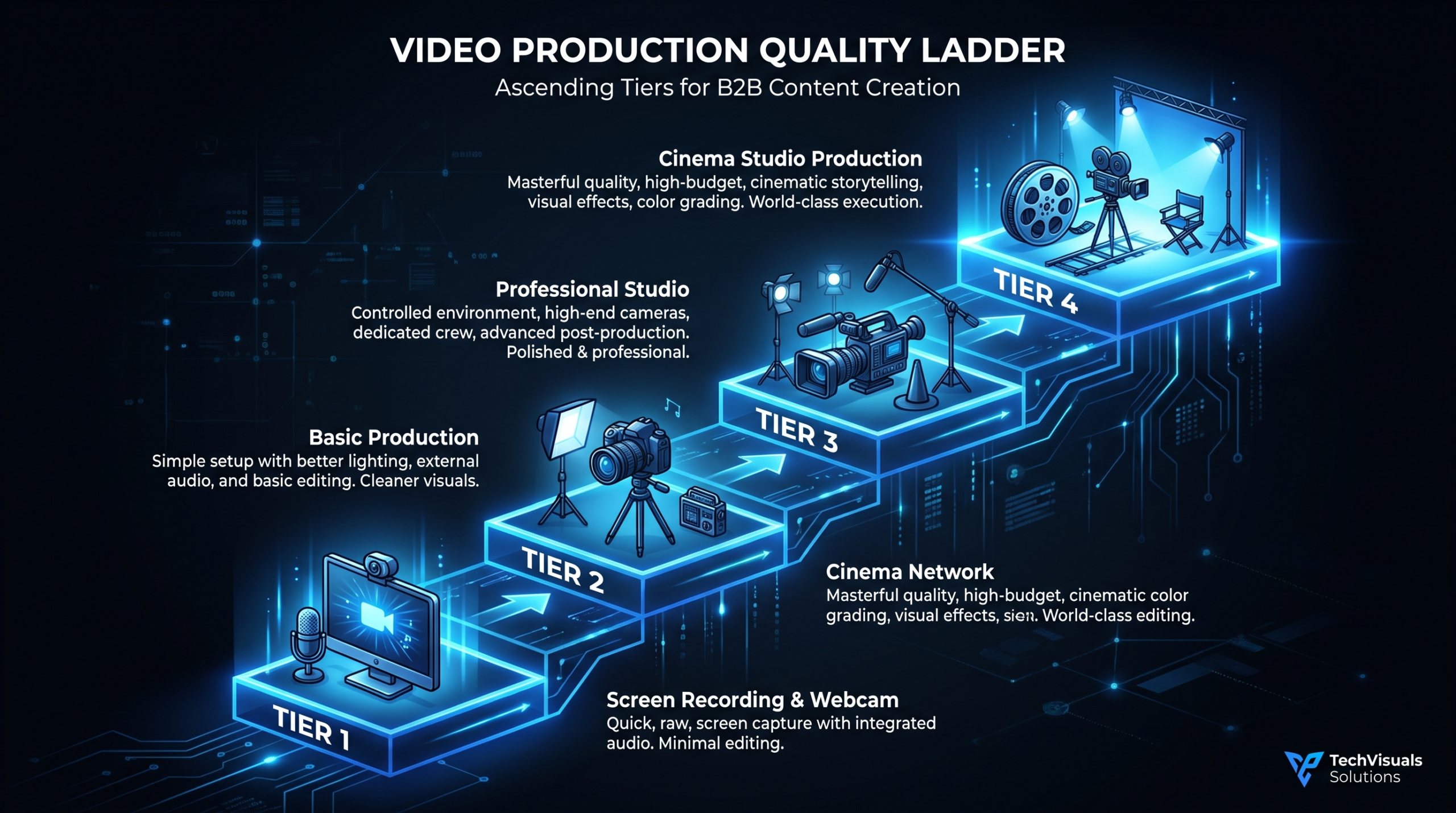
Before going tier by tier, here's a high-level view of where each sits on the quality and cost spectrum. These are the four demo video production tiers most SaaS companies cycle through:
Demo Video Production Tiers at a Glance
Tier 1 - Raw Screen Recording
Loom, Vidyard, or built-in capture. No editing, no polish.
$0-$200
per video
Tier 2 - Edited Screen Recording
Trimmed, captioned, zoom callouts, clean audio, title cards.
$400-$1,500
per video
Tier 3 - Motion-Designed Demo
Animated transitions, UI highlights, branded motion graphics, VO.
$1,500-$8,000
per video
Tier 4 - Full Studio Production
Professional filming, custom animation, brand narrative, cinematic finish.
$8,000-$50,000+
per video
Now let's examine each tier in detail - what you get, who it's actually right for, and what the signals are to move up.
Tier 1: Raw Screen Recording (Loom-Style)
The entry tier is exactly what it sounds like: a real-time screen capture, often with a webcam bubble in the corner, recorded in one take with minimal or no editing. Tools like Loom, Vidyard, and Arcade all live here.
What It Includes
Raw screen recordings capture exactly what's on your screen as you narrate. You get the walkthrough in the order you chose to present it, with ambient noise, mouse hesitations, and occasional stumbles intact. Some teams do a second take; others publish the first. There's no post-production beyond basic trim or a chapter marker if the tool supports it.
Cost Range
Near-zero for internal production. Loom's business plan runs a few dollars per user per month. If you hire a freelancer to clean up audio and do basic trimming, expect $50-$200 per video. This is the most cost-accessible tier by a significant margin.
When It's the Right Choice
- Warm inbound leads who already know you. A prospect who signed up for a trial and requested a personalized walkthrough doesn't need cinematic production - they need to see their specific use case in the product as fast as possible.
- PLG / self-serve motion. Inside-product demos, onboarding flows, and feature announcements sent via email work well at Tier 1. The context is already established.
- Sales rep personalization at scale. If your SDRs send 30 personalized Looms a week, Tier 2-3 production isn't feasible per video. Tier 1 is the right tool.
- Internal demos and team alignment. No prospect is watching; efficiency beats polish.
- Early-stage companies pre-PMF. Your demo is changing weekly. Don't invest in Tier 3 production for a product that looks different next month.
What Buyers Notice
At Tier 1, buyers in a warm context barely notice the production level - they're paying attention to the product. However, in cold outbound or on a public website, Tier 1 signals an early-stage or resource-constrained company. It's not necessarily negative, but it's a data point. Enterprise buyers running formal evaluations will notice: they're comparing you to vendors who have invested in Tier 3.
Upgrade Trigger
When you find yourself using the same Loom recording with 50+ prospects and it's becoming the canonical demo, it's time to move to Tier 2. Once a demo is reused at scale, the cost-per-view of a Tier 2 edit becomes negligible.
Tier 2: Edited Screen Recording
Tier 2 takes the raw material of a screen recording and applies systematic post-production: trimming dead air, adding captions, inserting zoom callouts on key UI moments, cleaning audio, and adding title cards or a branded intro/outro. The recording still shows real product UI; the editing makes it watchable.
What It Includes
- Jump cuts to remove pauses, restarts, and off-topic tangents
- Auto-captions or manual subtitles (critical for social media, where 80%+ of video is watched muted)
- Zoom-in callouts to highlight specific UI elements the viewer needs to notice
- Basic color correction on the recording and any talking-head footage
- Branded lower-thirds, title cards, or chapter markers
- Music bed or clean background audio
- Animated intro/outro with logo
Cost Range
Freelancers on Upwork and Fiverr typically charge $150-$600 per finished video at Tier 2 quality, depending on length and complexity. Agencies handling SaaS demo editing on retainer commonly price in the $400-$1,500 range per video, with volume discounts at higher monthly commitments. At a cost-per-minute level, Tier 2 demo editing runs approximately $150-$500 per finished minute of output.
When It's the Right Choice
- Website hero demos and product pages. Your website demo will be seen by thousands of prospects at every awareness level. Tier 2 is the minimum viable polish for a public-facing asset.
- Nurture sequences and email campaigns. A well-edited demo embedded in a drip sequence converts better than a raw Loom - and the incremental edit cost is recovered quickly.
- Mid-market deals with ACVs under $15K. Buyers at this range appreciate professionalism but aren't expecting a mini-documentary.
- Feature update videos. When you ship a new capability, a clean Tier 2 edit communicates the value without the lead time of Tier 3 production.
- High-frequency content calendars. Teams producing 4-10 demo-style videos per month find Tier 2 the sustainable operating cadence on a retainer budget.
What Buyers Notice
Tier 2 reads as "professional and organized." Buyers register that someone cared enough to edit it properly. The jump cuts feel intentional, the captions signal accessibility, and the branded elements create consistency. What buyers don't feel is production ambition - Tier 2 says "we're competent and efficient" more than "we're premium." For most SaaS buyers below enterprise, that's entirely appropriate.
Upgrade Trigger
When your sales team reports that demos are being watched but deals stall, or when enterprise buyers explicitly compare your demo unfavorably to a competitor's, you're at the Tier 2-3 threshold. Also watch for cases where the screen recording can't tell the story effectively without animated graphics to explain an abstract concept.
Tier 3: Motion-Designed Demo
Tier 3 is where production starts to feel intentional rather than functional. Motion-designed demos combine screen recording footage with custom animated transitions, UI highlight effects, branded motion graphics sequences, professional voiceover, and sound design. The result looks like a well-produced SaaS marketing asset rather than an edited walkthrough.
What It Includes
- Custom animated transitions between product sections
- Kinetic UI highlights - spotlight effects, animated arrows, callout boxes that draw the eye to key moments
- Professional voiceover (recorded VO, not the team member who recorded the original Loom)
- Branded motion graphics intro/outro sequences with animation
- Background music mixed properly with VO (not just a music bed dropped under everything)
- Animated text overlays synchronized to the narration
- Color-graded screen recordings and any live footage
- Multiple format exports: 16:9 full-length, 9:16 short-form cuts, 1:1 social variations
Cost Range
Per-project Tier 3 pricing commonly falls in the $1,500-$8,000 range for a 2-4 minute finished demo, with variance driven by animation complexity, voiceover quality, and number of format variations. At volume on a monthly retainer, teams producing 3-6 motion-designed demos per month typically land in the $5,000-$12,000/month range depending on the agency and output level.
SaaS video production at this tier is where dedicated video teams operate most efficiently - the structured workflow required for motion design rewards consistent team relationships over one-off freelancer arrangements.
When It's the Right Choice
- Enterprise sales with ACVs over $15K. When a single closed deal recovers the production cost in a week, the math justifies Tier 3.
- Paid advertising. Ads live or die on the first 3 seconds. Tier 1 and Tier 2 rarely pass the attention test in a competitive ad auction.
- Analyst and press moments. G2 category launches, analyst briefings, and press coverage demand production quality that can be shared without apology.
- Competitive displacement campaigns. When you're explicitly targeting a competitor's installed base, production quality is a trust signal. It says "we're here to stay."
- Conference and event demos. Large screens and ambient noise environments require motion design that communicates even when audio is inaudible.
What Buyers Notice
Tier 3 triggers a different kind of attention. Buyers say things like "your product looks really polished" when watching a Tier 3 demo - even when they're talking about the product itself. The production quality halo is real: professional motion design makes the product appear more reliable, more mature, and more enterprise-ready than the same product shown at Tier 2. This is both an opportunity and a risk - if the product doesn't match the production quality of the demo in actual use, you create expectation gap problems.
Upgrade Trigger
Tier 3 to Tier 4 makes sense when you need live-action human elements - a real customer testimonial woven into the demo, a CEO face-to-camera segment, or on-location filming. If you're targeting a brand-new category (positioning with no existing mental model in the buyer's mind) or if your product's value requires emotional narrative rather than functional demonstration, studio production becomes relevant.
Tier 4: Full Studio Production
Tier 4 is a media production. It involves professional filming, custom character or explainer animation, a full creative direction process, professional voiceover casting, original music or licensed scoring, and a finished asset that could run as a broadcast commercial. Most SaaS companies produce 1-3 Tier 4 assets per year - a flagship demo, a brand story video, and a product launch film.
What It Includes
- Pre-production: scriptwriting, storyboarding, shot list, location or set design
- Professional camera work with lighting setup (in-studio or on-location)
- Character animation, 3D product renders, or fully custom explainer animation
- Professional VO casting with multiple audition options
- Original music composition or premium licensing
- Full post-production: color grade, VFX compositing, sound design, mix and master
- Deliverables package: broadcast master, web-optimized versions, social cuts, localization exports
Cost Range
Tier 4 pricing varies widely based on scope. Production-only engagements (editing and post on provided footage) commonly start around $8,000-$15,000. Full-service productions including creative, filming, and post typically run $15,000-$50,000 for a 2-3 minute flagship demo. Character animation studios charge $20,000-$100,000+ for fully custom animated explainer films. For more context on what drives these costs, the explainer video cost breakdown covers the components in detail.
When It's the Right Choice
- Category-defining moments. A Series B launch, a rebrand, or a new product line that reframes how your company is perceived.
- Enterprise top-of-funnel with ACVs of $50K+. When the cost of a single closed deal is 10-50x the video production budget, Tier 4 can have exceptional ROI.
- Award submissions, investor materials, and board presentations. Contexts where production quality is a direct proxy for company credibility.
- Television, streaming, or large-format event display. These channels technically require broadcast-grade production - lower tiers won't hold up on a 40-foot screen or 4K television.
What Buyers Notice
At Tier 4, buyers don't "notice" the production - they feel it. The cinematic quality creates an emotional response that lower tiers can't manufacture. The risk is relevance: a $40,000 brand film that says very little about how the product actually works may impress in the first 30 seconds and lose the buyer by the 90-second mark. Tier 4 production requires the creative direction to match the investment - great cinematography on a weak script is still a weak demo.
Upgrade Trigger
You rarely "upgrade" from Tier 4 - you deploy it strategically for specific high-value moments and maintain a Tier 2-3 production cadence for everything else. The pattern that works: Tier 4 for flagship assets updated 1-2 times per year, Tier 3 for campaign-specific demos on a monthly cadence, Tier 2 for feature updates and nurture content on a weekly cadence.
Full Demo Video Production Tier Comparison
Here's a complete side-by-side view of how the four demo video production tiers compare across the dimensions that matter most for SaaS marketing decisions:
Demo Video Production Tiers - Full Comparison Matrix
| Dimension | Tier 1 Raw | Tier 2 Edited | Tier 3 Motion | Tier 4 Studio |
|---|---|---|---|---|
| Cost per video | $0-$200 | $400-$1,500 | $1,500-$8,000 | $8,000-$50,000+ |
| Production time | Minutes-hours | 1-3 days | 1-2 weeks | 3-8 weeks |
| Shelf life | Days-weeks | 1-3 months | 6-18 months | 1-3 years |
| Buyer perception | Early-stage / scrappy | Professional / competent | Premium / established | Enterprise-grade / authoritative |
| Best channel fit | Sales emails, PLG in-app | Website, email nurture | Paid ads, website hero, events | Brand launch, PR, enterprise deck |
| ACV sweet spot | Any / trial-first | Under $15K | $15K-$100K | $50K+ |
| Revision cycles | Re-record in minutes | 1-2 rounds, days | 2-3 rounds, 1-2 weeks | 3-5 rounds, weeks |
| Team required | 1 person | 1 editor | Editor + motion designer + VO | Full production crew |
| Right for fast-moving products | Yes | Yes | Sometimes | Rarely |
One more cost comparison worth running: if you're producing demos at volume, the per-video economics shift significantly. Here's what consistent monthly output looks like across tiers:
Monthly Demo Production Cost by Tier and Volume
| Monthly Volume | Tier 2 (Edited) | Tier 3 (Motion) | Tier 4 (Studio) |
|---|---|---|---|
| 1 video/month | $400-$1,500 | $1,500-$8,000 | $8,000-$50,000 |
| 4 videos/month | $1,200-$5,000 | $5,000-$20,000 | Not recommended (lead time) |
| 8 videos/month | $2,000-$8,000 | $9,000-$35,000 | Not recommended |
| Retainer range (8+/mo) | $3,000-$6,000/mo | $6,000-$16,000/mo | N/A - project-only |
At 4+ videos per month, retainer pricing becomes significantly more cost-effective than per-project rates for Tier 2 and Tier 3. This is the volume threshold where a dedicated video editing team starts to pay for itself. See VEC's pricing plans for what consistent Tier 2-3 output looks like at a fixed monthly cost.
What Buyers Actually Notice - And When It Matters
Production quality doesn't affect all buyers equally. The impact of tier on buyer perception varies by three factors: how warm the relationship is, the buyer's level of seniority, and whether they're comparing you to alternatives.
Warm vs. Cold Contexts
In warm contexts - a demo you send to a prospect after a good discovery call, a follow-up to a trial user who's already active in your product - production quality matters much less. The buyer already has a positive impression of your company. Tier 1 or Tier 2 works fine because they're watching for product signals, not brand signals.
In cold contexts - paid advertising, website hero sections, outbound prospecting sequences - production quality is a significant trust proxy. Research from Wistia's video engagement data consistently shows that viewer retention is highly sensitive to the perceived quality of the first 15 seconds. Cold audiences haven't invested emotionally in your product yet; production quality is how they quickly triage whether you're worth their time.
Seniority and Decision Role
Economic buyers (VP Marketing, CRO, CFO) in enterprise evaluations are accustomed to professional vendor presentations. They're pattern-matching against other category leaders. A Tier 1 demo in this context signals that video isn't a priority channel for your company - which may or may not be the story you want to tell.
End users and technical evaluators are typically more tolerant of raw recordings. They care about depth and accuracy over visual polish. A Tier 3 demo that glosses over technical detail to look beautiful can actually lose technical buyers who want to see the product working in realistic conditions.
Competitive Contexts
If you're the only vendor a buyer is evaluating, your demo tier matters less. When you're in a competitive shortlist alongside Salesforce, HubSpot, or a well-funded category leader, the production quality gap becomes visible. Buyers in competitive evaluations often compile demo libraries and share them internally - the video that gets shared and discussed positively at Tier 3 quality versus one that gets a "they seem small" comment at Tier 1 quality is a real pipeline difference.
"The quality of your demo video is a proxy for the quality of your product. It's not fair, but it's how buyers think - especially when they're evaluating five vendors in a two-week window."
Upgrade Triggers: When to Move Up a Tier
The following signals indicate it's time to move up a tier. These aren't rules - they're patterns worth taking seriously as commercial inputs.
Tier 1 ? Tier 2 Triggers
- The same recording is being shared with 20+ prospects. Once a demo goes from personalized to canonical, the edit cost amortizes to near-zero per view.
- You're embedding demos on a public website. Website visitors are cold. The bar for public-facing content is higher than one-to-one sales video.
- You've hired a sales team. Multiple reps using Tier 1 creates brand inconsistency. Tier 2 establishes a standard.
- Deals over $5K ACV are in the pipeline. At this value level, production polish begins to have commercial impact.
Tier 2 ? Tier 3 Triggers
- ACV crosses $15K-$25K. The ROI on Tier 3 production becomes compelling when a single closed deal covers months of production budget.
- You're running paid advertising with video. Platform algorithms reward completion rate; Tier 3 motion design materially improves it.
- Enterprise pilots or RFP processes are in motion. Formal evaluations involve multiple internal stakeholders reviewing your materials independently. The demo needs to present confidently without you narrating it live.
- A competitor's demo is visibly better received by mutual prospects. Sales teams hear this feedback directly. Take it seriously.
- You're at a product growth inflection - new market, new ICP, major launch. These moments warrant production investment that matches the strategic importance of the moment.
Tier 3 ? Tier 4 Triggers
- Average deal size exceeds $75K. At this ACV, a $30,000 brand film is a rounding error on the pipeline math.
- Series B or later fundraising with a brand film component. Investor materials increasingly include brand and product video.
- Television or streaming placements. These channels technically require broadcast-grade production.
- Your product story requires emotional narrative, not just functional demonstration. Some products (especially platform companies, vertical SaaS in emotional categories like HR or healthcare) benefit from storytelling that Tier 3 can't deliver.
Which Services Handle Each Tier Best
If you're looking to outsource demo production, here's an honest view of how the provider landscape maps to each tier. For Tier 2-4 specifically, the quality of the team you choose matters as much as the tier itself - a weak Tier 3 execution will underperform a strong Tier 2.
Demo Video Production Providers by Tier
| Provider | Best Tier | Price Range | Best For |
|---|---|---|---|
| Video Editing Company (VEC) | Tier 2-3 | $5K-$16K/mo retainer | SaaS teams needing consistent Tier 2-3 output at volume. Dedicated editing teams, guaranteed output, flat retainer with 90-day doubling guarantee. Growth ($5K), Core ($9.5K), Scale ($16K) plans cover most demo production programs. |
| Increditors | Tier 2-4 | ~$2.5K-$12K+/mo | Premium full-service video editing agency with dedicated editor pods (senior editor + junior editor + PM + creative director). Known for SaaS, YouTube creators, finance, and education clients. Custom retainer quotes; no instant online tiers. Good fit when you want Increditors' level of creative oversight on motion-designed demos. |
| Demo Duck | Tier 3-4 | $5,000-$25,000/project | Animated and live-action explainer-style demo videos. Project-based only; good for flagship demos with animation requirements. |
| Vidico | Tier 3-4 | $10,000-$50,000/project | SaaS-focused production studio. Full creative and production for high-value brand moments and launch films. Not optimized for ongoing volume output. |
| Freelancers (Upwork/Contra) | Tier 1-2 | $50-$500/video | Cost-effective for Tier 2 edits with consistent briefs. Quality variance is high; requires strong internal management and revision cycles. |
For teams looking to build a sustainable Tier 2-3 demo production cadence - consistently shipping edited and motion-designed demos every month without managing a freelancer roster - a dedicated retainer model handles volume, brand consistency, and revision management in a way that per-project or freelancer arrangements structurally can't. The full breakdown of what goes into a dedicated video editing team engagement covers what that looks like in practice.
Frequently Asked Questions
What tier of demo video production do most Series A-B SaaS companies use?
Most Series A-B companies producing demos consistently operate at Tier 2 for ongoing output (website, nurture, feature updates) and commission Tier 3 assets for high-value moments like product launches, major campaigns, and competitive displacement plays. Tier 4 typically becomes relevant post-Series B when brand budgets are established and deal sizes justify the production investment. The companies that punch above their weight most effectively use Tier 3 quality on their website hero demo while maintaining efficient Tier 2 production for everything else.
Is a Loom recording ever good enough for a website hero demo?
Rarely. Your website hero demo is seen by cold prospects at every stage of awareness, often before they've spoken to anyone at your company. A Tier 1 raw recording signals that video isn't a priority - which creates a perception gap if the rest of your site positioning is premium. The minimum viable website demo is a well-executed Tier 2 edit: trimmed, captioned, with branded elements and clean audio. Some early-stage companies use Tier 1 on their website while they're in rapid iteration mode, and that's a defensible temporary decision - but it should be intentional, not a default.
How do demo video production tiers affect conversion rates?
The conversion impact varies significantly by context and ACV. For cold inbound traffic on a product page, moving from Tier 1 to Tier 3 production has been reported to increase demo request conversion rates by meaningful margins in vendor case studies, though results vary widely by product category and audience. The cleaner data points come from paid advertising: Tier 3 motion-designed videos typically show better completion rates and lower CPAs than raw screen recordings running against the same audience and offer. For warm mid-funnel contexts (demos sent post-discovery), the tier impact on conversion is much smaller - the relationship and product quality drive the decision more than the video production level.
How long does it take to produce a Tier 3 motion-designed demo?
With an experienced SaaS video production team, a typical 2-3 minute Tier 3 demo runs 7-14 days from brief to final delivery. The timeline breaks down roughly as: 2-3 days for script finalization and creative brief approval, 1-2 days for voiceover recording and approval, 4-7 days for editing and motion design, and 1-2 revision rounds consuming 2-4 additional days. Teams that have an established workflow with a dedicated agency (familiar with your product, brand kit, and feedback patterns) operate at the faster end of this range. First-project timelines with a new agency typically run 2-3 weeks due to onboarding and alignment rounds.
When does it make sense to maintain demos at multiple tiers simultaneously?
Most mature SaaS marketing functions run a tiered demo portfolio: a Tier 3-4 flagship demo that's updated 1-2 times per year, Tier 2-3 campaign and persona-specific demos updated quarterly, and Tier 1-2 sales rep tools (personalized Looms, feature walkthrough recordings) refreshed continuously. This isn't redundancy - each tier serves a different stage of the buyer journey and a different distribution channel. The mistake is either using Tier 1 everywhere (underinvestment) or commissioning Tier 4 for every use case (overinvestment with long lead times). A well-designed demo program runs all tiers in parallel, with clear ownership and refresh cadences for each.
Need Consistent Tier 2-3 Demo Production on Retainer?
VEC's dedicated editing teams specialize in SaaS demo production at scale - from edited screen recordings to motion-designed demo suites - on a flat monthly retainer. Growth ($5K/mo), Core ($9.5K/mo), and Scale ($16K/mo) plans, with a guarantee to double your video output in 90 days or month four is free.
Book a Free Strategy Call View Pricing Plans