Superside Alternatives for Video: 2026 Comparison
TLDR — Quick Take
If video is your primary growth channel, a video-specialized partner almost always outperforms a generalist creative subscription for ongoing SaaS production. Here's the short version:
- VEC — Best overall for SaaS video programs (dedicated team, flat retainer, 90-day guarantee)
- Superside — Best when you need design + video from one vendor, not video-only
- Vidico — Best for premium launch and brand videos (project-based, high production value)
- Demo Duck — Best for animated explainers (specialist, longer timeline)
- Sandwich Video — Best for flagship brand films (premium, selective)
- Wyzowl — Best for budget-accessible animated explainers
- Tasty Edits / Video Husky — Best for high-volume simple editing at lower price points
- Edit Crew — Best for flexible editing + occasional production
Table of Contents
- Understanding the Superside Model
- #1: VEC — Dedicated SaaS Video Teams
- #2: Increditors — Best Premium Full-Service Team
- #3: Superside — Design-Led Creative + Video
- #4: Vidico — Premium Story-First Videos
- #5: Demo Duck — Animated Explainer Specialists
- #5: Sandwich Video — High-End Brand Films
- #7: Wyzowl — Budget-Accessible Animated Explainers
- #8 & #9: Tasty Edits & Video Husky — Subscription Editing
- #9: Edit Crew — Flexible Production
- Full Comparison Table
- Decision Framework: Superside vs. Video Specialist
- FAQ
You're spending $5,000–$8,000 a month on a creative subscription. The design output is solid — decks, ads, social graphics. But your video queue keeps slipping: turnaround isn't consistent, different editors handle each project, and you're constantly reexplaining your SaaS product from scratch.
That's the core tension with generalist creative platforms for SaaS video. According to Wyzowl's annual video marketing survey, 91% of businesses use video as a marketing tool — and SaaS companies in particular are driving video across demos, onboarding, case studies, and paid acquisition. The demand for consistent, high-quality video output has outpaced what many generalist creative subscriptions were designed to deliver.
This comparison breaks down Superside against seven video-specialized alternatives. For each: who it's genuinely best for, who should look elsewhere, what to expect on pricing, and honest pros and cons. The goal isn't to trash Superside — it's to help you route budget to the right partner for the work you actually need.
Understanding the Superside Model Before Comparing
Superside launched as a design subscription and has since expanded into motion graphics, video, and presentations. At its core, it's a design-first platform: vetted designers handling creative tasks in a queue-based workflow. Plans reportedly start around $5,000+/month and scale based on capacity tier — check superside.com for current pricing, which has evolved significantly over the past two years.
The honest case for Superside as a primary creative partner:
- Genuinely strong for design-heavy programs: ad creative, pitch decks, brand refresh, social graphics at scale
- Solid motion graphics capability within their design workflow
- Fast turnaround on simpler creative tasks — 24–48 hours is common for design work
- Single vendor for multiple creative categories, which reduces management overhead
- Well-funded company with strong infrastructure and account management
Where video gets complicated on generalist creative platforms:
Video production is more process-intensive than design. A 2-minute SaaS product demo involves script review, screen recording QA, voiceover sync, motion graphic overlays, color grading, music licensing, and multiple rounds of product-specific feedback — "that version of the dashboard is outdated," "the new onboarding flow looks different now." This level of iterative, domain-specific revision is where dedicated video teams have a structural advantage over generalist platforms.
The core question to ask Superside directly: how many capacity points go to video each month, and do you get the same video editors on repeat? Those answers will tell you more than any comparison post can.
With that context established, here's how the full landscape stacks up.
#1: VEC — Dedicated Video Teams Built for SaaS
Overview: VEC (Video Editing Company) is the only company on this list built exclusively for B2B SaaS video. The model is built around one principle: dedicated senior editors — not a rotating pool — matched to your SaaS niche and content type, with a project manager handling briefs, revisions, and delivery from day one.
Plans:
- Growth: $5,000/month
- Core: $9,500/month
- Scale: $16,000/month
The 90-day guarantee is specific: double your video output in 90 days, or month 4 is free. That accountability structure is uncommon in the creative services market and signals a different operating model from subscription-style platforms.
What Makes VEC Different
SaaS-only focus. Editors on VEC accounts understand SaaS products — they know what a dashboard UI looks like, what an onboarding flow animation should emphasize, and what the difference is between a top-of-funnel explainer and a bottom-of-funnel demo. This domain knowledge means fewer revision rounds because the editor already understands the product context before touching a frame.
Dedicated team, not a pool. When you submit a video to a generalist creative subscription, you may get a different editor each time. With VEC, the same editors work your account month after month. They learn your brand voice, your feedback patterns, your product's visual language. At 10–20 videos per month, this consistency produces a meaningfully different output quality than rotating creative pools. See how outsourcing video editing works in practice.
Flat monthly retainer. No per-project quotes, no scope negotiations, no revision-round billing. You know exactly what you're spending, and the team knows exactly what you need.
Best For
Series A–C SaaS companies running active video programs — product demo videos, SaaS explainers, case study videos, onboarding content, LinkedIn video, and campaign repurposing. Full plan details at videoeditingcompany.com/pricing.
Who Should NOT Use VEC
Brands that need photography, graphic design, copywriting, or companies producing fewer than 4 videos per month. VEC is purpose-built for teams with ongoing, high-volume video needs — not a one-off project option.
VEC at a Glance
| Factor | Details |
|---|---|
| Pricing Model | Flat monthly retainer |
| Starting Price | $5,000/month (Growth plan) |
| Best For | SaaS video programs at scale |
| Turnaround | 2–5 business days |
| Team Model | Dedicated senior editors + PM |
| Guarantee | 2× output in 90 days or month 4 free |
Pros:
- Dedicated senior team — same editors every month, not a rotating pool
- SaaS domain expertise built into the model from day one
- Flat retainer — no surprise invoices or scope creep
- 90-day output guarantee with clear accountability
- Strong for demo videos, product explainers, and case studies
Cons:
- Video-only — no design, copy, or photography covered
- Minimum commitment — not a single-video or one-off option
- Higher monthly floor than subscription-style competitors
#2: Increditors — Best Premium Full-Service Video Editing Team
Increditors is a premium full-service video editing agency operating on a dedicated pod model: each client gets a senior editor, junior editor, project manager, and creative director who stay assigned to the account. Unlike Superside’s pooled creative subscription (where video is one of many service lines), Increditors focuses primarily on video editing and production, with teams that develop deep content fluency for each client over time.
The agency covers YouTube creators, SaaS companies, finance brands, and education clients. Their most documented outcomes are channel growth results — clients report doubled views and improved audience retention — making them a strong option for teams where video performance metrics translate directly to business outcomes.
As a Superside alternative for video specifically, Increditors’ dedicated pod model produces more consistent output quality than a generalist design subscription where video editors rotate between accounts. The tradeoff: Superside bundles design and video under one retainer, which can be administratively convenient if you need both. Increditors is a video-first partner, not a design shop.
Best For: SaaS companies, YouTube channels, and finance or education brands that need ongoing high-quality video editing from a team that retains context between projects.
Pricing: Custom retainers, typically $2,500–$12,000/month (estimate; requires proposal).
Not ideal for: Teams that primarily need design services with video as an add-on; single one-off project needs; animated explainer-only programs.
#3: Superside — Best for Design-Led Programs That Include Video
Overview: Superside is a design-first creative subscription covering design, motion graphics, presentations, and video. They serve a range of company sizes and their platform (Superside Studio) handles brief submission, project management, and asset delivery in one place — a genuine operational advantage for teams managing many creative types simultaneously.
Pricing model: Subscription-based. Plans reportedly start around $5,000+/month and scale with capacity tier — check superside.com for current rates before budgeting, as their pricing structure has changed over time.
Best for: Marketing teams with broad creative needs — ad creative at scale, pitch decks, social graphics, brand assets, plus occasional video. If you need 30 design pieces and 2–4 videos per month and want to run them through one platform, Superside is a reasonable option.
Who should NOT use Superside as their primary video partner: SaaS teams where video production is the dominant creative deliverable and where you need editors with deep product knowledge working your account consistently. The platform's strength is breadth, and breadth has a cost in specialization depth.
Turnaround: 24–48 hours for simpler design tasks; video production timelines depend on complexity and current queue depth.
Pros:
- Strong design breadth — one vendor for most creative needs
- Established platform with solid project management tooling
- Good motion graphics and presentation capabilities
- Well-suited for enterprise teams with diverse creative demand
Cons:
- Design-first platform — video may not receive the same specialization depth
- Team rotation can mean re-explaining product context repeatedly for video
- Not optimized for iterative, SaaS-specific video revisions
- Capacity points may be better allocated to design than to complex video production
#4: Vidico — Best for Premium Story-First SaaS Videos
Overview: Vidico is a video production agency with a strong portfolio in the SaaS and tech space. They specialize in product explainers, brand videos, and launch films — work that blends live action with motion graphics in a polished, cinematic style. Their client roster includes recognized SaaS brands.
Pricing model: Project-based. Explainer videos typically start in the $8,000–$15,000+ range per video; more complex productions run higher. Retainer arrangements are possible for ongoing clients.
Best for: Companies needing 2–6 high-production videos per year — launch videos, investor-facing demos, brand films, or homepage hero videos where visual quality is a primary decision criterion.
Who should NOT use Vidico: Teams needing ongoing monthly production at volume. The project-based model means every engagement restarts the scoping process, and per-unit costs at high volume become expensive quickly. If you need 8+ videos per month, the math stops working in your favor.
Turnaround: Typically 4–8 weeks per project, depending on complexity and production scope.
Pros:
- High production quality — genuinely impressive creative work
- Strong track record in SaaS and tech product storytelling
- Full production capability: scripting, voiceover, animation, live action
- Good for videos that need to live and perform for 12–24 months
Cons:
- Per-project pricing becomes expensive at volume
- Long lead times compared to retainer or subscription models
- Premium pricing may exceed budget for straightforward video types
#5: Demo Duck — Animated Explainer Specialists
Overview: Demo Duck is a dedicated explainer video agency. They focus on one format: animated explainer videos for software companies. Their process is well-documented, their portfolio skews toward clean approachable animation, and their client list includes recognized SaaS brands that have used them for homepage and pricing page explainers.
Pricing model: Project-based. Animated explainers typically range from $5,000 to $25,000+ depending on animation style, length, and complexity. Simple 2D styles sit at the lower end; custom character animation or mixed-media production at the higher end.
Best for: Teams needing one or two polished animated explainers — product overview videos, onboarding flow animations, or feature highlight videos that will live on a homepage or pricing page for 12–24 months and represent the company professionally.
Who should NOT use Demo Duck: Teams with ongoing video programs beyond animated explainers. Their specialization is a strength in one format and a clear limitation for everything else — live action, screen recording, ongoing editing, or social video.
Turnaround: Typically 6–10 weeks from brief to final delivery.
Pros:
- Deep specialization in animated SaaS explainers
- Clear, well-documented production process with defined milestones
- Good at translating complex software into accessible visual stories
- Strong portfolio for evaluating style fit before committing
Cons:
- Single-format focus — limited to animated explainers
- Long production timeline (6–10 weeks)
- Per-project model — every engagement scoped from scratch
- Not designed for ongoing, high-volume production
#5: Sandwich Video — High-Budget Launch and Brand Films
Overview: Sandwich Video is a premium video production company known for producing visually striking product launch videos, particularly in the consumer tech and SaaS space. Their work has a recognizable aesthetic: wit, visual clarity, and strong creative direction that tends to make products feel more human.
Pricing model: Project-based, premium tier. Production at Sandwich Video likely starts at $25,000+ per project and scales significantly higher for complex shoots with talent, locations, or animation. They are selective about the projects they take on.
Best for: Well-funded SaaS companies planning a flagship launch video, a major brand film, or a product reveal that needs to be visually exceptional, widely shareable, and built to represent the brand for 2+ years.
Who should NOT use Sandwich Video: Teams with ongoing video needs or budgets under $25,000 per individual video. Their model is not designed for iterative, high-volume production — it's designed for landmark creative work.
Turnaround: Typically 8–16 weeks from brief to final delivery.
Pros:
- Exceptional production quality and creative vision
- Strong aesthetic track record in tech and SaaS
- Videos built to perform and last for 2+ years
Cons:
- Premium pricing that excludes most Series A–B budgets
- Long production timelines
- Not designed for volume or ongoing programs
- Selective intake — not always available for new clients
#7: Wyzowl — Budget-Accessible Animated Explainers
Overview: Wyzowl is one of the better-known animated explainer video companies, with transparent pricing, a defined production process, and a reputation for consistent — if somewhat template-driven — output. They also publish the industry's most widely cited video marketing statistics report, which gives them credibility in the SaaS content space.
Pricing model: Project-based with package pricing. Animated explainers typically start around $3,000–$10,000 depending on length and animation style. Their pricing is more transparent than most competitors at this tier.
Best for: Early-stage SaaS teams needing a clean, professional animated explainer at a reasonable price — homepage overviews, feature tour videos, or onboarding animations where budget is a primary constraint.
Who should NOT use Wyzowl: Teams needing live action, screen-recording-heavy content, or a highly custom animation style. Their strength is consistency within their production format — not creative flexibility. Also not ideal for ongoing production needs.
Turnaround: Typically 4–6 weeks per video.
Pros:
- Transparent, accessible pricing — no hidden scope games
- Proven production process with clear milestones
- Good fit for early-stage teams with limited video budgets
- Industry credibility through their published data and research
Cons:
- Animation style can feel template-driven for companies wanting distinctive aesthetics
- Single-format focus — animated explainers only
- Not designed for ongoing or high-volume production
#8 & #9: Tasty Edits & Video Husky — Subscription Editing for Simpler Content
These two belong in the same category: monthly subscription editing services built primarily for content creators and YouTube-first marketing teams. Both offer queue-based editing at relatively low price points, with straightforward onboarding and fast turnarounds on simple-format content.
Tasty Edits
Pricing model: Monthly subscription, reportedly starting around $500–$1,500/month depending on tier. One active request is processed at a time, with turnaround targets of 1–3 business days per video.
Best for: Small marketing teams producing consistent, similar-format videos — YouTube recaps, event recordings, podcast videos — where editing complexity is low and predictable month over month.
Who should NOT use it: B2B SaaS teams needing product demos, screen-recording-heavy edits with SaaS-specific motion graphics, or technical explainers. The subscription's complexity ceiling is real.
Turnaround: 1–3 business days per video, processed sequentially.
Video Husky
Pricing model: Monthly subscription, reportedly starting around $995–$1,995/month. Similar queue-based model with 2–3 business day turnarounds on standard videos.
Best for: Marketing teams running YouTube channels with regular talking-head or tutorial-style content. Strong for podcast video, weekly thought leadership clips, and consistent-format LinkedIn video.
Who should NOT use it: SaaS teams needing product demos or animated content. Video Husky's strength is editing speed on simple-format content — not B2B video production.
Turnaround: 2–3 business days per video.
Shared characteristics of both services:
- Affordable entry point for video editing
- Consistent turnaround for simple, repeatable formats
- Queue-based — work processed sequentially, not in parallel
- Not specialized in SaaS product video or complex B2B content
- Team rotation means variable brand consistency over time
#10: Edit Crew — Flexible Editing + Occasional Production
Overview: Edit Crew offers a hybrid between editing subscription and full-service production. You can submit editing-only requests or engage them for fuller production including scripting and filming coordination. It's positioned as a flexible alternative for teams that need both without managing separate vendors.
Pricing model: Monthly subscription starting around $1,000–$3,000/month for editing; full production projects are priced separately. Higher tiers allow multiple concurrent active requests, which improves throughput for teams with more volume.
Best for: Teams that need editing support and occasional full-production videos without juggling multiple vendor relationships. A reasonable middle ground for companies not yet at the scale where a dedicated team makes economic sense.
Who should NOT use Edit Crew: Teams with very high video volumes or specialized SaaS product video needs. The broader service range means less depth in any single category compared to dedicated specialists, and at higher monthly volumes the cost-per-video economics start favoring a dedicated team model instead.
Turnaround: 2–5 business days for editing; production timelines vary by project scope.
Pros:
- Flexible — covers editing and production from one vendor
- Multiple tiers to match volume and budget
- Single-vendor simplicity for mixed creative needs
Cons:
- Less specialized than pure-play SaaS video teams
- Brand consistency may vary without a truly dedicated team structure
- Cost-effectiveness diminishes at higher volumes versus a dedicated model
Full Comparison: Superside Alternatives for Video
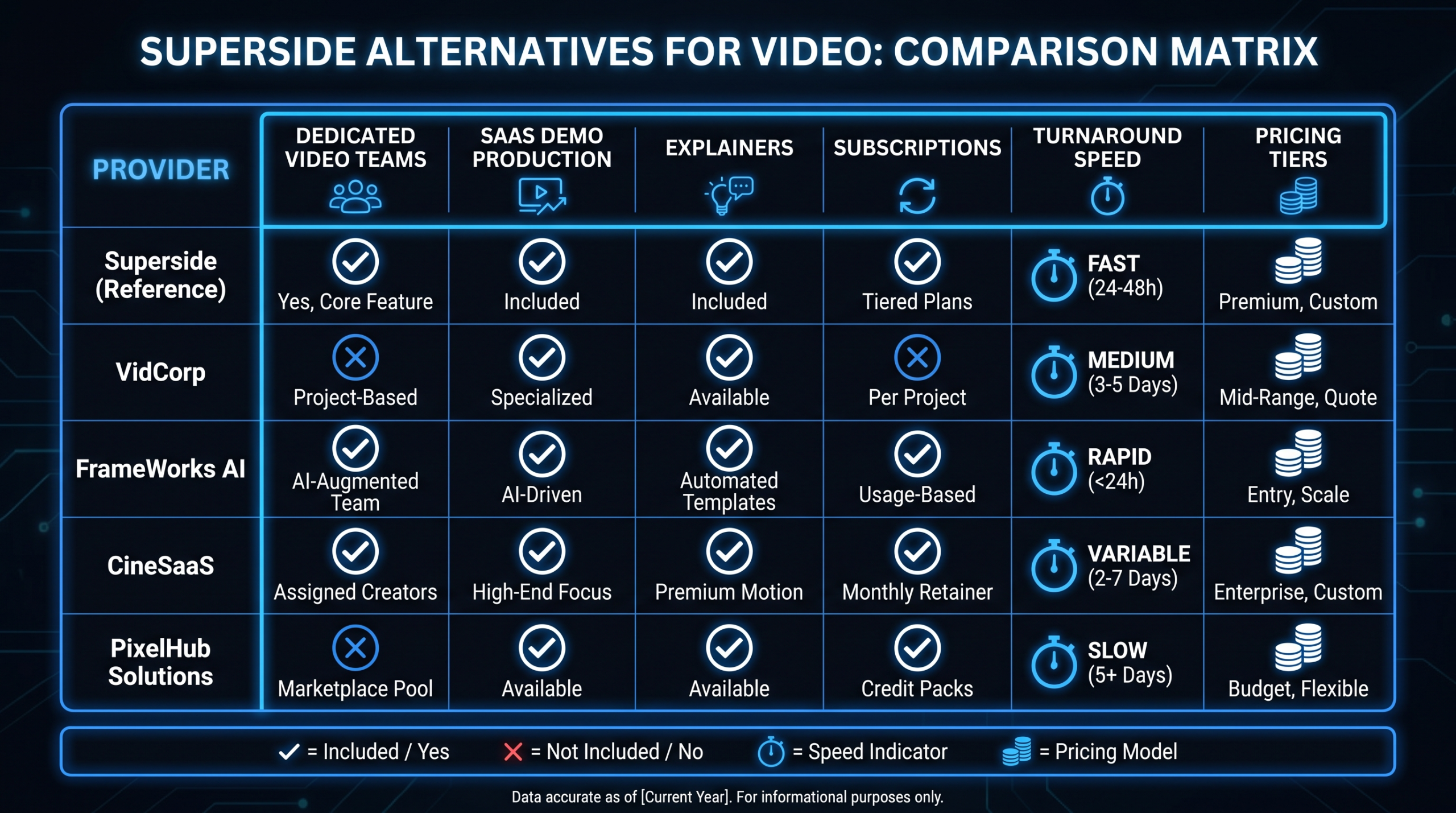
Here's the full side-by-side. Ratings are specifically for SaaS video program fit — not general creative quality.
Superside Alternatives — Side-by-Side Comparison
| Company | Pricing Model | Best For | Turnaround | SaaS Video Fit | ||
|---|---|---|---|---|---|---|
| VEC | Flat retainer ($5K–$16K/mo) | SaaS video programs at scale | 2–5 days | ★★★★★ | ||
| Increditors | Dedicated pod retainer | $2,500–$12,000/mo | Video-first, dedicated team | 3–5 days | ★★★★★ | ★★★★☆ |
| Superside | Subscription ($5K+/mo) | Design-led programs + occasional video | 24–48h (design); variable (video) | ★★★☆☆ | ||
| Vidico | Per project ($8K–$15K+) | Premium launch and brand videos | 4–8 weeks | ★★★★☆ | ||
| Demo Duck | Per project ($5K–$25K+) | Animated explainers | 6–10 weeks | ★★★★☆ | ||
| Sandwich Video | Per project ($25K+) | Flagship brand/launch films | 8–16 weeks | ★★★☆☆ | ||
| Wyzowl | Per project ($3K–$10K) | Budget animated explainers | 4–6 weeks | ★★★☆☆ | ||
| Tasty Edits | Subscription (~$500–$1.5K/mo) | Simple editing subscriptions | 1–3 days | ★★☆☆☆ | ||
| Video Husky | Subscription (~$1K–$2K/mo) | YouTube and thought leadership editing | 2–3 days | ★★☆☆☆ | ||
| Edit Crew | Subscription ($1K–$3K/mo) | Flexible editing + production | 2–5 days | ★★★☆☆ |
Pricing figures are hedged estimates based on publicly available information and may not reflect current rates — verify with each vendor before budgeting. Ratings reflect fit for B2B SaaS video programs specifically, not general creative quality.
Additional Comparison: Subscription vs. Retainer vs. Project-Based
Pricing Model Comparison by Use Case
| Model | Monthly Videos | Best Fit | Weaknesses |
|---|---|---|---|
| Project-based | 1–4/quarter | High-budget one-off or annual launch | Expensive at volume; slow ramp-up |
| Subscription ($1K–$3K) | 4–12 simple videos | YouTube, social, podcast edits | Complexity ceiling; no SaaS specialization |
| Generalist creative sub ($5K+) | Mixed: design-heavy + 2–4 videos | Broad creative needs, occasional video | Design-first; less video depth |
| Dedicated retainer ($5K–$16K) | 6–25+ videos | SaaS video programs at scale | Video-only; minimum commitment |
Decision Framework: When Superside Wins vs. When to Go Video-Specialized
The choice between Superside and a video-specialized partner isn't just about video quality — it's about how video fits into your broader creative program and what your marketing team actually needs to run effectively.
Use Superside (or a similar generalist creative subscription) when:
- You need 30+ pieces of design work per month alongside 2–4 videos and want to consolidate under one vendor
- Your video needs are relatively simple and infrequent — one product explainer per quarter, occasional social clips
- Consolidated vendor management is a priority over maximizing video output quality
- Video is a secondary creative priority — not your primary pipeline or conversion driver
- Your team doesn't have the bandwidth to manage a separate video partner relationship
Use a video-specialized partner (like VEC) when:
- Video production is one of your top two content investments and you expect 6–20+ videos per month
- You need dedicated editors who learn your product's UI, messaging, and brand voice and don't rotate off your account
- You're running active SaaS video programs: product demos, customer stories, feature release videos, onboarding content
- You've tried generalist platforms and hit the ceiling on video quality, turnaround consistency, or product-specific accuracy
- You need a flat, predictable budget with a performance guarantee — not per-project billing or capacity-point accounting
The most common mistake SaaS marketing teams make with creative subscriptions is treating video as a bolt-on feature when it actually requires a dedicated operating model to produce at quality and scale.
A Practical Three-Question Test
If you answer yes to two or more of these, a video-specialized partner will likely serve you better than a generalist creative subscription:
- Do you produce — or want to produce — more than 6 videos per month?
- Do you need editors with deep knowledge of your specific SaaS product?
- Is video directly tied to pipeline generation, trial conversion, or retention metrics?
If your answers lean toward infrequent video needs alongside heavy design demands, Superside or a similar generalist platform may be the right fit. The wrong move is forcing the wrong model on your actual content volume and complexity.
Frequently Asked Questions
Is Superside good for video production?
Superside can handle video — particularly motion graphics and simpler animated content — within their creative subscription. The limitation for SaaS teams is specialization depth: their platform is designed for design breadth, not video depth. If video is your primary deliverable category and you need editors with deep SaaS product knowledge working your account consistently, a video-specialized partner typically delivers better results.
What's a reasonable monthly budget for outsourced SaaS video production?
For ongoing SaaS video programs (6–15 videos/month), retainer-based models typically run $5,000–$16,000/month depending on volume, video complexity, and team configuration. Early-stage companies with simpler needs may find subscription editing services workable at $1,000–$3,000/month — but the complexity ceiling is real. For full plan details, see VEC's pricing page.
How long does it take to get a SaaS product demo video produced?
With a dedicated team on retainer, standard SaaS demo videos — screen recordings with motion graphic overlays and voiceover — typically turn around in 2–5 business days. Project-based agencies (Vidico, Demo Duck) typically run 4–10 weeks. The turnaround difference is structural: retainer teams already know your product and have no onboarding overhead; project agencies restart the learning curve with every new engagement.
Can I use Superside for design and a video specialist for video?
Yes, and some SaaS marketing teams do exactly this: Superside (or a similar platform) handles design-heavy creative needs — ad creative, pitch decks, social graphics — while a video-specialized partner manages the ongoing video program. The vendor management overhead is higher, but both vendors operate within their optimal use cases. For teams producing 10+ videos per month, the quality difference typically justifies the added coordination cost.
What should I look for in a SaaS video partner beyond pricing?
Three factors predict output quality more reliably than portfolio aesthetics alone: (1) Team consistency — do you get the same editors each month, or does the team rotate? (2) SaaS domain knowledge — do they understand your product category, SaaS UI conventions, and the difference between an explainer and a demo? (3) Revision transparency — is the process iterative and collaborative, or does every change trigger a new scope negotiation? These three things determine whether a partner becomes an extension of your team or another vendor to manage.
Ready to See What a Dedicated SaaS Video Team Delivers?
VEC assigns a dedicated senior editor team on day one — SaaS-only focus, flat monthly retainer, 90-day output guarantee. Book a free strategy call to find out whether Growth ($5K/mo), Core ($9.5K/mo), or Scale ($16K/mo) fits your program.
Book a Free Strategy Call View Pricing Plans