Best Product Demo Video Companies in 2026
TL;DR — Quick Verdict
- Best for ongoing SaaS demo programs: Video Editing Company (VEC) — dedicated teams, retainer model from $5K/mo, handles updates as your product ships
- Best premium SaaS studio (project-based): Vidico — polished, strategy-led, $15K–$50K+
- Best animated explainer hybrid: Demo Duck — strong narrative structure, mid-market pricing
- Best for tech launch films: Sandwich Video — cinematic quality, high budget
- Best fixed-scope animated demos: Wyzowl — affordable, reliable, approachable for early-stage teams
- Best for enterprise explainers: Explainify — voice-driven, structured, suited for complex SaaS products
- Best for B2B brand awareness: Umault — bold creative direction, not optimized for feature walkthroughs
Table of Contents
- What Makes a Great Product Demo Video Company?
- How Much Does a Product Demo Video Cost?
- What a Great SaaS Demo Video Actually Achieves
- The 10 Best Product Demo Video Companies in 2026
- #1 Video Editing Company (VEC)
- #2 Increditors
- #3 Vidico
- #4 Demo Duck
- #5 Sandwich Video
- #6 Wyzowl
- #7 Explainify
- #8 Umault
- #9 Yum Yum Videos
- #10 Thinkmojo
- Full Comparison Table
- How to Choose the Right Company
- FAQ
Your product demo video is often the first time a prospect truly understands what you’ve built. For B2B SaaS companies, a demo video placed on a landing page, inside a sales email, or linked from a LinkedIn ad can directly influence whether a deal advances to a call — or disappears into the archive of “not right now.”
The problem: not every video agency is equipped for the specific demands of SaaS demo production. A generalist shop might produce beautiful videos, but they’ll struggle when you need to update a workflow UI after a product sprint, when you need six regional versions of the same demo with different voiceovers, or when your sales team needs a 90-second feature explainer turned around in five days.
This guide reviews the nine best product demo video companies operating in 2026, with honest assessments of who each is right for, transparent pricing ranges (all hedged — you’ll need a written proposal for your actual scope), and a full comparison table so you can shortlist without a dozen discovery calls.
What Makes a Great Product Demo Video Company?
Most video agencies can produce a competent demo. The ones worth hiring for serious SaaS demo programs share four distinguishing traits:
SaaS Domain Expertise
Understanding SaaS products isn’t optional — it’s the foundation of the work. A great demo video company has worked with enough product teams to understand onboarding flows, feature hierarchy, and persona-based scripting. They know why the difference between “this is how it works” and “this is what changes for you” matters enormously in the B2B buying process. Agencies without SaaS experience tend to produce videos that feel like marketing copy read aloud over a screen recording rather than genuine product education that moves prospects through a funnel.
Revision Workflow Built for Product Teams
Product teams are fast. Sprint cycles run two to four weeks. A video studio that routes all feedback through a single account manager and returns revisions in ten business days is structurally incompatible with how SaaS companies operate. The agencies worth hiring have shared editing timelines, Slack or Loom-based async feedback systems, and guaranteed turnaround windows for changes — not “we’ll get to it next week.” Ask specifically how they handle revision requests before signing anything.
Script-to-Publish Support
The best companies don’t just edit footage. They help you develop a script that translates product features into business outcomes, advise on screen recording quality and pacing, handle voiceover casting and direction, apply motion graphics that match your brand system, and deliver in formats ready for web, sales decks, and LinkedIn. End-to-end coverage means fewer handoffs, fewer gaps, and a final asset that actually gets used rather than sitting in a shared drive waiting for one more “quick tweak.”
Update Cycle Capability for Fast-Moving Products
A SaaS demo video that was accurate when you published it may be outdated after two product releases. The best companies build update capacity into their model — either through retainer-based ongoing access to a dedicated editing team, or through a structured “refresh” service for project-based clients. If a vendor treats every UI update as a new project scope requiring a full briefing, estimate, and production cycle, your demo library will stagnate the moment you actually start shipping fast. This is the most underestimated requirement in the vendor selection process.
How Much Does a Product Demo Video Cost?
Pricing varies widely depending on whether you’re hiring for a one-time project or an ongoing program, and whether the vendor is a full-service production studio, a dedicated editing team, or a hybrid model. The ranges below reflect common market positioning as of 2026 — treat them as orientation, not quotes:
Product Demo Video Cost Ranges by Approach
| Approach | Typical Cost (Estimate) | Best For |
|---|---|---|
| DIY-assisted (freelancer + template) | $500–$2,500 per video | Pre-seed / seed teams, tight budgets |
| Mid-market agency (project-based) | $3,000–$15,000 per video | Series A teams, one-time launch demos |
| Premium studio (Vidico, Sandwich, Thinkmojo) | $15,000–$60,000+ per video | Enterprise launches, high-profile product moments |
| Retainer / dedicated team model | $5,000–$20,000/mo | Series B+ with ongoing demo needs, 4+ videos/month |
| Animated explainer (fixed-scope) | $3,000–$12,000 per video | Product concepts, investor decks, top-of-funnel |
For a more detailed breakdown of the cost drivers behind these numbers — length, complexity, voiceover, motion graphics, revision rounds — see our guide to explainer video cost breakdowns and the full product demo video production guide.
All pricing ranges in this guide are estimates based on publicly available information and market norms as of mid-2026. Actual quotes will vary by project scope, complexity, revision count, voiceover requirements, and agency capacity at the time of engagement. Always request a written scope before committing budget.
What a Great SaaS Demo Video Actually Achieves
Before you hire anyone, be precise about what you’re trying to accomplish. A product demo video placed at the right point in the funnel typically serves one of three goals:
- Async qualification — lets prospects self-educate so your sales team has fewer 30-minute “how does this work?” calls before a real conversation can happen
- Pipeline acceleration — shortens the time from marketing qualified lead to booked demo by giving prospects a visual proof point before the live call
- Post-call reinforcement — gives sales reps a shareable asset that keeps your product top of mind in the window between the discovery call and the purchase decision
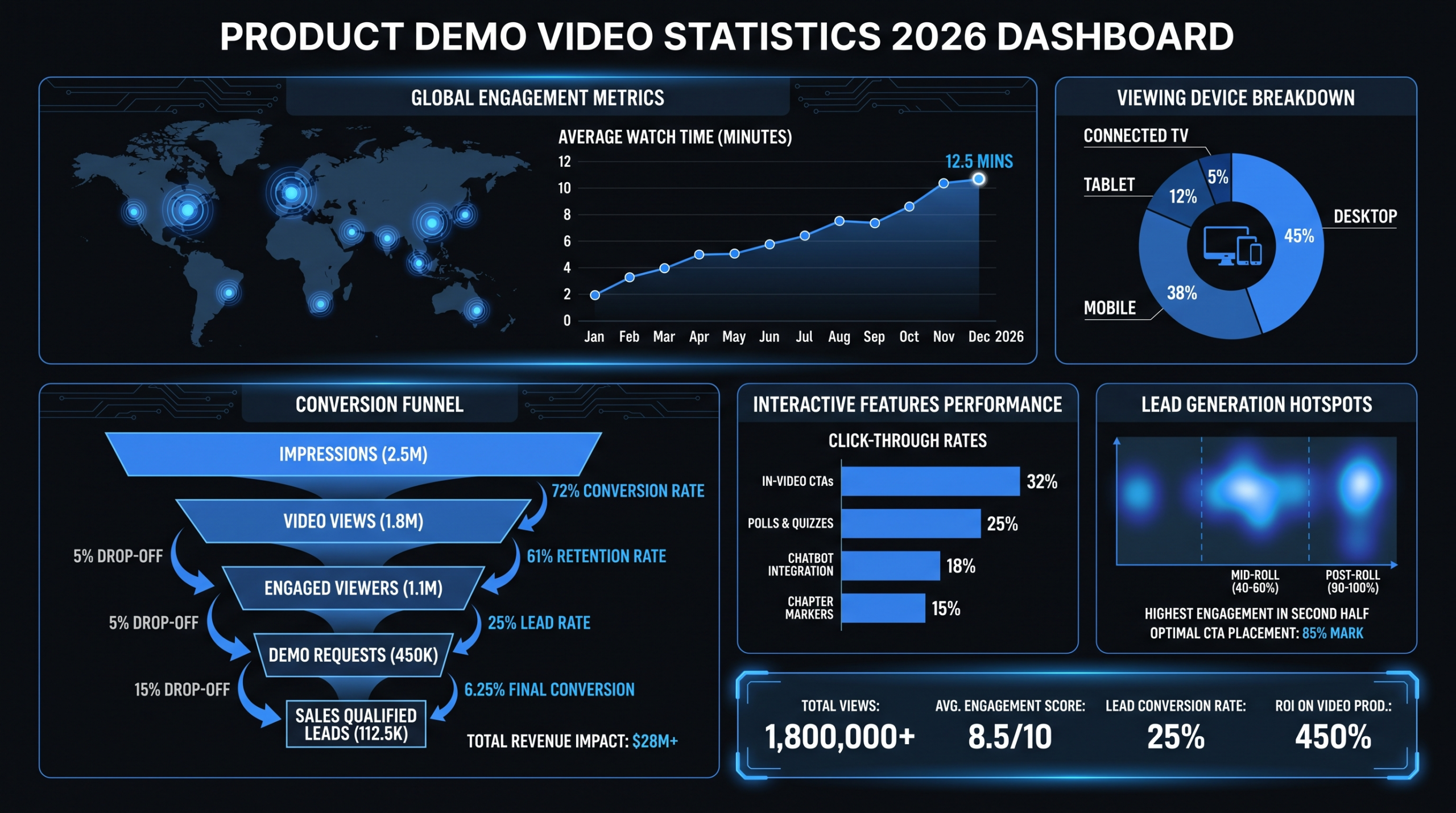
Research published by Wistia on video engagement patterns suggests that completion rates drop noticeably after the two-minute mark for most marketing videos — a useful benchmark for scoping demo length. For SaaS demos specifically, teams commonly report that a two-to-three-minute walkthrough performs better than a full five-plus-minute feature tour for top-of-funnel placement, while longer chapter-based demos tend to hold attention on embedded product pages where intent is already high.
Wyzowl’s annual State of Video Marketing report consistently shows that a significant majority of B2B buyers watch a vendor’s video before making a purchase decision — making demo video not a “nice to have” but a conversion asset that belongs alongside pricing pages and case studies in your sales infrastructure. Teams that treat their demo video library as a living content program — updating it when the product ships, versioning it by persona, and measuring completion rather than just views — typically see stronger pipeline influence than teams that produce one hero demo and call it done.
The 10 Best Product Demo Video Companies in 2026
1. Video Editing Company (VEC) — Best for Ongoing SaaS Demo Programs
VEC is a dedicated video team provider built specifically for B2B SaaS marketing organizations. Unlike project-based studios, VEC operates on a retainer model where you get an assigned team of senior editors and a project manager who stay with your account, learn your product inside out, and handle ongoing demo updates as your software ships new features.
Plans start at $5,000/mo (Growth tier) and scale through Core ($9,500/mo) and Scale ($16,000/mo). Every plan carries a clear guarantee: double your video output within 90 days, or your fourth month is free. For Series B+ SaaS companies publishing demo videos, feature explainers, and product update walkthroughs on a recurring basis, the dedicated team model eliminates the ramp-up cost of re-onboarding a new agency every time you need a revision or a new format.
VEC handles the full production chain: screen recording quality review, script development, motion graphics, voiceover sourcing and direction, captions, and delivery in multiple formats for web, LinkedIn, and sales decks. Because the same team touches every asset in your library, brand consistency compounds over time rather than degrading with each new project engagement.
Pricing: From $5,000/mo (retainer, no per-video fees)
Best for: SaaS teams producing four or more demo videos per month; companies with frequent product updates; teams that want one consistent creative partner for their entire video program
Not ideal for: One-off launch videos where you won’t need ongoing updates or multiple asset types
See how the model works at videoeditingcompany.com/how-it-works, or review plan details at the VEC pricing page.
2. Increditors — Best Premium Full-Service Video Editing Team
Increditors is a full-service video editing agency operating on a dedicated pod model — each client gets a senior editor, junior editor, project manager, and creative director assigned as a coordinated team. Unlike subscription queues where editors rotate between clients, your Increditors pod stays with your account, building deep product and brand familiarity over time.
The agency serves YouTube creators, SaaS companies, finance brands, and education clients. Their documented strength is in driving channel growth: clients report doubled views and improved audience retention after moving to a dedicated pod structure. For SaaS teams that produce demo programs alongside a broader content calendar, the combination of dedicated creative direction and execution capacity is a meaningful differentiator over project-based studios that require full re-onboarding with each engagement.
Increditors is not a pure-play animated explainer studio — their strength is in footage-based editing, screen recording work, and branded visual production rather than motion-graphics-first animation. Teams whose entire demo library is animated may find specialist animation studios a better fit. But for ongoing SaaS demo programs that blend screen walkthroughs, talking-head content, and multi-format delivery, the pod model competes well with both retainer services and project studios.
Pricing: Custom retainers typically $2,500–$12,000/month (estimate; requires scoped proposal)
Best for: SaaS companies and content-driven teams that need a consistent premium editing pod; YouTube channels tracking retention and growth metrics
Not ideal for: One-off animated explainer projects, teams needing instant self-serve pricing transparency, or companies whose output is primarily motion-graphics-only animation
Learn more at increditors.com.
3. Vidico — Best Premium SaaS Demo Studio
Vidico is an Australian-founded video production studio with a strong focus on SaaS and technology companies. They’ve produced work for brands including enterprise and growth-stage SaaS clients, and their production quality is genuinely premium — strong motion design, professional voiceover direction, and scripts that translate feature lists into business-outcome narratives rather than feature tours.
Vidico works project-by-project. Pricing is not publicly listed at a standard rate; based on market positioning and various industry sources, engagements commonly start in the $10,000–$15,000 range for simpler projects and scale significantly from there for complex or multi-video work. They include a brief-and-concept phase before full production begins, which adds time to the process but reduces expensive revision cycles later.
The tradeoff is operational: Vidico is not designed for ongoing update cycles or high-frequency demo production. Each project is scoped and staffed independently, which means there is a ramp-up period with each new engagement as the team relearns your product and brand.
Pricing: Typically $15,000–$50,000+ per project (estimate; contact for quote)
Best for: Launch demos for enterprise or high-profile products where production quality is a brand signal; teams that need a single, polished hero demo for a major product launch
Not ideal for: Ongoing update programs, high-volume demo libraries, or teams with budgets under $10K per video
4. Demo Duck — Best for Explainer-Style Demo Animation
Demo Duck is a Chicago-based studio that has been producing explainer and demo videos since 2011. Their specialty is the hybrid format: narrative-driven animated videos that explain how a product works while simultaneously making the case for why it matters to the viewer’s specific context. They’re recognized for strong scriptwriting and illustration styles that work well for SaaS products with abstract or complex value propositions that don’t photograph well.
Demo Duck is a good fit when you want a demo that reads more like a polished brand-animated explainer than a screen recording walkthrough — particularly useful for top-of-funnel placement where communicating the problem and the solution matters more than showing the exact UI flow. For UI-forward walkthroughs where showing the actual product interface is the goal, their animation approach may work against you.
Pricing: Typically $8,000–$30,000 per video (estimate; varies by length, animation style, and complexity)
Best for: Animated product explainers, concept-level demos, teams with strong creative briefs and a clear narrative angle
Not ideal for: UI walkthrough demos, fast-turnaround requests, high-volume programs requiring multiple asset versions
5. Sandwich Video — Best for High-Production Tech Launch Films
Sandwich Video is one of the most recognized names in tech product video. Based in Los Angeles, they specialize in live-action and mixed-format launch films — the kind of video you’d feature on a homepage redesign, announce at a user conference, or run as a paid media hero asset during a major product moment. Their production values are distinctly cinematic, and their work for early-stage and growth-stage tech companies has defined the visual language of tech product videos for much of the past decade.
Sandwich is not the right vendor for a standard SaaS demo. Their work skews toward brand storytelling and product narratives rather than feature walkthroughs or sales enablement videos. If you’re launching a major product rebrand, releasing a flagship feature that warrants a cinematic launch film, or running a campaign where emotional resonance matters as much as product comprehension, they’re worth the budget. For ongoing demo production at any reasonable volume, they are overengineered and overpriced.
Pricing: Typically $30,000–$100,000+ per project (estimate; no public pricing)
Best for: High-visibility product launches, homepage hero videos, brand narrative films for funded tech companies
Not ideal for: Routine demo production, feature explainers, update walkthroughs, or budget-constrained teams
6. Wyzowl — Best for Fixed-Scope Animated Demos
Wyzowl is a UK-based animated video company known for offering clear, fixed-scope packages at relatively accessible price points. They publish the State of Video Marketing report annually — one of the most widely cited datasets in B2B video marketing — which reflects their depth of familiarity with how buyers actually use video in purchase decisions.
Their animated demo and explainer packages are designed to be straightforward: a defined script length, a defined revision count, and a clear production timeline. For Series A teams that need a professional animated demo without navigating a complex agency engagement, Wyzowl is a sensible starting point. The tradeoff is that their style library is extensive but not deeply bespoke — expect polished and professional output rather than highly differentiated creative work. For teams that need a custom illustration style or complex motion design, they may feel constrained.
Pricing: Typically $3,000–$10,000 per video depending on length and complexity (estimate)
Best for: Early-stage or Series A teams needing a first animated demo; fixed-budget projects; straightforward product concepts with a clear problem-solution narrative
Not ideal for: Complex UI demos, live-action production, ongoing high-volume programs
7. Explainify — Best for Enterprise Voice-Driven Explainers
Explainify is an Arkansas-based studio focused on strategic explainer videos for B2B and enterprise clients. Their distinguishing approach is a strong investment in messaging and narrative architecture before production begins — they spend significant time in the script and positioning phase, which makes them well-suited for companies whose product is technically complex or whose buying process involves multiple stakeholders with different levels of product sophistication.
Their videos tend to be voiceover-led with clean motion graphics rather than UI-forward screen walkthroughs. This approach works well for products where the concept needs to be clearly understood before the interface is shown — common in compliance technology, data infrastructure platforms, and enterprise SaaS with long implementation cycles. If your primary challenge is “prospects don’t understand what we do,” Explainify is worth evaluating. If your challenge is “prospects understand what we do but need to see it working,” a UI-forward vendor will serve you better.
Pricing: Typically $8,000–$25,000 per video (estimate)
Best for: Enterprise SaaS with complex or abstract value propositions; products where narrative clarity matters more than UI walkthrough; companies with longer B2B sales cycles
Not ideal for: Fast-moving product updates, high-volume programs, or demos that must show the actual interface in detail
8. Umault — Best for B2B Brand Awareness Films
Umault is a Chicago-based B2B video agency known for bold, opinion-driven creative work. Their portfolio includes high-production brand films for SaaS and B2B tech companies — the kind of video content that generates LinkedIn shares, builds brand recall, and positions a company as a category leader rather than directly demonstrating product functionality.
Be clear about the distinction: Umault produces brand awareness and thought leadership content, not product demos. If you’re looking to build category authority, introduce a company rebrand, or create a video that earns attention at the top of the funnel before anyone knows what your product does, they’re an excellent and differentiated choice. If you need a VP of Engineering to understand how your data pipeline works or a sales prospect to follow a specific onboarding workflow, send them to a different vendor. Umault’s creative direction is intentionally bold and sometimes abstract — that works for brand awareness campaigns and actively works against feature comprehension.
Pricing: Typically $20,000–$60,000+ per project (estimate)
Best for: B2B brand films, thought leadership video series, awareness-stage content for companies building category leadership
Not ideal for: Product demos, feature explainers, sales enablement content, or teams needing clear feature comprehension
9. Yum Yum Videos — Best for Affordable Animated Demos
Yum Yum Videos is an Argentine animated video studio serving English-speaking markets primarily in North America and Europe. They produce explainer videos, animated product demos, and product overview content at price points more accessible than most US or UK-based studios, while maintaining consistent animation quality across a broad client base. Their portfolio spans B2B SaaS, healthcare technology, and financial services.
For Series A or bootstrapped SaaS companies that need a professional animated product demo but can’t yet justify $15,000 or more for a single asset, Yum Yum Videos represents a strong cost-to-quality ratio. Expect clean two-dimensional animation, professional voiceover, and a structured production process with clear milestones. Creative flexibility may be more limited than with boutique studios, and turnaround on revisions can vary depending on project load — worth confirming during the briefing phase.
Pricing: Typically $4,000–$12,000 per video (estimate)
Best for: Cost-conscious teams needing a professional animated demo; early-stage companies; straightforward product overviews
Not ideal for: Highly customized creative directions, UI-forward walkthroughs, or ongoing editing programs
10. Thinkmojo — Best for Strategic SaaS Storytelling
Thinkmojo is a San Francisco-based video agency that positions itself at the intersection of brand strategy and video production. They work with technology companies on product launches, brand films, and internal communications content, and are known for a strategy-first process that goes deeper than most agencies into positioning, messaging, and narrative architecture before a single frame is produced.
Their sweet spot is companies preparing for a significant product launch or brand evolution where getting the narrative right matters as much as the visual execution. They operate best when given creative latitude and a clear strategic challenge rather than a detailed production brief. For ongoing demo programs, feature update videos, or high-frequency asset production, they are not the right operational fit — but for a high-stakes single asset where both strategy and craft need to be exceptional, they are worth evaluating.
Pricing: Typically $20,000–$80,000+ per project (estimate)
Best for: Strategic product launches, company narrative films, teams that need deep creative and messaging partnership for a significant market moment
Not ideal for: Volume production, fast-turnaround updates, or price-sensitive engagements
Full Comparison Table
Here’s how all nine companies compare across the dimensions that matter most for B2B SaaS demo video buying decisions:
Product Demo Video Companies — Full Comparison (2026)
| Company | Model | Pricing (est.) | SaaS Focus | Update Cycle | Best For |
|---|---|---|---|---|---|
| Video Editing Company (VEC) | Dedicated retainer | From $5K/mo | ★★★★★ | Ongoing (built-in) | Ongoing programs, Series B+ |
| Increditors | Dedicated pod retainer | $2,500–$12,000/mo | ★★★★☆ | Ongoing (built-in) | Premium editing, creators & SaaS |
| Vidico | Project-based | $15K–$50K+ | ★★★★★ | New project required | Premium launch demos |
| Demo Duck | Project-based | $8K–$30K | ★★★☆☆ | New project required | Animated explainer demos |
| Sandwich Video | Project-based | $30K–$100K+ | ★★★☆☆ | New project required | Tech launch films |
| Wyzowl | Fixed-scope packages | $3K–$10K | ★★★☆☆ | New project required | Affordable animated demos |
| Explainify | Project-based | $8K–$25K | ★★★★☆ | New project required | Enterprise, complex products |
| Umault | Project-based | $20K–$60K+ | ★★☆☆☆ | New project required | Brand awareness films |
| Yum Yum Videos | Project-based | $4K–$12K | ★★★☆☆ | New project required | Affordable animated demos |
| Thinkmojo | Project-based | $20K–$80K+ | ★★★★☆ | New project required | Strategic launch narratives |
All pricing is estimated based on publicly available information and market positioning as of mid-2026. Ranges will vary by project scope, complexity, revision count, voiceover requirements, and agency capacity. Always request a written proposal before committing budget.
Specialization by Demo Video Type
| Company | UI Walkthroughs | Animated Explainers | Sales Enablement | Launch Films | Ongoing Updates |
|---|---|---|---|---|---|
| VEC | ★★★★★ | ★★★★☆ | ★★★★★ | ★★★☆☆ | ★★★★★ |
| Increditors | ★★★★☆ | ★★★☆☆ | ★★★★☆ | ★★★☆☆ | ★★★★☆ |
| Vidico | ★★★★★ | ★★★★★ | ★★★★☆ | ★★★★☆ | ★★☆☆☆ |
| Demo Duck | ★★★☆☆ | ★★★★★ | ★★★★☆ | ★★★☆☆ | ★★☆☆☆ |
| Sandwich Video | ★★☆☆☆ | ★★★☆☆ | ★★★☆☆ | ★★★★★ | ★☆☆☆☆ |
| Wyzowl | ★★★☆☆ | ★★★★☆ | ★★★☆☆ | ★★☆☆☆ | ★★☆☆☆ |
| Explainify | ★★★☆☆ | ★★★★☆ | ★★★★☆ | ★★★☆☆ | ★★☆☆☆ |
| Umault | ★★☆☆☆ | ★★★☆☆ | ★★★☆☆ | ★★★★★ | ★☆☆☆☆ |
| Yum Yum Videos | ★★★☆☆ | ★★★★☆ | ★★★☆☆ | ★★☆☆☆ | ★★☆☆☆ |
| Thinkmojo | ★★★★☆ | ★★★☆☆ | ★★★★☆ | ★★★★★ | ★★☆☆☆ |
How to Choose the Right Product Demo Video Company
Use these decision filters in sequence. The first filter that narrows your shortlist significantly is almost always the right starting point for your situation:
Filter 1: Volume and Cadence
If you produce four or more demo or feature videos per month — or expect to within the next quarter as your team scales — a project-based vendor will cost you significantly more per asset than a retainer or dedicated team arrangement. Calculate your expected monthly output over a six-month horizon before pricing out project-based agencies. The math usually resolves the question quickly.
For a detailed comparison of how different video production models stack up at different output volumes, read our guide on SaaS video production models.
Filter 2: Video Format
Are you primarily producing UI walkthrough and screen recording demos — common for mid-market SaaS sales where prospects need to see the product operating before a call? Or are you producing animated product overviews that communicate the concept without showing the interface? These are fundamentally different production disciplines. Most studios are genuinely better at one than the other. Clarify this before shortlisting.
Filter 3: Update Frequency
If your product ships on a two-to-four-week sprint cycle and your demo videos need to stay current, you need a partner that handles updates without treating every change as a new project scope. This is the most commonly underestimated selection criterion in demo video buying decisions — and the one where dedicated team models like VEC structurally outperform project-based studios. A project studio that needs to re-onboard, re-scope, and re-brief for every UI update will always be a sprint behind.
Filter 4: Budget and Pipeline Math
Be honest about what a single demo asset is worth to your pipeline. A demo video that closes one additional $50,000 ARR deal pays for a premium studio engagement. A demo video that helps qualify 200 inbound leads per month generates ongoing value that justifies a retainer investment. Price-per-video is not the right metric — pipeline influence per dollar spent is. Teams that frame the decision this way almost always invest at a higher level than teams that compare sticker prices.
Filter 5: Creative Involvement Available
Some SaaS teams have strong internal creative direction — a Head of Brand or Creative Director who can brief an agency with precision. Others need the agency to take full ownership of narrative structure, script development, and visual language. Be honest about how much creative input your team can realistically sustain. Agencies like Vidico and Thinkmojo perform best when you give them strategic latitude. VEC’s dedicated team model is built to work tightly within existing brand guidelines and internal workflows — they adapt to your process, not the other way around.
If you’re working through this decision and want to understand how a VEC engagement compares to your current per-project spend, the pricing page lays out the numbers clearly before any call is required.
Frequently Asked Questions
How long should a B2B SaaS product demo video be?
For top-of-funnel placement — landing pages, LinkedIn ads, and outbound sales emails — teams commonly find that 90 seconds to two and a half minutes performs well. Attention drops noticeably after the two-minute mark for cold audiences. For embedded demos on pricing or product pages where intent is high, three to five minutes is generally acceptable. Chapter-based interactive demos are gaining traction for enterprise buyers with specific evaluation criteria, allowing them to navigate directly to the features most relevant to their role. Keep landing page demos under two minutes if you can; trim ruthlessly for awareness-stage placements.
What’s the difference between a product demo video and an explainer video?
An explainer video communicates the problem your product solves and why it matters — often without showing the product interface at all. A product demo video shows how the product actually works, through screen recordings, UI walkthroughs, or scripted feature tours. The two formats serve different buyers at different stages. Explainers work better for awareness and brand introduction; demos work better for evaluation and purchase-stage qualification. Most SaaS companies need both, and the best vendors can produce both formats within the same engagement.
How do product demo video companies handle product updates?
Project-based studios typically treat each update as a new scope: you submit a change request, receive an estimate, approve, and wait for the revised version. This works for infrequent updates but becomes expensive and slow for products shipping every sprint. Retainer and dedicated team models handle updates as part of the ongoing engagement — the team already knows the product, has the source files, and can turn around UI updates in days rather than weeks. For companies on active shipping cycles, update workflow is one of the most important vendor selection criteria and one of the most commonly overlooked.
Should we use screen recordings, animation, or live action for our SaaS demo?
Most effective SaaS demo videos in 2026 combine approaches: polished screen recordings (not raw Loom captures) with motion graphics overlays to highlight key actions, paired with professional voiceover and optional contextual B-roll. Pure live-action demos age quickly as UI updates. Pure animation works well for concept-level explainers but can feel disconnected from the actual product experience for late-stage buyers. Pure screen recordings without motion design and professional audio tend to underperform against polished hybrid formats. The right mix depends on your product’s visual complexity and your audience’s evaluation sophistication — a good agency will guide you on this during the brief phase.
How many demo videos does a typical Series B SaaS company actually need?
More than most teams initially budget for. A reasonably complete demo video library for a Series B company typically includes: one homepage hero demo (approximately two minutes, broad audience), two to four feature-specific demos for key use cases, persona-based versions for technical vs. business buyers, and sales enablement clips for common objection-handling moments. If you’re expanding internationally, language and regional versions add to that count. That’s commonly eight to fifteen distinct assets — all of which require updating when the product ships new features. This volume math is why many Series B marketing teams move to a retainer-based production model rather than managing individual project engagements with multiple agencies.
Ready to Scale Your SaaS Demo Video Program?
VEC’s dedicated editor teams handle your full demo video library — from initial production through ongoing updates — on a flat monthly retainer. No per-video fees. No re-onboarding a new agency every sprint. Just a senior team that knows your product and keeps your demos current as you ship.
Book a Free Strategy Call View Plans & Pricing