
Video A/B Testing: What to Test and How to Measure Results
You published a product demo video. It got 2,400 views and a 1.8% conversion rate. Is that good? Bad? Could it be better? Without video A/B testing, you're guessing. And in B2B SaaS, where a single converted viewer can be worth $50,000+ in annual contract value, even a small improvement in video performance compounds into massive revenue impact.
Video A/B testing is one of the most underused optimization tactics in B2B marketing. Most companies test their landing page headlines, email subject lines, and ad copy religiously — but never touch their videos. They publish one version and hope for the best. That's leaving measurable improvement on the table.
This guide covers what to test in your videos, how to set up valid tests, which metrics to measure, and the specific frameworks that B2B SaaS teams use to systematically improve video performance over time.
Table of Contents
Why A/B Test Videos? (The Revenue Case)
Consider this scenario: your product demo video lives on a landing page that gets 5,000 visitors/month. The current video drives a 2% demo request rate (100 demos/month). Through A/B testing, you improve the video's performance to 2.8%. That's 40 additional demo requests per month. At a 20% close rate and $30K ACV, that's $240K in additional annual pipeline — from testing one video element.
Most marketing teams would happily run 50 landing page tests to achieve that kind of improvement. Yet they publish their video once and never iterate. Video A/B testing is high-leverage work because video sits at critical conversion points: landing pages, email campaigns, YouTube discovery, and sales enablement.
The 10 Elements You Can A/B Test in Video
Not every element is equally worth testing. Here they are, ranked by typical impact on performance:
Video A/B Testing Priority Matrix
1. Thumbnail (Highest Impact for YouTube/Social)
Your thumbnail determines click-through rate, which determines how many people see your video at all. Test different text overlays, colors, facial expressions, and image compositions. YouTube now offers built-in thumbnail A/B testing — use it for every video.
2. Opening Hook (First 5 Seconds)
The first 5 seconds determine whether viewers stay or leave. Test different opening approaches: start with a question, a surprising stat, a bold claim, or jump directly into the content versus using a branded intro. Data consistently shows that cold-opening (no intro animation) retains 15-25% more viewers in the first 30 seconds.
3. CTA Placement & Copy
Test CTA timing (beginning, middle, end, or multiple), CTA copy ("Book a demo" vs "See it in action" vs "Start your free trial"), and CTA format (verbal mention, on-screen text, clickable end screen, or pinned comment).
4. Video Length
Test a 2-minute version against a 5-minute version of the same content. For landing page videos, shorter often wins. For YouTube search, longer (8-15 minutes) often ranks better. The optimal length depends on where the video lives and what action you want viewers to take.
5. Speaker/Presenter
Test different presenters: founder vs. product manager vs. customer success lead. Different speakers resonate differently with different audiences. A VP of Marketing might connect better with a peer-level speaker than with a junior team member.
6-10. Secondary Elements
- Background music vs. none: Music can improve perceived quality or distract from the message
- Pacing: Fast-cut editing vs. longer takes; jump cuts vs. smooth transitions
- Format: Screen recording vs. talking head vs. animated vs. mixed
- Animation style: Minimal motion graphics vs. full animation
- Subtitles: Subtitles on vs. off (spoiler: subtitles almost always win)
The Video Testing Framework
Use the ICE framework to prioritize which tests to run first:
- Impact: How much could this test improve performance? (1-10)
- Confidence: How confident are you that this change will make a difference? (1-10)
- Ease: How easy is it to create the test variant? (1-10)
Score each potential test and run the highest-scoring ones first. Thumbnail tests always score high (high impact, high confidence, easy to create). Full re-shoots score lower (high impact but hard to execute).
Test One Element at a Time
The cardinal rule: change only one variable per test. If you test a new thumbnail AND a new opening hook simultaneously, you can't attribute any performance change to either element specifically. Isolate variables for clean data.
The Test-Learn-Iterate Cycle
- Hypothesize: "Changing the thumbnail from a product screenshot to a face with text overlay will increase CTR by 20%"
- Create variants: Produce Version A (control) and Version B (variant)
- Run the test: Split traffic equally between variants for a defined period
- Measure: Track the specific metric your hypothesis targets
- Decide: If statistically significant, implement the winner. If not, run longer or test a different hypothesis.
- Document: Record results in a testing log for team knowledge
Platform-Specific Testing Methods
YouTube: Thumbnail A/B Testing
YouTube's built-in "Test & Compare" feature lets you upload 2-3 thumbnail variants. YouTube automatically splits traffic and declares a winner based on watch time share (not just CTR, which prevents clickbait from winning). Results typically take 2-4 weeks depending on your traffic volume.
Landing Pages: Video Variant Testing
Use your A/B testing platform (VWO, Optimizely, Google Optimize) to serve different video embeds to different visitors. Test different videos on the same page, or the same video with different surrounding copy/placement. Track conversion rate (demo requests, sign-ups) as the primary metric.
Video Ads: Platform-Native Testing
Facebook/Meta, LinkedIn, and YouTube Ads all support creative testing natively. Upload multiple video variants as separate creatives within the same ad set. The platform's algorithm will optimize delivery toward the best performer. Minimum budget: $500-1,000 per variant to achieve statistical significance within 2 weeks.
Email: Video Thumbnail Testing
A/B test the video thumbnail image in your emails. Test: animated GIF vs. static image, different frames from the video, with or without play button overlay. Measure click-through rate on the video link. Most email platforms (HubSpot, Mailchimp, ActiveCampaign) support A/B testing natively.
Metrics to Track for Each Test
| TEST ELEMENT | PRIMARY METRIC | SECONDARY METRICS |
|---|---|---|
| Thumbnail | Click-through rate (CTR) | Watch time share, impression count |
| Opening hook | 30-second retention rate | Overall avg view duration, drop-off point |
| CTA placement | Conversion rate / click rate | Watch-through rate, engagement rate |
| Video length | Avg view duration (absolute) | Conversion rate, bounce rate |
| Speaker | Avg view duration + completion | Engagement (comments), sentiment |
| Subtitles on/off | Avg view duration | Watch completion %, mobile vs desktop |
| Landing page video | Page conversion rate | Time on page, bounce rate, scroll depth |
| Ad creative | Cost per acquisition (CPA) | CTR, view rate, cost per view |
Sample Size & Statistical Significance
The biggest mistake in video A/B testing: calling a winner too early. A 5% CTR difference after 200 views is noise, not signal.
• YouTube thumbnail tests: 10,000+ impressions per variant (YouTube handles this automatically)
• Landing page video tests: 1,000+ visitors per variant minimum
• Video ad tests: $500+ spend per variant or 5,000+ impressions
• Email video tests: 2,000+ recipients per variant
Target significance level: 95% (p < 0.05). Use a free calculator like Evan Miller's A/B test calculator to check significance before declaring winners.
Test Examples With Real Impact
Example 1: Thumbnail Test — Face vs Product Screenshot
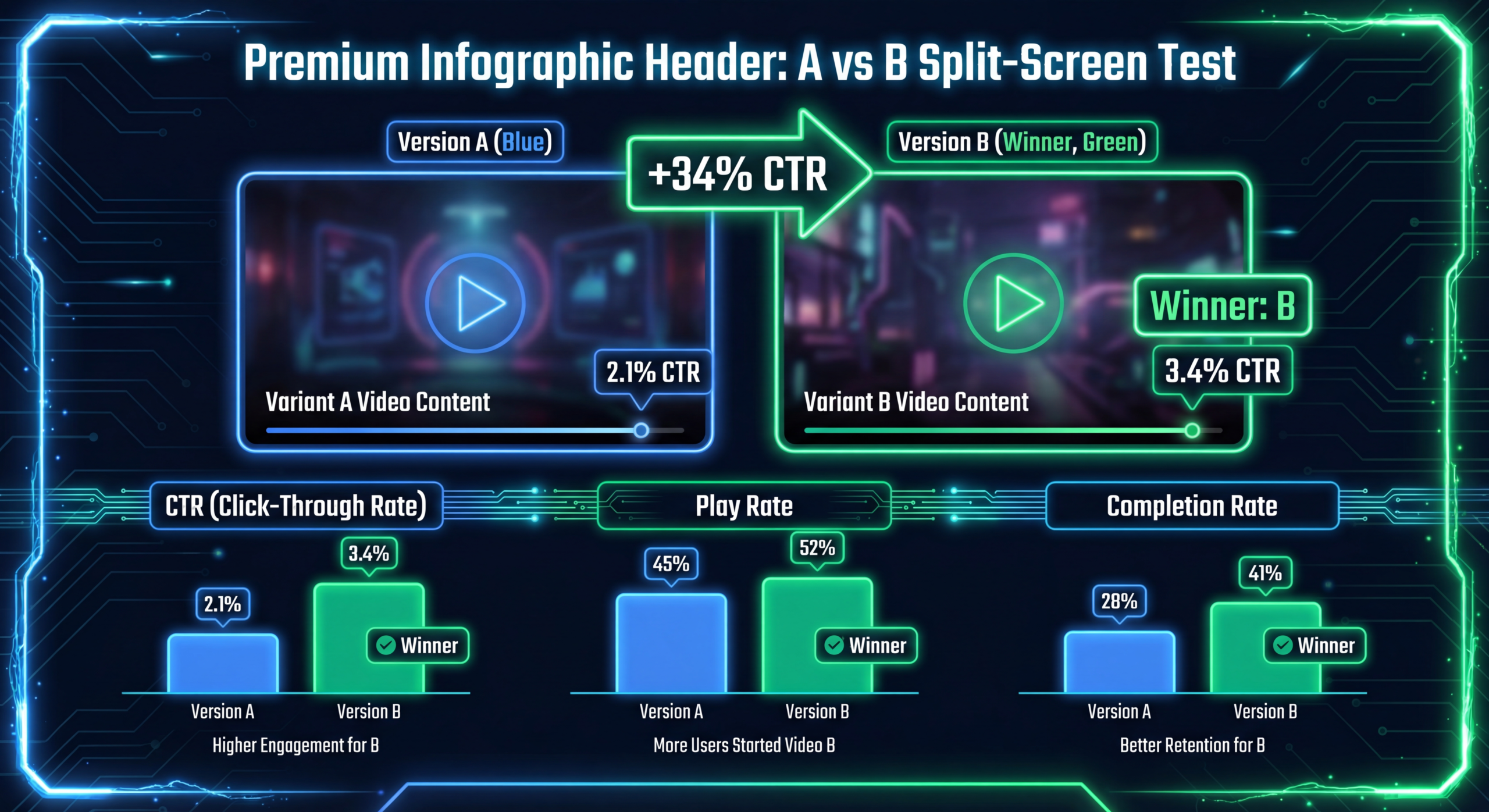
A SaaS company tested their product demo thumbnail: Version A showed a clean dashboard screenshot. Version B showed the founder's face with text overlay "I'll show you how this works in 3 minutes." Result: Version B increased CTR by 34% and watch time by 22%. People click on faces more than product screenshots.
Example 2: Opening Hook Test — Problem vs Solution
Version A opened with: "Let me show you our analytics dashboard." Version B opened with: "Most SaaS marketing teams waste 12 hours per week on manual reporting." Result: Version B improved 30-second retention by 41%. Problem-first hooks outperform product-first hooks consistently.
Example 3: Video Length on Landing Page
A SaaS landing page tested a 90-second explainer vs a 3-minute detailed walkthrough. Result: The 90-second version increased demo requests by 23%. On landing pages, shorter wins. On YouTube, the 3-minute version would likely rank better due to higher total watch time.
Example 4: CTA Timing in Product Demo
Tested CTA at the end only vs CTA at 60% mark + end. Result: Mid-video CTA generated 2.1x more clicks than end-only CTA. Most viewers don't watch to the end — if your only CTA is at 100% completion, you're missing the majority of viewers.
Tools for Video A/B Testing
| TOOL | BEST FOR | PRICE |
|---|---|---|
| YouTube Test & Compare | Thumbnail A/B testing on YouTube | Free (built-in) |
| Wistia | On-site video analytics + heatmaps | $19+/month |
| Vidyard | Sales video performance + A/B testing | $59+/month |
| VWO / Optimizely | Landing page video variant testing | $99+/month |
| TubeBuddy | YouTube thumbnail A/B testing + analytics | $7.50+/month |
| Google Ads | Video ad creative testing | Ad spend only |
Need Multiple Video Variants for Testing?
We produce A and B versions of your key videos — different hooks, lengths, CTAs, and speakers — so you can test and optimize with real data. Our dedicated teams make variant production fast and cost-effective.
Book a Free Strategy Call See PricingFrequently Asked Questions
Is video A/B testing worth it for small B2B channels?
Yes, but focus on high-traffic touchpoints first. Test your landing page video (where every visitor sees it) before testing YouTube thumbnails (where you need higher volume for significance). Even channels with 500 monthly visitors can get meaningful results from landing page video tests within 4-6 weeks.
How often should I run video A/B tests?
Aim for one active test at all times. Run tests in 2-4 week cycles. When one test concludes, start the next. Over a quarter, you'll complete 3-6 tests — enough to meaningfully improve your video performance across key touchpoints.
What's the first test I should run?
Test your highest-traffic video's thumbnail or opening hook. These two elements have the most impact on whether people watch your video at all. A 20% improvement in thumbnail CTR or opening retention cascades into better performance for every downstream metric.
Can I A/B test on YouTube without paying for tools?
Yes. YouTube's native "Test & Compare" feature is free and handles thumbnail A/B testing automatically. For other elements (titles, descriptions), you can manually test by changing them for 2-week periods and comparing analytics. It's less rigorous than simultaneous testing but still provides useful data.
Should I A/B test ads or organic videos first?
Test ads first if you're running paid campaigns — the data comes faster due to higher traffic volumes, and the ROI impact is more directly measurable. Then apply learnings to organic videos. For example, if a problem-first hook wins in ads, use that approach for your organic YouTube content too.
How do I build a culture of video testing on my team?
Start a shared testing log (Notion, Google Sheet) where every test hypothesis, result, and learning is documented. Share results in weekly marketing meetings. Celebrate both wins and learnings from failed tests. When the team sees data proving that a thumbnail change drove 30% more views, testing becomes self-reinforcing.
🎬 SaaS Video Swipe File
See 50+ examples of high-performing SaaS videos with detailed breakdowns of what makes them work — thumbnails, hooks, CTAs, and formats you can test for your own content.
Download the Free Swipe File →Stop Guessing. Start Testing.
Every video you publish without testing is a missed optimization opportunity. The math is simple: a 20% improvement on a video that drives 100 monthly conversions adds 20 additional conversions. At B2B SaaS deal sizes, that's hundreds of thousands in pipeline from a single test.
Start with your highest-stakes video — the one on your main landing page or your most-viewed YouTube video. Test the thumbnail. Test the opening hook. Let data tell you what works instead of guessing. Then apply those learnings to every video you produce going forward.
Need multiple video variants for testing? See how our dedicated teams work or check our pricing to learn about our production process.

