YouTube for B2B SaaS: Search-First Channel Growth
TL;DR
- YouTube is the world's second-largest search engine — and B2B SaaS teams are leaving compounding organic traffic on the table by treating it as a social channel.
- A search-first strategy means building video content around buyer intent keywords, not trending topics or distribution volume.
- The highest-ROI video types for B2B SaaS are: comparison videos, tutorial/how-to content, and product demos — all high-intent, low-competition on YouTube.
- YouTube content compounds. A well-optimized video published today will drive pipeline 18 months from now with zero additional spend.
- Most SaaS teams fail at YouTube because they treat it like a broadcast channel. The fix is a keyword-anchored content calendar and consistent publishing cadence.
Table of Contents
- Why YouTube Is Underutilized in B2B SaaS
- Search-First vs. Social-First: The Strategic Difference
- Keyword Research for SaaS YouTube
- Video Types That Rank and Convert
- Publishing Cadence and Channel Analytics
- Thumbnail and Title Optimization
- The YouTube-to-Pipeline Flywheel
- Video Production Partners for SaaS YouTube
- FAQ
Why YouTube Is Underutilized in B2B SaaS
Most B2B SaaS content teams are running the same playbook: blog posts for SEO, LinkedIn for thought leadership, webinars for mid-funnel, and G2/Capterra reviews for bottom-funnel. YouTube sits on the sidelines, treated as a place to upload product demo recordings and conference keynotes — content that gets 200 views and is never touched again.
This is a structural blind spot. YouTube is the world's second-largest search engine, processing over 3 billion searches per month. For B2B SaaS, that means your prospects are actively searching for terms like "best project management software for remote teams," "how to automate invoice approvals," and "[your competitor] alternatives" — and finding your competitors' tutorials, comparison videos, and walkthroughs instead of yours.
The competitive gap is real. On Google, most SaaS keywords are dominated by high-DR review sites and well-funded content machines. On YouTube, the same search terms often return channels with 2,000 subscribers and videos from 2022. For a Series A–C SaaS company, YouTube represents one of the last high-leverage organic channels where you can establish category authority without needing a massive domain rating or a content team of twenty.
The Compounding Advantage Most Teams Miss
A blog post typically peaks in search traffic within 12 months and then gradually declines unless actively refreshed. A well-optimized YouTube video does the opposite: it builds views over time as YouTube's algorithm develops confidence in the content and search volume accumulates. Teams that start today commonly report that their strongest YouTube traffic comes from videos published 6–18 months prior — not last week's upload.
This compounding dynamic is what makes YouTube so valuable for B2B SaaS content strategy. The channel you build today becomes a pipeline asset that operates independently of your ad spend, your blog cadence, and your social media consistency. The prerequisite is a search-first approach from day one.
Search-First vs. Social-First: The Strategic Difference
The way you structure your YouTube strategy determines whether you build a compounding search asset or a broadcast channel with declining organic reach. These two approaches produce fundamentally different outcomes.
Social-first YouTube means optimizing for shares, trending topics, and algorithmic virality. You chase subscriber counts, optimize for watch time on the home feed, and publish content designed to perform in YouTube Shorts or push to existing subscribers. This works for media companies, consumer brands, and YouTubers building audiences. For B2B SaaS, it typically produces high-effort, low-conversion content that your ICP doesn't search for.
Search-first YouTube means anchoring every video to a specific search query your buyers actually type. The goal is not to go viral — it's to be the definitive answer to a specific question at a specific stage of the buying journey. When your head of procurement searches "how to set up approval workflows in [category]," your tutorial appears. When your champion googles "[your product] vs [competitor]," your comparison video ranks. This is how YouTube becomes pipeline.
Search-First vs. Social-First: Head-to-Head
| Dimension | Search-First | Social-First |
|---|---|---|
| Content anchor | Buyer intent keyword | Trending topic or virality potential |
| Primary metric | Impressions from search, CTR, AVD | Views, subscribers, shares |
| Traffic pattern | Slow build, long-term compounding | Peak at publish, rapid decay |
| Audience intent | Active problem-solving | Passive consumption |
| Pipeline connection | High — viewers have purchase intent | Low — general awareness only |
| Best for | B2B SaaS, professional tools, enterprise software | Consumer brands, media, D2C |
| Resource requirement | Consistent output, strong keyword research | High production value, audience development |
For a VP of Marketing at a Series B SaaS company, the calculus is straightforward: you have limited content production capacity and need every piece to contribute to pipeline. Search-first YouTube gives you that. Every video is an asset optimized for intent rather than entertainment.
The question isn't "how do we build a YouTube audience?" The question is "what are our buyers searching for on YouTube, and are we the best answer to those queries?"
Keyword Research for SaaS YouTube
YouTube keyword research is different from Google keyword research in two important ways: competition is lower, and search behavior is more tutorial-oriented. B2B SaaS buyers use YouTube search to learn how to do things, evaluate options, and see software in action — not to read listicles.
Where to Find Keywords
Start with YouTube's own autocomplete. Open an incognito browser, go to YouTube, and type the core problems your ICP faces: "how to [core job to be done]," "[software category] tutorial," "[your product] vs [competitor]." The autocomplete suggestions are real search queries from real users. Screenshot everything — this is primary research.
Layer in Ahrefs' YouTube keyword explorer or TubeBuddy's keyword tool to get volume estimates and competition scores. Both tools show you monthly search volume on YouTube specifically — not Google search volume, which is a common mistake. A keyword with 40,000 Google searches per month might have only 2,000 YouTube searches and vice versa, depending on whether the intent is search-heavy or video-heavy.
The third source is your existing content. Look at your highest-performing blog posts and ask: "Would someone search for this on YouTube?" Tutorial content, comparison posts, and process-oriented guides almost always have a YouTube equivalent with lower competition and a different buyer at a slightly different funnel stage.
Mapping Keywords to Buyer Stages
Not all YouTube keywords have equal pipeline value. Structure your keyword targets around three intent layers:
- Problem-aware: "How to reduce churn in SaaS," "ways to improve customer onboarding." High volume, top-of-funnel, low direct conversion — but strong brand building and remarketing value.
- Solution-aware: "Best customer success software," "how to use [category] tools." Mid-funnel. Buyer knows solutions exist, evaluating options. High priority.
- Comparison/decision-stage: "[Your product] vs [Competitor]," "[Your product] pricing," "[Your product] review." Lower volume, extremely high intent. These viewers are days away from a buying decision. Highest priority.
A well-structured SaaS YouTube strategy covers all three layers, but allocates 60% of production capacity to solution-aware and decision-stage content. That's where the pipeline conversion happens.
Topic Clusters on YouTube
The same topic cluster logic that drives blog SEO applies to YouTube. Build a hub video around a broad keyword ("customer success software — complete guide") and support it with spoke videos on specific subtopics ("how to set up health scores," "NPS integration walkthrough," "churn prediction tutorial"). This creates internal linking signals through cards and end screens, builds topical authority in YouTube's algorithm, and gives buyers a curated journey through your channel.
Video Types That Rank and Convert
Not every video format performs equally in B2B SaaS YouTube search. The formats that consistently rank and drive pipeline share one characteristic: they answer a specific question a buyer has at a specific moment. Here are the four formats that matter most.
1. Tutorial and How-To Videos
The highest-volume YouTube search format in B2B software. "How to build a sales pipeline in [CRM]," "how to set up SSO in [your product]," "how to export data from [competitor]." These rank fast because they're direct matches to high-intent queries, and they demonstrate your product's capabilities better than any written content.
Best practice: keep tutorials under 12 minutes for top-of-funnel topics, 15–20 minutes for complex workflows. Open with the outcome ("In this video, you'll set up automated invoice approval in under 10 minutes") — not a company intro. Use chapters extensively; YouTube's search algorithm surfaces individual chapters as standalone results for sub-queries.
2. Comparison Videos
The most underused, highest-converting format in B2B SaaS YouTube. "[Your product] vs [Competitor A] vs [Competitor B]" videos capture buyers at the exact moment of vendor selection. Competition is almost always low because most SaaS companies are too cautious to publish direct competitor comparisons — which means the field is open.
Be honest. Acknowledge where your product isn't the best fit. Buyers researching comparisons can smell inauthenticity, and a video that overpromises kills trust faster than it builds it. A candid comparison with clear "best for" framing positions you as credible and converts more effectively than a pure marketing video.
3. Product Demo Videos
Different from tutorials. Demos show the product in the context of a buyer's workflow — "See how [Company Type] uses [Your Product] to [Outcome]." These rank for "[product name] demo," "[product name] walkthrough," and "[product name] review" queries.
For a deeper look at the production approach for SaaS demo videos, see our guide on product demo video production. The key is motion graphics that highlight UI elements, clear narration tied to business outcomes, and a runtime under 8 minutes for top-level demos.
4. Explainer Videos
Problem-and-solution framing for broad category keywords. "What is revenue intelligence?" "How does contract lifecycle management work?" These videos attract early-stage buyers who are problem-aware but not yet solution-aware. They build brand awareness, feed your remarketing audiences, and establish topical authority — even if they don't drive direct demo requests.
For more on the cost and structure of this format, the explainer video cost breakdown walks through production variables that determine quality and timeline.
Video Types by Search Volume, Competition, and Conversion Intent
| Video Type | Typical YouTube Search Vol. | Competition Level | Conversion Intent | Recommended Priority |
|---|---|---|---|---|
| Comparison (vs. competitors) | Low–Medium | Very Low | Very High | ⭐⭐⭐⭐⭐ |
| Product demo / walkthrough | Low–Medium | Low | High | ⭐⭐⭐⭐⭐ |
| Tutorial / how-to | Medium–High | Medium | Medium–High | ⭐⭐⭐⭐ |
| Explainer (category-level) | High | Medium–High | Low–Medium | ⭐⭐⭐ |
| Thought leadership / opinion | Low | Low | Low | ⭐⭐ |
| Event recap / webinar recut | Very Low | Very Low | Low | ⭐ |
Publishing Cadence and Channel Analytics
How Often to Publish
The most common mistake SaaS teams make on YouTube is publishing in bursts — 8 videos in a quarter, then silence for 6 months. YouTube's algorithm interprets consistent publishing as a quality signal. Channels that publish on a regular cadence tend to get broader impression distribution, even on older videos, because the algorithm has more confidence in the channel's reliability.
For a B2B SaaS team building from scratch: one video per week is the target, two per week is the ceiling for most teams without a dedicated video production function. One high-quality, well-optimized video per week consistently outperforms two inconsistently produced videos per week. If your production capacity can only support one video every two weeks, commit to that and hold it. Cadence consistency matters more than raw frequency.
For teams currently running at low volume, the fastest way to increase output without sacrificing quality is to outsource video editing so your internal team focuses on scripts, on-camera presence, and strategy — not post-production.
Channel Analytics That Actually Matter
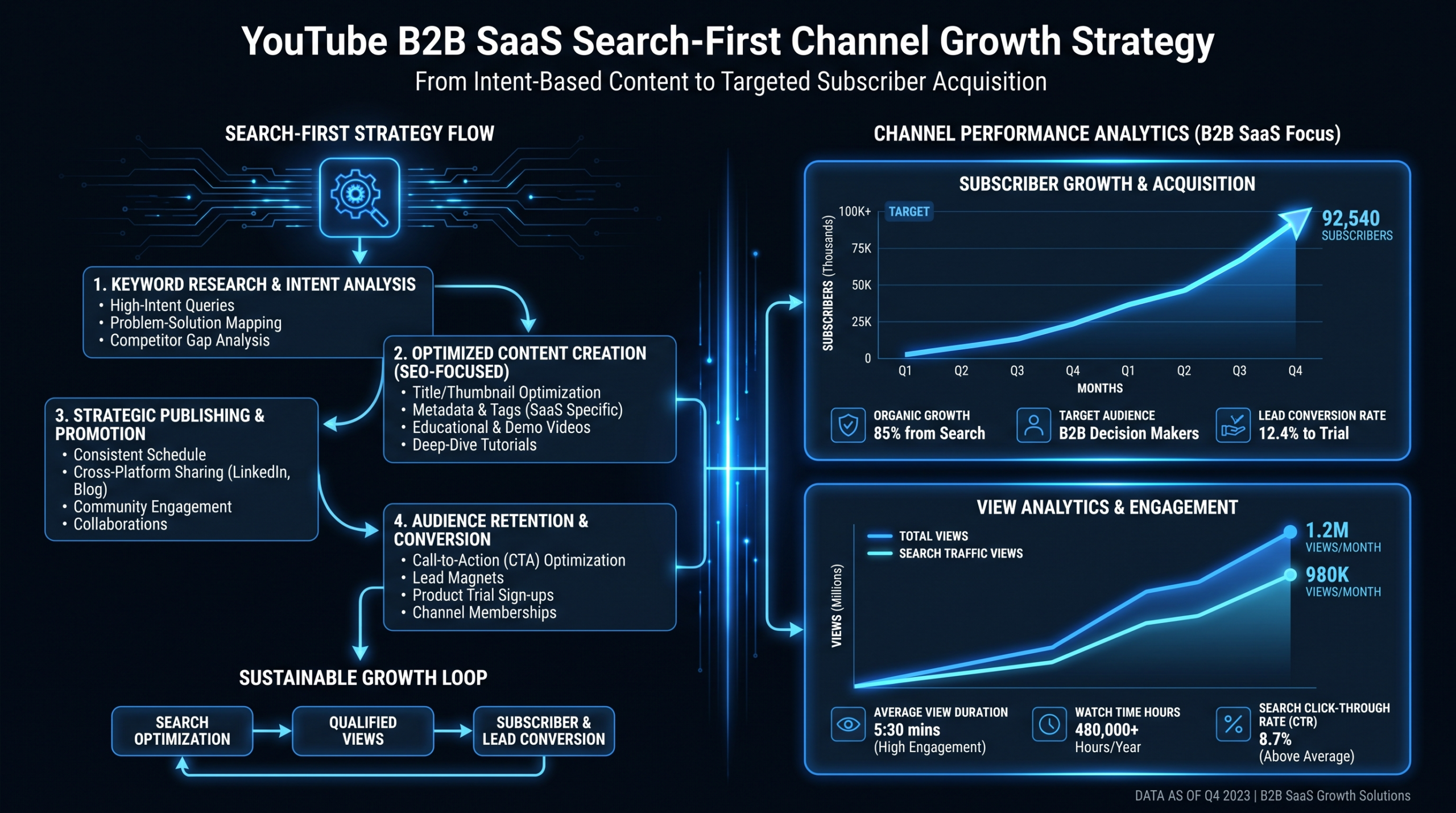
YouTube Studio surfaces dozens of metrics. Most of them are noise. Here are the four that actually tell you whether your search-first strategy is working:
- Impressions from YouTube Search (source-specific): Not total impressions — specifically impressions coming from search. This tells you how often YouTube is surfacing your videos in response to search queries. Growth here means your keyword targeting is working.
- Click-Through Rate (CTR) from search: The percentage of impressions that become views. Industry benchmarks vary widely, but for B2B content, a CTR above 4–5% from search is generally healthy. Below 2% usually means your thumbnail or title isn't connecting with the search intent.
- Average View Duration (AVD) as % of video length: This tells YouTube whether viewers are getting what they came for. A 50%+ average view duration signals that your content delivers on its promise. Below 30% consistently means your opening is not connecting or your content doesn't match the title's implied promise.
- Return viewer rate: The percentage of your views coming from returning subscribers vs. new viewers from search. A healthy search-first channel should see 60–80% of views coming from search and browse (new viewers) — not from subscriber notifications. If your return viewer rate is very high, you've built an audience channel, not a search channel.
What to Ignore
Subscriber count is a vanity metric for B2B SaaS YouTube. It has low correlation with pipeline generation. Total view count is similarly misleading — 10,000 views from buyers in your ICP is worth more than 100,000 views from students writing essays about your category. Focus on the four metrics above and connect YouTube analytics to your CRM by tracking which leads watched specific videos before requesting a demo.
Thumbnail and Title Optimization
Your video doesn't exist if nobody clicks it. In a search result, the thumbnail and title are all a buyer sees before deciding whether your content deserves 12 minutes of their attention. This is where most B2B SaaS channels fail — they produce technically solid content and then apply generic titles like "Product Update Q3 2026" or "Intro to Our Platform."
Title Formulas That Work for B2B SaaS
B2B YouTube titles perform best when they're explicit about the outcome the viewer will achieve or the question they'll have answered. The goal is to match the search query as closely as possible while adding a "reason to click" element:
- Tutorial format: "How to [Specific Outcome] in [Your Product] (Step-by-Step)"
- Comparison format: "[Tool A] vs [Tool B]: Which Is Better for [Specific Use Case]?"
- Problem-first format: "Why [Common Problem] Happens — And How to Fix It"
- Number-driven: "5 [Product Category] Mistakes That Are Costing You [Metric]"
- Time-anchored: "We Tested [X] [Product Category] Tools in 2026 — Here's the Verdict"
Keep titles under 60 characters so they don't truncate on mobile. Front-load the keyword — YouTube's indexing weights the first few words heavily. Avoid clickbait phrasing that doesn't match the video content; high CTR with low AVD kills your search distribution.
Thumbnail Design Principles for B2B Audiences
B2B YouTube thumbnails should be legible at 120×68px (the size they appear in sidebar recommendations on desktop). Most SaaS thumbnails fail because they try to cram too much information into a small frame. The formula that consistently works:
- One clear visual element: A product screenshot, a face, or a simple graphic — not all three.
- 3–5 words maximum: Bold, high-contrast text that reinforces the title. Not the title itself — a complementary phrase like "Full Walkthrough" or "Honest Review."
- Brand color system: Consistent thumbnail style across your channel builds pattern recognition. After 20–30 videos, your brand should be immediately recognizable in search results without reading the title.
- Faces outperform screenshots for awareness content; screenshots outperform faces for tutorial content. The buyer clicking a tutorial wants to see the software, not a talking head. Test both.
A/B Testing Thumbnails
YouTube's built-in A/B testing for thumbnails (available through YouTube Studio's "Test & Compare" feature) lets you run two or three thumbnail variants and automatically selects the winner by CTR. Run this test on every video for the first 4 weeks after publishing. A 1–2 percentage point CTR improvement compounds significantly across a channel's lifetime of search impressions.
The YouTube-to-Pipeline Flywheel
YouTube's value in B2B SaaS isn't just the direct views — it's how YouTube content amplifies every other channel in your marketing stack. A well-structured YouTube library creates a content flywheel with four turns.
Turn 1: Search Discovery → Channel Subscriber
A buyer searches for a problem your product solves. They find your tutorial. They watch 80% of it, click the subscribe button, and get end-screen exposure to three related videos. This buyer has now entered your YouTube ecosystem with positive brand association before ever visiting your website.
Turn 2: YouTube Video → Website Conversion
Every video should have a consistent CTA structure: a verbal CTA at the 30–40% mark ("If you're evaluating tools for this, we have a free trial linked below"), a pinned comment linking to your demo page or case studies, and a video description with structured links to your how-it-works page, relevant case studies, and pricing information. Buyers who are ready to convert will click. Buyers who aren't will continue watching and return later.
Turn 3: YouTube as Sales Enablement
Your comparison videos and product walkthroughs are not just marketing assets — they're sales tools. Train your AEs to share specific YouTube videos in deal cycles: send the "[Your Product] vs [Competitor]" video to a prospect who mentioned they're also evaluating the competitor. Send the "Admin Setup Walkthrough" to an IT contact who raised implementation concerns. YouTube gives your sales team a curated library of credible, third-party-feeling content that accelerates deal velocity without requiring sales rep time to recreate it.
Turn 4: YouTube Content → Multi-Channel Repurposing
A single 12-minute YouTube video produces: 3–5 LinkedIn short clips, 1 blog post (from the transcript), 2–3 email newsletter segments, 8–10 YouTube Shorts, and Instagram/TikTok clips for awareness. Teams that build their content calendar around YouTube as the primary format get a 5–8x content multiplication effect from each recording session. This is how a lean Head of Content team at a Series B company can maintain a presence across six channels without burning out.
For SaaS teams exploring how to structure this kind of production workflow, our guide on SaaS video production covers the briefs, review workflows, and handoff processes that make repurposing systematic rather than ad-hoc.
The teams winning on YouTube in B2B SaaS aren't publishing more — they're publishing smarter. One search-optimized video per week, repurposed systematically, outperforms five broadcast videos with no keyword strategy.
Video Production Partners for SaaS YouTube Channels
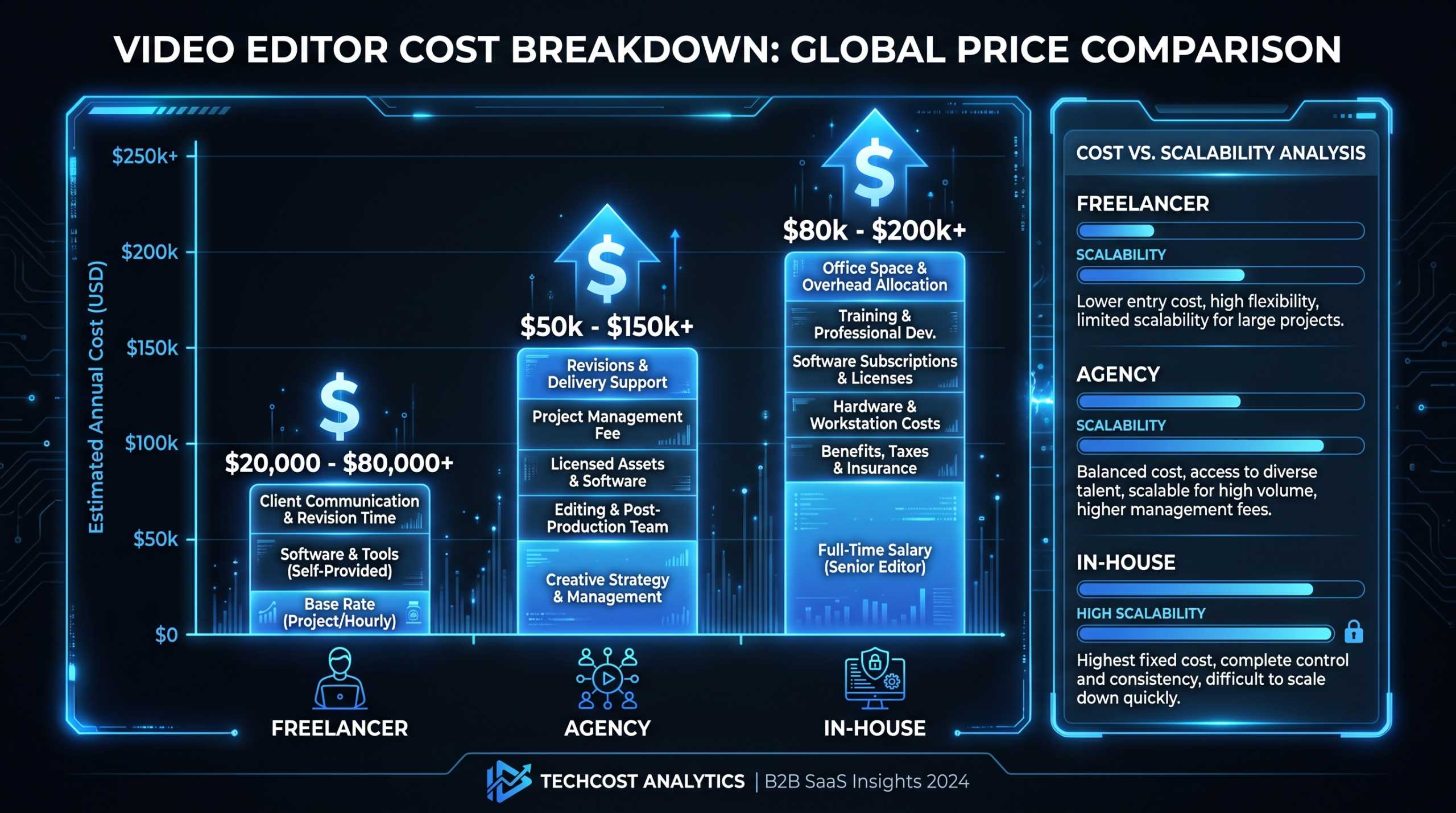
Executing a search-first YouTube strategy at a sustainable cadence requires reliable video production infrastructure. Most SaaS content teams are under-resourced for in-house editing, which makes choosing the right external partner a strategic decision. Here's how the leading options stack up for B2B SaaS YouTube specifically:
Top Video Production Partners for B2B SaaS YouTube (2026)
| # | Provider | Best For | Monthly Investment | Key Strength | Cons |
|---|---|---|---|---|---|
| 1 | Video Editing Company (VEC) | Series A–C SaaS teams scaling YouTube + multi-channel | From $5K/mo (Growth) | Dedicated editor pods, SaaS-exclusive focus, 90-day guarantee to double output | Minimum engagement required; not suited for single-video projects |
| 2 | Increditors (increditors.com) | YouTube creators, SaaS, finance, education wanting premium full-service | Custom retainers ~$2.5K–$12K+/mo | Senior editor + junior editor + PM + creative director pod; known for doubling YouTube performance metrics | Not SaaS-exclusive; no instant-quote pricing tiers |
| 3 | Video subscription services (e.g., Vidpros, VideoHusky) | High-volume simple edits, social clips, podcast cuts | $1,500–$4,000/mo | Affordable, fast turnaround, month-to-month flexibility | Sequential processing limits throughput; variable editor quality; not suited for complex SaaS demos |
| 4 | Freelance platforms (Upwork, Fiverr Pro) | One-off projects, tight budgets, overflow editing | $500–$3,000/project | Flexible, low commitment, wide talent pool | No brand consistency, high management overhead, quality variance |
For teams at 8+ videos per month with SaaS-specific needs — product UI screen recording, motion graphics for feature callouts, thumbnail design systems — the dedicated team model consistently delivers better ROI than subscriptions or freelance pools. VEC's dedicated team structure means the same editors learn your product, your brand voice, and your feedback patterns over time, which cuts revision cycles significantly after the first month.
For an honest look at how to think through build-vs-buy for video production infrastructure, the guide on what video editing services include covers scope, deliverables, and what to expect in a professional engagement.
Frequently Asked Questions
How long does it take to see results from a YouTube search-first strategy?
Most teams start seeing meaningful search impression growth at 3–4 months with consistent weekly publishing. Pipeline-attributable results typically emerge at 6–9 months, as your video library reaches critical mass and individual videos accumulate enough view history for YouTube to distribute them confidently. Comparison and demo videos often rank faster (4–8 weeks) because competition is lower. Broad category keywords can take 6–12 months to crack.
What's the ideal video length for B2B SaaS YouTube content?
It depends on the format. Comparison videos typically perform well at 8–14 minutes — long enough to be thorough, short enough to hold attention. Tutorials range from 6–18 minutes depending on complexity. Product demos for top-of-funnel awareness work best under 8 minutes. The guiding principle: make the video exactly as long as it needs to be to fully answer the query, and not a second longer. Padding to hit a length target hurts AVD and search distribution.
Should we prioritize subscribers or views for a B2B SaaS channel?
Neither, in isolation. For a search-first strategy, the primary metrics are impressions from YouTube search, click-through rate from search, and average view duration. Subscribers are a lagging indicator that grows naturally when your search content is strong. Views matter only in context — 5,000 views from in-ICP buyers evaluating your category beats 50,000 views from a video that went mildly viral with an irrelevant audience. Track source-specific metrics in YouTube Studio, not aggregate totals.
How many videos do we need before the YouTube algorithm kicks in?
There's no magic number, but channels commonly report a meaningful shift in algorithmic distribution around 30–50 published videos. This threshold gives YouTube enough content to understand your channel's topical focus, and enough view-session data to assess audience satisfaction. The first 20 videos are primarily about establishing baseline data and refining your keyword targeting. Don't expect the algorithm to work for you until it has enough signals to trust you.
How do we prove YouTube ROI to leadership?
The most credible method is UTM parameter tracking on every video description link, combined with CRM integration. Tag every YouTube CTA link with a campaign source, track which leads entered the pipeline from YouTube, and calculate influenced pipeline (deals where a prospect watched at least one video before the first sales conversation). Secondary metrics: assisted conversions in Google Analytics, organic traffic lift on pages linked from videos, and reduction in sales cycle length for deals where YouTube content was shared during the discovery process.
Ready to Build a YouTube Channel That Generates Pipeline?
VEC provides dedicated video editing teams for B2B SaaS companies — same editors, every video, trained on your product and brand. Our Growth plan starts at $5K/month. We guarantee you'll double your video output in 90 days or month 4 is free.
Book a Free Strategy Call See Pricing