Why Video Agencies Hide Prices (And We Don't)
TL;DR
Most video agencies hide prices to control the sales conversation, extract your budget ceiling before revealing a number, and protect inconsistent pricing across clients. This costs buyers 15–25 hours in unnecessary RFP cycles and routinely ends in scope mismatches that could have been filtered in seconds. This article explains the mechanics behind agency opacity, how to decode vague quotes, the red flags to watch for in proposals, and what genuinely transparent pricing actually looks like.
Table of Contents
You've Googled "video editing agency" and found something like this: polished portfolios, impressive client logos, case studies referencing doubled engagement — and then a contact form where pricing should be. "Every project is unique." "Let's discuss your needs." "We'll send a custom proposal."
This isn't an oversight. It's a deliberate strategy, refined over decades of agency sales. Understanding it changes how you buy — and how much you pay.
By the time you finish this piece, you'll know exactly why agencies hide prices, what it actually costs you, and how to get a real number out of any creative firm before you've spent a minute on a discovery call. We'll also tell you why VEC publishes its prices publicly — and what that decision costs us in deals where opacity would have let us charge more.
Why Agencies Hide Prices: The Business Logic
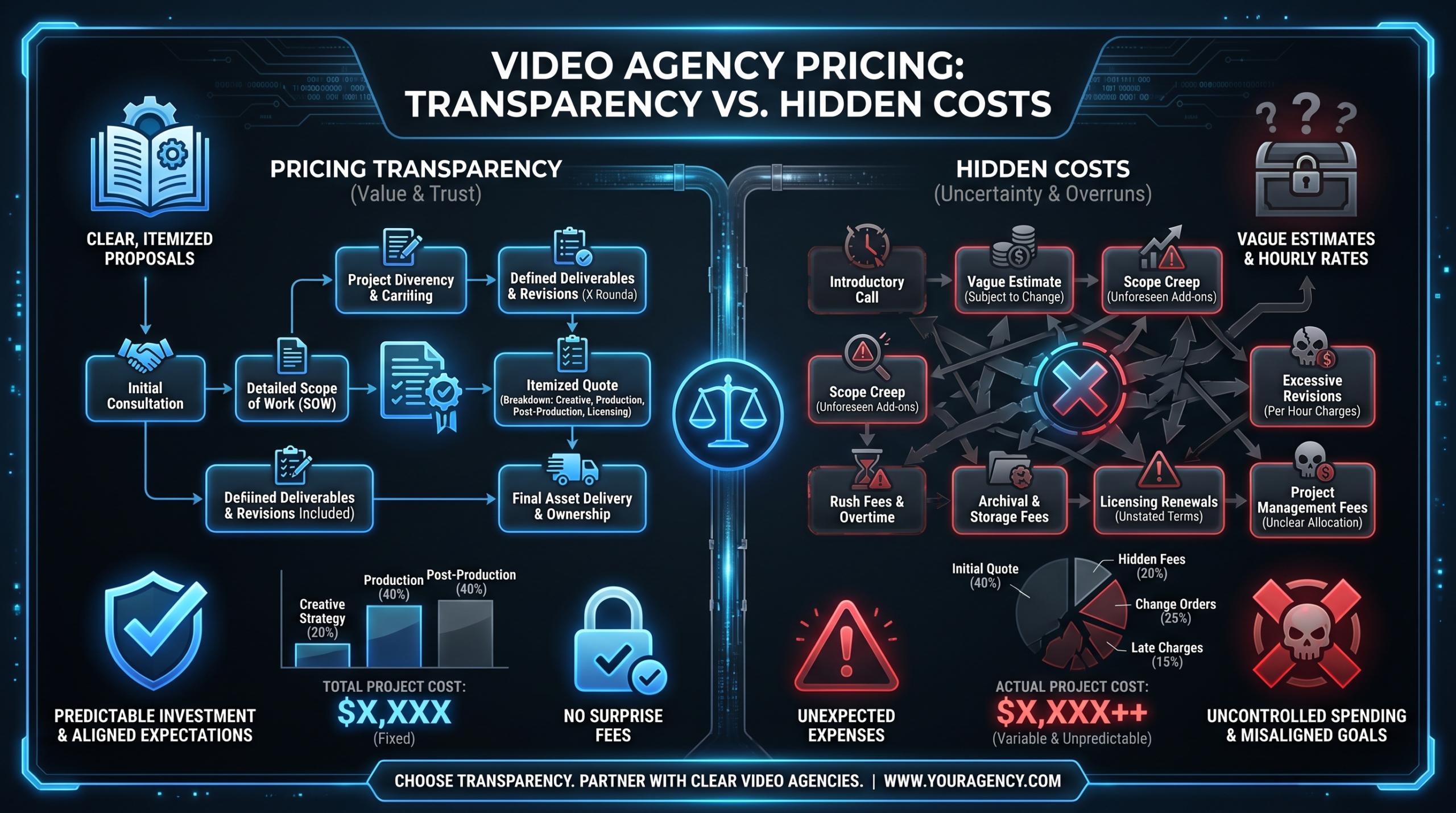
There are four distinct mechanisms at work when an agency chooses not to publish pricing. They don't operate independently — most agencies deploy all four simultaneously, and the combined effect is a sales process systematically designed to work against the buyer's information interests.
1. Fear of Anchoring
Behavioral economics has a well-documented concept called anchoring: the first number you see in a negotiation becomes a reference point that's difficult to dislodge, regardless of whether it's reasonable. If you visit an agency's site and see "$8,000/month," you form an immediate judgment. You compare it against competitors. You decide within 90 seconds whether you're even interested — before the agency has had a chance to make its case for value.
By withholding the number, the agency earns a 30-60 minute discovery call to shape your perception of value before you know the price. A skilled salesperson can frame $12,000/month as a bargain — if they've spent the last 45 minutes demonstrating complexity, risk mitigation, and strategic differentiation. That conversation never happens if you bounced off the website at "$8,000."
The asymmetry matters: the agency knows exactly what it charges and what the market bears. You don't. Hiding the price preserves that asymmetry as long as possible.
2. Budget Extraction
The discovery call isn't primarily about understanding your needs. It's about understanding your budget ceiling.
Within the first five to ten minutes of most agency sales calls, you'll be asked some version of: "Do you have a rough budget in mind for this?" It's framed as helpful — so they can "make sure they're not wasting your time." In practice, your answer sets the upper bound of what they'll quote you.
A company that says "$5,000/month" receives a proposal at $4,800/month. A company with identical needs that says "$15,000/month" receives a proposal at $14,500/month. The service isn't priced; the budget is priced. This isn't unique to video agencies — it's endemic across professional services. But it's particularly acute in creative services where scope variability makes the "custom quote" feel legitimate even when the underlying math is budget-first.
3. Upsell Flexibility
Published pricing constrains the upsell. If a prospect can see that a $5,000/month plan includes eight videos, two revision rounds, and basic motion graphics, they know exactly what costs extra. The agency's ability to add line items — "creative strategy session," "brand audit," "onboarding workshop" — is severely limited by the published scope.
When pricing is custom, every proposal can be structured to capture maximum margin. Stock footage licensing. Format variations. Rush fees. Account management time. These items are easy to include in a bespoke proposal and nearly impossible to challenge when there's no published baseline to compare against.
4. Inconsistency Management
Many agencies charge different clients dramatically different amounts for comparable scopes of work. This happens for legitimate reasons — deals struck at different times, different competitive situations, relationship pricing — and illegitimate ones, including charging clients with larger perceived budgets more, regardless of actual scope difference.
Published pricing makes this unsustainable. When anyone can read the rate card, pricing variation becomes a customer service liability. Opacity allows agencies to maintain a portfolio of clients at wildly different price points without the awkward conversation when Client A compares notes with Client B.
The Real Cost of Opacity to Buyers
The frustration of hidden pricing is obvious. The actual dollar cost is something most buyers never calculate — until they add it up.
The RFP Tax
When you can't compare agencies at a glance, you're forced into a formal evaluation process. The typical steps for a VP of Marketing sourcing a video production partner:
- Identify 4-6 agencies through search, referrals, and creative directories
- Reach out to each, wait for a response (1-3 business days)
- Sit through discovery calls (30-60 minutes each)
- Wait for custom proposals (3-10 business days each)
- Review and attempt to compare non-standardized proposals
- Shortlist 2-3 agencies, run a second round of conversations
- Negotiate and sign
This process routinely consumes 20-30 hours of calendar time — often spread across 4-6 weeks. At a fully-loaded internal cost of $150-250/hour for a marketing leader, that's $3,000-7,500 in organizational cost before you've produced a single frame of video. Transparent pricing eliminates most of this. A published rate card lets you filter 70% of the market in minutes, not weeks.
Budget Misalignment at the Finish Line
Hidden pricing doesn't just slow the process — it frequently produces mismatches that could have been avoided immediately. You invest four weeks evaluating an agency: discovery calls, brand briefing, culture fit assessment. Then the proposal arrives at 2-3x your available budget.
This isn't accidental. It's the expected outcome of a pricing strategy designed to get you invested before revealing the number. By the time you see the price, you've already spent time you'd rather not lose — and the agency is banking on that sunk cost to make you negotiate rather than walk away. Published pricing is a forcing function for early qualification. You know in 30 seconds whether the budget alignment is even possible. So does the agency. Everyone saves time when that information surfaces immediately.
The Trust Deficit
Creative partnerships require honest communication about what's working and what isn't. Video content that underperforms needs direct feedback. Brand guidelines that conflict with what's achievable at a given budget require frank discussion about trade-offs.
Starting a partnership with a sales process engineered around information asymmetry creates a problematic foundation. If your first interaction with an agency is a conversation designed to extract your budget before revealing any real pricing, you've already learned something important about how they operate. According to HubSpot's marketing research, B2B buyers consistently rank transparency as one of the top factors driving vendor selection — not just as a preference, but as a proxy for what the working relationship will feel like once the contract is signed.
How to Decode a Vague Quote
When you receive a "custom" proposal that doesn't give you clear unit economics, here's how to reverse-engineer it into something you can actually evaluate and compare.
Step 1: Demand a Unit Breakdown
Don't accept a monthly total. Ask for the price per video, per hour, or per deliverable. "$18,000/month" tells you nothing. "$18,000/month for 8 videos = $2,250 per video" is a number you can benchmark against market rates. For context on where those numbers should land, see our breakdown of video editing cost per minute — it gives you the underlying math behind what any finished video should cost at different complexity levels.
Step 2: Get Revision Terms in Writing
"Revisions as needed" means nothing. Before signing, get written clarity on: the number of included revision rounds, the definition of what constitutes a revision (minor color correction vs. structural re-edit), and the per-round overage cost. The difference between two revision rounds and three — when a complex video goes through multiple stakeholder reviews — can add $500-1,500 in unexpected costs on a single video.
Step 3: Enumerate Every Potential Add-On
Work through the proposal line by line against everything you'll realistically need. Common unlisted costs include stock footage licensing ($50-500 per clip), music licensing ($100-400 per track), format variations (separate deliverables for 16:9, 9:16, and 1:1 — often billed as distinct projects), caption/subtitle files, rush delivery fees (typically 25-50% premium), and account management time billed at hourly rates. Understanding each item before work starts prevents invoice surprises that erode budget mid-engagement.
Step 4: Ask for a Reference Client at Similar Scope
An agency with strong client relationships welcomes this question. A great follow-up question for any reference: "What were you paying per month, and how many finished videos did you receive?" A real comparable is more useful than any proposal. The answer gives you verified unit economics from a live engagement — not projected numbers from a sales deck.
Step 5: Run the Effective Cost Per Finished Minute
Divide total monthly cost by total minutes of finished video delivered. This single metric normalizes across different pricing models and billing structures, and lets you compare agencies that frame their pricing completely differently. A $10,000/month retainer delivering 30 minutes of finished video is $333/finished minute. A $7,000/month "subscription" delivering 15 minutes is $467/finished minute — a 40% difference that reads like a discount on the surface.
Quote Decoding Checklist
| What to Request | Why It Matters | Red Flag If They Say |
|---|---|---|
| Price per video or per finished minute | Lets you benchmark unit economics vs. market | "Scope is too variable to quantify" |
| Revision rounds — number and definition | Prevents overage surprise invoices | "Unlimited revisions until you're happy" |
| Complete add-on cost list (stock, music, formats) | True cost vs. headline sticker price | "We'll handle it case by case" |
| Reference client at similar scope | Real-world pricing validation | "We keep client details confidential" |
| Cancellation and pause terms | Reveals confidence in own delivery | 12-month lock-in, no flexibility |
Red Flags in Agency Proposals
Not all agency opacity is equally problematic. Here's how to read a proposal for signals that the pricing strategy is designed to work against you — and what each red flag actually indicates.
No Range, Ever
An agency that declines to give even a rough pricing range — "our projects typically run $X to $Y depending on scope" — isn't being thoughtful about customization. They're running a budget extraction play. Every legitimate agency knows approximately what similar work has cost comparable clients. A complete refusal to anchor on any number before a discovery call is a sales tactic, not a policy.
Proposal Before Genuine Discovery
If an agency sends a proposal within 24 hours of a 20-minute introductory call, without asking detailed questions about your video types, output volume, brand style, review workflow, and stakeholder structure — the "custom" proposal is a template. Real customization requires real discovery. A proposal delivered before the agency understands your specific operational needs is a pitch deck, not a plan.
Line Items You Never Discussed
Creative strategy workshops. Brand positioning sessions. Content calendar planning fees. If a video editing proposal includes services you never requested or discussed, treat each one as a margin builder. The test: remove each unlisted item from the proposal and ask the agency to justify its inclusion. The ones they defend with specific rationale are likely legitimate value. The ones they concede silently confirm they were padding.
Scope Defined Only in the Contract
If the proposal summary says "monthly video package, approximately 8-12 videos" but the contract defines specific exclusions, overage fees, and revision limits in detail, your interests and the agency's are misaligned by design. The proposal lands the deal; the contract protects the agency. Specific scope should be defined clearly in the proposal document, not buried in contract addenda. For a clear view of what a complete video editing scope definition should cover, see our breakdown of what video editing services include.
Refusal to Discuss Effective Hourly Rate
Even in project-based or retainer engagements, you should be able to ask: "What's your effective hourly rate for editing work?" A competent agency knows this number. If the answer is "it depends on too many variables," that's a negotiating position, not a real answer. If you can't calculate the implicit hourly rate in any pricing model, you can't evaluate whether it's efficient. For context on what market rates look like by region, our guide to video editing hourly rates by country gives you a useful benchmark.
Agency Transparency Score: What Each Behavior Signals
| Agency Behavior | What It Actually Signals | Score |
|---|---|---|
| Published pricing with defined deliverables | Operationally confident, consistent pricing model | High ✓ |
| Published price ranges with clear scope variables | Honest about variability, not hiding structure | Good ✓ |
| No prices, but ballpark given quickly on first call | Sales-led but not adversarial | Neutral ○ |
| Discovery call required before any number mentioned | Budget extraction process — proceed with caution | Low ✗ |
| Price revealed only in final contract after weeks of process | Deliberate opacity, adversarial information dynamic | Very Low ✗✗ |
What Transparent Pricing Actually Looks Like
Pricing transparency isn't about having the lowest number on your website. It's about giving buyers enough information to make an informed decision before they've invested time in a sales process.
Genuinely transparent pricing includes four things:
- A specific monthly cost — not a range that spans $20,000
- Defined deliverables — what you get for that price, stated specifically and verifiably
- Explicit exclusions — what's not included and what triggers additional cost
- A clear upgrade path — how pricing changes as your needs scale
VEC publishes all of this on its pricing page. Three plans, specific numbers, defined scope, and a performance guarantee that only exists because the operational model is consistent enough to back it:
VEC Published Plans (2026)
| Plan | Monthly Cost | Team Included | Guarantee |
|---|---|---|---|
| Growth | $5,000/month | Dedicated editor + project manager | Double video output in 90 days or month 4 free |
| Core | $9,500/month | Senior editor + editor + project manager | Double video output in 90 days or month 4 free |
| Scale | $16,000/month | Full dedicated team + creative direction | Double video output in 90 days or month 4 free |
The guarantee matters as much as the price. "Double your video output in 90 days or your fourth month is free" is a specific, measurable commitment. It's only possible when the operational model is consistent enough to promise it in writing. Agencies that can't quote you a price definitely can't attach a performance guarantee to one.
Why does VEC publish prices? Because we've built operations that deliver consistently at these price points and don't need to hide the number to close a deal. If our pricing doesn't fit your budget, a discovery call won't change that. We'd rather you know in 30 seconds than three weeks.
The other reason is discipline. Published prices are a commitment that forces operational consistency. You can't quietly raise rates on renewals. You can't charge one client 60% more than another for identical work. Transparency is a forcing function for the kind of rigor that produces results worth paying for — and results worth paying for are ultimately what keeps clients around.
For more context on how this approach compares to traditional agency models, our analysis of video production agency pricing models walks through the full landscape — from per-project to retainer to dedicated team — with real cost math at each volume tier.
The Questions to Ask Before You Commit
Whether you're evaluating VEC, a traditional agency, a boutique studio, or a freelance team, these six questions will surface what vague proposals hide. Ask them in conversation, not as a written list — the texture of the responses reveals more than the words themselves.
1. "What's your effective cost per finished minute of video?"
This normalizes across billing models and video types. An agency that can't or won't answer this question has pricing designed to obscure value, not communicate it. A good answer is a specific number with a brief, honest explanation of what drives it up or down — complexity, motion graphics intensity, footage volume. A non-answer is a signal.
2. "How do you define a revision, and how many are included?"
Push for specificity. "One complete structural change or up to five minor corrections per round" is a definition. "As many as you need until you're satisfied" is a negotiating tactic that will eventually become an invoice line. Get the definition in writing, before the SOW is signed.
3. "What happens if we're not satisfied with the output at the end of month one?"
A confident agency has a defined remedy process. Vague answers ("we'd work through it together") indicate the contract protects the agency in disputes, not the client. Look for: specific escalation process, defined output standards, clear recourse if delivery falls short of agreed scope.
4. "Can you give me a reference client with similar scope so I can ask about their experience?"
Agencies with strong client retention welcome this question without hesitation. Agencies that hedge it — "we'd need to ask their permission" followed by silence — either have client relationships that have deteriorated, or pricing inconsistency they'd rather not have discussed between accounts.
5. "What are your pause and cancellation terms?"
Easy exit terms are a leading indicator of confidence in delivery. A 12-month lock-in with financial penalties for early cancellation tells you that client retention is enforced by contract, not by results. The agency needs your revenue more than your results require their contract. Pause flexibility and short minimum commitments mean the agency is confident you'll stay because of the work — not because you're legally required to.
6. "Who specifically will work on our account, and does that change over time?"
Dedicated, named editors who learn your brand are a fundamentally different product from "a pool of available editors." Get the answer specific and in writing. If the agency can't tell you which editors will be on your account before signing, the "dedicated team" in their pitch is a selling point, not an operational commitment.
The best negotiating position is information. In any commercial relationship where the other party has systematically withheld information, you are negotiating on their terms — not yours.
Video has become a primary demand-generation and sales-enablement channel for B2B SaaS. According to Wyzowl's annual State of Video Marketing report, the overwhelming majority of B2B marketers report that video has a measurable positive impact on pipeline and revenue. At that level of strategic importance, the vendor selection process deserves the same rigor you'd apply to any mission-critical software or service contract — which means not accepting the information asymmetry that hidden pricing is designed to create.
Whether you're producing SaaS product videos or product demo videos at any real volume, the cost of a bad agency selection — in wasted ramp-up time, misaligned output, and delayed production — easily exceeds the time investment of a rigorous evaluation. Do the evaluation. Ask the questions. And walk away from any agency that won't give you a real number before you've committed time to their process.
For a complete guide to the commercial and operational decisions involved in agency selection, read our guide on how to outsource video editing — it covers the full process from initial evaluation through onboarding and workflow setup.
Frequently Asked Questions
Why do video agencies almost never put prices on their websites?
The primary reasons are budget extraction (learning your ceiling before revealing a number), anchoring avoidance (preventing early price comparison before they've made their value case), and upsell flexibility (keeping proposals open-ended enough to add margin). A secondary reason is inconsistency management — many agencies charge different clients different rates for similar work, and published pricing makes that untenable. Agencies with the most operational confidence are typically the ones willing to publish specific numbers publicly.
Is "custom pricing" ever legitimate, or is it always a red flag?
Some scopes genuinely require customization — multi-day production shoots, global distribution rights, complex animation, or specialized compliance requirements. In these cases, a custom quote is warranted and appropriate. But for the majority of B2B video editing and production work — dedicated editing teams, retainers, monthly output programs — the scope is defined enough to quote publicly. "Custom pricing" for a standard editing retainer is almost always a sales tactic, not a genuine reflection of scope complexity.
How do I know if a custom quote is actually fair?
Calculate the implied unit economics: divide the total monthly price by the number of videos delivered to get cost per video, then divide by approximate finished minutes per video to get cost per finished minute. Compare that number against published market benchmarks — the ranges covered in our video editing cost per minute guide give you calibrated reference points. If the agency's implied rate is materially above market without a clear justification (specialized expertise, guaranteed output, performance commitments), negotiate the specific line items or seek a second quote.
What should I watch for in the contract if the proposal was vague?
Vague proposals frequently hide specificity in the contract. Watch for: overage fees triggered by ambiguous scope definitions ("additional videos beyond the agreed estimate"), revision clauses that limit rounds without defining what constitutes a revision, termination clauses with financial penalties that weren't mentioned in the proposal, and rate adjustment provisions that allow unilateral price increases on renewal. If the contract is materially more restrictive than the proposal implied, that gap is not an oversight — it's the agency's protection against the promises its sales team made to win the deal.
What do VEC's published plans actually include?
VEC's Growth plan ($5,000/month), Core plan ($9,500/month), and Scale plan ($16,000/month) each include a dedicated editing team, a dedicated project manager, and a performance guarantee: double your video output in 90 days or your fourth month is free. The plans are structured for B2B SaaS companies at different content volumes — Growth for teams scaling video production from a low base, Core for teams with established content programs, and Scale for organizations where video is a primary marketing and sales channel. Full scope details, including what's included and what triggers additional cost, are on our pricing page.
Ready to See What Transparent Pricing Looks Like in Practice?
No discovery call required before you see a number. VEC publishes its plans publicly — Growth at $5K/month, Core at $9.5K/month, Scale at $16K/month — each with a dedicated team and a 90-day output guarantee. If the fit is right, we'll walk you through exactly how the engagement works on a focused 30-minute call.
Book a Free Strategy Call See Our Pricing