Video Quote Checklist: 12 Questions Before Signing
TL;DR
Most video editing quotes look similar on the surface — turnaround time, price, deliverables. The contract details that will actually cost you money are buried in the revision policy, file ownership terms, kill fees, and editor assignment clauses. This checklist gives you 12 specific questions to ask before signing any video editing contract, what a confident vendor answer looks like, and the exact red flags that should make you pause or walk away.
Table of Contents
- Why the Quote Stage Determines Everything
- Questions 1–3: Contracts, Ownership, and Licensing
- Questions 4–6: Team Composition and Quality
- Questions 7–9: Turnaround, Scope, and Cancellation
- Questions 10–12: Process, Onboarding, and Payment
- Master Checklist: All 12 Questions and Red Flags
- How Different Vendor Types Typically Answer
- What Transparent Vendors Say
- FAQ
Getting a video editing quote takes 30 minutes. Living with the contract you signed based on that quote takes 6 to 12 months. The questions most marketing teams ask during the quote stage — portfolio quality, rough pricing, turnaround time — are the easy ones. The questions that actually protect your budget and your content program are the ones nobody asks until they've already been burned.
This is not a generic "things to consider before hiring" article. It's a literal evaluation script: 12 specific questions, why each one matters, what a confident vendor will say, and what signals should make you push back or walk away. Run through all 12 on your next vendor call before a contract hits your inbox.
Why the Quote Stage Determines Everything
The quote stage is the only point in a vendor relationship where you have full negotiating leverage. Before you sign, you can negotiate revision rounds, price locks, kill fees, file ownership, and communication standards. After you sign, those terms are fixed — and if they're unfavorable, you live with the consequences for the duration of the engagement.
Three categories of contract terms routinely catch SaaS marketing teams off guard:
- Ownership and licensing. Who actually owns the assets you paid to produce — including raw footage, project files, and licensed music — and what rights you retain after the engagement ends.
- Team accountability. What happens when your assigned editor leaves the agency, goes on vacation with no warning, or your project gets quietly handed off to a junior mid-sprint.
- Scope and money. How scope creep, client-requested changes, and missed deadlines get resolved financially — and how much it costs you to exit if the relationship isn't working.
Most agencies are perfectly willing to clarify these terms upfront. The ones that deflect, get vague, or pressure you to sign before you've reviewed the contract are giving you important information about how they'll handle problems six months from now.
Before you evaluate any video editing quote, it helps to understand what's typically included and what's typically extra. Our guide to what's included in video editing services gives you a solid baseline before you start comparing vendors.
Questions 1–3: Contracts, Ownership, and Licensing
Question 1: What is your revision policy, and what specifically counts as a "revision"?
Why it matters: "Unlimited revisions" is marketing language, not a contract term. Every agency defines revisions differently. If the contract doesn't specify what a revision is, you'll discover the definition the hard way — when your request to change the outro music triggers a $300 "additional change fee" because it wasn't in the original brief, or when each individual comment you leave counts as a separate revision round, burning through your included rounds in two feedback sessions.
What to ask: How many rounds of revisions are included in the quoted price? What counts as a revision round vs. an additional request? What's the cost per round after the included rounds? Is there a cap on the number of comments per round, or is each round open-ended?
Good answer: "We include three revision rounds. A revision round is a batch of comments submitted at one time — we address everything in that batch as one round. Additional rounds are $[X] each. Changes to the original brief — new footage, different music, structural re-edits — are quoted separately before we begin."
Red flag: "We offer unlimited revisions" with no definition of what a revision is. "We're flexible about revisions" without pricing for overages. A policy buried in fine print that defines a revision as a single change item (meaning each comment counts as one revision round).
The most expensive three words in a video contract are "unlimited revisions" with no supporting definition.
Question 2: Who owns the raw files, project files, and source assets after delivery?
Why it matters: If you ever want to switch vendors, bring editing in-house, or re-edit a video two years from now, you need the project files. The raw footage, the Premiere Pro or DaVinci Resolve project file, the audio stems, the After Effects source files — without these, every future edit starts from scratch, and years of editing work effectively belong to your agency, not you.
Some agencies retain project files as a deliberate business model. The stated reasoning sounds legitimate ("we store them securely on our servers"), but the practical effect is that switching agencies means losing all your editing infrastructure — not just losing a vendor relationship but losing the institutional knowledge embedded in your source files. This is a meaningful switching cost that keeps clients locked in even when quality drops.
What to ask: Does the contract assign full ownership of raw files, project files, and source assets to the client upon delivery? In what format are files delivered, and is there a delivery fee or does transfer happen automatically at project completion?
Good answer: "Client owns all deliverables, raw files, and project source files outright. We deliver everything in the agreed formats at project completion at no additional charge. We recommend you maintain your own archive, but we retain files for 90 days if you need to re-download anything."
Red flag: Agency retains "custody" of project files. Project files are available "upon request" but aren't delivered automatically. Files are stored in a proprietary platform that requires an active subscription to access after the engagement ends.
Question 3: What music and stock footage licensing do I get, and what happens to that licensing if we stop working together?
Why it matters: If your vendor uses their agency subscription to Artlist, Musicbed, or Envato Elements for your video, that license is typically tied to their account, not yours. The video is technically legal to use while you're a paying client. The moment the engagement ends, the license may technically lapse depending on the platform's terms of service — leaving you running an ad built on an expired music license.
This matters most for content with long shelf lives: product demo videos, brand films, or explainer videos you intend to run in paid advertising for years. It's a non-issue for content that turns over quickly. Know which category your content falls into before you sign.
What to ask: Are music and stock footage licenses tied to your agency account or assigned to the client? What specific licensing tiers do you use (standard commercial vs. extended commercial)? Are licenses for paid advertising included? What happens to the licensing status if we end the engagement?
Good answer: "We use royalty-free music and stock footage with perpetual commercial licenses. The license covers the specific deliverable video and is not tied to our subscription — you can use the video in perpetuity regardless of whether we continue working together. We document all licensed assets used in a delivery package with each video."
Red flag: Vague answers like "we handle all the licensing." Use of subscription-based licensed tracks without clarifying whether the license extends beyond the subscription period. No delivery documentation listing which licensed assets appear in your videos. Resistance to providing license terms in writing.
Questions 4–6: Team Composition and Quality
Question 4: What percentage of my work will be handled by a senior editor vs. a junior editor?
Why it matters: The portfolio video you loved during the pitch was almost certainly edited by a senior. The video you'll actually receive may be rough-cut by a junior with a senior doing a spot-check review before delivery. This is a standard agency production model — it's not inherently wrong — but you need to know the split upfront so you can evaluate the quote accurately and set realistic quality expectations.
A recurring complaint from SaaS marketing teams is discovering mid-engagement that the "dedicated editor" assigned to their account has been with the agency for three months and the senior editor who pitched them is managing 12 client accounts simultaneously with minimal hands-on editing time per account.
What to ask: Who specifically will edit my videos? What's their experience level? What does the senior editor actually do — are they doing the creative edit, or reviewing and approving a junior's cut? Will the same person work on my content consistently from month to month?
Good answer: "Your account will be handled by [Name], a senior editor with [X] years of experience. [Name] does the primary creative edit, color grade, and final review. Our junior editor handles rough assembly, footage sync, and asset organization. You'll work with the same team every month."
Red flag: "We have a team of experienced editors" without naming the specific person. Answers that describe the agency's editorial hierarchy without telling you where your account sits within it. No option to speak with or even meet your editor before signing.
Question 5: Can I see samples specifically from the editor who will be assigned to my account?
Why it matters: Agency reels are curated best-of collections — the strongest work from the strongest projects from the strongest editors across years of output. The editor assigned to your account may produce work that looks nothing like the agency's showcase reel, especially if they're newer to the team or work in a different content category than what's featured prominently in the portfolio.
Asking to see work from your specific editor, before you sign, separates vendors who are proud of their entire team from vendors who are selling a brand their execution can't consistently deliver at the account level.
What to ask: Can you share a portfolio of work specifically from the editor who will be assigned to my account? Can I have a brief pre-signing call with that editor to discuss my content style and brand?
Good answer: Yes — editor-specific samples are provided without hesitation, and the editor is available for a pre-signing alignment call to discuss content style, brand voice, pacing preferences, and goals before any contract is signed.
Red flag: Only agency portfolio available; no editor-specific samples. Resistance to editor introductions before signing. "All our editors follow the same quality standards" offered as a deflection rather than a direct answer to the question.
Question 6: What happens if my assigned editor leaves the agency, gets sick, or goes on vacation?
Why it matters: Editor churn is real in the production industry. If your dedicated editor leaves mid-engagement and the agency doesn't have a clear transition plan, you're looking at a 2-4 week ramp-up delay while a new editor learns your style — during which you're still paying full rate for reduced output. The same risk applies to planned absences: if your editor is on vacation for two weeks in August and no briefed backup exists, your content calendar breaks with no warning.
This is a management and process question, not a trust question. Even excellent editors take vacations. The question is whether the agency has built a process that makes your content program resilient to individual availability.
What to ask: How do you handle planned absences (vacation, holidays, sick days)? If my primary editor leaves the agency, what is the transition process and timeline? Is there a dedicated backup editor who is already familiar with my brand and style?
Good answer: "We maintain a documented style guide for every active client account. If your primary editor is away, a trained backup who has reviewed your style guide steps in with no gap in delivery. If your primary editor leaves the agency, we provide a 2-week parallel handover period where both the outgoing and incoming editors work on your content before the transition completes — at no extra charge."
Red flag: No documented backup process. "We'll let you know if there's an issue" as the extent of the contingency plan. No mention of style documentation or brand guides that would enable a backup editor to maintain continuity. Editor availability described as guaranteed without any mention of what happens when it isn't.
Questions 7–9: Turnaround, Scope, and Cancellation
Question 7: What is the guaranteed turnaround SLA, and what happens if you miss it?
Why it matters: "Typically 5-7 business days" is a sales statement. "5 business days contractually, with a service credit for each day over" is a commitment. Content calendars run on deadlines — if a video isn't delivered for a product launch or campaign start date, the cost isn't just one late video, it's the downstream marketing activity that depends on it.
Turnaround SLAs that aren't backed by a defined consequence are aspirational targets, not contractual commitments. Know the difference before you sign anything.
What to ask: What is the contractual turnaround time for each video type I need? What happens when you miss a deadline — is there a credit, discount, or other recourse in the contract? Are there circumstances (high-volume periods, holidays, client delays) where the SLA is modified?
Good answer: "Standard turnaround is 5 business days for videos under 15 minutes, 3 business days for social clips and short-form content. If we miss a deadline without a client-side contributing cause, we credit one day of service for each business day we're late. Rush delivery (48-hour) is available at a defined premium. SLAs pause only when client-side delays (late footage, late feedback) push the timeline."
Red flag: SLAs described verbally in the pitch but absent from the contract. "Turnaround depends on current volume" without any floor commitment. No recourse clause for missed deadlines. Rush delivery requires 30+ days advance notice to arrange, making it effectively unavailable for real urgencies.
Question 8: How do you handle scope changes and additional requests mid-project?
Why it matters: Scope creep is the leading source of budget overruns in creative services engagements. "Can you add a quick animated intro?" or "We need this repurposed for LinkedIn — can you adjust the format?" each sounds minor in isolation. Across 12 videos a month over a 6-month engagement, these additions compound significantly. Without a clear scope-change process backed by a published rate card, you either get surprise invoices or a vendor who silently deprioritizes the unpriced extras and delivers substandard work.
For a broader look at how to structure outsourced video work to prevent scope drift from the start, our guide on how to outsource video editing effectively covers the full brief and approval workflow.
What to ask: What's the process when I need something that wasn't in the original scope? How are scope changes priced? Is there a published rate card for common additions like additional format versions, animated intros, or extended cuts? Is written client approval required before scope-change work begins?
Good answer: "All scope changes are submitted through our project management system and priced against a published rate card before we start any additional work. You receive a written estimate and approve the cost before anything happens. Common additions — social format variations, intro/outro variants, extra color grades — have fixed prices listed in the contract so there are no surprises."
Red flag: "We're flexible, just let us know what you need" with no pricing framework attached. Change orders estimated case-by-case with no benchmark pricing. No written client approval required before scope-change work begins. Scope changes verbally agreed during calls with no written confirmation.
Question 9: What are your kill fee terms if we need to cancel mid-project or end the engagement early?
Why it matters: Business circumstances change. A product line gets discontinued, a marketing strategy pivots, or a funding round falls through. If you need to cancel a $20,000 project at the 40% completion mark and the contract specifies a 75% kill fee, that's a $15,000 surprise on top of the budget you've already burned. Kill fees are standard and fair — the question is whether they're proportional to work completed, clearly documented, and tied to project stage rather than an arbitrary flat rate.
What to ask: What are the kill fee terms at different project stages — pre-production, mid-production, near delivery? Do you deliver completed work-in-progress materials if the project is cancelled? Are there early termination fees on monthly retainers or subscription agreements beyond the standard kill fee?
Good answer: "Kill fees are tiered by project stage: 15% if cancelled before production starts, 40% at mid-production, 65% at near-delivery. Regardless of the cancellation stage, we deliver all completed deliverables and project files. For monthly agreements, we require 30 days' written notice and there is no additional early termination fee beyond the notice period."
Red flag: Non-refundable deposits above 35% with no corresponding kill fee schedule. Kill fees that exceed the value of work completed at cancellation. No delivery of work-in-progress materials upon cancellation — you pay the kill fee and receive nothing. Monthly agreements with 60-90 day notice requirements and "liquidated damages" clauses on early termination.
Questions 10–12: Process, Onboarding, and Payment
Question 10: What is the communication cadence — specifically, who do I contact, on what channel, and what's the committed response time?
Why it matters: "We're very responsive" is in every agency pitch deck. What you need to know is the specific channel (Slack, email, project management tool), the specific person (named PM vs. shared inbox), and the committed response time backed by a contract term. The most common complaint about creative agencies is communication gaps — a 72-hour response to a feedback comment doesn't sound catastrophic until it's adding a week to every single video's turnaround cycle across a full calendar year of production.
What to ask: Who is my primary contact and what is their specific role on my account? What channel do you use for day-to-day communication? What is the committed response time during business hours, and is that commitment in the contract? Is there any coverage for urgent items outside business hours?
Good answer: "You have a dedicated project manager who is your single point of contact on this account. Day-to-day communication runs through [specific tool — Slack, Frame.io, etc.]. We commit to same-business-day responses and typically respond within 2-4 hours during business hours. For urgent launch-critical items, your PM has a direct line available outside standard hours."
Red flag: Communication routed through a general team inbox with no named contact. Response time commitments made verbally but absent from the contract. The project manager handling your account also manages 20+ other accounts simultaneously. All communication funneled through a ticketing system with no option for real-time conversation when speed matters.
Question 11: How do you handle the first video to calibrate our style and brand?
Why it matters: The first video from any new editor will need more revision cycles than any subsequent video. There's an unavoidable learning curve for your brand voice, pacing preferences, graphic style, music taste, and product positioning. The question isn't whether that calibration period happens — it always does — but whether the vendor has a structured process to shorten it and who absorbs the extra revision cost during that period.
Vendors with strong onboarding processes — brand questionnaires, editorial style guides, a dedicated calibration video with extra revision rounds included at no charge — consistently deliver better output starting from video two than vendors who jump straight into full production and charge you standard rates while figuring out your style.
What to ask: Do you have a structured onboarding process before the first video enters production? Is the first video treated differently (extra revision rounds, no additional cost)? Do you create a brand style guide or editorial playbook based on our feedback that guides all future work?
Good answer: "Onboarding starts with a brand questionnaire and an alignment call with your assigned editor before any production begins. We create an editorial brief that documents your pacing preferences, color palette, music style, graphic conventions, and key messaging. The first video includes five revision rounds at no additional charge — we use it explicitly as a style calibration exercise. Every subsequent video references that document."
Red flag: "We'll figure it out as we go." A generic intake form with no editor involvement in the onboarding. First video billed at standard revision rates with no acknowledgment of the calibration period. No style guide or brand document created or maintained as a living reference for ongoing work.
Question 12: What are your payment terms, and are there price escalation clauses buried in the contract?
Why it matters: Monthly retainer contracts that auto-renew with annual price escalation of 10-15% are standard in many agency agreements. So are contracts where the base rate is locked but "additional service fees" are added over time as deliverable scope expands. Knowing the full economic picture of the engagement — what you pay in month 1 vs. month 12, what triggers a rate review, whether you can pause without full billing, and how auto-renewals work — prevents budget surprises that require uncomfortable conversations with your CFO mid-year.
What to ask: Is the quoted rate locked for the full contract term? Are there annual price escalation clauses, and if so, what is the cap? What happens if we need to pause the engagement for a month — is there a hold fee or do we pay full rate? What are the payment terms (net 15, net 30, upfront monthly)?
Good answer: "The quoted rate is locked for the full contract term. There are no annual escalation clauses — any pricing change requires a new agreement that you actively sign. We offer a pause option at 20% of the monthly rate that holds your team allocation for up to 60 days. Payment is net 15 on monthly invoices, with no requirement for upfront multi-month payment."
Red flag: Price escalation clauses present in the contract but not highlighted during the pitch ("rates subject to change with 30 days' written notice"). Requirements for 100% upfront payment on monthly agreements. Pause fees that exceed 50% of the monthly rate, making pausing nearly as expensive as continuing. Auto-renewal clauses that lock you into extended commitment periods (6-12 months) without active re-signing.
Master Checklist: All 12 Questions and Red Flags
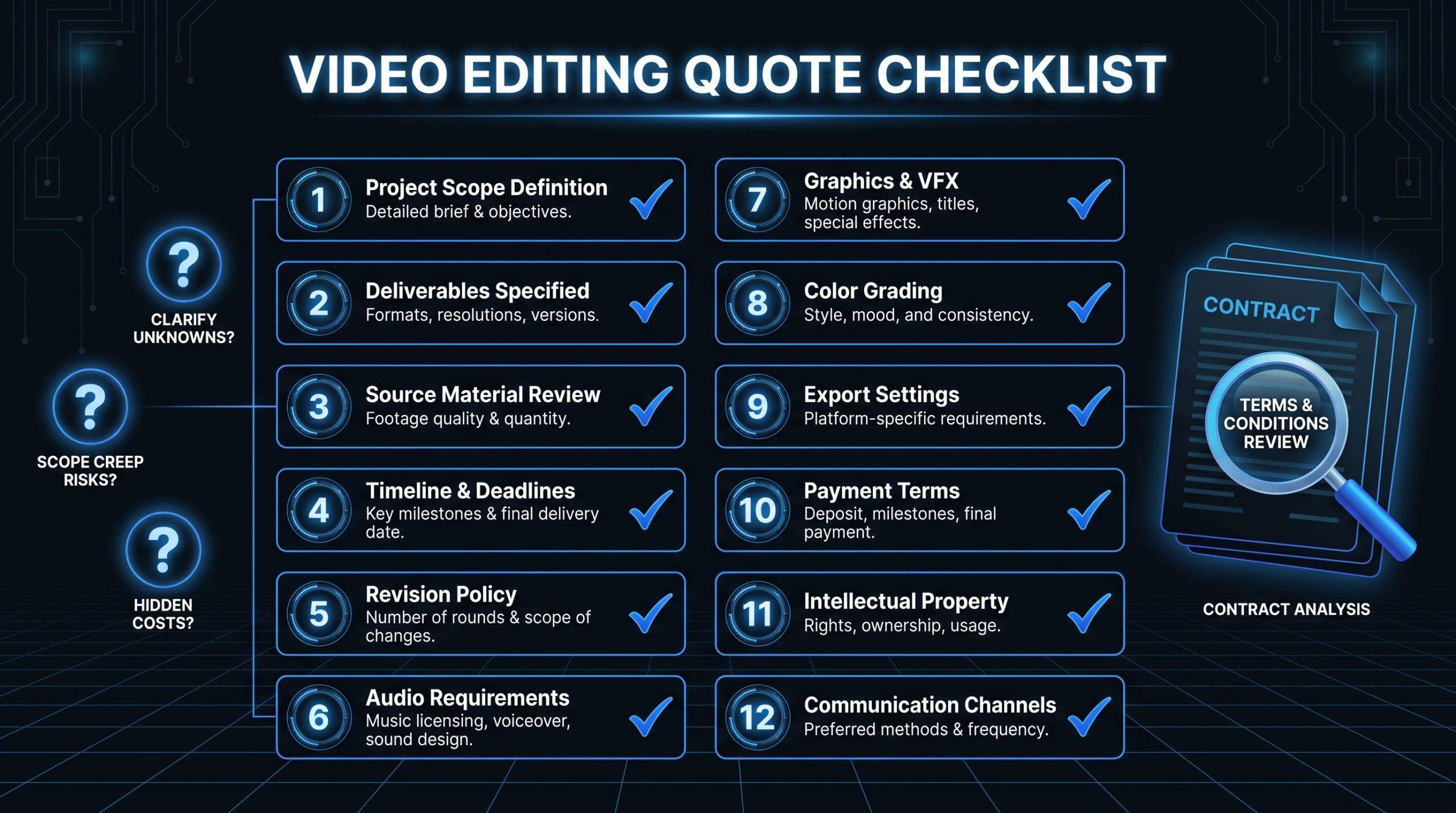
Use this table as a scoring sheet during your next vendor evaluation call. Rate each answer: green (specific and contractual), yellow (vague but not alarming), or red (evasive, absent from contract, or structurally unfavorable).
Video Editing Quote Checklist — 12 Questions + Red Flags
| # | Question | Green Flag | Red Flag |
|---|---|---|---|
| 1 | Revision policy | Defined rounds, clear definition of revision, priced overages | "Unlimited revisions" with no definition; per-comment billing |
| 2 | File ownership | Client owns all raw and project files; automatic delivery | Agency retains files; files locked to proprietary platform |
| 3 | Music/stock licensing | Perpetual commercial license independent of agency subscription; documented asset list | "We handle licensing" with no specifics; subscription-tied licenses |
| 4 | Senior vs. junior editor split | Named editor, specific role breakdown, consistent assignment | "Our team handles it"; senior only reviews junior output |
| 5 | Editor-specific portfolio | Samples from your assigned editor; pre-signing editor call offered | Agency reel only; editor introductions declined pre-signing |
| 6 | Editor backup plan | Style guide maintained; trained backup briefed; defined transition process | No contingency documented; "we'll handle it if it happens" |
| 7 | Turnaround SLA | Contractual SLA with defined credits for misses | "Typically" language; no contractual commitment; no recourse for lateness |
| 8 | Scope change process | Published rate card; written approval required before work starts | "We're flexible"; case-by-case estimates; verbal approvals only |
| 9 | Kill fee terms | Tiered by project stage; work-in-progress delivered on cancellation | Non-refundable deposit >35%; no WIP delivery; disproportionate flat fee |
| 10 | Communication cadence | Named PM; specific channel; committed response time in contract | General inbox; no committed response SLA; 20+ account PM |
| 11 | First-video onboarding | Structured onboarding; style guide created; calibration video with extra rounds included | "We'll figure it out"; generic intake form; standard rates on first video |
| 12 | Payment and price escalation | Rate locked for contract term; transparent billing; reasonable pause option | Escalation clauses not disclosed; 100% upfront required; auto-renewal traps |
Four or more red flags on a single vendor is a strong signal to keep evaluating. Two or three yellows are negotiating points — come back with specific contract language requests before signing. A vendor who resists putting reasonable terms in writing is showing you how they handle problems before you've even started working together.
How Different Vendor Types Typically Answer
The answers you get to these 12 questions vary significantly depending on whether you're evaluating a freelancer, a traditional agency, a subscription service, or a dedicated team provider. Knowing the typical pattern by vendor type helps you calibrate your expectations and know where to push hardest in each evaluation.
How Vendor Types Handle the 12 Checklist Questions
| Question Area | Freelancer | Traditional Agency | Subscription Service | Dedicated Team |
|---|---|---|---|---|
| Revision policy | Usually clear; 2–3 rounds stated | Variable; read contract carefully | Often vague; throughput-limited | Clearly defined; included rounds |
| File ownership | Usually client-owned; confirm in writing | Often retained by agency; negotiable | May be platform-locked | Client-owned; documented delivery |
| Senior/junior split | One person — you know exactly who | Opaque; depends on account size | Often junior-led; quality varies | Named team; explicit role breakdown |
| Turnaround SLA | Flexible; usually no formal SLA | Defined but often not contractual | Standardized; queue-dependent | Contractual SLA with credits |
| Scope changes | Ad hoc negotiation | Change order process; can be slow | Submit new request to queue | Rate card + PM approval workflow |
| Kill fees | Variable; often informal | Standard; check deposit percentage | Monthly; cancel anytime typical | Tiered; 30-day notice standard |
| Communication | Direct; response time varies widely | Account manager; can be slow | Platform/ticket-based | Dedicated PM; defined response time |
| Onboarding | Informal; editor-dependent | Brief intake call or document | Self-serve; minimal structured onboarding | Structured; style guide created |
Freelancers score well on transparency — you know exactly who you're getting — but poorly on backup coverage, scalability, and formal SLAs. Traditional agencies often have strong processes on paper but weaker execution on team composition questions, particularly the senior/junior split. Subscription services are optimized for throughput; the checklist questions that matter most in that evaluation are revision policy, senior/junior split, and communication. For SaaS teams producing complex, recurring content at scale, a dedicated team model typically scores best across the full checklist.
For a deeper breakdown of how these vendor models compare on actual cost per deliverable, see our video editing cost per minute analysis — it normalizes pricing across models so you're comparing apples to apples.
What Transparent Vendors Say
There's a reliable pattern among vendors who consistently deliver: they're specific, they're not defensive, and they've answered these questions before. A vendor who has built strong internal processes doesn't find these questions threatening — they find them efficient, because clear terms upfront prevent the friction that derails client relationships later.
When VEC designed its engagement model, the checklist above was a direct input into the contract terms. Every question a reasonable client should ask — revision policy, editor assignment, SLA commitment, kill fees, price lock — has a documented, written answer before the contract is signed. Not because these questions are tricky, but because transparent terms produce better client relationships from month one. You can review the specifics on the VEC pricing and engagement page.
The 90-day output guarantee VEC offers — double your video output in 90 days or month four is free — is a direct example of what it looks like when SLA commitments are backed by actual process. Guarantees like that only make commercial sense when the underlying infrastructure (SLA commitments, team allocation, onboarding quality) is already solid. When a vendor offers meaningful guarantees, it usually means they've built the operations to honor them.
If you're simultaneously evaluating multiple vendors with this checklist, Wyzowl's annual video marketing report provides useful benchmarks for industry-standard turnaround times and pricing ranges that you can use to pressure-test the numbers you're hearing. Wistia's video marketing guide is a strong companion resource for framing the content strategy context in which these vendor decisions sit.
Frequently Asked Questions
Do I need to ask all 12 questions before signing any video editing contract?
Prioritize based on your specific risk profile. For a 6-month monthly retainer, questions 9 (kill fees), 12 (payment/escalation), and 6 (editor backup) are non-negotiable. For a project-by-project arrangement, questions 1 (revision policy), 2 (file ownership), and 7 (turnaround SLA) carry the most weight. For any engagement over $5,000 per month or three months in duration, all 12 are worth running through — the return on a 30-minute call is enormous compared to the downside of discovering unfavorable terms after signing.
What's the single most important question on this list?
Question 2 — file ownership — tends to cause the worst long-term problems because its consequences aren't visible until you try to switch vendors, bring work in-house, or revisit old content. You pay the full engagement cost, produce a library of video assets, and then discover the editing infrastructure belongs to the agency. Revision policy (Q1) creates the most day-to-day friction. Kill fees (Q9) cause the most painful one-time surprises. If you're only going to verify one term in the contract before signing, make it who owns the project files.
Should I ask these questions to freelancers as well as agencies?
Yes, though the answers will look different. Freelancers typically don't offer formal SLAs, but you should confirm turnaround expectations in writing for every project. File ownership is usually cleaner with freelancers (work-for-hire is the standard assumption in most jurisdictions), but still worth explicitly confirming in your agreement. The backup coverage question is especially critical with freelancers — a solo editor who gets sick, goes on vacation, or takes on a larger client can stall your entire content calendar with no backup option available.
Is it reasonable to push back or negotiate if a vendor gives a concerning answer?
Yes, and how a vendor responds to reasonable pushback tells you as much as the original answer. Most concerning answers fall into two categories: vendor policies the agency hasn't thought through (and will agree to reasonable modifications), or policies deliberately structured to protect the agency at the client's expense (and they'll resist changes). A vendor who won't put a reasonable SLA in writing, or who insists on retaining your project files as a non-negotiable, is demonstrating how they handle client concerns before you've started working together. That information is valuable before you sign.
How do I compare quotes from vendors using completely different pricing models?
Normalize everything to effective cost per finished minute of video. Take the total expected monthly cost — base rate plus expected revision overages, licensing, and typical scope-change additions based on your historical request patterns — and divide by the total minutes of finished content you expect to receive monthly. This gives you a comparable number regardless of whether you're looking at a per-project quote, a monthly retainer, or a subscription plan. Our cost per minute breakdown provides industry benchmarks by video type to check your math against real market rates.
Ready to See What Transparent Answers Look Like?
Take this checklist into your next vendor conversation — or bring it to a call with VEC and run through all 12 questions with our team. We'll give you specific, written answers to every one before you see a contract.
Book a Free Strategy Call View Our Pricing & Terms