UGC Editing Services: 2026 Pricing Guide
TL;DR
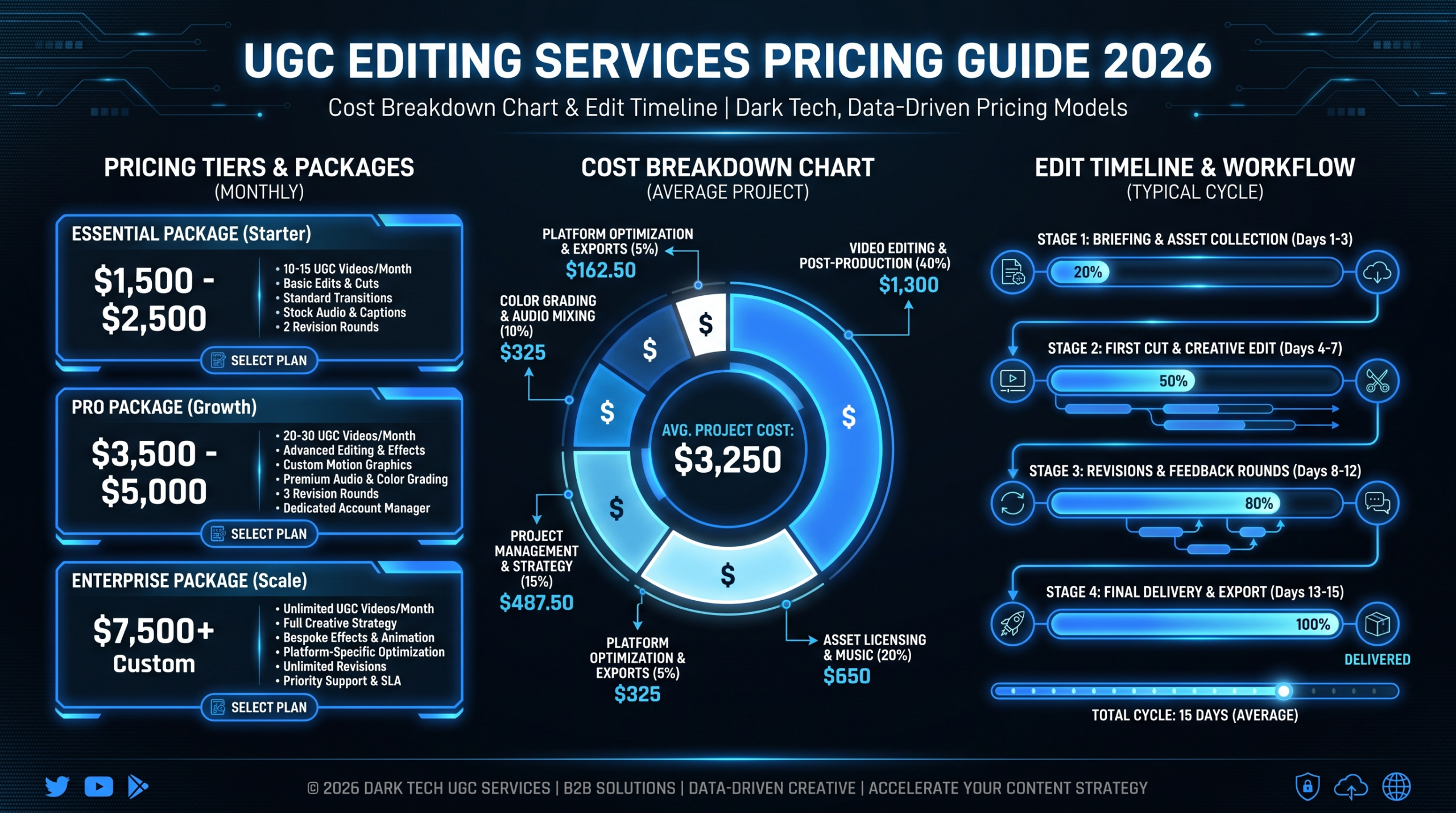
UGC editing cost typically runs $25–$150 per raw clip for basic cleanup and captions. Full-service packages — hook variants, multi-platform aspect ratios, A/B testing cuts, and paid-social cutdowns — range from $150 to $600+ per final deliverable set. Batch pricing and retainers reduce the per-video rate 30–50% compared to one-off orders. Cost spikes come from messy footage, tight turnarounds, and high variant counts. This guide breaks down what you'll actually pay at each tier and what to look for when comparing vendors.
Table of Contents
- What UGC Editing Services Actually Include
- UGC Editing Cost: Market Rate Ranges
- What Drives the Price Higher
- Pricing Models: Per-Video vs. Batch vs. Retainer
- Budget Scenarios by Team Type
- Paid-Social Cutdowns and A/B Testing Variants
- Turnaround Times and Rush Pricing
- How to Evaluate a UGC Editing Partner
- FAQ
User-generated content video has become one of the highest-performing ad formats across TikTok, Meta, YouTube Shorts, and connected TV. But the raw footage that creators deliver — shaky handheld clips, inconsistent audio, no b-roll structure — needs significant editing before it's ready to spend paid media budget behind.
That's the job of UGC editing services: take creator footage and turn it into polished, conversion-optimized assets that hold up at scale. The challenge for DTC brands, ecommerce teams, SaaS companies, and paid social managers is understanding what this service actually costs — and why two vendors can quote $30 and $300 for what sounds like the same job.
This guide covers the full UGC editing cost landscape in 2026: what's included at each price point, what makes costs climb, and how to structure your budget whether you're testing five creators or managing an ongoing UGC production engine.
What UGC Editing Services Actually Include
The scope of UGC editing varies enormously, and understanding what's included is the most important step before comparing prices. At the most basic level, UGC editing means assembling a usable video from raw creator footage. At the high end, it means producing a full suite of platform-optimized assets from that same footage — a fundamentally different deliverable.
Core Services (Basic Tier)
- Raw footage cleanup: Trimming dead space, removing false starts, syncing audio to lip movement where needed, basic color correction.
- Hook construction: Identifying and front-loading the strongest 3 seconds of the clip to stop the scroll.
- Subtitles and captions: Auto-generated captions cleaned by a human editor for accuracy, styled to match platform norms (TikTok-style animated text, clean SRT burn-in for Meta, etc.).
- Single aspect ratio output: Typically 9:16 (vertical) for short-form, or 1:1 for Meta feed. One format, one file.
Full-Service UGC Editing
- Multi-hook variants: The same creator footage cut with 2–5 different opening hooks — different first lines, different visual entry points — for split testing. Each variant is a separate deliverable.
- Multi-platform aspect ratios: 9:16 for TikTok/Reels/Shorts + 1:1 for Meta feed + 16:9 for YouTube or connected TV. Three files per video.
- Paid-social cutdowns: Shorter 15- or 30-second versions of longer UGC pieces, restructured specifically for paid placements. Not a simple trim — the narrative has to work in the reduced runtime.
- B-roll integration: Overlaying product shots, screen recordings, or stock footage to support creator claims.
- Brand motion overlays: Animated lower thirds, logo bugs, end cards, and brand-consistent text styles.
- A/B testing variants: Systematic production of testable variables — different CTAs, different text overlay positions, different music tracks — for structured creative testing programs.
The gap between "basic cleanup" and "full UGC creative suite" explains why prices vary so dramatically. A one-file delivery with captions is a different product than a 12-asset package with five hook variants across three aspect ratios.
UGC Editing Cost: Market Rate Ranges
Market rates for UGC editing in 2026 fall into four clear tiers: freelancer platforms, production freelancers, boutique UGC agencies, and dedicated editing teams with deep brand familiarity. Each has a different cost structure and a different quality ceiling.
UGC Editing Cost by Tier (2026 Market Ranges)
| Tier | Per-Video Rate | What You Get | Best For |
|---|---|---|---|
| Freelancer platforms (Fiverr, Upwork) | $15–$60 | Basic cut, auto-captions, one aspect ratio; variable consistency | Testing low volume; non-paid-media content |
| Production freelancer (vetted, ongoing) | $50–$150 | Quality cleanup, styled captions, one format; consistent style if long-term | Small teams, 5–20 videos/month |
| Boutique UGC editing service | $100–$350 | Hook-optimized cut, multi-format, branded elements; project management | DTC/ecommerce brands running paid UGC |
| Dedicated editing team (agency/retainer) | $60–$200 effective per video at volume | Full suite: hook variants, A/B assets, cutdowns, multi-platform; brand knowledge | Growth-stage brands with ongoing paid social |
A few important caveats about these ranges. The "per-video rate" for dedicated teams typically looks higher on the monthly invoice — you're paying a flat retainer — but the effective per-asset cost drops substantially as volume increases. Also, the freelancer platform tier carries the highest hidden cost: inconsistency. When the same creator's footage gets assigned to different editors each week, output quality diverges and your creative testing data becomes unreliable.
Per-Service Rate Breakdown
If you're buying individual services rather than packages, here's how individual line items typically price in 2026:
Individual UGC Editing Services — Rate Ranges
| Service | Typical Range | Notes |
|---|---|---|
| Raw footage cleanup + basic cut (single format) | $25–$80 | 60–90 sec final output from 3–10 min of raw footage |
| Styled captions / subtitles | $10–$35 add-on | Auto-gen + human QA; animated captions cost more |
| Additional aspect ratio version | $15–$45 per format | 9:16 → 1:1 or 16:9 conversion |
| Hook variant (same footage, different opening) | $30–$80 per variant | Includes finding, trimming, and rebuilding the hook |
| Paid-social cutdown (15 or 30 sec) | $40–$100 | Narrative restructure, not just a trim |
| B-roll / product shot integration | $30–$80 add-on | Assuming client provides the b-roll assets |
| Brand motion overlay (lower thirds, end card) | $25–$60 add-on | One-time template creation higher; per-video application lower |
| A/B testing asset pack (full variant set) | $150–$500 | Typically 4–8 deliverables per creator clip |
To put this in context against broader video editing rates, see our breakdown of video editing cost per minute — UGC editing often runs below the per-minute cost of long-form content because the raw footage is shorter, even if the service complexity is high.
What Drives the Price Higher
Understanding UGC editing cost requires knowing the specific factors that cause estimates to spike. Two briefs that sound identical on paper can produce quotes that differ by 3–5x based on these variables.
Footage Complexity
Creator footage varies enormously in quality. Footage shot in a professional environment with good natural light, stable framing, and clean audio is straightforward to edit. Footage shot in mixed lighting with background noise, inconsistent framing, and multiple false starts takes significantly longer to work with. Editors commonly report that difficult footage takes 2–3x longer to cut than clean footage — and if pricing isn't fixed, that time shows up on your invoice.
Number of Hook Variants
Each additional hook variant isn't just a minor tweak — it's a distinct creative decision. The editor has to identify a different strong moment in the footage, rebuild the opening around it, potentially resequence the middle section to maintain narrative flow, and recut the caption timing. Three hook variants from one creator clip can represent nearly as much work as three separate videos.
Aspect Ratio Count
Multi-platform delivery multiplies work. 9:16, 1:1, and 16:9 versions of the same video are three separate files, each requiring reframing decisions (especially for talking-head UGC where the subject's face needs to remain in the safe zone across all formats). Platforms like Meta and TikTok have different recommended aspect ratios, and automated conversion tools produce poor results for content where framing matters.
Caption Complexity
Auto-generated captions from tools like Descript or Premiere's transcription features are fast but imperfect — especially with creator accents, product names, or brand terminology. Human QA on captions adds time. Animated captions (word-by-word pop-in, karaoke-style highlighting, emoji integration) add more. A branded caption style developed from scratch for a new client adds even more at the setup stage.
Turnaround Requirements
Rush orders typically carry a 25–50% premium. The definition of "rush" varies by vendor: some can turn around same-day for a fee; others define rush as anything under 48 hours. If your paid-social team needs fresh creative for a Friday campaign and assets arrive Tuesday, you're paying rush rates regularly. Batch submissions with 5–7 day lead time typically get standard pricing.
Volume vs. One-Off
One-off orders carry a significant markup. The editor has to ramp up on your brand from scratch — understand your product, your competitor positioning, your creator's typical style and what works. Consistent batch orders amortize that ramp-up cost. Vendors who know your brand deeply can complete the same edit in less time, and those savings are typically shared through volume pricing.
Pricing Models: Per-Video vs. Batch vs. Retainer
The right pricing model for UGC editing depends on your volume, predictability, and how tightly integrated your editing partner needs to be with your creative testing program.
Per-Video Pricing
The simplest model: you submit footage, they quote a price per deliverable, you pay per output. Works well for sporadic needs — a campaign test, a one-off creator partnership, overflow capacity. Carries the highest effective per-video cost and the least brand consistency over time. Most appropriate when you're producing fewer than 10–15 UGC videos per month.
Batch Pricing
You submit a batch of creator clips (typically 5–20 at a time) and receive a bundled price with a per-unit discount vs. one-off ordering. Batch pricing is common in UGC-specific agencies that handle high volumes of similar content. A vendor who processes 50 creator clips at once can standardize their workflow — same caption style, same brand template, same quality bar — in a way that serial one-off submissions can't match. Discounts for batch ordering typically range from 15–35% off one-off rates.
Monthly Retainer
A fixed monthly fee for an agreed volume of deliverables or editing hours. The right model for brands running active paid-social programs where UGC editing is a continuous function, not a campaign-by-campaign purchase. Retainers provide predictable budget, reserved editor capacity, and the deep brand familiarity that improves edit quality over time. For a full breakdown of retainer economics, see our guide on what's included in professional video editing services.
Retainer pricing for UGC editing typically starts around $2,500–$4,000/month for a small brand (10–20 deliverables) and scales to $8,000–$15,000/month for teams producing 50–100+ assets per month across multiple creators and platforms. The effective per-video cost at retainer scale — when you factor in variants and cutdowns — often comes in well below batch pricing per individual deliverable.
VEC's dedicated editing retainers (Growth $5K/mo, Core $9.5K/mo, Scale $16K/mo) are structured around this model — a fixed team that handles ongoing UGC and brand video production for B2B and DTC clients. The dedicated team model means the same editors work on your account every month, building brand context that makes each subsequent round of editing faster and better.
Per-Creator Model
Some UGC-focused agencies price per creator rather than per video. You pay a monthly fee that covers editing all footage from one creator's monthly output — typically a set number of videos per month. This works well when you have a fixed creator roster but variable footage volume. The risk is that underperforming creators generate the same fee regardless of how many videos they actually submit.
Budget Scenarios by Team Type
To make the pricing concrete, here's what UGC editing budgets look like across different buyer types in 2026.
UGC Editing Budget Scenarios by Team Type
| Team Profile | Monthly Volume | Typical Budget Range | Recommended Model |
|---|---|---|---|
| DTC brand, early testing (Seed–Series A) | 5–15 creator clips/mo | $500–$2,500/mo | Per-video or small batch |
| Ecommerce brand, active paid social | 20–50 deliverables/mo | $2,500–$6,000/mo | Batch pricing or light retainer |
| SaaS company, demo + social content | 10–30 videos/mo mixed | $2,000–$7,000/mo | Retainer with mixed UGC + product video |
| Paid social team, performance creative | 50–100+ assets/mo | $5,000–$15,000/mo | Dedicated editing team |
| Individual creator / UGC creator | 4–12 videos/mo | $200–$800/mo | Per-video or platform subscription |
The biggest budget shock most teams encounter is the jump from "we need a few videos edited" to "we're running a systematic creative testing program." The latter isn't just more videos — it's a fundamentally different editorial process. You're not finishing footage; you're building a library of testable assets where each variant has to be correctly structured to isolate the variable you're testing.
DTC and Ecommerce Teams
DTC brands running Meta and TikTok ads typically need the highest asset volume because creative fatigue is real and algorithmic reach declines fast on repeated creative. Ecommerce teams often find that 3–5 hook variants per creator clip, delivered weekly, is the minimum viable cadence for keeping paid campaigns fresh without constantly sourcing new creators. At that volume — say, 40 deliverables/month — a retainer or high-volume batch pricing almost always beats per-video ordering.
SaaS and B2B Teams
SaaS teams using UGC typically have lower raw volume but higher complexity per video: screen recording integrations, product walkthrough overlays, demo-specific captions, compliance-aware text. The mix of UGC and professional video editing makes dedicated team retainers a natural fit. See our guide to SaaS video production for how leading SaaS content teams structure their full video operation.
Creator and UGC Creator Teams
Individual creators and creator studio operators typically need consistent, fast, affordable editing — not complex paid-social infrastructure. Platform-style subscriptions (one active request, 48–72hr turnaround) and per-video freelancer relationships are the dominant model in this segment. The tradeoff is consistency: a new editor on each job means the style and caption treatment can vary week to week.
Paid-Social Cutdowns and A/B Testing Variants
Paid-social cutdowns and A/B testing variants represent the highest-value — and most misunderstood — part of UGC editing services. The goal is systematic, not creative: you're building assets designed to isolate testable variables in your paid media creative.
What a Paid-Social Cutdown Actually Requires
A 15-second cutdown from a 60-second UGC video isn't a trim — it's a restructure. The first 3 seconds still need to function as a hook (often different from the original's hook). The middle 10 seconds need to deliver enough context that the viewer understands the offer without the setup from the full video. The final 2 seconds need a clear CTA. Editors without paid-social experience often produce cuts that are technically correct but narratively broken — they feel like they're missing context because they are.
Effective paid-social cutdowns typically require editors who understand the funnel purpose of the ad (awareness vs. retargeting vs. conversion), the platform's user behavior, and your specific offer structure. This is skilled editorial work, not a mechanical trim.
Structuring A/B Testing Variant Packages
The most common structured A/B testing approach for UGC is the hook test: keep everything constant (same body, same CTA, same music) and vary only the first 3 seconds. This requires producing 3–5 versions of the opening from the same creator footage, then delivering all variants in identical formats so your attribution data is clean.
Good creative testing requires disciplined asset production. If the hooks are different but the caption styles are also different, you can't isolate what drove the performance variance. The editing process has to be rigorous, not just fast.
Beyond hook tests, teams also commonly test: CTA text overlays (different end-card copy), music tracks (same edit, different audio feel), caption styles (no captions vs. styled subtitles), and video length (60-sec vs. 30-sec vs. 15-sec). Each of these requires distinct editorial work — the number of test dimensions determines how many variants you need per creator clip, and therefore how your editing costs scale.
For a broader look at how UGC video fits within a performance creative stack, Wistia's video marketing resource hub covers how leading teams structure their creative testing programs. Sprout Social's guide to user-generated content also provides useful context on how UGC is being used across paid and organic social channels.
Turnaround Times and Rush Pricing
Turnaround expectations vary significantly by vendor and service tier. Understanding the standard timelines — and what triggers rush pricing — helps you build a realistic editorial calendar.
UGC Editing Turnaround Time Benchmarks
| Turnaround | Typical Premium | What This Looks Like |
|---|---|---|
| Standard (5–7 business days) | Base rate | Planned campaign cycles; batch submissions |
| Fast (2–3 business days) | +15–25% | Reactive campaigns; reactive creator content |
| Rush (24 hours) | +30–50% | Same-day ad response; trending audio capture |
| Emergency (same day / <8 hours) | +50–100%+ | Crisis creative; launch-day response |
Teams that run a consistent editorial calendar — creator content in on Mondays, edited assets returned by Thursday, live campaigns Friday — avoid rush premiums almost entirely. The teams most likely to pay rush fees are those with reactive, campaign-by-campaign workflows where creative requests come in without lead time. If rush fees are a recurring line item in your budget, it's usually a planning problem, not an editing problem.
Dedicated retainer relationships often include 48-hour turnaround as standard (without premium pricing), because the editor team isn't balancing your work against other clients. This is one of the underappreciated benefits of retainer structures — your baseline speed improves without needing to pay for it separately. For more on how outsourcing video editing affects turnaround and cost, see our guide on how to outsource video editing.
How to Evaluate a UGC Editing Partner
The right UGC editing partner isn't just the cheapest or fastest — it's the one whose workflow integrates cleanly with your production process and whose quality bar matches your paid media standards. Here's how to evaluate vendors before committing.
Request a Sample Edit
Any credible UGC editing service should be willing to edit one or two of your creator clips as a paid test before you commit to a contract. Use real footage — your messiest, most challenging creator clip, not the cleanest one. The test tells you how the vendor handles the hard cases that will inevitably come up in production. Evaluate: hook strength, caption accuracy, visual consistency with your brand, and responsiveness to feedback.
Ask About Editor Consistency
Will the same editor handle your account over time, or are clips distributed across a pool? Pool-based models are more scalable for the vendor but worse for your brand consistency. Ask directly: "If I'm happy with the quality on this first batch, will the same person edit my ongoing submissions?" A "yes" with no qualification is good. A hedged answer about their assignment process is a signal.
Understand the Revision Process
How many revision rounds are included? What counts as a revision (a caption fix vs. a structural recut)? What's the turnaround on revisions? Revision terms are where many UGC editing relationships break down — the vendor considers the job done, the client considers it unfinished, and there's no clear process for resolution. Get this in writing before starting.
Check Platform Familiarity
Editors who work primarily on YouTube long-form may not have the instincts for TikTok-style UGC hooks. Ask to see examples specifically on the platforms you're targeting. An editor who can articulate why a hook works on TikTok vs. Instagram Reels (different user velocity, different content expectations) has the platform awareness you need for paid social UGC.
Evaluate Pricing Transparency
Can the vendor give you a clear per-deliverable price list, or do they require a custom quote for every project? Transparent pricing suggests an established, scalable workflow. Constant custom quoting often means pricing is inconsistent or that the vendor is optimizing per-job rather than building a durable relationship.
Teams scaling their UGC creative programs often find that VEC's dedicated editing model — where a fixed team handles all UGC and video editing across the account — provides the consistency and turnaround speed that per-job vendors can't match at volume. See our pricing page for current retainer structures.
Frequently Asked Questions
How much does UGC editing cost per video?
Basic UGC editing — raw cleanup, captions, single aspect ratio — typically runs $25–$150 per video depending on footage quality and the vendor tier. Full-service packages with hook variants, multi-platform formats, and cutdowns range from $150 to $500+ per creator clip, reflecting the multiple deliverables produced from each piece of footage.
What's included in UGC editing services?
At minimum: footage cleanup, hook construction, captions, and single-format output. Higher-tier services add multi-hook variants (same footage, different openings for A/B testing), multi-platform aspect ratios (9:16, 1:1, 16:9), paid-social cutdowns (15 or 30 sec), b-roll integration, and brand motion overlays. The scope varies significantly between vendors — always confirm the deliverable list before comparing prices.
Is batch pricing worth it for UGC editing?
Yes, for most brands producing more than 10 UGC videos per month. Batch pricing typically reduces the per-video rate by 15–35% compared to one-off ordering, and the workflow consistency from submitting organized batches usually improves quality as well. The breakeven point where batch pricing clearly beats one-off depends on your vendor, but generally kicks in around 10–15 videos per submission.
How many hook variants should I order per creator clip?
For active paid social campaigns, 3–5 hook variants per creator clip is a common starting point. This gives you enough variation to identify a top performer without producing so many variants that your media budget can't fund meaningful impressions on each. As you scale your creative testing program, the number of variants per clip can increase — particularly for evergreen product categories where creative cycles are long.
When does a UGC editing retainer make more sense than per-video pricing?
A retainer typically makes sense when you're producing 20 or more edited deliverables per month consistently, when you need consistent brand treatment across all output, and when turnaround time matters enough that you need reserved capacity. The monthly cost looks higher than per-video pricing on a small order, but the effective per-deliverable cost at volume — and the quality improvement from ongoing brand familiarity — usually makes retainers the better choice for brands running active paid social programs. For a broader comparison of video editing pricing structures, see our guide on video production agency pricing models.
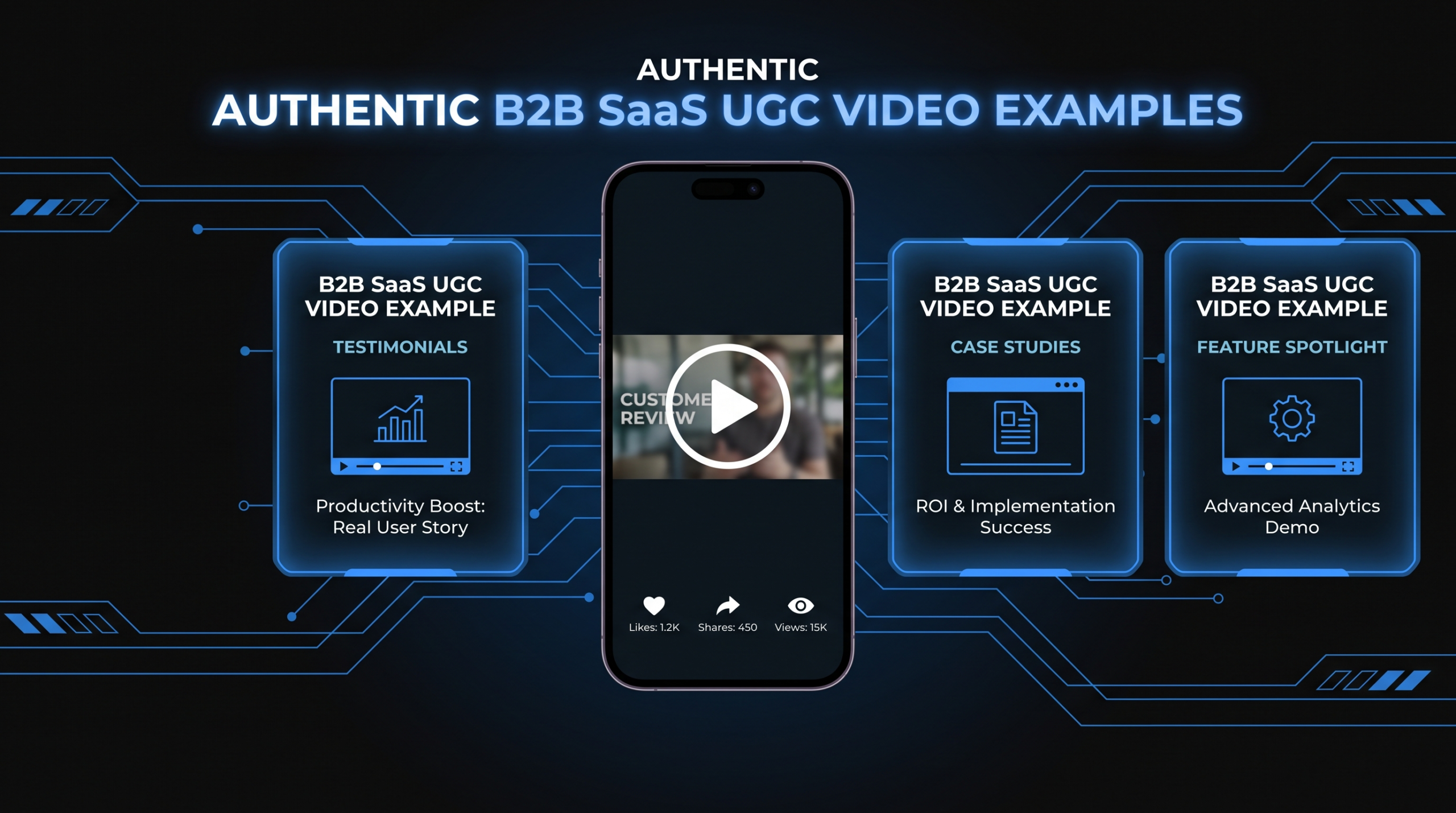
If you want to see how UGC fits into the broader B2B video mix, our guide to UGC video examples for B2B & SaaS walks through 8 real formats — including screen-share testimonials, day-in-the-life walkthroughs, and comparison hooks — with embedded examples and a full cost breakdown.
Building a UGC Editing Program That Scales?
VEC's dedicated editing teams handle ongoing UGC editing, hook variants, paid-social cutdowns, and multi-platform delivery for DTC, ecommerce, and SaaS brands. Same team every month. Predictable pricing. Built for creative testing at volume.
Book a Free Strategy Call See Pricing Plans