Thought Leadership Videos for Consultants
TL;DR
Consultants who generate consistent deal flow from content combine three formats—POV videos, expert or partner interviews, and repurposed webinars—distributed two to four times per week on LinkedIn. The production model that makes this sustainable is a remote post-production retainer: you appear on camera, a dedicated team handles editing, captions, motion graphics, and social cuts. Production retainers typically start around $5K–$9.5K/month at meaningful output volume. The return on this investment is authority and deal-velocity, not reach metrics.
Table of Contents
- Why Video Is the Authority Channel for Consultants in 2026
- POV Videos: The Fastest Format to Build a Consulting Brand
- Webinar Repurposing: One Session, Twelve Assets
- Case-Study-Led Thought Leadership: Let Results Do the Talking
- Partner and Expert Content: Borrowing Credibility at Scale
- LinkedIn Distribution: Where Consulting Video Actually Lands
- Editorial Cadence and Review Workflow
- Remote Post-Production Economics for Consultants
- Frequently Asked Questions
Why Video Is the Authority Channel for Consultants in 2026
Video has become the primary trust signal in consulting business development. A white paper takes six weeks to produce and rarely gets shared spontaneously; a two-minute POV video reaches a potential client's feed within 48 hours of recording. The consulting firms and independent practitioners who understand this distinction are consistently shortlisting earlier, warming cold conversations before the first call, and closing faster than their text-only peers.
The mechanism is straightforward: consulting engagements are high-trust, high-stakes purchases. Buyers spend considerable time researching how a consultant thinks before they agree to a discovery call. Video compresses that research loop. When a VP of Operations watches three of your videos before reaching out, the first call feels like the third meeting. The trust gap—normally closed over months of proposals and references—is already substantially bridged.
The challenge consultants face is not knowing whether video is worth it—it clearly is—but building a production system that produces content consistently without consuming time reserved for billable engagements. That production problem is what this guide addresses.
POV Videos: The Fastest Format to Build a Consulting Brand
POV (point-of-view) videos—where a consultant speaks directly to camera about a specific opinion, framework, or industry observation—are the highest-leverage format for consulting thought leadership. They're fast to produce, personal in tone, and algorithmically favored on LinkedIn. More importantly, they communicate something no case study or white paper can: how you think under uncertainty.
What Makes a POV Video Actually Work
A strong consulting POV video has three characteristics. First, it takes a specific, arguable position—not "change management is important" but "most change management programs fail because they measure adoption, not behavior change." Second, it runs between 90 seconds and four minutes: long enough to develop the argument, short enough to hold attention without sound. Third, it opens with the conclusion, not the wind-up. Both LinkedIn's algorithm and the average viewer reward videos that reach the point within the first ten seconds.
The formats that consistently perform for consulting POVs:
- The contrarian take. Challenge a widely held assumption in your practice area. State the opposing view in the first sentence so the viewer immediately understands what they're watching.
- The client pattern. "In the last 12 months, every engagement I've started with a [role] began with the same conversation about [problem]." This signals experience without naming clients, and it's immediately relatable to anyone in that role.
- The framework reveal. Walk through a three-step or four-part model you use. Give it away completely. The value isn't the framework—it's the judgment that comes from knowing when to apply it.
- The 'what I wish I'd known' format. Lessons from real engagements, properly anonymized. High credibility and high shareability because it implies earned experience.
Production Requirements for POV Videos
POV videos don't require studio production. What they require is consistent visual identity. The same background, the same lighting setup, the same intro-to-video framing every time. That consistency signals professionalism and makes your content recognizable as a series rather than isolated clips. The polish itself comes from post-production—clean captions, tight cut points between takes, a title card that conveys the main argument without sound.
Native LinkedIn uploads substantially outperform links to external platforms. This means you need a properly edited file for every upload, not a raw recording. The editing requirement is where most solo practitioners get stuck—which is why the production model matters as much as the content.
For a detailed look at how thought leadership video strategy works across the full SaaS and professional services funnel, our related post on thought leadership video strategy for SaaS founders covers complementary positioning mechanics that consulting practices can adapt directly.
Webinar Repurposing: One Session, Twelve Assets
Webinars are the most underutilized asset in consulting content programs. A 60-minute live session typically generates one recording, which gets emailed to registrants and then forgotten. The better approach: treat every webinar as a content production event that yields 10–14 derivative assets over the following four to six weeks.
The Repurposing Stack
From a single well-recorded 60-minute webinar, a professional editing team can extract:
- Three to five standalone POV clips (two to four minutes each) featuring the consultant's strongest self-contained arguments
- Eight to twelve short-form clips (60–90 seconds) formatted for LinkedIn native upload and newsletter embedding
- A highlight reel (three to five minutes) for the firm's website or YouTube channel
- Audiogram versions with waveform animation for podcast-adjacent distribution
- A full edited version with chapter markers, lower thirds, and normalized audio for the YouTube archive
This stack stretches a single recording session into six to eight weeks of consistent posting without requiring the consultant to appear on camera again. For practices that can run one solid live session per month—a client webinar, a panel discussion, an expert interview—this approach makes sustained content output genuinely feasible within normal consulting workload constraints.
What Requires Post-Production Work
Raw webinar recordings are rarely suitable for direct distribution. Common issues include variable audio quality across speakers with different setups, long dead-air sections during transitions, slides that don't read well when cropped to vertical format, and the absence of captions. According to LinkedIn's creator guidance (business.linkedin.com/marketing-solutions), captioned videos see substantially higher completion rates than uncaptioned ones—because most LinkedIn video is watched silently in a scroll.
A dedicated editing team handles all of these issues as part of the repurposing workflow. The result is content that looks intentional and structured rather than incidental and cobbled together.
Our guide on what's included in professional video editing services covers exactly what goes into this kind of multi-asset production, including the turnaround timelines consultants should expect.
Case-Study-Led Thought Leadership: Let Results Do the Talking
Case study videos are typically the highest-converting asset in a consulting content program. They combine social proof with methodology demonstration—showing not just that results were achieved, but how the consultant thinks through problems. Done well, they answer the buyer's implicit question before it's asked: "Would this approach work for us?"
The Consulting Case Study Video Format
The five-part structure that works consistently for consulting case study videos:
- Context in 30 seconds. Client profile—industry, approximate size, presenting situation—without naming them. "A 200-person professional services firm facing a billing reconciliation problem across three geographies" is enough to establish credibility and relevance.
- The diagnosis phase. What the consultant found when they actually started looking. This part demonstrates methodology more than any other section—it shows whether the consultant asks sharp questions or accepts surface-level answers.
- The intervention. What was actually done, described at the level of principle rather than proprietary process detail. Buyers at this stage want to assess fit, not copy the methodology.
- The result, hedged accurately. "Within six months, the client's operational throughput had improved substantially and the team had rebuilt confidence in the tracking system" is credible and honest. Specific percentages without verifiable sourcing undermine credibility—avoid them entirely.
- The transferable lesson. One insight the viewer can apply regardless of whether they hire you. This is the element that drives sharing and earns trust beyond the immediate buyer.
This five-part structure works comfortably in three to six minutes of video and converts more reliably than a written case study because the consultant's presence makes the narrative credible. The viewer is evaluating judgment in real time.
Client Approval Workflow
Many consultants avoid case study video because of client approval complexity. The practical solution is to obtain written permission during the engagement, not after the fact. A brief video case study clause in the engagement letter is easy to include and easy for satisfied clients to approve. Clients who hesitate are providing useful signal about satisfaction levels.
Anonymized versions perform nearly as well as named case studies. "A Series B SaaS company in logistics with a 90-day customer onboarding problem" signals relevant experience without breaching confidentiality. The review workflow for case study video should include a client-approval checkpoint before the final cut is published, and that checkpoint should be built into the production timeline rather than added as an afterthought.
Partner and Expert Content: Borrowing Credibility at Scale
Solo consultants and boutique firms face an authority scalability problem: building credibility from a single perspective takes time. Partner and expert content accelerates this by bringing external voices—with their own audiences and credentials—into your video presence.
Interview Formats That Work for Consultants
The interview formats with the strongest performance record in consulting thought leadership:
- Peer-to-peer debate. Two practitioners with similar but genuinely distinct views on a methodology or market trend. Works because authentic disagreement is more watchable than polished consensus. The viewer gets to pick a side, which increases engagement and retention.
- Client spotlight. A brief interview with a satisfied client discussing the challenge and outcome in their own words. Carries dramatically more weight than the consultant describing the same result—the credibility gap between self-report and third-party testimony is significant in professional services.
- Expert Q&A with an adjacent domain specialist. You pose questions to a private equity partner, a regulatory specialist, or a technology vendor's founder. You benefit from association and provide context; they get distribution and positioning. The arrangement is mutually valuable and easy to propose.
Production Logistics for Remote Expert Interviews
Most consulting firm expert interviews happen remotely via Zoom, Teams, or similar platforms. The production challenge is quality consistency: the guest may be recording on a laptop camera in inadequate lighting. Standard solutions include sending a pre-interview tech guide (lighting angle, audio check, camera height at eye level), recording both feeds at full quality, and using a post-production normalization process that equalizes visual quality across participants.
Wistia's production guidance (wistia.com/learn/production) recommends a similar prep-and-normalize approach for professional remote interviews. VEC handles this normalization as a standard part of the remote interview editing workflow, including lower thirds with speaker attribution and consistent color grading across all participants.
LinkedIn Distribution: Where Consulting Video Actually Lands
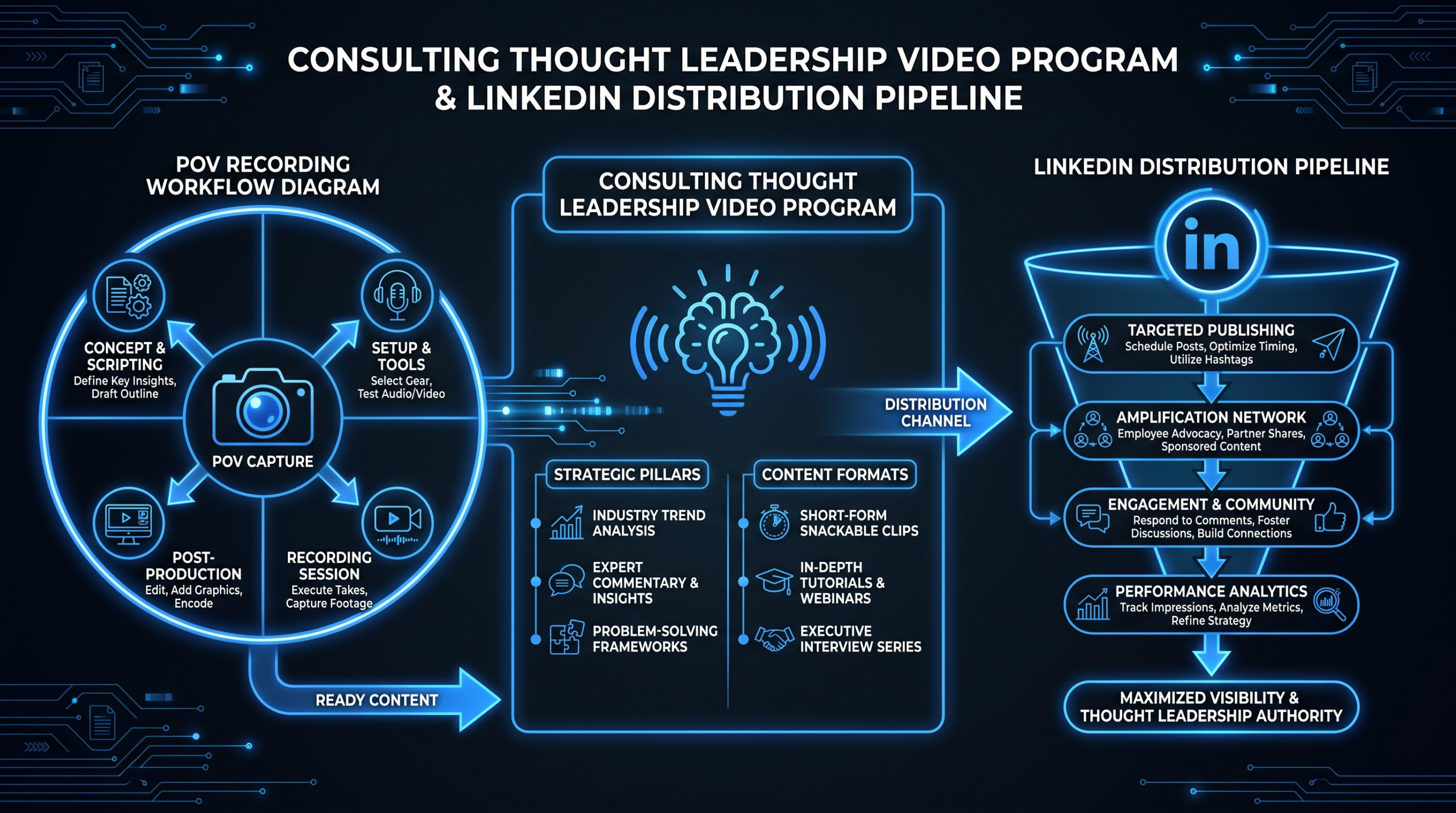
LinkedIn remains the primary distribution channel for consulting thought leadership video in 2026. The platform's algorithm explicitly rewards native video uploads, and its audience skews toward decision-makers in the purchasing role for consulting services. Knowing how to distribute correctly is as important as producing quality content—a well-edited video posted as a YouTube link will consistently underperform the same video uploaded natively.
Distribution Mechanics That Consistently Work
Native video outperforms YouTube or Vimeo links on every measurable dimension. Upload the edited file directly to LinkedIn—do not post an external video link in the caption. LinkedIn suppresses link-based posts in organic distribution; native uploads receive algorithmic promotion.
Caption strategy is equally important: the first two lines of text appear before the "see more" fold on mobile. Those two lines determine whether the viewer pauses to watch. The best-performing openers are either the main argument stated plainly ("Most consulting retainers are priced wrong—here's the structural reason why") or a specific question the target audience is actively navigating ("How do you tell a CFO that their cost-reduction initiative is about to increase costs by 20%?").
Posting cadence: two to four times per week is the sustainable range for individual consultants and small practices. Fewer than twice weekly makes momentum difficult to build; more than four and content quality tends to decline or the feed feels like noise. The weekly schedule should rotate across POV clips, case-study content, and partner or expert material to maintain variety.
LinkedIn Algorithm Behavior Worth Understanding
LinkedIn's algorithm weights early engagement—especially comments in the first 60–90 minutes—more heavily than total reach. Notifying two or three colleagues or practice partners to comment on a post shortly after publishing has a disproportionate effect on organic distribution. This is standard content promotion practice, not a workaround.
Videos under four minutes see meaningfully better completion rates on LinkedIn than longer formats. If webinar repurposing generates clips of six or seven minutes, releasing them as two-part content often outperforms the single full clip in both completion rate and net engagement.
Editorial Cadence and Review Workflow
The consulting practices that sustain consistent video output over months solve the same operational problem: they decouple content creation from content production. The consultant creates—records, speaks, participates in interviews. The production team handles editing, captions, formatting, and distribution-ready exports. The review workflow is the bridge between the two, and its design determines whether the whole system is sustainable or chronically bottlenecked.
A Functional Monthly Cadence
Monthly Consulting Video Cadence — Sustainable Model
| Week | Consultant's Role | Production Team's Role | Output by End of Week |
|---|---|---|---|
| Week 1 | Record 2–3 POV videos (30–45 min total recording time) | Edit, caption, export POV clips + LinkedIn-format social cuts | 3 POV videos, 6 short-form clips |
| Week 2 | Host monthly webinar or conduct expert interview | Process live session recording through repurposing stack | 1 full edit, 4–6 POV clips, 8–10 social-format cuts |
| Week 3 | Record 1 case study video; review and approve Week 1–2 deliverables | Edit case study; deliver all Week 3 assets for review | 1 case study video, 3–4 cuts; client approval checkpoint |
| Week 4 | Final approvals; load content calendar for following three weeks | Apply final revisions; finalize backlog and scheduling queue | Content calendar loaded 3–4 weeks forward |
The Review Workflow That Doesn't Kill Cadence
Review workflows with more than two approval rounds consistently kill publishing cadence. The structure that works in practice: first cut delivered within 48–72 hours of recording; consultant provides written feedback asynchronously—not a call, which compresses the review into a synchronous schedule; second cut is considered final unless there is a factual error or a client approval issue. Cosmetic preferences should be resolved through a style guide agreed at the start of the engagement, so they don't recur as round-by-round debates.
What Kills Cadence in Consulting Content Programs
- Waiting for the perfect recording. Good-enough recordings produced consistently outperform sporadic excellent recordings by a significant margin. LinkedIn rewards publishing frequency within reason; the algorithm does not know which videos were recorded in two takes versus twenty.
- Single-point approval bottlenecks. If the senior partner must personally approve every clip, every clip is delayed to their schedule. Define upfront which formats require senior approval and which can be cleared by a marketing lead or chief of staff.
- Scope creep in edits. The production team needs a defined scope—captions, music, graphics, format exports yes; script rewriting or adding motion graphics not in the brief, no. Anything outside scope should trigger a change order, not a free revision round.
Remote Post-Production Economics for Consultants
Remote post-production—where a consulting firm's raw recordings are sent to a specialist editing team who delivers polished, distribution-ready assets—is the production model that makes consulting thought leadership economically sustainable. Here is the honest economic picture.
What Remote Post-Production Actually Costs
Remote Post-Production Cost Tiers for Consulting Firms
| Production Model | Monthly Cost Range | Typical Monthly Output | Best For |
|---|---|---|---|
| Single freelance editor (async) | $1,000–$3,500 | 6–10 finished deliverables | Solo practitioners, light cadence, simple formats |
| Subscription editing service | $1,500–$5,000 | 8–15 clips (sequential queue) | High-volume social clips; limited to simple edits |
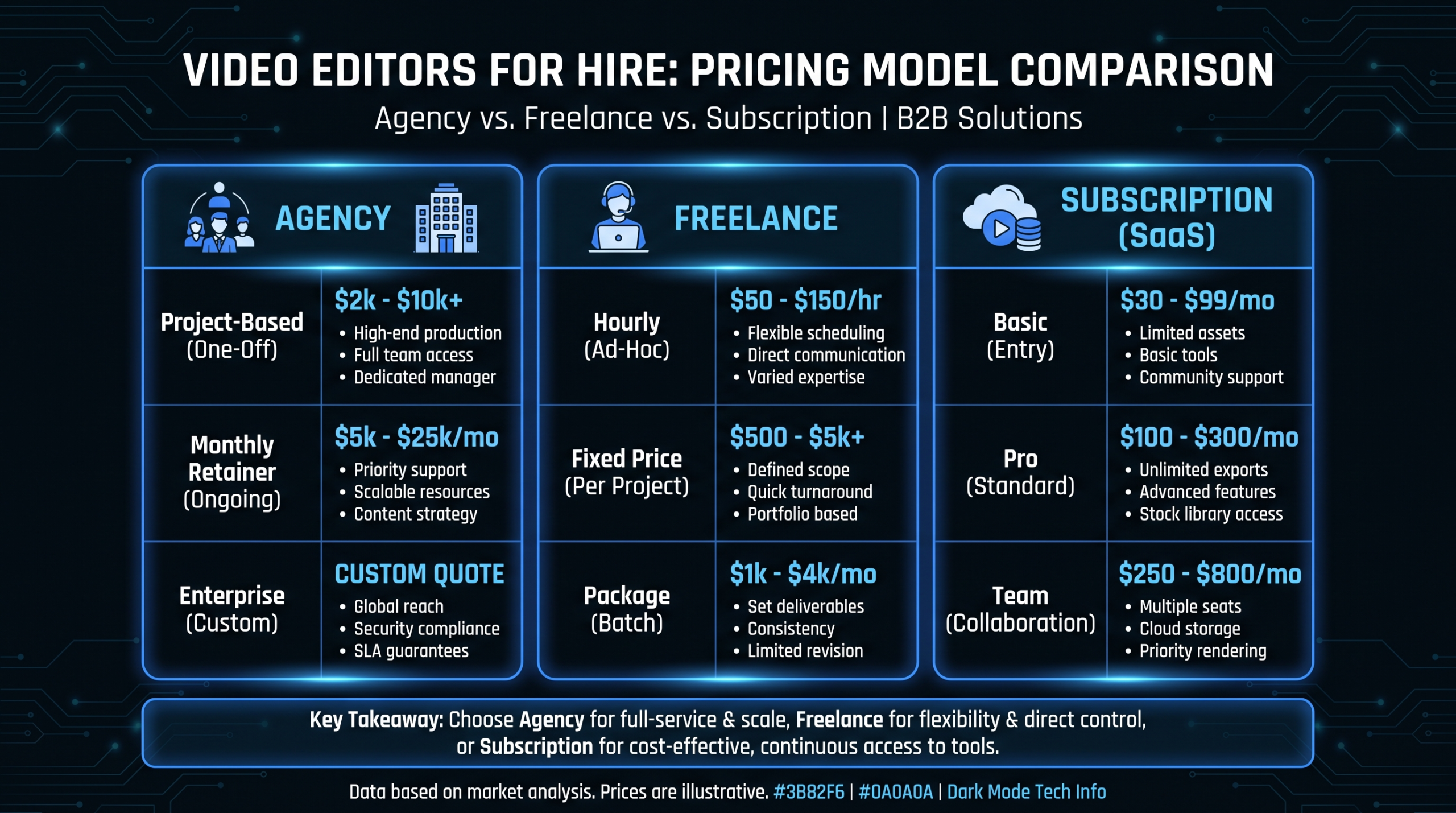
| Dedicated team retainer (Growth) | $5,000–$9,500 | 15–25 deliverables with full post-production stack | Boutique firms running a full content program |
| Full-service retainer (Core/Scale) | $9,500–$16,000+ | 25–45+ deliverables, strategy and creative direction included | Established practices, multi-partner content programs |
VEC's dedicated team model starts at $5K/month (Growth plan) and covers the full post-production stack for a consulting content program—editing, captioning, motion graphics, multi-format exports for LinkedIn and YouTube, and a dedicated project manager who maintains your brand standards across every asset. For consulting practices producing content seriously over a 90-day window, this tier typically represents the crossover point where output volume and production quality both justify the investment relative to alternatives.
The True Cost of DIY Post-Production
Consultants who handle their own post-production commonly report spending four to eight hours of their time per polished video—logging footage, cutting takes, adding captions, exporting in multiple formats. At a consulting billing rate of $250–$500 per hour, that's $1,000–$4,000 in opportunity cost per video, which is before counting the cognitive load of context-switching between client work and video production.
Outsourcing post-production to a dedicated team at $5K–$9.5K/month and producing 20+ assets makes straightforward economic sense by the second month of a sustained content program—even before accounting for the revenue impact of consistent distribution on pipeline velocity.
For a detailed look at what professional video editing services include and how post-production economics work across different B2B content volumes, see our guides to how to outsource video editing and SaaS video production models. Both apply directly to consulting firm content programs.
What to Look for in a Remote Production Partner for Consulting Content
Not every remote editing team is suited for consulting thought leadership content. The specific requirements for this content type:
- Demonstrated experience with talking-head and interview formats, not primarily B-roll-heavy corporate video or social media entertainment content
- Caption accuracy and terminology consistency, particularly for technical consulting language—strategy, transformation, due diligence, governance—that generalist teams sometimes miscaption
- Multi-format delivery in a single package—16:9 main video plus 1:1 and 9:16 social cuts—so you're not managing separate requests for each platform
- Confidentiality protocols for raw footage, since consulting recordings often include sensitive client context before editing
- Async-compatible review workflow that accommodates a consultant's travel-heavy, call-heavy schedule without requiring synchronous approval meetings
Check our how it works page for the specifics of how VEC structures dedicated team engagements for professional services clients, including onboarding timeline and the standard review workflow.
Frequently Asked Questions
How often should a consultant post thought leadership videos on LinkedIn?
Two to four times per week is the sustainable range for most consulting practices. Fewer than twice a week makes it difficult to build feed presence; more than four and quality tends to suffer or the content feels like noise. Consistency over any 90-day window matters more than peak frequency—irregular bursts followed by silence perform significantly worse than a steady, moderate cadence.
Do consulting thought leadership videos need professional studio production?
They need professional post-production, but they don't require a studio. Consistent visual framing—the same background, the same lighting setup each time—plus professional editing (clean captions, tight cuts, title cards) is sufficient to project credibility. Raw recordings with inconsistent audio and no captions undermine credibility even when the content is excellent. The editing is where professional quality actually lives.
How do I build a video thought leadership program without naming specific clients?
Anonymized case studies work well and are widely understood in professional services contexts. Describe the client by vertical, approximate size, and presenting problem without naming them: "A Series B SaaS company in healthcare logistics with a 90-day customer onboarding problem" is specific enough to be credible and vague enough to be confidential. Client-pattern videos—"Every engagement I start with a CFO includes the same conversation about X"—are another strong format that implies a broad client base without exposing anyone.
What's the ROI calculation for consulting thought leadership video?
The most honest ROI frame for consulting video is deal velocity, not direct attribution. Track whether inbound leads who have engaged with your video content before reaching out require fewer discovery calls, convert at higher rates, or close faster than leads from referral or cold outreach. Many practices find the reduction in sales cycle length to be the primary economic justification. Hard attribution of specific revenues to specific videos is usually not meaningful—the influence is cumulative, and it operates before any trackable touchpoint.
How does webinar repurposing work when multiple consultants are speaking?
Multi-speaker webinar repurposing requires an editorial decision upfront: which speaker's segments become standalone POV clips, and which moments warrant joint-perspective treatment. The standard approach is to cut individual clips for each speaker's strongest arguments and one or two joint-insight segments for newsletter and YouTube archive distribution. Each speaker then distributes their own clips through their individual LinkedIn presence, while the host profile distributes the full session summary. The production team handles speaker attribution through lower thirds and clip labeling.
Ready to Build Your Consulting Thought Leadership Video Program?
VEC provides dedicated post-production teams for professional services firms and consulting practices. You show up on camera; we handle editing, captions, multi-format exports, and weekly delivery on your content calendar.
Book a Free Strategy Call View Pricing