Scaling 2 to 20 Videos a Month Without Hiring
TL;DR
- Most in-house video teams hit a hard ceiling at 2-4 videos/month due to editor bandwidth and review cycle friction, not creative strategy.
- Outsourcing to a dedicated partner is faster, cheaper, and lower-risk than hiring a full-time team at the 10+ video/month threshold.
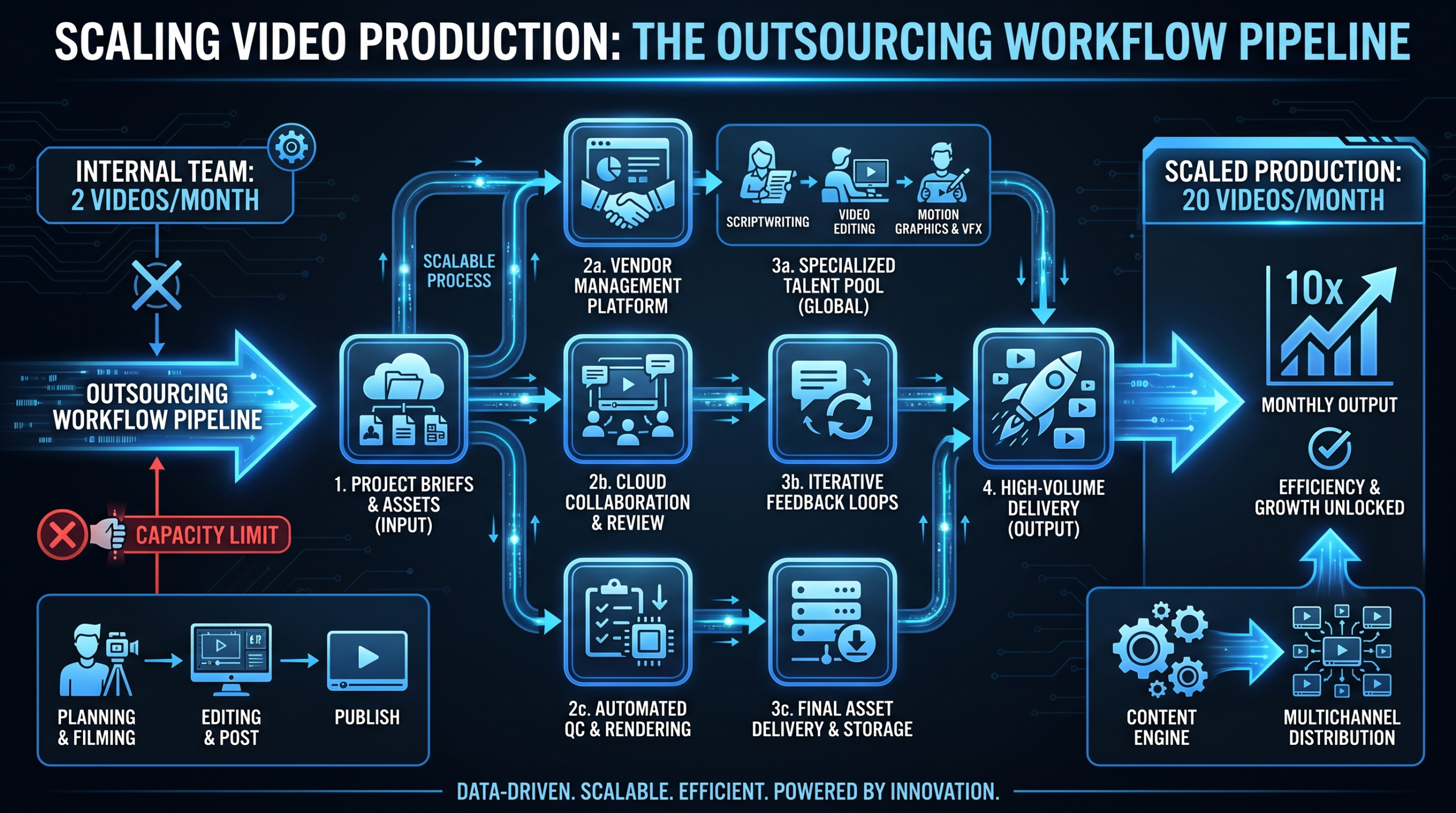
- The key to scaling is a standardized workflow: brief ? production ? async review ? publish - not more headcount.
- The right tooling stack (Frame.io + Notion + Slack + Dropbox) can cut coordination overhead by 40-60%.
- Most SaaS content teams can reach 20 videos/month within 90 days of engaging the right partner.
Table of Contents
- Why In-House Teams Cap at 2-4 Videos/Month
- Hire vs. Outsource: The Decision Framework
- Building a Scalable Video Production Workflow
- The Tooling Stack That Makes Remote Production Work
- What to Demand from Your Video Partner (SLA Expectations)
- Week-by-Week Ramp Plan: 2 to 20 Videos in 90 Days
- Addressing the Trust Objections
- Choosing the Right Video Partner at Scale
- Building the Content Calendar That Feeds the Machine
- FAQ
Most SaaS content teams are producing 2-4 videos a month. Their leadership wants 15-20. The gap between those two numbers is not a budget problem or a strategy problem. It is a capacity architecture problem - and it has a straightforward solution that does not involve hiring a single full-time employee.
This guide is written for VP Marketing and Head of Content roles at Series A through Series C SaaS companies. If you are managing a video program and wondering how to dramatically scale output without blowing your headcount plan, this is the operational framework you need.
Why In-House Teams Cap at 2-4 Videos Per Month
The ceiling is structural, not individual. Your editor is not underperforming - the system has a hard limit built into it.
The Single-Editor Bottleneck
A competent video editor working on B2B SaaS content - product demos, explainer videos, webinar cuts, social clips - can realistically produce 3-5 polished videos per month when working solo. That estimate factors in:
- 3-8 hours of editing time per finished video depending on complexity and footage quality
- Asset ingestion and organization time, which commonly accounts for 20-30% of total edit time
- Revision cycles: typically 2-3 rounds per video, each requiring re-export and QA review
- Project management and stakeholder coordination overhead
- Rendering, transcoding, and file delivery time
At 3-5 videos per month, one editor is essentially working at capacity. Add a second video format request, a rush project, or a sick day, and the entire pipeline stalls.
The Review Cycle Compresses Everything
The hidden killer in most in-house video workflows is the review cycle. A VP of Marketing reviewing a product demo once a week creates a 7-day lag per revision. If a video needs two revision rounds, that is two weeks of elapsed time for work that took 4 hours to execute.
At 20 videos/month, you cannot afford a 7-day review loop. You need asynchronous, same-day review - and that requires process redesign, not more staff.
The Context-Switching Tax
In-house editors at SaaS companies rarely edit full-time. They attend meetings. They help with screenshots for the marketing deck. They export clips for the sales team. Each context switch costs 20-40 minutes of reorientation time. A full-time editor who is interrupted 4 times a day loses roughly 2 hours of productive editing capacity - cutting effective output by 25-30%.
The arithmetic is unforgiving: 160 working hours per month, minus 20% for coordination and interruptions, minus 15% for revision cycles on a standard review process, leaves roughly 104 productive editing hours. At 8 hours per finished video on average, that caps you at 13 videos per month in theory - and far less in practice once you account for realistic conditions.
Hire vs. Outsource: The Decision Framework
At some point, scaling video output forces a decision: add headcount or outsource. Most SaaS finance teams prefer the latter - but it is worth understanding the math explicitly.
The Real Cost of a Full-Time Video Editor
Total compensation for a mid-level video editor in a US metro market commonly runs $75,000-$110,000 in base salary. Add employer payroll taxes, benefits, equipment ($5,000-$15,000 upfront for a capable workstation and software licenses), management overhead, and ramp time - typically 60-90 days before full productivity - and the all-in annual cost is closer to $115,000-$160,000.
That buys you 3-5 videos per month. At the midpoint - roughly $135,000/year - you are spending approximately $2,250-$3,750 per video before accounting for any overhead costs.
The Outsourcing Math
Hire vs. Outsource: Cost Comparison at Scale
| Model | Monthly Cost | Output | Effective Cost/Video |
|---|---|---|---|
| 1 FTE editor (US, all-in) | ~$11,000 | 4-5 videos/mo | $2,200-2,750 |
| 2 FTE editors (US, all-in) | ~$22,000 | 8-10 videos/mo | $2,200-2,750 |
| Dedicated outsourced team (Growth) | ~$5,000-9,500 | 8-15 videos/mo | $380-625 |
| Dedicated outsourced team (Scale) | ~$9,500-16,000 | 15-25 videos/mo | $480-800 |
The cost-per-video differential is significant - but the more important number for a growth-stage SaaS company is speed to capacity. A dedicated outsourced team is producing at full volume within 30-60 days. An in-house hire is typically at full capacity in 90-120 days, after recruiting (4-8 weeks), onboarding, and brand-learning.
When Hiring Makes Sense Anyway
Outsourcing wins on volume economics, but there are legitimate scenarios where an in-house hire is the right call:
- Your video content requires real-time, in-person filming that cannot be delegated
- Your production involves highly proprietary product information and your legal team has strict data-sharing restrictions
- You need a creative director or video strategist role - someone setting direction, not executing on briefs
- Your video needs are highly experimental or change week-to-week in unpredictable ways with no repeatable formats
The more your video content is execution-heavy (editing, motion graphics, color grading, sound mixing) vs. strategy-heavy, the stronger the outsourcing case becomes. Most B2B SaaS video programs are execution-heavy by design. For a broader look at how SaaS companies structure their video programs at different growth stages, see our guide to SaaS video production.
Building a Scalable Video Production Workflow
The single biggest lever for scaling video output is not headcount - it is workflow standardization. Most teams scale from 2 to 20 videos/month not by working harder but by eliminating the 8-10 hours of coordination waste per video that exists in unstructured processes.
The Four-Stage Production Framework
Every scalable video operation runs on four stages. The key is making each stage asynchronous and documented - no video should ever be blocked waiting for a verbal approval or a scheduled meeting.
Stage 1: Brief
A video that is not properly briefed will cost you 2-3x the editing time in revisions. Your brief template should include:
- Video type and purpose: Product demo, customer testimonial, explainer, social clip, webinar cut
- Target viewer and funnel stage: Cold prospect (ToFu), evaluation stage (MoFu), customer (BoFu/onboarding)
- Key messages (max 3): What the viewer must take away - not everything you want to say, just the three things that matter
- Tone and pacing reference: Link to 1-2 existing videos that match the desired style
- Footage location: Exact folder path in your shared drive - no searching, no ambiguity
- Output specs: Format (16:9, 9:16, 1:1), file type, max duration, destination platform
- Deadline and priority: Absolute deadline plus priority ranking vs. other active videos
- Approved music library: Preapproved tracks to avoid licensing back-and-forth mid-production
Teams that use a standardized brief template commonly report cutting revision cycles by roughly half - because the editor has everything they need to execute without guessing the intent or making judgment calls that the stakeholder later overrides.
Stage 2: Production
Production should happen entirely on the vendor/editor side with zero interruptions from your team. This requires three things:
- Complete footage delivered upfront. No drip-feeding of clips mid-edit. If your footage is not ready, the video does not enter production - it stays in briefing.
- A brand guide the editor can reference autonomously. Font, color palette, motion style, lower-third templates, intro/outro sequences - all documented and stored in the shared project folder before the first video enters production.
- SLA on first draft delivery. You should receive a first draft within an agreed window (typically 48-72 hours for standard videos) without needing to follow up.
Stage 3: Review
This is where most teams lose 30-40% of their throughput. The fix is structured asynchronous review:
- One reviewer, one round. Designate a single approver per video - not three stakeholders who each have separate notes that may contradict each other.
- Frame.io or equivalent for timestamped comments. "At 0:34, the music is too loud" beats "the music in the middle part needs work." Specificity eliminates guess-and-check revision cycles.
- 24-hour review SLA. If your team has not reviewed within 24 hours, the video moves to the next job and returns to queue. No blocking the editor's schedule waiting for feedback.
- Max 2 revision rounds included. Scope your vendor contract for 2 rounds of revisions per video. More than 2 rounds typically indicates a broken brief, not a broken edit.
Stage 4: Publish
Publication should be the simplest stage and the one requiring the least decision-making at delivery. Standardize it completely:
- Final file delivered to a designated Dropbox or Google Drive folder with an agreed naming convention
- Naming convention: [YYYY-MM-DD]-[video-type]-[platform]-[version] (e.g., 2026-07-15-product-demo-youtube-v1)
- Accompanying metadata file: title, description, tags, thumbnail file path, scheduled publish date/time
- Upload task triggered automatically from the delivery folder via Zapier or Make automation
The Tooling Stack That Makes Remote Production Work
Scaling video production remotely requires a coordination stack that replaces the organic communication that happens when a team shares a physical space. These are the tools used most effectively by SaaS content teams producing 10-20 videos/month with an external partner.
Core Stack
Recommended Tooling Stack for Remote Video Production at Scale
| Function | Tool | Purpose in the Workflow |
|---|---|---|
| Video review | Frame.io | Timestamped comments, version management, approval workflows |
| Project management | Notion or Airtable | Video calendar, brief library, status tracking, asset index |
| Communication | Slack | Dedicated #video-production channel, async updates, quick decisions |
| File storage | Dropbox or Google Drive | Raw footage, final deliverables, brand assets, music library |
| Brand assets | Notion + shared folder | Brand guide, approved templates, motion graphics kit |
| Automation | Zapier or Make | Status triggers, delivery notifications, upload automation |
Frame.io: Your Review Hub
Frame.io is the industry standard for remote video review for a clear reason: it turns the review process from an email chain into a structured, traceable workflow. Reviewers leave timestamped comments directly on the video frame. Editors respond in-thread. Version history is automatically maintained so every stakeholder can see exactly which version is current and what changed between drafts.
For teams scaling to 10+ videos/month, Frame.io's project organization features - which let you manage multiple active videos simultaneously across a shared workspace - become essential. Current pricing details are available on Frame.io's pricing page and plans are tiered for team use.
Notion as the Production Brain
The most effective setup uses Notion as the single source of truth for the entire video program:
- Video Calendar database: Every planned video with columns for type, deadline, brief status, production status, and named reviewer
- Brief library: Completed briefs stored and searchable - so a new video type (e.g., your first customer testimonial) can reference a prior brief as a starting template
- Brand Guide page: Fonts, colors, motion principles, tone examples - what you hand to a new editor on day one of an engagement
- Vendor SLA tracker: First draft delivery dates, revision cycle logs, on-time delivery rate - the metrics that tell you if your partner is performing
Slack for Async Coordination
Dedicate a single Slack channel to video production: #video-production. Establish channel norms at the outset: no decisions in DMs, all video-related questions in channel, response SLA of 4 hours during business hours. This makes the entire production communication history searchable and keeps your vendor from having to chase down answers from multiple stakeholders in different threads.
Dropbox for Footage and Deliverables
Dropbox's selective sync feature is particularly useful for video teams: editors can access only the folders relevant to their active projects without needing to sync your entire footage library. Establish a clean folder architecture before production starts:
/brand-assets- fonts, logos, motion templates, approved color palettes/footage-inbox- raw footage dropped here when briefing is complete/in-progress- working files, organized by video project/deliverables- final approved files, ready for upload/music-library- preapproved licensed tracks only
What to Demand from Your Video Partner (SLA Expectations)
Not all outsourced video partners operate at the same service level. When evaluating partners - and when writing your service agreement - these are the SLAs that separate production-scale operations from project-based vendors who happen to offer retainers.
Delivery SLAs
- First draft delivery: 48-72 hours from complete brief plus footage receipt for standard complexity. 5-7 business days for motion-heavy or animated content.
- Revision turnaround: 24 hours for minor revisions (color adjustments, text changes, music swaps). 48 hours for structural changes requiring re-editing.
- Rush delivery: Defined option for 24-hour delivery with a reasonable surcharge - typically 20-30% above standard rates.
Quality SLAs
- First-draft acceptance rate: A quality vendor at steady-state should achieve 70-80% first-draft approval with minimal structural revisions needed. If every first draft requires major rework, the brief process or the editor assignment is broken - not the edit itself.
- Dedicated editor assignment: The same editor or team handles your account consistently - not whoever is available in a general job queue. This is the single most important quality predictor.
- QA review before delivery: Every deliverable reviewed by a project manager or senior editor before you see it. You should never be the first QA checkpoint in the chain.
Communication SLAs
- Dedicated point of contact - a named project manager or account lead, not a support ticket system
- Response time of 2-4 hours during agreed business hours
- Weekly status update: active videos in production, upcoming deliveries, any blockers
- Monthly review: output metrics, quality scores, pipeline for the next 30 days
For more detail on vetting production partners and what contracts should cover, our guide on how to outsource video editing walks through the full evaluation process.
Week-by-Week Ramp Plan: 2 to 20 Videos in 90 Days
Scaling from 2 to 20 videos per month does not happen overnight - and attempting to go from 2 to 20 in a single month is a reliable way to produce low-quality work that damages the program's credibility. A structured 90-day ramp protects quality, builds brand familiarity, and gives your team time to develop the new operational habits the workflow requires.
Weeks 1-2: Foundation Setup
- Deliver brand guide to partner: fonts, colors, motion style, tone of voice, 2-3 sample approved videos
- Create shared folder architecture in Dropbox or Google Drive
- Set up Frame.io workspace and project structure for active productions
- Create Notion production database and brief template - have your team fill out 2-3 briefs as a test
- Create Slack
#video-productionchannel; add partner PM and set channel norms - Commission 2 test videos - your most common formats - to establish quality baseline before scaling volume
Weeks 3-4: Calibration
- Review the 2 test videos against brand standards; provide detailed timestamped feedback via Frame.io
- Iterate to final approved versions - this calibration investment is what accelerates all subsequent production
- Document what the editor got right and wrong in a "style notes" file shared in Notion
- Ramp to 4-6 active videos simultaneously in production
- Refine the brief template based on questions that came up during production of the test videos
Weeks 5-8: Production Scale-Up
- Increase volume to 8-12 videos per month
- Introduce a second video format if applicable (e.g., add social clip repurposing from long-form content)
- Run the first monthly review: on-time delivery rate, first-draft acceptance rate, revision cycles per video
- Identify any workflow friction and resolve it at the process level - not video by video
- Begin building the rolling 4-week brief queue so the partner always has work staged ahead
Weeks 9-12: Full Velocity
- Reach target volume: 15-20 videos/month
- Activate the full content calendar with 4-6 weeks of planned briefs ahead at all times
- Introduce more complex formats: animated explainers, customer case study videos with B-roll
- Establish quarterly creative refresh: new templates, updated intros/outros, refreshed brand standards
90-Day Output Progression
| Phase | Weeks | Monthly Output | Primary Focus |
|---|---|---|---|
| Foundation | 1-2 | 2-3 videos | Setup, brand delivery, test video production |
| Calibration | 3-4 | 4-6 videos | Quality alignment, workflow refinement, style documentation |
| Scale-Up | 5-8 | 8-12 videos | Volume increase, format expansion, rolling brief queue |
| Full Velocity | 9-12 | 15-20 videos | Full calendar operation, complex formats, QA optimization |
Addressing the Trust Objections
The hesitation most content leads have about outsourcing at scale is not primarily financial - it is trust. Will the quality hold? Will our brand stay consistent? What about sensitive product information? These are legitimate concerns with practical answers that professional partners address routinely.
Quality Objection: "We Can't Trust an External Team to Match Our Standards"
Quality risk is real with the wrong partner and manageable with the right one. The indicators that predict quality at scale:
- Dedicated editor assignment. The same editor on your account for every video - not a rotating pool. The first 30 days of a dedicated engagement are the calibration investment; after that, quality typically exceeds what a junior in-house hire delivers in the same period.
- PM-level QA before delivery. Every video reviewed internally before you see it. A first-draft acceptance rate of 70%+ is achievable and should be a contractual commitment.
- References from similar SaaS clients. Ask for case studies or references from B2B SaaS accounts at similar video volume. Wistia's research on video marketing consistently shows that production consistency and volume matter more than production polish for driving SaaS content performance metrics.
Brand Consistency Objection: "Our Brand Is Too Specific to Hand Off"
Every sophisticated brand believes this until they invest in proper documentation. The reality is that a well-documented brand guide plus a template library eliminates 90% of brand drift risk. What you need to build:
- Motion graphics templates (lower thirds, titles, transitions) in a format your editor can apply without making design decisions
- Approved color palette and font stack in the editing software's native format (Premiere Pro presets, DaVinci Resolve color nodes)
- 2-3 "gold standard" videos the editor can reference when uncertain about execution
- An explicit "do not do" list: stock footage styles to avoid, music genres that feel off-brand, animation styles that conflict with your brand personality
After 60-90 days with a dedicated team, brand consistency commonly improves relative to early in-house production - because external editors follow documented standards more rigorously than in-house editors who "already know" the brand and improvise under time pressure.
Security Objection: "We Can't Share Unreleased Product Footage"
This is the most legitimate concern and the most straightforward to address contractually:
- NDA as baseline. Any professional video partner will sign an NDA before receiving access to any footage. This is standard practice, not a special request.
- Need-to-know footage delivery. Share only the footage clips relevant to the specific video in production - not access to your entire raw footage library or internal product infrastructure.
- Watermarked review copies. Frame.io supports viewer-side watermarking on review links, so even if a review link is forwarded, the footage is marked as confidential with the viewer's identity.
- Access revocation on project close. Set a standard policy of removing partner access from all shared folders when a project concludes and the final deliverable is approved.
For how VEC structures data handling and partner access protocols, see our how it works page. HubSpot's video marketing research notes that 87% of marketers report video giving them a positive ROI - and the bottleneck they most commonly cite is production capacity, not creative quality. The teams that solve the capacity problem consistently out-produce those still waiting for headcount approval.
Choosing the Right Video Partner at Scale
Not every video partner is built for the 10-20 video/month operating model. Here is how the major categories compare for SaaS content teams at this volume:
Video Partner Comparison: SaaS Teams Scaling to 20 Videos/Month
| # | Partner | Monthly Cost Range | Throughput | Best For | Key Limitations |
|---|---|---|---|---|---|
| 1 | Video Editing Company (VEC) | $5K-$16K/mo | 8-25 videos/mo | B2B SaaS dedicated team model; guaranteed to double output in 90 days or month 4 is free | 3-month minimum; works best when your brief and footage pipeline is ready |
| 2 | Increditors | ~$2.5K-$12K+/mo | 8-20 videos/mo | YouTube creators, SaaS, finance, education; dedicated editor pods (senior editor + junior editor + PM + creative director); known for doubling YouTube channel performance | Not SaaS-exclusive; custom-quote pricing with no instant online tiers |
| 3 | Video editing subscription services (e.g., Vidpros, Vidchops) | $1.5K-$4K/mo | 6-12 videos/mo | High-volume simple edits; social clips; podcast cuts; teams prioritizing speed over polish | Sequential queue limits throughput; quality varies by assigned editor; complex content usually excluded |
| 4 | Boutique agency (project-based) | $2K-$8K/project | 2-6 videos/mo | One-off campaigns; brand films; high-production value launch videos | Expensive at volume; slow ramp-up per project; no dedicated team continuity |
| 5 | Freelance marketplace (Upwork, Toptal) | $500-$3K/mo | 4-8 videos/mo | Budget-constrained teams; simple repetitive edits; testing formats before scaling | Full management overhead on your side; inconsistent quality; no PM layer; reliability risk |
For teams scaling past 10 videos/month, the dedicated model - where a consistent team is assigned to your account - delivers meaningfully better outcomes than rotating subscription queues. The quality flywheel only activates with team continuity: editor learns your brand ? briefs get faster ? first drafts need fewer revisions ? throughput increases organically. See our breakdown of what video editing services include at each tier to understand what you are actually buying.
Building the Content Calendar That Feeds the Machine
A production operation capable of 20 videos/month is only as good as the content pipeline feeding it. Without a structured 4-6 week advance calendar, you will hit your production ceiling not because of editor capacity but because briefs are not ready. The bottleneck moves from production to planning.
The 4-Week Rolling Brief Queue
Target: at any given moment, you have 4 weeks of briefs in some stage of readiness.
- 4 weeks ahead: Video ideas logged in Notion - topic approved, video type and purpose defined
- 3 weeks ahead: Brief template started, key messages drafted, footage collection begun
- 2 weeks ahead: Brief complete, footage in the intake folder, reviewer assigned by name
- 1 week ahead: Brief submitted to production partner, video in active production
This rolling queue ensures your production partner never goes idle - and you never face the "we have editor capacity but no briefs ready" problem that commonly stalls scaling attempts after the initial ramp month.
Video Type Mix at 20 Videos/Month
A common content mix for a Series B SaaS company producing 20 videos/month:
- 6-8 long-form videos for YouTube: product deep-dives, thought leadership pieces, tutorial walkthroughs
- 6-8 social clips repurposed from long-form content: LinkedIn, Instagram Reels, short-form formats
- 2-3 product demos or feature announcement videos for sales and demand generation
- 1-2 customer testimonials or case study videos for mid-funnel and sales enablement use
- 1-2 ad creatives or campaign-specific videos for paid media
The repurposing ratio is significant: if you produce 8 long-form videos and generate 1-2 social clips from each, you reach 16-24 deliverables from 8 original productions. That efficiency multiplier - not raw editing throughput - is often what gets teams from 10 to 20+ videos/month without proportional cost increases. For more on structuring your product demo video production as a repeatable format rather than a one-off project, see our dedicated guide.
Frequently Asked Questions
How long does it realistically take to scale from 2 to 20 videos per month?
Most SaaS teams working with a dedicated production partner reach full velocity within 60-90 days. Weeks 1-2 are setup and calibration - brand guide delivery, workflow configuration, test video production. Weeks 3-8 are the ramp phase where output typically grows from 4 to 12 videos/month. By weeks 9-12, teams at the right plan level commonly reach 15-20 videos/month consistently. The speed of the ramp depends more on how quickly your team develops the briefing habit than on the partner's production capacity - the bottleneck at scale is almost always brief readiness, not editing throughput.
What is the minimum infrastructure I need before outsourcing video production at scale?
Three things: a documented brand guide (even a 3-page Notion doc with fonts, colors, and 2 reference videos), a shared cloud folder structure your vendor can access, and a single named reviewer with a 24-hour review commitment. You do not need Frame.io or a full Notion production database on day one - those come after the first two weeks once you have validated the workflow basics. What you cannot skip is brand documentation; without it, you will spend the first month in revision cycles that a brief would have prevented entirely.
Can we outsource product demo videos if the product involves unreleased or sensitive features?
Yes, with the right controls in place. A standard NDA is the baseline - any professional partner will sign one before receiving footage. Beyond that: share only the footage clips relevant to the specific video in production, use Frame.io's viewer-side watermarking for review copies, and specify footage deletion protocols in your service agreement. Most professional partners who focus on SaaS video production handle this routinely. The sensitivity of SaaS product footage is well understood, and the standard controls are straightforward to implement.
How do we maintain brand consistency when editors are working remotely?
Brand consistency is a documentation problem, not a geography problem. The teams that maintain the highest consistency with remote editors are those with the most explicit documentation: motion template files in the editing software's native format, an explicit do/don't list, approved music playlists, and annotated examples of approved vs. rejected work. After 60-90 days of a dedicated engagement, most teams report that brand consistency improves relative to the early in-house phase - because external editors follow documented standards more rigorously than in-house editors who improvise from informal knowledge.
What should a vendor SLA for 20 videos/month actually specify?
At minimum: first draft delivery within 48-72 hours of receiving a complete brief and footage (for standard complexity); revision turnaround of 24 hours for minor changes and 48 hours for structural revisions; a dedicated project manager as the single point of contact; weekly pipeline status updates; and a monthly review of delivery metrics including on-time rate and first-draft acceptance rate. Any partner unwilling to commit to these terms in writing is not built for production-scale operations. VEC's pricing plans include defined SLA commitments at each tier along with the 90-day output guarantee.
Ready to Scale Your Video Output Without Hiring?
VEC provides dedicated video editing teams for B2B SaaS companies. We guarantee to double your video output in 90 days - or month four is free. Plans start at $5,000/month with no production per-video fees.
Book a Free Strategy Call See Pricing Plans