Same-Day Video Editing: Turnaround Guide
TL;DR
Same-day video editing is realistic for short clips (under 5 minutes) with organized, pre-sorted footage — and with the right editing partner in place. For longer or more complex videos, 24-hour turnaround is the practical target. This guide covers when fast turnaround is achievable, which video types qualify, how dedicated teams beat freelancers on speed, and what workflow changes cut your current turnaround in half.
Table of Contents
Same-day video editing is possible — and for the right video types with the right production setup, it's repeatable. The question isn't whether it can happen, but whether your footage, brief, and editing partner are set up to make it happen consistently.
This guide is for VP Marketing and Head of Content teams at B2B SaaS companies who need fast video delivery without sacrificing quality. We'll cover exactly when same-day and 24-hour turnarounds are achievable, what kills speed in practice, and how to build a workflow that makes fast delivery the norm rather than the exception.
What "Same-Day" Actually Means in Video Editing
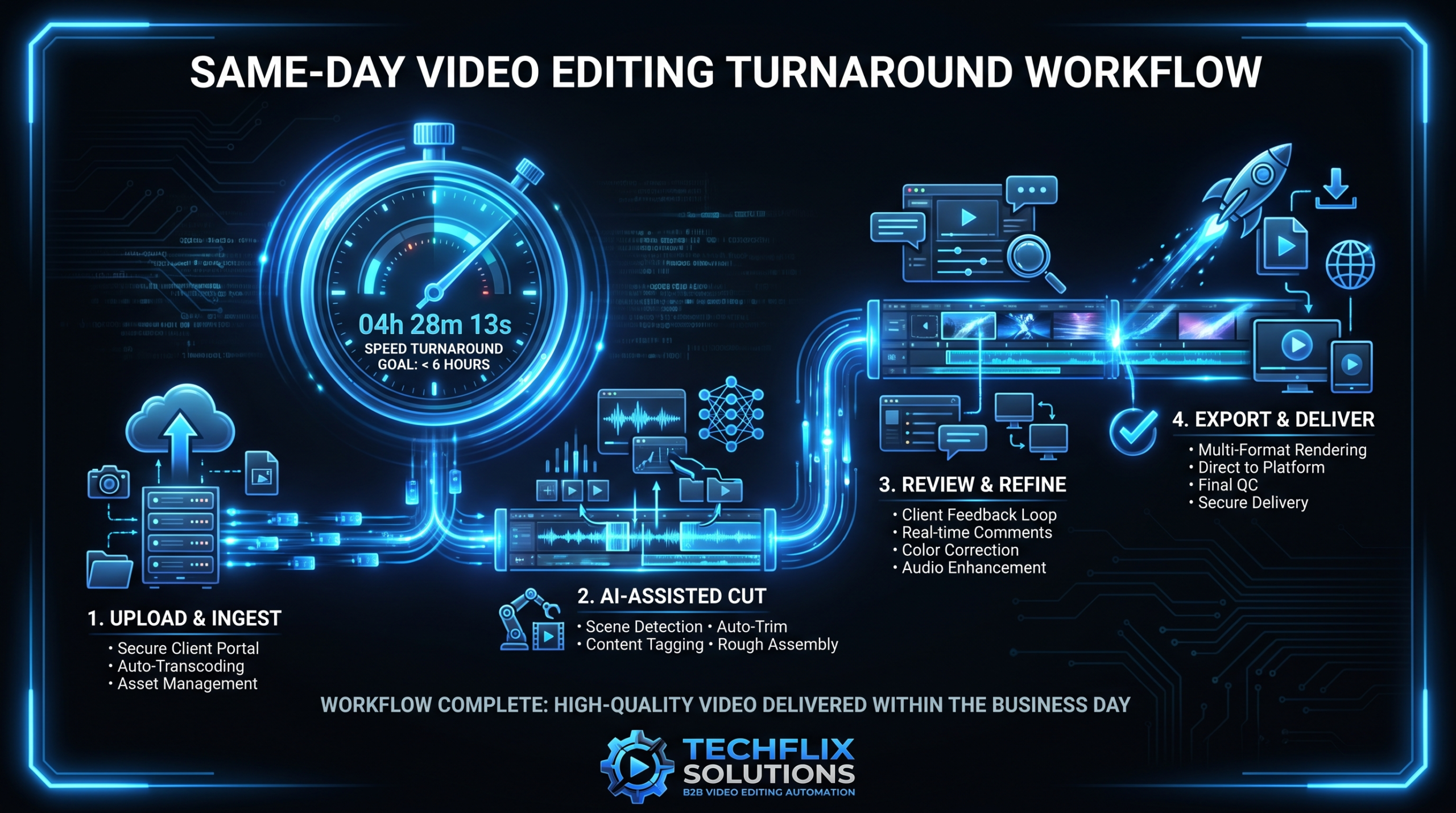
Same-day video editing means receiving a finished, approved edit within the same business day as footage submission — typically 6–8 hours of active editing time. For practical purposes in content marketing workflows, teams distinguish between two tiers:
- True same-day (6–8 hours): Footage submitted by 9–10 AM, draft returned by 5–6 PM. Requires organized footage, a clear brief, and no back-and-forth on brief clarifications.
- 24-hour turnaround: Draft returned within one business day of submission, regardless of when footage lands. This is the more commonly quoted "rush" standard across freelancers and agencies.
The distinction matters because most providers advertising "same-day" delivery actually mean 24 hours. If you need a video ready before end-of-day for a LinkedIn post, a product launch, or an event — true same-day is a different operational ask than 24-hour rush.
For a broader look at what editing timelines look like across video types, see our video editing turnaround times guide — it benchmarks realistic timelines by complexity so you can set accurate internal expectations.
When Same-Day Turnaround Is Realistic
Same-day delivery is achievable under specific conditions. All four of these need to be true simultaneously:
- Short-form content only. Clips under 5 minutes of finished runtime are the practical ceiling for same-day delivery. Anything longer adds review, render, and revision time that pushes past a business day.
- Footage is pre-sorted and labeled. If the editor has to hunt through 3 hours of raw footage to find the 10 minutes worth using, the clock starts before editing does. Pre-selected takes save 1–3 hours per video.
- Brief is complete before submission. Vague briefs generate clarification rounds, and each round adds 30–90 minutes. A brief with the cut structure, motion graphic specs, music preference, and output format eliminates this entirely.
- The editing partner knows your brand. A new freelancer needs 2–4 hours to understand your visual language, pacing, and style preferences — eating directly into same-day viability. A dedicated team that has worked on your account for weeks or months needs none of that time.
When these conditions aren't met, 24-hour turnaround is the realistic standard. It's still fast by industry norms, but the operational setup is different. Understanding the gap between the two is the first step to closing it.
Turnaround Times by Video Type
Not all videos take the same amount of time to edit. Here's a realistic breakdown by content type, split by standard and rush delivery, based on typical agency benchmarks (individual results vary based on footage quality, brief clarity, and editor experience):
Turnaround Times by Video Type
| Video Type | Finished Length | Standard Turnaround | 24-Hour Rush | True Same-Day |
|---|---|---|---|---|
| Social media clip (cut-down) | 15–60 sec | 24–48 hrs | ✅ Yes | ✅ Yes (with org. footage) |
| Short-form talking head | 1–3 min | 24–48 hrs | ✅ Yes | ✅ Possible |
| Podcast/webinar highlight clip | 2–5 min | 48–72 hrs | ✅ Yes | ⚠️ Tight |
| YouTube-style long-form edit | 8–20 min | 3–5 business days | ⚠️ 24–36 hrs with premium | ❌ Not realistic |
| Product demo video | 2–5 min | 3–7 business days | ⚠️ Possible with brief | ❌ Rarely |
| Animated explainer | 60–90 sec | 7–14 business days | ❌ Not feasible | ❌ Not feasible |
| Case study / testimonial | 2–4 min | 5–7 business days | ⚠️ 48 hrs minimum | ❌ Not realistic |
The takeaway: same-day delivery is a short-form video feature, not a full-service capability. Any provider claiming same-day turnaround on animated explainers or multi-camera productions is either overpromising or delivering work that needs significant revision rounds afterward — which negates the speed advantage entirely.
What Determines Your Editing Speed
Four variables control how fast any given video edit can be turned around. Understanding these lets you systematically improve speed without relying on rush fees or editorial heroics.
1. Footage Organization
Raw footage from a single-camera shoot of a 10-minute talk produces anywhere from 30 minutes to 3+ hours of raw material, depending on takes, B-roll, and coverage. An editor who receives labeled, timestamped selects can begin cutting immediately. An editor who receives unorganized drives needs to log footage first — a task that routinely takes as long as the edit itself.
The fix: designate someone on your team (or include it as an explicit deliverable in your agency brief) to produce a selects document before footage is submitted. This single process change commonly cuts turnaround times by 25–40%.
2. Brief Completeness
A complete brief for a simple talking-head edit specifies: the intended cut structure, which takes to use (by timecode if possible), required music (or "match existing brand music"), motion graphic specs (lower thirds names, titles), target length, output format (16:9, 9:16, or both), and color grade preference (match existing or describe). When any of these are missing, the editor pauses and asks — or guesses and misses. Either outcome costs time. Brief completeness is one of the highest-leverage investments a content team can make in throughput.
3. Revision Rounds
Every revision round adds a full communication cycle: send draft → client reviews → notes written → notes received → revisions made → return draft. Even a "small" revision can add 4–8 hours to the timeline depending on time zones, scheduling, and the clarity of the feedback. Teams that get to final-approved on the first draft deliver consistently faster — not because they rush, but because they invest in the brief so the first draft is essentially the final draft.
4. Team Familiarity
An editor who has worked on your account for three months knows your opening style, your preferred pacing, your B-roll library, your fonts, your brand music, and your approval quirks. This institutional knowledge turns a 6-hour edit into a 3-hour edit. It's the single biggest speed advantage a dedicated team model offers over freelancers or subscription services that rotate editors between projects.
Freelancer vs. Agency vs. Dedicated Team: Speed Compared
Your choice of editing partner has a direct impact on what turnaround speeds are achievable. Here's how the main options compare on the dimensions that matter for fast delivery:
Speed Comparison: Freelancer vs. Agency vs. Dedicated Team
| Factor | Freelancer | Traditional Agency | Dedicated Team |
|---|---|---|---|
| Same-day availability | Inconsistent — depends on their schedule | Rare — requires rush fee, queue clearing | Yes — capacity reserved for your account |
| 24-hour turnaround | Possible with advance notice | Yes, with rush premium (typically 25–50%) | Standard tier — no rush fee required |
| Brand familiarity ramp-up | 2–5 hours per new project | 1–3 hours per project | Near-zero after first 4–6 weeks |
| Capacity predictability | Low — freelancer juggles other clients | Medium — shared pool of editors | High — your work is prioritized |
| Rush fee | Varies (25–75%+ premium) | Standard rush: 25–50% | Included in retainer model |
| Revision turnaround | Hours to days | Same day to 48 hrs | Same day, typically within hours |
The pattern is consistent: dedicated teams are structurally faster than freelancers or traditional agencies for recurring content, not because of superior skill, but because of reserved capacity and accumulated brand knowledge. For a one-off video, any option can deliver — but for a team publishing 8–20+ videos per month who needs consistent fast turnaround, the dedicated model removes the structural bottlenecks that slow everything else down.
VEC's dedicated team model is built specifically for this — B2B SaaS marketing teams that need reliable output speed without managing freelancers or paying individual rush fees every time something is urgent. Learn more about how VEC's delivery model works or review our plan pricing starting at $5K/month.
For teams evaluating whether to outsource at all, our guide to outsourcing video editing covers the full decision framework, including how to vet for turnaround reliability before signing any agreement.
Setting Up Your Workflow for Fast Turnaround
Fast turnaround is a workflow outcome, not a vendor characteristic. The teams that consistently hit same-day and 24-hour delivery have operational processes in place — not just fast editors. Here's the setup that makes it repeatable:
Pre-Production: Build Your Brief Template
A standardized brief template eliminates the biggest source of clarification delay. Your template should include fields for: video type, target length, intended platform (and aspect ratios needed), key talking points or structure, music reference (link to a track or say "match brand playlist"), motion graphic requirements, footage selects (timecodes or file names), and the deadline with priority level. Teams that fill this template completely before submitting footage routinely see first-draft accuracy improve significantly — fewer revision rounds means faster final delivery.
Asset Organization: The Selects Document
Before any footage is submitted for editing, someone on the content team should produce a selects document: a simple spreadsheet or doc that lists which takes to use, by file name and approximate timecode, with any notes on what the editor should pay attention to (best moment in a take, where to cut, etc.). This shifts 1–3 hours of organizational work off the editor's plate and makes it possible to begin cutting immediately on receipt.
Feedback: Timestamp-Referenced Notes
Revision notes that say "the section around the 2-minute mark feels slow" waste time. Notes that say "2:14–2:31: cut to tighten — we don't need the full explanation, just the punchline" save it. Implement a policy of timestamp-referenced feedback across your team. Tools like Frame.io or Vimeo Review make this the default behavior for video-specific feedback — editors receive notes tied to exact frames, eliminating the "which section did they mean?" back-and-forth entirely.
Communication: Agreed Response Windows
The most reliable way to lose time in a video production pipeline is undefined response windows. When you submit footage at 9 AM and expect a same-day draft, your editing partner needs to know the deadline — and you need to know when to expect it. Establish explicit SLAs (see next section) and build a habit of same-day feedback when drafts arrive, so revision turnaround stays inside the same business day when needed.
Archive and Reuse
A well-maintained asset library lets future edits happen faster. When your editor knows exactly where your B-roll library, brand music playlist, lower-third templates, and motion graphics presets live, each new video starts from a running start rather than from scratch. Teams that maintain organized shared drives or project management tools for video assets often see per-video editing time decrease significantly over the course of a 3–6 month engagement as the library grows.
For a complete breakdown of what a professional editing relationship should cover from day one, see our overview of what video editing services include — it helps teams know exactly what to ask for upfront.
Turnaround SLAs: What to Negotiate
A verbal promise of "fast turnaround" is not an SLA. If speed matters to your business, it should be written into your agreement. Here's what to negotiate and what realistic commitments look like across provider types:
What a Strong Video Editing SLA Covers
- First-draft delivery window (e.g., "all videos under 5 minutes delivered within 24 hours of approved brief and organized footage receipt")
- Revision response window (e.g., "all revision rounds returned within 4 business hours of client feedback")
- Rush definition (what qualifies as a rush request — is a 6-hour request a rush, or is that standard?)
- Rush capacity (how many rush requests can be handled per week before queue limits apply?)
- Escalation path (who do you contact if a deadline is at risk, and how early?)
Realistic SLA Benchmarks by Provider Type
| Commitment | Freelancer | Traditional Agency | Dedicated Team |
|---|---|---|---|
| Standard first draft (short-form) | 24–72 hrs | 48–72 hrs | 12–24 hrs |
| Standard first draft (long-form) | 3–7 days | 3–5 days | 2–4 days |
| Revision turnaround | Unspecified / varies | 24–48 hrs | Same day / 4–8 hrs |
| Rush first draft (short-form) | Same-day possible | Same-day with 25–50% fee | Included (4–8 hrs) |
| Guaranteed capacity | No | No (shared pool) | Yes (reserved) |
When negotiating SLAs, focus on specificity over speed. An SLA that says "we aim for quick turnaround" is not enforceable. An SLA that says "first draft of videos under 5 minutes delivered within 24 hours of complete brief and organized footage receipt, with revision drafts within 4 business hours of written client feedback" creates mutual accountability.
Also negotiate the definition of a "complete submission." Providers frequently push back on missed SLAs by citing incomplete briefs or disorganized footage — having a written checklist in your contract that defines what a qualifying submission looks like protects both parties and eliminates the ambiguity.
"The teams that get the fastest turnaround aren't the ones with the most urgent requests — they're the ones with the most organized submissions. Brief quality is the single biggest lever a client controls."
For additional context on how turnaround expectations stack up across video types and complexity tiers, the Wistia video production guide provides useful baseline framing for how production stages map to timeline, which helps set realistic expectations when briefing both internal and external stakeholders.
HubSpot's video marketing statistics reference gives useful context on how video publishing frequency has become a competitive differentiator — relevant background when making the case internally for investing in a faster editing infrastructure.
Frequently Asked Questions
Is same-day video editing actually possible, or is it just marketing?
Same-day video editing is genuinely possible for short-form content — typically clips under 5 minutes with organized footage and a complete brief. For longer or more complex videos, 24-hour turnaround is the realistic standard. The key prerequisite is having a dedicated editor who already knows your brand; a new freelancer needs ramp-up time that eliminates same-day viability regardless of their speed.
How much extra does rush video editing cost?
Rush fees for freelancers and traditional agencies typically run 25–50% above the standard rate for 24-hour turnaround, and can reach 75%+ for true same-day delivery. Dedicated team arrangements often include fast turnaround as a standard feature of the retainer, eliminating rush fees entirely for routine urgent requests. If your team frequently needs fast delivery, calculating the cumulative cost of rush fees versus a dedicated team retainer often makes the math favor the latter within a few months.
What's the fastest way to reduce my current video editing turnaround?
The highest-leverage changes — in order — are: (1) implementing a complete brief template so editors can begin without asking clarifying questions, (2) producing a selects document before submitting footage so editors aren't logging raw material, and (3) establishing timestamp-referenced feedback so revision rounds complete within hours instead of days. These workflow changes typically reduce turnaround by 30–50% without changing your editing partner at all.
How do dedicated video editing teams deliver faster than agencies?
Dedicated teams are faster primarily because of reserved capacity and accumulated brand knowledge. A shared agency pool juggles requests across multiple clients and has no pre-existing familiarity with your visual style, pacing, or preferences. A dedicated team has your brand in muscle memory — they know your templates, your B-roll library, your approval patterns — which cuts editing time dramatically on recurring content types. Reserved capacity also means your requests aren't competing with other clients' work for queue position.
What should a same-day video editing SLA look like?
A strong same-day SLA specifies: the video length ceiling that qualifies (e.g., under 5 minutes), the submission window (e.g., footage and brief received by 10 AM local time), the delivery commitment (e.g., first draft by 5 PM same business day), what constitutes a complete qualifying submission, and the escalation contact if the deadline is at risk. Vague commitments like "fast turnaround" are not enforceable — specificity in the contract protects both sides and creates the accountability that makes SLAs meaningful.
Need Faster Video Turnaround Without the Rush Fees?
VEC's dedicated teams are built for B2B SaaS companies that publish regularly and can't afford to wait. Same-business-day delivery on short-form, 24-hour turnaround standard, and a team that knows your brand after the first month. No per-rush surcharges.
Book a Free Strategy Call See Pricing Plans