Recruitment Video Production: 2026 Guide
TL;DR
Recruitment video production is the process of creating video content that attracts, engages, and converts qualified candidates — spanning culture videos, job previews, employee testimonials, and day-in-the-life content. In 2026, companies that treat recruitment video as a production program (not one-off projects) report shorter time-to-hire and higher offer acceptance rates. This guide covers every format, the full production process, real company examples, cost benchmarks, and how to decide between DIY, freelancer, or a dedicated video production partner.
Table of Contents
- What Is Recruitment Video Production?
- Why Recruitment Videos Work in 2026
- The 6 Core Types of Recruitment Videos
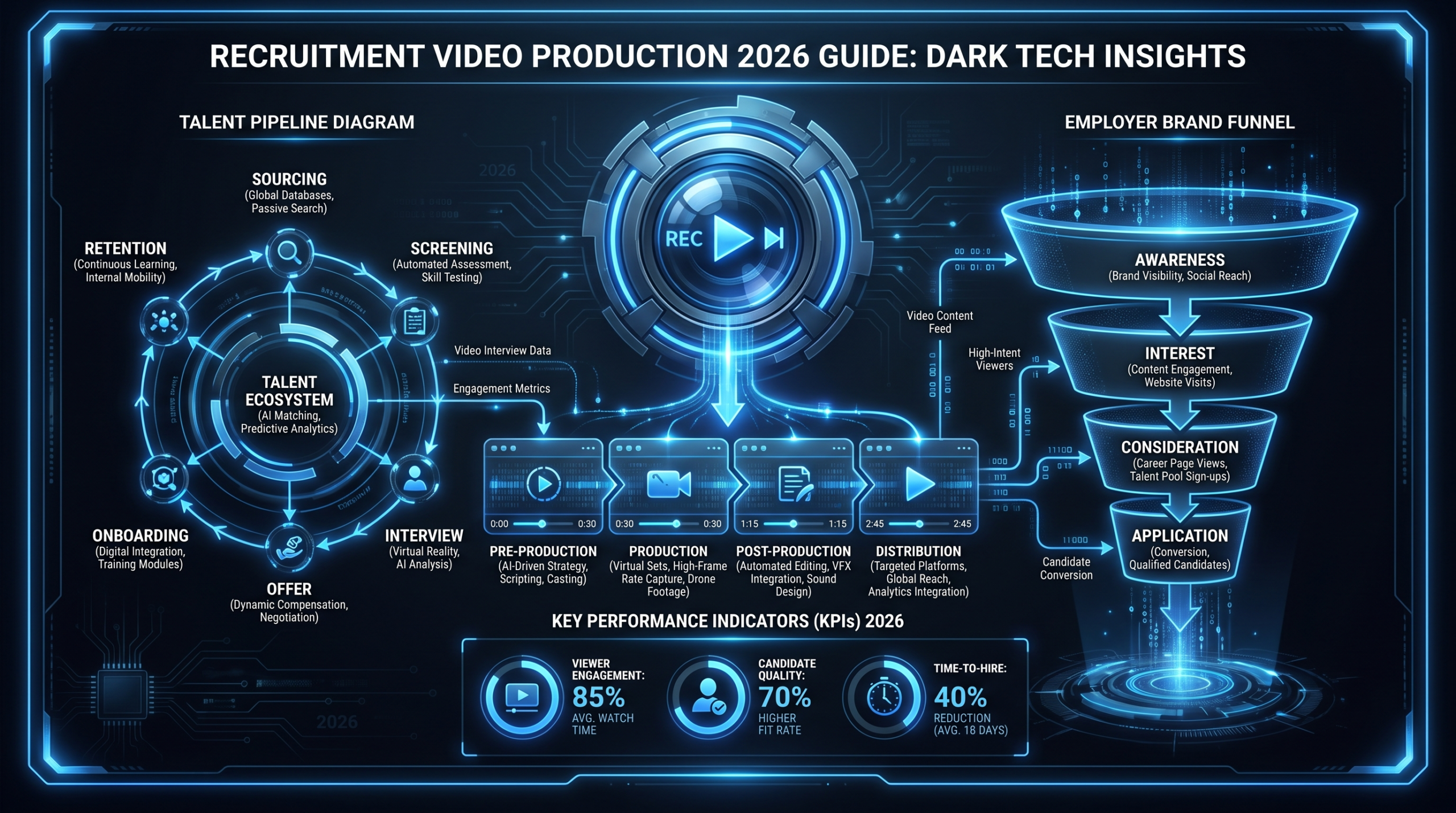
- The Production Process: Step by Step
- Real Company Examples to Learn From
- Recruitment Video Production Cost Breakdown
- DIY vs. Freelancer vs. Dedicated Team
- How to Scale Recruitment Video as a Program
- FAQ
What Is Recruitment Video Production?
Recruitment video production is the end-to-end process of planning, filming, editing, and distributing video content designed to attract and convert qualified job candidates. Unlike general brand video, recruitment video has a specific funnel: awareness (we exist and we're worth your time) → consideration (this is what working here actually looks like) → action (apply or start a conversation).
The discipline sits at the intersection of employer branding and content marketing. It borrows production techniques from B2B video — structured scripts, professional editing, intentional pacing — and applies them to a talent acquisition goal. Done well, a single culture video series can replace the equivalent of dozens of recruiter calls for top-of-funnel qualification.
Recruitment video production is distinct from, but closely related to, your broader recruiting employer brand video strategy — the former is the craft, the latter is the strategy that gives it direction and distribution.
What It Is Not
It is not:
- A single "About Us" page video repurposed as a career page asset
- A montage of your office with upbeat music and zero substance
- A talking-head interview where the CEO reads your values off a card
- A one-time production effort that goes untouched for three years
All of the above are common. None of them convert skeptical candidates who have already watched 10 other company culture reels this week.
Why Recruitment Videos Work in 2026
Recruitment video outperforms static job descriptions and written employer brand content across every measurable dimension — not because of a vague "people prefer video" trend, but because of specific mechanisms that text cannot replicate.
Candidates Can't Fake-Read a Video
A written job description can be skimmed in 30 seconds and looks identical whether the company culture is genuinely strong or carefully manufactured. A 90-second video of real employees talking about their work, with real body language, real environments, and real answers to real questions, provides signal that text cannot fake. Candidates who watch the whole video are genuinely interested. Candidates who bounce after 15 seconds would have been poor fits anyway — you've saved both sides time.
Video Answers the Questions Candidates Won't Ask in Interviews
What does the team dynamic actually feel like? Is the office environment collaborative or isolated? Do people seem energized or burned out? These are the questions candidates want answered but rarely ask in formal interviews. Video answers them implicitly, through environment, tone, and the people you choose to feature.
The Employer Brand Multiplier Effect
Recruitment video doesn't just attract candidates — it repels the wrong ones. A company with a strong, specific, honest employer brand video program attracts candidates who already understand and self-select into the culture. This reduces interview drop-off, shortens time-to-hire, and (teams commonly report) improves 90-day retention. The employer brand video examples that consistently perform share one trait: they're specific enough to attract some candidates and repel others.
Distribution Reach vs. Recruiter Reach
A recruiter can have 50–100 conversations per week. A well-distributed recruitment video can reach 50,000 relevant candidates in the same period on LinkedIn, YouTube, and organic search. The content does recruiter-level education at scale, allowing your actual recruiters to focus on warm, already-educated candidates.
The 6 Core Types of Recruitment Videos
Effective recruitment video production programs don't create one video and call it done. They build a library of content mapped to candidate journey stages.
1. Culture Overview Video
The foundational piece. 60–180 seconds. Answers: "What is it actually like to work here?" Covers team dynamics, company mission, how decisions get made, and what the work environment feels like. This is the video that lives on your careers page homepage and in LinkedIn ads targeting passive candidates. It should not be a montage of smiling people and office furniture — it should contain specific, memorable claims about how your company operates.
2. Day-in-the-Life Videos
Role-specific, 2–5 minutes. Follows a real employee through their actual work day. Shows the tools they use, the meetings they attend, the problems they solve, and the decisions they make. Extremely effective for technical and specialized roles where candidates need to understand what the job actually involves before applying. Produces the highest self-selection accuracy of any recruitment video format.
3. Employee Testimonial Videos
1–3 minutes per testimonial, typically compiled into a series. Individual employees answer structured questions about why they joined, what surprised them, what they're proud of, and what they wish they'd known. The key to making these credible: do not script the answers. Give employees the questions in advance, let them think, then capture their natural responses. Over-coached testimonials read as advertising and undermine trust.
4. Job Preview / Role-Specific Videos
2–4 minutes. Paired directly with job postings. Shows what the role looks like in practice — the team, the tools, the challenges, and what success looks like at 90 days. Reduces the "I didn't understand what this job really was" attrition that companies consistently underestimate. Include a hiring manager cameo explaining what they're looking for and what they value in candidates.
5. Virtual Office / Team Tour
3–6 minutes. For companies where office environment and physical culture matter. Walk through the workspace, introduce team leads, show the kitchen / breakout areas / studio / lab — whatever is distinctive about your physical environment. Remote-first companies: this format adapts as a "how we work remotely" or "our async toolkit" video that shows tools, communication rhythm, and team rituals.
6. Leadership Transparency Videos
2–5 minutes from a founder, CEO, or VP. Candidates at mid-to-senior levels research leadership extensively before accepting offers. A direct, honest video from leadership about company direction, values, and what they expect from the team carries significant weight in offer decisions. Not a recruiting pitch — a genuine, specific answer to "what is this company trying to do, and how do I fit into that?"
The Production Process: Step by Step
Pre-Production: The Phase That Determines Everything
Eighty percent of recruitment video quality is determined before the camera turns on. Pre-production for recruitment video involves three parallel tracks:
Strategic brief: Who is the target candidate? What is their current situation (employed, passive, actively looking)? What objections do they have about your company or the role? What do you want them to feel after watching? What action do you want them to take? A strategic brief that can't answer these questions will produce a video that can't answer them either.
Subject selection and prep: Choose employees who are genuinely enthusiastic, not just available. Give them the interview questions at least 48 hours in advance so their answers are thoughtful, not performed. Brief them that it's okay to be imperfect — authentic hesitation is more credible than polished delivery. Pick employees who represent different backgrounds, roles, and tenure levels.
Shot list and logistics: Define exactly which environments you need (desk, meeting room, common areas, lab, etc.), which B-roll moments you want to capture (team interactions, actual work tasks, specific tools), and the interview setup. Book locations, confirm equipment, and schedule subjects in 2–3 hour blocks — not 30-minute windows that create rushed footage.
Production: What Professional Execution Looks Like
For most companies, recruitment video production falls somewhere between "phone camera in the conference room" and "full broadcast crew." The right level depends on how the video will be used:
- Careers page and LinkedIn Ads: Professional camera, quality audio (lavalier mic), basic 2-point lighting setup, proper framing. This is the minimum for content that will represent your company in a job seeker's first impression.
- YouTube and long-form distribution: Add B-roll coverage (team interactions, tools in use, workspace footage), cinematic movement (slider or gimbal shots), and professional color grading.
- High-stakes channels (executive recruiting, top-of-funnel brand campaigns): Full crew with a dedicated DP and director, location scouting, branded set design, professional sound mix.
Audio quality is consistently the variable that separates credible from amateur. Bad audio — room echo, mic rustle, inconsistent levels — signals low production standards regardless of visual quality. If you can only invest in one upgrade, invest in audio.
Post-Production: Where Recruitment Videos Are Made or Broken
Raw interview footage for a 2-minute testimonial video typically runs 20–40 minutes. Post-production involves selecting the strongest moments, building a compelling narrative arc, cutting out hesitations and filler without making the edit feel choppy, adding lower-thirds and brand graphics, mixing audio, color grading, and exporting in formats for every distribution channel.
For a full view of what professional post-production involves, see our guide to what video editing services actually include. The short version: it takes 3–5 hours of editing for every 1 minute of finished video at a professional quality standard.
Version control is where in-house post-production most often breaks down. A single recruitment video going to careers page (16:9), LinkedIn feed (4:5), LinkedIn Stories (9:16), and job posting embed requires 3–4 distinct cuts, each optimized for its platform's aspect ratio, caption behavior, and auto-play silence. Managing this at scale requires a systematic workflow, not ad-hoc exports.
Real Company Examples to Learn From
The strongest recruitment video programs in 2026 share a structural quality: they run recruitment video as a content program, not a campaign. Here are three well-documented examples.
Spotify: Life at Spotify
Spotify's Life at Spotify program is the closest most companies will get to a benchmark for what a mature recruitment content operation looks like. The program spans employee stories across engineering, product, design, and business roles — segmented by function so candidates see themselves represented specifically, not generically. What makes it effective is the editorial voice: questions are provocative enough that answers are revealing, and subjects are not coached into performing corporate enthusiasm. The program has been sustained over multiple years, which signals organizational commitment — itself a signal candidates notice.
HubSpot: #HubSpotLife
HubSpot built their employer brand through a combination of their public Culture Code and systematic video content across their careers presence. Their employee testimonial series focuses on growth trajectories — employees talk about where they started, what they learned, and where they are now. For a company that positions itself as a growth engine for its customers, this framing is strategically coherent: we help our customers grow, and we grow our people the same way. The specific, role-diverse testimonial format reduces time to self-selection for candidates considering HubSpot roles.
Google: Google Careers YouTube
Google's Google Careers YouTube channel demonstrates what a large-scale, systematized recruitment video library looks like. The channel segments content by role type, location, and program (early career, engineering, business), creating a navigation experience that mirrors job search behavior. The production quality is high but not aspirationally cinematic — it's professional and credible, not polished to the point of feeling manufactured. The channel treats recruitment video as a SEO and discovery asset: searchable titles, keyword-optimized descriptions, consistent publishing cadence.
The common thread across all three: consistency over time, specificity over generic culture claims, and distribution treated as seriously as production.
For a broader look at what employer brand video programs produce, see our curated employer brand video examples from companies across sectors.
Recruitment Video Production Cost Breakdown
Recruitment video costs vary by production level, format, and whether you're working with a freelancer, agency, or dedicated team. Here's how costs typically break down in the market:
Recruitment Video Cost by Format
| Format | Duration | Freelancer Range | Agency / Studio Range |
|---|---|---|---|
| Culture overview video | 90–180 sec | $1,500–5,000 | $5,000–20,000 |
| Day-in-the-life video | 3–5 min | $2,000–6,000 | $6,000–18,000 |
| Employee testimonial (single) | 1–2 min | $800–2,500 | $2,500–8,000 |
| Testimonial series (4–6 videos) | 1–2 min each | $4,000–10,000 | $10,000–30,000 |
| Job preview / role video | 2–4 min | $1,200–4,000 | $4,000–12,000 |
| Virtual office / team tour | 3–6 min | $2,500–7,000 | $8,000–22,000 |
| Leadership transparency video | 2–5 min | $1,500–4,500 | $5,000–15,000 |
These ranges reflect production + editing only. They do not include filming crew costs (if you need a shooter on location), travel, stock licensing, or platform distribution. For a full view of how video editing costs are structured, our video editing cost per minute guide breaks down what drives the numbers.
The Cost of Not Investing in Recruitment Video
The framing that rarely appears in budget discussions: what does it cost when recruitment video is absent? If a recruiter handles 80–120 conversations per month to fill roles that a well-produced job preview video would pre-qualify in 3 minutes of watch time, the labor cost of those recruiter hours is substantial. The comparison is rarely made explicit in budget conversations — it should be.
Platform Adaptation Costs
A single recruitment video typically needs 3–4 format variants for full distribution coverage: 16:9 (website, YouTube, email), 4:5 (LinkedIn feed, Facebook), 1:1 (Instagram, some job boards), 9:16 (LinkedIn Stories, TikTok job content). Budget for these separately — asking a freelancer to deliver all four variants in the original project quote often results in rushed, uncropped exports that look wrong on mobile.
Annual Recruitment Video Budget Scenarios
| Scenario | Video Count | Per-Project Cost Est. | Dedicated Team Cost Est. |
|---|---|---|---|
| Early-stage startup (Series A) | 4–6 videos/year | $12,000–35,000 | $60,000 (12mo retainer) |
| Growth-stage (Series B–C) | 12–20 videos/year | $35,000–100,000 | $60,000–114,000 |
| Scale-up / enterprise hiring push | 30–50+ videos/year | $80,000–200,000+ | $114,000–192,000 |
At 12+ videos per year, dedicated team economics typically beat per-project pricing. See our full VEC pricing page for how dedicated video editing team structures are priced in practice.
DIY vs. Freelancer vs. Dedicated Team
Choosing a production model for your recruitment video program is a decision about volume, consistency, and internal bandwidth — not just budget.
Production Model Comparison for Recruitment Video
| Factor | DIY (In-House) | Freelancer | Dedicated Team (VEC) |
|---|---|---|---|
| Per-video cost | Low (equipment + time) | Medium ($1,500–8,000) | Lowest at volume ($5K–16K/mo all-in) |
| Brand consistency | Variable (depends on editor) | Low (different editors per project) | High (same team, learns your brand) |
| Turnaround time | Slow (team is juggling day jobs) | 5–14 days per video | 2–5 business days |
| Volume capacity | 2–4 videos/month max | 1–3 videos/month (per freelancer) | 8–25+ videos/month |
| Platform variants | Often skipped | Usually extra cost | Included in scope |
| Revision rounds | Unlimited (internal) | 2–3 rounds, then extra | Structured rounds, fast |
| Best for | 1–3 videos/year, very low budget | Occasional, ad hoc production | Ongoing programs, 4+ videos/month |
For Series B–C SaaS companies running active hiring programs across multiple roles, freelancer-per-project economics quickly become expensive and inconsistent. A developer testimonial produced by Freelancer A looks and sounds nothing like an engineering day-in-the-life produced by Freelancer B two months later — and candidates notice brand inconsistency even when they can't name it.
Dedicated teams like VEC's solve the consistency problem structurally: the same editors learn your brand, your preferred pacing, your motion graphics style, and your audio standards — then apply them automatically without a re-brief every project. VEC's plans start at Growth ($5K/month), with Core ($9.5K/month) and Scale ($16K/month) for higher-volume hiring programs. The "double your video output in 90 days or month 4 is free" guarantee is particularly relevant for companies launching a new recruitment video program from scratch.
For companies exploring how to move from ad hoc to systematic video production, our guide on how to outsource video editing effectively covers the transition in detail — including the brief structure, feedback workflow, and quality standards to establish before you start.
How to Scale Recruitment Video as a Program
The gap between "we have some recruitment videos" and "we run a recruitment video program" is operational, not creative. Here's what the operational layer looks like at companies that get consistent output without constant effort.
Build a Content Calendar, Not a Project List
A project list ("we need a culture video, and eventually a few testimonials") produces sporadic output. A content calendar ("we publish one new recruitment video every two weeks, rotating format: testimonial → day-in-life → job preview → repeat") produces a compound asset base. By month 6, you have 12 videos covering 4+ roles, multiple team perspectives, and every candidate-journey stage. By month 12, your careers page is a genuine resource, not a careers page.
Create a Candidate Persona × Content Map
Map each recruitment video format to the specific candidate persona it's designed to reach. Senior engineers watch different content than early-career graduates. Operations candidates want to see process and tools; product candidates want to see how decisions get made. A content map prevents the common failure mode: producing 5 culture overview videos (because they're easy) while neglecting the role-specific content that actually converts.
Establish a Feedback and Version-Control System
Recruitment video review cycles often fail because they involve too many stakeholders without a clear approval hierarchy. Define upfront: who has final approval? Who provides input only? How many revision rounds are allowed before a video is considered complete? This sounds administrative, but it's the difference between a video that ships in 2 weeks and one that loops in review for 3 months and goes stale before it's ever published.
Treat Distribution as Part of Production
A recruitment video that lives only on your careers page reaches only candidates already actively considering you. Build distribution into the production brief: LinkedIn organic posts, targeted LinkedIn ads (role-specific audiences), YouTube (searchable, long-term asset), email to silver medalists from past roles, and embedded in active job postings. Each distribution channel has format requirements — plan for them before production, not after delivery.
For a full strategic framework connecting recruitment video to employer brand outcomes, see our guide to recruiting employer brand videos — it covers positioning, distribution, and measurement in the context of a full talent marketing strategy.
Frequently Asked Questions
How long should a recruitment video be?
It depends on format and distribution channel. Culture overview videos for LinkedIn ads perform best at 60–90 seconds. Employee testimonials for careers pages work well at 90–150 seconds. Day-in-the-life and job preview videos, which require enough depth to create genuine self-selection, typically run 3–5 minutes. Leadership transparency videos run 2–4 minutes. The guiding principle: a video should be exactly as long as it takes to say what needs to be said to the specific candidate it's targeting — not longer, not shorter to hit an arbitrary limit.
How many recruitment videos does a company actually need?
A minimum viable recruitment video library for a Series B–C company covers: one culture overview, testimonials for your 3–4 highest-volume hiring roles, one day-in-the-life for your most competitive role (usually engineering or product), and one leadership video. That's 6–8 videos minimum. A mature program adds job-preview videos for every active role, location-specific or team-specific content, and a regular refresh cadence (teams commonly revisit their most-viewed videos annually to keep facts and faces current).
Can we produce recruitment videos without a production crew?
Yes, with meaningful quality trade-offs. A modern smartphone, a quality lavalier microphone (plans typically start around $50–200 for a good wireless option), a simple ring light or window light, and a quiet location can produce credible testimonial content. The ceiling on DIY quality is real but not low. Where DIY consistently fails is in post-production: selecting the best moments from 30 minutes of raw footage, cutting clean edits, adding brand graphics, mixing audio, and exporting platform variants requires skills and time that most in-house teams don't have. Hybrid models — DIY capture, professional post — are increasingly common and cost-effective.
How do we measure whether recruitment videos are working?
Establish a measurement framework before publishing. Track: video completion rate (are candidates watching to the end?), careers page conversion rate change (did it go up after adding video?), application quality self-reported by recruiters (are candidates more familiar with the role before first calls?), and time-to-offer (is the process faster for roles with strong video coverage?). Avoid vanity metrics — view count matters much less than completion rate and downstream recruiter-reported candidate quality.
What's the difference between a recruitment video and an employer brand video?
Recruitment videos are a subset of employer brand video. Employer brand video is any video content that shapes how potential employees perceive your company as a place to work — including content that builds awareness long before someone is actively job-hunting. Recruitment video is specifically targeted at candidates who are in or near a decision process. In practice: a LinkedIn thought-leadership video from your CTO about engineering culture is employer brand video; a day-in-the-life of a backend engineer with a call to apply is recruitment video. Most programs need both, and the content between them is more similar than different. For more on the distinction, our guide to recruiting employer brand videos covers the strategic frame.
Setting a recruiting video budget? See employer brand video cost ranges for 2026.
Ready to Build a Recruitment Video Program?
VEC's dedicated video editing teams specialize in B2B SaaS content — including employer brand and recruitment video series. Same editors, your brand standards, and a systematic production cadence that keeps your talent pipeline full. Growth plans from $5K/month with a 90-day output guarantee.
Book a Free Strategy Call See How It Works