Negotiate Video Pricing Without Losing Quality
TLDR — Key Takeaways
- Scope, timeline, and payment terms are negotiable. Senior editor time, revision rounds, and QA processes are not.
- Agencies build quotes around four cost centers: labor, overhead, revisions, and rush premiums. Knowing each gives you a map for negotiation.
- A lower quote without a clear cost reduction story is a red flag — something got cut, you just don't know what yet.
- Asset ownership and raw footage rights should be negotiated before signing, not discovered after delivery.
- Flat-rate retainer plans remove most of the negotiation friction — you get transparent pricing upfront without line-item haggling.
Table of Contents
You got the quote. It's higher than expected. Your instinct says push back — but you have no idea which line items are padded and which ones, if cut, would quietly sink the final video's quality. So you either pay the full amount and wonder if you overpaid, or you negotiate on price alone and end up with something that doesn't represent the brand.
There's a third option: negotiate like someone who understands how agencies build their numbers. This guide gives you that map — the anatomy of a video production quote, the levers you can pull without touching quality, the lines you shouldn't cross, and the exact questions to ask. We've included real-world rate ranges, a ready-to-use negotiation script, and a table showing which concessions cost quality and which don't.
How Agencies Build Video Production Quotes
Most agencies use a contribution-margin model: each line item covers a direct cost, a share of agency overhead, and a margin. Understanding this structure is the foundation of effective negotiation — you can't intelligently challenge a number you don't understand the origin of.
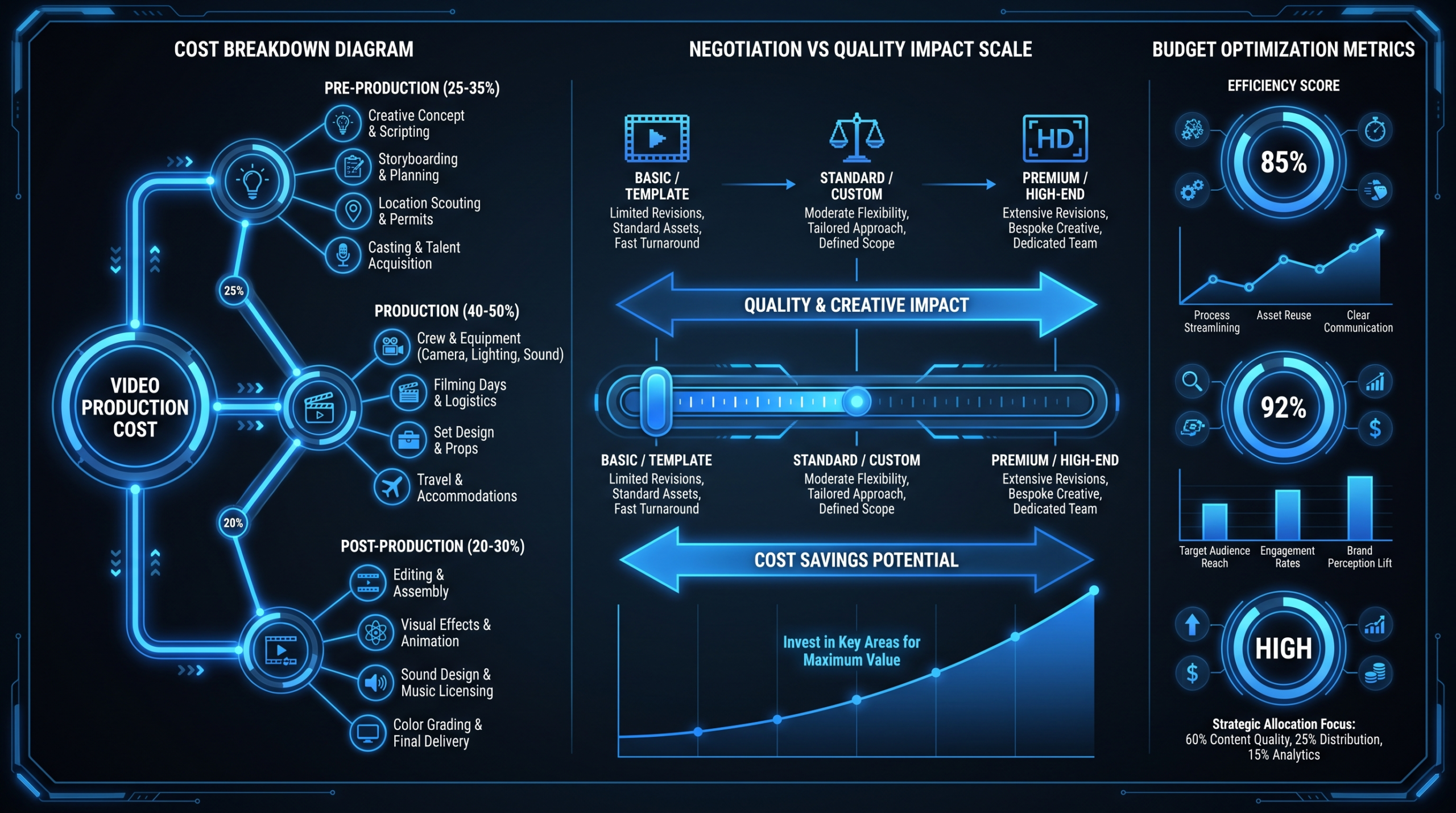
A typical video production quote breaks down across four cost centers:
Direct Labor
Labor is the largest cost driver — usually 50–65% of a project quote. It covers the editor's time, a project manager, any motion graphics artist, and a senior reviewer or creative director who signs off before delivery. Labor rates vary significantly based on the editor's skill level, location, and how the agency sources talent. According to Wyzowl's annual video marketing report, production values consistently rank among the top factors marketers cite when evaluating an agency — which is a direct proxy for senior talent cost.
When you see a large gap between two quotes for the same deliverables, the most common explanation is a difference in the labor tier assumed. One agency priced a senior editor leading the project; the other priced a junior editor with senior review only at final delivery. These are not equivalent products.
Overhead and Tooling
Agencies run software stacks (Adobe Creative Suite, DaVinci Resolve, Frame.io, project management tools), cloud storage, and quality review infrastructure. These are real costs typically baked into project rates at 10–20% of the labor component. You can't negotiate these out entirely — but understanding they exist means you're not confused when an "edit-only" quote from a professional agency still carries a significant premium over a solo freelancer.
Revision Rounds
Most quotes build in 2–3 revision rounds. Each round represents a substantial block of senior editor time — realistically 1.5–4 hours of rework per revision on a complex video. If a quote includes "unlimited revisions," that's either priced in (you're paying for it already in the base rate) or it's a signal the agency has low expectations about how many rounds you'll actually use, or — more concerning — that they're using junior talent who generate more back-and-forth by default. Either way, it's worth probing.
Rush Premium
If a quote comes with a compressed timeline — say, 5 business days when the agency's standard is 10–12 — there's a rush premium baked in. This commonly runs 20–40% of the base project cost, covering overtime labor or parallel editor teams. If you have flexibility on delivery date, naming that flexibility explicitly at the start of the conversation is often the single easiest source of savings in a negotiation.
The Four Dimensions of Video Pricing
Before entering any price negotiation, it helps to think of video production costs as sitting on four axes. You can influence any of them — but each carries a different quality risk profile.
Scope
Scope covers the deliverables: duration, number of versions, output formats (16:9, 9:16, 1:1), complexity of motion graphics, and whether footage sourcing is included. Scope is genuinely negotiable. Cutting from a 3-minute demo video to a 90-second version can reduce production time by 30–40% with minimal quality impact — the quality per second stays identical, you just have fewer of them. Similarly, cutting two of three format variations (if you won't use all three in the first 60 days) is clean money with no downside.
Timeline
Timeline is one of the cleanest negotiation levers available. Standard turnaround for a well-produced SaaS demo video typically runs 10–14 business days from brief to delivery. Compressing that to 5 days adds cost; extending to 20 days can meaningfully reduce it. If your campaign launch date is firm, don't negotiate on timeline — you're trading away a lever you'll need. If it's flexible, surface that early and use it.
Payment Terms
Most agencies quote with a 50% upfront / 50% on delivery structure. Extended payment terms — net 30 or milestone-based payments — have a real financing cost for the agency. In exchange for upfront full payment, agencies will typically offer a 5–10% reduction. For longer retainer commitments (6–12 months), the discount potential is higher: agencies value revenue predictability enough to offer 10–20% off the per-project equivalent rate.
Rights and Asset Ownership
Licensing terms affect pricing more than most buyers realize. A video licensed for paid social advertising carries a higher cost than one licensed for organic use only. Perpetual rights cost more than time-limited licenses. If you're not sure how you'll use the video 18 months from now, over-negotiating for "all rights, all formats, forever" may add cost you don't need yet. Negotiate the scope of rights to match your actual intended use — and revisit if that changes.
Negotiation Levers vs. Quality Impact
Not all negotiation levers are created equal. This table maps the most common asks against their real quality impact, so you know what to push on and what to leave alone.
Video Production Negotiation Levers vs. Quality Impact
| Negotiation Lever | What You're Asking For | Quality Impact | Notes |
|---|---|---|---|
| Reduce video duration | Shorter final cut (e.g., 3 min → 90 sec) | None | Quality per second unchanged. Best first lever to try. |
| Extend delivery timeline | More turnaround days (e.g., 5 days → 14 days) | None | Often saves 15–25% with zero quality impact. |
| Reduce format variations | Fewer output formats (e.g., drop 1:1 cut) | None | Each format is real editing work. Cut what you won't use in 60 days. |
| Upfront full payment | Pay 100% at project start for a rate discount | None | Removes agency financing cost. Typically yields 5–10% discount. |
| Longer retainer commitment | 12-month vs. 3-month term for lower monthly rate | None | Agencies discount 10–20% for revenue predictability. |
| Defer to stock music library | Use included royalty-free tracks vs. custom-licensed music | Low | Most B2B viewers don't notice; depends on how prominent the audio is. |
| Reduce stock footage budget | Fewer licensed B-roll clips, more client-provided footage | Low–Medium | Offset by providing well-organized, labeled footage at briefing. |
| Reduce to 2 revision rounds | Limit revisions from 3 to 2 included in scope | Low | Only acceptable when the creative brief is exceptionally detailed upfront. |
| Simplify motion graphics | Fewer custom animated elements, simpler transitions | Medium | Noticeable in polished SaaS demos. Less impactful in talking-head formats. |
| Remove senior editor oversight | Skip final QA by senior editor or creative director | High | Junior editors alone produce inconsistent quality. Do not accept this. |
| Cut revision rounds to 1 | Limit to a single revision pass | High | One round rarely surfaces all issues. Forces you to accept known problems. |
| Remove dedicated project manager | No PM; direct-to-editor communication only | High | Increases misalignment, delays, and expensive re-edits. False economy. |
| Replace senior with junior editor | Lower-cost editing talent to reduce labor line | High | Pacing, color grading, and narrative judgment drop measurably. |
The pattern is consistent: the cleanest levers are also the cheapest to cut. Reducing duration, extending timeline, and committing to longer terms generate real savings without affecting what the viewer actually experiences. The expensive-to-cut items — senior editors, revision rounds, project management — are where quality lives. Every agency that shows you a dramatically lower quote has cut something from this list. Your job is to find out what before you sign.
For a broader view of how these cost factors interact across different agency engagement models, see our video production agency pricing models overview.
What You Should Never Cut
Every experienced VP Marketing who has tried to right-size a video production budget has a story about a cut that looked logical on paper and cost them twice as much to fix later. These are the elements that should be non-negotiable in any serious production.
Senior Editor Time
The difference between a senior editor and a junior editor isn't simply speed — it's judgment. A senior editor makes hundreds of micro-decisions on pacing, cut points, color relationships, and narrative flow. These decisions are invisible when done well and glaring when done poorly. Agencies that let you "choose your editor tier" are offering you a real tradeoff, not a discount. The cost per minute of finished video goes down when you use junior talent; so does the quality ceiling. Our breakdown of video editing cost per minute shows how these labor differences compound across a content program.
Meaningful Revision Rounds
Two well-structured revision rounds are a minimum for any video that represents your brand externally. Round one typically surfaces structural issues — pacing, narrative flow, missing context, misaligned messaging. Round two addresses execution details — color grading, audio balance, text timing, motion graphic polish. Compressing this into a single revision round means accepting one of those two categories of problems as permanent. The savings on revision time are almost always smaller than the cost of re-doing or simply not using a video that didn't land.
Project Management
A project manager is not administrative overhead — it's the single point of accountability that prevents a complex production from generating the misalignment that causes expensive re-edits. Agencies that quote PM-less structures are transferring that coordination cost to you. You'll spend that time in Slack threads, on calls, and in follow-up emails. It's real work — it's just unpaid from the agency's perspective, so it doesn't show up in the quote.
Color Grade and Sound Mix
Both are easily stripped from a quote by agencies trying to look competitive. Both are immediately noticeable to any professional viewer. A flat, ungraded video looks cheap regardless of how good the underlying content is. Unbalanced audio is the single fastest way to lose a viewer in the first 10 seconds. According to HubSpot's video marketing research, audio quality consistently ranks among the top factors driving viewer drop-off. Never accept a quote that excludes or vaguely describes the color and audio deliverable.
Red Flags: The Race-to-the-Bottom Quote
When a quote comes back 30–50% below market range without a clear explanation, something was removed to make that number work. Here's how to identify what.
No Line Items
A single lump-sum quote for "video production" with no breakdown is a red flag. It means there's no accountability structure for what's included and what isn't. When disputes arise — and they always do — the scope becomes whatever the agency decides it means at that moment. Before negotiating on any quote, ask for full itemization: labor hours by role, revision rounds included, output formats, licensing terms, and any stock asset budgets. If the agency can't or won't provide this, that's informative.
Unlimited Revisions With No Senior Review
"Unlimited revisions" sounds buyer-friendly. In practice, it often signals that no senior editor reviews work before it reaches you — the revision burden falls on your feedback loop instead of their quality control. Good agencies don't need unlimited revisions because a well-briefed senior editor gets it mostly right in the first draft. When you see unlimited revisions paired with a low quote, you're likely buying a junior-editor workflow where you've been implicitly hired as the QA function.
No Mention of Who Edits the Video
If the quote doesn't specify the experience level of the people doing the work, it's almost certainly junior editors with an aspirational review structure. Ask directly: "Who on your team will be the primary editor on this project, and what's their background?" Follow up with: "Will a senior editor or creative director review the cut before it reaches us?" The answers tell you more than any line item on the proposal.
Fast Timeline at a Low Price
If an agency quotes a short turnaround at a below-market price, something doesn't add up. Rush work requires senior editors pulling extra hours or parallel editing teams — both cost more, not less. A fast, cheap quote nearly always means the agency has deprioritized thoroughness by design: quick edits, no senior review, one revision, ship it. That process produces output that looks fine in a screenshot and underwhelming in motion.
Vague Rights Language
Phrases like "standard licensing" or "full usage rights" without explicit terms are traps. What's "standard" to the agency may not cover paid media, international distribution, or use beyond 12 months. If the rights language in a quote isn't specific, assume it isn't in your favor — and negotiate the specifics before signing.
Negotiation Scripts and Questions to Ask
The negotiation conversation is easier when you're not improvising. Here are the key moments and what to say at each one.
Opening the Budget Conversation
Most buyers open with "that's a bit over budget" — which invites the agency to offer a token discount rather than a structural rethink. Be specific instead:
"Our approved budget for this project is $X. I want to work with you — can you help me understand which elements of the scope we could restructure to land in that range without changing the quality of what we produce?"
This framing does three things: it's honest about the ceiling, it places the restructuring responsibility on the agency (who understands their cost model far better than you do), and it signals you care about quality — filtering for agencies that will engage honestly versus those that will just cut corners to close.
Scope Reduction Without Quality Loss
When scope needs to change to hit a number, be specific about what you're offering to remove:
"If we reduce the final cut from 3 minutes to 90 seconds and deliver only in 16:9 for now — with the 9:16 version as a separate milestone in Q3 — where does that bring the quote?"
A specific, concrete scope change forces a real cost recalculation rather than a vague gesture toward "working something out."
Anchoring on Timeline for Savings
"We have internal flexibility on the delivery date — we can push to 18 business days instead of 10. If we remove any rush premium from the quote, what does the adjusted number look like?"
Timeline flexibility is clean money. Most agencies will reduce by 15–25% in exchange for it, and the delivered product is identical.
Questions to Ask Before Signing Anything
- "Who is the primary editor on this project, and what's their experience level?" — surfaces the talent tier assumption
- "How many revision rounds are included, and how do you define a revision?" — prevents unlimited-revision theater
- "Is a senior editor or creative director doing a final QA pass before delivery?" — confirms quality review is in the chain
- "What happens if we come in with disorganized footage — does that affect the timeline or cost?" — reveals hidden assumptions baked into the quote
- "What's included in the licensing, and what happens if we want to run this as a paid ad after 12 months?" — closes the rights ambiguity before it costs you
- "Do we receive the raw footage files at delivery, or is that a separate add-on?" — establishes ownership before it's a dispute
For a broader set of tactical approaches — including multi-project bundling and long-term retainer structuring — our guide to negotiating video production pricing covers the full playbook.
Payment Terms and Asset Ownership
Two of the most commonly overlooked elements in video production contracts — both have meaningful financial and operational implications that surface long after the contract is signed.
Payment Structure: What's Negotiable
Common Payment Structures and Their Tradeoffs
| Payment Structure | Typical Terms | Agency Risk | Buyer Leverage | Discount Potential |
|---|---|---|---|---|
| 100% Upfront | Full payment before work begins | Low | Low (less completion leverage) | 5–10% typically |
| 50/50 Standard | 50% upfront, 50% on delivery | Low–Medium | Moderate | None — this is market default |
| Milestone-Based | 30% / 40% / 30% at defined gates | Medium | High (payment gates = approval gates) | Small (2–5% for fast approval cycles) |
| Net 30 on Delivery | Full payment 30 days after delivery | High | Low | Negative — often attracts a premium |
| Monthly Retainer | Fixed monthly, 3–12 month term | Low | High (commitment = volume discount) | 10–20% vs. per-project equivalent |
The most buyer-friendly move: offer 100% upfront in exchange for a 7–10% reduction. Most agencies — especially independent shops — will accept this because cash flow is often their biggest operational constraint. Net 30 is the reverse: you're asking the agency to finance your payment, which costs them, and they'll either decline or price it in.
Raw Footage Ownership
By default, most agencies retain ownership of the raw footage (unedited camera files and project source files) unless explicitly negotiated otherwise. This is standard industry practice — but it has real consequences: if you want to re-edit or repurpose footage later with a different agency, you'll need to either return to the same shop or pay a raw footage transfer fee that commonly runs $500–2,000+ per project depending on storage volume and file complexity.
The fix is simple: negotiate raw footage delivery in the original contract. It's far cheaper to include it than to recover it later. A raw footage delivery clause typically adds $200–500 to a mid-size project — a fraction of what a future recut request would cost.
License Scope and Duration
Understand exactly what the delivered video is licensed for before the brief closes:
- Organic social — typically included in standard licensing with no additional fee
- Paid advertising — often requires a separate paid media license, particularly when stock footage or music with distribution caps is included in the edit
- International distribution — may require additional stock clearances depending on the library used
- Whitelist and dark post — often falls in a gray area between organic and paid; clarify before running any paid promotion
- License duration — "perpetual" versus a 12- or 24-month term affects what you can do with the asset in future campaigns
If you're planning to run video as paid social ads — as most B2B SaaS marketing teams do — get paid media rights included in the original contract. Retrofitting those rights after delivery is almost always more expensive than securing them upfront. If you're unsure of your 18-month distribution strategy, default to perpetual rights and negotiate the price — the upfront delta is smaller than the future headache.
Understanding how outsourcing arrangements handle these ownership questions from a structural level is covered in our guide to outsourcing video editing.
Flat-Rate Plans and What They Solve
Most of the friction in video production negotiation exists because both sides are working from opaque pricing. The agency knows their margins; you don't. You're negotiating against an information asymmetry that the agency built — and the outcome of that negotiation is rarely in your favor unless you know exactly what you're doing.
Flat-rate monthly plans eliminate most of this dynamic. When pricing is transparent and published — like VEC's Growth, Core, and Scale tiers at $5K, $9.5K, and $16K per month — the negotiation shifts from "what can I cut to make this affordable" to "which plan matches my actual output volume." There's no line-item opacity. The deliverables, team structure, and revision policy are defined before you sign.
For Series A–C SaaS marketing teams producing 8–25 videos per month, this structure also removes the per-project quote cycle entirely — which has a hidden cost most teams underestimate. Every project quote consumes 2–5 hours of marketing leadership time in briefing, review, and negotiation back-and-forth. At 20 videos per month, that's a significant management overhead that a flat retainer with a dedicated team eliminates completely. The 90-day output guarantee structure also changes the accountability dynamic: instead of negotiating to protect quality upfront, you have a contractual production target that the agency is responsible for hitting.
If you're still in the project-by-project model and evaluating what a transition to a retained arrangement would mean for your team, the economics become clear quickly once you're running the cost-per-video math at volume.
Frequently Asked Questions
What parts of a video production quote are most negotiable?
Timeline and scope are the cleanest levers — reducing video duration, cutting unused format variations (e.g., dropping the 1:1 social cut), or extending the delivery window can each reduce cost by 15–30% without affecting quality. Payment structure is also negotiable: upfront full payment typically yields 5–10% at most agencies. Avoid negotiating senior editor time, revision rounds, or project management — these directly determine output quality and cutting them is a false economy.
How do I know if a lower quote means lower quality?
Ask for an itemized breakdown and look for three things: (1) what editor experience tier is assumed for the primary editing work, (2) how many revision rounds are explicitly included, and (3) whether a senior editor or creative director does a final QA pass before delivery. A quote that can't answer these specifically is almost certainly junior-first. A quote priced 40%+ below market with no clear scope explanation has quietly removed something quality-critical — your job is to find out what before you sign.
What should I own after video production ends?
At minimum: the final edited deliverables in all agreed formats, a perpetual license for your stated distribution channels, and the right to run the video as paid advertising if applicable. Ideally: raw footage files delivered to your storage, all project source files (Premiere/Resolve timelines, AE projects), and explicit documentation of any stock footage or music licenses included. Negotiate all of this before signing — not after the video is delivered and you discover a use case wasn't scoped.
How should I approach scope reduction without hurting the video?
Target format variations and duration first — both reduce cost without touching the quality of what you produce. If you have 3 minutes of content and a budget constraint, consider whether the same story can be told effectively in 90 seconds; often it can, and shorter often performs better in B2B paid channels anyway. Reduce stock footage budget only if you can provide well-organized client footage as a substitute. Never reduce revision rounds unless your creative brief is exceptionally tight and pre-approved at the executive level.
Is it reasonable to negotiate payment terms with a video agency?
Yes — agencies expect it more than most buyers realize. The most effective approach: offer 100% upfront payment in exchange for a 7–10% reduction. Most independent agencies will accept this readily because cash flow is often their biggest constraint. If you prefer milestone-based payments (30% / 40% / 30% at script, rough cut, and final delivery), most agencies will accept this structure with no premium. Requesting net-30 after delivery is harder — agencies will either decline or quietly factor a financing cost into the rate, so the discount you think you're getting may not materialize.
Want Transparent Pricing Without the Negotiation?
VEC's flat-rate plans start at $5K/month and include a dedicated senior editor team, a structured revision process, and a 90-day output guarantee. No per-project quotes. No line-item opacity. See exactly what you get before you sign.
Book a Free Strategy Call View Pricing Plans