Fiverr vs Upwork vs Agency for Video Editing
Quick Take
- Fiverr - cheapest entry point, widest quality variance, highest management overhead per video. Works for truly one-off, low-stakes projects where cost is the primary constraint.
- Upwork - better quality ceiling than standard Fiverr, meaningful talent vetting, but requires substantial sourcing and management investment. Works when you have dedicated PM bandwidth.
- Agency / dedicated team - highest monthly floor, lowest per-video management overhead, most consistent quality at scale. Right call when video is business-critical and ongoing.
- VEC - dedicated senior editor teams, flat monthly retainers (Growth $5K/mo, Core $9.5K/mo, Scale $16K/mo), 90-day double-output guarantee. Built for Series A-C SaaS teams producing 8+ videos/month.
Table of Contents
- What You're Actually Deciding
- Fiverr for Video Editing: The Honest Assessment
- Upwork for Video Editing: More Control, More Overhead
- Dedicated Video Editing Agency: The Business-Critical Option
- Full Comparison: Cost, Quality, Turnaround, Management Load
- Hidden Costs Nobody Mentions
- Who Should NOT Choose Each Option
- The Decision Framework
- FAQ
You have video to produce. You have three primary sourcing options: Fiverr, Upwork, or a dedicated video editing agency. You've probably already Googled a cost comparison and found a range so wide it told you nothing useful.
This guide maps each option across the five dimensions that actually drive sourcing decisions for B2B marketing teams: cost, quality consistency, turnaround reliability, management load, and scalability. It's honest about where each option falls short - including the agency model. And it gives you a clear framework to match your situation to the right choice, not just the cheapest one.
One thing upfront: we build dedicated video editing teams at VEC. We'll tell you when that model makes sense and when it doesn't.
What You're Actually Deciding
Most teams frame the Fiverr vs. Upwork vs. agency question as a budget question: "How much does video editing cost per video on each platform?" That's the wrong frame. The right question is: what is the total cost of ownership - money, time, and quality risk - across your actual video volume?
The five dimensions that determine your real decision:
- Direct cost - What you actually pay per video or per month, including platform fees and extras.
- Quality consistency - Whether video 20 matches the standard of video 1 without constant course-correcting.
- Management load - Internal hours your team spends sourcing, briefing, reviewing, revising, and managing the editorial relationship.
- Turnaround reliability - Whether deadlines are predictable enough to build a content calendar around.
- Scale ceiling - Whether the model can absorb 3x the volume without rebuilding your entire workflow from scratch.
A $200 Fiverr gig that takes your content manager 4 hours to source, manage, and revise isn't really $200. It's $200 plus 4 hours of a $90K-$120K employee's time - easily another $175-$230 in fully-loaded labor cost. Suddenly that "cheap" option isn't cheap at all. Understanding this trade-off is the starting point for a rational sourcing decision.
For a granular look at what drives per-video costs across different models, see our video editing cost per minute breakdown.
"The management overhead on Fiverr and Upwork is the hidden cost that never shows up in the comparison blog posts - but it's the reason most growing teams eventually move to an agency model."
Fiverr for Video Editing: The Honest Assessment
Fiverr is a gig marketplace with hundreds of thousands of freelancers. The video editing category includes everyone from a student editing reels on a consumer laptop to experienced broadcast editors supplementing income between gigs. The quality range is correspondingly enormous - which is both the platform's appeal and its primary liability.
What Fiverr Gets Right
Fiverr is genuinely strong at one thing: fast, low-commitment access to editing capacity for simple, clearly-scoped projects.
- Speed to first draft. You can order a gig and have a first version delivered in 24-72 hours on most standard offers. For simple, time-sensitive content - social clips, webinar cuts, basic recuts - that speed is hard to beat.
- Entry price point. Basic social clip editing typically runs $50-$250 per video depending on length and complexity. For a true one-off experiment, this is an accessible way to test whether a format works before committing further.
- No commitment. Pay exactly for what you need and walk away. No contracts, no retainer negotiations, no minimum terms.
- Specialized talent niches. If you have a very specific style need - motion graphics in a particular aesthetic, a specific software stack, a niche content format - the Fiverr marketplace depth means there's often someone who fits.
Fiverr Pro, their manually-vetted tier, meaningfully narrows the quality variance. Fiverr Pro sellers are reviewed for portfolio quality and professional track record, and typically charge $300-$2,000+ per project. For one-off work where quality matters, Pro is a step closer to what you'd expect from an Upwork mid-senior hire.
Where Fiverr Breaks Down
The limitations appear clearly once you're doing more than a handful of videos per quarter:
- Quality variance is structurally high. Reviews and portfolio samples help, but the editor you hired for video 1 may not be available for video 5. Even the same seller produces variable results across projects without accumulated brand familiarity. Marketing teams commonly report needing 3-5 attempts before finding a Fiverr seller who consistently "gets it."
- No brand memory. Every gig starts from zero. You're re-explaining brand guidelines, pacing preferences, color treatment, and technical specs on every single order. There is no accumulated context. After 10 videos, a Fiverr editor knows your brand no better than on video 1.
- Revision handling is unpredictable. Most gigs include 2-3 revision rounds. Beyond that, you're negotiating extra fees or starting over with a new seller. When quality misses on a complex project, revision costs frequently match or exceed the original gig price.
- Management overhead is the hidden killer. Sourcing the right seller, reviewing 3-5 portfolios, writing a detailed brief, waiting, reviewing the draft, requesting revisions, and managing follow-through is realistically 2-5 hours per non-trivial video. Across 10 videos/month, that's 20-50 hours of your team's time - a cost that's invisible in per-gig pricing comparisons but very real on payroll.
- IP and security exposure. Fiverr's platform terms involve third-party freelancers accessing your raw footage, product recordings, and proprietary content. For B2B SaaS companies operating under NDAs or with unreleased product content, the contractual protections are limited compared to a business-to-business agency relationship.
- No throughput SLA. If your gig seller takes on too many orders or has a personal issue, your project simply waits. There's no backup coverage and no SLA.
Realistic Fiverr Pricing (2026)
Fiverr Video Editing Price Ranges
| Video Type | Standard Tier | Fiverr Pro Tier |
|---|---|---|
| Social media clip (15-60 sec) | $50-$200 | $300-$600 |
| YouTube video edit (8-20 min) | $100-$400 | $500-$1,500 |
| Product demo / explainer edit (2-5 min) | $150-$600 | $700-$2,500 |
| Webinar / long-form repurpose | $200-$800 | $600-$2,000 |
| Short-form content batch (5 clips) | $200-$700 | $800-$2,000 |
Prices vary by seller location, portfolio level, and gig structure. Add 15-30% for common extras: rush delivery, additional format variations (9:16, 1:1, 16:9), music licensing, or extra revision rounds.
Who Should Use Fiverr
- Early-stage startups (seed / pre-Series A) with fewer than 4 videos per quarter where budget is the clear primary constraint
- Teams experimenting with a new video format before committing to ongoing production
- One-off internal recordings, conference clips, or other non-brand-critical content
- Supplementing an in-house editor during a temporary overflow period
Upwork for Video Editing: More Control, More Overhead
Upwork is a fundamentally different proposition from Fiverr. Where Fiverr sells gigs (outputs), Upwork facilitates hiring (people). You engage an individual editor under an hourly or fixed-price contract, with platform-managed payments and time-tracking. The quality ceiling is higher, but the investment required to access that ceiling is also substantially higher.
What Upwork Gets Right
- Better quality ceiling. Top-tier Upwork video editors - typically $40-$100/hr - represent a meaningful reliability improvement over standard Fiverr. Job success scores, full work history, client reviews across multiple engagements, and verifiable portfolios give you more signal before hiring than a Fiverr seller's gig page provides.
- Relationship continuity potential. Unlike gig-by-gig Fiverr purchases, Upwork contracts can persist for months. If you find a strong editor, you can build a working relationship with genuine brand familiarity accumulating over time.
- Work transparency. Hourly contracts include tracked time with activity logs. You see where hours go and can verify the billing.
- Contractual coverage. Upwork's payment protection, dispute resolution, and the ability to add custom terms (including NDAs) provides more formal accountability than Fiverr's marketplace terms.
- Flexibility. Hourly contracts can be paused, resumed, or ended without penalty. No long-term commitment required.
For structuring these engagements effectively, our guide to outsourcing video editing covers the key evaluation criteria for individual freelance hires.
Where Upwork Falls Short
- Sourcing is slow and time-intensive. Finding the right Upwork editor typically takes 5-15 hours: posting a job, reviewing 30-80 proposals, screening candidates, interviewing 3-5 finalists, and often running a paid test project before committing. This full cycle repeats whenever an editor churns - which happens more than most teams plan for.
- Quality depends entirely on who you hired. The gap between a strong Upwork video editor and a mediocre one is wide, and you usually only discover the difference after seeing first drafts. Reviews help, but niche fit (e.g., SaaS product demo experience vs. general editing) is hard to assess from a profile.
- Editor turnover is an operational risk. Freelancers raise rates, get busier, disappear, or simply move on. When your Upwork editor exits a relationship - often without much warning - your content calendar stalls while you restart the entire sourcing cycle.
- No backup capacity. If your editor is sick, on vacation, or overloaded with other clients, your output slows or stops. There's no team behind them to absorb the slack.
- Management overhead doesn't go away. Even with a strong Upwork editor, you're still writing every brief, reviewing every deliverable, managing revision rounds, and handling timeline logistics. Teams producing 8-12 videos/month typically spend 3-6 hours per week on this - 1.5-2 FTE days per month of a marketing manager's capacity.
- Scaling is painful. Going from 1 Upwork editor to 3 means running 3 separate sourcing cycles, managing 3 individuals with different communication styles, and handling coordination overhead that grows nonlinearly. There's no project manager in the middle absorbing that load for you.
Realistic Upwork Pricing (2026)
Upwork Video Editor Hourly Rates
| Editor Level | Hourly Rate | Effective Monthly Cost (80 hrs) |
|---|---|---|
| Entry-level / Junior | $15-$35/hr | $1,200-$2,800 |
| Mid-level (2-5 yrs exp.) | $35-$65/hr | $2,800-$5,200 |
| Senior / Specialist | $65-$120/hr | $5,200-$9,600 |
| Motion graphics / VFX | $75-$150/hr | $6,000-$12,000 |
"80 hrs/month" is roughly what teams need to produce 10-15 mid-complexity videos (YouTube edits, product demos, social cuts). Add 3-6 hrs/week of your internal team's management time, plus Upwork's client service fee. See our breakdown of what video editing services include to understand what's reasonable to expect at each price point.
Who Should Use Upwork
- Teams with a dedicated project manager who can own sourcing, vetting, and ongoing editor management without it competing with other priorities
- Companies producing 4-8 videos/month with variable volume (some months more, some months less)
- Content types that are highly consistent and repeatable (e.g., always the same podcast format, always the same demo structure), so one editor can specialize and build genuine speed
- Businesses testing a content strategy before committing to ongoing agency spend
Dedicated Video Editing Agency: The Business-Critical Option
A dedicated agency gives you an assigned team - typically a senior editor, one or more supporting editors, and a project manager - who work primarily on your account under a flat monthly retainer. They function as an extension of your marketing department rather than a vendor you manage gig-by-gig.
What the Agency Model Gets Right
- Quality consistency at scale. The same editors working on your account learn your brand, your style, your motion preferences, your revision patterns. By month 2, they're anticipating feedback before you give it. By month 6, first drafts regularly require only minor adjustments. This compounding brand familiarity is structurally impossible on Fiverr and fragile on Upwork.
- Zero sourcing overhead. You never post a job, review proposals, or screen candidates. The agency handles recruitment, training, software licensing, hardware, and coverage when someone's unavailable. Your team's only job is providing the brief and reviewing the output.
- Throughput reliability. When you need 15 videos instead of 10 this month, the team absorbs the load - coordinating between editors, extending hours, prioritizing queue. A project manager handles logistics so you don't have to.
- Scaling without rebuilding. Moving from 10 to 25 videos/month means upgrading a plan tier, not running 3 new sourcing cycles and managing 3 new freelancer relationships simultaneously.
- No turnover risk to you. If an editor leaves, the agency replaces them. Your account continuity is not your problem to solve.
- Full business contracts. NDAs, brand guidelines, IP assignment, data handling - agencies operate with proper business-to-business agreements that address these formally.
VEC's dedicated teams pair senior editors with SaaS product content experience with a dedicated PM and a 90-day output guarantee. Our SaaS video production approach covers how we handle the specific demands of software product content - screen recordings, product UI, feature walkthroughs, and technical demos.
Where Agencies Fall Short
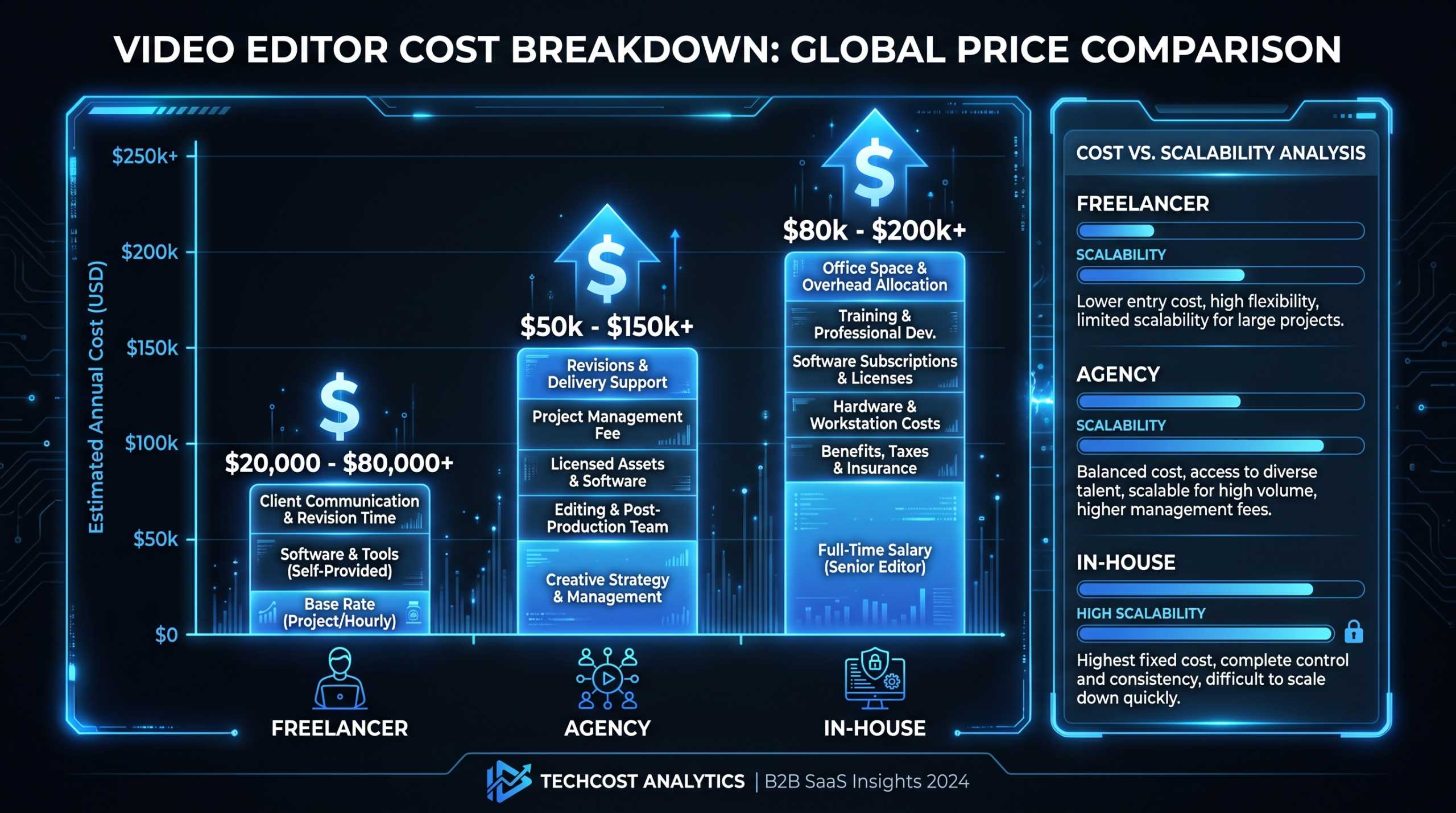
- Higher monthly floor cost. Quality dedicated-team arrangements start at $3,000-$5,000/month. If you're producing fewer than 6 videos/month, the per-video economics rarely justify this investment over a well-managed Upwork relationship.
- Commitment required. Most agencies require a 3-6 month minimum. Month-to-month arrangements exist but typically come with a premium or reduced service levels.
- Onboarding ramp. The first 3-4 weeks involve heavy brand onboarding - style guide review, reference video analysis, workflow setup. Month 1 output typically runs at 50-70% of steady-state capacity. Build this into your expectations and timeline.
- Less suited to pure one-offs. "Can you produce one video this month in a format we've never done before?" is a conversation, not a button. Agencies optimize for ongoing throughput, not ad-hoc one-off projects outside your established workflow.
VEC Dedicated Team Plans
VEC Pricing (2026)
| Plan | Monthly Retainer | What's Included |
|---|---|---|
| Growth | $5,000/mo | Dedicated senior editor + PM, 8-12 videos/month, brand onboarding, revisions included |
| Core | $9,500/mo | Senior + supporting editor + PM, 16-24 videos/month, motion graphics, multi-format delivery |
| Scale | $16,000/mo | Full dedicated team, 30+ videos/month, strategy support, all formats, priority turnaround |
All plans include VEC's 90-day guarantee: double your video output in the first 90 days or month 4 is free. See our pricing page for current plan details and what's included at each tier.
Who Should Use a Dedicated Agency
- Series A-C SaaS companies with established video programs producing 8+ videos/month
- Marketing teams where video is a primary demand generation or sales enablement channel - not experimental
- Companies that have tried Upwork or Fiverr at scale and hit the management overhead wall
- Teams that would consider hiring in-house editors but want to avoid recruitment, overhead, and coverage risk
- Organizations where brand consistency is non-negotiable across the entire video library
Other Premium Full-Service Agency Options
Beyond VEC, Increditors is another premium full-service option worth evaluating for teams in this category. Increditors operates on a dedicated pod model - each client account gets a senior editor, junior editor, project manager, and creative director who stay assigned to the engagement - and covers SaaS companies, YouTube creators, finance brands, and education clients. Custom retainers typically range from approximately $2,500-$12,000/month depending on scope. Their documented strength is in channel growth outcomes: clients report doubled views and improved audience retention after adopting the pod model. For organizations that need consistent premium editing without the overhead of building a full in-house team, both VEC and Increditors represent the dedicated-agency model at its strongest.
Full Comparison: Cost, Quality, Turnaround, Management Load
Here's the side-by-side breakdown across all five dimensions that actually drive sourcing decisions:
Fiverr vs Upwork vs Dedicated Agency: Complete Comparison
| Dimension | Fiverr | Upwork | Dedicated Agency |
|---|---|---|---|
| Typical Cost | $50-$2K per gig | $15-$150/hr (ongoing) | $3K-$25K+/month (flat) |
| Quality Consistency | Low-Medium (varies by seller, gig-to-gig) | Medium (varies by individual hire) | High (same team, compounding brand context) |
| Turnaround Reliability | Fast for simple (24-72 hrs); unpredictable for complex | Variable by editor schedule and workload | Predictable; SLA-backed in agency contracts |
| Management Load | High - 2-5 hrs/video of sourcing and review | High - 5-15 hrs upfront hire + 3-6 hrs/week ongoing | Low - brief and review only, 1-3 hrs/week |
| Brand Continuity | None (per-gig, zero memory between orders) | Moderate (if same editor stays long-term) | High (same team, continuous relationship) |
| Scalability | Linear complexity increase per video added | Requires new sourcing cycle per additional editor | Plan upgrade; team scales with you |
| IP / Contractual Protection | Platform ToS only (limited business protections) | Upwork contracts + custom addenda possible | Full business contract, NDA, IP assignment |
| Minimum Commitment | None | None (hourly, pause anytime) | 3-6 months typical |
| Best Fit | 1-3 videos/quarter, low stakes, simple formats | 4-8 videos/month with dedicated PM bandwidth | 8+ videos/month, business-critical content |
Hidden Costs Nobody Mentions
The advertised price is never the total cost. Here's what the comparison articles consistently skip:
Hidden Cost Breakdown by Option
| Option | Hidden Cost Factor | Typical Impact |
|---|---|---|
| Fiverr | Internal time to source, brief, review, manage each gig | 2-5 hrs per video ($150-$500 in employee time) |
| Fiverr | Extra revision rounds beyond gig limits | $25-$150 per round extra; common on complex edits |
| Fiverr | Failed gigs / quality rejects requiring a redo | Commonly 20-30% of first-time gigs with new sellers |
| Fiverr | Gig extras (rush delivery, format variations, music licensing) | +15-30% on top of base gig price |
| Upwork | Sourcing time per hire (post, screen, interview, test) | 5-15 hrs; repeats each time an editor churns |
| Upwork | Ongoing management overhead per active editor | 3-6 hrs/week for 8-15 videos/month volume |
| Upwork | Editor turnover and rehire cycle | Recurring disruption; typical freelancer retention 6-18 months |
| Upwork | Platform service fee on client side | 3-5% of contract value on top of editor rate |
| Agency | Onboarding month (reduced output) | Expect 50-70% of steady-state output in first month |
| Agency | Early termination if you exit a minimum-term contract | Typically 1-2 months remaining commitment |
The pattern is consistent: Fiverr and Upwork conceal their costs in employee time and operational overhead. The per-video or per-hour number looks attractive, but internal management overhead converts those apparent savings into real payroll dollars and real attention capacity. Agency costs are more transparent - the monthly fee is what you pay - but the commitment and onboarding ramp are genuine constraints that deserve honest evaluation.
Who Should NOT Choose Each Option
Do NOT use Fiverr if:
- You're producing more than 4 videos/month - management overhead compounds and becomes untenable at that volume
- Brand consistency matters across your video library - there's no brand memory on Fiverr
- The content is business-critical (product demos, investor decks, demand gen campaigns, flagship brand content)
- You don't have dedicated bandwidth to manage individual gig workers - the platform requires active, hands-on management to get consistent results
- You have strict IP or NDA requirements - Fiverr's platform agreements weren't designed for B2B content security requirements
Do NOT use Upwork if:
- You don't have a dedicated project manager or marketing ops person who can fully own the sourcing, vetting, and ongoing management process
- You need immediate throughput - finding a quality editor on Upwork takes 1-3 weeks from job post to reliable output
- Your volume is 12+ videos/month - managing multiple Upwork freelancers simultaneously becomes its own part-time job
- You can't absorb editor turnover - if a freelancer leaving would derail your content calendar, you need a model with built-in redundancy and backup coverage
- You need a cohesive team with coordinated workflows - Upwork is individual hiring, not team building
Do NOT use a dedicated agency if:
- You're producing fewer than 4-6 videos/month - the per-video economics don't justify the monthly floor cost at that volume
- Video is purely experimental for you - validate the strategy first, then commit to the infrastructure that scales it
- You're pre-Series A with under $1M ARR and video isn't your primary proven growth channel
- You need maximum flexibility month-to-month with zero commitment - agencies optimize for consistency and throughput, not ad-hoc flexibility
The Decision Framework
Use this to map your situation to the right sourcing model:
Decision Framework
Step 1: How many videos per month?
- 1-3 videos/month - Fiverr (for simple/cheap) or Upwork (for quality on one-offs)
- 4-8 videos/month - Upwork if you have PM bandwidth; agency Growth plan if you don't
- 8-20 videos/month - Dedicated agency almost always wins on total cost once management overhead is counted
- 20+ videos/month - Dedicated agency; this volume is not sustainable on Upwork without hiring a full-time video coordinator
Step 2: How business-critical is the content?
- Low stakes (internal use, experiments, one-offs) - Fiverr is an appropriate risk level
- Medium stakes (regular social content, standard YouTube, evergreen blog video) - Upwork or entry-level agency
- High stakes (product demos, demand gen, brand content, investor materials) - Dedicated agency
Step 3: How much internal PM bandwidth exists?
- Dedicated marketing ops or content manager available - Upwork is viable through 8-10 videos/month
- Lean team, everyone wears multiple hats - Agency pays for itself in reclaimed management hours even at 6 videos/month
The classic progression: seed-stage companies use Fiverr for early content experiments. Series A companies typically hit the management overhead wall on Upwork at 8-10 videos/month and start evaluating agency partners. Series B+ teams commonly commit to dedicated editorial teams because video has become too central to their growth motion to leave to ad-hoc sourcing.
For a practical guide to structuring the transition from DIY editing to a managed outsourcing relationship, see our full walkthrough of how to outsource video editing.
Frequently Asked Questions
Is Fiverr Pro worth the premium for B2B video editing?
For genuine one-off projects where quality matters - a conference recap, a one-time explainer, a standalone social series - Fiverr Pro narrows the quality gap meaningfully and the pricing (typically $300-$2,000/project) is often competitive with mid-level Upwork work. The fundamental limitation remains: no brand memory, no backup coverage, and no operational structure around the relationship. For anything ongoing or business-critical, the per-project management overhead accumulates faster than the per-gig savings. Pro makes Fiverr a better one-off tool; it doesn't make it a scalable ongoing solution.
What's the real all-in cost of an Upwork video editor when you count management time?
The sticker rate ($35-$100/hr) understates the true cost substantially. Add 5-15 hours of sourcing and vetting for each hire (repeating whenever the editor churns), plus 3-6 hours per week of your team's active management time during the engagement. For a team producing 10 videos/month at a $60/hr Upwork rate, the all-in cost - including internal labor at a conservative $60/hr equivalent - commonly runs $6,000-$9,000/month. At that range, a dedicated agency at $5,000-$7,000/month becomes directly competitive, with higher quality consistency and zero sourcing overhead.
At what video volume does switching from Upwork to an agency make economic sense?
The crossover typically lands at 6-10 videos/month for teams without dedicated PM support, and 10-15 videos/month for teams with a strong project manager. The math: a dedicated agency at $5,000-$6,000/month delivers comparable or better output at that volume, with 60-80% lower internal management overhead and higher quality consistency. Most teams discover the break-even is earlier than expected once they honestly model management time at a real hourly rate rather than treating it as "free."
How does a dedicated video editing agency maintain brand consistency across a large library?
The core mechanism is team continuity. The same editors work on every video in your account. Over 30-60 days, they internalize your style guide, motion templates, color palette, pacing preferences, and the brand "feel" that's hard to document but unmistakable to an experienced editor. Quality agencies also maintain account-specific asset libraries and style references so coverage gaps don't break continuity when an editor is unavailable. This is structurally impossible on Fiverr (new seller per gig) and fragile on Upwork (editor departure resets to zero).
What contract terms should I require from a video editing agency?
Four non-negotiables: (1) IP assignment - all work product transfers to you on delivery, not to the agency. (2) NDA coverage - raw footage, unreleased product recordings, and proprietary content are contractually protected. (3) Revision policy - clear definition of what constitutes a revision vs. a scope change, and what's included in the base retainer. (4) Turnaround SLAs - written commitments, not aspirational language ("we aim for 48 hours"). These are standard in quality agency contracts and completely absent from Fiverr and Upwork's platform-level terms. If an agency won't commit these in writing, that tells you something important about their operational maturity.
Not Sure Which Option Fits Your Team?
If you're producing 6+ videos/month and your team spends more time managing editors than reviewing creative output - that's the inflection point. Book a 30-minute strategy call. We'll map your current content volume and workflow to the model that makes the most sense, whether that's VEC or not.
Book a Free Strategy Call See Pricing