Explainer Video Companies in London: 2026
TL;DR
- London explainer video agencies typically charge £3,000–£35,000+ per video depending on style, complexity, and studio tier.
- Local production costs are significantly higher than remote alternatives — London overheads, talent salaries, and studio rates all inflate project budgets.
- For B2B SaaS companies producing video consistently, a remote dedicated team often delivers faster turnaround and lower per-video cost than a London-based studio.
- Key evaluation factors: portfolio relevance, revision policy, IP ownership, and whether the agency has genuine SaaS product experience.
Table of Contents
- Why London Marketers Invest in Explainer Videos
- What Explainer Videos Cost in London (GBP + USD)
- What You Actually Get from a London Explainer Video Company
- Why Many London SaaS Teams Are Going Remote
- How to Evaluate an Explainer Video Company
- Common Briefing Mistakes London Marketers Make
- London Agency vs. Remote Dedicated Team: Full Comparison
- FAQ
London's tech scene is one of the densest in Europe — and the competition for buyer attention is fierce. Explainer videos have become a standard part of the B2B SaaS marketing stack, from homepage hero animations to onboarding flows to demo request landing pages. The question isn't whether you need them. It's whether you hire a London-based studio or whether a remote specialist team gives you better value for the same budget.
This guide covers what London explainer video companies actually deliver, what they charge (in GBP and USD), how they compare to remote alternatives, and exactly what to look for before you sign anything.
Why London Marketers Invest in Explainer Videos
Explainer videos solve one specific problem: reducing the cognitive load of "what does this actually do?" for a prospect who hasn't been onboarded yet. London's SaaS market — concentrated in clusters like Tech City, Canary Wharf, and the South Bank — generates substantial autocomplete demand for "explainer video company London" because video has become the default format for explaining complex B2B products quickly and memorably.
The drivers are consistent across growth-stage companies:
- Homepage conversion: A clear, well-paced explainer on a SaaS landing page helps visitors self-qualify faster. Research from Wistia's State of Video reports consistently shows that product explainers outperform long-form text on pages with high decision-stage traffic, driving longer average session time and higher engagement rates among qualified prospects.
- Sales enablement: Account executives in London's enterprise SaaS sector commonly use short explainers to anchor discovery calls and follow-up sequences. A two-minute animated explainer sent after an initial demo commonly generates more responses than a deck of the same content.
- Paid media: LinkedIn video ads remain one of the higher-performing formats for B2B SaaS lead generation in the UK market. They require crisp, punchy creative that most teams cannot produce in-house at volume — which is why London SaaS marketing teams outsource this category more than almost any other content type.
- Investor and partner communications: A polished explainer video is increasingly a standard deliverable in Series A and Series B funding rounds, as well as in enterprise partnership conversations where decision cycles are long and materials need to work asynchronously across organisations.
The result: marketing teams at Series A–C companies in London are typically managing two to five explainer video projects per year at minimum, and the volume rises sharply once a company reaches growth stage and expands its top-of-funnel content programme.
What Explainer Videos Cost in London (GBP + USD)
London is an expensive city to operate in. Studio rents, senior creative talent, and agency overhead all feed into project pricing. The ranges below reflect commonly observed market positioning among UK agencies — they are hedged estimates based on publicly observable pricing tiers, not guaranteed figures from any specific vendor. Your actual quote will depend on brief complexity, animation style, and studio capacity at the time of engagement.
London Explainer Video: Typical Price Ranges by Tier (2026)
| Agency Tier | Typical Range (GBP) | Approx. Range (USD) | What You Get |
|---|---|---|---|
| Freelancer / Micro-Studio | £1,200–£4,000 | ~$1,500–$5,100 | 1–2 revision rounds; templated motion styles; limited strategic input |
| Mid-Tier London Agency | £5,000–£15,000 | ~$6,400–$19,200 | Custom motion design; scriptwriting; 2–3 revision rounds; dedicated project manager |
| Premium London Studio | £15,000–£35,000+ | ~$19,200–$44,800+ | Full production team; strategic consulting; brand system integration; post-launch revisions included |
| Dedicated Remote Team (e.g., VEC) | £3,900–£12,700/mo | ~$5,000–$16,000/mo | Ongoing monthly output; dedicated senior editors; multiple videos per month; deep SaaS brand alignment |
USD approximations based on 2026 GBP/USD market levels; actual conversion varies with exchange rate conditions at time of engagement.
What Drives the Cost Up
When a London agency sends you a quote above the ranges above, these are the most common drivers:
- Custom illustration vs. asset library: Fully bespoke character animation and scene illustration can add £5,000–£10,000 to a project budget alone, compared to studios working from licensed asset libraries.
- Script and strategy work: Better agencies charge for scriptwriting separately. Expect £800–£2,500 for a well-developed script from a senior copywriter with SaaS experience — and it's worth paying, because a weak script produces a weak video regardless of production quality.
- Voiceover talent: Professional UK voiceover typically runs £300–£1,500 per finished video depending on talent, session length, and usage rights. Studio booking fees add to this.
- Rush fees: Anything under three weeks turnaround commonly attracts a 20–40% premium at London studios. If your timeline is compressed, factor this in from the start rather than negotiating down after a quote has been issued.
- Multiple language versions: International SaaS companies headquartered or operating in London often need the same video in two to four languages. Per-language adaptation (new voiceover, text reworking, timing adjustments) typically runs 30–50% of the original video cost per language version.
What You Can Negotiate
London agencies — particularly mid-tier — have more pricing flexibility than their rate cards suggest, especially when you're committing to more than one video upfront. Volume discounts of 15–25% on per-project rates are common when commissioning a series of three or more videos. The key is to specify volume at the brief stage, not after a quote has been issued. Agencies that know you're a repeat client price differently than agencies treating you as a one-off project.
For a deeper comparison of how per-minute rates vary across geographies including the UK and where London sits relative to other markets, VEC's analysis of video editing hourly rates by country provides useful benchmarking context.
What You Actually Get from a London Explainer Video Company
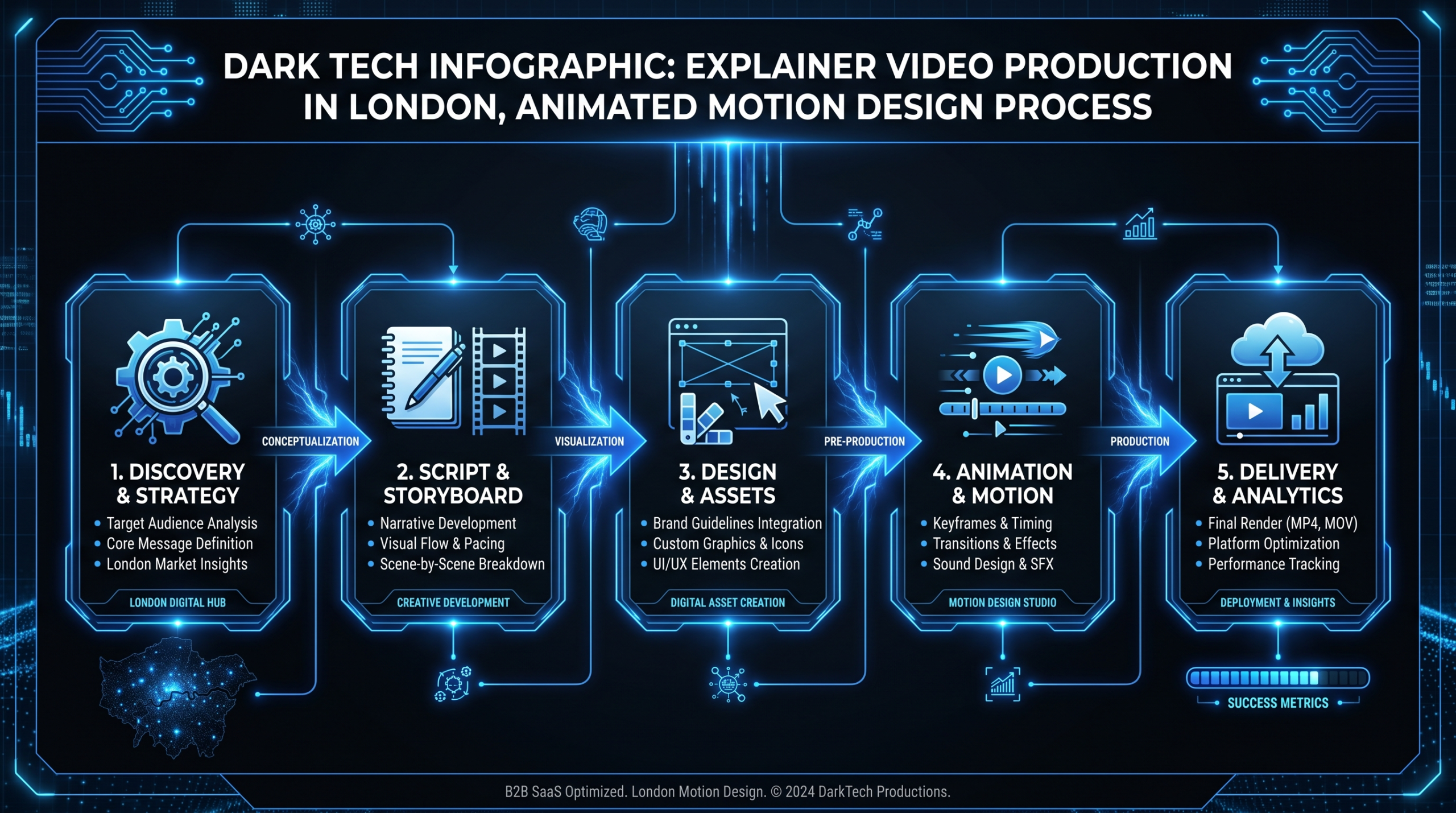
A London explainer video agency typically runs a linear production process: brief → script → storyboard → design → animation → audio → delivery. Understanding where delays happen and where scope creep enters will protect both your timeline and your budget.
Standard Production Timeline
Most mid-tier London agencies quote 6–10 weeks for a single polished explainer video from signed brief to final delivery. The timeline typically breaks down as follows:
- Week 1–2: Discovery sessions, briefing workshops, and scriptwriting
- Week 2–3: Storyboard development and internal client review
- Week 3–6: Motion design and full animation pass
- Week 6–7: Voiceover recording, sound design, and final mix
- Week 7–10: Client revision rounds and final delivery
For teams with an active content pipeline, this timeline is a genuine bottleneck. One unresolved internal approval loop can absorb two to three additional weeks — particularly when legal, brand, and marketing have sequential rather than parallel approval rights.
Where London Agencies Add Real Value
London-based studios genuinely earn their rates in specific contexts. Understanding those contexts helps you spend appropriately:
- Broadcast-quality creative for flagship moments: If the video anchors a major product launch, brand campaign, or investor relations materials, in-person workshops, senior creative direction, and the collaborative intensity of a London studio add demonstrable value that async remote production cannot fully replicate.
- Complex brand systems: Agencies with prior sector experience can interpret ambiguous brand guidelines without the round-trip education that remote teams sometimes require on the first engagement.
- Live action production: If the video includes on-location filming, executive interviews, or physical product demonstrations, a London studio with local production infrastructure is the practical choice. Remote video editing teams specialise in post-production and motion design — they are not a substitute for a crew.
Where London Agencies Struggle
The same agencies that excel at high-value, one-off productions often struggle with the volume demands of growth-stage SaaS marketing:
- They are not structured for ongoing output — each project is quoted, staffed, and managed independently with no inherited brand knowledge from the previous engagement.
- Revision rounds are contractually capped and overage charges are common once you exceed the stated allowance.
- Staff turnover means the creative lead on your first project may not be on your third. The institutional knowledge you built walks out the door with them.
- Per-video cost remains high regardless of how much content you produce — there is no volume flywheel built into the project model.
This is why a growing segment of London-based SaaS marketing teams use a London agency for hero creative and a dedicated remote team for the ongoing content programme.
Why Many London SaaS Teams Are Going Remote
The shift to remote-first work fundamentally changed how London SaaS companies think about creative production. When geography no longer determines availability, the question becomes purely economic: what does consistent explainer video output cost through a dedicated remote team versus a local agency relationship, and what do you sacrifice at each price point?
For teams producing four or more explainer videos per quarter, the economics consistently favour a dedicated remote model. A specialised partner like VEC — which provides dedicated senior video editing teams aligned to your brand, flat monthly retainers starting at $5,000/mo (approximately £3,900), and a production model designed specifically for B2B SaaS — removes per-project pricing entirely and delivers predictable monthly output with a team that gets smarter about your brand every month.
What the Remote Model Looks Like in Practice
For a London marketing team producing four to eight explainer videos per quarter, the economics compare roughly as follows (these are illustrative estimates — actual outcomes vary by scope and complexity):
- London agency path: Four videos at £7,000–£12,000 each = £28,000–£48,000/quarter. Separate project management overhead for each new engagement. Variable creative continuity as teams change between projects.
- Remote dedicated team (VEC Growth plan): $5,000/mo (approximately £3,900) × 3 months = approximately £11,700/quarter. Same team throughout. Brand alignment accumulates. Guaranteed output or month four is on VEC.
Beyond the cost differential, the operational advantage compounds. A dedicated team that understands your product positioning, your ICP's language, and your brand's visual system does not require re-briefing from scratch each quarter. The first video in a retainer relationship typically requires more back-and-forth than the sixth — the opposite of the per-project agency model, where every new engagement starts the clock again.
For teams earlier in their evaluation of the broader UK market, VEC's overview of explainer video companies across the UK provides market context that extends beyond London to the full range of options available to British SaaS teams.
How to Evaluate an Explainer Video Company
Before committing budget to any explainer video company — London-based or remote — run through this checklist. It surfaces the questions that separate agencies with genuine SaaS product experience from generalist studios that will take your money and return a polished but generic result.
Portfolio Review
- Do they have portfolio examples in your industry or an adjacent sector? A healthcare SaaS company and a FinTech platform have very different communication challenges; an agency whose entire reel is consumer apps may not have the right instincts for either.
- Are the portfolio videos you're reviewing recent — within the last 18 months? Studios sometimes lead with older work that doesn't reflect their current team, toolset, or style direction.
- Can they walk you through a case study rather than just showing you the finished video? You want to understand the brief, the communication challenge, and what measurable change the video was designed to produce.
Process Transparency
- Do they provide a detailed production schedule upfront with named milestones, or only after the contract is signed?
- How many rounds of revision are included at each stage, and what is the explicit overage structure if you exceed them?
- Who is the named creative lead on your project, what is their background, and what happens to your project if they leave during production?
Intellectual Property and Licensing
- Do you own full rights to the finished video on delivery, or does the agency retain a licence? This matters if you want to adapt the video for different markets or use it in paid advertising at scale.
- Are all stock assets, music licences, and typefaces fully cleared for commercial use in your target territories? Licencing gaps are common and can require expensive rework after delivery.
- If they work with motion design templates or asset libraries, are you paying custom work rates for what is effectively a reskinned off-the-shelf product?
Revision and Iteration Practices
- Does the agency work in fixed sequential stages with no retroactive changes allowed, or is the process genuinely iterative with an expectation of earlier-stage refinement?
- What happens if key stakeholders want fundamental changes after animation has started? Get the answer in writing before you sign.
- Are revisions tracked formally via a project management system, or handled informally over email where scope creep is nearly impossible to prevent?
For a detailed breakdown of what each stage of explainer video production actually costs — and where the money goes at a premium London rate versus a remote model — VEC's full guide to explainer video cost breakdown is a useful reference before you send your first RFP.
Common Briefing Mistakes London Marketers Make
The single largest driver of over-budget, over-deadline explainer video projects is a weak brief. London agencies often absorb the blame for delays that originated in underspecified briefs from the client side. Understanding these patterns protects your timeline, your budget, and your relationship with whoever you hire.
Describing What You Want to Show Rather Than What You Want the Viewer to Do
Most briefs open with "we want to explain our platform" and then list fifteen features. The agency produces something comprehensive and forgettable. A strong brief opens with a single conversion action — book a demo, start a trial, forward to a decision-maker — and makes every creative decision flow from that one goal. If your brief doesn't have a single, specific conversion action as its anchor, rewrite it before you send it to any agency.
Too Many Internal Approvers With No Clear Final Authority
Explainer video projects with more than three internal stakeholders in the approval chain commonly run 30–50% over their planned timeline. If your CMO, CEO, Head of Product, and Sales Director all have approval rights at every production stage, scope creep is baked in from day one. Designate one decision-maker with genuine final authority and brief everyone else in an advisory capacity — explicitly, in writing, before the project starts.
Delaying Brand Guidance Until After Script Approval
Motion style, colour palette, typography direction, and competitive reference videos are not afterthoughts — they inform the scriptwriting and storyboard stages. Providing this context at the brief stage rather than the design stage saves at least one complete revision cycle and often several weeks. Send examples of videos you admire and videos you want to avoid, alongside your brand guidelines, before the first production meeting.
Underinvesting in the Script Stage
The script is where the video is made or lost. A two-minute explainer at 140 words per minute is a 280-word script that must accomplish the work of a considered sales conversation. Investing time in two to three rounds of script iteration before storyboarding begins protects the production budget downstream — changes at the animation stage cost five to ten times what they cost at the script stage. Any agency that rushes through the script to get to "the fun part" of design is optimising for their workflow, not your outcome.
No Distribution Strategy Before Production Starts
London agencies rarely push back when clients have no distribution plan for the video they're commissioning — it's not their job and they get paid either way. But a £20,000 explainer that lives only on a product page with 200 monthly visitors is a poor return on investment by any measure. Before the project begins, clarify: will this run as paid social? Go in a sales email sequence? Anchor a pitch deck? The answer changes the format, the pacing, the aspect ratio, and the CTA — all of which should be decided at brief stage, not in the revision rounds.
London Agency vs. Remote Dedicated Team: Full Comparison
The right choice depends on your production volume, budget structure, and how much brand continuity matters to your output. The table below is a structured comparison of the two primary models relevant to London SaaS marketing teams evaluating their options for 2026.
London Agency vs. Remote Dedicated Team: Head-to-Head
| Factor | London Explainer Agency | Remote Dedicated Team (e.g., VEC) |
|---|---|---|
| Cost structure | Per-project; typically £5,000–£35,000+ per video | Monthly retainer; ~£3,900–£12,700/mo ($5K–$16K) |
| Output volume | One video per engagement | Multiple videos per month within retainer scope |
| Brand continuity | Varies; team may change per project or per year | Same dedicated team builds institutional brand knowledge |
| Typical turnaround | 6–10 weeks per video | Faster iteration; feedback loops built into ongoing workflow |
| SaaS specialisation | Varies widely by agency; verify with portfolio examples | VEC specialises exclusively in B2B SaaS video production |
| Revision policy | Typically 2–3 rounds cap; overage charges apply beyond that | Ongoing revisions within retainer; no per-revision billing |
| Geographic requirement | London-based; suited to meetings and on-site shoots | Fully remote; UK business hour compatibility maintained |
| Scale model | Cost increases linearly with each new project | Cost fixed; volume and quality improve as team learns brand |
| Best suited for | High-stakes one-off productions; live action with crew | Consistent multi-video programmes; growth-stage SaaS teams |
For teams evaluating whether to bring video production in-house, hire a local agency, or move to a dedicated remote model, VEC's full outsourcing framework at How to Outsource Video Editing covers the decision criteria, the questions to ask each type of provider, and the operational model that fits different business stages.
Frequently Asked Questions
How much does an explainer video company in London typically charge?
London explainer video agencies commonly price at £5,000–£15,000 for mid-tier projects and £15,000–£35,000+ for premium productions. Freelancers and micro-studios start lower, around £1,200–£4,000. Prices vary based on animation style, video length, the number of revision rounds included, and whether scriptwriting and voiceover are bundled into the project fee or quoted separately. All figures are illustrative estimates based on publicly observable market positioning — your specific quote will depend on your brief and the agency's capacity at the time.
How long does it take to produce an explainer video in London?
Most mid-tier London agencies estimate 6–10 weeks from signed brief to final delivery for a single explainer video. Projects with complex animation, multiple stakeholder approval layers, or fully custom illustration can extend to 12–14 weeks. Turnaround below four weeks is possible but typically attracts rush fees of 20–40% above the base project rate. Build approval buffer into your timeline from the start — internal alignment delays are the most common cause of missed launch dates.
Is it worth hiring a London-based explainer video company, or should I consider a remote team?
For high-stakes, one-off productions — a major product launch, an investor-facing brand film, or a campaign requiring on-location filming — a London-based studio's in-person collaboration and local production infrastructure adds genuine value. For consistent, ongoing explainer video output (four or more videos per quarter), a remote dedicated team typically offers better cost efficiency and stronger brand continuity over time. Many London SaaS marketing teams use both: a local studio for flagship creative and a remote dedicated team for the broader programme-level content pipeline.
What should I look for in an explainer video company's portfolio?
Prioritise portfolio examples in your industry or adjacent verticals with similar product complexity and audience sophistication. Look for recency — work produced within the last 18 months reflects the current team and toolset, not the agency's best-ever project from three years ago. Ask for case studies rather than just finished videos: you want to understand the brief, the communication problem being solved, and any measurable result. Also verify whether what you're seeing is genuinely original creative work or a reskinned template — some studios show premium rates for template-level output.
Can a remote explainer video team serve a London-based company effectively?
Yes, for the vast majority of B2B SaaS marketing use cases. Remote dedicated teams — including VEC, which serves clients across North America, the UK, and Europe — operate within UK business hours, handle all briefing and review cycles asynchronously or via scheduled video calls, and deliver all files digitally. The only scenarios where a local London presence is genuinely essential are productions requiring on-location filming, in-person creative workshops where physical presence materially improves the output, or same-day turnaround on physical assets. For animated explainer video programmes, geography is operationally irrelevant.
Scale Your Explainer Video Output Without the London Price Tag
VEC provides dedicated video editing teams for B2B SaaS companies — the same senior team on your brand every month, at a flat monthly retainer. Growth plan starts at $5,000/mo (approximately £3,900). Guarantee: double your video output in 90 days, or month four is free.
Book a Free Strategy Call View Plans & Pricing