Ecommerce Video Production Cost: 2026
TL;DR
- Product videos typically run $150–$5,000+ depending on format and whether you DIY, hire a freelancer, or use an agency.
- UGC clips via creator marketplaces commonly cost $50–$300 per video; managed UGC campaigns with licensing run higher.
- Lifestyle shoots range from $1,500–$15,000+ per day depending on crew size, location, and post-production complexity.
- Social ad video editing typically costs $75–$800 per asset when outsourced; production-from-scratch ranges $500–$5,000.
- Unboxing videos are one of the lowest-cost formats — $50–$500 for produced UGC, $1,000–$4,000 for professional versions.
- The biggest lever on cost is tier: DIY costs almost nothing in cash but a lot in time; freelancers cut per-video cost significantly; agencies add consistency and brand alignment at a premium.
Table of Contents
Ecommerce video budgets are routinely misallocated — not because marketers don't care, but because the range of what "video production" can mean is enormous. A product demo can cost $200 on Fiverr or $12,000 from a full-service agency. Both are "product demos." The actual number that belongs in your budget depends on your tier, your format, your volume, and what you're trying to accomplish.
This guide breaks down ecommerce video production costs by type — product videos, UGC, lifestyle shoots, social ads, and unboxing — and maps each to the DIY, freelancer, and agency tiers. At the end, you'll find a cost calculator framework you can apply to your specific content mix. No invented statistics — every range here is grounded in publicly observable market pricing as of 2026.
For broader context on ecommerce video strategy, see our ecommerce video production hub.
Ecommerce Video Costs at a Glance
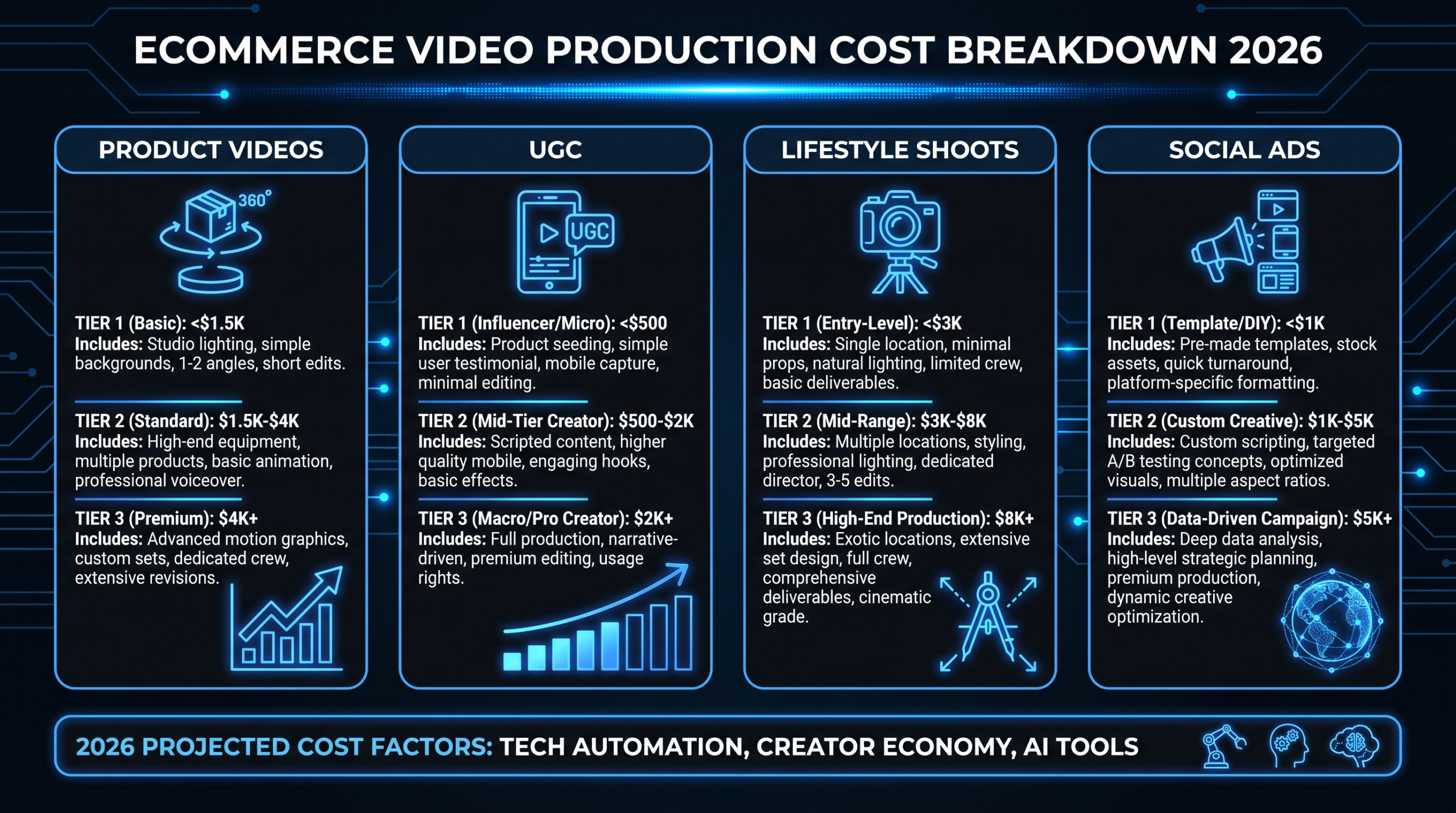
Before going format-by-format, here's how the major ecommerce video types compare at entry-level, mid-tier, and premium price points:
Ecommerce Video Production Cost Ranges by Type
| Video Type | Entry (DIY / Budget Freelancer) | Mid-Tier (Experienced Freelancer) | Premium (Agency / Full Production) |
|---|---|---|---|
| Product video (simple) | $0–$300 | $300–$1,500 | $2,000–$8,000+ |
| UGC clip (single creator) | $0–$100 | $100–$300 | $300–$800 (managed) |
| Lifestyle shoot (half-day) | $500–$1,500 | $1,500–$5,000 | $5,000–$15,000+ |
| Social ad video (edit only) | $75–$200 | $200–$500 | $500–$2,000 |
| Social ad video (full production) | $200–$800 | $800–$2,500 | $2,500–$8,000+ |
| Unboxing video (UGC) | $0–$150 | $150–$500 | $500–$1,500 (managed) |
| Unboxing (professional) | $300–$800 | $800–$2,000 | $2,000–$5,000 |
The ranges above are deliberately wide because ecommerce video costs vary based on factors that vary enormously between brands: complexity, location, licensing needs, revision rounds, and whether you're sourcing raw footage or starting from scratch. The sections below break down the key drivers for each format.
Product Video Costs
Product videos are the workhorse of ecommerce content — they show what an item looks like in use, communicate its value proposition, and convert browsers into buyers. The cost range for a single product video spans from near-zero to tens of thousands, depending on the production approach.
Simple Product Shots (Tabletop / Studio)
Simple product videos — a clean tabletop setup with the item on a lightbox or flat surface, showing different angles, textures, or color options — are the most accessible format to produce at low cost. With a smartphone, a $30 ring light, and a white background, you can produce acceptable content for entry-level DTC brands.
The production cost inflection points:
- DIY: Equipment cost only ($50–$300 for lights and a basic mount). Time investment is typically 2–4 hours per SKU including setup, filming, and editing.
- Freelancer (Upwork / Fiverr): $200–$800 per video for editing of footage you shoot; $400–$1,500 if the freelancer handles filming. Quality varies significantly at this tier.
- Product photography/video studio: $1,500–$5,000 per day, producing 6–15 product videos from a single day's shoot. Per-video cost drops fast as SKU count rises.
- Full-service agency: $3,000–$8,000 per individual product video when you factor in pre-production, creative direction, and full post-production including color grading and sound design.
Lifestyle and In-Context Product Videos
Showing a product in actual use — worn, used in a kitchen, tested in a real environment — costs more than tabletop work because you need people, locations, and more complex lighting setups.
A single lifestyle product video (30–90 seconds) with one talent, one location, and standard post-production typically runs:
- Budget freelancer setup: $500–$2,000 (local videographer, no stylist, minimal crew)
- Mid-tier production team: $2,000–$6,000 (DP + assistant, art direction, 1 talent day rate)
- Agency full production: $6,000–$20,000+ (full crew, multiple looks, comprehensive post)
Animated Product Explainers
Animated explainers show how a product works — common for tech products, supplements, or anything with invisible mechanisms. These skip filming entirely and are instead produced in motion design tools.
For a detailed look at animated video pricing, see our explainer video cost breakdown. The short version for ecommerce products: a 60–90 second animated product explainer runs $1,500–$8,000 from a freelancer and $5,000–$20,000 from a specialized animation studio.
UGC Video Costs
User-generated content videos have become a dominant format in ecommerce — they perform well in paid social precisely because they look authentic and unpolished. The cost structure for UGC is fundamentally different from produced video: you're paying for creator time and content licensing, not studio overhead.
Creator Marketplace UGC
Platforms like Billo, Minisocial, and Insense connect brands with creators who film UGC-style content using the brand's product. The brand ships the product to the creator; the creator films and delivers raw or minimally edited clips.
Typical pricing as of 2026:
- Budget marketplaces (Billo, Trend): $50–$150 per video for a 30–60 second clip with usage rights
- Mid-tier creators: $150–$400 per deliverable; some include multiple formats (vertical + square)
- Nano/micro-influencer UGC with organic rights: $200–$600 per video plus product cost
- Managed UGC campaigns (agency-run): $500–$1,500 per final video when you factor in creator sourcing, briefing, QA, and revisions
DIY UGC
Some brands produce their own UGC-style content — employees, customers, or brand ambassadors filming casual product demos on their phones. The cash cost is near zero; the real cost is the internal coordination, coaching, and editing time.
If you're editing DIY UGC internally, expect 1–2 hours of editing time per clip. At a freelancer rate of $40–$75/hr, that translates to $40–$150 per video in editing cost alone, even when the footage is free. For a detailed breakdown of editing rates, our video editing cost per minute guide is the reference.
UGC Volume Economics
UGC is a volume game. Most brands need 20–50 UGC variations per month to properly test ad creative — testing different hooks, CTAs, products, and audiences. At $100–$300 per creator video, a 30-video UGC program runs $3,000–$9,000 per month. This is often the most cost-effective paid social creative at scale because the per-unit cost is low and creative testing is built into the model.
Lifestyle Shoot Costs
Lifestyle shoots are the most complex ecommerce video format — you're coordinating talent, locations, crew, styling, and post-production into a single production day that needs to generate enough footage for multiple final videos.
Half-Day vs. Full-Day Shoots
Lifestyle Shoot Costs by Scale
| Shoot Scale | Typical Cost Range | What's Included | Deliverables (Typical) |
|---|---|---|---|
| Half-day (DIY / small crew) | $800–$2,500 | 1–2 person crew, 1 talent, owned/rented space | 3–6 short clips |
| Half-day (mid-tier) | $2,500–$6,000 | 3–4 crew, 1–2 talent, location fee, basic styling | 6–12 clips + B-roll |
| Full-day (mid-tier) | $5,000–$12,000 | 4–6 crew, 2–3 talent, location fee, hair/makeup, styling | 12–20 clips + B-roll |
| Full-day (agency) | $12,000–$25,000+ | Full crew, creative director, multiple locations, full wardrobe | 20–40 assets across formats |
Batching to Reduce Per-Video Cost
The most important cost lever for lifestyle video is batching. A well-organized $8,000 full-day shoot producing 20 clips brings the per-video cost to $400. The same budget spent on 8 separate half-day mini-sessions would produce maybe 24 clips but cost $1,000 each in overhead and coordination.
The highest-ROI approach for growing ecommerce brands: shoot quarterly, plan 20–40 assets per shoot day, brief the creative director on the full content calendar before production begins. This is the model VEC clients typically use — a dedicated production team handles the edit pipeline after the shoot day, ensuring consistent output without repeated production overhead. See VEC's pricing plans for how ongoing editing fits into this model.
Location and Talent Costs
The two most variable costs in a lifestyle shoot:
- Location: Studio rentals commonly run $200–$1,000 per day in major US cities; permit-required outdoor locations can run $500–$3,000+. Owned or rented storefronts/homes eliminate this cost.
- Talent: Non-union talent day rates typically start around $200–$400 for newer models and run $600–$1,500+ for experienced commercial talent. Usage rights (paid social, extended license) add 50–100% on top of day rates for established talent.
Social Ad Video Costs
Social ad video sits at the intersection of creative strategy and production. The cost depends on whether you're editing existing footage into ad-ready clips or producing net-new content specifically for paid channels.
Editing-Only Social Ad Videos
If you have raw footage from a lifestyle shoot, product video, or UGC campaign, the editing cost to cut it into platform-optimized ad videos is relatively low:
- Freelancer (Upwork/Fiverr): $75–$300 per ad edit, depending on complexity and number of text overlays/motion graphics
- Mid-tier freelancer or small agency: $300–$600 per ad with hooks, captions, CTA graphics, and platform resizing (16:9, 9:16, 1:1)
- Full-service agency: $600–$2,000 per polished ad with strategic hook writing, A/B variants, and full motion design
Full-Production Social Ad Videos
When you need net-new footage specifically for paid social — a performance creative shoot, a direct-response video ad — the cost structure looks different:
- UGC-style ad (creator brief + editing): $200–$800 per final ad
- Produced direct-response ad (small crew + edit): $1,000–$3,500 per deliverable
- High-production ad with multiple talent and locations: $5,000–$15,000 per final ad
Platform Format Multiplier
One factor brands routinely underestimate: each social platform requires different aspect ratios and text-safe zones. A single source video cut into TikTok (9:16 full bleed), Meta Feed (1:1), Meta Stories (9:16), and YouTube Pre-roll (16:9) is effectively four different edit jobs. Budget 30–50% of the per-video editing cost for each additional format adaptation.
For a deeper look at how post-production costs stack up by video type, our guide to video production agency pricing models covers the mechanics in detail.
Unboxing Video Costs
Unboxing videos are uniquely cost-efficient in ecommerce — the format is inherently casual, the "production value" is often intentionally low, and the content is closely tied to authentic first-impression reactions that can't be faked convincingly.
Creator-Produced Unboxing
Most ecommerce brands source unboxing content through UGC creator networks or micro-influencer partnerships. The pricing:
- Budget UGC marketplace (Billo, Minisocial): $75–$200 per unboxing clip with usage rights
- Micro-influencer unboxing (organic post included): $150–$600 per deliverable
- Managed unboxing campaign (5–10 creators): $1,500–$5,000 for the bundle, inclusive of briefing, QA, and licensing
Professional Unboxing Video
Some premium brands produce polished unboxing videos with high-quality cinematography, styling, and music. These function more as brand films than authentic UGC:
- Small-crew produced unboxing (1–2 camera ops, basic lighting): $800–$2,500
- Full-production unboxing with props, styling, and motion graphics: $2,500–$6,000
The decision between authentic-casual and polished production is a creative strategy question as much as a budget question. According to Wyzowl's annual video marketing research, consumers increasingly trust raw-looking content for product discovery — but polished brand films still outperform in mid-funnel environments. The right answer depends on where in your funnel you're deploying unboxing content.
DIY vs. Freelancer vs. Agency: Full Breakdown
The tier you choose has a bigger impact on cost than the format. Here's how all three tiers compare across the dimensions that matter for ecommerce brands:
Ecommerce Video Production: DIY vs. Freelancer vs. Agency
| Dimension | DIY | Freelancer | Agency |
|---|---|---|---|
| Cash cost per video | $0–$200 (equipment only) | $150–$2,000 | $1,500–$15,000+ |
| Time cost per video | High (4–12 hrs internal) | Low–Medium (1–3 hrs coordination) | Low (1–2 hrs approvals) |
| Brand consistency | Variable | Variable to good | Good to excellent |
| Quality ceiling | Medium | Good (varies by hire) | High |
| Scalability | Low | Medium | High |
| Strategic input | None (you bring it) | Minimal | Included |
| Revision process | Instant (do it yourself) | 1–3 days per round | 2–5 days per round |
| Best for | Launch-phase brands, tight budgets, UGC/authentic formats | Growing brands, 3–8 videos/month, defined briefs | Scale-stage brands, 10+ videos/month, brand-critical content |
DIY Tier
DIY ecommerce video works best for UGC-style content and simple product demonstrations where production polish isn't a differentiator. The cash cost is low — often just equipment and software subscriptions — but the time cost is real and often invisible. A founder spending 6 hours editing a product video is spending $600–$1,200 worth of their time (at any reasonable estimate of founder hour value) to produce a $200-equivalent piece of content.
DIY is the right call when: you're pre-launch or pre-revenue; you're testing a product category before investing in professional production; your brand positioning is intentionally raw and unpolished; or you have an in-house team member with genuine production skills.
Freelancer Tier
The freelancer tier covers the widest quality range of any option. A $50/hr Fiverr editor and a $120/hr experienced commercial videographer both technically fall under "freelancer," but the output gap is enormous. The key skill at this tier is briefing — freelancers execute what you describe, so the output quality is often proportional to the quality of your brief and your ability to give clear feedback.
For brands producing 3–10 videos per month, a reliable freelancer or small team of 2–3 specialists (videographer, editor, motion designer) can handle the output at materially lower cost than an agency. The tradeoff is coordination overhead and the risk of availability conflicts when you need to scale up quickly.
Agency Tier
Agencies add value in two ways that freelancers can't match: brand consistency at scale and strategic creative direction. A dedicated team that has worked on your brand for 3+ months will develop an instinctive understanding of your voice, visual style, and performance creative patterns that speeds up production and reduces revision rounds.
VEC's model — dedicated video editing teams working on a monthly retainer (Growth at $5K/mo, Core at $9.5K/mo, Scale at $16K/mo) — is designed specifically for ecommerce and DTC brands that have graduated from freelancer-tier coordination headaches and need reliable, high-volume output. The "double your video output in 90 days or month 4 is free" guarantee reflects the output consistency that comes from dedicated team structures versus project-by-project sourcing.
For a full analysis of how to structure outsourced video at scale, our guide on how to outsource video editing covers the decision framework in depth.
Cost Calculator Framework
To build your own ecommerce video budget, work through these four steps:
Step 1: Map Your Monthly Content Mix
List the video types you need and their target quantities per month:
- Product videos (studio/tabletop): __ per month
- UGC clips (creator-sourced): __ per month
- Lifestyle clips (from shoots or repurposed): __ per month
- Social ad variations (edits from existing footage): __ per month
- Unboxing videos: __ per month
Step 2: Apply Tier Costs
Multiply your monthly quantities by the per-unit cost for your chosen tier. Use the ranges from this guide as starting benchmarks, then adjust based on your specific brief complexity:
Sample Monthly Budget Calculator: 30-Video Mix
| Video Type | Qty | DIY Cost | Freelancer Cost | Agency Cost |
|---|---|---|---|---|
| Product videos (studio) | 5 | $0–$500 | $1,500–$5,000 | $5,000–$15,000 |
| UGC clips | 15 | $0–$750 | $1,500–$4,500 | $3,000–$9,000 |
| Social ad edits (from footage) | 8 | $0–$400 | $600–$2,400 | $2,400–$8,000 |
| Unboxing clips | 2 | $0–$200 | $300–$1,000 | $800–$2,500 |
| Total (30 videos) | 30 | $0–$1,850 | $3,900–$12,900 | $11,200–$34,500 |
Step 3: Factor In Hidden Costs
Common line items that don't show up in per-video quotes:
- Product cost + shipping to UGC creators: $20–$150 per creator depending on product
- Usage licensing fees for creator content in paid social: add 50–100% to creator fee for extended paid usage
- Platform format variations: Budget 30–50% per-video additional for each platform resize (9:16, 1:1, 16:9)
- Music licensing: $20–$150 per track for commercial music not covered under your platform subscription
- Revision rounds beyond scope: Most freelancers include 2–3 revisions; agencies typically include 2. Round 3+ commonly runs $100–$300 per round at the freelancer tier.
Step 4: Calculate Effective Cost Per Conversion
The real metric isn't cost per video — it's cost per conversion from video. A $2,000 product video that generates $40,000 in attributed revenue is infinitely more cost-effective than a $200 video that generates nothing. Track video-attributed revenue alongside production cost to know which formats and tiers actually deliver ROI for your brand. Shopify's guidance on product video strategy is a useful starting point for setting up attribution frameworks.
Frequently Asked Questions
How much does a basic product video cost for an ecommerce brand?
A basic tabletop product video — clean background, multiple angles, no talent — typically costs $150–$500 from a budget freelancer or $500–$1,500 from a mid-tier videographer. DIY production with owned equipment can bring this to near zero in cash cost, though it requires 3–6 hours of internal time per video. Studio or agency production starts around $2,000 and scales with complexity.
What's the most cost-efficient video format for ecommerce?
UGC clips sourced through creator marketplaces consistently offer the best cost-per-result for paid social. At $75–$300 per video, they're low-cost to produce, high-volume to test, and often outperform polished produced content in direct-response environments. The caveat: quality control is harder at this tier, and you need volume (10–30+ variations) to run meaningful creative tests.
When should an ecommerce brand move from freelancers to an agency?
The typical inflection point is when you're producing 10+ videos per month and spending more than 5 hours per week managing freelancer coordination, revisions, and quality issues. At that volume, the coordination overhead and inconsistency risk of the freelancer model commonly exceeds the cost savings versus a retainer or dedicated team arrangement.
How much does a lifestyle shoot cost for ecommerce video content?
A half-day lifestyle shoot with a 2–3 person crew, one talent, and a rented location typically runs $2,500–$6,000 inclusive of production and basic post-processing. A full production day with multiple talent, styling, and full post-production commonly runs $8,000–$20,000. The per-video cost drops significantly when you batch: a $10,000 full-day shoot producing 20 final clips costs $500 per video — often cheaper than sourcing the same output through individual project quotes.
Is DIY ecommerce video production worth it?
DIY is worth it for early-stage brands, UGC-format content, and any video type where production polish doesn't drive conversion. It stops making sense when internal time cost exceeds what outsourcing would cost, when you're losing sales from low-quality product presentation, or when inconsistent brand visual identity is becoming a credibility issue. Most brands graduate out of full DIY by the time they're producing more than 5–8 videos per month.
Need a Consistent Ecommerce Video Pipeline?
VEC provides dedicated video editing teams for ecommerce brands that need reliable, high-volume output without the overhead of in-house hiring. Growth plan from $5K/month — guaranteed to double your video output in 90 days or month 4 is free.
Book a Free Strategy Call View Pricing Plans