Cybersecurity Video Production Cost: 2026
TL;DR
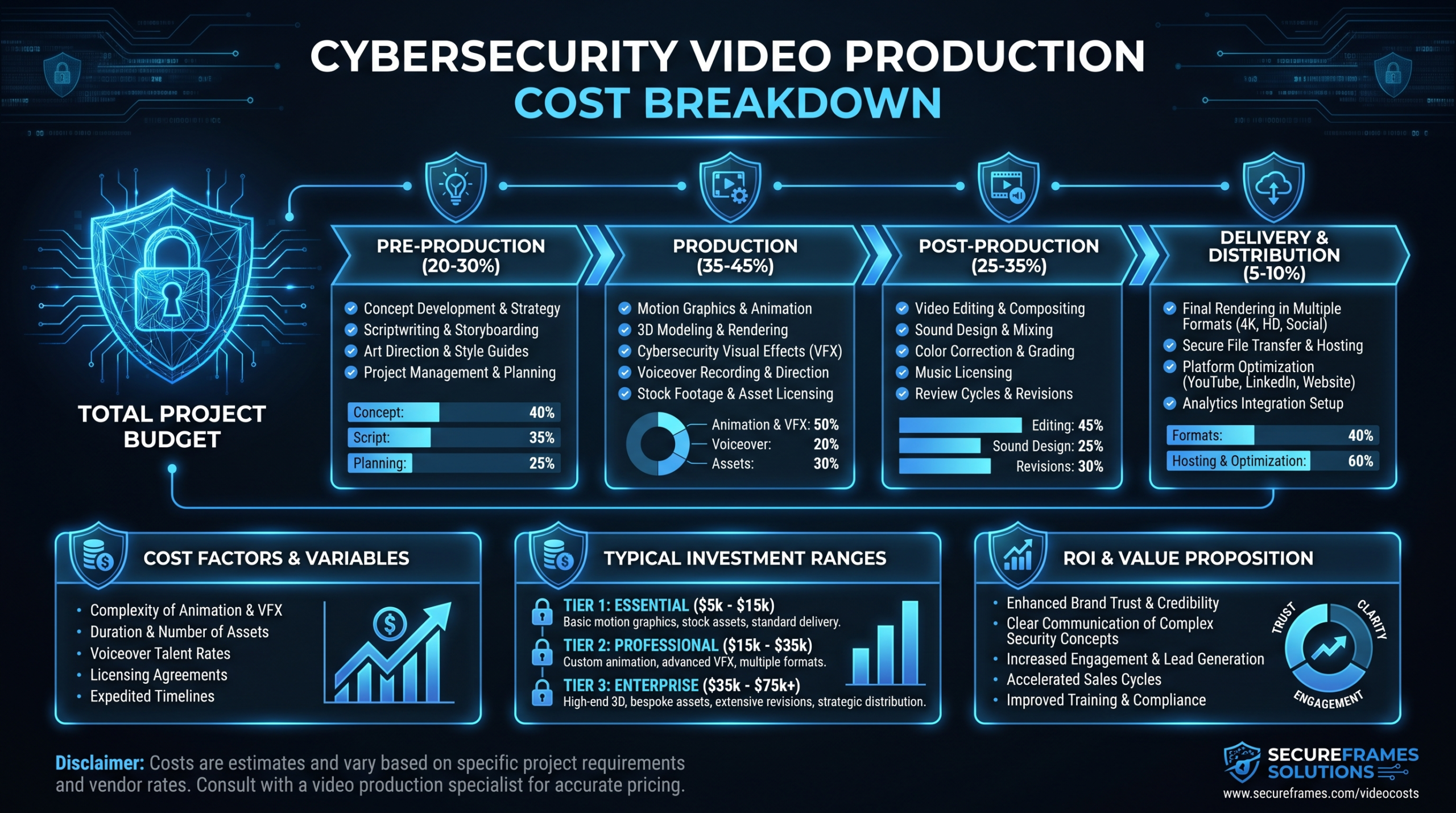
- Cybersecurity video production typically costs $1,500–$20,000+ per video depending on type, production approach, and vendor.
- Animation-heavy explainers and compliance training videos carry the highest per-minute costs in this vertical — technical accuracy demands more revision rounds.
- Monthly retainers for ongoing cybersecurity content range from roughly $5,000–$20,000/month depending on volume and complexity.
- Dedicated teams (like those from VEC) typically deliver the lowest effective cost-per-video once you exceed 8–10 assets per month.
- The biggest hidden cost isn't production — it's getting technical accuracy approved through your security and legal teams.
Table of Contents
- Why Cybersecurity Video Costs More Than Most Verticals
- Cybersecurity Video Types and What Each Costs
- Pricing Breakdown: Freelancer vs. Agency vs. Dedicated Team
- The Hidden Cost Drivers Specific to Cybersecurity
- In-House vs. Outsourced: The Real Cost Math
- How to Budget Cybersecurity Video for the Full Year
- What to Look for in a Cybersecurity Video Partner
- Frequently Asked Questions
Cybersecurity marketing teams face a challenge most other verticals don't: the product they're selling is invisible. You can't film a firewall stopping a ransomware attack. You can't show a SOC analyst "catching" a threat in a way that's both accurate and accessible to a non-technical buyer. That gap — between what your product does and what a buyer can intuitively understand — is exactly what video exists to close.
But that same gap is also why cybersecurity video production cost trends higher than most B2B categories. Technical accuracy requirements add revision rounds. Compliance and legal review add timeline. Animation — the dominant format in this vertical because live action can't show software behavior — adds cost per minute. And the audience expects sophistication: a generic explainer video won't earn the trust of a CISO.
This guide breaks down what cybersecurity video production actually costs in 2026, where the money goes, and how to structure your budget whether you're producing a handful of brand videos or running a full-scale content engine.
Why Cybersecurity Video Costs More Than Most Verticals
Before getting into specific numbers, it helps to understand the structural reasons cybersecurity video skews expensive. These aren't avoidable inefficiencies — they're inherent to the category.
Animation is the default, not the exception
In most B2B verticals, you can supplement animation with talking-head interviews, office footage, and product screencasts. In cybersecurity, the core concepts — threat detection, network architecture, zero-trust frameworks, encryption flows — are abstract by nature. That means motion graphics and 2D or 3D animation carry a significantly higher share of your budget than in, say, HR tech or e-commerce. Animation typically runs 3–5× the cost per minute of live-action editing at comparable quality levels.
Technical review adds rounds
A general-market SaaS explainer might go through two revision rounds before approval. A cybersecurity video explaining how your EDR product detects lateral movement needs to survive review by a VP of Engineering, a technical marketing manager who actually understands the product, and sometimes a legal team worried about regulatory claims. Teams commonly report adding one to three extra revision cycles compared to non-technical video projects. Each round costs time, and time costs money.
The audience is skeptical by profession
Security practitioners are trained to probe for holes. A video with a technically inaccurate diagram, an overclaimed feature, or unrealistic attack timeline will be noticed — and will damage credibility rather than build it. That pressure pushes cybersecurity brands toward higher-quality production standards than, for instance, a retail SaaS company targeting SMB owners. Quality floors in this vertical are higher, which raises the floor on costs.
Compliance training adds a separate cost category
Many cybersecurity companies also produce employee security awareness and compliance training video — a category that combines e-learning instructional design with video production. These typically require accessibility compliance (captions, transcripts, WCAG considerations), LMS integration, and modular chapter structure. That's a meaningfully different production workflow than a brand video, and commands a different price range.
Cybersecurity Video Types and What Each Costs
Cybersecurity marketing teams commonly produce across six video categories. Here's an honest look at what each costs, based on the range you'd encounter working with freelancers through premium agencies.
Cybersecurity Video Types: Cost Ranges
| Video Type | Typical Duration | Price Range (Per Video) | Primary Format |
|---|---|---|---|
| Animated explainer (product overview) | 90 sec – 2 min | $5,000 – $25,000 | 2D/motion graphics |
| Technical product demo | 3 – 6 min | $3,500 – $15,000 | Screen recording + voiceover + graphics |
| Thought leadership / executive interview | 4 – 10 min | $2,500 – $12,000 | Live-action with b-roll and graphics |
| Threat briefing / threat intelligence video | 5 – 12 min | $4,000 – $18,000 | Animation + screen recording + voiceover |
| Customer case study / testimonial | 2 – 4 min | $4,000 – $15,000 | Live-action interview + motion graphics |
| Security awareness / compliance training | 10 – 30 min (modular) | $8,000 – $40,000+ | Animation + screencasts + voiceover |
These ranges reflect the full production scope — scripting, storyboarding, voiceover, motion graphics, and revisions — not just editing. Post-production editing alone (for footage or screencasts already captured) sits at the lower end of each range.
Why animated explainers cost what they do
A 90-second animated explainer in the cybersecurity space involves scriptwriting that has to be technically accurate, a style frame approval process, character or icon design, frame-by-frame animation, sound design, and typically professional voiceover talent. Premium studios charge $15,000–$25,000 for this format. Mid-market agencies delivering solid but not award-caliber work typically fall in the $6,000–$12,000 range. Freelance animators on project-based work often quote $3,000–$7,000, though revision limits and technical review capacity vary significantly. For a deeper look at what drives cost per minute, see our video editing cost-per-minute guide.
Technical demos and product walkthroughs
These are the workhorses of cybersecurity video marketing — showing how the product actually works. They often combine screen-recorded product footage, animated overlays to highlight key interface elements, voiceover or on-camera presenter, and lower-third graphics for context. Costs scale with complexity: a simple 3-minute SOC platform walkthrough with voiceover and basic motion graphics can run $3,500–$6,000; a multi-scene demo with animated attack simulation overlays and professional talent might reach $12,000–$15,000.
Security awareness training: a category of its own
Compliance training video is distinct from marketing video in important ways. Instructional design, branching scenarios, accessibility requirements, and LMS-ready output all add meaningful cost. Teams producing annual security awareness training programs often budget $25,000–$60,000+ annually for a full curriculum, though modular approaches can reduce this. This category sits outside a typical video editing retainer — it generally requires a specialized e-learning production partner or an in-house instructional design function alongside the video production team.
Pricing Breakdown: Freelancer vs. Agency vs. Dedicated Team
The right production model depends on your output volume and consistency requirements. Here's how the three main approaches compare for cybersecurity marketing teams.
Cybersecurity Video Production: Model Comparison
| Model | Typical Monthly Cost | Best For | Cybersecurity-Specific Consideration |
|---|---|---|---|
| Freelancer (per project) | $1,500 – $8,000/project | 1–4 videos/quarter, one-off campaigns | Limited technical revision capacity; risk of inconsistent quality across projects |
| Boutique animation studio | $8,000 – $25,000/project | High-polish hero explainers, one-time brand videos | High quality but slow turnaround (4–8 weeks); not built for ongoing cadence |
| General video agency (retainer) | $5,000 – $15,000/month | 6–15 videos/month, mixed formats | May lack cybersecurity-specific script review process; need strong internal SME handoff |
| Dedicated video team (e.g. VEC) | $5,000 – $16,000/month | 8–25+ videos/month, SaaS-focused content engine | Assigned team builds vertical familiarity over time; strong fit for product demo + thought leadership cadence |
| In-house team | $15,000 – $30,000+/month | Very high-volume, brand-critical content | Highest control over technical accuracy; highest fixed overhead; see in-house comparison below |
For cybersecurity brands running an ongoing content program — monthly thought leadership videos, product demo updates, customer stories, event recap content — the dedicated team model generally delivers the best effective cost-per-video once you're producing more than 8 assets per month. The team builds familiarity with your product vocabulary, your visual brand standards, and your common revision patterns, which compresses turnaround over time. See our full video production agency pricing models breakdown for a detailed comparison of each approach.
VEC's cybersecurity video production plans
Video Editing Company offers three dedicated team plans suited to cybersecurity companies at different content volumes: Growth at $5K/month (entry-level dedicated team, suited for 8–12 assets/month including product demos and social cuts), Core at $9.5K/month (expanded team capacity for 12–20 assets/month, including motion graphics and animation support), and Scale at $16K/month (full-scale team for 20+ assets with creative direction and multi-format delivery). All plans include a 90-day output guarantee — double your video output in 90 days, or month four is free. See current plan details at VEC's pricing page.
The Hidden Cost Drivers Specific to Cybersecurity
The per-video or monthly retainer figure is never the complete picture. Cybersecurity video production carries several hidden cost drivers that are either more severe or more frequent in this vertical than in general B2B marketing.
Technical script review and SME time
Every cybersecurity video script needs subject-matter expert (SME) review before production begins. For marketing teams inside the company, this means pulling engineers, product managers, or threat researchers away from their primary work. Even at conservative internal billing rates, a 2-hour review cycle with two SMEs adds $400–$1,200 in real economic cost per video, not counting the calendar friction of scheduling busy technical staff. High-volume video programs — producing 10+ videos per month — need a structured SME review pipeline to avoid this becoming a bottleneck that inflates effective cost.
Legal and compliance review
Cybersecurity claims face particular scrutiny. Statements about detection rates, response times, or protection effectiveness can create regulatory and legal exposure if not carefully framed. Many cybersecurity brands require legal review before any video discussing product capabilities goes public. A standard legal review cycle adds 3–7 business days to production timelines and may generate revision requests that require additional production work. Teams that don't budget for this often find their "approved" video costs $1,000–$3,000 more than the original quote once revision work is factored in.
Voiceover talent calibration
Cybersecurity content tends to skew toward authoritative, credible voiceover — not the upbeat consumer-marketing tone that works for a fintech app. Finding and briefing the right voiceover talent takes longer in this vertical, and talent with genuine technical credibility commands a premium. Budget $400–$1,200 per video for professional voiceover (not AI-generated); high-volume programs often build in a dedicated voiceover retainer to simplify this.
Motion graphics asset library development
The first 3–5 cybersecurity videos an agency or team produces for you will cost more than subsequent videos because they're building the asset library: your network diagram templates, your custom icon set (locks, shields, servers, threat actors), your color-coded data flow templates. These upfront design assets are amortized across future videos. If you're switching vendors or starting fresh, budget an additional $2,000–$6,000 in the first month for asset library development that will reduce per-video costs in months 2+.
Format versioning
A 2-minute product explainer doesn't live on one channel. Cybersecurity marketing teams typically need the same core content in: full-length (YouTube, website), 60-second cut (LinkedIn), 30-second cut (paid social), and sometimes a square 1:1 version for specific placements. Producing all versions from the same base edit adds 30–60% to the per-project cost versus the hero version alone. Building versioning into your production brief from the start is the most cost-efficient approach — not retrofitting it after the master is locked. Wistia's video repurposing research consistently shows that multi-format distribution dramatically improves ROI per production dollar.
In-House vs. Outsourced: The Real Cost Math
The in-house vs. outsource debate comes up for every cybersecurity marketing team that reaches 8–12+ videos per month. Here's what the math typically looks like when you account for total cost of ownership rather than just base salary.
In-House Video Team vs. Outsourced: Annual Cost Comparison
| Cost Component | In-House (1 Senior Editor + 1 Junior Editor) | Outsourced Dedicated Team (VEC Core Plan) |
|---|---|---|
| Base salaries / retainer | $145,000 – $185,000/yr (combined) | $114,000/yr ($9,500/mo) |
| Benefits and payroll taxes | $35,000 – $55,000/yr | $0 (included) |
| Equipment and software | $8,000 – $15,000/yr (Adobe CC, hardware amortized) | $0 (included) |
| Recruitment and onboarding | $8,000 – $20,000 (one-time, recurring if turnover) | $0 (handled by agency) |
| Management overhead | 3–5 hrs/week of senior marketing time | 1–2 hrs/week (PM handled by agency) |
| Backup capacity when editor is sick/on leave | Production stops or freelancer surge cost | Team coverage included |
| Effective annual cost | $196,000 – $275,000+/yr | $114,000/yr |
This comparison is approximate and will vary by market, seniority level, and benefit structure — but it illustrates why cybersecurity companies at medium content volumes often find outsourcing more cost-effective than it appears at first glance. The key constraint: in-house teams are fixed capacity. When you have a product launch or an RSA Conference content sprint and need 20 videos in 30 days, you're either burning out your team or paying freelancer surge rates. A dedicated agency team can flex capacity within the arrangement more gracefully.
For a full tactical breakdown of the outsourcing decision for SaaS companies, see our SaaS video production guide.
How to Budget Cybersecurity Video for the Full Year
Most cybersecurity marketing teams don't produce video at a steady month-to-month pace. The content calendar tends to cluster around a few predictable events and moments, with lower baseline production in between. A realistic annual budget model accounts for this pattern.
The four-zone annual calendar
Zone 1 — Major conference season (RSA, Black Hat, DEF CON — typically Q2–Q3): This is where cybersecurity brands concentrate their biggest video investments. Hero explainers, executive keynote packages, customer case studies, and product announcement videos all cluster here. Budget $20,000–$60,000+ in concentrated conference season production if you're presenting or heavily marketing.
Zone 2 — Ongoing content engine (year-round baseline): Monthly thought leadership videos, product demo updates, threat briefings, and social clip repurposing. This is where a monthly retainer or dedicated team pays off most clearly — consistent output at a lower effective cost-per-video. Budget $5,000–$16,000/month depending on volume.
Zone 3 — Annual security awareness training refresh (typically Q1): If your organization produces compliance training video, budget this as a separate line item. Annual curriculum refresh for a mid-size organization commonly runs $15,000–$40,000 depending on scope and whether you're creating new modules or updating existing ones.
Zone 4 — Reactive/incident content: Threat intelligence videos, rapid response content following a major CVE or industry event, event recap videos. These are hard to budget in advance but plan for $5,000–$15,000 in reactive capacity annually. The teams that handle this best have an ongoing production arrangement that can flex — not a per-project vendor who requires a new contract for each request.
Sample annual budget by company stage
Cybersecurity Video Budget by Company Stage
| Stage | Typical Video Volume | Estimated Annual Budget | Recommended Model |
|---|---|---|---|
| Early-stage / Series A | 6–15 videos/year | $25,000 – $60,000 | Per-project freelancer + 1–2 studio explainers |
| Growth / Series B–C | 20–60 videos/year | $60,000 – $150,000 | Dedicated team retainer ($5K–$9.5K/mo) |
| Scale / Late-stage or public | 60–150+ videos/year | $120,000 – $250,000+ | Dedicated team ($9.5K–$16K/mo) + specialist studio for hero assets |
These ranges are deliberately wide because video budget correlates strongly with strategy, not just headcount. A Series B company that makes video central to its pipeline enablement program will spend more than a similarly sized company that treats video as an occasional marketing project. The companies that consistently report the highest video ROI in B2B security — as observed in HubSpot's annual State of Marketing research — tend to treat video as a channel with a dedicated budget, not a line item that gets cut when things slow down.
What to Look for in a Cybersecurity Video Partner
Not all video production vendors are equally equipped to serve cybersecurity brands. Here's what distinguishes partners who understand the vertical from generic content shops.
Technical literacy, not just production skill
Your video partner doesn't need to hold a CISSP certification, but they should be able to read a technical brief, ask intelligent clarifying questions about accuracy, and flag when a diagram or claim might not align with the product reality. Teams with B2B SaaS experience, particularly in technical categories, build this skill over time. Ask prospective partners: "What do you do when you receive a technically complex brief and you're not sure if the script is accurate?" The answer tells you everything.
Structured revision and review workflow
Given the SME and legal review cycles common in cybersecurity, your video partner needs a revision workflow that accommodates multiple stakeholders without constant scope-creep surprises. Look for clear documentation of how many revision rounds are included, what counts as a "round" (consolidated feedback vs. rolling changes), and how they handle technical accuracy changes that require animation rework late in the process.
Animation capability in-house vs. outsourced
Many "full-service" video agencies outsource their animation to a third party. For cybersecurity content where animation is the primary format, this matters: a third-party animator adds a communication layer between your feedback and the person executing it, which compounds revision cycles and cost. Ask directly whether motion graphics and animation are produced in-house or subcontracted.
A proven B2B SaaS portfolio
Cybersecurity video is a subset of B2B SaaS marketing video. An agency with a strong portfolio of technical SaaS explainers — even if not exclusively cybersecurity — will ramp faster than a generalist shop. Ask to see work samples specifically for: technical product explainers, executive interview packages, and product demo edits with UI animation overlays. These three formats represent the core of most cybersecurity content programs.
Video Editing Company's dedicated team model is built specifically for B2B SaaS content programs at scale. Our team includes motion graphics specialists and project managers experienced in technical content cycles. You can see examples of our approach at our SaaS video production page.
Budget planning tip: Before approaching vendors, map your content calendar for the next 6 months and categorize each planned video by type (explainer, demo, thought leadership, etc.). This brief is the single most valuable input for getting accurate quotes — it allows vendors to price based on your actual mix rather than their worst-case assumptions.
Frequently Asked Questions
How much does a cybersecurity explainer video cost?
A standard 90-second animated explainer video for a cybersecurity product typically costs $5,000–$20,000 depending on animation complexity, revision rounds, and production quality tier. Budget-tier freelancers can deliver at $3,000–$5,000, but technical accuracy review capacity and style quality are usually limited. Mid-market agencies with B2B SaaS experience typically quote $7,000–$15,000 for this format. Premium boutique animation studios start at $15,000+.
Is it worth investing in animated video for cybersecurity marketing?
For most cybersecurity products, yes — animation is often the only format that can accurately represent the product's behavior in a way that's visually clear and buyer-friendly. Live-action alone can't show threat detection, network topology, or encryption flows in a compelling way. The ROI case for animated explainers is strong when the video addresses a specific buyer concern that's hard to communicate in text or static images. The question is less "animation vs. live-action" and more "what format best closes the understanding gap for your specific buyer."
How long does cybersecurity video production take?
A full-production animated explainer (script through final delivery) typically takes 4–8 weeks with a capable agency, accounting for script approval, storyboard review, animation production, and revision cycles. Technical product demos using screen recording with motion graphic overlays often run faster: 2–4 weeks. The main timeline variable in cybersecurity is internal review — if your SME and legal approval cycles are slow, that adds time regardless of how fast the production team moves. Teams with an ongoing retainer arrangement typically see turnaround compress over time as the team builds brand familiarity.
Should a cybersecurity company use a specialized video agency or a general B2B video partner?
A specialized cybersecurity video agency offers deeper subject-matter familiarity but typically operates at per-project pricing with longer timelines — suited for one-off hero explainers. A strong B2B SaaS video partner with a dedicated team model can serve your ongoing content engine (demos, thought leadership, social cuts) more efficiently and at lower effective cost-per-video once you're producing 8+ assets per month. Many cybersecurity brands use both: a specialist studio for the annual brand refresh or product launch hero video, and a dedicated team for ongoing production cadence.
What's the most common mistake cybersecurity companies make with video budgets?
Treating video as a project budget rather than a channel budget. When video is funded one project at a time — requiring a new budget approval for each video — teams produce inconsistently and never build the library of assets that compound over time. The cybersecurity companies that get the best video ROI typically commit a defined annual or quarterly video budget and use a retainer or dedicated team arrangement that lets them produce at a consistent cadence without re-approving spend each time. This also allows the production team to build deep brand familiarity, which directly reduces revision cycles and per-video cost over time.
Ready to Build a Cybersecurity Video Engine?
VEC provides dedicated video editing teams for B2B SaaS and cybersecurity brands. Plans from $5K/month. Double your video output in 90 days — or month four is free.
Book a Free Strategy Call See Pricing Plans