How Long Should a Commercial Be? (2026)
The right commercial length depends on your platform and goal: 30 seconds for broadcast TV, 15 seconds for YouTube and most paid social, and 6 seconds for bumper ads and pre-roll where you can't afford a skip. Most B2B brands default to 30 seconds and leave significant performance on the table by ignoring the 15-second format that now dominates digital ad inventory.
This guide breaks down standard commercial lengths by platform, explains what drives the decision, and gives you a clear framework for choosing the right duration for every placement you buy.
Key Takeaways
- 30 seconds remains the broadcast TV standard — it's the most purchased slot on linear television worldwide.
- 15 seconds is the dominant format for YouTube, Facebook, Instagram, and LinkedIn paid placements.
- 6 seconds (bumper ads) outperform longer formats for brand recall when the message is simple and singular.
- 60 seconds works for product launches, brand storytelling, and connected TV where viewer intent is high.
- Platform maximums matter: YouTube non-skippable tops out at 15–20 seconds; ignoring this forces your 30-second spot into a skippable slot most viewers skip after 5 seconds.
Table of Contents
- Key Takeaways
- How Long Are TV Commercials?
- How Long Should a YouTube Commercial Be?
- How Long Should Social Media Commercials Be?
- How Long Are Radio and Streaming Commercials?
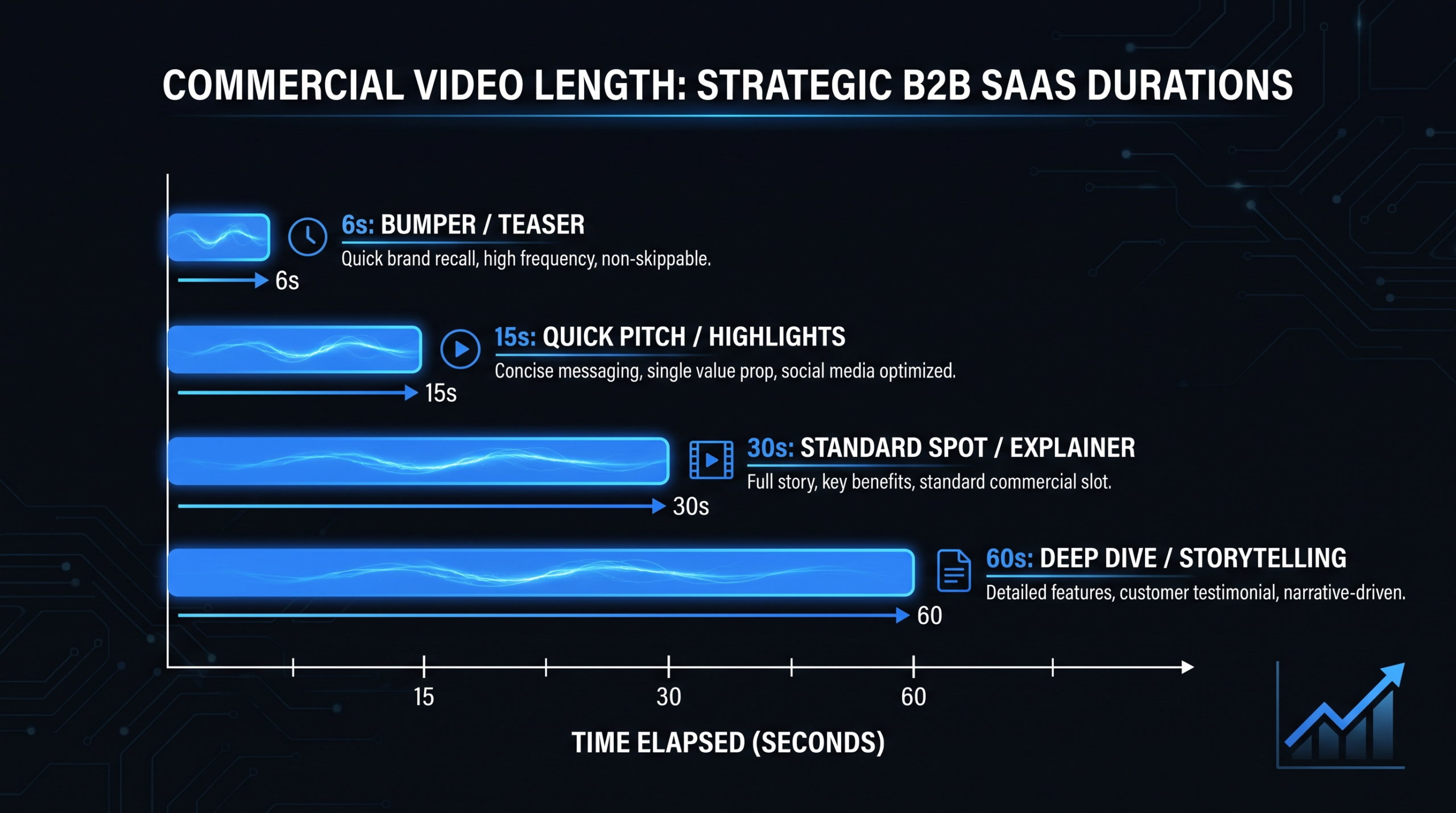
- What's the Best Commercial Length for B2B SaaS?
- How Much Does a Commercial Cost?
- Which Commercial Length Gets the Best Results?
- Frequently Asked Questions
How Long Are TV Commercials?
Broadcast and cable television commercials are sold in standardized time slots. These haven't changed fundamentally in decades because the ad break structure of linear TV demands predictable units that fit together cleanly.
Standard TV Commercial Lengths
TV Commercial Length by Format
| Length | Format Name | Best Use | Relative Cost |
|---|---|---|---|
| :06 | Bumper / Billboard | Brand reminder, retargeting | $ |
| :15 | Short spot | Single message, high frequency | $$ |
| :30 | Standard spot | Full-story, product demo | $$$ |
| :60 | Long spot | Brand storytelling, emotional narrative | $$$$ |
| :90–:120 | Extended spot | Infomercial-style, high-consideration products | $$$$$ |
The 30-second spot is the default. When marketers say "a commercial," they typically mean a 30-second TV spot. Networks price their inventory around it, production budgets are quoted against it, and most creative briefs assume it. The 15-second spot gained traction as a cost-effective companion to a 30-second campaign — you produce a 30, cut it to 15 for frequency buys, and maintain message continuity at a lower CPM.
The 60-second format is used when the story requires more time: insurance, automotive, high-end consumer goods, and SaaS products with complex value propositions. It costs more in both production and airtime, so the decision to go long needs a clear creative rationale — not just "we have a lot to say."
If you're planning a full commercial production, understanding commercial video production from brief to final cut will help you set realistic timelines and budgets before you brief an agency.
How Long Should a YouTube Commercial Be?
YouTube runs four distinct ad formats, each with a different length ceiling and viewer behavior. Matching your creative to the right format — rather than repurposing a TV spot — is one of the highest-leverage decisions in digital advertising.
YouTube Ad Format Length Guide
YouTube Ad Formats and Lengths
| Format | Length | Skippable? | Best For |
|---|---|---|---|
| Bumper ads | 6 seconds max | No | Brand recall, retargeting, awareness |
| Non-skippable in-stream | 15–20 seconds | No | Simple single-message campaigns |
| Skippable in-stream (TrueView) | 12 seconds–3 minutes | Yes (after 5s) | Product demos, longer narratives, B2B |
| In-feed video ads | Up to several minutes | Yes (user-initiated) | Education, how-to, consideration stage |
The critical insight for YouTube: a skippable 30-second ad is not a 30-second ad. Most viewers skip at second 5. Your effective message window is 5 seconds unless you earn the watch with a compelling hook. If your commercial doesn't deliver value in the first 5 seconds, design it as a 15-second non-skippable or a 6-second bumper instead.
For B2B SaaS brands running product demo video campaigns, the skippable format at 60–90 seconds often outperforms shorter cuts when the audience is in-market — they want depth, not brevity. Learn more about crafting content for this audience in our product demo video production guide.
YouTube publicly documents its ad format length limits and skippability rules at YouTube for Advertisers — the platform updates these periodically, so always verify current specs before planning a campaign buy.
The 15-Second YouTube Sweet Spot
Non-skippable 15-second placements consistently deliver higher completion rates than longer skippable formats for awareness and consideration objectives. The viewer has no exit option, so the message lands — provided the creative is built for that constraint. This doesn't mean cramming a 30-second story into 15 seconds; it means writing a new, purpose-built 15-second script.
How Long Should Social Media Commercials Be?
Social media platforms set their own technical maximums, but technical maximums and optimal lengths are different numbers. The table below separates them.
Social Media Commercial Lengths by Platform
| Platform | Format | Technical Max | Recommended Length | Notes |
|---|---|---|---|---|
| Stories ad | 120 seconds | 9–15 seconds | Full-screen vertical, sound-optional | |
| Reels ad | 90 seconds | 15–30 seconds | Match organic Reels pacing | |
| Feed video ad | 240 minutes | 15–30 seconds | Auto-plays muted; first 3s critical | |
| TikTok | In-Feed ad | 60 seconds | 9–15 seconds | Native-feeling content outperforms polished ads |
| Single video ad | 30 minutes | 15–30 seconds for awareness; 60s for thought leadership | B2B audience tolerates longer; max 30s for direct response | |
| X (Twitter) | Promoted video | 2 minutes 20 seconds | 6–15 seconds | Fast scroll environment; shorter wins |
Social media commercial lengths are not platform preferences — they're audience-behavior constraints. A 60-second commercial that performs on connected TV will struggle on TikTok because the viewer environment is fundamentally different: context, intent, attention mode, and device orientation are all mismatched. Build platform-native cuts, not repurposed TV spots.
Understanding how your video editing services are structured helps when briefing multi-platform campaigns — each format cut requires its own edit, not a crop of the master.
How Long Are Radio and Streaming Commercials?
Audio-only (radio) and connected TV (CTV/OTT streaming) follow different conventions than digital social, and many brands overlook the CTV opportunity entirely.
Radio Commercial Lengths
Radio commercials run in the same standardized slots as TV: 30 seconds and 60 seconds are the industry-standard formats. The 30-second radio spot is the most commonly purchased. A 60-second spot is used when the message requires setup — a testimonial format, a multi-step offer, or a product explanation that needs room to breathe. Fifteen-second radio spots exist but are less common and typically used as companion units to a primary 30 or 60.
Connected TV (CTV) and Streaming
CTV / OTT Ad Length Norms
| Platform / Format | Common Lengths | Skippable? |
|---|---|---|
| Hulu (standard) | 15 or 30 seconds | No (standard plan) |
| Peacock | 15 or 30 seconds | Mostly no |
| Roku Channel | 15 or 30 seconds | No |
| Amazon Prime Video ads | 15 or 30 seconds | No |
| YouTube TV | 15, 30, or 60 seconds | Some |
CTV is one of the highest-attention advertising environments available in 2026. Viewers watching content on a TV screen are lean-back, full-screen, and passive — dramatically different from a phone-scrolling social media viewer. The 30-second format performs strongly here, and the 60-second format is viable in a way it isn't on mobile social. Non-skippable delivery means your full message plays, which makes production quality more important — a poorly produced spot can't be skipped past, only resented.
For SaaS video production teams considering CTV as a channel, the non-skippable environment is an argument for investing in professional production quality, not against it.
What's the Best Commercial Length for B2B SaaS?
B2B SaaS commercials sit at the intersection of brand advertising and product education. The decision framework is different from consumer goods because your buyer is a professional making a considered purchase, not an impulse consumer. This changes what "optimal length" means.
Awareness Stage (Top of Funnel)
At the awareness stage, shorter is almost always better. A 15-second non-skippable YouTube ad or a 6-second bumper in a programmatic buy can efficiently plant the brand and a single value proposition. The goal is not to explain your product — it's to create enough familiarity that when the buyer encounters your brand in a search or LinkedIn post, they recognize it rather than encountering it cold.
Consideration Stage (Middle of Funnel)
In-market buyers will watch longer videos. A 60–90 second product demo commercial on YouTube (skippable format, targeted to in-market audiences) or a 30-second LinkedIn video ad can carry significantly more product information. This is where product demo production budgets are well spent — an audience that's already researching your category will actively watch a well-produced demo if it delivers what they're looking for.
Retargeting (Bottom of Funnel)
Retargeting a visitor who already spent time on your pricing page doesn't need a 60-second education — it needs a 6–15 second reminder, a tight message about the offer, and a clear CTA. Longer formats here are wasteful. Spending budget on a 60-second retargeting ad that a warm prospect skips after 5 seconds is a production cost and media cost you don't need to incur.
Understanding the production side of the equation — what goes into making these formats, the difference between editing a short bumper versus a full demo — is covered in our guide to outsourcing video editing and our overview of what video editing services include.
How Much Does a Commercial Cost?
Commercial production costs vary significantly by length, complexity, and who produces it. The relationship between length and cost is not linear — a 60-second spot doesn't cost twice as much as a 30-second spot. But a 30-second animated explainer commercial will cost more than a 30-second talking-head commercial, because length is only one cost driver.
Commercial Production Cost by Length and Type
| Commercial Type | Length | Freelancer / Low-End | Mid-Tier Agency | Full-Service Agency |
|---|---|---|---|---|
| Social media commercial (live action) | :15 | $500–$1,500 | $2,000–$5,000 | $5,000–$15,000 |
| Digital commercial (live action) | :30 | $1,000–$3,500 | $4,000–$10,000 | $10,000–$30,000 |
| Broadcast TV commercial (live action) | :30 | $5,000–$15,000 | $15,000–$50,000 | $50,000–$500,000+ |
| Animated commercial | :15 | $1,500–$4,000 | $4,000–$12,000 | $12,000–$40,000 |
| Animated commercial | :30 | $2,500–$8,000 | $8,000–$25,000 | $25,000–$80,000 |
| Broadcast TV commercial (live action) | :60 | $8,000–$25,000 | $25,000–$75,000 | $75,000–$750,000+ |
| CTV/OTT commercial | :15–:30 | $2,000–$6,000 | $6,000–$20,000 | $20,000–$60,000 |
These ranges reflect production only — they don't include media buying. Broadcast TV airtime, YouTube ad spend, and social media placements are separate line items on top of production costs. For a complete breakdown of what goes into commercial video production costs including pre-production, production, and post-production, see our detailed guide on commercial video production cost.
For brands outsourcing the editing and post-production component of their commercials, our video editing cost per minute breakdown shows how editorial rates vary by project complexity. VEC's Growth plan starts at $5K/month and covers ongoing commercial editing needs for SaaS brands producing multiple formats per quarter.
Which Commercial Length Gets the Best Results?
There is no universal "best" commercial length — but there are clear principles that govern performance by objective.
For Brand Recall: Shorter Wins
Six-second bumper ads and 15-second non-skippable placements consistently drive high recall relative to their cost. The constraint forces creative discipline: one message, one visual, one CTA. When the creative team can't hide behind a long runtime, they have to make every second count. Brands that master the 6-second format often produce more memorable advertising than those with a generous 60-second budget.
Industry resources like Wistia's video marketing research consistently show that completion rates drop sharply past the 2-minute mark for most digital placements — reinforcing the case for purpose-built short-form creative over repurposed long-form content.
For Conversion: Match Length to Complexity
High-consideration B2B purchases — enterprise software, subscription services, high-ticket products — require more message to convert. A 15-second ad cannot explain a SaaS platform's ROI to a VP of Marketing. A 60–90 second skippable YouTube ad can, if the hook earns the watch. The right length is the minimum length needed to deliver the message that closes the gap between the viewer's current knowledge and the action you want them to take.
For Reach Efficiency: Buy Short
Shorter placements allow you to reach more people with the same media budget. A 15-second non-skippable buy typically reaches a larger audience than the same CPM spend on 30-second skippable inventory. If your objective is top-of-funnel awareness across a large target market, shorter placements deliver more impressions per dollar.
Platform-Length Fit Matrix
Recommended Commercial Length by Platform and Objective
| Platform | Awareness | Consideration | Conversion/Retargeting |
|---|---|---|---|
| Broadcast TV | :15–:30 | :30–:60 | :15–:30 |
| YouTube (non-skip) | :06–:15 | :15 | :15 |
| YouTube (skippable) | :15–:30 | :45–:90 | :15–:30 |
| Instagram Stories | :06–:15 | :15–:30 | :06–:15 |
| Facebook Feed | :15 | :30–:60 | :15 |
| :15–:30 | :30–:60 | :15–:30 | |
| CTV / OTT | :15–:30 | :30–:60 | :15–:30 |
If you're managing commercial production across multiple platforms, the post-production workflow matters as much as the creative strategy. Each platform version requires its own edit — different aspect ratios, different cutdown lengths, different caption and audio requirements. Our breakdown of what video editing services include explains how agencies scope multi-platform commercial packages.
Brands running consistent commercial programs often find that outsourcing the editing side to a dedicated team — rather than managing per-project freelancers for every format variation — reduces both cost and turnaround time. See how outsourcing video editing works for ongoing commercial programs, and explore our video production agency pricing models to compare options. Our own case studies show how SaaS brands have structured this for multi-platform campaigns.
Frequently Asked Questions
How long is a standard commercial?
The standard commercial is 30 seconds. This is the most common format purchased on broadcast TV, used as the baseline for most production budgets, and the format that most agencies quote against. For digital placements, 15 seconds has become equally standard — most YouTube and social media ad buys default to 15-second non-skippable or 15-second in-stream formats.
How long are commercials on TV?
TV commercials typically run in 15-second, 30-second, or 60-second slots. The 30-second spot is the most purchased. Fifteen-second spots are sold as companion units or for high-frequency campaigns where cost matters more than story depth. Sixty-second spots are used for brand storytelling, complex products, or emotional narratives where the story requires room to develop.
Can a commercial be longer than 60 seconds?
Yes. Ninety-second and 120-second commercials exist for broadcast TV, typically in infomercial-adjacent contexts or high-budget brand campaigns. On digital platforms, ad formats can run much longer — YouTube in-feed ads and Facebook video ads technically support very long runtimes. In practice, longer formats only work when the audience's intent is high enough to justify extended attention, which is rare outside of late-funnel targeting.
How long should a YouTube commercial be?
For non-skippable YouTube placements, 15 seconds is the standard length and the platform's maximum for most inventory types. For skippable TrueView ads, design for a 5-second hook that earns the watch, then build the full message in 15–60 seconds depending on your objective. Bumper ads are exactly 6 seconds and are non-skippable — use them for retargeting and brand recall campaigns. See our product demo video production guide for SaaS-specific YouTube ad formats.
What's the difference between a 15-second and 30-second commercial in terms of cost?
Production cost differences between a 15-second and 30-second commercial are smaller than most people expect — often 15–30% rather than 50%. The largest production cost drivers are shoot days, talent, location fees, and animation complexity, not the final runtime. Media buying cost differences are more significant: a 15-second placement on most digital platforms costs roughly half of a 30-second placement at equivalent CPMs, making the shorter format more efficient for reach objectives. For a detailed cost breakdown, see our guide on commercial video production costs and video editing cost per minute.
Need a Commercial Cut for Every Platform?
VEC's dedicated editing teams produce platform-native commercial formats for B2B SaaS brands — from 6-second bumpers to 60-second CTV spots — on a predictable monthly retainer. Double your video output in 90 days or month 4 is free.
Book a Free Strategy Call See Pricing