Video Production Cost Per Hour: 2026 Rates
TL;DR
Video production cost per hour ranges from roughly $25/hr for a junior freelance editor up to $300+/hr for a full-service agency crew with equipment. The number that matters most isn't the raw hourly rate — it's how many hours the project actually takes and whether the rate includes management, revision cycles, and brand onboarding. For B2B SaaS teams producing consistent video volume, flat-rate retainers typically outperform hourly billing beyond about 20 hours/month.
Table of Contents
- What "Video Production Cost Per Hour" Actually Covers
- Video Editor Hourly Rates by Role and Experience
- Production Crew Day Rates — Broken Down to Hourly
- Agency vs. Freelancer: Hourly Rate Comparison
- How Many Hours Does a Typical Project Take?
- When Hourly Pricing Works — and When It Doesn't
- Flat-Rate vs. Hourly: Real Cost Math for SaaS Teams
- Hidden Hours That Inflate Your Invoice
- FAQ
What "Video Production Cost Per Hour" Actually Covers
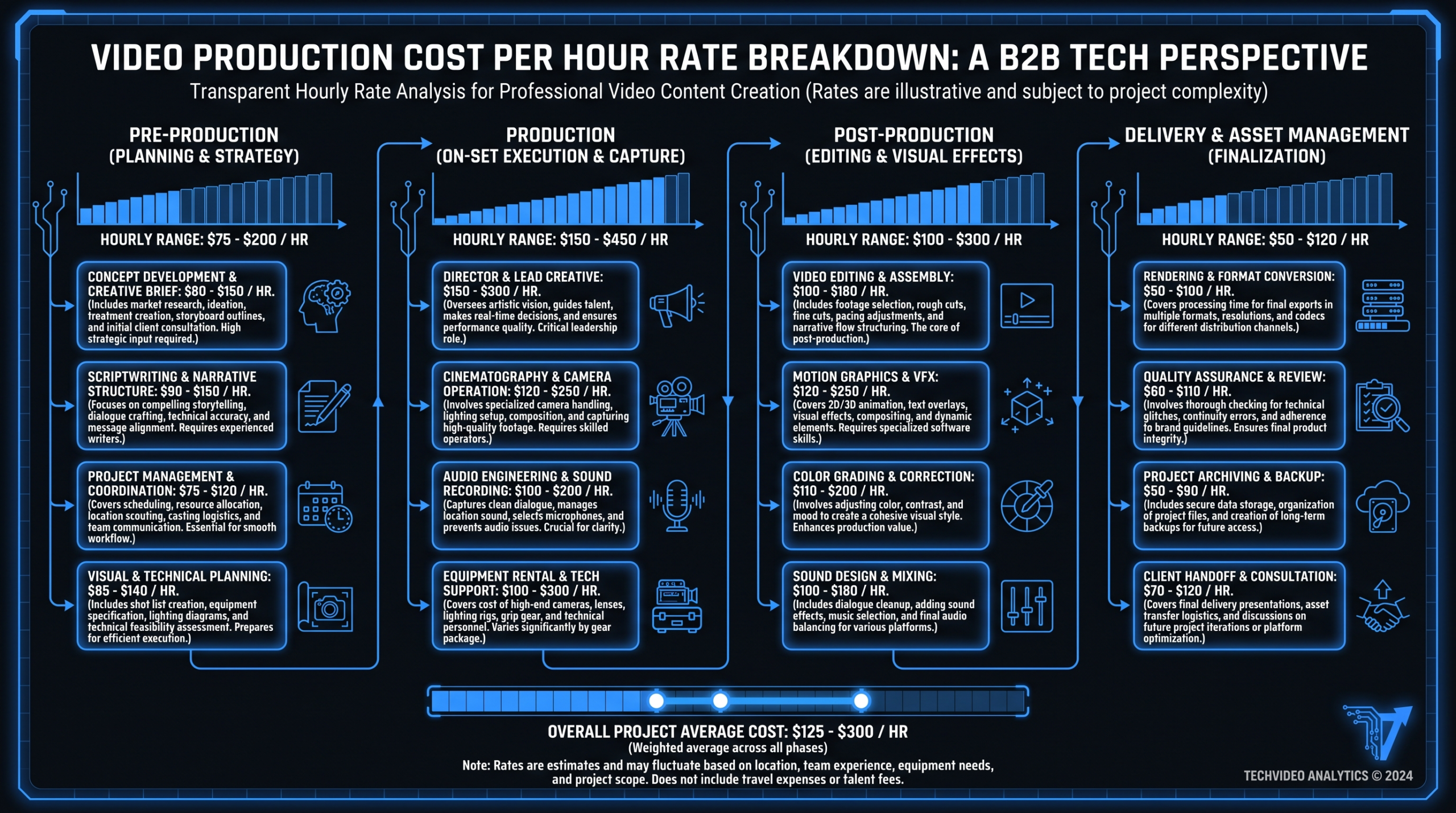
Video production cost per hour is not one number — it's several different clocks running simultaneously. When a buyer searches this phrase, they're usually asking about one of three distinct billing contexts:
- Post-production editing rates: What an editor charges per hour to cut raw footage into a finished video. This is the most common hourly billing scenario.
- Production crew day rates converted to hourly: A camera operator, director, or gaffer typically quotes a day rate; divided by 8–10 hours on set, you get an implied hourly cost.
- Full-service agency retainers expressed hourly: An agency's monthly retainer divided by estimated hours worked, which is how buyers try to compare apples to apples across vendors.
This post addresses all three — but focuses primarily on the hourly rates you'll encounter when hiring editors and agencies, since that's where most B2B SaaS buyers are making purchase decisions. If you're budgeting a full shoot from scratch, our video production cost breakdown covers the end-to-end project math in more detail.
Hourly rates look like a neutral comparison metric. They're not. Two editors at $65/hr can produce wildly different outputs in the same 10 hours. Always evaluate rate alongside portfolio quality and time estimates — not rate alone.
Video Editor Hourly Rates by Role and Experience
Post-production hourly rates vary most by editor experience, geographic market, and scope complexity. Here are the market bands seen across platforms like Upwork, Contra, and direct agency quotes in 2026. All ranges are hedged and based on publicly available rate data from multiple sources, including Wistia’s video production cost guide — individual quotes will vary.
Video Editor Hourly Rates by Experience Level (2026)
| Editor Level | Typical Hourly Rate | Best For | Revision Capacity |
|---|---|---|---|
| Junior freelancer (entry-level, Fiverr/Upwork) | $15–35/hr | Simple social clips, basic YouTube cuts | Limited — slower turnaround on complex notes |
| Mid-level freelancer (2–5 years experience) | $40–75/hr | YouTube channels, podcast edits, marketing content | Good — handles client feedback efficiently |
| Senior editor (5+ years, specialist skills) | $75–150/hr | Brand films, product demos, complex narrative | Strong — fewer revision rounds needed |
| Motion graphics / animator | $75–200/hr | Animated explainers, SaaS product walkthroughs | Variable — depends on complexity of assets |
| Colorist (color grading only) | $100–250/hr | Brand video, cinematic finish, broadcast-quality output | High — revision cycles are predictable |
| Agency editor (managed service) | $85–175/hr | Consistent output, brand familiarity, PM included | Structured — defined revision rounds in contract |
The jump from mid-level freelancer to senior editor — roughly $40–75/hr to $75–150/hr — often pays for itself in reduced revision cycles. Senior editors typically need one fewer round of revisions per project, which on a 10-hour job can save you $300–600 in total cost even though the rate is higher. See our detailed look at video editing cost per minute for how these hourly rates translate to the cost of actual finished footage.
Geographic Rate Variation
Location still matters significantly in video editing markets, even in a remote-first world. A mid-level editor in the US commonly charges $50–80/hr; the same skill level in Eastern Europe or Southeast Asia typically ranges from $20–45/hr on managed platforms. The gap narrows when you factor in quality management time and communication overhead — but offshore editing can be genuinely cost-effective when the agency has strong QA processes in place.
Hourly Rate Ranges by Region (Mid-Level Editor, 2026)
| Region | Typical Hourly Rate | Key Markets |
|---|---|---|
| United States / Canada | $50–120/hr | New York, LA, Austin, Toronto |
| United Kingdom / Western Europe | $45–100/hr | London, Berlin, Amsterdam |
| Eastern Europe | $25–55/hr | Poland, Czech Republic, Romania, Ukraine |
| Southeast Asia | $15–40/hr | Philippines, Vietnam, Indonesia |
| South Asia | $12–35/hr | India, Pakistan, Sri Lanka |
| Latin America | $20–50/hr | Mexico, Colombia, Brazil, Argentina |
Note that managed offshore teams — where an agency handles quality control, communication, and revision management — typically add a management layer of $15–40/hr on top of the editor's base rate. That management overhead is often worth it; unmanaged offshore freelancers can cost more in your own time than the rate savings justify.
Production Crew Day Rates — Broken Down to Hourly
On-location video production uses day rates rather than hourly billing. A standard production day is typically 8–10 hours; a "half-day" is usually 4–5 hours billed at roughly 60–70% of the full day rate. Converting these to hourly gives you a useful comparison point when budgeting multi-day shoots.
Common Crew Roles and Their Implied Hourly Costs
Video Production Crew: Day Rate vs. Implied Hourly (2026)
| Role | Typical Day Rate | Implied Hourly (8-hr day) | Notes |
|---|---|---|---|
| Director / Creative Director | $800–3,000/day | $100–375/hr | Higher end for narrative/brand work |
| Director of Photography (DP) | $600–2,000/day | $75–250/hr | Camera package often priced separately |
| Camera Operator (without DP credit) | $400–900/day | $50–112/hr | Standard for run-and-gun corporate shoots |
| Audio Engineer / Sound Recordist | $350–800/day | $44–100/hr | Includes basic kit; location sound |
| Gaffer / Lighting Technician | $350–750/day | $44–94/hr | Lighting kit usually separate |
| Production Assistant (PA) | $150–300/day | $19–38/hr | Set support; varies widely by market |
| Producer / Line Producer | $500–1,500/day | $62–188/hr | Pre-production days often separately billed |
A typical two-person corporate video shoot (camera operator + audio) runs roughly $800–1,800/day in most US markets before equipment rental. For SaaS product demos and testimonial videos — where a full crew often isn't necessary — a single DP with a solid mirrorless kit commonly charges $600–1,200/day all-in. Add editing at $60–100/hr for 8–12 hours of post-production, and a finished 3-minute product demo can total $2,500–6,000 all-in. Our full production cost breakdown maps this math for common SaaS video types.
Agency vs. Freelancer: Hourly Rate Comparison
The agency vs. freelancer question is really a question about what you're paying for beyond the raw editing. Agency hourly rates look higher on paper; the value case rests on what's bundled into that rate.
Agency vs. Freelancer: What the Hourly Rate Includes
| Factor | Freelancer ($25–150/hr) | Agency ($75–250/hr effective) |
|---|---|---|
| Editor skill level | Variable — depends on who you hire | Consistent — agency QA'd |
| Project management | You manage the relationship | Dedicated PM included |
| Brand onboarding | You train the editor | Agency handles documentation + onboarding |
| Backup capacity | None — if they're sick, you wait | Covered by agency bench |
| Revision process | Ad hoc, you manage feedback | Structured rounds, tracked |
| Scalability | Limited to one editor's bandwidth | Can scale to multiple editors |
| Software / licenses | May pass costs to you | Usually included |
| Contract / SLA | Informal or basic freelance agreement | Formal SLA, defined turnarounds |
The break-even point is roughly where your own management time starts to cost more than the agency premium. If a VP of Content spends 5 hours/week managing a freelance editor — reviewing work, chasing revisions, handling replacement when the editor disappears — that's 20 hours/month at an internal cost of $100–150/hr (fully-loaded cost of a senior marketing hire). That's $2,000–3,000/month in hidden management cost that never appears on the invoice.
For companies producing more than 4–6 videos per month, the agency model typically wins on total cost of ownership once management time is included. For teams producing fewer than that, a well-vetted mid-level freelancer at $50–70/hr is often the better economic choice.
Our guide on video editing cost per project shows how these hourly rates roll up into real project costs, which is often the more useful comparison for budget planning.
How Many Hours Does a Typical Project Take?
Hourly rates only make sense once you know how many hours a given video type actually requires — and how much video your marketing plan calls for in the first place (HubSpot’s video marketing guide is a solid primer on scoping that). The numbers below reflect typical ranges — actual hours vary with footage quality, revision scope, and editor familiarity with your brand.
Typical Editing Hours by Video Type
| Video Type | Raw Footage | Editing Hours | At $65/hr Average |
|---|---|---|---|
| 60-second social clip (recut from existing) | 30–60 min | 1–3 hrs | $65–195 |
| Podcast episode (audio-led, basic visuals) | 60–90 min | 2–4 hrs | $130–260 |
| YouTube video (talking head, b-roll, titles) | 60–120 min | 4–8 hrs | $260–520 |
| Product demo / SaaS walkthrough (2–5 min) | 30–90 min | 6–14 hrs | $390–910 |
| Customer testimonial (interview-style, 3–5 min) | 30–90 min | 5–10 hrs | $325–650 |
| Animated explainer (60–90 sec) | Script + VO | 15–40 hrs | $975–2,600 |
| Brand video (2–4 min, mixed footage) | 2–6 hrs shoot | 20–50 hrs | $1,300–3,250 |
These ranges assume a competent mid-level editor working with organized, selectable footage. Add 30–50% if footage is disorganized (unlabeled takes, no selects provided, mismatched audio sync) — organization time is billable editing time. Add another 20–30% for the first project with a new editor who doesn't yet know your brand, style, or feedback preferences.
The First-Project Premium
This is one of the most underestimated costs in hourly billing. An editor who doesn't know your brand will spend extra time on the first 1–3 projects learning your preferences — font choices, color palette, pacing style, music taste, how to handle B-roll transitions, what you mean by "tighten it up." That learning curve typically adds 30–50% to first-project hours. By project 4–5, a good editor's time per project drops noticeably. If you're paying hourly, you're subsidizing that learning curve.
When Hourly Pricing Works — and When It Doesn't
Hourly pricing is a genuinely good model in specific circumstances. The problem is that many teams use it by default, in situations where it actively works against them.
Hourly Works Well When:
- Your video needs are sporadic and unpredictable. One month you need 20 hours, next month you need 2. Hourly billing means you only pay for what you use.
- You're supplementing an in-house editor. Your internal team is at capacity; you need an hourly overflow editor for specific overflow tasks.
- The work is highly repetitive and easy to estimate. If every podcast episode takes exactly 3 hours to edit, you have predictable costs without a retainer commitment.
- You're vetting a new editor. A 10-hour paid trial at hourly rates before committing to a larger engagement is a smart way to evaluate fit.
Hourly Pricing Hurts You When:
- Volume exceeds 20 hours/month. The hourly total typically exceeds what a retainer or flat-rate arrangement would cost for the same output.
- Your work is complex and brand-specific. Hourly rates don't account for brand learning — you pay full rate while the editor learns what you need.
- You need consistent editors. Hourly-only freelancers often juggle multiple clients. If your work isn't priority, turnaround slips.
- You can't predict scope. "Just trim this clip" projects that turn into 5-hour edits when the footage is unusable — on hourly billing, that surprise lands on you.
Flat-Rate vs. Hourly: Real Cost Math for SaaS Teams
The question that actually matters for a Series A–C SaaS marketing team isn't "what's the hourly rate" — it's "what does a full month of video editing actually cost me, and is there a better structure?" Here's that math across different output volumes.
Monthly Cost: Hourly Billing vs. Flat-Rate Retainer
| Monthly Output | Hourly ($65/hr avg) | Agency Retainer (approx) | VEC Dedicated Team |
|---|---|---|---|
| 4 videos/mo (40 hrs editing) | ~$2,600/mo | $3,500–5,000/mo | Not the right fit (below Growth tier volume) |
| 8 videos/mo (80 hrs editing) | ~$5,200/mo | $5,000–7,000/mo | VEC Growth — from $5,000/mo |
| 15 videos/mo (150 hrs editing) | ~$9,750/mo | $8,000–12,000/mo | VEC Core — from $9,500/mo |
| 25 videos/mo (240 hrs editing) | ~$15,600/mo | $12,000–18,000/mo | VEC Scale — from $16,000/mo |
At 8 videos/month, hourly and retainer costs are roughly comparable — the retainer's value is the predictability and the consistent team, not necessarily the raw price. At 15+ videos/month, the flat-rate model consistently comes out ahead: you're not paying for scope-creep hours, and the dedicated team is producing faster because they know your brand.
Video Editing Company (VEC) operates on this dedicated team model: each client gets a senior editor, junior editor, project manager, and creative director assigned exclusively to their account. Plans start at $5,000/month (Growth), with Core at $9,500/month and Scale at $16,000/month. The guarantee: double your video output in 90 days, or month 4 is free. See the full VEC pricing page for plan details.
The key structural difference from hourly billing: when you're on a flat-rate plan with a dedicated team, the editor's incentive is to get faster and better at your content — not to bill more hours. That alignment matters more than most buyers realize when they're comparing raw rate cards.
If you're weighing how the hourly model compares to flat-rate for specific project types, our video editing cost per project analysis shows the math in detail.
Hidden Hours That Inflate Your Invoice
Experienced buyers of hourly video production know to ask not just "what's your rate?" but "what's billable?" Here are the time sinks that inflate hourly invoices beyond the quoted estimate:
Organization and Ingestion
Editing starts before the first cut. Ingesting footage, syncing audio and video, organizing bins by scene or interview subject, reviewing all takes to select the best — this is typically 10–20% of total editing time on a well-organized project and 25–40% on a disorganized one. At $65/hr, a poorly organized shoot that takes 3 extra hours to organize costs an extra $195 — before a single cut is made.
Client Communication
Emails, Slack messages, review calls, feedback clarifications — these count as billable time under most hourly arrangements. A 30-minute review call at $65/hr adds $32.50. Multiply by 3 revision rounds and 12 projects/year, and you've added ~$1,170 in billable communication costs you likely didn't budget for.
Revision Scope Creep
The most common invoice surprise. "Just change the music" turns into a re-sync of every cut. "Tighten this section" requires restructuring 4 minutes of timeline. Vague feedback costs more in revision hours than specific, actionable notes. This is structural — hourly billing has no incentive to push back on scope; the editor earns more when revisions expand.
Format Variations
Repurposing a 3-minute YouTube video into 4 social clips (9:16 for Instagram/TikTok, 1:1 for LinkedIn) is often presented as a quick task. In practice, re-editing for vertical formats requires repositioning captions, re-timing cuts for shorter attention spans, and often adding new hooks. Budget 1–3 hours per format variation at full hourly rate.
Render and Export Wait Time
Some editors bill for render time; most don't. But render queues on complex motion graphics projects can consume 1–2 hours of clock time per export. Clarify upfront whether this is billable before signing a time-and-materials arrangement.
The true test of an hourly billing relationship is whether your editor volunteers scope estimates before starting work, not after. An editor who starts without giving you an hour estimate is either inexperienced or working against your interests.
Frequently Asked Questions
What is the average video production cost per hour in 2026?
For post-production editing, the average across all experience levels and markets runs roughly $50–90/hr when you weight toward mid-level editors in mid-cost markets. On the low end, junior freelancers charge $15–35/hr; senior editors and motion graphics specialists commonly charge $100–200/hr. For on-location production crew, implied hourly costs (from day rates) run $50–375/hr depending on role.
How does hourly rate pricing differ from per-minute pricing?
Hourly rate reflects the time the editor works — including organization, communication, and revisions, not just the cut time. Per-minute pricing is based on the length of finished video delivered. A 5-minute video might take 12 hours to edit, making per-minute pricing look cheaper (e.g., $200/minute = $1,000 total) versus hourly ($65/hr × 12 hrs = $780) — or more expensive depending on the project. See our video editing cost per minute guide for a direct comparison.
When should a SaaS company switch from hourly to a retainer?
The trigger point is typically around 15–20 editing hours per month. Below that threshold, hourly billing gives you flexibility without over-committing. Above it, the predictability and team-familiarity benefits of a retainer or dedicated team model outweigh the flexibility premium of hourly billing — and the monthly cost often comes out lower too.
Are agency hourly rates actually more expensive than freelancers?
On a raw rate basis, yes — agency effective hourly rates typically run $85–175/hr versus $40–100/hr for experienced freelancers. But agencies bundle project management, revision tracking, brand onboarding, and backup capacity into that rate. When you add your own management time to the freelancer cost, the gap narrows significantly — and often reverses at volumes above 20 hours/month.
What's the typical hourly rate for motion graphics and animation?
Motion graphics work commonly runs $75–200/hr depending on complexity. Simple lower-thirds and title cards are on the lower end; complex animated explainers with custom character illustration or 3D elements can exceed $200/hr. Animated explainer video projects are often quoted per project rather than hourly — our video production cost breakdown covers these project costs in full.
Tired of Tracking Hours and Managing Revision Rounds?
VEC gives B2B SaaS teams a dedicated editing team — senior editor, junior editor, project manager, creative director — for a flat monthly rate. No invoice surprises. No scope-creep billing. Just consistent, high-quality video output. Plans from $5,000/month with a 90-day output guarantee.
Book a Free Strategy Call View Pricing PlansIf you're budgeting for the full shoot-and-edit cycle, our videographer cost guide breaks down day rates, project-type ranges, and how to split shoot vs. post-production spend.