12 Cost Questions to Ask a Video Agency
Most video agency pricing conversations go like this: the agency sends a quote, you look at the total, you decide if you can afford it, and you sign. That's the wrong approach — and it's how marketing teams end up with surprise invoices, blown budgets, and strained agency relationships.
The real cost of working with a video agency isn't just the number on the quote. It's revision fees, format variations, stock licensing, rush charges, kill fees, and scale penalties — costs that live in the fine print of every contract but rarely appear in the initial proposal.
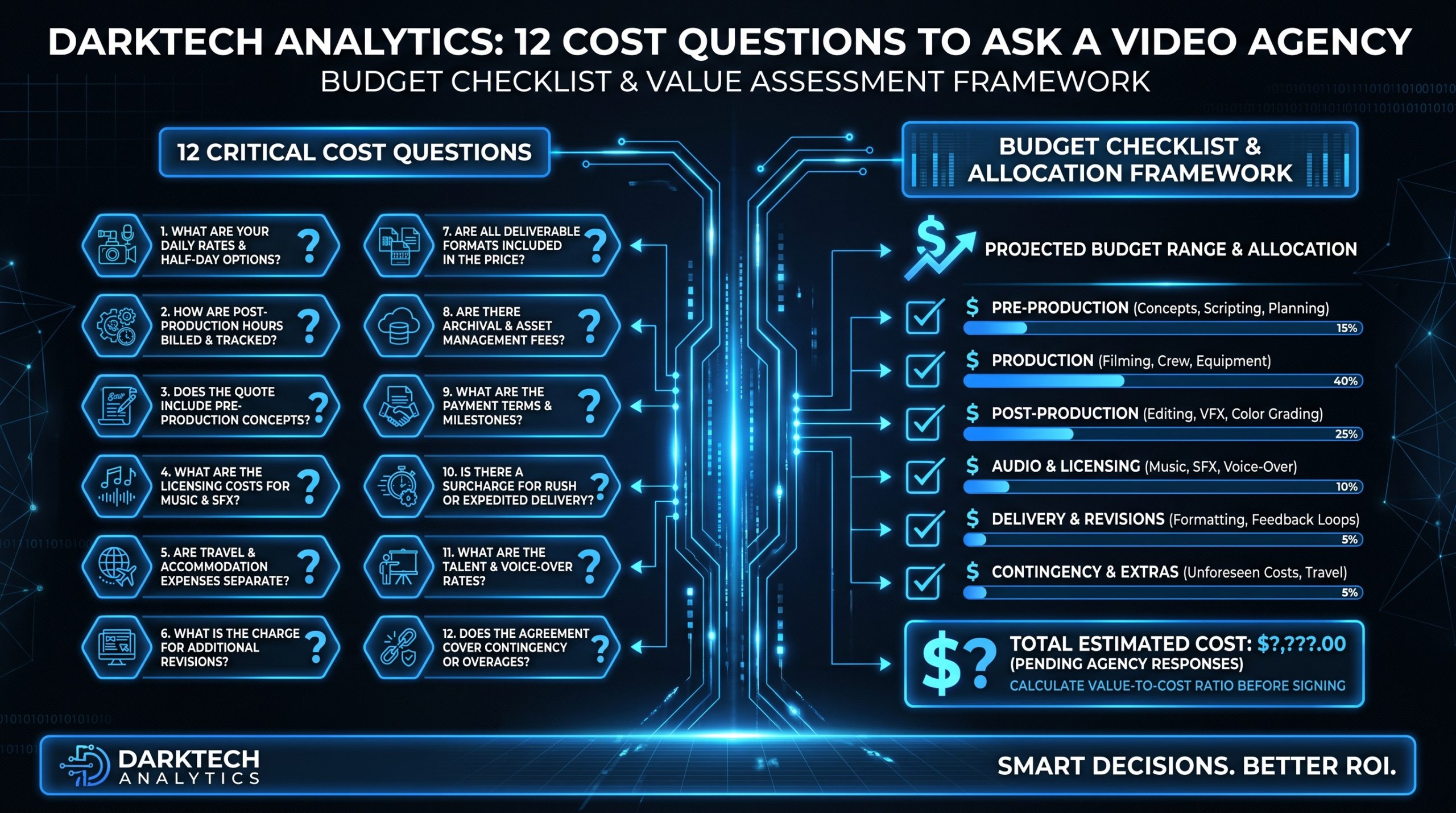
These 12 questions are designed to surface the total cost of the engagement before you commit. Each one is a self-contained line of inquiry you can bring directly into your next agency conversation. For help interpreting quotes once you have them, see our guide to reading video production quotes.
TL;DR
- Line-item quotes are non-negotiable — base prices almost never include scripting, stock footage, music, or format variations.
- Revisions kill budgets: most agencies include 2–3 rounds; additional rounds cost $75–$300 each.
- Calculate effective cost per video at your actual output volume before comparing agencies — retainers and dedicated teams become dramatically cheaper at 6+ videos per month.
- Rush fees add 25–50% to most base quotes — ask whether fast turnarounds are standard or always an exception.
- Format variations are almost always extra — if you publish on three platforms, those cuts add up fast.
- Ask about scale pricing upfront — the best agencies give you a predictable cost structure that doesn't punish growth.
Table of Contents
- Q1: What's included in this quote — and what's excluded?
- Q2: What are the biggest cost drivers for this type of video?
- Q3: How do you price revisions — and what counts as one?
- Q4: What pricing model do you use?
- Q5: Does this include scripting, voiceover, and creative direction?
- Q6: Are stock footage, music licenses, and b-roll covered?
- Q7: What's the rush fee for faster turnarounds?
- Q8: What's my effective cost per video at my actual volume?
- Q9: Do you charge for format variations — 16:9, 9:16, 1:1?
- Q10: Is project management billed separately?
- Q11: What are your payment terms, kill fees, and scope-change policies?
- Q12: How does pricing change when we scale?
- FAQ
Q1: What's included in this quote — and what's excluded?
Most video agency quotes cover editing, color grading, and basic sound design. They almost never include scripting, voiceover recording, stock footage, licensed music, or additional format cuts. These exclusions can quietly add $500–$3,000+ to the final invoice.
Ask for a full line-item breakdown before signing anything. A quote that says "video production — $4,500" tells you almost nothing. A quote that lists "editing (8 hrs), color grade (2 hrs), licensed music (1 track), master 16:9 + 9:16 social cut" tells you exactly what you're getting and where the scope could expand.
The most common surprise add-ons buyers discover after signing:
- Stock footage: $50–$500 per clip, depending on library and licensing terms
- Music licensing: $30–$300 per track (or an annual library fee passed through as a flat charge)
- Voiceover talent: $250–$800 for a standard 2-minute script
- Additional format cuts (16:9 → 9:16): $100–$300 per cut
- Captions and closed captioning: $50–$150 per video depending on length
- Revisions beyond the included rounds: $75–$300 per additional round
Before you approve any quote, ask directly: "If we need three social cuts in addition to the main video, is that included or billed separately?" The transparency of that answer tells you a lot about what the invoicing relationship will look like.
Q2: What are the biggest cost drivers for this type of video?
The answer depends entirely on the video type. For editing-heavy work — podcast clips, webinar cuts, social content repurposing — turnaround speed and revision complexity are the main cost drivers. For production-heavy work — product demos, testimonials, brand films — footage quality, crew size, and filming location dominate.
Knowing the cost drivers upfront gives you leverage for smart scope trade-offs. If you're producing a high volume of social clips each month, ask: "Would pre-organizing our footage before submission reduce the editing hours?" At hourly-rate agencies, footage organization — syncing audio, sorting takes, finding selects — typically accounts for 15–25% of total editing time. That's billable overhead you can often absorb internally at zero cost to you.
Other common cost escalators to understand before the project starts:
- Poor source footage quality — shaky handheld clips and bad audio require significantly more cleanup time than well-shot material
- Unclear creative briefs — vague direction leads to off-base first cuts and multiple structural revision rounds
- Late-stage scope changes — adding a product b-roll sequence after the assembly cut is done often means rebuilding sections from scratch
- Compressed timelines — rush rates apply when deadlines require reprioritizing the editor's existing workload
- Complex motion graphics — layering custom animations onto edited footage adds specialized hours beyond standard editing rates
The goal of this question isn't to negotiate — it's to understand where you can make informed trade-offs. Delivering clean, well-organized footage with a detailed brief reliably reduces cost across every pricing model.
Q3: How do you price revisions — and what counts as one?
Most agencies include 2–3 revision rounds in their base quote. Additional rounds typically cost $75–$300 each, depending on complexity. But "one revision round" means very different things at different agencies — and that ambiguity is where budgets get unexpectedly strained.
Get clarity on three specific points:
- How many revision rounds are included in the quoted price?
- What constitutes one round — one consolidated feedback document, or each individual note counted separately?
- What falls outside revision policy — structural changes, footage additions, or scope expansions that trigger a change order?
Structural revisions — changing the core narrative arc, adding footage that wasn't filmed, or rebuilding the edit from scratch because the brief changed — almost always fall outside revision policies regardless of what the contract says. These are effectively new scopes, not edits to the existing one.
One practical safeguard: agencies that invest time in a pre-production brief before editing starts tend to require far fewer revision rounds. The editor understands what you're building before the first frame is cut. Ask whether the agency does a formal brief review or pre-production call as part of the standard workflow. If they skip this step, budget for extra revision rounds.
According to Wistia's production guides, unclear pre-production alignment is one of the most consistent sources of production cost overruns in video marketing — agencies that invest in upfront clarity save significant time in the revision cycle.
Q4: What pricing model do you use — per-project, hourly, retainer, or dedicated team?
The billing model matters as much as the listed rate. An agency charging $800/video on a per-project basis looks cheap compared to a $7,000/month retainer — until you calculate that you need 10 videos per month, at which point per-project becomes $8,000/month versus the retainer's effective $700/video.
Understand how each model behaves at your actual content volume before you compare price tags. For a detailed breakdown of how each model performs across different output levels, see our guide to video production agency pricing models.
Video Agency Pricing Models: At a Glance
| Model | Best For | Effective Cost Trend | Main Risk |
|---|---|---|---|
| Per-Project | Infrequent, one-off videos (<4/quarter) | Highest per-video; no volume benefit | Scope creep; revision overages |
| Hourly Rate | Overflow editing; simple repetitive cuts | Variable; hard to predict monthly totals | Misaligned incentives; unpredictable bills |
| Monthly Retainer | 6–15 videos/month with consistent output | 20–40% lower per-video vs. per-project | Underutilization; use-it-or-lose-it months |
| Dedicated Team | 15+ videos/month; brand consistency critical | Lowest per-video at scale | Higher minimum commitment; ramp-up period |
When comparing agencies on different models, reduce everything to one number: effective cost per finished video at your actual monthly output. That calculation cuts through the noise faster than any other metric.
Q5: Does this price include scripting, voiceover, and creative direction?
Rarely. Most video agency quotes cover post-production only — editing, color grading, and audio mixing. Scripting, voiceover, and creative direction are typically separate service lines, each priced independently.
Scripting rates at established agencies commonly run $500–$3,000 per video, depending on length, complexity, and the strategic thinking required. A 60-second brand spot with a defined narrative requires significantly more scripting effort than editing a webinar down to key clips. Professional voiceover talent typically starts around $250–$500 for a short script and scales with recording length and talent tier.
Creative direction — positioning the video strategically, defining messaging hierarchy, and guiding look and feel — is sometimes bundled into higher-tier retainer or dedicated team plans, but it's rarely included in standard per-project quotes. Ask directly: "Who owns the creative brief, and is that work billable?"
If your team doesn't bring in-house creative direction and strategy, factor these costs into your total budget from the start. A video quote of $3,000 that doesn't include a $1,500 script, $400 voiceover, and $500 creative direction call is a $5,400 project, not a $3,000 one. The agencies that are transparent about this upfront are the ones worth working with long-term.
Q6: Are stock footage, music licenses, and b-roll covered?
Almost always no. Stock footage, licensed music, and additional b-roll are nearly universally passed through as separate costs — either at cost or with a markup. Understanding who sources these assets and who owns the license matters both for your budget and your legal exposure.
Premium stock footage from libraries like Shutterstock or Getty runs $50–$500 per clip depending on resolution, licensing type (standard vs. extended), and usage rights. Licensed production music runs $30–$300 per track per project, or some agencies operate on annual blanket licenses from services like Artlist or Musicbed — in which case you may or may not be entitled to use those tracks after the engagement ends.
Ask three specific questions about assets before any work begins:
- Who sources and pays for stock footage? Is it billed at cost or with a markup?
- Is music licensing a one-time fee or an ongoing license? Does it expire if we end the engagement?
- Will we own the licenses for assets used in our videos? Or do the licenses belong to the agency?
Common Video Production Add-Ons Not in the Base Quote
| Add-On | Typical Range | Notes |
|---|---|---|
| Scripting | $500–$3,000 per video | Scales with length and strategy complexity |
| Voiceover talent | $250–$800 | Per 2-minute script; scales with talent tier |
| Stock footage | $50–$500 per clip | Standard vs. extended licensing varies |
| Licensed music | $30–$300 per track | Or annual blanket license passed through |
| Rush fee | 25–50% premium | Applied when turnaround is under 48–72 hrs |
| Format variations | $100–$300 per cut | Each additional aspect ratio (9:16, 1:1) |
| Captions / subtitles | $50–$150 per video | May be per-minute of finished content |
| Extra revision rounds | $75–$300 per round | Beyond the 2–3 rounds typically included |
| Project management (hourly agencies) | 15–25% of total project | Calls, coordination, file org billed at editor rate |
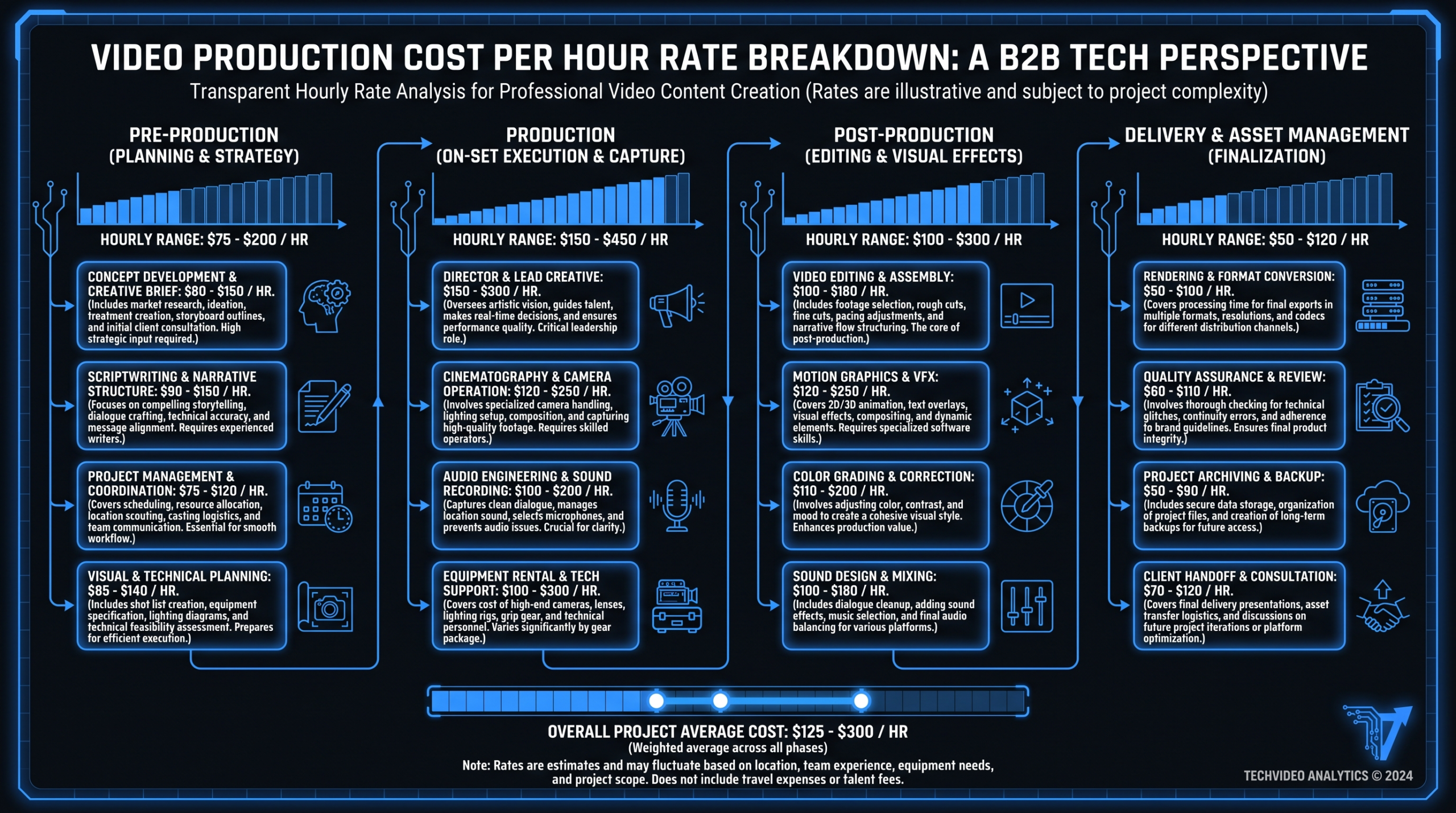
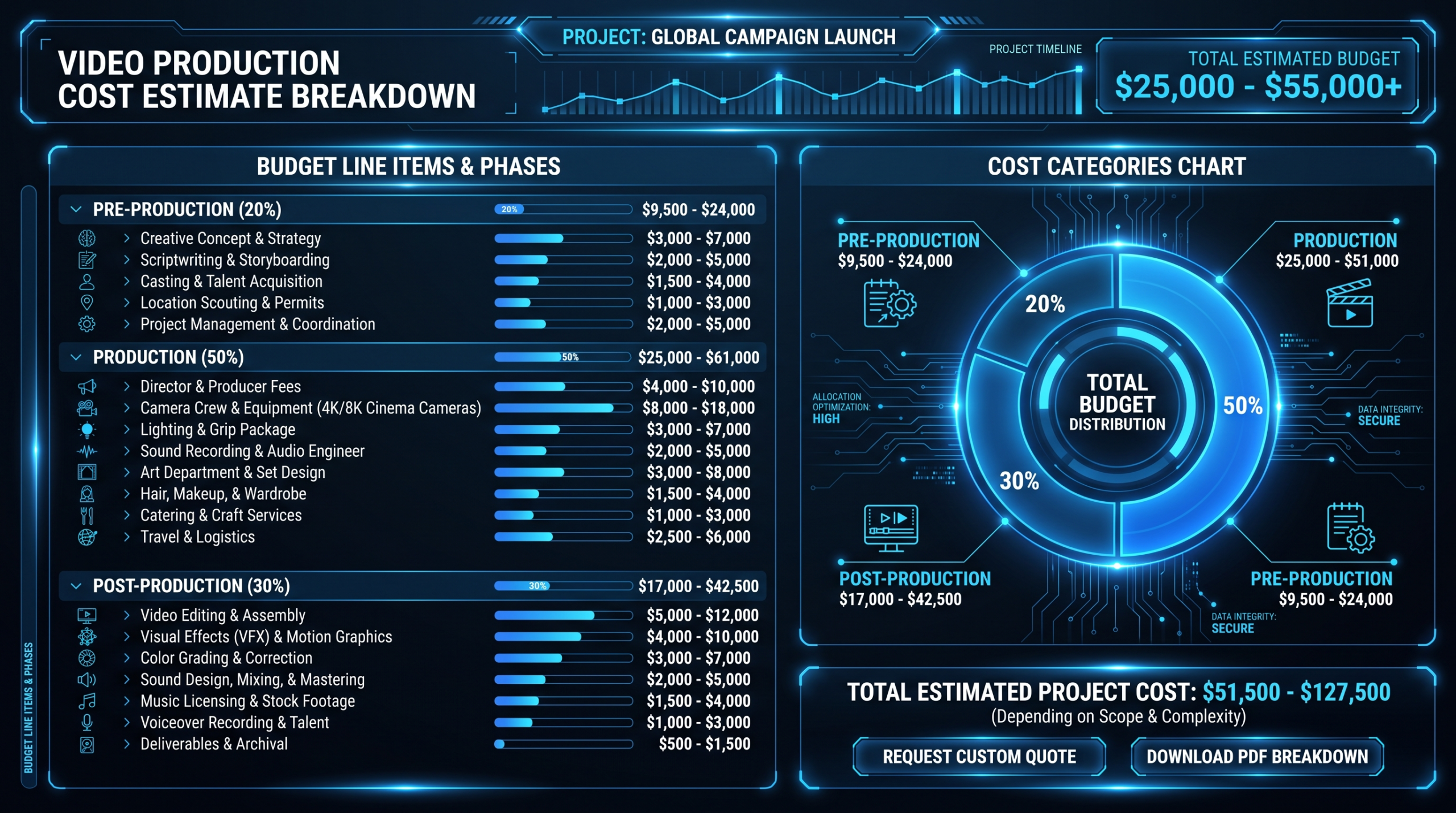
For a full picture of what drives video production costs line by line, see our video production cost breakdown.
Q7: What's the rush fee for faster turnarounds?
Most agencies charge a 25–50% premium for turnarounds under 48–72 hours. Some structure this as a flat rush fee ($200–$500 per project); others apply a percentage multiplier to the full project cost. Rush pricing compensates the agency for reprioritizing the editor's existing client workload — someone else's job gets pushed to accommodate your timeline.
If your team regularly needs fast turnarounds — for time-sensitive campaigns, event recap videos, or weekly content publishing cadences — this question becomes a budget-planning question, not just a one-off inquiry. Ask whether rush pricing can be built into a retainer's standard SLA, or whether you'll pay the premium every single time a deadline is tight.
Agencies with dedicated team models often offer faster standard turnarounds because your editors aren't juggling multiple clients' workloads. When a team is assigned exclusively (or primarily) to your account, there's no queue to jump and no other client to deprioritize. The speed benefit is structural rather than a line item on an invoice.
Ask specifically: "What's your standard turnaround for a 3-minute edited video delivered from raw footage? What's the fastest you can deliver, and what does that cost? Is there a way to get faster turnarounds as a standard SLA rather than paying rush fees each time?"
Q8: What's my effective cost per video at my actual output volume?
This is the most important question on this list — and the one most buyers skip. Agencies present their pricing in different structures (per project, per hour, per month), which makes direct comparison almost impossible until you reduce everything to one metric: effective cost per finished video at your monthly output.
Run the math before your next agency call:
- Per-project at $1,200/video × 10 videos/month = $12,000/month effective, or $1,200/video
- Retainer at $7,000/month for ~12 videos = $583/video effective
- Dedicated team at $9,500/month for 20 videos = $475/video effective
The numbers change dramatically based on volume. An agency that looks expensive on a per-project basis may offer significantly better value once you factor in your monthly production needs. The best agencies will run this math with you openly — because their model tends to win when the numbers are laid out clearly.
VEC's plans — Growth at $5K/month, Core at $9.5K/month, Scale at $16K/month — are structured so the effective per-video cost decreases as output grows, rather than charging hourly overages when you push past a threshold. You can model scenarios at our pricing page.
Ask every agency you're evaluating: "If I produce X videos per month consistently, what is my effective cost per video in your pricing model? Can you show me the math?" An agency that deflects this question isn't optimized for high-volume clients.
Q9: Do you charge for format variations — 16:9, 9:16, and 1:1?
Yes, almost always. Most agencies treat each format variation as a separate deliverable, typically priced at $100–$300 per additional cut. Creating a 9:16 version of a 16:9 video isn't a simple crop — it often requires reframing every shot, repositioning text and graphics, re-timing pacing for the vertical format, and adjusting audio mix for mobile playback.
If you publish across YouTube (16:9), LinkedIn feed (1:1 or 4:5), Instagram Reels (9:16), and TikTok (9:16), you may need 3–4 format variations from every main video. At $200/cut × 3 cuts × 8 videos/month, format variations alone add $4,800/month to your budget — and that number won't appear anywhere in the base quote.
Some retainer plans and dedicated team arrangements include a defined number of format cuts as part of the standard deliverables. If your strategy depends on multi-platform distribution, make format cuts a first-conversation item, not an afterthought. Ask: "If we need three format cuts per video, are those included or billed separately? Can you show me the math for our expected monthly volume?"
For context on how video editing costs break down by task and format type, our video editing cost per minute guide covers the factors that drive per-cut pricing.
Q10: Is project management billed separately?
At flat-rate agencies — retainer and dedicated team models — project management is typically included in the base price. At hourly-rate agencies, every touch point counts: intake calls, feedback sessions, file organization, revision coordination, and status updates are all billed at the editor or PM's hourly rate.
At an agency charging $75/hour, a 30-minute onboarding call, a 30-minute feedback review session, and 30 minutes of file organization add $112.50 in project management overhead before a single edit frame is cut. On a $2,000/month engagement, that's 5–6% of your budget going to coordination alone — and that's a conservative estimate.
Ask: "What percentage of my total invoice typically comes from project management and coordination versus actual editing and production?" At a well-run agency, PM overhead should represent less than 15–20% of total costs. Significantly higher than that is a signal of inefficient internal workflows that you're paying for.
At agencies with dedicated team structures, the project manager is a relationship investment that pays off over time. They learn your brand's conventions, your feedback style, and your production calendar — which reduces briefing overhead and revision rounds month over month. The PM cost stays stable while the value delivered per hour increases.
Q11: What are your payment terms, kill fees, and scope-change policies?
Payment terms for per-project work typically run 50% upfront at contract signing and 50% on final delivery. For retainers, monthly invoicing on net-15 or net-30 terms is common. Get this in writing because it directly affects your cash flow planning — especially if you're managing a monthly marketing budget with defined expense timing.
Kill fees apply when a project is cancelled after work has started. Most agencies charge 25–50% of the remaining project value as a kill fee to compensate for editor time already allocated and other client opportunities declined. Projects cancelled before any work begins typically qualify for a full deposit refund — but not always. Confirm the specific policy in writing before signing.
Scope-change policies matter most on complex, multi-week projects. Most agencies require a written change order for any material scope expansion — additional videos, new format variations, late-stage script changes that require re-recording. Without a clear change order process, scope can drift ambiguously until you receive an unexpectedly large invoice at the end of the project.
Ask specifically: "If we need to change the scope mid-project — say, we want to add two more videos to this batch — how is that handled? Do you require a formal change order? What's your kill fee if we need to cancel?"
A transparent, reasonable answer to these questions is itself a positive signal about how the agency operates day-to-day. The agencies that are clear about this upfront tend to be easier to work with when things inevitably get complicated.
Q12: How does pricing change when we scale?
The answer to this question reveals whether an agency is built for growth or optimized for one-off projects. Agencies with scalable pricing structures — where additional output doesn't trigger hourly overages or per-unit charges — are better long-term partners for companies building serious content programs.
Two models to understand:
- Tiered plan upgrades: Moving to a higher tier unlocks more capacity at a lower effective per-video cost. Clean and predictable. You know exactly what scaling costs before you commit to the upgrade.
- Hourly overflow billing: When you exceed your retainer's included deliverables, you pay hourly or per-project rates for the excess. This model punishes productive months — the months you need video most, you pay the most per video.
VEC's dedicated team model handles scale differently: as your output grows, the team's capacity scales without hourly overages or per-video surcharges. A month where you produce 25 videos instead of 15 doesn't trigger an invoice multiplier — the dedicated team absorbs the volume. This is the model that makes financial sense for Series A–C SaaS companies treating video as a core demand generation channel.
Ask any agency you're evaluating: "What happens to our pricing if we double our video output next quarter? Is there a per-unit overage, or does the model absorb that volume at the same monthly rate?" The answer will tell you whether the agency is built to grow with you or built to profit from your growth.
For a broader look at how B2B companies structure video agency relationships over time, HubSpot's video marketing guide covers how content volume typically scales alongside company growth stages.
Frequently Asked Questions
What's the single most important cost question to ask a video agency?
Ask for your effective cost per video at your actual monthly output volume across every pricing model they offer. This one calculation cuts through the structural differences between per-project, retainer, and dedicated team models and gives you a comparable number for decision-making. Most pricing conversations skip this step entirely — and that's where budget surprises originate.
How do I compare quotes from agencies using different pricing models?
Normalize everything to effective cost per finished video per month. Take the total monthly spend (including any add-ons you'll realistically need: stock footage, format variations, rush fees) and divide by your expected monthly video output. Run this calculation for every agency in your shortlist, then compare the resulting per-video number — not the headline price.
What's a fair revision policy for video editing work?
A fair policy includes 2–3 revision rounds in the base price, defines one round as one consolidated feedback document (not individual notes counted separately), and is explicit about what constitutes a revision versus a scope change. The best agencies couple a clear revision policy with a pre-production brief process — which reduces the total number of rounds needed and keeps projects on budget.
When does a retainer make more financial sense than per-project pricing?
Generally when you're producing 6 or more videos per month consistently. Below that threshold, the underutilization risk of a retainer (paying for capacity you don't use) often outweighs the per-video discount. At 8–10 videos per month, the math typically favors a retainer by 25–40% versus the equivalent per-project rate. Run the effective cost per video calculation at your actual volume to confirm the crossover point for your specific situation.
Can I negotiate video agency pricing?
Yes — and the most effective levers are longer contract terms, higher volume commitments, and bringing better-organized footage and briefs to the table. Agencies value predictable revenue and reduced coordination overhead. A 12-month retainer commitment commonly yields a 10–20% lower monthly rate than a 3-month arrangement. Pre-organizing your footage before submission can reduce hourly billing by 15–25% at agencies that charge for that time. The agencies most open to these conversations are the ones worth working with long-term.
Ready to Get a Transparent Video Agency Quote?
VEC gives you a line-item breakdown before you commit — no black-box pricing, no surprise invoices. Our plans are built so your per-video cost goes down as output grows, not up. Book a call and we'll model the exact cost structure for your content volume.
Book a Free Strategy Call See Our Pricing