Employer Brand Video Examples That Recruit
TL;DR
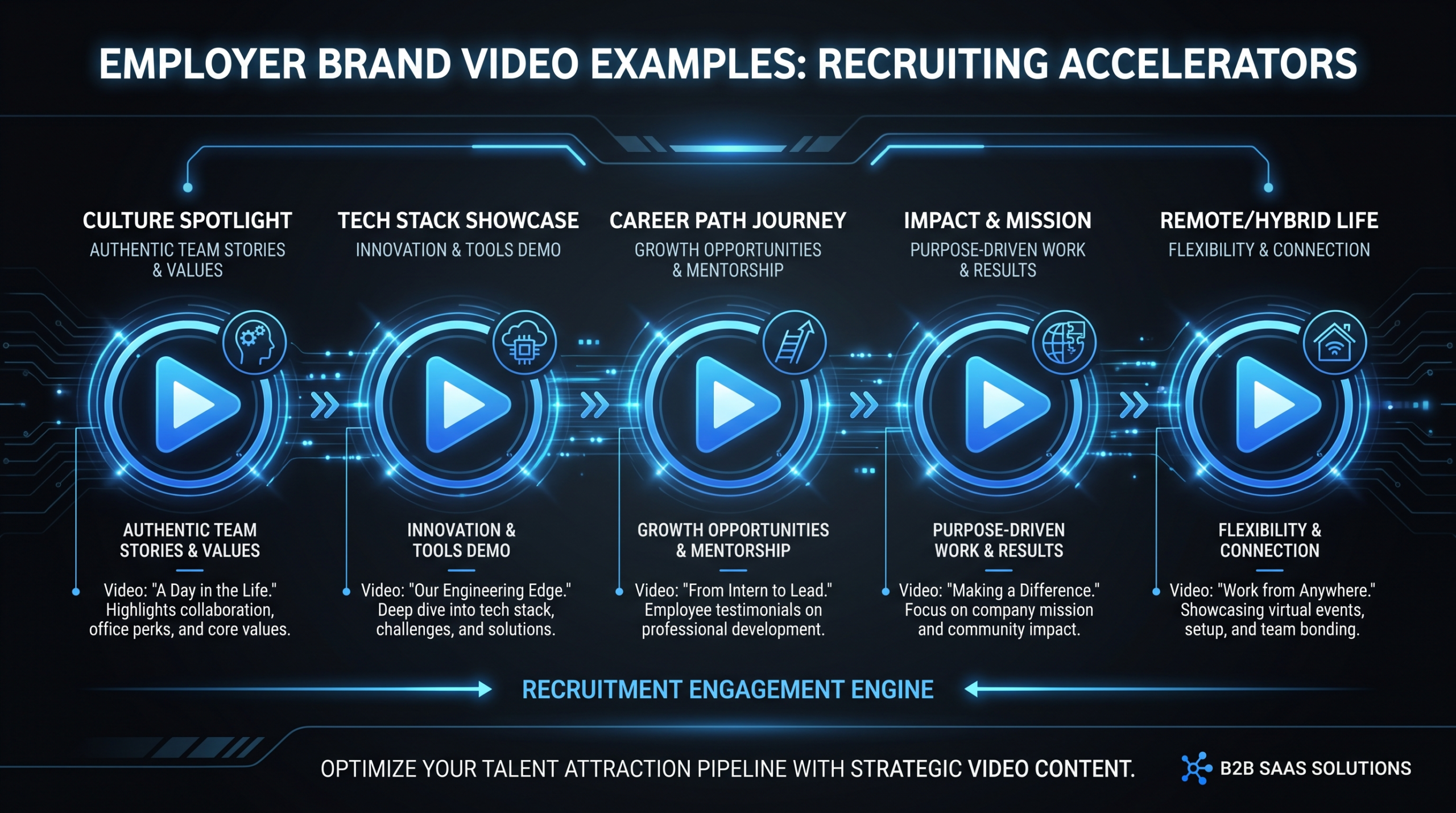
The employer brand videos that consistently fill pipelines share three qualities: specific over generic, employee voice over executive script, and honest over polished. This guide breaks down the six formats that work — day-in-the-life, culture and values, employee testimonials, hiring manager intros, team spotlights, and "why I stayed" videos — with real company examples, a funnel-stage match table, and a production budget vs. authenticity analysis to help you build a video program that actually attracts the candidates you want.
Table of Contents
- What Makes Employer Brand Videos Work for Recruiting
- Day-in-the-Life and Behind-the-Scenes Examples
- Culture and Values Video Examples
- Employee Story and Testimonial Video Examples
- Hiring Manager and Team Spotlight Examples
- Matching Video Type to Recruiting Funnel Stage
- Production Quality vs. Authenticity: What Actually Converts
- Employer Brand Video Strategy for SaaS Companies
- FAQ
Your careers page exists. Your job descriptions are live. Candidates land there, read three bullet points, and leave. The problem is not your benefits package. It is that you have not given candidates a reason to feel anything about working for you.
Employer brand videos fix that. When done well they move a passive candidate from "seen the listing" to "I want to work there before I even apply." When done poorly they produce a three-minute reel of stock footage and an executive saying "people are our greatest asset."
This guide covers six formats that consistently work — with real company examples from organizations that have published this content publicly — plus the data you need to decide where to invest production budget and how to sequence videos across the recruiting funnel.
What Makes Employer Brand Videos Work for Recruiting
Employer brand videos that move candidates share three qualities: specificity, employee voice, and honesty about trade-offs. Generic content about teamwork and innovation is invisible. Specific content about how a Monday morning sprint planning meeting actually runs at your company is memorable.
The formats that consistently underperform in recruiting contexts are those produced entirely for an awards reel — cinematic B-roll with an inspirational voiceover about mission. High production value without substance reads as corporate. Candidates who have done their research on Glassdoor, LinkedIn, and Blind already know a polished video does not equal a good place to work.
What candidates actually use employer brand video for:
- Culture fit check — do the people look like people I want to spend eight hours a day with?
- Manager calibration — does the hiring manager seem like someone I can grow under?
- Role reality check — is the day-to-day of this role what I think it is?
- Growth signal — is this company investing in people or burning through them?
Each of these questions maps to a specific video format. Building an employer brand library means covering all four — not just filming a culture reel and calling it done.
Day-in-the-Life and Behind-the-Scenes Examples
Day-in-the-life videos are the highest-performing employer brand format for roles with a defined work rhythm — engineers, designers, product managers, customer-facing teams. They answer the "is this role what I think it is?" question directly, and they do it through observation rather than claim.
What These Videos Do
A well-produced day-in-the-life follows a single employee through a real work day: morning standup, the tool stack they actually use, a cross-functional conversation, a decision point, end-of-day wind-down. The value is not the individual moments — it is the accumulation of authentic detail that candidates cannot get from a job description.
Real Examples
HubSpot — "A Day in the Life" series. HubSpot publishes a consistent series of role-specific day-in-the-life videos on their careers page and YouTube channel, covering roles from software engineer to customer success manager. What makes these effective: they show the internal tool stack (HubSpot's own products plus Slack, Zoom), they include a 60-second "what I wish I'd known before starting" segment, and they do not cut away every time the work looks difficult. The result is a video that pre-qualifies candidates rather than simply attracting them.
Shopify — behind-the-scenes engineering content. Shopify's engineering team produces content through the Shopify Engineering blog and careers hub that blends written and video formats. Their engineering day-in-the-life content specifically names the technology, shows pair programming sessions, and includes real conversations about production incidents. The honest framing ("here is what a bad week looks like") tends to perform better with senior engineers who have been burned by overpromising job descriptions.
Slack — team culture capture. Slack has published employer brand video content through their careers channels that shows small-team dynamics at work — the specific kind of cross-functional collaboration that engineering and design candidates care about. The production quality is deliberately informal: iPhone-quality footage, unscripted conversation, real workspace environments rather than staged setups.
Production note
Day-in-the-life videos typically run three to eight minutes. Shorter does not serve the format — candidates need accumulation of detail to form a judgment. Over-editing into a fast-cut highlights reel defeats the purpose.
Culture and Values Video Examples
Culture and values videos answer the "do these people share my operating principles?" question. They are harder to produce well than day-in-the-life content because vague values language ("we move fast," "we put customers first") is endemic to the format. The companies that do this well anchor values to specific, observable behaviors — not abstract declarations.
What These Videos Do
Effective culture videos show the behaviors that result from a company's stated values, not the values themselves. "We own our mistakes" becomes a clip of a post-mortem meeting where a senior engineer explains what they missed and what the team changed. "We invest in growth" becomes an employee describing the budget they were given for external conferences and how they used it.
Real Examples
Salesforce — Ohana culture content. Salesforce has built employer brand video around their "Ohana" concept of company as family — and unlike most culture branding, theirs is specific enough to be testable. Their video content on the Salesforce careers hub includes employee resource group spotlights, volunteer time-off stories, and executive roundtables where leaders discuss what the culture actually costs them in terms of the decisions they will not make. The specificity earns credibility.
Google — Life at Google. Google's "Life at Google" content on YouTube is one of the most-referenced employer brand video programs in the industry. What makes it instructive is the volume: hundreds of videos spanning role-specific, team-specific, and location-specific content. Candidates can find a video about the engineering team in Singapore, the UX research team in New York, or the legal team in London. That granularity makes the brand feel real rather than curated.
Airbnb — Belong Anywhere as an internal principle. Airbnb's employer brand video content ties their external consumer brand ("belong anywhere") directly to how they hire and retain employees. Videos on their careers channels show employees describing moments when the company's stated commitment to belonging showed up in a workplace decision — a leave policy, a team restructure, a performance conversation. The inside-out storytelling is distinctive because it treats the consumer brand promise as a testable internal standard.
Employee Story and Testimonial Video Examples
Employee story videos are the most trusted format in employer branding because they are the hardest to fake. A candidate's internal BS detector flags an executive saying "we care about growth" immediately. The same claim from a mid-level engineer three years into the company, describing a specific career conversation they had with their manager, lands differently.
What These Videos Do
Employee testimonial videos work when they are structured around a specific moment or decision, not a general endorsement of the company. "I love working here" is worthless. "I was offered a role at a competitor paying 20% more and here is the specific reason I stayed" is a content asset that will influence candidate decisions for years.
Real Examples
LinkedIn — Talent Brand content. LinkedIn produces employer brand video content about their own hiring practices and employee experience — which has a self-reinforcing credibility effect, since they are the platform where most B2B hiring happens. Their content on the LinkedIn Life page frequently features employees describing non-linear career paths within the company: an SDR who moved into product, an engineer who transitioned to marketing, a recruiter who became an engineering manager. Non-linear career stories are among the highest-performing employer brand content types for attracting candidates who have been in their current role for four or more years and are starting to feel stuck.
Dropbox — remote work culture documentation. After Dropbox moved to a distributed-first model, they produced a series of employee story videos specifically about what changed — and what did not. The format is honest about the trade-offs: some employees describe losing energy from in-person collaboration, others describe gaining two hours a day. The willingness to show both sides is what makes the content trustworthy rather than promotional.
Stripe — engineering culture specificity. Stripe's employer brand presence includes written and video content about their engineering practices — but what distinguishes it is the level of technical specificity. Videos reference real architectural decisions, describe the trade-offs in their system design, and allow engineers to express genuine disagreement with past choices. For senior engineering candidates who have learned to read through corporate employer brand content, that specificity is a strong signal about intellectual honesty at the company.
Hiring Manager and Team Spotlight Examples
Hiring manager intro videos are underused and over-perform. Candidates applying for a role will spend significant time researching the hiring manager on LinkedIn. A two-minute video where the hiring manager describes how they run their team, what they value in candidates, and what the first 90 days looks like reduces candidate anxiety and increases application-to-interview conversion.
What These Videos Do
The best hiring manager videos answer four questions: What does this team actually work on? How do you run 1:1s and feedback loops? What does success look like in the first 90 days? What kind of person tends to thrive here — and what kind tends to struggle? That last question, asked honestly, is the differentiator. Most hiring managers will not say "people who need a lot of process guidance struggle here" — but that is exactly the specificity that pre-qualifies candidates and reduces post-hire churn.
Real Examples
HubSpot — hiring manager series. HubSpot supplements their day-in-the-life content with short hiring manager introduction videos embedded directly in job listings. The format is deliberately low-production: the manager, a camera, five minutes. The content covers team structure, working style, and an honest description of what makes the role difficult. Embedding these directly in job descriptions increases application rates for senior roles where candidates are evaluating multiple offers simultaneously.
Salesforce — team spotlight format. Salesforce uses team spotlight videos to show candidates what it looks like to join a specific team in a specific city, not just to work at Salesforce generally. A team spotlight for the London enterprise sales team describes the specific clients they work with, the career progression that team has produced historically, and the dynamics of selling in the European enterprise market. That level of specificity converts candidates who were already considering the role but uncertain about the team context.
Matching Video Type to Recruiting Funnel Stage
Different employer brand video formats serve different stages of the candidate journey. Using a culture video at the point-of-application stage is a mismatch — candidates who have already applied are evaluating specifics, not assessing general fit. The table below maps format to stage, with recommended length and primary use case.
Employer Brand Video by Recruiting Funnel Stage
| Funnel Stage | Candidate Question | Best Video Format | Recommended Length | Primary Placement |
|---|---|---|---|---|
| Awareness | Should I consider this company? | Culture and values video | 60–90 sec | LinkedIn, social media ads |
| Consideration | Is this the right kind of place for me? | Day-in-the-life, team spotlight | 3–6 min | Careers page, YouTube |
| Application intent | Is this the right role for me? | Hiring manager intro, role-specific testimonial | 2–4 min | Job listing, ATS confirmation email |
| Offer stage | Should I take this offer over others? | "Why I stayed" employee story | 3–5 min | Offer email, recruiter send |
| Post-accept / onboarding | Did I make the right choice? | New hire first-week video, team welcome | 2–3 min | Onboarding portal, welcome email |
Most employer brand video programs focus entirely on the awareness and consideration stages — culture reels and day-in-the-life content. The offer stage and post-accept stages are almost entirely neglected, even though these are the highest-leverage moments: a candidate weighing two offers is more likely to convert based on a specific employee story than a general careers page.
Building a complete funnel library typically requires eight to twelve videos. For most companies, the right sequence is: start with two or three awareness-stage videos for social distribution, add two day-in-the-life videos for the careers page, then add hiring manager intros for your two or three highest-volume roles. The offer-stage videos come last and produce an outsized return on production investment given how few companies use them.
Production Quality vs. Authenticity: What Actually Converts
Employer brand video does not follow the normal quality-converts logic of product video. A higher-production employer brand video often performs worse than a lower-production one because the gap between the video's polish and the candidate's daily reality becomes a credibility problem. The research from LinkedIn's talent solutions team on employer branding consistently shows that authenticity is the primary driver of candidate trust — not production value.
That said, there is a floor below which poor production actively damages credibility. Inaudible audio, shaky handheld footage without stabilization, and visible lighting problems signal a company that does not invest in basics. The goal is not zero production — it is calibrated production that matches the authentic character of the company.
Production Approach Comparison for Employer Brand Video
| Production Approach | Typical Cost Range | Authenticity Signal | Best Fit Role Level | Notes |
|---|---|---|---|---|
| In-house smartphone + basic lighting | Under $500/video | High | IC and early-career | Works best when company culture is genuinely informal; falls flat at formal enterprise organizations |
| Semi-professional (crew of 1–2, basic kit) | $1,500–4,000/video | Medium-high | IC to manager | Reliable baseline for most tech companies; looks intentional without looking staged |
| Agency-produced, single-day shoot | $4,000–10,000/video | Medium | Senior IC, manager | Good for team spotlights and culture pieces; requires strong editorial direction to avoid generic output |
| Full-production employer brand film | $10,000–40,000+ | Low-medium | Executive, brand-level | High risk of credibility gap if company reality does not match production quality; appropriate for external awards or brand reels, not core recruiting use |
For SaaS companies specifically, the semi-professional tier ($1,500–$4,000 per video) consistently outperforms both cheaper and more expensive alternatives. It is polished enough to reflect well on a tech brand while remaining grounded enough to feel honest. For a full cost breakdown of employer brand video production, see our analysis of employer brand video cost ranges across different company sizes and markets.
The editing phase is where the authenticity-quality balance is most often lost. Over-edited employer brand video — fast cuts, constant music swell, every pause removed — produces content that feels like a commercial rather than a window into a real work environment. The editing brief for employer brand video should explicitly preserve pauses, imperfect phrasing, and genuine moments of thought. These are not mistakes to fix — they are signals of authenticity that candidates trust.
Video Editing Company works with SaaS teams specifically on this calibration. Our dedicated editing teams understand the difference between corporate editing standards and employer brand editing standards — and we apply them differently because the audience and goal are fundamentally different. See our SaaS video production services for more on how we approach content for a technical B2B audience.
Employer Brand Video Strategy for SaaS Companies
SaaS companies face a specific recruiting challenge: the talent they most need — senior engineers, product managers, growth marketers — have more options than almost any other job category and are most skeptical of branded content. Generic employer brand video performs worse with this audience than with almost any other. Role-specific, technically honest content performs better.
What SaaS Employer Brand Video Gets Wrong
The most common SaaS employer brand video mistake is producing content calibrated for a general audience rather than the specific roles that are hardest to fill. A culture video about company values resonates with administrative and entry-level candidates. It does not move a staff engineer evaluating offers from four well-funded companies simultaneously.
Senior engineering candidates specifically want to understand: the technical architecture they would be working in, the decision-making authority they would have, the caliber of the people they would work with, and the honest assessment of the company's technical debt. Almost no employer brand video addresses any of these — which is precisely why a company that does address them in video format stands out immediately.
The SaaS Employer Brand Video Sequence
For a Series A–C SaaS company building an employer brand video library from scratch, this sequence produces the fastest recruiting impact:
- Start with two or three role-specific day-in-the-life videos for your hardest-to-fill roles (typically senior engineering, product management, and one revenue role). These go on the careers page immediately.
- Add hiring manager intro videos for those same roles, embedded in job listings. Two to three minutes each. Deliberately low-production.
- Produce one culture video for LinkedIn distribution — 60 to 90 seconds, focused on a single specific value demonstrated through a specific behavior, not a montage of company moments.
- Build the offer-stage library over the following quarter: two or three "why I stayed" employee stories from people who had competing offers and chose to stay. These are sent by recruiters during offer negotiation.
For the editing and production workflow behind this library, see our guide on how to outsource video editing — the employer brand context requires specific editorial guidelines that differ significantly from product or marketing video workflows.
Budget planning is the most common sticking point. See our full analysis of employer brand video cost to understand what different production tiers actually deliver and where the marginal investment matters most. For teams that want to discuss building this library with a dedicated editing team, our pricing page covers how VEC structures employer brand video programs within our Growth, Core, and Scale plans.
The external benchmark to compare your program against: LinkedIn's Talent Solutions research on employer branding consistently documents that companies with an active employer brand video presence report lower cost-per-hire and shorter time-to-fill for senior roles. The mechanism is candidate quality at the top of funnel — better video content pre-qualifies candidates before they apply, which means a higher proportion of applicants are genuinely interested rather than spray-and-pray. For a deeper framework on employer brand video ROI, Wistia's video marketing learning center covers measurement approaches that apply directly to recruiting use cases.
Frequently Asked Questions
What is an employer brand video?
An employer brand video is any video produced to help candidates understand what it is like to work at a company — covering culture, role reality, team dynamics, or employee stories. It differs from a recruitment ad (which is designed to generate applications immediately) in that it builds the perception and trust that make candidates want to apply in the first place. The most effective employer brand videos are not calls to action — they are windows into a real work environment.
How long should employer brand videos be?
Length depends on the format and placement. Awareness-stage culture videos for social media should typically run 60 to 90 seconds. Day-in-the-life videos on the careers page work best at three to six minutes — long enough for candidates to accumulate the specific detail they need to form a judgment. Hiring manager intro videos embedded in job listings should run two to three minutes. "Why I stayed" offer-stage videos can run up to five minutes because candidates watching them are already highly motivated to learn more.
How many employer brand videos do you need?
A minimum viable employer brand video library is five to eight videos: one to two culture or values videos for social distribution, two to three role-specific day-in-the-life videos for the careers page, and one to two hiring manager intros for your highest-volume roles. That foundation covers awareness through consideration. Adding offer-stage and onboarding videos builds out the full funnel and is where companies with established libraries tend to see the highest marginal return on additional video investment.
Should employer brand videos be highly produced?
Generally not. High production value in employer brand video often creates a credibility gap — candidates recognize when the polished presentation does not match what they hear from employees on Glassdoor or LinkedIn. The effective production level is "intentionally good": clean audio, stable footage, decent lighting — enough to look professional and reflect well on the brand, but not so polished that it reads as a commercial rather than an honest window into the company. The exception is a CEO or executive-level brand film intended for external audiences rather than direct candidate conversion.
How do I measure whether employer brand videos are working?
The most useful metrics for employer brand video effectiveness are: application rate on pages with video vs. without video, time-on-page (video increases dwell time significantly), offer acceptance rate when offer-stage videos are shared vs. when they are not, and the self-reported source in post-hire surveys ("what convinced you to apply?"). Direct attribution is difficult — most candidates consume multiple touchpoints. Track the aggregate by role and funnel stage rather than expecting single-video attribution.
Build an Employer Brand Video Library That Actually Recruits
VEC works with Series A–C SaaS companies to produce and edit employer brand video content — day-in-the-life, hiring manager intros, culture videos, and offer-stage testimonials — on a dedicated team model. Growth plan starts at $5K/month, with a 90-day output guarantee.
Book a Free Strategy Call See Pricing