Podcast Editing Cost Per Episode: 2026
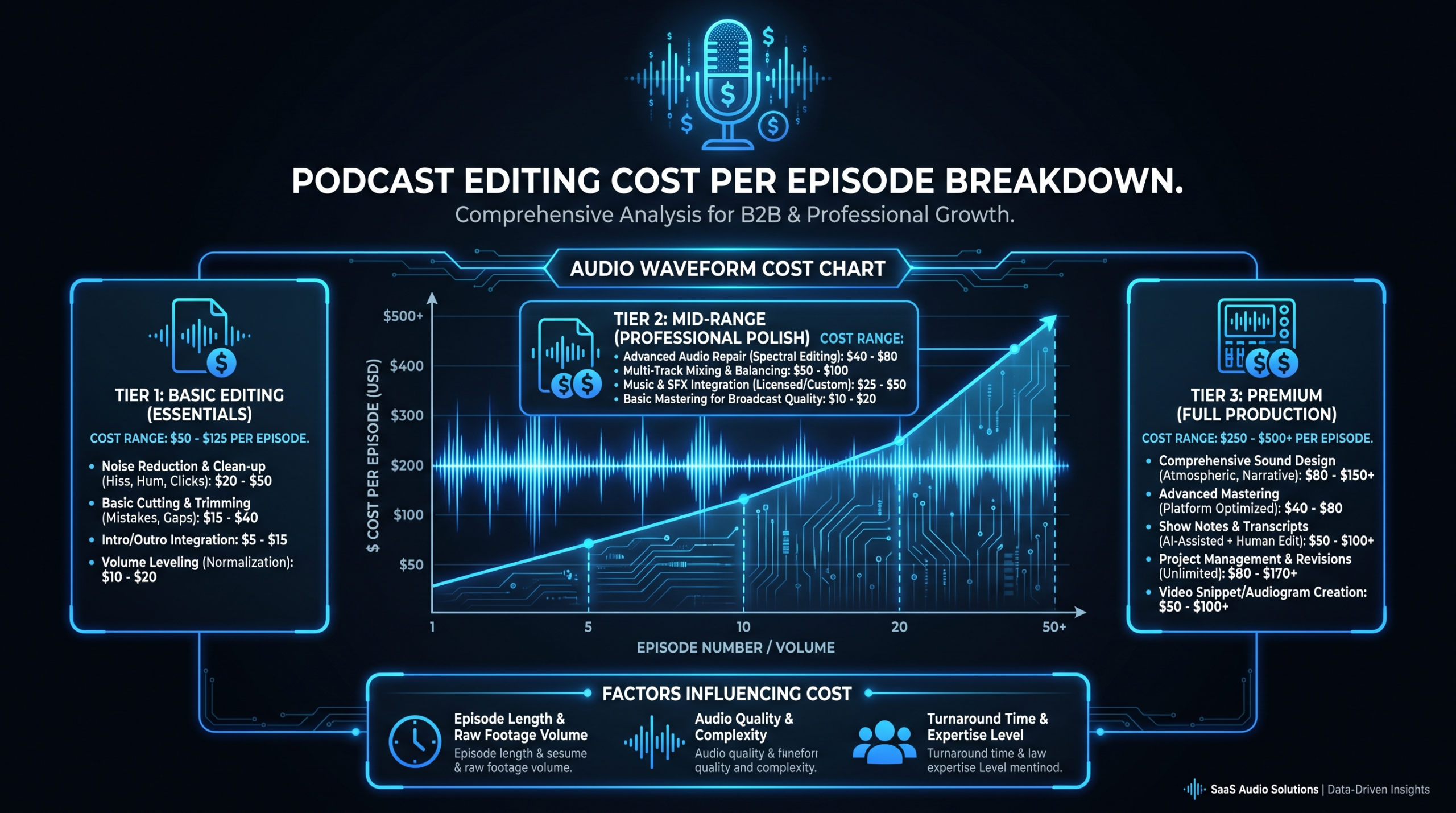
Podcast editing typically costs $50–$250 per episode for audio-only shows and $200–$1,200 per episode for video podcasts in 2026, depending on episode length, complexity, and provider type. Whether you hire a freelancer, use a subscription service, or work with a dedicated editing team, the per-episode rate you pay varies substantially — and knowing what drives those differences is the fastest way to stop overpaying.
TL;DR — Podcast Editing Cost Per Episode
- Audio-only podcast editing: $50–$250/episode (freelancer to mid-tier agency)
- Video podcast editing: $200–$1,200/episode depending on complexity
- Subscription services: $200–$600/month for a fixed episode count
- Dedicated editing team: $5,000–$16,000/month for multi-format, unlimited-output pipelines
- Episode length, guest count, revision rounds, and deliverable formats are the biggest cost levers
- Per-episode pricing sounds simple but often costs more than a monthly retainer at 8+ episodes/month
Table of Contents
Podcast Editing Cost: Audio vs. Video
The single biggest variable in podcast editing cost per episode is whether you're producing audio-only or video. Audio post-production — noise reduction, level balancing, intro/outro music, chapter markers — typically runs 1–2 hours of editor time per 30-minute episode. Video podcast editing adds camera syncing, B-roll cuts, lower thirds, thumbnail export, and often a 90-second social clip, pushing that to 3–6 hours for the same episode length.
Audio Podcast Editing: Typical Ranges
For a standard 30–45 minute audio episode with two guests and basic production (noise reduction, music, chapter markers, show notes), most teams report paying in the $75–$150 per episode range from experienced freelancers and boutique services. Simpler solo-host formats with clean audio can come in at $40–$80. Complex multi-guest productions with custom music, dynamic ads, and full transcript delivery commonly run $150–$300+.
Video Podcast Editing: Typical Ranges
Video podcast editing starts at roughly $150–$400 per episode for a basic multi-camera cut with titles and audio mix, and climbs to $600–$1,200+ for full-production episodes that include B-roll, custom motion graphics, color grading, social clip exports, and a YouTube thumbnail. For SaaS brands running the podcast as a demand generation channel — not just audience building — that full-production tier is usually the right investment, because every episode also generates two to four social assets.
Cost by Provider Type
The provider model you choose shapes the per-episode rate more than the editing itself. Here's how the four main categories break down in 2026.
Freelance Podcast Editors
Freelancers on platforms like Upwork and Fiverr typically charge $35–$80/hour for audio editing and $50–$120/hour for video podcast work. Translated to per-episode rates, a 45-minute audio episode at 1.5 hours of work comes to roughly $55–$120; the same episode in video format at 4 hours runs $200–$480. More experienced freelancers with niche podcast expertise charge at the higher end or quote per-episode flat rates.
The upside: low minimum commitment. The downside: availability risk, inconsistency across episodes, and no project management layer. For brands publishing weekly or bi-weekly, a freelancer vacation or workload crunch stalls the pipeline. For a deeper look at how hourly rates translate across editing categories, see our video editing cost-per-minute breakdown.
Podcast Editing Subscription Services
Subscription-based services have grown significantly in the podcast space. Providers typically offer tiered plans — e.g., one, two, or four episodes per month — at fixed monthly rates. Depending on the provider, these run roughly $200–$600/month for one to two episodes, which translates to a per-episode rate of $100–$300 for audio-only work. Video podcast subscriptions at comparable quality tend to start around $400–$800/month for two episodes. Tools like Descript also offer a hybrid path — software-plus-editing workflows where AI handles rough assembly and a human editor does the polish pass.
These services work well for solo founders and small teams with predictable, low-volume output. The constraint: scope creep (extra social clips, transcripts, show notes) often pushes you into a higher tier or triggers add-on charges that erase the apparent simplicity of flat pricing.
Boutique Podcast Editing Agencies
Full-service podcast agencies — typically a team of two to four specialists handling audio, video, and distribution — quote per-episode packages ranging from $300–$800 for audio and $700–$2,000 for video podcast production at the polished end. These shops include production management, quality review, and sometimes show notes or SEO-optimized transcripts in their packages.
Notable examples in this tier include Increditors, a premium full-service video editing agency known for dedicated editor pods (senior editor + junior editor + PM + creative director) serving YouTube creators, SaaS brands, and education platforms. Their custom retainers reportedly run $2.5K–$12K+/month. Genuine pros: deep editorial experience and consistent quality across episode batches. Honest cons: custom-quote pricing with no instant tiers, and scope is broader than podcast-only.
For brands running one or two podcast series, boutique agencies offer a useful middle ground between freelancer inconsistency and dedicated-team overhead. Verify deliverable scope carefully before comparing quotes — a $300 "package" that excludes social clips is not equivalent to a $500 one that includes three platform-specific cuts.
Dedicated Editing Teams
For SaaS content teams running a podcast as part of a broader video strategy — not just one deliverable but a system producing the long-form episode, short-form social clips, a YouTube upload, and assets for the sales team — the per-episode framing breaks down. Dedicated team services like VEC's Growth, Core, and Scale plans ($5K–$16K/month) structure around monthly output rather than per-unit pricing. At that throughput level — four or more episodes per month alongside campaign content — the per-episode blended cost typically lands well below boutique agency rates while delivering brand consistency that per-episode vendors struggle to match.
See also: our 2026 podcast editing rates breakdown covering audio vs. video rates by editor tier and geography.
Per-Episode Cost Comparison Table
Podcast Editing Cost Per Episode by Provider Type (2026)
| Provider Type | Audio (30-45 min ep) | Video (30-45 min ep) | Best For |
|---|---|---|---|
| Entry-level freelancer | $40–$80 | $120–$280 | Tight budgets, solo hosts, simple edits |
| Experienced freelancer | $80–$180 | $250–$550 | Quality audio, some B-roll, 1–2 guests |
| Subscription service | $100–$250 | $250–$500 | Low-volume, predictable output, solo hosts |
| Boutique agency | $250–$500 | $600–$1,500 | Polished brand shows, multi-guest panels |
| Dedicated editing team | $100–$200 (blended) | $250–$500 (blended) | High-volume, multi-format, SaaS content teams |
Blended per-episode rates for dedicated teams assume 4+ episodes/month alongside other video deliverables. Ranges are illustrative benchmarks — actual quotes will vary by provider, scope, and revision terms.
What Drives Podcast Editing Cost Per Episode
Understanding the cost levers lets you spec your brief strategically — you pay for what you actually need rather than a default package that includes features you'll ignore.
Episode Length
This is the most linear driver. Most editors price audio work on a roughly 1:1 to 2:1 ratio of editing time to finished episode length, depending on complexity. A 20-minute episode with clean audio takes less time than a 60-minute multi-guest panel with crosstalk and technical issues. When getting quotes, specify the typical recorded length, not the target edited length — editors price off raw footage, not the final cut.
Number of Guests and Audio Tracks
Solo-host episodes with a single mic track are the simplest to edit. Add a remote guest recorded on a separate track, and the editor needs to sync, balance, and clean two independent signals. Add three remote guests with variable recording quality, and complexity compounds. Multi-track audio editing — especially when one guest has background noise or inconsistent levels — meaningfully increases editing time and, therefore, cost.
Audio vs. Video Format
As covered above, video adds camera work to the edit. If you're recording in a studio with two or three angles, the editor needs to sync audio and video, make camera-cut decisions, add lower thirds and titles, and color-grade the footage. Add B-roll and motion graphics for a finished look, and you're looking at three to five times the editing time of an audio-only episode.
Deliverable Scope Per Episode
The base deliverable is one edited episode file. Everything additional costs more:
- Social clips (60–90 sec cuts for LinkedIn, Instagram, X): typically $50–$150 per clip
- YouTube thumbnail: $20–$80 per thumbnail from a designer or included in some packages
- Show notes and timestamps: $30–$100 depending on length and SEO optimization
- Full transcript: $15–$50 via AI tools, $50–$150 for human-reviewed transcripts
- Chapter markers: usually included at good services, add-on at budget tiers
A full production package delivering the episode, two social clips, a thumbnail, and show notes effectively doubles the editing-only price for most providers. Budget for the full pipeline, not just the edit.
Revision Rounds
Most freelancers and subscription services include one or two revision rounds. Beyond that, expect hourly charges at their standard rate. Agencies typically include two to three structured review rounds. Teams that work with you on an ongoing retainer basis build institutional knowledge of your preferences, reducing revision cycles over time — a real cost advantage that doesn't show up in the per-episode sticker price.
Turnaround Time
Standard turnaround for a 45-minute episode is typically two to five business days from raw file delivery. Rush turnarounds — 24-hour delivery — carry a premium of 25–50% at most providers. If your publishing schedule requires consistent fast turnarounds, negotiate that into your contract rather than paying rush premiums ad hoc.
For a detailed breakdown of how long podcast editing actually takes at each stage and format, see: How Long Does It Take to Edit a Podcast?
Per-Episode vs. Monthly Retainer: The Math
Per-episode pricing feels transparent — you pay per unit, you control volume. But the math shifts quickly once you pass a threshold. Here's a realistic comparison for a video podcast team publishing weekly.
Annual Cost Comparison: Per-Episode vs. Monthly Retainer (Video Podcast, Weekly Publishing)
| Model | Assumptions | Monthly Cost | Annual Cost |
|---|---|---|---|
| Freelancer (per-episode) | 4 eps/mo × $350 average | $1,400 | $16,800 |
| Boutique agency (per-episode) | 4 eps/mo × $900 average | $3,600 | $43,200 |
| Subscription service | 4 eps/mo plan, video tier | $1,800–$2,400 | $21,600–$28,800 |
| Dedicated team (Growth) | 4 eps + social clips + other assets | $5,000 | $60,000 |
The dedicated team line includes deliverables beyond the podcast episode itself — social clips, other video content, and campaign assets. If you're comparing apples to apples on podcast editing only, the freelancer and subscription tiers remain cost-competitive at low volume. The dedicated team model pays off when video output covers multiple channels simultaneously.
For brands where the podcast is one asset in a larger content system, a dedicated team arrangement compresses the per-unit economics significantly. VEC's approach — a dedicated senior editor, junior editor, project manager, and creative director assigned to your account — means institutional knowledge accumulates across episodes rather than resetting with each new brief. For more context on how the per-minute and hourly rate picture fits the broader market, see video editing hourly rates by country in 2026.
Deliverables That Push the Price Up
When you're comparing podcast editing quotes, the deliverable list is where hidden cost lives. Providers who quote $150/episode and providers who quote $600/episode are often delivering completely different scopes. Before you anchor on the headline number, map the deliverable list:
Audiogram / Social Clips
A 60–90 second clip with captions, a waveform visualization, and branded graphics is increasingly expected for podcast distribution. Standalone, these cost $50–$150 each from most video editors. At two clips per episode and weekly publishing, that's $400–$1,200/month in add-on costs that a flat per-episode rate quote may not include.
Captions and Subtitles
Auto-generated captions from tools like Otter.ai or Descript cost $15–$25/month for the software layer, but accuracy for technical terms, proper nouns, and industry jargon typically requires human review. Edited captions with 99%+ accuracy run $30–$100 per episode depending on length and complexity.
Show Notes and SEO Transcripts
AI-drafted show notes are fast and cheap ($10–$20 through most tools), but SEO-optimized show notes — structured to rank for the episode topic, with proper header hierarchy and keyword integration — require a human pass. Budget $75–$200 per episode if this matters for your content strategy, which it should if podcast discovery through search is part of your growth plan.
Custom Motion Graphics and Branded Intros
A branded animated intro (5–10 seconds) is typically a one-time production cost of $200–$800, then reused across episodes. Custom lower thirds, chapter animation, and episode-specific motion graphics add $100–$400 per episode at mid-tier quality. These are the elements that separate a show that looks like a content investment from one that looks like a side project.
How to Evaluate Podcast Editing Value
The cheapest per-episode rate is rarely the best value. A $80 freelancer who misses your publishing date once a quarter, delivers inconsistent audio quality, and requires two rounds of revision corrections costs more in lost momentum than a $300 service that runs on autopilot. Here's how to evaluate the actual value equation:
Define Your Publishing Cadence First
If you publish one episode per month, per-episode pricing from a boutique service makes sense. If you publish weekly, calculate the monthly equivalent and compare it against subscription and retainer options. The crossover point where per-episode becomes more expensive than a retainer typically falls around four to six episodes per month for most mid-tier providers.
Measure Quality on Episode 10, Not Episode 1
Most providers front-load quality on the first few episodes. Ask for samples from ongoing clients six months into a relationship, not just portfolio pieces. Consistency over time — especially during high-throughput periods — is where providers differentiate.
Factor In Your Internal Time Cost
Every brief you write, every revision note you give, every upload you manage is editor time that comes from your or your team's week. A $150/episode freelancer who requires 45 minutes of project management per episode effectively costs your team $150 + 45 minutes of an executive's time, which at $100/hour is really $225/episode. Good editing services absorb project management. Great ones make you forget it exists.
Evaluate the Revision Policy Before You Commit
Understand exactly how revisions work: how many rounds are included, what counts as a revision vs. a new request, and what the turnaround is per revision cycle. A service with two included revisions and a 48-hour turnaround per cycle means a minor fix can take five business days to resolve. For weekly publishing, that matters. Review our guide to what video editing services typically include to build a checklist before you sign a contract.
Ask About Pipeline Transparency
Can you see where your episode is in the production queue at any time? Does the service use a project management platform (Frame.io, ClickUp, Notion) that gives you visibility? Opaque pipelines create anxiety and often hide bottlenecks until they become missed deadlines. Transparency is a service quality indicator, not a nice-to-have.
"The hidden cost of cheap podcast editing isn't the revision rounds — it's the editorial inconsistency that makes your show sound like a different production every four episodes."
Frequently Asked Questions
How much does podcast editing cost per episode on average?
Audio podcast editing typically runs $50–$200 per episode for a 30–45 minute show from a freelancer or mid-tier service, and $200–$600+ for video podcasts at similar length. The wide range reflects differences in provider type, episode complexity, guest count, and deliverable scope. A simple solo-host audio episode with clean audio can be edited for $40–$75; a full video podcast with social clips, captions, and motion graphics can exceed $1,000 per episode.
Is it cheaper to edit a podcast per episode or pay a monthly retainer?
Per-episode pricing is usually more cost-effective at one to three episodes per month. Beyond four episodes per month, monthly retainer pricing typically becomes cheaper — and delivers better consistency because the editor learns your brand. Do the math for your specific volume: multiply your expected per-episode rate by your monthly episode count and compare it to retainer quotes. Most teams that publish weekly find retainer pricing saves 20–40% within six months.
What's the difference between audio and video podcast editing costs?
Video podcast editing costs roughly three to five times more than audio editing for the same episode length. Audio editing covers noise reduction, level balancing, music integration, and chapter markers. Video editing adds camera-cut decisions, B-roll, lower thirds, color grading, and social clip exports — significantly more production time. A 45-minute audio episode that costs $100 to edit might cost $400–$600 in video format with comparable quality expectations.
What deliverables should be included in a podcast editing package?
A solid base package for an audio podcast should include noise reduction and audio leveling, music integration (intro/outro), chapter markers, and a final mixed MP3 or WAV. A full video podcast package should add camera-cut editing, lower thirds and titles, one social clip, a YouTube thumbnail, and basic color grading. Show notes, additional social clips, and transcripts are often add-ons. Always request a complete deliverable list before comparing prices across providers.
How do I find the right podcast editing service for my budget?
Start by defining your publishing cadence, format (audio vs. video), and deliverable list. Then request quotes from two or three providers, specifying those parameters exactly. Ask for samples from clients at month six or later — not just portfolio highlights. Factor in your internal project management time, revision policy, and turnaround guarantees. For SaaS teams where the podcast is part of a broader video content system, a dedicated video editing team often delivers better total economics than per-episode vendors once volume exceeds four episodes per month.
Need Consistent Podcast Editing at Scale?
VEC provides dedicated editing teams for B2B SaaS companies — senior editor, junior editor, PM, and creative director assigned to your account. We guarantee double your video output in 90 days, or month four is free.
Book a Free Strategy Call See Pricing Plans