Enterprise Video Production: 2026 Guide
TL;DR
- Enterprise video production means operating a multi-format, multi-team video program with brand governance, procurement compliance, and measurable pipeline impact — not just making better-looking videos.
- The build vs. buy vs. partner decision hinges on monthly volume, brand consistency requirements, and how much management overhead your content team can absorb for an in-house crew.
- Most enterprise content teams running 15+ videos per month find that a dedicated external production partner reduces per-video cost by 40–60% versus fully in-house — while freeing internal headcount for strategy and distribution.
- ROI measurement at enterprise scale requires connecting video metrics to pipeline data in your CRM — impressions and view counts alone will not justify the budget in a board review.
Table of Contents
Enterprise video production is not just making more videos. It is operating a content infrastructure: brand governance, multi-team coordination, procurement compliance, global distribution, and measurable revenue contribution. The tools, workflows, and partner models that work for a 50-person startup break down at 500 or 5,000 employees.
This guide is written for VP Marketing, Head of Content, and Content Operations leaders at Series B and beyond — teams that have already proven video works and now need to scale it without losing quality, consistency, or control. We cover the strategic framework, the build-versus-partner economics, the six content types that move the needle at enterprise scale, and the operational details that separate programs with genuine pipeline impact from those that spend six figures on content nobody watches.
What Is Enterprise Video Production?
Enterprise video production is the systematic, multi-format creation and distribution of video content at organizational scale — typically 20 or more videos per month across multiple formats, audiences, and distribution channels. It is defined less by production quality and more by the operational requirements that scale introduces.
Three factors distinguish enterprise video from standard corporate video production:
Brand Governance at Scale
When five teams across three time zones are briefing video projects simultaneously, brand consistency cannot rely on individual memory or judgment. Enterprise programs require documented brand guidelines for video — visual language, approved color palette, typography, music guidelines, approved b-roll sources — plus a review and approval chain with defined SLAs and version control for finished assets. Without this infrastructure, a program producing 30 videos per month ends up with a portfolio that looks like it was made by five different companies. This is the single most common operational failure in scaling video programs.
Procurement and Compliance Layer
Enterprise video production typically flows through procurement: vendor onboarding, MSA negotiation, SOC 2 or ISO 27001 requirements for any vendor handling internal footage, data processing agreements for AI tools in the production chain, and approval workflows for content referencing regulated topics such as financial projections, health claims, or legal commitments. This layer adds four to eight weeks to a new vendor relationship and must be factored into any partnership timeline from day one.
Multi-Stakeholder Output Governance
A small marketing team can approve a video in a Slack thread. Enterprise programs need structured approval workflows: legal review for any customer-facing claims, regional marketing review for localized content, executive review for thought leadership, and product marketing sign-off for technical accuracy. Designing these workflows upfront — not patching them on after a compliance incident — determines whether your program can operate at speed without becoming a bottleneck that delays campaigns.
Why Enterprises Are Scaling Video in 2026
The strategic case for enterprise video investment has strengthened significantly over the past two years, driven by three structural shifts that are not reversing.
AI-Driven Buyer Research Is Increasingly Visual
Buyers now use AI assistants — ChatGPT, Perplexity, Google AI Overviews — as their first research layer. These tools increasingly surface and summarize video content: product walkthroughs, comparison demos, executive interviews. Enterprise teams that invested in text-only content libraries are finding their research-stage presence eroding in AI-mediated discovery. Structured video content, particularly demo and explainer formats with clear transcripts and metadata, is being indexed and cited at rates that pressure text-only content programs to adapt. Wistia's research on B2B video engagement consistently shows that video drives higher engagement per minute of content consumed than written alternatives — see their State of Video benchmarks for the most current data.
Sales Cycle Compression Through Self-Serve Video
Enterprise sales teams commonly report that prospects who engage with video content before a discovery call arrive better prepared and with more specific questions — patterns that correlate with faster deal velocity. The mechanism is straightforward: a well-made product demo compresses what previously required three discovery calls into a 12-minute self-serve experience. At enterprise deal sizes, a meaningful reduction in sales cycle length has measurable impact on revenue recognition timing and quarterly forecasting accuracy. This is why sales enablement video has become a budget priority at organizations that previously viewed video as a marketing-only investment.
Internal Communications ROI Is Now Measurable
The rise of internal video platforms — Loom, Vimeo for Teams, SharePoint Stream, Notion video embeds — has made internal video consumption measurable for the first time. HR and internal communications teams can now demonstrate completion rates, engagement scores, and knowledge-check performance for training and onboarding content. This measurability has unlocked budget conversations that previously required faith-based arguments. Organizations that have shifted leadership updates, onboarding modules, and compliance training to video report reductions in time-to-productivity for new hires and lower support ticket volume for internal process changes.
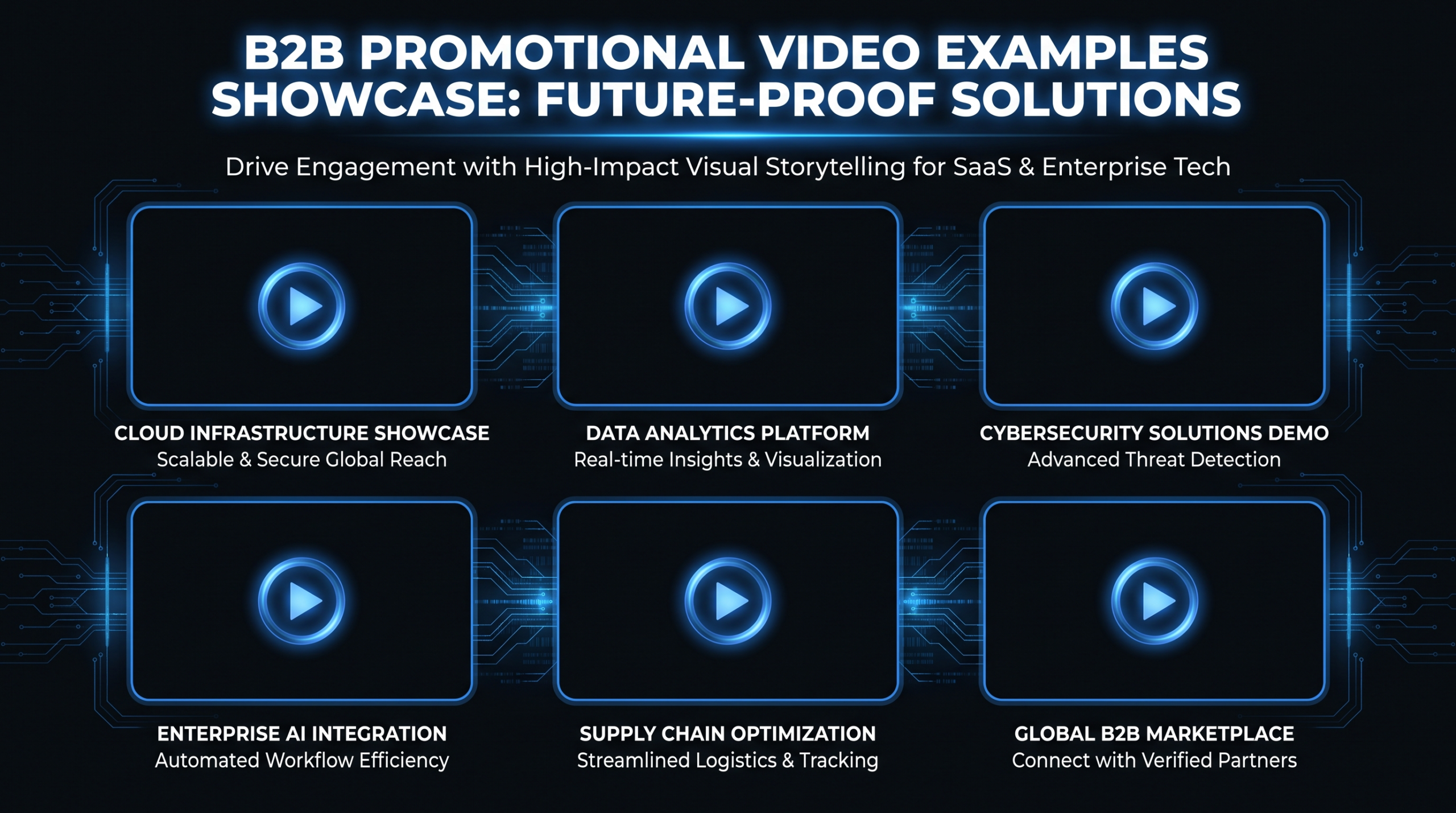
The 6 Core Types of Enterprise Video Content
Enterprise programs typically span six content categories, each with distinct production requirements, approval workflows, and distribution channels. Understanding the operating requirements for each type is essential for scoping production partnerships and setting realistic timelines.
1. Product Demos and Walkthroughs
The highest-ROI video type for B2B SaaS. Well-made product demos — filmed in the live product interface with professional motion graphics, not shaky screen recordings — reduce time-to-understand for prospects and compress the evaluation phase of the sales cycle. Production typically requires a senior editor with motion graphics capability, a clear approved script, and tight coordination with product marketing for technical accuracy review. Turnaround should target five to seven business days for a polished five-to-ten minute demo. For a detailed look at what separates converting demos from ones that get skipped, see our guide to product demo video production.
2. Customer Evidence: Testimonials and Case Studies
The most trusted content type in the enterprise buying cycle. Decision-makers at large organizations weight peer social proof heavily — a well-produced customer story featuring a recognizable company name can move deals that have been stalled at the procurement stage for months. Production requires customer coordination: release agreements, scheduling, on-site or professional remote setups, and post-production that presents the customer well without making claims that cannot be substantiated. Budget for $3,000–$10,000 per testimonial depending on location and production value, with three to six weeks of lead time for the customer coordination layer. You can see how we approach customer evidence production in our case studies.
3. Executive Thought Leadership
LinkedIn video has become the primary channel for enterprise executive positioning. The format that consistently outperforms: 60–90 second vertical or square videos featuring the executive speaking directly to camera with a strong, specific point of view, captioned for silent viewing, posted with a hook in the caption text. These require production support — on-site or studio setup, teleprompter, controlled lighting, fast-turnaround editing — and a content calendar tied to industry moments, analyst report releases, and company announcements. The production cycle should target 24–48 hours for filmed content to match the pace of relevant news cycles.
4. Internal Communications and Training
The fastest-growing category in enterprise video budgets. Organizations with 500 or more employees are replacing email-heavy internal communications with structured video: weekly leadership updates, town hall recaps, product training modules, and compliance onboarding. Production requirements are lighter than customer-facing content — a clean setup, clear audio, and competent editing — but volume is high and turnaround expectations are tight. Same-week delivery is the standard for most internal content. For high-volume internal programs, understanding the economics of outsourcing video editing can dramatically reduce cost per asset without compromising quality.
5. Sales Enablement Videos
Prospect-specific or persona-specific videos used by the sales team: battlecard summaries, competitive positioning clips, vertical-specific use case demos, and outreach personalization sequences. These are typically shorter — two to five minutes — frequently updated as competitive positioning evolves, and require a fast production loop. A 48–72 hour turnaround from brief to finished edit is the enterprise standard for sales enablement content. Programs that cannot hit this turnaround consistently find that sales teams stop requesting video assets because the content arrives after the deal moment has passed.
6. Event and Webinar Content
Recorded events, conference presentations, panel discussions, and webinar replays. Raw event recordings are rarely usable without post-production: clean intros and outros, chapter markers, transcript-synced captions, motion graphics for key data points, and social clips for distribution. A single half-day event can yield 15–20 derivative video assets when processed with a competent editing workflow. Most enterprise programs batch this content with a dedicated production sprint in the week following the event — it is one of the highest-leverage production investments in terms of asset output per production hour.
Build vs. Buy vs. Partner
Every enterprise content leader eventually faces the same decision: build an in-house studio, license tools and templates for internal production, or partner with an external production team. The right answer depends on your volume, complexity requirements, and internal management capacity — and it changes as the program matures.
Building In-House
An in-house video team gives you maximum control, fastest turnaround for internal content, and deep brand familiarity over time. The cost is significant. A minimal enterprise video team — one senior editor, one motion designer, one producer — runs $180,000–$280,000 per year in fully-loaded compensation (salary, benefits, equipment, software licenses). This does not include studio space, camera systems, or the management overhead of running a creative team inside a marketing department. The break-even point versus a dedicated production partner is commonly around 30–40 polished videos per month at comparable quality.
The hidden cost of in-house production is coverage and continuity. When your senior editor leaves, you face a six-to-twelve week recruiting cycle during which production halts. When your only camera operator is unavailable the day of an executive shoot, there is no backup. Enterprise video programs that rely on one or two critical internal hires are one resignation away from a production crisis that affects live campaigns and committed deadlines.
DIY Tools and Templates
DIY video tools — Descript, Loom, Canva Video, Adobe Express — have improved substantially and now enable non-specialists to produce acceptable internal communications and social content. This model works well for low-complexity, high-volume content where "good enough" is genuinely sufficient: internal announcements, simple training screen recordings, rough social clips. It breaks down for customer-facing content where production quality signals brand quality, and for complex formats — animated explainers, multi-camera executive shoots, motion-heavy product demos — that require genuine editorial skill. Most mature enterprise programs use a hybrid: DIY tools for internal content, professional production for all customer-facing assets.
Partnering with a Dedicated Video Team
A dedicated external production partner — a team assigned to your account that accumulates your brand knowledge, your template library, and your feedback history — delivers most of the benefits of in-house production at 40–60% of the cost, with built-in redundancy and management included in the engagement. This is the model Video Editing Company is built around: dedicated senior-editor-led teams for B2B SaaS organizations, with plans starting at $5,000/month for the Growth tier and scaling to $16,000/month for the Scale plan. The guarantee is specific: double your video output in 90 days, or month four is free. See how it works for a detailed look at how dedicated team engagements are structured from onboarding through steady-state production.
The key differentiator between a dedicated partner and a general agency is account continuity. A general agency assigns whoever is available. A dedicated partner model means the same editors learn your product, your brand voice, your revision preferences — and produce at higher quality with fewer revision cycles over time as institutional knowledge accumulates. After two or three months, a well-integrated dedicated team requires significantly less briefing time per project than a new-project agency because the baseline brand context is already established.
The Hybrid Model
In practice, most mature enterprise video programs use all three approaches: an internal producer or content operations manager who owns strategy, briefing quality, and stakeholder relationships; DIY tools for internal and informal content; and a dedicated external team for all customer-facing and high-production assets. In this model, the internal person's job shifts from doing production work to managing a production system — a higher-leverage use of internal headcount that scales more efficiently than adding in-house editors.
How to Choose an Enterprise Video Partner
Enterprise-grade production partnerships require vetting that goes beyond reviewing a demo reel. The following criteria consistently predict partnership success at enterprise scale.
Procurement Readiness
Can the partner complete your vendor security review process? Do they have an MSA template that accommodates enterprise legal requirements around IP ownership, indemnification, and data handling? Can they execute a data processing agreement covering any footage or personal data processed through their production workflow? Partners with genuine enterprise experience will have these documents ready. Partners who have primarily served small clients will require weeks to produce them — or will decline to sign them entirely, which eliminates them from consideration regardless of production quality.
Dedicated Team Structure
Ask specifically: will we have a named senior editor on our account? Will that editor change between projects? What is your coverage plan when our assigned editor is unavailable? Subscription-style services and pool-based agencies route work to whoever is available on a given day — which means retraining on your brand with every project. True dedicated teams assign named resources and provide a specific coverage plan. This distinction matters enormously at enterprise volume, where brand consistency failure is not just an aesthetic problem but a risk to customer-facing campaigns.
Turnaround SLAs and Revision Policy
Enterprise programs run on content calendars with fixed publication dates and committed campaign go-live windows. Get turnaround SLAs in writing: first draft delivery time, revision round turnaround, and final approval deadline. Clarify how many revision rounds are included in the base engagement and what triggers a scope change. For sales enablement and internal communications content, 48–72 hour first-draft delivery is the enterprise standard. For complex animated content or multi-camera shoots, 10–14 business days is reasonable. Partners who cannot commit to SLAs in writing are signaling a capacity or process problem.
Scalability Headroom
Your video program will grow. The partner needs to scale with it — adding editors when monthly volume spikes during product launches or campaign cycles, handling multi-format campaigns that require simultaneous production across content types, and supporting multiple concurrent high-priority projects. Ask for references from clients whose volume grew significantly during their engagement and how the partner handled the transition. A partner that works well at 10 videos per month may show cracks at 30 if their team structure cannot absorb additional throughput.
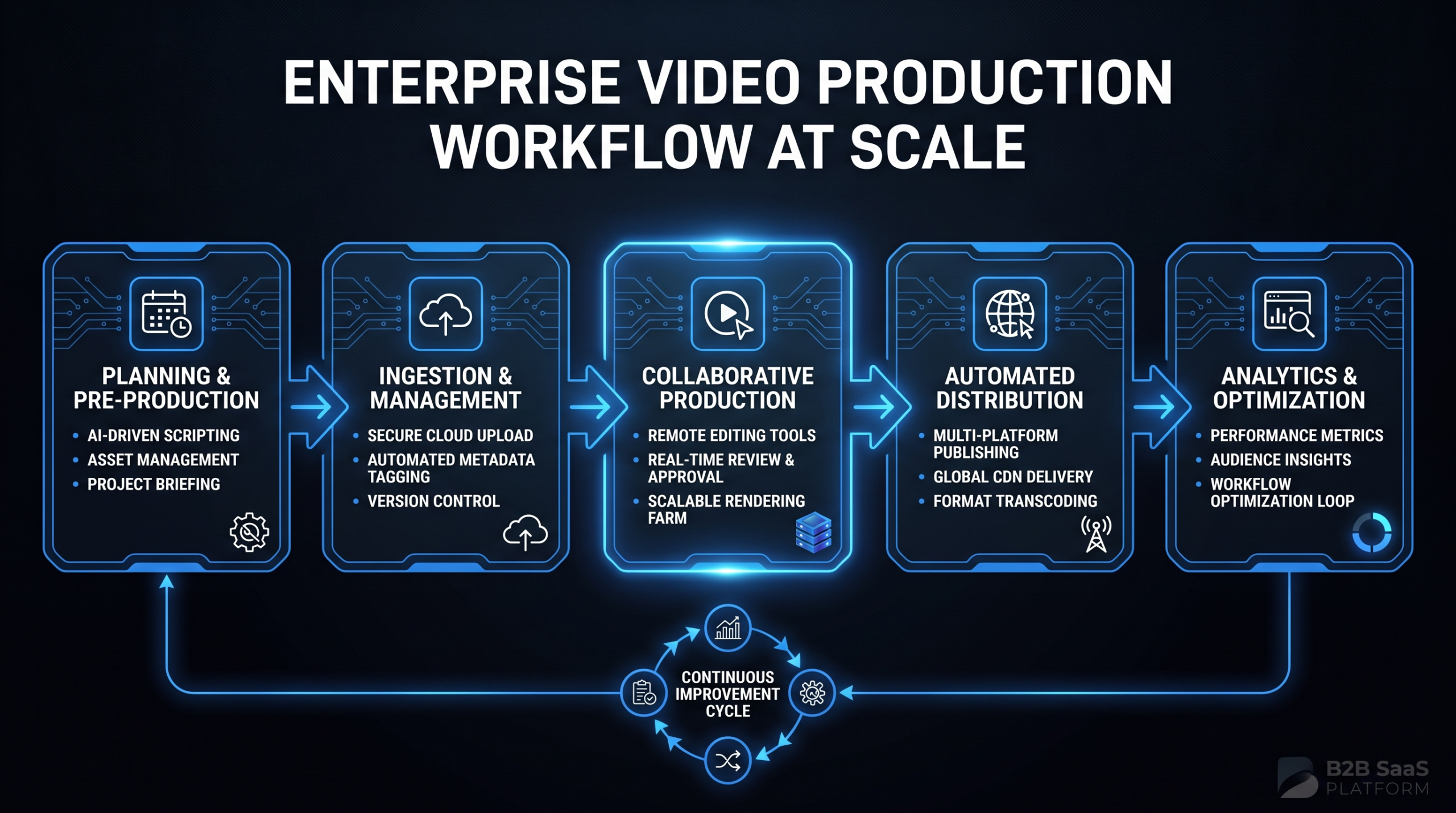
Enterprise Video Workflow at Scale
The workflow that scales enterprise video programs has three stages: structured intake, parallelized production, and systematic distribution. Bottlenecks at any single stage collapse the entire program's throughput — and the bottleneck is almost always at intake, not production.
Structured Intake: The Brief as Contract
Every video project should begin with a standard brief template: video type, target audience, one-sentence key message, distribution channel, maximum length, hard deadline, approval chain, and a checklist of available footage and assets. A brief that takes 15 minutes to complete saves two to three rounds of revisions that each take 24–48 hours. Content operations teams that run high-volume programs treat the brief template as their most important operational document — it is the contract between the internal requester and the production team on what "done" looks like before production begins.
Parallelized Production
At enterprise volume — 20 or more videos per month — sequential production (finish one video before starting the next) creates a predictable throughput ceiling. High-performing programs batch similar content by type: all this month's testimonials, all the sales enablement clips, all the event recap packages. Running these batches in parallel with dedicated resources for each content type dramatically increases monthly output without proportionally increasing cost. The efficiency gain is significant: a batch of eight similar social clips can often be produced in roughly the same wall-clock time as two standalone custom projects.
Asset Management and Distribution
Finished video assets need a systematic home: a digital asset management system or at minimum a structured folder system with consistent naming conventions, metadata tags, and version tracking. Distribution checklists — correct format for each channel, correct caption files, correct aspect ratio, approved thumbnail — should be templated and owned by the content operations function, not left to individual judgment on each project. Programs that do not systematize distribution lose significant reach as assets get uploaded in the wrong format or without captions, which suppresses algorithmic performance on every major platform.
Measuring ROI on Your Enterprise Video Program
Enterprise video programs need to demonstrate ROI in terms that matter to finance and executive leadership: pipeline influence, deal velocity, and cost per qualified view — not just view counts and engagement rates, which measure content consumption but not business impact.
Connecting Video Engagement to Pipeline Data
The measurement infrastructure this requires: video hosting with individual contact-level engagement tracking (Wistia, Vidyard, or Vimeo with CRM integration), UTM tagging on all video distribution links, and a defined attribution model for how video engagement is weighted in your pipeline reporting. Contacts who watch a demo video before a discovery call should be tagged in your CRM. Accumulate this data across one quarter and you can run a cohort analysis: do video-engaged prospects move faster through the pipeline? Do they close at a higher rate? Do they require fewer sales touches? These questions, answered with actual pipeline data, constitute the executive-ready business case for scaling the program. Wyzowl's annual State of Video Marketing report provides benchmark data that can contextualize your internal metrics against broader industry patterns.
Cost Per Video vs. Cost Per Qualified View
Standard cost-per-video metrics (total program spend divided by number of videos produced) ignore distribution effectiveness entirely. A more useful enterprise metric is cost per qualified view: total program spend divided by the number of views meeting a minimum engagement threshold — say, 60% or more completion — by contacts who match your buyer persona. This metric connects production investment to actual audience reach and filters out incidental views that carry no business signal. Programs that track this metric discover quickly which content types are producing qualified reach and which are consuming budget without generating pipeline contact.
Content Refresh Cadence
Enterprise video assets have shelf lives tied to product evolution cycles. A product demo filmed in early 2025 may be showing an outdated UI or deprecated feature set by late 2026. Programs that do not track content age against product release timelines end up distributing assets that actively mislead prospects — a credibility problem that compounds over time. Establish a quarterly content audit: compare the current product and messaging state against the video library, flag content older than 18 months for accuracy review, and build refresh cycles into the production calendar and budget. Our pricing page details how VEC structures ongoing refresh and maintenance work within dedicated team engagements at each plan tier.
Cost and Capability Comparison
Enterprise Video Production Model Comparison at 20 Videos per Month
| Production Model | Est. Monthly Cost | Brand Consistency | Scalability | Internal Management Load |
|---|---|---|---|---|
| In-house team (2 editors + producer) | $18,000–$28,000 | Excellent | Limited (hiring bottleneck) | High |
| Per-project agency | $25,000–$40,000 | Variable (no continuity) | Moderate | High (rebriefing each project) |
| Subscription editing service | $6,000–$10,000 | Low (rotating pool) | High | Low |
| Dedicated partner — VEC Scale plan | $16,000 | Excellent (named team) | High | Low–Medium |
Enterprise Video Content Type: Complexity, Timeline, and Recommended Model
| Content Type | Complexity | Typical Turnaround | Recommended Model |
|---|---|---|---|
| Internal comms and async updates | Low | 24–48 hrs | DIY tools (Loom, Descript) |
| Social clips (LinkedIn, Shorts) | Low–Medium | 48–72 hrs | Dedicated partner or subscription |
| Product demos and walkthroughs | Medium–High | 5–7 business days | Dedicated partner |
| Customer testimonials and case studies | High | 10–20 business days | Dedicated partner with on-site capability |
| Animated explainers | High | 15–25 business days | Specialist or dedicated partner with animation |
| Event recap and webinar content | Medium | 3–5 business days | Dedicated partner (batch processing) |
| Executive thought leadership (LinkedIn) | Low–Medium | 24–48 hrs | Dedicated partner with standing brief |
Frequently Asked Questions
What is the difference between enterprise video production and standard corporate video?
Scale, governance, and integration. Enterprise video production operates across multiple teams, formats, and audiences simultaneously — with formal approval workflows, procurement compliance requirements, brand governance systems, and CRM-connected measurement that links video engagement to pipeline outcomes. Standard corporate video typically handles one-off or small-batch projects with informal review processes. The production craft is similar; the operational infrastructure required to run it at enterprise scale is entirely different, and that infrastructure — not the creative quality — is where most enterprise video programs either succeed or fail.
How much should an enterprise video program budget annually?
Enterprise content teams commonly allocate 15–25% of their total marketing budget to video production and distribution combined. Within a $2M marketing budget, that typically translates to $300,000–$500,000 annually. Production typically accounts for 50–60% of that allocation and distribution — paid promotion, hosting platforms, DAM tooling — for the remainder. These are orientation benchmarks; actual allocation depends on your funnel mix, deal cycle length, and the role video plays in your buyer journey relative to other channels.
How do I build the business case for scaling our enterprise video program?
Connect video investment to pipeline data. Pull your CRM records for the last six months and segment deals by whether prospects engaged with video content at any stage before close. If video-engaged prospects show faster velocity, higher close rates, or fewer required sales touches, that cohort analysis is your executive-ready business case. Supplement with cost comparison: project your current per-video cost at the volume you want to reach, then compare to a dedicated partner rate. Most enterprise content leaders find the per-video cost math strongly favors scaling through a partner versus replicating the same volume with per-project agency work or additional in-house hires.
What video formats perform best in enterprise B2B buying cycles?
Product demos and customer case studies consistently outperform other formats in pipeline influence. Demo videos allow prospects to self-qualify before a discovery call, arriving better prepared and advancing faster through procurement stages. Customer case studies provide the peer social proof that enterprise buying committees require for final approval. Executive thought leadership performs well for brand awareness and top-of-funnel reach. At the consideration stage, comparison-focused content and ROI-framed content tend to engage the economic buyers who make final decisions at large organizations — and they tend to look for content that is specific, substantiated, and honest about trade-offs.
How do we maintain brand consistency across a high-volume enterprise video program?
Brand consistency at scale requires three elements working together: a documented visual brand guide for video (color palette, typography, lower-third templates, music guidelines, approved b-roll sources); a dedicated production team that builds familiarity with your brand over time rather than a rotating pool of freelancers who treat each project as a first encounter; and a systematic QA checklist at the end of every project rather than relying on reviewer memory. A 10-point brand compliance checklist reviewed before final delivery catches inconsistencies that memory-based review misses at volume. Programs that rely on individual reviewers to catch brand drift will see consistency degrade as production volume increases.
Scale Enterprise Video Without Scaling Your Team
VEC deploys dedicated senior-editor-led teams for B2B SaaS organizations — the same editors on every project, building brand knowledge that compounds over time. Growth plan from $5,000/month. Guarantee: double your video output in 90 days or month four is free.
Book a Free Strategy Call View Plans & Pricing