Video Editing Costs in Europe: 2026 Rates
TL;DR
- Video editing costs in Europe range from roughly €15–250+/hour depending on region, experience level, and service model.
- Eastern Europe typically offers the lowest freelancer rates; the UK, Nordics, and Western Europe command the highest.
- Remote retainers and subscription models often deliver more predictable costs than hiring regionally, especially across multiple European markets.
- VAT treatment, currency risk, and localization requirements are real procurement variables that affect total cost — not just day rates.
- VEC's dedicated remote post-production teams serve European SaaS and marketing teams at flat monthly rates starting at $5K, without regional billing complexity.
Table of Contents
- What Drives Video Editing Costs in Europe?
- Video Editing Rates Across European Regions
- UK & Ireland: Premium Market, Premium Rates
- Freelancer vs. Agency vs. Remote Retainer
- Currency, VAT, and Procurement Considerations
- Quality, Communication, and Localization Risks
- Budget Scenarios for Common European Use Cases
- Frequently Asked Questions
European marketing and content teams face a genuinely complex procurement decision when it comes to video editing. Unlike the US market, where costs tend to cluster around a few recognizable tiers, video editing cost in Europe varies dramatically — sometimes by a factor of 5x to 10x — depending on whether you're sourcing in London, Warsaw, Amsterdam, or Lisbon.
This guide breaks down the actual rate landscape across European regions in 2026, compares service models (freelancer, local agency, and remote retainer), explains the currency and VAT factors that add real cost and complexity, and gives you practical budget scenarios for common content programs. We've kept all figures as hedged ranges because local rates shift, talent quality varies, and any source quoting precise country-by-country rates without heavy caveats should be read skeptically.
What Drives Video Editing Costs in Europe?
The cost of video editing in Europe is shaped by a cluster of factors that compound one another. Understanding them separately helps you make smarter sourcing decisions.
Local Wage Levels
Wage levels across Europe span an enormous range. A video editor in the UK, Switzerland, or Norway operates in a labor market where mid-level creative professionals commonly earn annual salaries well above the EU median. An editor in Bulgaria, Romania, or Hungary works in a labor market where equivalent talent earns significantly less. Agencies pass these differences through to clients in the form of day rates and project fees — which is why sourcing decisions are rarely just about "where is the quality best."
Agency Overhead vs. Freelancer Lean Structures
Local agencies in Western Europe and the Nordics carry substantial overhead: office leases in expensive cities, senior creative directors, account management layers, and employment costs including employer-side social contributions that can add 20–40% on top of gross salary. That overhead lands in your invoice. Freelancers working remotely in the same market may charge 30–50% less per hour — but come without the project management, QA processes, and backup coverage agencies provide.
Specialization and Complexity
Motion graphics, 3D animation, color grading to broadcast standard, and multi-language versioning all command premiums across every European market. A straight edit of talking-head footage costs far less than a fully animated explainer with voiceover sync in five languages. Factor in the complexity of your deliverables before comparing rates across vendors — an apples-to-apples comparison requires equivalent scope.
Language and Localization Requirements
European SaaS companies targeting multiple markets often need subtitling, voiceover, and on-screen text in multiple languages. This multiplies production cost in ways that aren't always obvious at the brief stage. A single hero video localized into German, French, and Dutch for different market teams can cost 2–3x the base edit cost when you factor in professional voiceover, review cycles, and format adjustments.
Turnaround and Revision Cycles
Rush fees exist across all European markets, though they vary in how explicitly they're surfaced. An editor or agency working at full capacity will typically add 25–50% to expedited requests. Similarly, revision-heavy workflows — common when multiple internal stakeholders review final cuts — inflate actual cost regardless of the stated rate.
Video Editing Rates Across European Regions
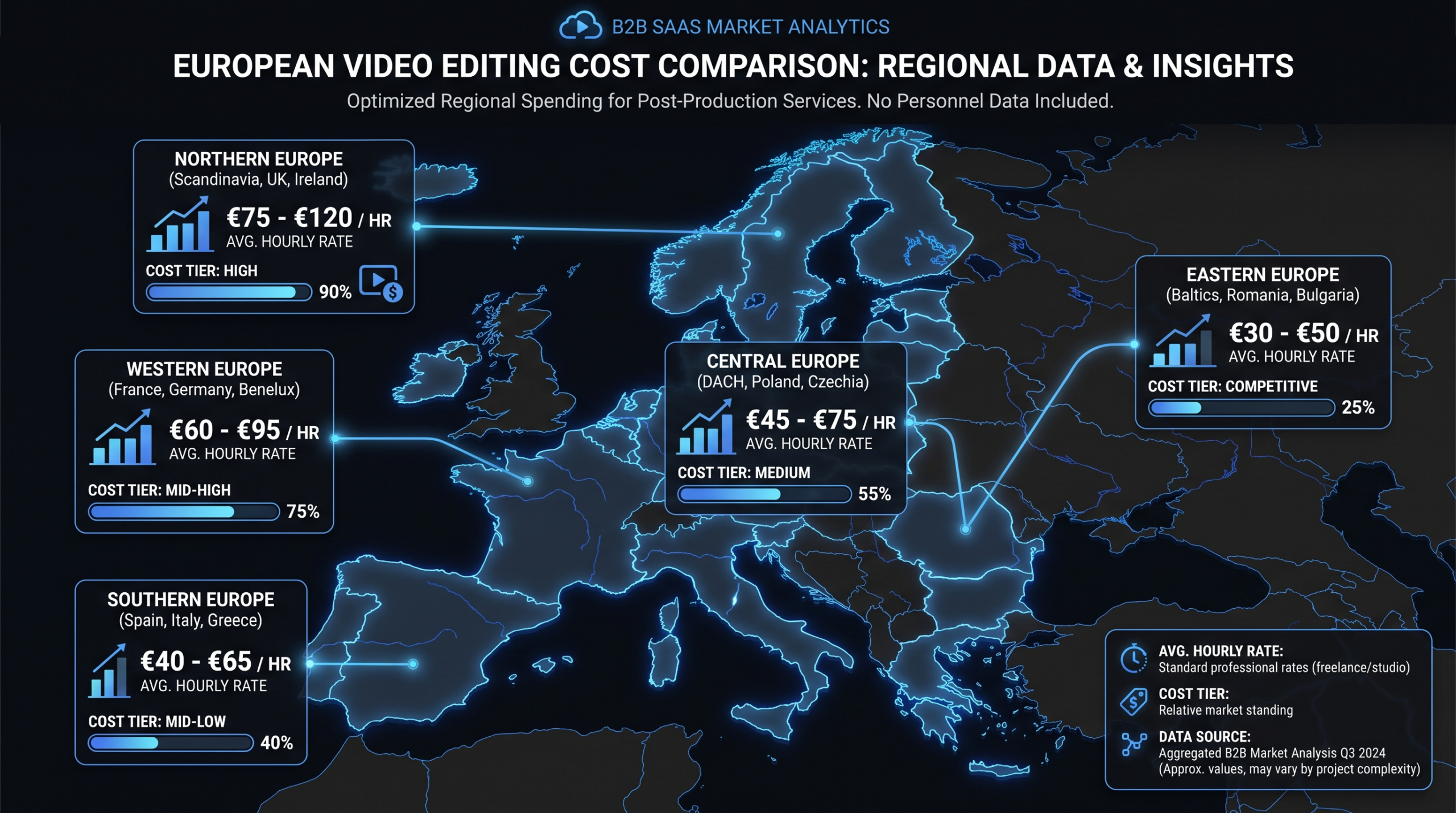
The table below reflects typical market rate ranges based on publicly observable freelancer platforms, agency rate cards where disclosed, and industry-reported benchmarks such as Wyzowl's video marketing statistics. These are indicative ranges, not guarantees — individual variation within any country is significant, and exchange rate movements can shift EUR/GBP/USD comparisons materially over time.
Video Editing Hourly Rate Ranges by European Region (2026)
| Region | Freelancer (Junior–Senior) | Agency Day Rate | Notes |
|---|---|---|---|
| UK & Ireland | £25–£150/hr | £600–£1,800/day | Highest market rates; London agencies at premium end |
| Nordics (Sweden, Norway, Denmark, Finland) | €40–€180/hr | €800–€2,000/day | High labor costs; strong motion design capabilities |
| Western Europe (Germany, Netherlands, France, Belgium, Austria, Switzerland) | €35–€150/hr | €700–€1,800/day | Broad range; German-market agencies at mid-to-high end |
| Southern Europe (Spain, Portugal, Italy, Greece) | €20–€90/hr | €350–€1,000/day | Growing talent base; Portugal and Spain strong in tech-sector video |
| Eastern Europe (Poland, Czech Republic, Romania, Hungary, Bulgaria, Slovakia) | €12–€60/hr | €200–€600/day | Largest rate spread vs. Western Europe; quality varies significantly |
A few important caveats: rates on platforms like Upwork reflect the floor of the market, not the mean. A Polish video editor with five years of SaaS content experience and a strong portfolio commands rates in the upper range of the Eastern Europe bracket — not the bottom. Similarly, a boutique London agency with a specialist SaaS or tech client roster can price well above even the ranges cited here for complex motion work.
For a more granular breakdown of how hourly rates differ across freelancer levels globally, see our full guide to video editing hourly rates by country.
Western Europe: Germany, Netherlands, France
Western Europe's established creative economies — Germany, Netherlands, France — have deep agency markets with strong motion design and broadcast post-production traditions. Freelancers in these markets are typically EUR-invoiced, operate within professional freelance structures, and understand B2B content well. The trade-off: rates are 2–4x higher than Eastern Europe for comparable work, and agencies carry significant overhead. Many German-market agencies also have minimum project sizes that make them impractical for ongoing content programs below €5,000/month.
Nordics: Sweden, Norway, Denmark, Finland
The Nordics offer some of Europe's highest-quality video production talent — and its most expensive. Swedish and Norwegian editors working in tech and SaaS content are often extremely strong in motion graphics and brand consistency, but agency day rates can rival London. Teams here are typically English-proficient, which simplifies communication for international projects. Budget-conscious buyers often treat Nordic talent as a source for senior oversight or QA rather than full production.
Eastern Europe: Poland, Romania, Czech Republic
Eastern Europe has become a major source of video editing capacity for European and US SaaS companies over the past decade. Polish, Romanian, and Czech editors commonly work at 30–60% below Western European rates for comparable skill levels, with English proficiency generally strong in urban tech hubs. The main risks: turnover in freelancer relationships, inconsistency in output quality across a rotating pool, and the management overhead of running remote quality control. The solution — dedicated team models or vetted agency relationships — closes most of the quality gap while preserving the rate advantage. See our guide on how to outsource video editing for practical frameworks on vetting and managing remote teams.
Southern Europe: Spain, Portugal, Italy
Southern Europe has seen growing investment in its creative industries, particularly in Spain (Madrid and Barcelona) and Portugal (Lisbon). Both markets offer rates well below the UK and Nordics, with increasingly strong English proficiency and growing B2B content experience. Lisbon in particular has emerged as a hub for tech-adjacent creative services, partly driven by the growing international tech company presence in the city. Italian agencies, while technically capable, often work primarily in Italian-market content and may require more active management for international deliverables.
UK & Ireland: Premium Market, Premium Rates
The UK and Ireland deserve their own section because they operate as a distinct market in ways that go beyond rates. UK agencies typically invoice in GBP, apply 20% VAT (which non-UK companies need to handle correctly), and operate within British employment frameworks that add cost and contracting considerations absent in other European markets.
Post-Brexit Procurement Complexity
Since Brexit, UK-based agencies contracting with EU clients face additional administrative complexity. For EU SaaS companies buying video services from UK providers: ensure contracts address service classification for VAT purposes (typically reverse-charged for B2B services; see GOV.UK's VAT place-of-supply guidance), payment terms in GBP introduce currency exposure, and data handling may require specific GDPR-compatible data transfer arrangements depending on the nature of materials shared. None of these are prohibitive, but each adds procurement friction that a remote global provider avoids entirely.
Irish Agencies: EU Market with English-Language Advantage
Dublin-based agencies offer a middle path: English-language production capability within the EU regulatory and VAT framework, rates typically 15–25% below London, and strong alignment with international tech culture (given Ireland's position as the EU headquarters for many US tech companies). For EU SaaS companies wanting English-language content at slightly lower rates than London, Irish agencies can be worth evaluating.
Freelancer vs. Agency vs. Remote Retainer
The regional rate table above tells you what individuals and agencies charge per hour or day — but the service model question is at least as important as the geography. For most European SaaS and marketing teams producing more than a handful of videos per month, the choice between service models has larger cost implications than the choice between countries.
Service Model Comparison for European Buyers
| Model | Typical Monthly Cost | Best For | Main Risks |
|---|---|---|---|
| Freelancer (local) | €1,500–€8,000 (variable) | One-off projects, overflow edits, simple content | Availability, consistency, management overhead |
| Local agency | €5,000–€25,000+ | Brand films, campaigns, high-production content | High cost, slow iteration, minimum project sizes |
| Eastern European agency | €2,000–€10,000 | Ongoing content at reduced cost | Quality consistency, communication lag, turnover |
| Remote dedicated retainer | $5,000–$16,000/mo (USD) | SaaS content programs, 10–40+ videos/month | USD invoicing (currency exposure for EUR buyers) |
The Freelancer Model: Lower Rates, Higher Overhead
Hiring a freelancer directly — whether local or via a platform — delivers the lowest nominal hourly rate. But "total cost of the freelancer model" includes your time managing the relationship, handling quality control, briefing, revision management, and dealing with availability gaps during peak demand. For teams producing three or fewer videos per month, this overhead is manageable. For teams producing ten or more videos monthly, it typically consumes more internal capacity than it saves in fees.
Local Agency: Quality Assurance with a Price Tag
A local UK, German, or Dutch agency brings brand familiarity, account management, and quality processes — but at rates that can make ongoing content programs economically unsustainable. Local agencies are best deployed for high-stakes, high-production-value work: brand films, campaign hero videos, product launch content where creative quality is the primary variable. For the month-to-month video content that powers SaaS marketing funnels, they're typically overpriced.
Remote Dedicated Retainer: Predictable Cost, Global Talent
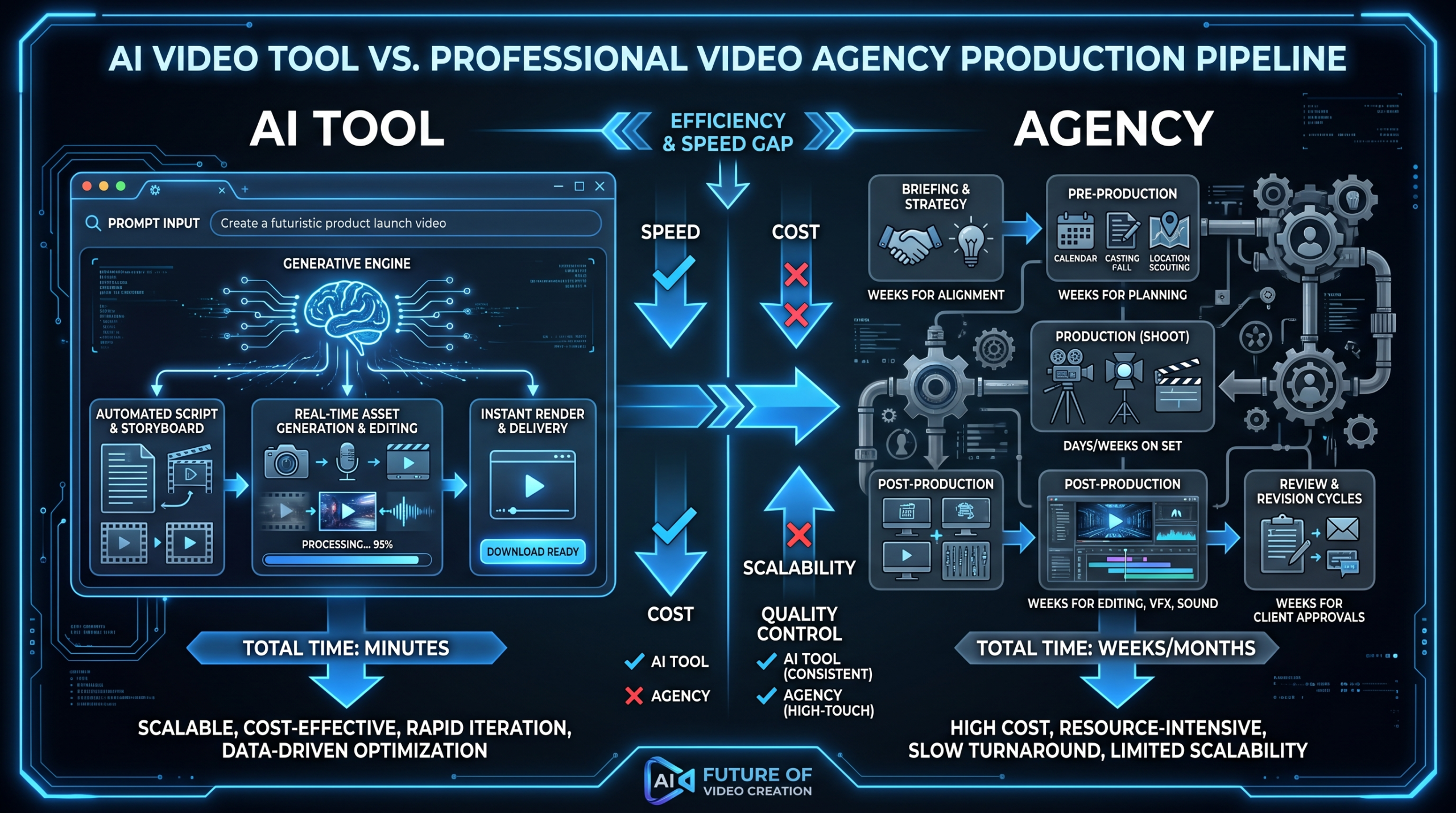
The model that most European SaaS marketing teams eventually converge on for ongoing content programs is a remote dedicated team — typically a US or global provider offering a fixed monthly rate for a dedicated editor pod. VEC, for example, provides dedicated post-production teams at Growth ($5K/mo), Core ($9.5K/mo), and Scale ($16K/mo) tiers, with a 90-day output guarantee. Billing is in USD, which introduces currency exposure for EUR or GBP buyers — but also removes the regional rate complexity, VAT admin, and management overhead of running a mixed-geography freelancer pool. See our pricing page for current plan details.
For more context on how pricing models compare structurally, read our analysis of video production agency pricing models.
Currency, VAT, and Procurement Considerations
European buyers face procurement variables that don't exist for US-only buyers. Getting these wrong adds real cost — and in VAT's case, potential compliance exposure.
Currency Risk
If your budget is in EUR and you're invoiced in GBP or USD, you carry currency risk that compounds over a 12-month retainer. EUR/GBP and EUR/USD have historically moved ±10–15% in a 12-month window, which can meaningfully change the effective cost of a retainer contract. Mitigation options: negotiate EUR invoicing with international providers willing to accommodate it, hedge through your treasury function if you're large enough, or build a buffer in your content budget for FX movement.
VAT on Cross-Border Services
For EU companies buying video editing services from non-EU providers (UK, US): under standard EU rules for B2B services, the customer self-accounts for VAT under the reverse charge mechanism — meaning you report the VAT liability on your return and (if you're VAT-registered and the service is used for taxable business) immediately reclaim it. Net cash cost is typically zero, but the admin must be handled correctly. For intra-EU purchases (e.g., a German company buying from a Polish agency), similar reverse-charge rules apply for B2B services when the supplier and customer are in different EU member states.
This is a high-level overview — always verify current treatment with your local tax adviser. VAT rules change, country-specific exceptions exist, and treatment of digital/creative services can vary.
Payment Terms and Late Payment Regulations
The EU Late Payment Directive sets a maximum 60-day payment term for B2B transactions in most member states, with statutory interest accruing from day 31 unless otherwise agreed. UK agencies post-Brexit operate under the UK's equivalent legislation. Most professional agency contracts reflect these norms. If you're negotiating payment terms, be aware that pushing past 60 days may create compliance issues for your supplier and damage the relationship.
Quality, Communication, and Localization Risks
Rate is only one dimension of the sourcing decision. The hidden cost of a low-rate provider that requires intensive QA, re-edits, or produces brand-inconsistent output can easily exceed the savings on the nominal rate.
Communication Overhead Across Time Zones
European buyers working with Eastern European teams typically deal with 0–2 hour time zone differences — far more manageable than working across 8–11 hours with US or Asian providers. A Warsaw-based editor and an Amsterdam-based content manager can share a full working day with minimal scheduling friction. This is a genuine operational advantage of intra-European sourcing that rate tables don't capture.
English-Language Proficiency Varies
English proficiency across Europe is high on average but uneven. In the Nordics, Netherlands, and Germany, English fluency at a professional level is near-universal in creative industries. In Southern Europe, fluency is strong in urban tech hubs but can drop in more traditional agencies or among senior editors whose careers predate the English-dominant tech media landscape. Brief clearly, provide written references, and check English comprehension early in the vetting process for any supplier where you'll communicate primarily in English.
Localization Adds Cost and Complexity
If your content program requires versions in multiple European languages — German, French, Spanish, Italian, Dutch — plan for this to add 50–150% to your base edit cost per version, depending on the complexity of voiceover, subtitle timing, and on-screen text adaptation. A provider who edits well in English may not have strong in-house localization capability. Establish this in vendor vetting; don't assume it's included in a standard edit rate.
Brand Consistency Risk at Scale
The core quality risk with any multi-editor or rotating freelancer model is brand drift — subtle changes in color treatment, caption style, motion graphic choices, or pacing that accumulate over time and erode brand consistency. The mitigation is a dedicated team structure where the same editors work on your content repeatedly, building brand knowledge over months. This is true whether that team is based in Warsaw, Amsterdam, or remotely through a provider like VEC. What matters is continuity of personnel on your account, not where they sit.
For a practical framework on managing remote video editors for quality and consistency, see our guide on what video editing services include and what to verify in SLAs.
Budget Scenarios for Common European Use Cases
Abstract rate ranges become actionable when mapped to real content programs. The scenarios below reflect common patterns we see from European SaaS marketing and ecommerce teams.
Scenario A: Series B SaaS Company, UK HQ, 8–12 Videos/Month
A UK-based Series B SaaS company running an active content program — product demos, customer stories, LinkedIn clips repurposed from long-form — needs 8–12 finished videos monthly. Options and indicative costs:
- London agency retainer: £6,000–£12,000/month. Highest quality assurance, slowest iteration, minimum contract terms.
- Eastern European agency: €3,000–€6,000/month. Lower rates, but requires investment in quality management and communication processes.
- Remote dedicated retainer (e.g., VEC Growth or Core plan): $5,000–$9,500/month. Flat rate, dedicated editor pod, no currency guessing within plan tier.
Scenario B: Ecommerce Brand, Germany, Product Video Program
A German ecommerce brand needs ongoing product video editing — lifestyle clips, unboxing formats, platform-specific cuts for Amazon, Instagram, and TikTok. Volume: 15–25 short videos monthly. The German market expectation for quality and precision is high; brand guidelines are tight.
- German freelancer pool: €4,000–€10,000/month depending on hours. Management overhead significant at this volume.
- Polish agency: €2,500–€6,000/month. Rate-efficient but requires structured onboarding and a clear brand guide.
- Remote subscription model: $5,000–$9,500/month. Works well for consistent format, high-volume simple edits; less suited for complex color-critical work.
Scenario C: Pan-European Creator Agency, 30+ Videos Monthly, Multi-Language
A creator management agency producing content for multiple European creator clients needs volume editing plus multi-language versioning — a mix of simple cuts and more complex branded edits. At this volume, per-unit economics dominate.
- Offshore dedicated team: $9,500–$16,000/month with a provider offering scale plans. Most cost-effective for this volume.
- Hybrid model: Offshore team for raw editing + regional freelancers for language-specific localization. More complex to manage but potentially better on localization quality.
Most European teams underestimate total cost of ownership for the freelancer model. By the time you add management time, rework cycles, inconsistency penalties, and availability gaps, the effective cost per finished video often exceeds a well-structured retainer at equivalent or better output quality.
For a deeper look at how per-minute cost compares across models and volume levels, see our breakdown of video editing cost per minute.
Frequently Asked Questions
What is a typical video editing cost in Europe for a 2–3 minute video?
A 2–3 minute edited video in Europe typically ranges from €400 to €3,000+ depending on complexity, the market you're sourcing in, and the service model. A straight talking-head edit from a freelancer in Eastern Europe might fall below €500; a motion-graphics-heavy product video from a Western European agency can easily exceed €2,500 for the same finished length. The key driver is complexity, not duration.
Is it cheaper to hire a video editor in Eastern Europe than in Western Europe?
Nominal rates are typically 40–70% lower in Eastern European markets like Poland, Romania, and the Czech Republic compared to Germany, France, or the UK. However, total cost depends on your quality management investment and how much oversight the relationship requires. Eastern European talent at the upper end of the local rate range often delivers equivalent quality to mid-range Western European freelancers — the rate gap is not always a quality gap.
Do I need to pay VAT when buying video editing services from a European agency?
For B2B cross-border services within the EU, the reverse charge mechanism typically means you self-account for VAT rather than paying it to the supplier — and if you're VAT-registered and the service is for your business, you reclaim it immediately. Net cash cost is zero, but the admin is real. For services from UK providers post-Brexit, similar rules apply. Always verify current treatment with your tax adviser, as rules and country-specific exceptions vary.
What service model works best for European SaaS companies producing 10+ videos per month?
For SaaS companies at that production volume, a dedicated team model — whether through a local agency retainer or a remote dedicated provider — almost always beats a freelancer pool or per-project approach on total cost and output consistency. The breakeven point where a retainer's per-unit cost is lower than project-by-project sourcing typically sits between 8 and 12 videos per month for most agencies. Above that threshold, dedicated teams offer better economics and far better brand consistency.
How do currency fluctuations affect video editing budgets for European buyers?
EUR/GBP and EUR/USD can move ±10–15% over a 12-month period, which matters if you're on a fixed-rate contract invoiced in a foreign currency. The practical mitigations: negotiate EUR invoicing if possible, build a 10–15% FX buffer into your annual content budget, or anchor to a provider willing to invoice in your local currency. For most teams, FX impact is manageable if planned for — it becomes a problem only when budgets are set on spot rates with no buffer.
Benchmarking European Video Costs?
VEC provides dedicated post-production teams for SaaS, ecommerce, and agency clients across Europe and globally — flat monthly rates, no regional billing complexity, 90-day output guarantee. Talk to our team about your content volume and we'll map the right plan.
Book a Free Strategy Call View Pricing Plans