UGC vs Studio Video for DTC Brands
TL;DR
- UGC-style video dominates paid social and top-of-funnel because it mirrors how real people scroll — it earns trust fast and lets you test creative at volume without heavy spend.
- Studio/product video wins on PDPs, brand campaigns, and any context where polish signals quality and justifies a premium price.
- The strongest DTC content programs blend both: UGC drives discovery and tests messaging; studio content converts and retains brand perception.
- The real decision is not which is better — it's which you need right now based on your funnel stage, ROAS targets, and budget.
Table of Contents
- What UGC-Style Video Actually Means in 2026
- What Studio and Product Video Means for DTC
- Head-to-Head: UGC vs Studio on 8 Dimensions
- Where UGC-Style Video Wins
- Where Studio Video Wins
- Cost Structure Comparison
- Creative Fatigue and Testing Velocity
- When to Blend Both Formats
- Decision Framework: How to Choose
- FAQ
Your paid social performance is declining. Creative fatigue is real. A competitor just launched a scrappy-looking TikTok campaign and it's outselling your polished brand video three-to-one on Meta. You open your creative brief and stare at a blank page.
The UGC-vs-studio debate is not an ideological one. It is a performance and budget allocation question — and the answer changes depending on where in the funnel you are, what platform you're on, and what your audience already believes about your product.
This guide walks through every dimension that actually matters for DTC and ecommerce teams: trust, polish, testing speed, paid social fit, PDP fit, cost structure, and creative fatigue. We'll give you decision criteria and tables so you can build a brief — not just a point of view.
What UGC-Style Video Actually Means in 2026
The term "UGC" has drifted. Strictly, user-generated content is video created voluntarily by real customers — unboxing clips, product reviews, organic posts. In practice, the DTC industry now uses "UGC-style" to describe a broader creative format: video that looks like it was made by a real person, even when it wasn't.
This includes:
- Organic UGC: Authentic content from real customers, sourced via review platforms, DMs, or community programs. Zero production cost beyond licensing/outreach.
- Creator-led UGC: Paid content from nano or micro influencers (typically 1K–100K followers) who produce content in their natural style, on their own devices.
- Scripted UGC: Brand-briefed content shot on an iPhone in a home environment. A real person, a real-looking setting, but with brand-approved talking points and a clear CTA.
- UGC-style in-house: Your own marketing team creates content that looks like UGC — selfie-mode, handheld, casual voiceover — but is produced internally.
What all of these have in common: low-production aesthetic, first-person credibility, and a native feel for the feed. They look like content a person chose to watch, not content an algorithm served them.
Why the Low-Production Aesthetic Matters
Platform algorithms on TikTok, Instagram Reels, and Meta reward content that keeps users in the feed. Highly produced video with branded bumpers, polished color grades, and corporate voiceovers often signals "ad" before the first second is over — triggering a scroll. UGC-style content earns a fraction of a second more attention because it pattern-matches to organic content. That fraction is often enough to determine whether someone stops or keeps scrolling.
What Studio and Product Video Means for DTC
Studio video is the opposite intentional choice: controlled environment, professional crew or dedicated editing team, deliberate lighting, color grading, motion graphics, and careful brand alignment. For DTC brands, studio-style content typically includes:
- Product videos: Hero shots of the product in a clean or branded environment — often used on PDPs, Amazon listings, and retail media.
- Brand campaigns: Cinematic storytelling about the brand's mission, founding story, or lifestyle aspiration.
- How-it-works / explainer videos: Animated or live-action videos that demonstrate product mechanism — often in the consideration phase.
- Testimonial and case study videos: High-production interviews with customers — shot on proper cameras with lighting, edited for narrative clarity.
Studio video signals investment. It tells a customer: we believe in this product enough to make it look extraordinary. For brands competing on perceived quality, luxury positioning, or categories where safety and efficacy claims matter, that signal carries weight.
The Polish-Credibility Trade-off
The paradox of studio video in DTC is that polish can actually lower trust in some categories. A supplement brand running a highly produced TV-style ad competes against a person in their kitchen saying "I've been taking this for 90 days and here's what happened." The kitchen wins on authenticity — even if the studio ad has a better story. This is category- and placement-specific, which is why the comparison matters.
Head-to-Head: UGC vs Studio on 8 Dimensions
Here's the direct comparison across the dimensions that move the needle for DTC marketing teams:
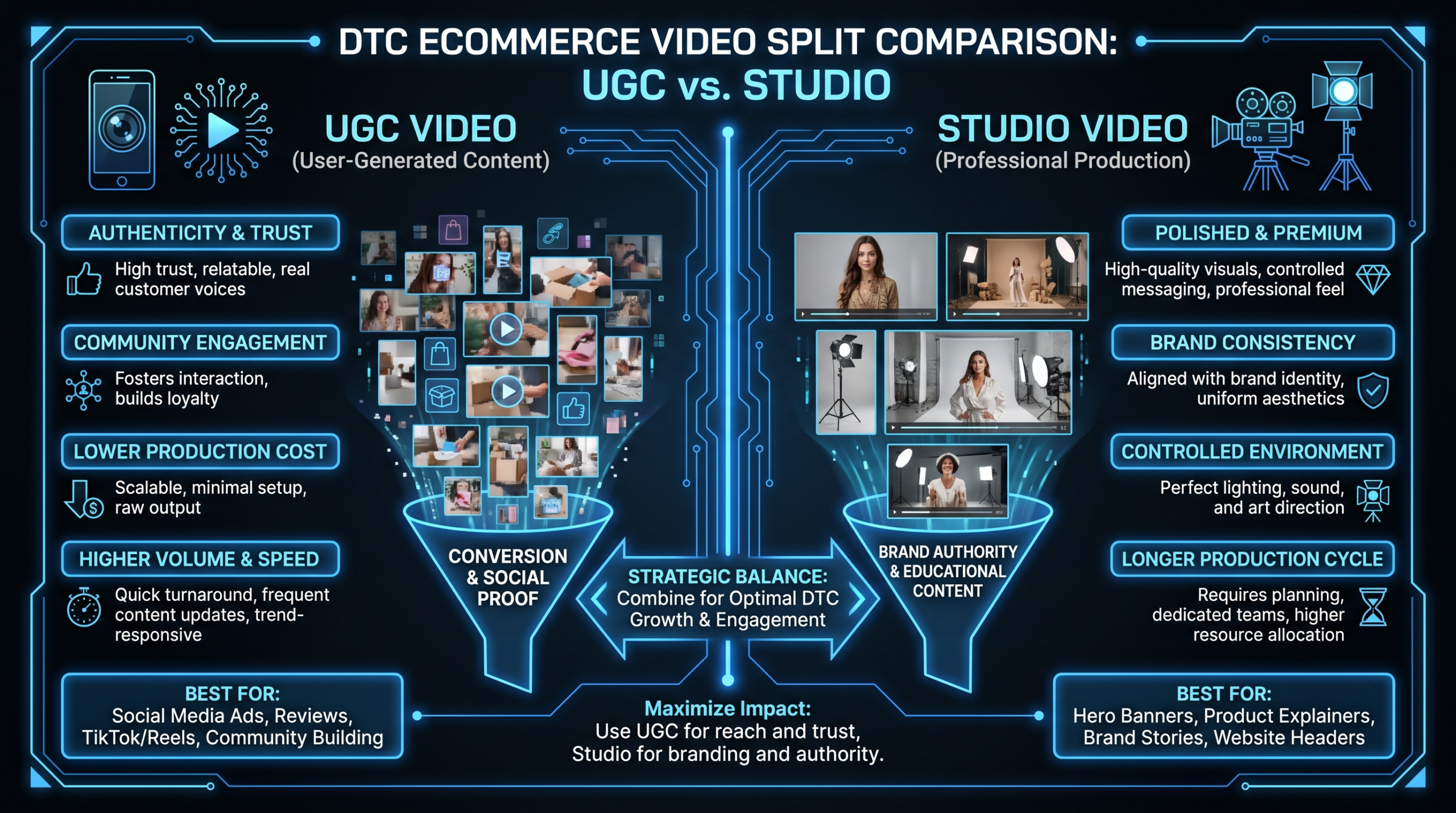
UGC vs Studio Video: Core Comparison
| Dimension | UGC-Style | Studio/Product Video |
|---|---|---|
| Trust signal | High — feels like a peer recommendation | Medium — polished signals professionalism, not authenticity |
| Polish / brand control | Low to medium — intentionally raw | High — full creative control, exact brand alignment |
| Testing speed | Fast — hours to days per asset | Slow — days to weeks per asset |
| Paid social fit | Strong — native to feed; lower CPMs reported by teams using UGC vs. polished ads | Variable — works in display and video placements; higher skip rates on Reels/TikTok |
| PDP / retail fit | Moderate — "real customer" videos on PDPs lift trust, but look inconsistent in a gallery | Strong — clean product shots, consistent gallery presentation |
| Cost per asset | Lower — typically $150–$800 per creator deliverable | Higher — typically $1,500–$10,000+ per polished piece |
| Creative fatigue speed | Fast — audiences tire of similar UGC hooks quickly; need constant iteration | Slower — brand video wears out less quickly in evergreen placements |
| Brand perception impact | Neutral to positive — authenticity works, but overuse can cheapen a premium brand | Positive for premium positioning — reinforces quality and investment |
No single column wins across the board. The performance case for each format depends almost entirely on where you use it and what you're trying to make the viewer do.
Where UGC-Style Video Wins
UGC-style video consistently outperforms studio content in specific contexts. Understanding these contexts prevents wasted spend on studio production in places where it simply won't perform as well.
Paid Social — Top of Funnel
Meta, TikTok, and Instagram Reels are the primary battlegrounds for DTC paid social. All three platforms use engagement signals (watch time, saves, shares, clicks) to determine distribution. Content that pattern-matches to organic posts tends to earn better initial engagement, which feeds the algorithm more signal, which improves delivery efficiency.
DTC teams commonly report that UGC-style creatives outperform polished ads in early-funnel cold audiences — lower CPMs, higher CTRs, more efficient cost-per-initiate-checkout. The exact margins vary by category, audience temperature, and creative quality, but the directional advantage of UGC in the feed is well-documented by practitioners across the industry.
For a deeper look at how video production budgets map to paid social performance, see our guide to video production agency pricing models.
Creative Testing at Volume
If you're running a structured creative testing program — testing hooks, angles, CTAs, and value propositions — UGC-style content is the right vehicle. Why? Because you can produce 10–20 UGC variants for the cost of 2 studio videos. Testing at that volume lets you identify winning angles faster and kill losing concepts before they burn significant budget.
The best DTC creative teams treat UGC as their hypothesis generator: find the angle that works in UGC, then invest in a polished studio execution of that proven concept. Wistia's video marketing resources cover how engagement patterns differ across production styles.
Social Proof and Review Content
Organic customer reviews in video format — real customers showing their results, unboxing experiences, or before-and-after outcomes — are among the most powerful conversion assets available to DTC brands. These work on PDPs (positioned as "See it in real life"), in email campaigns, in retargeting creative, and as organic social content.
No studio video replicates this. A customer in bad lighting saying "I've tried everything and this is the first thing that worked" outconverts a polished testimonial in a majority of categories where the outcome matters more than the production value.
Trend Response and Speed-to-Market
When a trend breaks on TikTok or Reels, the window to capture organic reach is measured in days, not weeks. Studio production can't move that fast. UGC-style content — shot by an in-house team or a creator — can be live within 24–48 hours of the brief. For DTC brands in fashion, beauty, wellness, and food, that speed advantage compounds over time into meaningful organic reach.
Where Studio Video Wins
There are clear situations where cutting corners on production quality actively hurts your brand. These are the use cases where studio investment pays off — often for years, not weeks.
Product Detail Pages (PDPs)
Your PDP is where purchase intent peaks. A visitor on your PDP has already cleared awareness and consideration — they're evaluating whether to trust your product enough to pay for it. This is the wrong moment to show a shaky iPhone video. Studio product shots — clean backgrounds, multiple angles, features in use — answer the silent question: "Is this product worth what you're charging?"
Ecommerce platforms including Shopify consistently publish data showing that video on PDPs lifts conversion rates. The specific lift depends on category and implementation, but the directional case for video on PDPs is strong. And on PDPs, polished product video outperforms raw UGC in almost every controlled test — because the goal is not relatability, it's validation.
Brand Campaigns and Awareness Lifting
Brand equity is built through consistent, high-quality signals over time. A brand that only runs UGC-style content risks being perceived as a scrappy DTC upstart indefinitely — even after achieving meaningful revenue scale. Studio brand campaigns (brand films, manifesto videos, campaign hero content) establish the aspirational dimension of your product. They tell customers not just what you sell, but what you stand for.
For Series B and later DTC brands investing in brand awareness — particularly through YouTube pre-roll, connected TV, or premium display — studio quality is the baseline. UGC won't perform in those environments.
Retail and Wholesale Media
If you sell through Target, Walmart, Amazon, or any major retailer, their media networks have production quality standards. Amazon's brand-registered product videos, Walmart Connect video placements, and retailer co-op campaigns all expect a level of polish that UGC-style content rarely meets. Studio video is not optional in these channels.
Investor and Partner Decks
Not every video asset is consumer-facing. Brand videos used in fundraising decks, retail buyer presentations, wholesale pitches, and press kits carry different stakes. Here, production quality signals that you're a legitimate business — not just a Shopify store. Studio investment in a 60–90 second brand video pays dividends far beyond its direct marketing use.
Cost Structure Comparison
The cost structure of UGC versus studio video is not just about per-asset price — it's about throughput, iteration speed, and total investment to hit a performance target. Here's how the economics play out:
UGC vs Studio: Cost Structure Breakdown
| Cost Factor | UGC-Style | Studio/Product Video |
|---|---|---|
| Per-asset cost | $150–$800 (creator) / $50–$200 (in-house) | $1,500–$10,000+ depending on complexity |
| Turnaround time | 24–72 hours (creator) / same day (in-house) | 5–20 business days |
| Revision cycles | 1–2 rounds typically included | 2–3 rounds; additional rounds add cost |
| Volume per $5,000 budget | ~8–30 assets | ~2–4 assets |
| Creative iteration cost | Low — swap hooks, voiceover, text overlays cheaply | High — reshooting or major edits require significant budget |
| Shelf life | 2–8 weeks before fatigue in paid channels | 6–24 months for evergreen placements |
| Repurposing flexibility | Medium — works across social; rarely fits premium placements | High — can be cut into 16:9, 9:16, 1:1, GIFs, thumbnails |
The key insight: UGC has a lower cost-per-asset but a shorter shelf life and a higher volume requirement to sustain paid social performance. Studio video has a higher upfront cost but amortizes over a longer period and across more channels.
Teams that treat UGC as a "cheap alternative to studio" and then stop investing in studio production typically see brand erosion over 12–18 months. Teams that treat studio as "the only real creative" and ignore UGC typically see declining paid social efficiency as their polished ads stop stopping the scroll.
For context on what a full video editing retainer costs across format types, see our breakdown of video editing cost per minute — which covers how per-minute rates shift across UGC, polished social, and brand-level production.
Creative Fatigue and Testing Velocity
Creative fatigue is the silent performance killer in DTC paid social. An ad set that was producing strong ROAS in week one often deteriorates by week three — not because the product got worse, but because the algorithm has shown your creative to the same people enough times that they've stopped responding.
How UGC Affects Fatigue
UGC-style content fatigues fast but is cheap to replace. A well-structured UGC program produces a new batch of hooks and angles every two to four weeks. The goal is never to find one perfect ad — it's to maintain a pipeline of testable variants so you always have fresh creative entering the auction.
Meta's own creative guidance consistently points toward having multiple creative variants active per ad set. Teams running structured UGC programs can maintain this without significant incremental spend, because the cost-per-asset is low enough to sustain volume.
How Studio Affects Fatigue
Studio video fatigues more slowly in evergreen placements — YouTube pre-roll, brand awareness campaigns, and retargeting sequences tend to run the same creative for months without the same deterioration seen in UGC performance placements. This is partly because these placements reach smaller audiences less frequently, and partly because the creative is designed for longer attention spans.
However, when studio video is used in the same high-frequency placements as UGC — running the same brand video at scale to the same cold audiences — it fatigues just as fast. The mistake is assuming that "better quality" means "longer shelf life in all contexts."
The Testing Velocity Advantage
UGC-style content lets you test significantly more hypotheses in the same time window. If your monthly creative budget is $5,000 and you spend it on studio production, you might test 2–3 angles over 4–6 weeks. If you spend it on UGC, you might test 15–20 angles in the same window.
More tests mean faster learning. Faster learning means identifying winning value propositions sooner. Winning value propositions inform not just future UGC — they inform studio production briefs, landing page copy, email sequences, and product positioning. The creative intelligence gathered from UGC testing compounds across your entire marketing program.
See how outsourcing video editing can accelerate your team's creative throughput without adding headcount.
When to Blend Both Formats
The most sophisticated DTC content programs are not UGC-only or studio-only. They operate a deliberate creative system where each format plays a specific role at a specific stage.
The DTC Creative Hierarchy
How DTC Brands Structure UGC and Studio Together
| Funnel Stage | Recommended Format | Goal |
|---|---|---|
| Top of Funnel (cold audiences, paid social) | UGC-style — hooks, testimonials, problem-led | Stop the scroll, earn attention, generate click |
| Middle of Funnel (warm audiences, retargeting) | Blend — UGC social proof + studio product demos | Remove objections, reinforce benefit claims |
| Bottom of Funnel (PDP, cart, email) | Studio — product video, clean unboxing, features | Validate purchase decision, answer product questions |
| Retention (email, loyalty, unboxing) | UGC-style — community content, real customer outcomes | Build emotional connection, drive repeat purchase |
| Brand / PR / retail media | Studio — brand films, campaign hero content | Build long-term brand equity and category authority |
The Proven Blend Pattern
DTC teams that consistently outperform in paid social tend to run this loop:
- Test at scale with UGC. Run 10–20 UGC variants per month across audiences. Identify the 2–3 angles producing the strongest click-to-purchase rates and lowest CPAs.
- Elevate winning angles with studio. Take the best-performing message and brief a studio-quality execution — same hook, same value proposition, higher production value.
- Deploy studio for retention and brand. Use the polished version for retargeting (audiences who already engaged), for PDP placement, and for any brand campaign activity.
- Feed organic learnings back to UGC briefs. What customers actually say in organic reviews and DMs informs the next batch of UGC hooks — creating a closed feedback loop.
This approach means UGC and studio are not competitors — UGC is the R&D arm and studio is the scaling mechanism. That framing changes how you brief and budget both.
Video Editing Company works with DTC and ecommerce brands running exactly this kind of hybrid creative program — dedicated editing teams handle the volume, versioning, and consistency across both format types. If your content production is becoming the bottleneck, see our how it works page for how the team model operates, or review our pricing plans starting at $5K/month.
Decision Framework: How to Choose
Use these criteria to build a defensible brief — not just a creative preference. The right choice is almost always context-dependent, not format-dependent.
UGC vs Studio: Decision Criteria by Situation
| Situation | Recommended Format | Why |
|---|---|---|
| Cold audience paid social on Meta or TikTok | UGC-Style | Native feed feel; lower CPMs; better hook performance |
| PDP video on Shopify or Amazon | Studio | Purchase intent is high; polish validates price and quality |
| Creative testing — new product launch | UGC-Style | Speed and volume let you find the winning angle before scaling |
| Retargeting warm audiences | Blend | Combine UGC social proof with studio product clarity |
| Brand awareness campaign (YouTube, CTV) | Studio | Platform and audience expectations demand production quality |
| Category where safety / efficacy matters (supplements, skincare, medical) | Blend | UGC builds belief; studio demonstrates product and mechanism |
| Premium / luxury positioning DTC | Studio | Perceived quality is part of the product; UGC undercuts it |
| Community building and retention | UGC-Style | Real customer content fosters belonging, not advertising |
| Retail media and co-op campaigns | Studio | Retailer production standards require polished assets |
| Limited budget, early-stage DTC | UGC-Style | Maximum creative output per dollar; fastest performance signal |
Signals That You're Using the Wrong Format
You might be over-relying on UGC if:
- Your brand is maturing but still looks "scrappy" in retail or wholesale conversations
- PDP conversion rates are stagnating despite traffic growth
- Customers can't articulate why your product is different from alternatives
- Your repeat purchase rate is low — brand loyalty isn't forming
You might be over-investing in studio if:
- Paid social CPAs are rising and you haven't refreshed creative in over 8 weeks
- Your creative testing program is running fewer than 5 variants per month
- You're spending 80%+ of your creative budget on production and less than 20% on iteration
- You know what angles you want to test but can't afford to produce them at the cost of studio
The Budget Allocation Heuristic
A rough starting point that many DTC teams find workable: allocate roughly 60–70% of creative budget to UGC-style content (for paid social, testing, and community) and 30–40% to studio production (for PDP, brand campaigns, and evergreen retargeting). This ratio should shift depending on your funnel maturity — earlier-stage brands often push further toward UGC; established brands with retail presence and brand equity goals often shift more toward studio.
For a deeper dive into how video post-production services fit into a DTC content strategy, see our overview of what video editing services include — and what to expect at each quality tier.
Frequently Asked Questions
Is UGC-style video always cheaper than studio video?
On a per-asset basis, yes — UGC-style content typically costs $150–$800 per deliverable from a creator versus $1,500–$10,000+ for a polished studio piece. However, UGC has a shorter shelf life in paid social (commonly 2–8 weeks before fatigue) and requires ongoing volume to sustain performance. The total annual spend on a UGC program at scale can approach or exceed a studio production budget — the advantage is speed and iteration, not just cost.
Can UGC-style video work on product detail pages?
Yes — with a caveat. Authentic customer review videos placed on PDPs as "social proof" consistently lift conversion rates in studies across ecommerce platforms. However, raw UGC as the primary or only product video on a PDP typically underperforms a clean studio product video, particularly for higher-ticket items where perceived quality and product clarity matter. The strongest PDP video strategy combines both: studio as the primary product video, UGC customer testimonials as secondary proof assets.
How many UGC variants should a DTC brand be producing per month?
It depends on your paid social scale, but teams running structured creative testing programs typically target a minimum of 8–15 new UGC variants per month. This gives enough volume to run statistically meaningful creative tests across audiences and placements, while rotating creative frequently enough to manage fatigue in high-frequency placements. Brands scaling rapidly often run 20–30+ variants monthly to keep testing velocity high.
Does studio video perform better than UGC on TikTok?
Generally, no — TikTok's algorithm and audience culture reward native-feeling content over produced advertising. Polished studio content with corporate voiceovers, branded end-cards, and production-heavy aesthetics typically sees higher skip rates and lower engagement on TikTok than UGC-style content that blends into the organic feed. That said, the best-performing TikTok creative is often "produced UGC" — content that looks casual but has clear hooks, pacing, and a well-briefed message.
What's the minimum studio investment a DTC brand should make each year?
There's no universal answer, but a useful benchmark: if you're generating over $2M in annual revenue and spending on paid social, you likely need at least 2–4 hero studio assets per year (a brand video, 1–2 product videos, and a testimonial cut) to maintain brand credibility in mid-funnel placements, retailer conversations, and any press or PR activity. For brands at $10M+ in revenue, a quarterly refresh of studio assets is common practice — the investment is typically recoverable through PDP conversion lift alone.
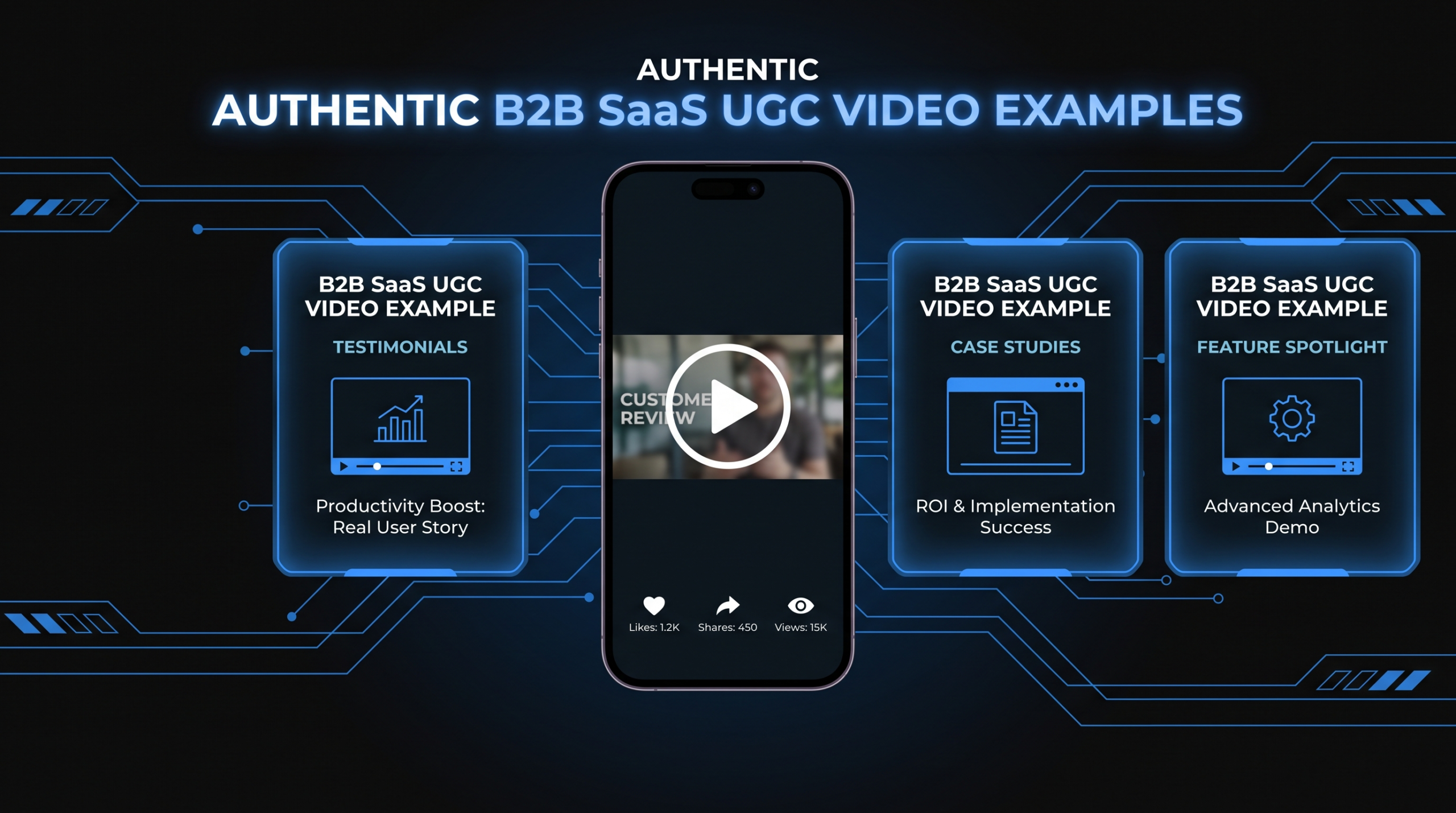
For teams that want to see what B2B UGC looks like in practice before making the studio-vs-UGC call, our guide to UGC video examples for B2B & SaaS covers 8 real formats with embedded examples — including screen-share testimonials, comparison hooks, and day-in-the-life walkthroughs, plus a full cost breakdown by hiring model.
Need Both UGC Editing and Studio-Quality Production?
VEC's dedicated editing teams handle both — from fast-turnaround UGC assembly and caption-ready social clips to polished product videos and brand campaign cuts. One team. Consistent quality. 90-day output guarantee.
Book a Free Strategy Call View Pricing Plans