Cybersecurity Explainer Videos: 2026 Guide
TL;DR
- Most cybersecurity explainer videos fail because they lead with fear instead of buyer outcomes — this guide shows the framework that works.
- Effective cybersecurity explainers translate technical architecture into business value without fabricating threat statistics or overstating product capabilities.
- Script structure, compliance-safe messaging, and objection handling built directly into the video can shorten enterprise sales cycles significantly.
- Production specs differ by stage: awareness videos run 60–90 seconds, demo-style explainers run 2–4 minutes, and deep-dive technical content can run 6–10 minutes.
Table of Contents
- Why Most Cybersecurity Explainer Videos Fail
- The Fearmongering Trap and How to Avoid It
- Framework: Translating Security Complexity Into Business Language
- Script Structure and Examples by Video Type
- Building Objection Handling Into the Video
- Compliance-Sensitive Messaging: Rules and Red Lines
- Format, Length, and Production Specs
- Comparison: Explainer Approaches by Audience and Funnel Stage
- FAQ
Cybersecurity marketing has a problem: the product is genuinely important, the technology is genuinely complex, and the sales cycle is genuinely long. Video should solve all three of these things. But most cybersecurity explainer videos make the problem worse.
They lead with breach statistics designed to provoke anxiety, then pivot to product features that only a CISO already familiar with the category can understand, then close with a generic "learn more" call to action. The viewer — usually a VP of IT or Head of Security Operations — leaves more confused and no closer to buying.
This guide is a concrete framework for doing it right: explaining complex security products in plain language, writing scripts that address real buyer objections, navigating compliance-sensitive messaging, and positioning your product around outcomes rather than fear. It's written for the marketing leaders at cybersecurity SaaS companies who need to produce explainer video content that actually moves pipeline.
Why Most Cybersecurity Explainer Videos Fail
The failure modes are consistent and predictable. Understanding them is the prerequisite to avoiding them.
Feature Dumping Instead of Problem Solving
The most common mistake: the explainer video becomes a product tour. "Our platform features adaptive threat detection, zero-trust network access, real-time SIEM integration, and cloud-native deployment." Every one of those features may be real and genuinely valuable — but strung together without context, they're meaningless to anyone who isn't already a buyer evaluating your specific category.
The buyer watching an awareness-stage explainer doesn't know enough yet to evaluate your features. They need to understand the problem you solve in terms of their world — missed vulnerabilities, compliance audit failures, slow incident response — before any feature list becomes relevant.
Fear That Doesn't Connect to the Product
Many cybersecurity explainers open with dire breach scenarios: hackers in dark rooms, red alert screens, dramatic statistics about data loss. This is fear without resolution. If the viewer is scared but can't see a clear line between that fear and your product's mechanism of action, you've just raised their anxiety and given them nothing to do with it.
Fear is a legitimate emotional lever in cybersecurity marketing — but only when it's immediately followed by a credible, specific resolution. The threat has to connect directly to what your product does, and the connection has to be honest. A product that speeds up threat detection by helping analysts review alerts faster should say exactly that — not "prevent the next catastrophic breach."
Technical Language Without Translation
Security engineers and marketing teams have different vocabularies. "Our platform uses behavioral analytics to detect lateral movement patterns and automates playbook execution at machine speed" is accurate and impressive to a practitioner — and completely opaque to the VP of Finance who just joined your prospect's buying committee.
Effective cybersecurity explainers translate without dumbing down. The goal is clarity, not oversimplification. "We detect when someone inside your network is moving in ways that look like an attacker, and we automatically trigger your response playbook before your team has had time to open a ticket" says the same thing in language anyone on the buying committee can act on.
Ignoring the Enterprise Buying Process
Enterprise cybersecurity purchases involve multiple stakeholders: the CISO who owns the decision, the security team that will use the product daily, the IT team that will deploy and maintain it, procurement, legal, and often a compliance officer. A single explainer video trying to speak to all of them will succeed with none of them.
The solution isn't one video — it's a video content system mapped to the buying committee. But if you're producing a single top-of-funnel explainer, it should speak primarily to the person with the buying authority (typically the CISO or Head of Security), with the secondary goal of giving that person language to socialize the value internally.
The Fearmongering Trap and How to Avoid It
Fearmongering in cybersecurity video marketing means using threat scenarios to drive buyer anxiety without providing an honest, accurate account of how your product addresses those scenarios. It's a short-term tactic with long-term costs: it attracts buyers who are scared, creates expectations your product may not meet, and damages trust in the category overall.
Here's the line. Fear is legitimate when:
- The threat is real and verifiable (not invented or wildly exaggerated)
- Your product's connection to the threat is direct and honest
- You're specific about what your product does and doesn't do
- You're not implying that competitors leave buyers unprotected
Fear crosses into fearmongering when:
- You cite statistics you can't trace to a primary source
- You describe threats your product doesn't actually address
- You imply that without your product, a breach is inevitable or imminent
- You use catastrophic imagery (entire companies going dark, financial ruin) disproportionate to what your product prevents
The Outcome-First Alternative
The most effective cybersecurity explainers don't open with threats — they open with outcomes. The viewer's first question is "what does success look like with this product?" not "what bad thing happens without it?" Answer that question in the first 15 seconds and you've earned the next two minutes of their attention.
"What if your security team could investigate every alert that matters — without spending three hours separating noise from signal?" beats "Hackers breached 68% of organizations last year" as an opening every time.
The outcome frame is more honest, more memorable, and harder to dismiss. It also sets up the product explanation that follows in a way that feels relevant rather than reactive.
Framework: Translating Security Complexity Into Business Language
Security products describe what they do in technical terms. Buyers make decisions in business terms. The explainer video's job is to bridge that gap. This three-layer translation framework makes that systematic.
Layer 1: The Technical Reality
Start by writing down exactly what the product does in honest technical terms. Not marketing copy — a plain-English technical description a security engineer would find accurate. This is the source of truth everything else is derived from. If you don't have this documented, write it before you write a single word of script.
Example (EDR product): "Our agent monitors process behavior on endpoints and compares activity against a baseline. When it detects anomalous behavior patterns associated with known attack techniques, it alerts the SOC and can automatically isolate the endpoint from the network."
Layer 2: The Business Translation
For each technical capability, write the business outcome it enables. This translation must be honest — the outcome has to be directly and accurately connected to the technical mechanism. Overpromising here is what creates disappointed customers and damaged trust.
Technical-to-Business Translation Framework
| Technical Capability | Business Outcome (Honest Translation) | What Not to Say (Overreach) |
|---|---|---|
| Behavioral anomaly detection | "Flag suspicious activity before it spreads" | "Prevent all breaches" |
| Automated endpoint isolation | "Contain threats in seconds instead of hours" | "Eliminate attacker dwell time entirely" |
| SIEM integration | "Enrich your existing alerts with endpoint context" | "Replace your SIEM" |
| Compliance reporting dashboard | "Reduce audit prep from weeks to hours" | "Guarantee compliance" |
| Cloud-native deployment | "Deploy without touching your on-prem infrastructure" | "Zero deployment effort" |
| ML-based threat scoring | "Help analysts prioritize which alerts need human review" | "AI eliminates alert fatigue" |
Layer 3: The Buying Committee Frame
For each business outcome, identify which member of the buying committee cares most about it. CISO: risk reduction, board-level reporting, compliance posture. SOC manager: analyst efficiency, alert fidelity, mean time to respond. IT: deployment complexity, maintenance burden, integration compatibility. CFO: cost vs. alternatives, liability reduction. This mapping determines how you sequence and weight content in the video.
Most awareness-stage explainers should prioritize the CISO/VP Security frame. Technical deep-dives can go deeper into the SOC manager frame. Procurement-focused content addresses the CFO frame. You can see how this maps to video format choices in the comparison table below.
Script Structure and Examples by Video Type
The right script structure depends on the video's funnel position and intended audience. Here are three proven structures with annotated examples.
Structure 1: Top-of-Funnel Awareness (60–90 seconds)
Goal: make the viewer aware of the category problem and give them language to describe it. Does not need to sell the product — just needs to earn the next touchpoint.
- 0–15 sec: State the specific, relatable problem without manufactured urgency. ("Your SOC team investigates hundreds of alerts a day. Most are noise. The ones that aren't get found too late.")
- 15–45 sec: Introduce the product's core mechanism as the solution — what it does, not how it works technically. ("ProductName watches how every process behaves on every endpoint and flags the patterns that signal an actual attack — before your analyst opens a ticket.")
- 45–60 sec: Describe one concrete outcome in business terms. ("The result: your analysts spend time on the alerts that matter, your mean time to detect drops, and you have evidence for the next board report.")
- 60–90 sec: Clear, low-friction CTA. ("See how it works in a 15-minute walkthrough. [link]")
Structure 2: Mid-Funnel Demo Explainer (2–4 minutes)
Goal: show the product working against a realistic scenario. The viewer is already aware of the category — they need to understand if this specific product fits their environment.
- 0–20 sec: State which specific problem this video addresses. Not a general problem — a specific scenario. ("Let's walk through what happens when a credential stuffing attack hits your environment and how ProductName responds.")
- 20–90 sec: Show the attack scenario with realistic but non-catastrophizing framing. Keep technical language but translate in voiceover as you go.
- 90 sec–3 min: Show the product's response in the UI. Real interface, real workflow. Annotate what each step means for the analyst and why.
- 3–4 min: Summarize the outcome, address the top 1–2 objections you hear in sales calls, CTA to a trial or meeting.
This structure overlaps with product demo video production — many cybersecurity companies use demo-style explainers rather than pure animation for mid-funnel content because live UI recordings are more credible with technical buyers.
Structure 3: Technical Deep-Dive (6–10 minutes)
Goal: satisfy the security engineer or architect evaluating the product's technical architecture. This is a late-funnel asset, often used in proof-of-concept stages.
- Lead with the architecture diagram — what sits where, what communicates with what
- Explain the data flow: what gets collected, where it's stored, how it's analyzed
- Address deployment requirements honestly: agent-based vs. agentless, resource overhead, OS support, integration dependencies
- Cover what data leaves the customer environment and where it goes — this is often the pivotal concern for compliance-sensitive prospects
- End with an honest limitations section: what the product doesn't cover and what it requires from the customer environment to work well
That last point is important. Technical buyers trust vendors who acknowledge limitations more than those who don't. A "limitations and requirements" section in a technical explainer is a trust-building mechanism, not a weakness.
Building Objection Handling Into the Video
Most explainer videos ignore buyer objections entirely, leaving them to be handled in sales calls — which is late and inefficient. The best cybersecurity explainers preempt the top three objections in the narrative itself.
Objection 1: "We Already Have [Category Tool]"
This is the most common objection in mature security categories (EDR, SIEM, firewall, email security). Handle it in the video by clearly positioning against the specific gap your product fills that the existing tool doesn't. Not by attacking the competitor — by being precise about your differentiation.
Script example: "Most organizations running [Category] still struggle with [specific problem your product solves]. ProductName isn't a replacement — it's the layer that addresses what [Category] tools weren't designed to catch."
Objection 2: "How Much Does It Affect Performance?"
For endpoint and network products, performance impact is a real concern and often a deal-breaker if not addressed. The answer should be specific and honest. If your agent runs at 1–3% CPU overhead in steady state, say that. If it spikes during scans, explain when and by how much. Vague reassurances ("minimal impact") don't address the concern — specific, testable claims do.
If you have this data from internal testing, cite it with context ("in our test environment on [OS versions], under [workload conditions]"). If you don't have published benchmarks, don't fabricate them — instead, offer a trial or POC as the way to validate performance in their environment.
Objection 3: "What About Compliance?"
For prospects in regulated industries (healthcare, finance, government), compliance isn't a checkbox — it's often the primary buying criterion. Address it directly in the video with the specific frameworks you're aligned with (SOC 2, HIPAA, FedRAMP, GDPR, PCI-DSS). Don't claim certifications you don't have, and don't imply that using your product makes the customer compliant — explain what your product does and what it doesn't do in relation to compliance.
For this section of the script, get your legal or compliance team to review the language before it goes into production. The cost of a legal review is far lower than the cost of a regulatory claim that can't be substantiated.
Compliance-Sensitive Messaging: Rules and Red Lines
Cybersecurity video marketing operates in an unusual environment: the claims you make in a video can be used against you in sales negotiations, contract language, and — in regulated markets — regulatory or legal proceedings. This section covers the messaging rules that protect both credibility and legal standing.
Claims That Require Substantiation
Any specific claim about product performance, security outcomes, or comparative advantage must be substantiated before it goes into a video. This includes:
- Response time claims ("detect threats in under 60 seconds")
- Reduction claims ("reduce alert fatigue by X%")
- Comparative claims ("outperforms Category tools in detection accuracy")
- Compliance claims ("HIPAA-ready" or "FedRAMP authorized")
If you have customer data, third-party testing results, or internal benchmarks to support these claims, they're fair game with appropriate attribution and hedging. If you don't, remove them. A video with fewer claims that are all substantiatable is more credible — and more legally defensible — than one with impressive-sounding numbers that can't be backed up.
The "Guaranteed" and "Prevent" Problem
Avoid absolute terms: "guarantee," "prevent," "eliminate," "protect against all." No security product can guarantee an outcome in a threat environment it doesn't control. These terms create implied warranties in some jurisdictions and will be challenged in enterprise negotiations.
Replace absolutes with specifics:
- "Prevent breaches" → "Detect and contain threats before they spread laterally"
- "Guarantee compliance" → "Align your endpoint posture with SOC 2 Type II controls"
- "Eliminate ransomware" → "Detect ransomware behavior patterns before encryption begins"
Handling Statistics Responsibly
Cybersecurity is awash in statistics from annual reports, surveys, and industry associations — including Wyzowl's annual State of Video Marketing report. The temptation to cite them in explainer videos is understandable — they make claims feel authoritative. But many of these statistics are based on methodologies that don't hold up to scrutiny, and citing them can backfire with technically sophisticated buyers who know the primary source.
The safest approach: only cite statistics you've traced to the primary source, and include the source in the video's description or accompanying content. For stats you can't source, use hedged framing: "Organizations commonly report…", "Security teams in regulated industries typically find…", "Procurement teams often describe…." Hedged and honest beats precise and invented every time.
For more on how leading cybersecurity companies approach video production budgeting and production decisions, see our explainer video cost breakdown.
Regulatory Advertising Considerations
In highly regulated markets — particularly healthcare cybersecurity, financial services, and government/defense — explainer video content may be subject to the same advertising review requirements as other marketing materials. Check with your compliance team before publishing externally, especially for any content that:
- Names specific regulations (HIPAA, SOX, ITAR, FedRAMP) and implies compliance
- Claims specific security outcomes that could be construed as warranties
- Directly compares your product to named competitors
- Uses customer logos or case study data without explicit written approval
Format, Length, and Production Specs
Production choices for cybersecurity explainer videos depend heavily on audience technical sophistication and funnel stage. Here's the practical framework.
Animation vs. Live UI Recording vs. Hybrid
Most cybersecurity explainer videos use one of three approaches:
- Motion graphics / animation: Best for explaining abstract concepts (zero-trust architecture, threat kill chains, data flows). High production value, works well for CISO-level audiences who need the business frame, not the UI. Typically runs $8,000–$25,000+ for a 90-second polished piece from a full-service agency.
- Live UI recording with professional edit: Best for mid-funnel demo explainers where you're showing real product behavior. Lower production cost, higher credibility with technical buyers. Requires clean, annotated screen recordings and professional voiceover.
- Hybrid (animation intro + UI demo body): The most versatile format. Sets the problem in 30–45 seconds with motion graphics, then pivots to live product footage to address the "but how does it actually work?" question. Works across funnel stages.
HubSpot's video marketing research consistently shows that shorter, problem-focused videos outperform feature-led content in awareness stages. For SaaS companies building a content library across awareness through evaluation, we generally recommend starting with a hybrid top-of-funnel explainer, then adding targeted technical videos as the sales cycle develops. See our full guide on SaaS video production for how this fits into the broader content architecture.
Format and Delivery Specs
Cybersecurity Explainer Video Specs by Use Case
| Use Case | Recommended Length | Primary Format | Distribution Channel |
|---|---|---|---|
| Homepage / landing page | 60–90 seconds | Animated or hybrid | Wistia embed (auto-play muted) |
| Paid social awareness | 30–60 seconds | Motion graphics, 9:16 or 1:1 | LinkedIn, YouTube pre-roll |
| Sales email / outreach | 60–90 seconds | Personalized loom-style or edited demo clip | Vidyard / Wistia with tracking |
| Mid-funnel evaluation | 2–4 minutes | Hybrid or UI demo | Product site, email sequences |
| Technical deep-dive | 6–10 minutes | Screenshare + voiceover + diagrams | Gated content hub, customer portal |
| Conference / event | 3–5 minutes | High-production hybrid | On-screen, booth display, post-event replay |
Voiceover and Brand Voice
Cybersecurity audiences are sophisticated and skeptical. The voiceover style should match: confident and direct, not hyped. Avoid exclamation points, superlatives, and artificial urgency. The ideal tone is closer to a senior security consultant briefing a CISO than a product marketer pitching at a booth.
For technical deep-dives, a practitioner voice — someone who sounds like they understand security engineering, not just marketing copy — builds credibility with the SOC manager and architect audience. Many cybersecurity companies use internal subject matter experts for voiceover in technical content, then invest in professional voiceover for top-of-funnel material where audio quality and delivery matter more.
Comparison: Explainer Approaches by Audience and Funnel Stage
Matching the right approach to the right audience and stage is what separates a video content strategy from a collection of videos. Here's the decision framework.
Cybersecurity Explainer Video: Approach by Audience and Stage
| Audience | Funnel Stage | Best Approach | Key Message Focus | Length |
|---|---|---|---|---|
| CISO / VP Security | Awareness | Animated, outcome-first | Risk reduction, board reporting, ROI | 60–90 sec |
| CISO / VP Security | Consideration | Hybrid, case study frame | Proof points, peer validation | 2–3 min |
| SOC Manager / Analyst | Evaluation | UI demo + voiceover | Workflow integration, analyst efficiency | 3–5 min |
| IT / Security Architect | Technical review | Screenshare + architecture diagrams | Deployment, data flow, integrations | 6–10 min |
| CFO / Procurement | Justification | Short ROI-framed video | Cost vs. alternatives, liability reduction | 60–90 sec |
| General awareness (LinkedIn) | Top of funnel | Motion graphics, 9:16 | Category problem, brand recall | 30–45 sec |
Teams producing cybersecurity video content for the first time should prioritize the CISO awareness video and the SOC manager evaluation video. These two cover the primary decision-maker and the primary influencer — the combination that most directly moves enterprise deals forward.
Once those two are producing results, layer in the technical deep-dive and the CFO justification video. At that point, you have coverage across the full buying committee, which is the standard that enterprise cybersecurity deals require.
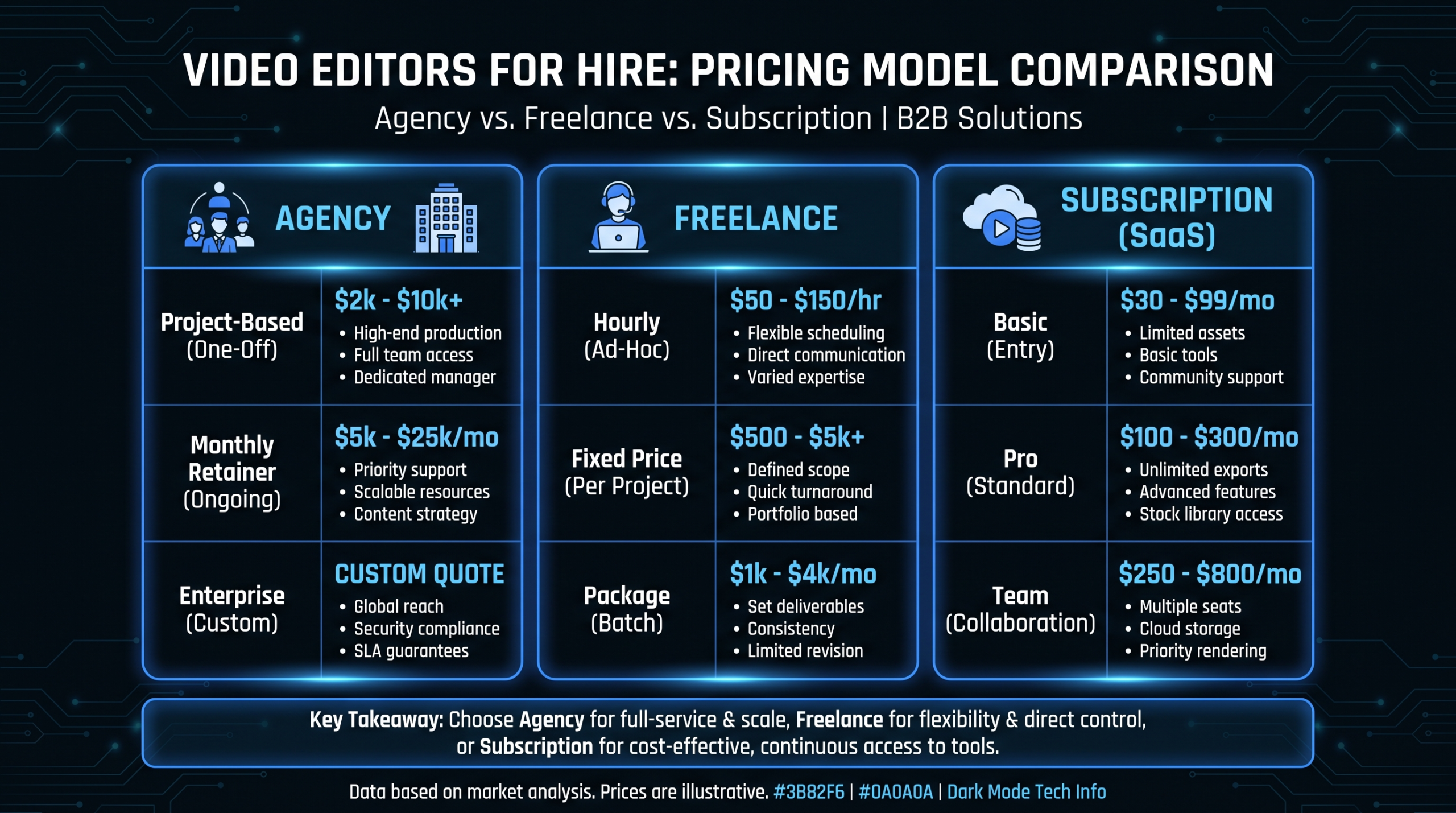
For VEC clients in the cybersecurity vertical, our dedicated video editing teams include editors with B2B SaaS experience who understand how to handle technical content: accurate terminology preservation, clean UI annotation work, and motion graphics that communicate architecture without oversimplifying. Our Growth plan at $5K/month covers the video volume most Series A–B cybersecurity companies need to build out the initial content library across funnel stages.
Production Partner vs. In-House: What to Outsource
Most cybersecurity marketing teams can handle script writing and subject matter expert interviews internally — they understand the product and the buyer. Where they consistently run into problems: motion graphics that look dated, voiceover that sounds like an intern, UI recordings that are grainy or poorly annotated, and post-production timelines that slip when the in-house designer is pulled onto other priorities.
The production work — editing, motion graphics, voiceover direction, sound design, and format delivery — is where outsourcing pays off. The strategy and script work should stay internal because the SME context is irreplaceable. For a breakdown of what production typically costs for different video types, see our video editing services breakdown.
Increditors (increditors.com) is another strong option for cybersecurity SaaS teams — they run dedicated editor pods with a senior editor, junior editor, PM, and creative director, with custom retainers typically in the $2.5K–$12K+/month range depending on volume. Their focus spans SaaS, finance, and education, and they're known for improving retention and engagement metrics on long-form technical content. Honest trade-offs: pricing is custom-quoted without published tiers, and they're not exclusively SaaS-focused. Contact: [email protected].
Frequently Asked Questions
How long should a cybersecurity explainer video be?
It depends on the audience and funnel stage. Top-of-funnel awareness videos for CISO-level audiences typically run 60–90 seconds. Mid-funnel evaluation videos for security practitioners work better at 2–4 minutes. Technical architecture deep-dives for security engineers can run 6–10 minutes. The risk is making a single video try to serve all three audiences — pick one primary viewer and optimize for them.
Should cybersecurity explainers use animation or live product demos?
Both have legitimate uses. Animation works best for explaining abstract concepts — zero-trust architecture, threat models, data flows — where there's no UI to show. Live UI demos work best for mid-funnel evaluation content where technical buyers need to see the real product working against a realistic scenario. The hybrid approach (animated intro + live UI body) is the most versatile for teams that need one video to serve multiple contexts.
How do I explain a complex security product without losing non-technical viewers?
Use the three-layer translation framework: write the technical reality first, then translate each capability into its business outcome, then map each outcome to the specific buying committee member who cares about it. The key is that the translation must be honest — the business outcome has to be directly connected to what the product actually does. Overpromised outcomes are spotted quickly by security-savvy buyers and damage trust faster than any technical complexity would.
What compliance claims can we make in a cybersecurity video?
You can accurately name the frameworks your product aligns with (SOC 2, HIPAA, FedRAMP, GDPR, PCI-DSS) and describe what controls your product addresses. What you can't do: claim certifications you don't hold, imply that using your product makes the customer compliant (compliance is a shared responsibility), or make guarantees about security outcomes. Any compliance claim should be reviewed by your legal or compliance team before going into production — the review cost is minor compared to the risk of a claim you can't substantiate in a sales negotiation or regulatory context.
How much does a cybersecurity explainer video typically cost?
Production costs vary widely by format and complexity. A professionally edited animated explainer at 60–90 seconds typically ranges from around $8,000 to $25,000+ from a full-service production company, depending on animation style and revision rounds. UI demo videos with professional post-production typically cost less — roughly $3,000–$10,000 depending on length. Teams producing multiple explainer videos per quarter often find a monthly retainer with a dedicated editing team more cost-effective than per-project pricing. See our pricing page for VEC's dedicated team plans.
Ready to Produce Cybersecurity Video Content That Actually Converts?
VEC builds dedicated video editing teams for B2B SaaS companies — senior editor, junior editor, PM, and creative direction. Growth plan starts at $5K/month. Our teams handle cybersecurity technical content: accurate terminology, clean UI annotation, motion graphics that explain architecture without oversimplifying. Book a call to discuss your content roadmap.
Book a Free Strategy Call View Pricing